
How to Keep an IBC Tote From Freezing: 9 Proven Methods to Protect Your Liquid Storage
To prevent IBC totes from freezing and protect your liquid storage, implement these proven methods: Use insulation jackets, reflective wraps, or bury the totes to retain ground heat. Consider adding compatible antifreeze or glycol mixtures to lower the freeze point. For active temperature control, utilize immersion heaters, heated blankets, or circulation pumps with thermostats. Additionally, elevate the totes, shield them from wind, and monitor temperatures with remote sensors. Always adhere to safety, containment, and labeling regulations. For detailed methods, costs, and installation guidance, continue reading.
What Happens When an IBC Tote Freezes and Why Prevention Matters
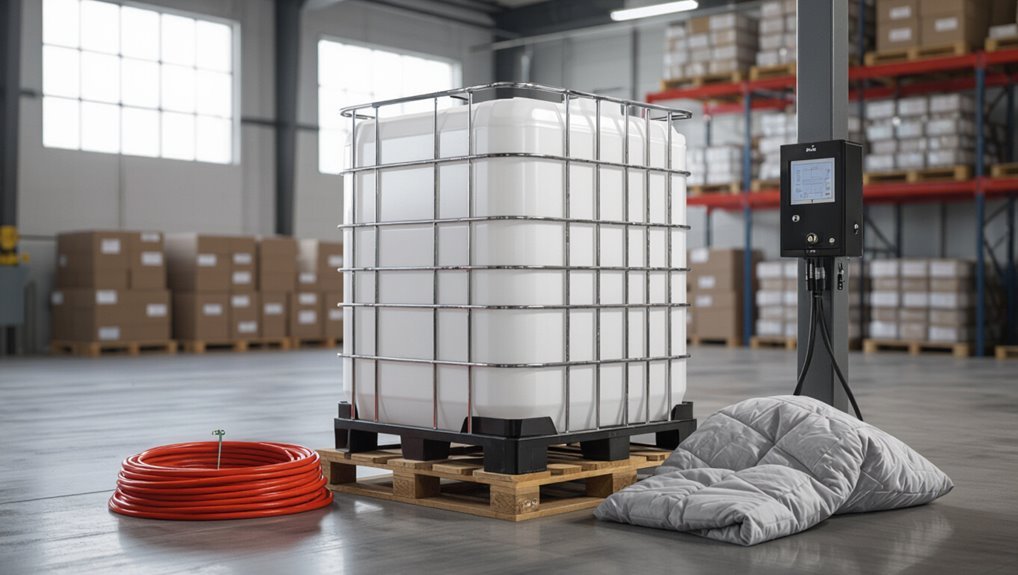
When an IBC tote freezes, expanding ice can crack the container, warp fittings, and compromise seals while some stored liquids separate or lose efficacy.
Observable signs include bulging walls, fractured lids or valves, cloudy or crystallized contents, and sudden leakage when thawing begins.
Knowing critical temperature thresholds for common liquids—water, chemical concentrates, and food-grade syrups—allows operators to prioritize insulation or heating before damage occurs.
How freezing damages IBC totes and stored liquids
Freezing can crack the rigid plastic of an IBC tote, distort its metal cage, and compromise welded seams, allowing leaks and structural failure.
Ice expansion ruptures fittings and valves, contaminating or losing stored liquids and altering viscosity or chemical stability.
Corrosion accelerates where moisture collects.
Understanding how to keep ibc tote from freezing is essential to prevent costly damage, downtime, and safety hazards.
Signs that freezing has already occurred
A frozen IBC tote often reveals itself through visible and functional changes: cracked or bulging polyethylene walls, warped or separated metal cage bars, and split or leaking fittings and valves.
Additional signs include swollen contents displacing fill caps, ice slurries or solid blocks inside when opened, compromised seals allowing contamination, and failed pumps or meters.
Inspect promptly for structural compromise and product loss.
Temperature thresholds for common liquids stored in IBCs
Visible damage and operational failures from a frozen IBC underscore the need to understand at what temperatures specific stored liquids begin to freeze or lose performance.
Water freezes at 0°C (32°F).
Brines and glycol mixtures vary by concentration (often -10°C to -50°C).
Diesel gels near -9°C to -15°C, and many lubricants thicken well above 0°C, impairing pumps and valves—monitoring and additives are essential.
Quick Action: Immediate Steps to Protect a Toting IBC When Temperatures Drop
When temperatures fall suddenly, operators should employ immediate short-term measures such as wrapping the tote in insulated blankets, directing warm air around the container, or applying approved heat packs to vulnerable areas to prevent contents from freezing within hours.
Before approaching a frozen or near-frozen IBC, personnel must follow safety protocols including wearing appropriate PPE, ensuring grounding for flammable contents, and verifying that heating methods are compatible with the stored material.
Quick assessment of valve integrity and surrounding hazards should precede any intervention to avoid spills or ignition.
Short-term methods to prevent freezing within hours
Act quickly: secure temporary heat and insulation to an IBC tote as temperatures fall below freezing, focusing on measures that can be implemented within hours.
Apply portable electric heaters or heated blankets rated for outdoor use. Wrap the tote with insulating tarps or foam panels, and tape seams.
Circulate warmer fluid if possible, and relocate the tote to a sheltered, wind‑protected area to slow freezing.
Safety precautions before handling frozen or near-frozen totes
After implementing short‑term heating and insulation, attention must shift to safety before handling a frozen or near‑frozen IBC tote.
Personnel should wear insulated gloves, eye protection, and respiratory gear if vapors are possible.
Verify structural integrity, check pressure relief and valve condition, and de‑energize nearby equipment.
Use non‑sparking tools, maintain clear escape routes, and have emergency spill containment ready.
9 Proven Methods to Keep an IBC Tote from Freezing
A range of practical strategies can prevent an IBC tote from freezing, each balancing cost, complexity, and reliability. The following methods cover insulation, electric heating options, and sheltered or heated enclosures with guidance on selection and safe installation.
Practical tips on materials, power needs, and placement help inform the best choice for specific site conditions.
- Insulating the tote: materials, wrapping techniques, and R-value targets
- Heated blankets and heat tape: selection, installation, and thermostat recommendations
- Immersion or inline heaters: types, power requirements, and safe mounting
- Portable space heaters for enclosures: sizing, placement, and ventilation needs
- Heated shelters, greenhouses, or enclosures: design tips and door access
Method 1 Insulating the Tote: materials, wrapping techniques, and R’value targets
Insulation is the primary passive defense against freezing for IBC totes, reducing heat loss and stabilizing fluid temperature.
Recommended materials include closed-cell foam, polyethylene panels, and reflective foil. Wrap seams tightly, cover pallet bases, and secure with waterproof tape or straps.
Aim for an overall R-value of R-6 to R-10 depending on exposure; add windproof outer layers in severe conditions.
Method 2 Heated Blankets and Heat Tape: selection, installation, and thermostat recommendations
When passive insulation is insufficient for prolonged cold or fluctuating temperatures, active heating—such as electric heated blankets and self-regulating heat tape—provides reliable freeze protection for IBC totes.
Select UL‑listed, weatherproof blankets or tape sized for tank diameter and contents. Secure with straps, avoid overlaps that trap moisture, and use a thermostat or digital controller set slightly above freezing.
Follow manufacturer wiring and grounding instructions.
Method 3 Immersion or Inline Heaters: types, power requirements, and safe mounting
Although more complex than surface heating, immersion and inline heaters deliver direct, efficient heat to an IBC tote’s liquid, making them ideal for viscous or high‑volume fluids that resist surface-warmed circulation.
Options include cartridge, flanged immersion, and in‑line pipe heaters. Match wattage to volume and freeze point; typically 5–25 W/gal.
Mounting requires secure brackets, corrosion‑resistant fittings, proper grounding, and thermostat or overtemp protection.
Method 4 Portable Space Heaters for Enclosures: sizing, placement, and ventilation needs
Portable space heaters can provide a simple, flexible way to maintain ambient temperatures inside enclosures housing IBC totes. However, their effectiveness depends on correct sizing, strategic placement, and adequate ventilation.
Selection should match enclosure volume and heat loss. Place heaters to promote even circulation, avoiding direct contact with plastic.
Verify carbon monoxide safety for combustion units and provide intake/exhaust or passive venting to prevent moisture and CO buildup.
Method 5 Use of Heated Shelters, Greenhouses, or Enclosures: design tips and door access
A heated shelter, greenhouse, or insulated enclosure provides a controlled microclimate around an IBC tote, reducing heat loss and preventing ice formation more reliably than spot heating alone.
Design emphasizes insulated walls, clear roof panels for passive solar gain, and raised, ventilated flooring.
Include properly sized doors or roll-up panels for easy tote access, weatherproof seals, and simple airflow control to balance heat retention and condensation management.
Method 6 Circulation and Recirculation Systems: pumps, loop designs, and temperature uniformity
Implementing circulation or recirculation systems keeps fluid temperature uniform and prevents stratified cold pockets that can freeze first.
Pumps, properly sized and rated for viscosity and temperature, move liquid through insulated return loops and external heat exchangers.
Loop design minimizes dead zones and encourages complete turnover.
Flow control, periodic cycling, and monitoring prevent stagnation and guarantee consistent thermal distribution without altering fluid chemistry.
Method 7 Adding Antifreeze or Glycol Solutions: compatibility, dilution ratios, and regulatory considerations
When temperatures approach freezing, adding a compatible antifreeze or glycol solution lowers the fluid’s freezing point and is a common preventive measure for IBC totes.
Selection depends on stored product compatibility, toxicity, and environmental discharge rules. Appropriate dilution ratios follow manufacturer tables; over- or under-dilution risks performance loss or contamination.
Documentation, labeling, and compliance with transport and disposal regulations are essential.
Method 8 Burying or Partial Burial: insulation from soil, frost line considerations, and pros/cons
After addressing chemical approaches such as antifreeze or glycol, physical strategies like burying or partially burying an IBC tote offer an alternative by using the ground as thermal mass and insulation.
Burial reduces freeze risk by leveraging stable subterranean temperatures; depth must exceed local frost line.
Pros: passive, low-energy.
Cons: excavation, drainage, access and regulatory or contamination concerns that require planning and permits.
Method 9 Strategic Placement and Stacking: sun exposure, windbreaks, and grouping multiple totes
Strategic placement and stacking use site microclimate and container arrangement to reduce freezing risk without added energy inputs.
Position totes to maximize winter sun and minimize wind exposure—south-facing, near thermal mass or reflective surfaces.
Use windbreaks (fences, hedges) and group totes to share heat.
Elevate off cold ground, stagger stacking to prevent freezing at outlets, and allow access for maintenance.
Choosing the Right Method: Factors to Consider
Selecting an anti-freeze strategy requires matching the method to the liquid’s properties—freeze point, viscosity, and chemical reactivity—alongside local climate severity and expected duration of cold spells.
Practical constraints such as power availability, upfront and operating costs, and relative energy efficiency will narrow feasible options.
Finally, safety, regulatory limits, and environmental impact must be weighed before implementation.
Liquid properties affecting method choice (freeze point, viscosity, reactivity)
Liquid characteristics—chiefly freezing point, viscosity, and chemical reactivity—directly determine which anti-freeze strategies are safe and effective for an IBC tote.
Low freeze-point liquids may need less heat or simple insulation. High-viscosity fluids require gentle warming to avoid shear damage.
Reactive chemicals restrict additive use and electrical heaters; compatibility, material ratings, and safety data sheets guide permissible interventions and limits.
Climate and duration of cold spells
When cold snaps are brief and temperatures only dip marginally below freezing, passive measures like insulation or reflective covers often suffice.
For prolonged or severe freezes, active heating and continuous monitoring become necessary. Local climate patterns, nighttime lows, wind chill, and freeze frequency determine resilience needs.
Anticipated freeze duration guides choice between temporary mitigation and permanent systems to prevent costly freezing and product loss.
Power availability, costs, and energy efficiency comparison
Because power access and operating cost vary widely by site, evaluating availability, upfront and ongoing expenses, and energy efficiency is essential before choosing a freeze-prevention method for an IBC tote. Assess grid vs. generator vs. solar, installation cost, fuel or electricity rates, and expected runtime to compare total cost and thermal performance.
| Method | Upfront cost | Energy efficiency |
|---|---|---|
| Grid power | Medium | High |
| Generator | Low | Low |
| Solar + battery | High | Variable |
Safety, regulatory, and environmental constraints
While selecting a freeze-prevention strategy for an IBC tote, stakeholders must account for safety, regulatory, and environmental constraints that can limit feasible options and dictate installation and operation requirements.
Consider hazardous-material classifications, electrical and heating codes, spill containment, ventilation for vapors, and emissions limits.
Choose compatible materials, certified equipment, and documented procedures to guarantee compliance, minimize environmental impact, and protect personnel and assets.
Equipment, Materials, and Cost Estimates
Recommended equipment and materials—such as insulated tote covers, immersion heaters with thermostat controls, heated pads, and weatherproof power supplies—are listed with key specifications to match tote size and fluid type.
Estimated costs are presented as ranges for DIY solutions versus professional heating or shelter installations to help weigh upfront and ongoing expenses.
Typical maintenance tasks, inspection intervals, and expected service lifetimes for each component are summarized to inform budgeting and replacement planning.
List of recommended products and specifications
A concise list of equipment, materials, and estimated costs follows to help select and size components for keeping an IBC tote from freezing; each item includes typical specifications, power or capacity ratings, and a price range to support budgeting and procurement decisions.
- Immersion heater: 500–1500 W, 110–240 V, $40–$150
- Insulation jacket: closed-cell foam, R4–R8, $30–$120
- Thermostat controller: PID or on/off, -40–+60°C, $35–$120
- Circulation pump: 10–50 L/min, 12–240 V, $80–$300
- Heat tape: 5–30 W/m, self-regulating, $10–$60
Rough cost ranges for DIY vs. professional installations
Many installations fall into two clear cost bands: DIY setups using off-the-shelf components and full professional installations that include labor, permits, and safety upgrades.
DIY ranges typically run $100–$800 for heaters, insulation, thermostats, and fittings.
Professional jobs commonly cost $1,000–$6,000+, covering custom heating, electrical work, site prep, and compliance; extremes depend on capacity and complexity.
Maintenance schedules and lifetime expectations
Establish a regular maintenance rhythm to preserve equipment performance and avoid costly failures: inspect insulation and heat sources monthly during cold months, test thermostats and freeze-protection controllers quarterly, and perform a full system check—including tank fittings, pumps, and electrical connections—annually.
Expected component lifespans: heaters and controllers 5–10 years, insulation 10–15 years, pumps 3–7 years; replace per wear and manufacturer guidance.
Installation and Setup Best Practices
The section outlines a concise step-by-step checklist for insulating and heating an IBC tote, from surface preparation to securing blankets and installing heating elements.
It explains recommended sensor and thermostat placement to guarantee accurate temperature feedback and reliable control.
It also covers essential electrical safety measures, grounding procedures, and weatherproofing practices for outdoor installations.
Step-by-step checklist for insulating and heating an IBC tote
A concise, ordered checklist helps guarantee proper insulation and heating of an IBC tote before winter conditions arrive.
Inspect tote for damage; clean and dry interior.
Select appropriate insulation type and measure dimensions.
Install insulation and protective weather barrier.
Mount heating elements and secure cords.
Test system for leaks and heat output.
Label controls, document settings, and schedule periodic inspections.
Proper sensor and thermostat placement for reliable control
Having completed insulation and heater installation, attention shifts to sensor and thermostat placement to guarantee the system maintains target temperatures reliably.
Sensors should contact the liquid or tank wall where representative temperature is measured, avoiding drafts and direct heater exposure.
Thermostats must be mounted at mid-height, sheltered from sun and precipitation, with probe wiring routed to minimize heat influence and allow accurate feedback.
Electrical safety, grounding, and weatherproofing tips
Several essential electrical precautions guarantee safe, reliable operation when preventing an IBC tote from freezing: circuits should be dedicated and correctly sized for heater loads, all equipment must be GFCI-protected, wiring and connections kept off the ground and inside weatherproof enclosures, and grounding tied to a common earth point to prevent stray voltages.
Regular inspections, corrosion-resistant fittings, surge protection, and clear labeling reduce risk and downtime.
Monitoring, Troubleshooting, and Winter Operation
The section outlines remote monitoring options and alarm setups to guarantee timely notification of temperature excursions and power loss.
It summarizes common problems — cold spots, power failures, and leaks — with practical fixes and diagnostic steps.
Finally, it provides a winter operation checklist and an emergency response plan to minimize downtime and product loss.
Remote monitoring options and alarm setups
Integrate remote sensors and alert systems to maintain real-time visibility of an IBC tote’s temperature, liquid level, and power status during cold conditions.
Use wireless temperature probes, float or ultrasonic level sensors, and smart power monitors linked to a central dashboard or smartphone app.
Configure threshold-based SMS/email/push alerts and redundancies (cellular plus Wi‑Fi) to guarantee timely responses and logging for winter compliance.
Common problems and how to fix them (cold spots, power failures, leaks)
How can operators quickly identify and resolve common winter issues with an IBC tote—cold spots, power failures, and leaks—before they escalate?
Inspect thermal blankets and probe multiple points to find cold spots; adjust insulation or add localized heat.
Test backup power and battery health; switch to generators if needed.
Check seams, valves, and pallets for drips; tighten fittings, replace seals, and drain/contain spills promptly.
Winter operation checklist and emergency response plan
While winter conditions demand constant vigilance, a concise operation checklist and clear emergency response plan keep IBC tote systems monitored, troubleshootable, and operable under stress.
Include daily temperature/log checks, heater and insulation inspections, pump and power-status tests, and spill/leak walkabouts.
Designate contact lists, shutdown criteria, repair procedures, and spare-parts locations.
Train staff on escalation steps, shelter-in-place, and safe thawing protocols.
Case Examples and Application Scenarios
The section presents practical case examples illustrating how the freezing-prevention techniques apply in real settings.
Examples include small farm fuel storage, industrial chemical handling in subzero climates, and temporary construction-site water supply.
Each scenario highlights specific risks, chosen countermeasures, and operational trade-offs.
Small farm fuel storage solution
When storing diesel and gasoline on a small farm, practical solutions balance cost, safety, and ease of access. IBC totes offer a compact, transportable option when adapted for fuel use.
Farmers should use approved fuel-grade liners, grounded metal cages, secure venting, and spill containment.
Passive winterization—insulation and sheltered placement—plus periodic fuel turnover prevents gelling and contamination while meeting local regulations.
Industrial chemical storage in subzero climates
Cold-climate industrial storage demands careful selection of container materials, thermal management, and operational procedures to preserve chemical integrity and maintain safety.
Case examples include insulated and heated IBC arrays for antifreeze and solvent blends, trace-heated manifolds for viscous reagents, and secondary-containment with freeze-tolerant drainage.
Monitoring, redundant heating, and documented emergency protocols minimize freeze-related degradation, spill risk, and production downtime in subzero operations.
Temporary construction site water supply
Temporary construction sites in subzero regions face similar freezing risks to industrial chemical storage, but with added priorities of potable supply, flow continuity, and frequent setup changes.
Portable IBCs require insulated skins, blanket heaters, heated enclosures, and thermostatic controls. Circulation loops and glycol mixtures prevent stagnation. Rapid deployment favors pre-insulated totes and trailer-mounted heaters.
Compliance with potable standards remains essential.
Environmental and Regulatory Considerations
The discussion shifts to environmental and regulatory considerations that affect IBC freeze protection strategies.
Attention is given to spill prevention and secondary containment during freeze/thaw cycles, proper disposal and handling of antifreeze or additives, and compliance with local codes and permitting for heated enclosures.
These factors determine acceptable methods and documentation requirements for safe, legal operation.
Spill prevention and secondary containment during freeze/thaw cycles
Many facilities must account for increased spill risk during freeze/thaw cycles by implementing robust secondary containment and spill-prevention measures; failing to do so can result in environmental contamination, regulatory violations, and costly remediation.
Secondary containment should accommodate expansion, ice displacement, and overflow; regular inspections, clear drainage controls, compatible berms/pallets, and documented response plans minimize accidental releases and guarantee compliance during temperature fluctuations.
Disposal and handling of antifreeze or additives
After addressing secondary containment and spill-prevention during freeze/thaw cycles, facilities must also manage antifreeze and other additives with strict attention to environmental and regulatory requirements.
Proper labeling, secure storage, and segregation prevent cross-contamination.
Disposal follows local hazardous-waste rules: use licensed haulers, document manifests, and retain records.
Training on handling, PPE, and emergency response minimizes liability and environmental harm.
Local code and permitting considerations for heated enclosures
When facilities plan heated enclosures for IBC totes, they must confirm compliance with local building, fire, and environmental codes—since requirements often dictate heater types, ventilation, electrical classifications, and permitting thresholds.
Authorities may require permits, inspections, hazardous-area ratings, secondary containment, emissions controls, and documented safety plans.
Coordinating with code officials and qualified contractors guarantees legal operation, prevents fines, and mitigates liability.
Final Recommendations and Decision Checklist
A concise decision flowchart is presented to guide choices based on available power, budget limits, and the specific liquid contained.
The author highlights the most reliable solutions, the most cost-effective choices, and the lowest-maintenance options for common scenarios.
Readers are encouraged to use the checklist to match site constraints with the recommended approaches.
Quick decision flowchart criteria (power, budget, liquid type)
Begin by evaluating three decisive factors—available power, budget constraints, and the liquid’s freezing characteristics—to guide selection of the most practical anti-freeze strategy for an IBC tote.
Use high power and higher budget for active heating; select passive insulation and thermal mass on tight budgets with low power.
For sensitive liquids, prioritize low-temperature-gradient solutions and compatible materials; document chosen criteria and next steps.
Summary of most reliable, cost-effective, and low-maintenance options
If power availability and budget permit, active heating with a thermostatic heater or recirculating pump offers the most reliable protection against freezing.
Otherwise, prioritizing good insulation combined with increased thermal mass or passive heat sources provides the most cost-effective, low‑maintenance solution for typical IBC totes.
Evaluate liquid freeze point, access to electricity, maintenance capacity, and budget; choose active heating for critical fluids, insulation+massing for low‑risk cases.
Conclusion
Preventing IBC tote freezing protects product integrity and operations: about 30% of winter storage failures trace back to inadequate freeze protection, underscoring prevention’s value. By selecting appropriate insulation, heat tracing, enclosure, or passive measures based on fluid properties and site risk, operators minimize downtime, spills, and costly replacement. Regular monitoring, simple treatments, and contingency planning keep liquids usable through cold snaps. Prioritize methods matched to temperature exposure, volume, and budget for reliable winter performance.
