What Is Poly Pipe? Uses, Types & How to Choose the Right One
Poly pipe, or polyethylene tubing, is a versatile material commonly used for applications such as irrigation, potable water supply, gas lines, and various industrial fluid transport. It is preferred due to its resistance to corrosion, lightweight nature, and ability to handle ground movement and vibration better than rigid piping. There are different types of poly pipe available, including thin-walled drip tubing and pressure-rated PE80/PE100 mains with varying SDR wall thicknesses. When choosing poly pipe, consider factors such as pressure rating, temperature limits, UV resistance, compatibility with fittings, and adherence to applicable standards. For more information on sizing, installation, and certification, continue reading.
What Is Poly Pipe and Why It Matters
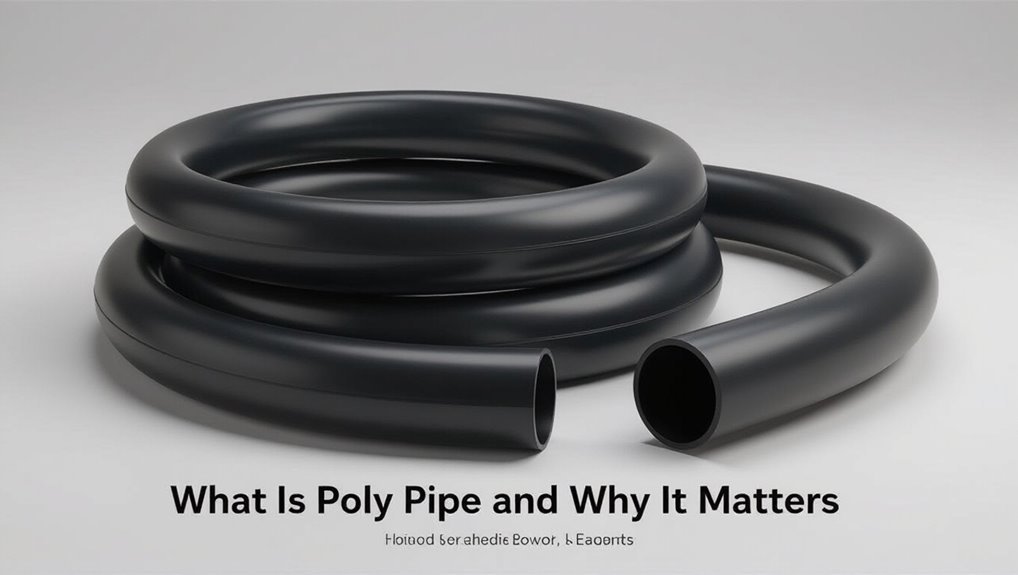
In many outdoor and underground applications, poly pipe refers to flexible tubing made from polyethylene designed to transport water, gas, or chemicals. It serves irrigation, potable supply, natural gas distribution, and industrial fluid conveyance.
Lightweight and corrosion-resistant, it simplifies installation and reduces joint requirements compared with rigid piping. Available in various diameters, pressure ratings, and color codes, selection depends on application demands, regulatory standards, and expected lifespan.
Proper fittings and installation practices maintain system integrity. Understanding service temperature limits, chemical compatibility, and required certifications helps professionals choose appropriate poly pipe for safe, economical, and durable fluid transport.
How Polyethylene Makes Poly Pipe Flexible and Durable
Having established the applications and selection factors for poly pipe, attention turns to the material properties of polyethylene that give the tubing its flexibility and durability.
Polyethylene’s molecular structure—long, linear or branched polymer chains with limited crosslinking—permits chain mobility, yielding elastic deformation under stress and resistance to cracking. Low glass transition temperature keeps the material pliable across typical service conditions.
Semi-crystalline morphology balances toughness and stiffness: crystalline regions provide strength while amorphous regions allow flexibility. Chemical resistance and low water absorption prevent degradation.
Together these traits produce tubing that withstands impact, cyclic loading, soil movement, and many corrosive environments.
Common Names: Poly Pipe, PE Pipe, Drip Tubing – What’s Different?
What distinguishes the labels “poly pipe,” “PE pipe,” and “drip tubing” are differences in material specification, purposeful use, and manufacturing standards. Poly pipe is a general consumer term for flexible polyethylene tubing. PE pipe references standardized polyethylene formulations (PE80/PE100) used for pressure-rated potable, irrigation, and mains. Drip tubing is thin-walled poly designed specifically for low-pressure, emitter-integrated irrigation. Selection depends on pressure requirements, regulatory compliance, and emitter needs. Typical connectors and ratings differ.
| Name | Typical Use | Notable Feature |
|---|---|---|
| Poly pipe | General irrigation | Flexible, economical |
| PE pipe | Mains, potable | Rated materials |
| Drip tubing | Drip lines | Built-in emitters |
Typical Sizes and Dimensions for Poly Pipe
Poly pipe is manufactured in a range of nominal diameters—commonly from 1/4 inch for drip tubing up to several inches for service and irrigation mains.
Wall thickness varies by pressure rating and application, with options expressed as SDR or specific millimeter/inch values.
Compatibility with fittings and couplings follows those diameter and wall standards, so correct sizing prevents leaks and failures.
Common Diameter Ranges
Across applications, poly pipe is manufactured in a range of diameters tailored to flow requirements and installation constraints. Typical ranges address residential, commercial, agricultural, and municipal needs without discussing wall thickness options.
Common nominal diameters and their typical uses include:
- 1/2″–3/4″: drip irrigation, supply lines for fixtures.
- 1″–1¼”: small service lines, potable water to homes.
- 1½”–2″: yard irrigation, medium service runs.
- 3″–6″: larger irrigation mains, commercial feeders.
- 8″ and above: municipal distribution, large conveyance where flexible pipe is acceptable.
Selection depends on required flow, head loss, and connection compatibility.
Wall Thickness Options
When specified by manufacturers and standards, wall thickness determines a poly pipe’s pressure rating, stiffness, and resistance to external loads.
Typical wall thicknesses follow nominal diameter and SDR (standard dimension ratio) systems: lower SDR means thicker wall and higher pressure capacity. Common SDR values for irrigation and potable water range from SDR 7 to SDR 17, while agricultural and low-pressure applications often use higher SDRs.
Metric and imperial catalogs list exact millimeter or inch measurements for each size/SDR combination.
Selection balances operating pressure, burial depth, expected mechanical stresses, and regulatory requirements to guarantee long-term performance and safety.
Fitting And Coupling Sizes
Proper wall thickness choices influence the range of compatible fittings and couplings, since connectors must match both outer and inner diameters as well as pressure ratings. Typical poly pipe sizing references nominal diameter and SDR (standard dimension ratio), affecting ID/OD and clamp or compression fitting selection. Manufacturers list dimensions and pressure-class ratings; installers verify compatibility before assembly. Common sizes accommodate irrigation, potable, and industrial needs.
- 1/2″, 3/4″, 1″ — small-scale irrigation
- 1¼”, 1½”, 2″ — residential supply
- 3″, 4″ — larger distribution
- SDR 9, 11, 13.5 — thickness classes
- Metric/imperial fittings require adapters
Pressure Ratings and What They Mean for Use
Pressure ratings indicate the maximum internal pressure a poly pipe can safely withstand and are expressed in pounds per square inch (psi) or bar; understanding them is essential for matching pipe to application and avoiding failure.
Ratings reflect material formulation, wall thickness, temperature, and manufacture standards; higher ratings suit pressurized water, irrigation, or potable systems while lower ratings fit gravity or low-pressure uses.
Safety margins, cyclic loading, and surge pressures reduce usable limits.
Selection must consider long-term exposure, UV and chemical environments, and joint integrity.
Properly rated pipe minimizes burst risk, maintenance costs, and regulatory noncompliance.
How to Read Pressure Ratings and Choose the Right PN
How does one interpret the markings on poly pipe and select the correct PN (nominal pressure) for a job? The pipe’s imprint shows PN or pressure class, material designation, and diameter. PN indicates allowable working pressure at a reference temperature; choose PN equal to or above system working pressure with margin for safety factors and transient spikes. Consider application (potable, irrigation, industrial) and applicable standards. Verify manufacturer datasheets for pressure/age behavior.
- Read pipe stamp: PN, size, material
- Match system working pressure to PN
- Include safety margin for transients
- Confirm standards compliance
- Cross-check datasheet ratings
Temperature Limits and Environmental Resilience
The section outlines how poly pipe performs across temperature extremes and under environmental stresses.
It compares cold-weather flexibility and embrittlement risks with maximum service temperatures and long-term heat exposure limits.
It also addresses resistance to UV degradation and common chemicals to guide material selection for specific climates and applications.
Cold Weather Performance
Facing subfreezing temperatures, poly pipe’s performance depends on material formulation, wall thickness, and installation practices. Cold reduces flexibility, increases brittleness, and raises freeze-risk for trapped water.
Proper selection and siting mitigate failures: higher-density resins and thicker walls resist cracking; insulated burial and slope promote drainage; fittings rated for low temperatures prevent joint failures. Regular inspection after cold snaps catches stress fractures early. Consider seasonal draining where freezing is unavoidable.
- Material grade: choose low-temperature-rated resin
- Wall thickness: higher SDR for colder climates
- Burial depth: below frost line when possible
- Insulation: foam or soil blankets
- Maintenance: inspect after freezes
Heat Resistance Limits
Evaluating heat resistance limits clarifies how poly pipe performs under sustained high temperatures and intermittent thermal spikes. Manufacturers specify continuous operating temperatures—typically 60–80°C for common polyethylene grades—with short-term tolerance up to about 95–110°C depending on formulation and pressure.
Elevated heat reduces strength and increases creep, shortening service life under load; design must account for reduced pressure ratings at temperature. Insulation, burial depth, and ambient conditions mitigate thermal exposure.
For systems encountering frequent thermal cycling, selecting higher-temperature-rated resins or alternative materials prevents deformation. Engineering data sheets and temperature derating curves guide appropriate application and safe long-term performance.
UV And Chemical Durability
When exposed to sunlight and chemicals, poly pipe’s performance depends on resin formulation, stabilizers, and protective treatments.
Durability varies: UV-resistant pigments, carbon black, and antioxidant additives slow degradation; specialized copolymers resist organic solvents and acids.
Proper choice aligns expected service life with environment and temperature.
Consider installation shading, burial, or coatings for extra protection.
Monitor for embrittlement, discoloration, or reduced flexibility.
- UV-stabilized grades resist surface cracking
- Carbon black offers strong UV protection
- Additives improve chemical compatibility
- Coatings and jacketing extend outdoor life
- Burial reduces UV exposure but watch soil chemistry
UV Exposure: How Sunlight Affects Poly Pipe Lifespan
Although inherently durable, poly pipe exposed to direct sunlight undergoes gradual degradation as ultraviolet (UV) radiation breaks down polymer chains, causing surface embrittlement, color fading, and reduced tensile strength.
Over time this leads to microcracking, increased brittleness at fittings, and higher failure rates under pressure or impact.
Lifespan depends on exposure duration, intensity, and ambient temperature cycles; buried or shaded installations fare markedly better.
Inspection should target surface crazing, stiffness changes, and loss of flexibility.
Planning includes minimizing direct sunlight exposure, using protective coverings or routing to shaded areas, and scheduling more frequent inspections in high‑UV environments.
Common Additives and What They Do (UV Stabilizers, Antioxidants)
The composition of poly pipe often includes additives that extend service life and preserve material properties under stress.
UV stabilizers absorb or block harmful solar radiation while antioxidant additives slow chemical degradation from heat and processing.
Choosing additives depends on expected sunlight exposure, operating temperature, and required longevity.
UV Stabilizer Function
Exposed to sunlight, poly pipe degrades as ultraviolet (UV) radiation breaks polymer chains, so manufacturers add UV stabilizers to absorb or dissipate that energy and protect the material’s structural integrity.
These additives extend service life, reduce surface crazing, and preserve flexibility without altering core polymer properties. Selection balances effectiveness, cost, and compatibility with colorants or other modifiers.
Performance varies by stabilizer type and concentration; testing predicts longevity under local sunlight and temperature conditions.
- Hindered amine light stabilizers (HALS) scavenge free radicals
- UV absorbers convert UV to heat
- Quenchers dissipate excited states
- Synergists enhance stability
- Proper dosing prevents photobleaching
Antioxidant Additives Role
Acting alongside UV stabilizers, antioxidant additives protect poly pipe by slowing thermal and oxidative degradation that occurs during processing and service. These additives interrupt radical chain reactions and neutralize peroxides formed during extrusion, welding, and long-term exposure to heat and oxygen.
Common types include primary (hindered phenols) that scavenge free radicals and secondary (phosphites/phosphonites) that decompose hydroperoxides. Synergistic blends extend polymer lifetime without altering mechanical properties or weldability when correctly formulated.
Their presence reduces discoloration, embrittlement, and molecular weight loss, supporting reliable hydraulic and potable water performance across varied temperatures and service conditions.
Selection Criteria For Additives
When selecting additives for poly pipe formulations, engineers balance performance targets, processing constraints, regulatory limits, and lifecycle costs.
Selection focuses on end-use requirements: UV exposure, thermal stability, mechanical longevity, and chemical resistance.
Typical choices prioritize compatibility with base polymer and processing temperatures while minimizing extractables and odor.
- UV stabilizers: absorb or screen radiation to prevent surface degradation
- HALS: interrupt free-radical degradation cycles for long-term light stability
- Primary antioxidants: prevent oxidative chain scission during processing
- Secondary antioxidants: decompose hydroperoxides formed in service
- Processing aids: improve melt flow and dispersion without compromising properties
PE63 vs PE80 vs PE100: Strength, Lifespan, and Recommended Uses
Comparing PE63, PE80, and PE100 involves evaluating molecular density, tensile strength, and long-term performance to match pipe grade to application demands. PE63 suits low-pressure, short-lifespan needs; PE80 fits general water distribution with moderate durability; PE100 offers highest strength and longest service life for demanding or buried applications. Selection balances cost, pressure, and expected lifespan; installation environment and safety margins guide recommendation. Below, an evocative table contrasts attributes to aid decision-making.
| Grade | Emotion | Implication |
|---|---|---|
| PE63 | Concern | Limited use, cost-sensitive |
| PE80 | Confidence | Reliable everyday service |
| PE100 | Assurance | Long-term, high-stress use |
Material Grades and Standards for Poly Pipe
In evaluating poly pipe, material grades and standards define the chemical composition, mechanical properties, and approved uses that determine suitability for specific applications.
Specifications like PE63, PE80, and PE100 establish minimum tensile strength, density, and environmental stress crack resistance.
Industry standards (ISO, ASTM, EN) set testing methods, pressure ratings, and marking requirements.
Compliance guarantees interchangeability, safety, and warranty adherence.
Selection should consider certification, stated service temperature range, and chemical compatibility with conveyed media.
- ISO 4427 / EN 12201 guidance
- ASTM F714 references
- Manufacturer batch testing
- Traceability and marking
- Third‑party certification
Flexible vs Rigid Applications: Matching Pipe Behavior to Need
The choice between flexible and rigid poly pipe hinges on the demands of the installation: flexibility offers ease of routing, vibration damping, and tolerance for ground movement.
Rigid pipe, by contrast, provides structural strength, higher burst resistance, and long-term stability under fixed loads. Evaluating site conditions and performance priorities guides which behavior best suits the application.
Flexible Application Benefits
For projects that require bending around obstacles, accommodating ground movement, or simplifying long runs, flexible poly pipe offers clear advantages over rigid conduit: it can be routed with fewer fittings, tolerates minor shifts without cracking, and absorbs vibration that would otherwise stress joints.
Flexible pipe suits varied installations where alignment is imperfect or future settling is likely.
It reduces installation time and fitting costs, and eases maintenance access.
Consider material grade, UV resistance, and pressure rating to match the application.
- Easier routing around obstructions
- Fewer couplings and joints
- Greater tolerance for ground movement
- Improved vibration damping
- Faster installation and lower labor costs
Rigid Application Strengths
Rigid-structure installations demand materials that maintain line and form under sustained loads, and rigid poly pipe excels where stiffness, predictable load-bearing, and minimal deflection are priorities.
It suits culverts, structural sleeves, water mains beneath roadways, and trenchless installations requiring dimensional stability. Rigid formulations resist distortion from surface loads and allow consistent flow characteristics under pressure.
They simplify alignment during installation and reduce joint movement risk. Selection factors include wall thickness, material grade, temperature tolerance, and compatibility with fittings.
Designers favor rigid poly when long-term geometry, load transfer, and reduced maintenance outweigh the benefits of flexibility.
Temporary vs Permanent Installations: Pros and Cons
When comparing temporary and permanent poly pipe installations, decision-makers must weigh durability, cost, installation speed, and future adaptability. Temporary setups offer rapid deployment and lower initial expense but shorter lifespan and susceptibility to damage.
Permanent installations demand greater upfront investment and robust fittings yet deliver longevity, UV resistance, and lower maintenance. Selection depends on project timeline, expected loads, and replacement access. Consider lifecycle cost versus immediate needs.
- Temporary: quick, low-cost, portable
- Temporary: vulnerable to puncture and UV
- Permanent: higher durability and longevity
- Permanent: greater installation complexity
- Permanent: lower long-term maintenance
Agriculture Uses: Irrigation, Drip Lines, and Lateral Systems
Poly pipe serves as the backbone for agricultural water distribution, with irrigation mainlines needing sufficient diameter and pressure rating to feed downstream systems.
Choosing appropriate drip line types and emitter spacing determines flow uniformity and crop water efficiency.
Effective lateral system layout minimizes head loss and simplifies maintenance while matching field topography and crop spacing.
Irrigation Mainlines
In agricultural irrigation systems, mainlines serve as the principal pressurized conduits that deliver water from the source to laterals, drippers, and submains. They require durability, correct diameter, pressure rating, and UV resistance to maintain consistent flow and minimize leakage.
Material choice affects installation ease, joint methods, and lifespan; polyethylene offers flexibility and cost-effectiveness for many farms. Proper layout reduces head loss and pump strain. Maintenance access and valve placement improve control and isolation.
- Diameter selection based on flow and velocity
- Pressure class and burst safety factor
- Resistant fittings and secure joints
- Burial depth and UV protection
- Accessible valves and meters
Drip Line Selection
Following the mainlines, selection of drip lines determines water delivery uniformity and crop yield by matching emitter spacing, flow rate, and lateral layout to crop root zones and soil infiltration characteristics. Choice depends on crop spacing, soil type, pressure stability, and maintenance needs. Low-flow emitters suit shallow-rooted vegetables; higher flow fits tree crops. Consider clogging resistance, UV stability, and ease of repair. Pressure-compensating options improve uniformity on uneven terrain. Installation planning should coordinate with filtration and fertigation. Performance is validated by emitter discharge tests and field inspections.
| Factor | Impact |
|---|---|
| Emitter spacing | Coverage uniformity |
| Flow rate | Root zone wetting |
| Material | Durability/UV resistance |
| Type | Clogging/maintenance |
Lateral System Layout
For efficient water delivery and uniform crop performance, lateral system layout arranges drip lines and spacing to match field geometry, plant rows, and hydraulic constraints. It optimizes emitter spacing, pipe diameter, and run lengths to maintain pressure and flow, reducing uneven application and waste.
Designers consider slope, soil infiltration, and crop rooting depth to determine lateral spacing and scheduling. Installation sequencing, valve placement, and flushing access points improve operation and maintenance. Monitoring points help detect blockages or leaks.
- Match lateral spacing to crop and soil
- Minimize lateral length for pressure control
- Use manifolds for uniform distribution
- Provide flush/clean access
- Include pressure regulation
Landscape Uses: Sprinkler Supply and Garden Irrigation
Used primarily to deliver water across yards and beds, poly pipe provides a flexible, durable backbone for sprinkler systems and garden irrigation lines. It resists crushing and freezing when buried shallowly, simplifies routing around obstacles, and connects easily to emitters, valves, and drip tubing.
Installers favor continuous runs to minimize joints and leaks; barbed fittings and clamp seals permit quick repairs. Selection depends on pressure rating, wall thickness, and UV exposure for aboveground segments.
For vegetable plots, flower beds, and turf, poly pipe supports zoned distribution and low-volume drip setups, enabling efficient, targeted irrigation with minimal maintenance.
Potable Water Use: Can Poly Pipe Carry Drinking Water?
Poly pipe can be suitable for drinking water when it meets recognized certification and material standards that guarantee chemical safety and microbial resistance.
Attention to proper installation—using approved fittings, avoiding contamination during connection, and protecting from sunlight—and routine maintenance are necessary to preserve water quality.
Verification of local codes and certified product labeling is recommended before selecting poly pipe for potable systems.
Drinking Water Safety
Frequently, questions arise about whether poly pipe is suitable for delivering potable water; the answer depends on the pipe’s formulation and certification. Properly specified poly pipe can transport drinking water without imparting taste or harmful contaminants. Key considerations include material chemistry, resistance to leaching, installation practices, and system pressure. Regular inspection and flushing after installation reduce particulate buildup. Avoid exposure to solvents and prolonged UV without protection. Monitoring and maintenance preserve water quality over time.
- Confirm food-grade material selection
- Make sure clean storage and handling
- Protect from sunlight and heat
- Follow manufacturer installation guidance
- Implement routine system flushing
Certification And Standards
Certification and standards determine whether a given polyethylene pipe is acceptable for potable water by specifying required materials, testing protocols, and labeling.
Regulatory frameworks—such as NSF/ANSI 61 in the United States, CSA B137 in Canada, and WRAS in the UK—set criteria for chemical composition, leaching limits, and microbial safety.
Certification requires laboratory testing for taste, odor, contaminants, and long-term durability under pressure and temperature cycles.
Markings on pipe and packaging indicate compliance.
Local plumbing codes reference or require specific standards; certified products simplify permitting.
Consumers and specifiers should verify certification stamps and consult authorities having jurisdiction before selecting pipe for drinking water.
Installation And Maintenance
Typically, installers follow manufacturer guidelines and local codes to guarantee polyethylene pipe systems for drinking water are correctly placed, connected, and protected. Installation emphasizes proper trenching, support, fittings rated for potable use, and avoidance of contamination during handling.
Maintenance focuses on routine inspection, pressure testing, and flushing to preserve water quality. Repairs use compatible fittings and trained technicians to maintain system integrity and certification. Long-term performance depends on UV protection, avoiding chemical exposure, and adherence to replacement schedules where required.
- Use only certified potable-grade poly pipe
- Follow depth and bedding requirements
- Avoid sharp bends and stresses
- Document pressure tests and repairs
- Schedule periodic water quality checks
Sewer and Drainage: When Poly Pipe Is Appropriate
When is poly pipe a suitable choice for sewer and drainage systems? Polyethylene pipe suits non-pressurized gravity drains, temporary diversion lines, and collector drains where flexibility, corrosion resistance, and ease of installation matter.
It performs well in trenchless repairs, sloped runs, and areas subject to ground movement, provided flows are solids-free or pre-screened.
Selection should consider pipe diameter, wall thickness, UV protection for exposed sections, and proper bedding to prevent deformation.
Poly is less appropriate for high-temperature effluent, pressurized sewer mains, or applications requiring rigid alignment.
Proper fittings and adherence to local codes guarantee reliable, long-term performance.
Industrial Uses for Poly Pipe: Compatible Fluids and Limits
For industrial applications, selection of poly pipe begins with a chemical compatibility chart to confirm the pipe material resists the targeted fluids.
Equally important are the temperature and pressure limits, which determine safe operating ranges and required wall thickness or ratings.
Finally, abrasion and UV resistance influence lifespan in abrasive slurries or outdoor exposure and may necessitate liners, coatings, or alternative materials.
Chemical Compatibility Chart
A chemical compatibility chart summarizes which fluids and concentrations are safe to convey through different grades of poly pipe, indicating allowable temperature and pressure limits as well as known degradation risks.
It catalogs polymer types (PE, HDPE, MDPE, PVC), common industrial chemicals, and notes reactions such as swelling, embrittlement, or stress cracking.
Users consult charts to match service, select material grade, and specify additives or liners.
Charts cite test methods and exposure duration.
If uncertain, perform site-specific testing or consult manufacturers.
- Consult polymer-specific entries
- Note concentration and exposure time
- Verify additive effects
- Check documented failures
- Seek manufacturer confirmation
Temperature And Pressure Limits
In industrial service, temperature and pressure limits define the safe operating envelope of poly pipe and depend on polymer type, wall thickness, joint method, and fluid properties. Manufacturers provide pressure–temperature curves showing allowable working pressures; polyethylene grades (PE80, PE100) and PVDF have distinct derating with temperature.
Elevated heat reduces burst strength and long-term hydrostatic performance; low temperatures can embrittle some formulations. Joints—fusion, mechanical, or solvent—introduce different ratings and failure modes. Compatible fluid chemistry and transient events (water hammer, thermal cycling) must be assessed. Engineering margins, applicable codes, and periodic inspection uphold safety when operating near rated limits.
Abrasion And UV Resistance
While abrasion and ultraviolet (UV) exposure pose distinct degradation mechanisms, both critically influence poly pipe selection and longevity in industrial settings.
Resistance varies by polymer type, wall thickness, and additives; understanding wear and sunlight effects determines service life and maintenance.
Applications with abrasive slurries or prolonged sun exposure require specific choices and protections.
- Choose HDPE or UHMW for high abrasion environments
- Consider thicker walls or liners to reduce wear
- Use UV-stabilized compounds or carbon-black black pigmentation
- Apply mechanical shields or buried installation to limit exposure
- Schedule inspections and replace before perforation or embrittlement
Comparing Poly Pipe to PVC: Flexibility, Cost, and Durability
Because performance demands vary by application, comparing poly pipe and PVC requires focusing on three practical criteria: flexibility, cost, and durability.
Poly pipe offers superior flexibility, enabling easier routing around obstacles and fewer fittings; it handles freeze-thaw movement better.
PVC is rigid, suited to straight runs and structural installations.
Cost-wise, PVC pipe and fittings often have lower upfront material cost, but poly’s installation savings (fewer joints, faster labor) can offset that.
Durability depends on exposure: poly resists impact and cyclic stress while PVC resists chemical exposure and UV when formulated; selection should match site conditions and longevity needs.
Comparing Poly Pipe to HDPE and PEX: Use-Case Differences
Following the comparison with PVC, attention shifts to how poly pipe stacks up against HDPE and PEX, since those materials often address similar needs but with different strengths. Poly pipe is cost-effective, flexible, and suited for irrigation and low-pressure water delivery, while HDPE offers toughness and long runs for mains; PEX excels in indoor potable and heated plumbing.
Selection depends on pressure, temperature, installation method, and chemical exposure.
- Poly: cheap, flexible, UV-sensitive risk
- HDPE: high impact, long continuous lengths
- PEX: heat-tolerant, ideal for indoor plumbing
- Joining: varied fittings and fusion methods
- Typical uses: irrigation, mains, residential hot/cold
How to Choose Poly Pipe by Pressure Class: Matching PN to Application
Selection of poly pipe should start by matching the pipe’s PN (pressure nominal) rating to the system’s regular operating pressure and expected loads.
The chosen PN must also account for operating temperature, since higher temperatures reduce allowable pressure capacity.
Finally, designers should include margin for transient surge pressures (water hammer) when sizing pressure class to guarantee reliable long-term performance.
Match PN To Application
When matching poly pipe to an application by pressure class (PN), the critical factors are the system’s maximum operating pressure, temperature, and any transient loads such as water hammer. The selection process compares required safety margins and expected lifespan against manufacturer PN ratings. Designers verify surge allowances, connection compatibility, and regulatory requirements. Matching PN prevents premature failure and guarantees efficient operation.
- Determine steady-state and peak pressures
- Account for transient events and surge protection
- Confirm fitting and joint pressure compatibility
- Check applicable codes and safety factors
- Choose PN with margin for aging and chemical exposure
Consider Operating Temperature
How does temperature affect the pressure rating of poly pipe? Material strength and flexibility change with temperature, reducing allowable internal pressure as temperatures rise. Manufacturers publish pressure–temperature charts (PN or SDR equivalents) that specify reduced ratings at elevated temperatures and sometimes increased ratings at low temperatures.
Selecting a PN requires comparing expected operating and maximum ambient temperatures to those charts, including heat sources like sunlight or adjacent equipment. Design should use the reduced pressure value for continuous service, adding safety margin for thermal cycling.
Proper selection prevents deformation, accelerated aging, and premature failure under normal thermal conditions.
Allow For Surge Pressure
Against transient events such as pump starts, valve closures, or rapid flow changes, surge (water hammer) can produce short-duration pressures far above steady-state ratings and must be included when matching a poly pipe’s PN to its service.
The engineer evaluates expected transient magnitude, duration, and system damping to select a PN with appropriate safety margin. Material fatigue, joint ratings, and installation supports influence acceptable surge. Mitigation—such as slow‑closing valves, surge tanks, and air chambers—reduces peak loads.
Consider code requirements and testing history when specifying PN for systems prone to transients.
- Assess worst‑case surge events
- Add safety margin to PN
- Verify joint ratings
- Use mitigation devices
- Follow standards
Choose Wall Thickness: SDR vs IPS
Select the appropriate wall thickness by comparing SDR (Standard Dimension Ratio) and IPS (Iron Pipe Size) systems, which use different methods to express pipe strength and dimensions.
SDR indicates a ratio of pipe diameter to wall thickness; lower SDR means thicker walls and higher pressure capacity.
IPS denotes nominal diameters with specified wall thicknesses tied to pressure class standards; it aligns with fittings and legacy metal-pipe sizing.
Choosing between SDR and IPS depends on compatibility with existing systems, required pressure rating, and available fittings.
Verify manufacturer pressure tables, temperature derating, and applicable standards to confirm selected wall thickness meets service conditions.
Selecting the Right Diameter for Flow and Pressure Requirements
Selecting the correct pipe diameter begins with calculating the required flow rate for the system to guarantee adequate delivery without excessive velocity.
Once flow needs are established, the designer compares available diameters to pressure ratings so the chosen size sustains operating pressure and peak surges. Proper matching of flow capacity and pressure rating prevents excessive head loss and reduces the risk of failure.
Calculating Required Flow Rate
How much water must move through a poly pipe and at what pressure determines the pipe diameter needed for reliable performance. Calculating required flow rate begins with fixture or emitter demand, then sums simultaneous use, and converts volume per minute into velocity targets. Designers avoid excessive velocity to limit friction loss and erosion. Voltage-equivalent system head calculations come later.
- List each outlet flow (gpm or lpm)
- Estimate diversity or simultaneous factor
- Sum peak system flow
- Convert to desired pipe velocity (ft/s or m/s)
- Use charts or Manning/Hazen-Williams to select diameter
Accuracy preserves service and reduces energy waste.
Matching Pressure Ratings
When sizing poly pipe, matching pressure ratings is as important as matching diameter to flow: the pipe, fittings and joints must all withstand the system’s maximum static and dynamic pressures without excessive stress or permanent deformation.
Designers compare service pressure, surge (water hammer), and temperature effects against pipe and fitting pressure ratings; safety factors and applicable codes guide selection.
Larger diameters reduce velocity but can have lower pressure class options.
Pressure-rated poly (PE) comes in SDR or class ratings; choose components with equal or higher ratings than the calculated peak pressure, make certain compatible joint methods, and verify long-term chemical and thermal influences.
Sizing Calculations: Basic Flow, Pressure Drop, and Head Loss
In sizing poly pipe systems, basic flow rates, pressure drop, and head loss together determine pipe diameter and pump requirements. Calculations begin with required flow (gpm or L/min) and acceptable velocity; next, friction loss over length and fittings is estimated using charts or the Hazen-Williams/Darcy-Weisbach equations. Total dynamic head adds elevation change and losses to set pump specs. Conservative margins guard against undersizing.
Typical steps include:
- Determine design flow rate and velocity limits
- Select candidate pipe sizes
- Compute friction loss per unit length
- Sum head losses plus elevation head
- Choose pump to meet total dynamic head and flow
Fittings and Joining Methods: Compression, Barbed, Electrofusion
Poly pipe systems rely on a small set of reliable fitting and joining methods—compression, barbed, and electrofusion—that balance ease of installation, leak resistance, and suitability for pressure or buried applications. Compression fittings clamp pipe with rings and nuts for quick, serviceable joins. Barbed fittings use hose clamps for low-pressure, flexible connections. Electrofusion welds pipe ends with heated coils, ideal for permanent, pressure-rated joints and repairs. Selection depends on pressure class, accessibility, and longevity requirements.
| Method | Best use |
|---|---|
| Compression | Aboveground, serviceable |
| Barbed | Low-pressure, flexible |
| Electrofusion | Permanent, buried |
| Quick-connect | Temporary or testing |
Trenching, Bedding, and Backfill Best Practices for Poly Pipe
For buried installations, careful trenching, consistent bedding, and proper backfill are essential to protect polyethylene pipe from point loading, deformation, and premature failure.
Trench depth and width should follow local codes; stable, uniform base material prevents sagging. Bedding must cradle the pipe with compatible granular material, eliminating voids beneath the pipe. Backfill in controlled lifts, compacting gently to avoid pipe distortion. Keep heavy equipment off the trench until backfill is stable.
- Verify native soil suitability and remove large stones
- Use sand or pea gravel bedding when required
- Maintain minimum cover per pressure class
- Protect joints during backfill
- Avoid large clods or frozen material
Above-Ground Installation Tips to Avoid Abrasion and Kinks
After addressing buried-line precautions, attention turns to above-ground runs where polyethylene pipe faces different hazards: abrasion from contact with structures, chafing at supports, and kinking from improper bending or thermal movement. Installers should pad contact points, use smooth saddles, allow expansion loops, and secure gentle radii. Spacing supports to prevent sag and using UV-resistant coatings reduces wear. Inspect joints for movement and protect exposed sections with cover plates. Regular visual checks catch early damage before leaks form.
| Concern | Action | Feeling |
|---|---|---|
| Abrasion | Pad & saddle | Relieved |
| Kinking | Gentle radius | Confident |
| Movement | Expansion loop | Assured |
How to Store and Handle Poly Pipe Before Installation
When delivered to site, polyethylene pipe should be kept on its original reel or coil, elevated off the ground, and covered to shield it from sunlight, dirt, and mechanical damage.
Storage and handling practices preserve material integrity and simplify installation.
Inspect coils for UV discoloration, cuts, or deformation.
Avoid dragging heavy lengths across rough surfaces.
Keep stored stock organized by size and pressure rating to prevent mismatches.
- Protect from direct sunlight and heat
- Keep off sharp objects and chemicals
- Use soft slings or padded supports when lifting
- Maintain manufacturer paperwork with each coil
- Rotate stock to use oldest material first
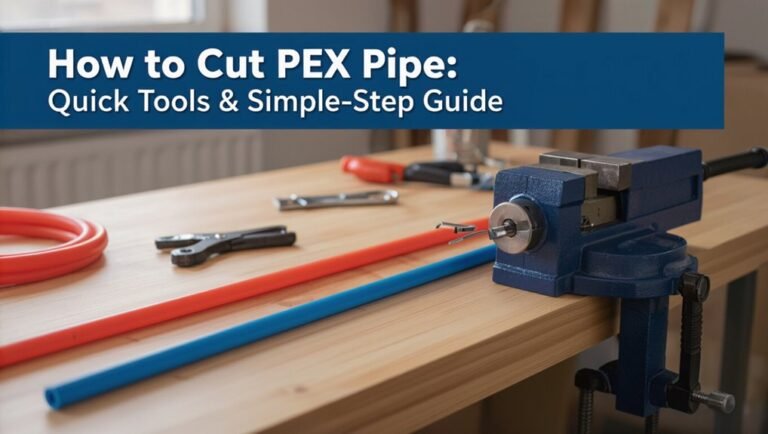
Tools You Need: Cutters, Crimpers, and Fusion Equipment
A concise set of tools is essential to cut, join, and secure poly pipe correctly: quality cutters for clean ends, reliable crimpers or compression tools for mechanical fittings, and fusion equipment (electrofusion or butt-fusion) for permanent joints.
Complementary items include deburring tools, pipe stands, and measuring tapes to guarantee accurate lengths and smooth connections. Crimpers must match fitting specifications and be calibrated; compression tools offer quick, reversible joins.
Electrofusion requires compatible fittings and a control unit; butt-fusion needs a heater plate, facing tool, and alignment clamps. Proper PPE, manufacturer manuals, and routine maintenance of equipment guarantee consistent, code-compliant installations.
Common Installation Mistakes and How to Avoid Them
In installations of poly pipe, several recurring errors—improper joint preparation, incorrect tool selection, and inadequate support—account for most leaks and premature failures. Installers must follow manufacturer specs, clean and deburr ends, and use correct fittings and torque.
Bedding and backfill practices prevent abrasion and bending stresses. Avoid chemical exposure and UV without protection. Proper labeling and pressure testing after installation confirm system integrity.
- Failing to chamfer or clean pipe ends
- Using wrong crimp or fusion tools
- Insufficient clamps or hangers
- Tight bends beyond bend radius
- Exposing pipe to solvents or prolonged sun
Detecting and Repairing Leaks in Poly Pipe Systems
Detecting leaks in poly pipe systems begins with systematic observation and testing to pinpoint moisture, pressure loss, or visible damage. Technicians isolate zones, monitor pressure gauges, and perform shut-off tests to locate losses.
Visual inspections examine fittings, crimps, and UV-exposed sections for hairline cracks. Once located, repairs use compatible couplers, compression fittings, or slip repair sleeves; damaged segments are cut back to sound material and rejoined with proper clamps and seals.
After repair, pressure tests confirm integrity and inspections make certain no residual seepage. Documentation of repair location, cause, and corrective method supports future maintenance and warranty records.
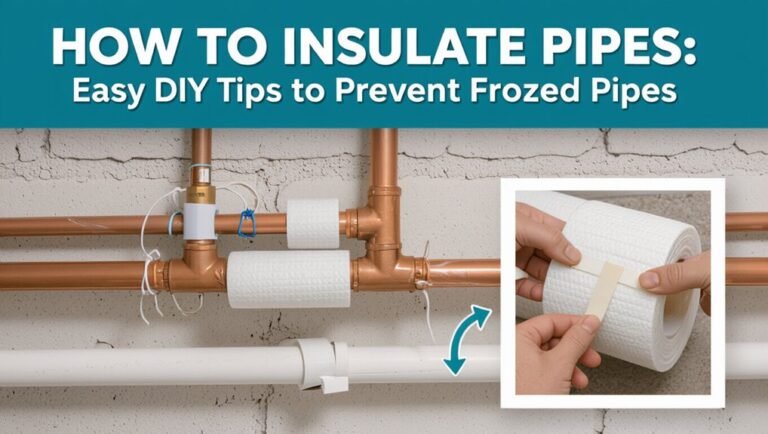
Winterizing Poly Pipe to Prevent Freeze Damage
Preparing poly pipe for winter requires targeted steps to prevent freezing, splitting, and downstream damage.
The procedure focuses on draining, insulating, and protecting exposed runs while avoiding pressure testing topics.
Recommended actions include:
- Drain and blow out lines with compressed air to remove standing water.
- Install insulation sleeves or heat tape on above-ground sections.
- Slope buried lines toward drain points and verify frost depth coverage.
- Isolate and winterize valves, backflow devices, and irrigation heads.
- Secure fittings and support to prevent movement from ice expansion.
Routine documentation of winterizing measures aids future maintenance and reduces freeze-related failures.
Testing and Inspection: Pressure Tests and Quality Checks
After winterization steps remove moisture and protect exposed runs, attention shifts to testing and inspection to confirm system integrity.
Technicians perform hydrostatic or pneumatic pressure tests at manufacturer-recommended levels and durations, monitoring for drops that indicate leaks.
Visual inspection checks fittings, joints, support spacing, and UV or abrasion damage.
Samples or in-line sections may undergo dimensional and wall-thickness verification, while hardness and material identification tests validate polymer grade.
Test records document pressure, duration, inspector, and remedial actions.
Any failing components are repaired or replaced, and retesting verifies repairs before returning the system to service.
Environmental and Regulatory Considerations: Codes and Approvals
Environmental and regulatory considerations guide selection, installation, and maintenance of poly pipe to guarantee compliance with local, national, and industry standards. Codes influence material grade, pressure ratings, ultraviolet resistance, and allowed applications; approvals from agencies (e.g., NSF, AWWA, ASTM) confirm suitability.
Installers must document permits, follow trenching and backfill requirements, and adhere to potable water separation rules. Environmental assessments address leak prevention, chemical compatibility, and groundwater protection.
- Confirm applicable municipal and state plumbing codes
- Verify third‑party certifications (NSF, AWWA, ASTM)
- Obtain required permits before installation
- Follow erosion and sediment control rules
- Maintain inspection and documentation records
Lifespan Expectations and When to Replace Poly Pipe
How long will poly pipe last in service depends on material formulation, operating conditions, and installation quality.
Typical HDPE and PE-RT systems often reach 25–50 years under recommended pressures and temperatures; agricultural low-pressure tubing may last 10–30 years.
Degradation accelerators include UV exposure, chemical exposure, cyclic pressure, and mechanical abrasion.
Signs indicating replacement: visible cracking, persistent leaks, loss of flexibility, discolored or brittle sections, and repeated repair failures.
Routine inspection, pressure testing, and tracking service history guide replacement timing.
Conservative practice replaces aging mains before failure to avoid system downtime and environmental or property damage.
Quick Decision Checklist: Pick the Right Poly Pipe for Your Project
Knowing when to replace poly pipe naturally leads to choosing the right type up front to minimize failures and downtime. A compact checklist helps match pipe to project needs, factoring pressure, UV exposure, chemical contact, burial depth, and budget constraints.
Inspect requirements, select material grade, confirm fittings compatibility, and plan installation practices. Consider future maintenance access and regulatory compliance before purchase.
- Required operating pressure and pipe SDR
- Exposure: sunlight, chemicals, temperature range
- Installation: aboveground, buried, or encased
- Connector and valve compatibility
- Budget, warranty, and replacement ease
Apply checklist to finalize the correct poly pipe choice.
Conclusion
Poly pipe endures as a quietly versatile workhorse, its polyethylene core bending without breaking through irrigation seasons and pressure cycles. Investigating the theory that flexibility equals longevity reveals images of sun-warmed coils lying patient in fields, fitting varied fittings, resisting roots and frost. Practical testing and codes confirm that the right material, size, and rating transform simple tubing into reliable infrastructure. Choosing carefully turns that humble coil into decades of unobtrusive service.