Flexible Pipes Explained: Uses, Types & Benefits for Plumbing Projects
Flexible pipes are versatile multi-layer conduits designed to transport water, gas, or chemicals while allowing for bends and thermal movement. Made from materials like PEX, braided stainless steel, corrugated metal, or reinforced PVC, they are selected based on pressure, temperature, and chemical compatibility. The advantages of using flexible pipes include simplified routing, reduced need for fittings, vibration absorption, and quicker installation. However, users must be mindful of connectors, abrasion, and UV exposure. To ensure their suitability, it’s essential to consider service limits, relevant codes, and proper joint techniques. For detailed guidance on selection, limitations, and installation, please continue reading.
What Are Flexible Pipes and How They Work
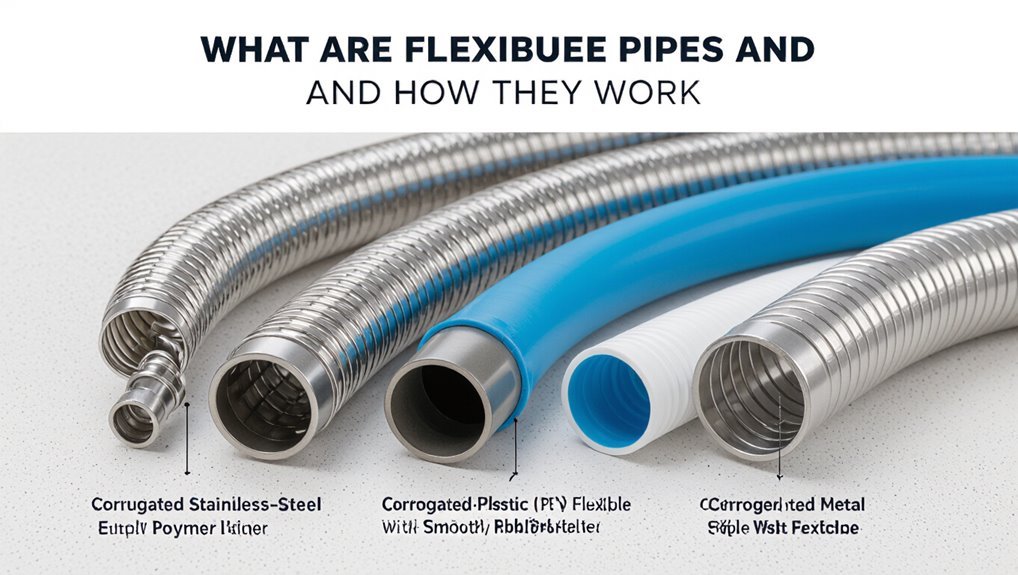
In engineering and construction contexts, flexible pipes are multi-layered conduits designed to transport fluids or gases while accommodating movement, bending, and thermal expansion.
They combine inner liners, reinforcement layers (braided or helically wound), and outer jackets to balance permeability, pressure resistance, and abrasion protection.
Materials include metal alloys, polymers, or composites selected for chemical compatibility and temperature range.
Flexibility derives from geometry and material properties, allowing installation in constrained routes and vibration isolation.
Connections use fittings, swage ends, or flanges to maintain seals under dynamic loads.
Regular inspection addresses wear, corrosion, and fatigue to guarantee operational integrity.
How to Choose the Right Flexible Pipe (Decision Checklist)
To select the appropriate flexible pipe, evaluate service conditions and performance requirements against material, construction, and connection options: define the conveyed media, pressure and temperature ranges, expected mechanical loads (bending radius, axial movement, vibration), environmental exposures (UV, chemicals, abrasion), and regulatory or industry standards, then shortlist designs (metallic, polymeric, composite) and reinforcement types that meet those constraints while allowing installation space and inspection access.
Next, assess compatibility with fittings, joint types, and sealing methods; verify durability, fatigue resistance, and corrosion or chemical resistance; consider installation complexity, maintenance needs, lifecycle cost, supplier reputation, and documented testing or certification.
Flow, Pressure, and Temperature Limits to Check
Evaluate flow, pressure, and temperature limits as primary determinants of a flexible pipe’s suitability: flow rate and velocity govern internal erosion and pressure drop, maximum allowable pressure and surge margins define wall and reinforcement requirements, and continuous plus peak temperature ranges affect material selection, sealing integrity, and fatigue life.
The spec review should include steady and transient flow scenarios, allowable velocity to limit abrasion, and calculated pressure losses. Confirm working pressure, test pressure, and safety factors against expected surges. Verify temperature ratings for fluid and ambient conditions, chemical compatibility at temperature, and long‑term thermal cycling effects on joints and polymers.
Comparing Flexible vs. Rigid Pipe: When to Pick Which
A comparison of flexible and rigid pipe should begin with how each handles routing and space constraints, since flexibility often simplifies complex runs while rigid pipe may require fittings and supports.
Durability and longevity deserve separate consideration, as material selection, abrasion resistance, and joint integrity affect service life differently for each type.
Finally, cost and installation trade-offs — including material, labor, and maintenance expenses — help determine the most appropriate choice for a given application.
Flexibility And Routing
When space constraints, movement, or complex routing are factors, flexible pipe often provides easier installation than rigid pipe because it can bend around obstacles and accommodate vibration without additional fittings.
Flexible tubing simplifies runs through studs, tight corners, and crowded mechanical spaces, reducing joints and leak points.
It permits smoother shifts between fixtures and equipment with fewer couplings, saving labor and materials.
Rigid pipe remains preferable for long, straight runs or where structural support and predictable alignment matter.
Designers weigh access, bend radius, thermal expansion, and connection types to choose the system that best balances installation speed and functional requirements.
Durability And Longevity
Often, durability and longevity hinge on material composition, installation quality, and operating conditions, so selecting between flexible and rigid pipe requires evaluating corrosion resistance, abrasion tolerance, UV exposure, temperature cycling, and joint integrity.
Flexible pipes resist vibration and accommodate thermal movement, reducing joint stress; some polymer hoses resist corrosion but may degrade under UV or high temperatures.
Rigid pipes offer predictable lifespan under compressive loads and better abrasion resistance in buried runs but can fail at fixed joints if movement occurs.
Service environment and maintenance expectations dictate choice; compatibility with fluids and protective measures determine real-world longevity.
- Flexible: absorbs vibration, tolerates thermal expansion
- Rigid: resists abrasion, stable under compression
- Consider UV, chemicals, and temperature cycles
- Joint integrity and protective coatings affect lifespan
Cost And Installation
Material and service-life considerations naturally affect upfront and long-term costs, so comparing flexible and rigid pipe requires looking beyond purchase price to installation labor, fittings, and expected maintenance.
Flexible piping typically costs more per foot but reduces labor and joint count, lowering installation time in retrofits and tight spaces. Rigid pipe often has lower material cost but higher labor for cutting, alignment, and supports.
Long-term costs hinge on failure rates, accessibility for repairs, and compatibility with fittings. Project scope, access, local labor rates, and expected service life determine whether flexible or rigid becomes the more economical choice.
Common Plumbing Uses and Best‑Fit Flexible Pipe Types
The section outlines typical applications where flexible pipes are preferred, including connections for bathroom fixtures, outdoor irrigation lines, and kitchen appliance hookups.
It compares material choices and sizing considerations that match each use case.
Practical selection tips and common installation concerns are summarized to guide appropriate pipe type choice.
Bathroom Fixtures Connections
Bathroom fixture connections demand flexibility, corrosion resistance, and compatibility with existing supply and drain lines to guarantee reliable water delivery and leak-free performance.
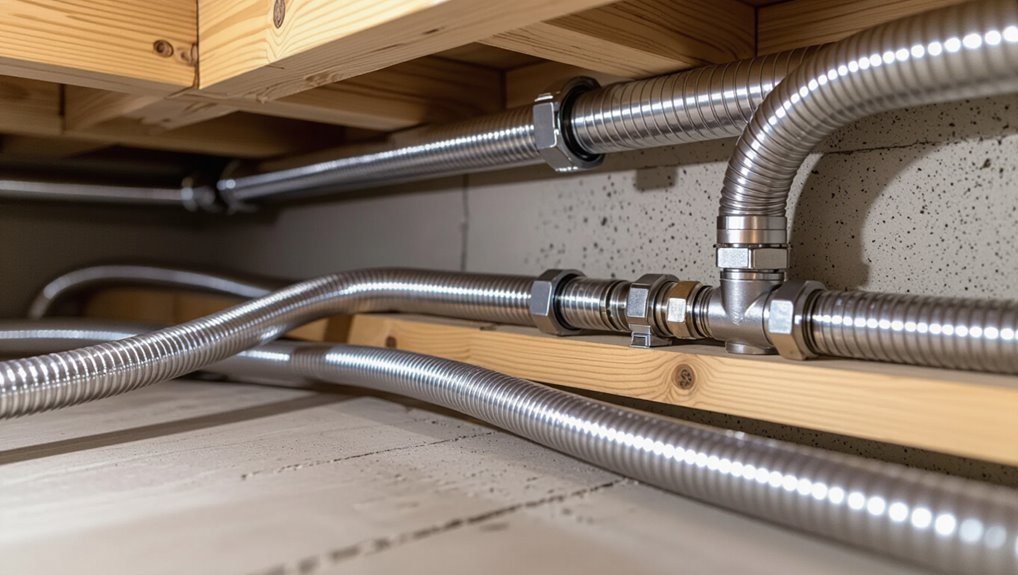
Flexible pipes simplify connections to sinks, toilets, tubs, and showers where misalignment or tight spaces prevent rigid fittings. Stainless braided hoses, PEX with compression fittings, and corrugated stainless supply lines all reduce installation time and vibration noise.
For drains, flexible trap connectors ease alignment while maintaining code-compliant slope. Selection hinges on pressure rating, temperature tolerance, and local code. Proper clamps and dielectric fittings prevent galvanic corrosion and secure long-term service.
- Sink supply to shutoff valve
- Toilet fill lines
- Shower/tub mixer feeds
- Sink drain trap alignment
Outdoor Irrigation Lines
Moving from indoor fixture hookups to outdoor water distribution, irrigation systems demand flexible piping that resists UV, sunlight, ground movement, and seasonal temperature swings while maintaining steady pressure and leak-free joints.
Flexible polyethylene and polyethylene-aluminum-polyethylene (PEX-AL-PEX) deliver durability for buried drip lines, lateral runs, and temporary sprinkler setups; UV-stabilized polyethylene tubing suits exposed spans and garden beds.
Quick-connect fittings and barbed couplers allow fast repairs and layout changes.
Freeze-tolerant PEX variants reduce rupture risk in climates with frost.
Selection prioritizes abrasion resistance, kink recovery, and compatibility with emitters, valves, and pressure-regulating components for reliable outdoor service.
Kitchen Appliance Hookups
For kitchen appliance hookups, flexible piping must balance compact routing, vibration isolation, and resistance to food‑service conditions while matching appliance inlet sizes and water pressures. The discussion examines dishwashers, refrigerators with ice makers, sinks with instant‑hot units, and washing appliances; materials like braided stainless, reinforced PEX, and food‑grade PVC address corrosion, kinking, and thermal demands. Selection considers connection types (compression, flared, threaded), pressure ratings, and ease of replacement to minimize downtime and leaks. Proper clamps, shutoff valves, and accessibility for service are essential to maintain sanitation and safety in busy kitchen environments.
- Dishwasher to house supply using braided stainless
- Refrigerator ice maker with 1/4″ PEX
- Instant‑hot tank to sink via reinforced PVC
- Washing machine with high‑pressure reinforced hose
PEX Pipe: Benefits, Limits, and Best Applications
PEX pipe offers a flexible, durable alternative to traditional copper and PVC piping, combining ease of installation with resistance to corrosion and scale.
It excels in potable hot and cold water distribution, radiant-floor heating, and retrofit projects where bending around obstacles reduces fittings.
PEX resists freeze-related bursting better than rigid pipe but can degrade with prolonged UV exposure and must not be used outdoors without protection.
Compatibility with fittings and manifolds varies by system type (PEX-A, B, C), so installers should follow manufacturer guidelines and local codes.
Its cost-effectiveness, noise reduction, and thermal efficiency make it a practical choice for many residential applications.
CSST for Gas Lines: Pros, Risks, and Code Notes
Corrugated stainless steel tubing (CSST) offers flexible routing and reduced fittings for gas lines, but its thin jacket can present heightened risk from lightning-induced arcing if not properly managed.
Proper installation requires approved fittings, continuous bonding to the building grounding system, and adherence to manufacturer instructions to mitigate strike and static hazards.
Compliance with local codes and inspection practices varies, so installers should confirm applicable standards and permit requirements before use.
CSST Lightning Risks
Occasionally, installers and homeowners encounter questions about the lightning-related vulnerabilities of corrugated stainless steel tubing (CSST) used for gas lines, particularly because its thin metal jacket and continuous runs can behave differently than traditional black steel pipe during nearby strikes. Evidence shows rare direct strike damage and occasional arcing where lightning-induced potentials find weak points. Risk factors include bonding status, jacket type, routing near conductive systems, and proximity to strikes. Awareness of these variables guides risk assessment without suggesting inevitability.
- Thin jacket can permit puncture from high-energy arcing
- Long continuous runs may allow higher induced voltages
- Nearby conductive paths increase potential differences
- Reports of isolated, localized damage rather than widespread failures
Installation And Bonding
In discussing installation and bonding of CSST used for gas lines, attention centers on proper grounding connections, bonding locations, and compliance with manufacturer instructions and local codes to minimize electrical and mechanical risks.
Installers must attach bonding clamps to recommended conductive components, use appropriately sized bonding conductors, and avoid insulated fittings or coatings that impede continuity.
Bonding points should create a low-impedance path to the electrical grounding system to reduce arcing potential during faults or lightning events.
Mechanical protection near penetrations, secure support spacing, and careful routing to prevent abrasion complete best practices for reducing damage and maintaining system integrity.
Code Compliance Notes
When evaluating code compliance for CSST gas systems, authorities and installers must consider model building codes, appliance and fuel gas codes, manufacturer installation instructions, and local amendments to guarantee safe and approved use. CSST offers flexibility and reduced joints but introduces bonding, grounding, and lightning risk considerations.
Inspectors verify listed materials, proper bonding conductor size and connection location, and adherence to required clearances and supports. Documentation and labeling help demonstrate compliance. Noncompliance can mandate retrofit bonding or replacement.
- Confirm manufacturer-approved bonding method and hardware
- Verify bonding conductor routing and termination
- Check labeling and installation documentation
- assure compliance with local code amendments
Flexible Copper Pipe and Copper‑Clad Options
Many builders and plumbers prefer flexible copper pipe for its combination of corrosion resistance, antimicrobial properties, and reliable long-term performance in water and HVAC systems.
Flexible copper delivers easy routing in tight spaces, solderable joints, and stability at varied temperatures.
Copper-clad alternatives — typically aluminum or steel cores with a copper exterior — offer lower cost and lighter weight while retaining solderability and some corrosion protection.
Selection depends on pressure ratings, code approval, and compatibility with fittings and solder types.
Installers should verify oxygen barriers where required and avoid dissimilar metal contact to prevent galvanic corrosion and premature failure.
Braided Stainless Flexible Supply Lines for Fixtures
Shifting from rigid and copper-clad tubing to fixture connections, braided stainless flexible supply lines are the common choice for attaching faucets, toilets, and appliances because they combine flexibility with high burst strength and corrosion resistance.
They simplify installation in tight spaces, reduce vibration transmission, and resist kinking better than plain rubber lines. Common lengths and end fittings fit standard plumbing, while stainless braiding shields inner tubing from abrasion and sunlight.
They suit both residential and commercial fixtures, with options rated for hot and cold use and various pressure classes.
- Flexible stainless braid over EPDM inner tube
- Standard 3/8″, 1/2″ connector sizes
- Temperature and pressure ratings visible on sleeve
- Quick-connect and compression end styles
Flexible PVC/CPVC : When Plastic Is the Smart Choice
Flexible PVC and CPVC tubing offer a practical alternative to metal when flexibility, chemical resistance, and cost-effectiveness are priorities. These plastics suit cold- and hot-water distribution respectively, simplifying installation with solvent-weld or push-fit joints and reducing need for specialized tools.
Corrosion resistance makes them suitable for potable water, chemical lines, and many residential applications where metal contamination or galvanic corrosion is a concern. Lightweight construction eases handling in tight spaces and lowers labor costs.
Compatibility with common fittings and adaptability to retrofit work make PVC/CPVC a pragmatic choice for projects emphasizing affordability and straightforward installation.
Lifespan, Failure Modes, and Durability by Pipe Type
Typically, pipe lifespan and modes of failure vary widely by material, installation quality, and operating conditions. Different flexible pipe types exhibit characteristic durability profiles: metal flex lines resist pressure and heat but corrode or fatigue; PEX tolerates freeze cycles but can degrade from UV or chlorinated water; PVC/CPVC is chemically resistant yet brittle at low temperatures and joint failure is common; composite or corrugated hoses offer flexibility but risk abrasion and connector wear. Consider expected service life, environmental exposure, and chemical compatibility when selecting pipe type.
- Metal: corrosion, fatigue, galvanic attack
- PEX: UV degradation, chlorine embrittlement
- PVC/CPVC: brittleness, joint leaks
- Composites: abrasion, connector failure
Cutting, Joining, and Routing Flexible Pipe (Installation Tips)
After evaluating lifespan and common failure modes, attention turns to practical installation practices that help prevent those failures: correct cutting, secure joining, and mindful routing.
Use the recommended tools for clean, square cuts to avoid burrs and stress points. Deburr and inspect ends before joining. Select connectors compatible with material—compression, crimp, or push-fit—and follow torque or crimp specifications.
Allow appropriate expansion loops and gentle bends to respect minimum bend radius. Secure runs with properly spaced supports to prevent sagging and vibration.
Route away from heat sources, sharp edges, and moving parts. Test the assembled system under pressure before concealment.
Common Installation Mistakes to Avoid
Often installers overlook small shortcuts that later cause major leaks, failures, or costly rework. Common mistakes include improper support, incorrect fittings, and ignoring bend radii, each reducing service life and performance.
Attention to material compatibility, contamination during assembly, and avoiding excessive torque prevents failures. Proper planning and verification of clearances and routing minimize abrasion and stress points. Regularly checking connections during pressure tests catches issues early.
- Using wrong fittings or adapters that stress seals
- Insufficient clamps or unsupported spans causing sag
- Tight bends violating minimum bend radius
- Contaminants left in pipe before joining
Codes, Safety, and Inspections by Application
Across industries and applications, codes and safety requirements govern flexible-pipe selection, installation, testing, and inspection to guarantee system integrity and protect personnel and the environment.
Applicable standards—plumbing codes, building codes, fire codes, ASME, ASTM, NFPA, and local ordinances—define materials, pressure ratings, supports, joint methods, and exposure limits.
Inspectors verify compliance via visual checks, pressure tests, leak detection, and documentation.
Hazard-specific rules address potable water, gas, chemical, and wastewater services, plus seismic and corrosion considerations.
Contractors must maintain records, certifications, and corrective actions.
Strict adherence reduces failures, liability, and downtime while ensuring safe, code-compliant systems.
Cost Comparison of Flexible Pipe Types (Material & Labor)
A clear comparison of flexible pipe types requires evaluating both material and labor costs together, since purchase price, installation complexity, and long-term maintenance drive total project expense. Material costs vary: PEX is inexpensive, corrugated stainless steel is pricier, and braided hoses fall between. Labor depends on fittings, accessibility, and required tooling. Project scale shifts per-foot to total-system economics. Lifespan and warranty influence lifecycle value without detailing repair signals.
- PEX: low material, moderate labor for connections
- Stainless corrugated: high material, skilled labor
- Braided hoses: mid material, minimal labor
- Specialized liners: variable material, intensive labor
Maintenance, Repair, and Replacement Signals
Material and labor cost differences dictate inspection frequency and repair strategy: lower-cost PEX runs may tolerate quicker replacement, while high-end corrugated stainless installations justify more proactive maintenance.
Observable signals prompting action include visible leaks, pressure loss, discolored water, persistent odors, and unusual noise.
Routine inspections target fittings, clamps, and support points for wear, corrosion, or movement.
Small leaks merit prompt repair; multiple failure points or widespread age-related degradation indicate replacement.
After repairs, pressure testing and water quality checks confirm integrity.
Documentation of interventions, material type, and service life supports future decisions and optimizes lifecycle cost management.
Conclusion
When the last joint is tightened and the water stirs awake, a quiet decision lingers: will flexibility mean salvation or slow surprise? The finished run gleams, yet beneath its bend lies a choice made—material, pressure, code—each whispering consequences. Inspectors may nod, owners may sleep, but time will tell which pipe holds firm and which will teach a lesson. For now, the project rests on a promise and the faint click of patience.