What Is ABS Pipe? Quick Guide to Uses, Benefits & Types
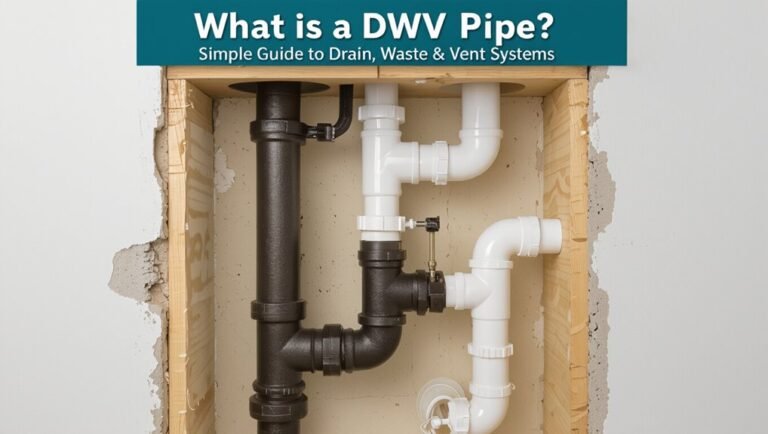
ABS pipe is a lightweight thermoplastic designed primarily for drain, waste, and vent (DWV) plumbing in both residential and commercial settings. Its construction combines rigid acrylonitrile-styrene segments with flexible polybutadiene, resulting in a material that is tough, impact-resistant, and performs well in low temperatures. ABS pipe is easy to join using solvent welds, resists many common household chemicals, and is often more cost-effective and quicker to install than metal alternatives. However, it does have limitations, including lower heat resistance and susceptibility to certain solvents. For more details on its types, comparisons with other materials, and installation tips, continue reading.
What Is ABS Pipe and Why It Matters
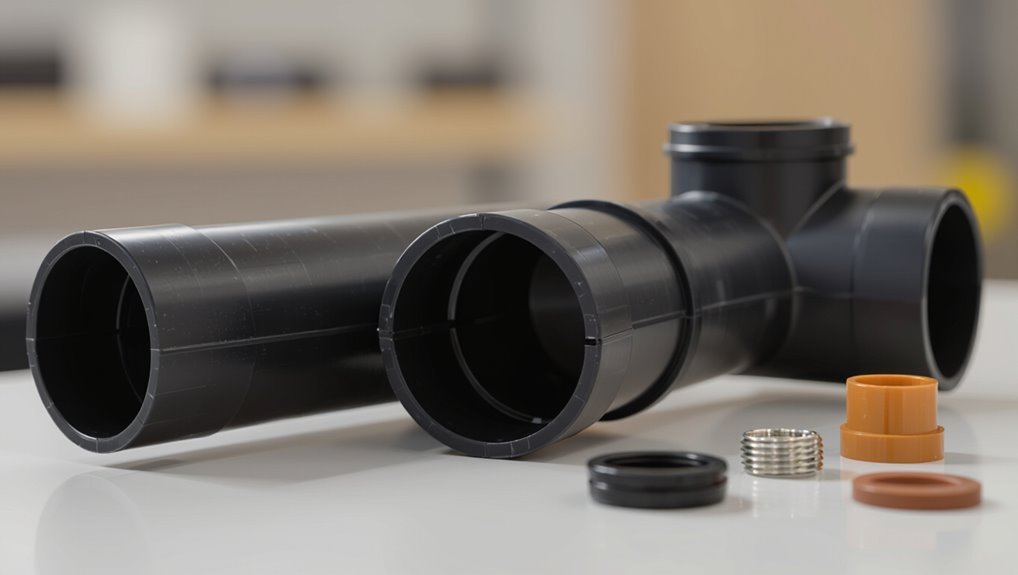
In many residential and commercial plumbing systems, acrylonitrile butadiene styrene (ABS) pipe serves as a lightweight, durable thermoplastic conduit for drain, waste, and vent (DWV) applications.
It provides reliable fluid conveyance, resists impact and common household chemicals, and simplifies installation with solvent-welded joints.
Builders and plumbers value ABS for predictable performance, code acceptance in many jurisdictions, and suitability for remodels and new construction.
Its use reduces labor time and often lowers material costs compared with heavier alternatives.
Appropriate sizing, proper joining techniques, and adherence to local regulations guarantee functional longevity and system integrity.
ABS Pipe Material: Composition and Properties
Building on its practical advantages in DWV systems, examining what ABS is made of and how its molecular structure yields performance clarifies why it is widely used.
Acrylonitrile butadiene styrene is a thermoplastic copolymer combining rigid acrylonitrile-styrene segments with rubbery polybutadiene, producing toughness and impact resistance.
Its amorphous morphology provides dimensional stability and good low-temperature performance.
Chemical resistance covers many household chemicals, though strong solvents can attack it.
ABS melts around 200–240°C, allowing extrusion and injection molding.
Mechanical strength, ease of fabrication, and predictable aging make ABS suitable for drainage, vents, and fittings where durability and manufacturability are priorities.
How ABS Differs From PVC and CPVC
ABS, PVC, and CPVC differ markedly in their chemical resistance, with ABS more susceptible to certain solvents while PVC and especially CPVC tolerate a broader range of chemicals.
Temperature handling is also distinct: ABS performs well at lower temperatures but has a lower continuous service temperature than CPVC, which is rated for higher-temperature applications.
These contrasts shape material selection for specific chemical exposures and thermal conditions.
Chemical Resistance Differences
Comparing chemical resistance, ABS shows a different performance profile than PVC and CPVC under many common industrial and plumbing exposures.
ABS resists many acids, alkalis, and hydrocarbons but is more vulnerable to strong oxidizers and certain solvents compared with CPVC.
PVC and CPVC offer superior resistance to chlorinated solvents and stronger acids; CPVC extends that resistance to higher concentrations and temperatures.
ABS may degrade or swell when exposed to aromatic or chlorinated hydrocarbons that have limited effect on PVC/CPVC.
Selection depends on the specific chemical environment, contact duration, and concentration; compatibility charts and testing inform proper material choice.
Temperature Handling Limits
Exhibiting lower heat tolerance than CPVC and somewhat different limits from PVC, ABS generally performs well in cold and moderate-temperature applications but softens and loses mechanical strength at elevated temperatures.
Typical ABS service temperatures range from about -40°C up to roughly 60–80°C; prolonged exposure near the upper end accelerates creep and deformation.
CPVC tolerates considerably higher hot-water temperatures, while PVC sits between ABS and CPVC for thermal endurance.
Installers must consider maximum operating temperature, pressure derating, and ambient heat sources.
Appropriate material selection, insulation, and avoidance of continuous high-temperature service extend ABS lifespan and maintain safety.
Choosing Between ABS, PVC and CPVC: Use Cases and Tradeoffs
When selecting among ABS, PVC, and CPVC, considerations include durability and impact resistance, operating temperature and chemical compatibility, and the relative costs and installation complexities.
ABS often offers superior toughness for cold or impact-prone applications, while CPVC tolerates higher temperatures and more aggressive chemicals than PVC or ABS.
Cost and ease of joining—solvent welding, primer use, or specialized fittings—frequently determine the practical choice for a given project.
Durability And Impact Resistance
In evaluating durability and impact resistance, ABS, PVC and CPVC each offer distinct mechanical characteristics that make them better suited to different applications: ABS is tougher and more impact-resistant at low temperatures, PVC is rigid and cost-effective but more brittle under shock, and CPVC maintains improved heat resistance while sacrificing some ductility compared with ABS.
- ABS: High toughness, resists cracking from impact and flex at low temperatures.
- PVC: Stiff and durable for static loads; more prone to sudden fracture under blunt force.
- CPVC: Greater thermal durability but reduced impact tolerance relative to ABS.
- Selection balances expected mechanical stress, installation demands, and lifecycle risks.
Temperature And Chemical Limits
Although each thermoplastic shares common corrosion resistance, ABS, PVC, and CPVC diverge sharply in usable temperature ranges and solvent compatibility, which drives their selection for specific fluids and service conditions.
ABS performs well at lower temperatures and resists impact and many hydrocarbons but softens near 80–100°C.
PVC handles moderate temperatures to about 60°C and is compatible with many acids and bases but is attacked by some solvents and hot organics.
CPVC extends useful temperatures to roughly 90–110°C and tolerates hotter potable water and many chemicals that degrade PVC.
Compatibility charts and application specifics determine appropriate choice.
Cost And Installation Tradeoffs
Why choose one thermoplastic over another for a project? Cost and installation tradeoffs guide material selection by balancing upfront expense, labor, and long-term performance. ABS is typically cheaper and easier to solvent-weld, while PVC offers wider availability and lower material cost in many regions. CPVC costs more but resists higher temperatures.
Consider:
- Material cost: CPVC > PVC ≈ ABS (region-dependent).
- Labor: solvent welding speeds ABS/PVC; CPVC may need careful handling.
- Lifetime expenses: repair frequency and thermal limits affect total cost.
- Code and application: compliance can dictate choice despite price differences.
Common ABS Pipe Sizes and Dimensions
Across residential and commercial applications, ABS pipe commonly appears in a handful of standard diameters and wall thicknesses that match specific drainage, venting, and waste needs.
Typical nominal sizes range from 1¼” and 1½” for fixture drains, through 2″ and 3″ for branch drains and vents, to 4″ for main soil stacks. Pipe schedules and SDR values determine wall thickness; thinner walls suit low-pressure drain lines while thicker variants handle longer runs and structural demands.
Lengths are commonly 10′ or 20′, with fittings sized to match nominal diameters. Adapters bridge ABS to other materials when required.
How ABS Pipe Is Marked: Colors and Codes
ABS pipe is typically marked with color, sizing, and certification codes to convey material type, designated use, and compliance at a glance. Markings assist inspectors, installers, and designers in identifying intended service and standards conformance. Common color conventions differentiate sewer, drain, and nonpotable applications from potable or specialized systems.
Printed codes include nominal size, schedule/class, ASTM or CSA standard numbers, manufacturer ID, and production date. Marking locations are near fittings or every specified length. Typical labels also show pressure ratings when applicable, and UV or flame-retardant indicators when installed in exposed or commercial settings.
- Color bands indicate service
- Size and schedule
- Standard numbers (ASTM/CSA)
- Manufacturer and date
ABS Pipe Pressure and Temperature Limits
Defines the working limits for solvent-cemented acrylonitrile butadiene styrene (ABS) piping are set by material properties, wall thickness (schedule or SDR), and applicable standards; these factors determine maximum allowable internal pressure and safe continuous temperature for drainage, venting, and certain pressure applications.
Manufacturers publish pressure ratings that decline with temperature; typical ABS pressure ratings apply at ambient temperatures and decrease above about 73°F (23°C).
ABS is not rated for high-temperature service; continuous exposure above roughly 140°F (60°C) degrades strength and joint integrity.
Design must use applicable codes, temperature derating tables, and conservative safety factors for long-term performance.
Why ABS Is Popular for DWV Systems
ABS is favored in DWV systems for its high durability and impact resistance, which reduces the risk of cracks and breaks during installation and use.
Its resistance to many chemicals and corrosion helps maintain long-term flow performance in waste and vent lines.
Installers also value ABS for its lightweight nature and straightforward joining methods, which speed up assembly and reduce labor.
Durability And Impact Resistance
Boasting a dense, non-porous composition, ABS offers exceptional durability and impact resistance that make it well suited for drainage, waste, and vent (DWV) systems.
Its toughness reduces fracture risk during installation and under thermal contraction or settling, extending service life.
Lightweight yet rigid, ABS tolerates mechanical stresses from soil and traffic when buried with proper bedding.
Maintenance needs remain low due to resistance to cracking from physical forces.
- High impact strength reduces breakage.
- Flexural rigidity maintains alignment over time.
- Resilient to freeze–thaw movement when installed correctly.
- Durable joints sustain repeated loading without deformation.
Chemical And Corrosion Resistance
Chemical stability underlies ABS pipe’s widespread use in drainage, waste, and vent (DWV) systems: its polymer matrix resists degradation from common household chemicals, cleaning agents, and mildly acidic or alkaline effluents, preventing pitting and loss of structural integrity. It also resists biological corrosion and many solvents, reducing maintenance and leak risk over decades. Compatibility charts guide selection where stronger solvents or industrial effluents occur. UV exposure and some hydrocarbons are concerns; appropriate shielding or alternative materials may be required.
| Substance category | ABS response |
|---|---|
| Household cleaners | Resistant |
| Mild acids/bases | Stable |
| Strong solvents | Vulnerable |
| Biological agents | Resistant |
Ease Of Installation
In many residential and light commercial projects, the material’s lightweight construction and forgiving jointing methods markedly reduce installation time and labor costs.
Installers favor ABS for DWV systems because it cuts, fits, and secures quickly, requiring fewer specialty tools and less curing time than alternatives. Consistent dimensions and tolerances simplify planning and reduce on-site adjustments. The material’s resilience tolerates minor misalignment during assembly without compromising integrity.
- Rapid solvent-weld and gasketed joints
- Minimal support spacing due to rigidity
- Ease of cutting and threading for fittings
- Reduced need for heavy lifting and bracing
Residential Uses for ABS Pipe
ABS pipe finds common application in residential plumbing systems where durability, ease of installation, and resistance to corrosion are priorities.
It is frequently used for drain, waste, and vent (DWV) lines in bathrooms, kitchens, and laundry areas due to smooth interior surfaces that reduce clogs and odor traps.
ABS serves in underground sewer connections and branch drains because of toughness against ground movement and chemical exposure.
Home remodels benefit from its lightweight handling and solvent-weld joints, speeding labor.
In cold climates, ABS tolerates low temperatures better than some alternatives, reducing risk of brittle failure in exterior runs.
Commercial Uses for ABS Pipe
How do commercial projects leverage ABS pipe for large-scale drainage and venting systems? In commercial buildings, ABS offers reliable waste and vent conveyance, ease of installation, and code compatibility. Designers favor its dimensional stability and resistance to common chemicals in occupant facilities.
- Cost-effective runs for multi-story plumbing stacks and branches.
- Rapid assembly reduces labor in office, retail, and hospitality projects.
- Compatibility with engineered drainage layouts and prefabricated modules.
- Long-term performance with minimal maintenance for tenant spaces and common areas.
Specification, proper support, and fire-stopping integration guarantee ABS performs as intended in commercial applications.
Industrial Uses for ABS Pipe
In industrial settings, ABS pipe is used for chemical transport lines where its chemical resistance and impact strength help maintain safe, leak-free conveyance of corrosive fluids.
It also appears in equipment housing panels, providing lightweight, durable enclosures that resist solvents and physical wear.
Together these applications highlight ABS’s suitability for demanding plant environments.
Chemical Transport Lines
For conveying corrosive or reactive fluids within industrial plants, ABS pipe offers a balance of chemical resistance, toughness, and cost-effectiveness that suits many secondary and closed-loop systems.
Its rigidity limits permeation and supports predictable flow regimes, while impact resistance aids longevity in congested utility corridors.
Installers favor solvent-weld joints for leak-tight runs and prefabricated bends to reduce field fittings.
Selection depends on chemical compatibility charts, temperature limits, and pressure ratings; periodic inspection is advised where aggressive agents are present.
- Compatibility assessment
- Pressure and temperature limits
- Jointing method selection
- Inspection and maintenance
Equipment Housing Panels
Used as modular cladding and access panels, ABS pipe sections and fabricated sheets provide a lightweight, impact-resistant option for equipment housings in industrial settings.
They resist oil, grease, and common industrial solvents, reducing corrosion and maintenance compared with metal enclosures.
Fabrication techniques include cutting, thermoforming, and adhesive or mechanical joining to create custom-fit panels, vents, and service doors.
Electrical insulation properties and dimensional stability under moderate temperature variations make ABS suitable for control cabinets and instrument housings.
Panels can be textured or colored for safety marking.
Recyclability and cost-effectiveness further support ABS as a practical choice for industrial equipment enclosures.
Using ABS Outdoors and Underground: Limits and Tips
When exposed to soil, sunlight, or fluctuating temperatures, ABS pipe performs well in many outdoor and buried installations but requires attention to certain limits—UV degrades the plastic surface over time, and freezing temperatures can make it more brittle.
Installers should follow burial depth guidelines, use UV-blocking coatings or coverings for exposed runs, and provide thermal protection in cold climates. Connections must remain accessible for inspection and allow slight movement without stress.
- Confirm local code allowances for exterior use.
- Select proper bedding and backfill materials.
- Protect exposed sections from direct sunlight.
- Allow for thermal expansion and contraction.
How to Choose ABS Pipe for a Plumbing Project (5 Criteria)
After confirming site-specific limits for outdoor or buried ABS runs, selecting the right pipe for a project requires balancing five practical criteria: size and flow capacity, pressure and temperature ratings, chemical compatibility, joint and installation method, and applicable codes and standards. The decision-maker assesses expected flow, peak pressures, and thermal exposure; verifies chemical resistance to transported fluids; chooses compatible fittings and approved joining techniques; and confirms compliance with local plumbing codes and inspector preferences. Cost, availability, and installer familiarity influence final selection.
| Criterion | Quick check |
|---|---|
| Flow/Size | Match demand |
| Ratings/Code | Verify limits |
Solvent‑Welding ABS Pipe (Step‑by‑Step)
In preparing to solvent‑weld ABS pipe, a clear, methodical sequence guarantees strong, leak‑free joints: surfaces are cleaned and deburred, fittings are dry‑fit and marked for alignment, cement is applied sparingly to the proper areas, and assemblies are joined with a firm twist and held until set.
Steps include:
- Measure, cut square, and remove burrs; test fit components.
- Wipe mating surfaces with solvent or cloth to remove oil and debris.
- Apply ABS cement to pipe end and fitting socket per manufacturer directions.
- Assemble with a quarter‑turn to distribute cement, align, and hold until tack sets.
Curing time and ventilation follow product guidance.
Mechanical Fittings and Adapters for ABS Pipe
For changes that cannot rely on solvent welding, mechanical fittings and adapters provide secure, removable connections between ABS pipe and dissimilar materials, threaded systems, or field-modified layouts. Common options include compression couplings, threaded adapters, rubber-sleeve clamps, and flanged transitions. Selection depends on pressure rating, vibration, and ease of disassembly. Installers verify pipe OD, gasket material compatibility, and torque specs. Mechanical joints are valuable for repairs, temporary layouts, and interfacing with metal or PVC. Proper seating and corrosion-resistant hardware extend service life; periodic inspection confirms seal integrity and detects movement or loosening before leaks develop.
| Fitting Type | Typical Use |
|---|---|
| Compression coupling | Quick repair |
| Threaded adapter | Metal connections |
| Flange adapter | High‑strength joins |
Cutting and Preparing ABS Pipe Correctly
Accurate cutting and careful preparation guarantee ABS pipe will join properly and maintain a reliable seal. The process begins with measuring and marking the pipe, ensuring square cuts and correct lengths.
Burrs and shavings are removed to prevent interference with fittings. Surfaces are cleaned to remove grease, dirt, and moisture before solvent application. Proper alignment and brief cure times are observed for reliable bonds.
- Measure twice, mark once for square cutting.
- Use a fine-tooth saw or PVC cutter for clean edges.
- Deburr and chamfer inner and outer edges.
- Wipe surfaces with approved cleaner before solvent cement.
Common Installation Mistakes With ABS Pipe to Avoid
When installed improperly, ABS piping can lead to leaks, blockages, and premature failures that increase repair costs and downtime.
Common mistakes include inadequate support spacing causing sagging and joint stress, improper solvent welding from insufficient cleaning or incorrect glue, and using incompatible fittings or adhesives.
Over-tightening straps that deform pipe, failing to allow thermal expansion, and sharp bends that impede flow are frequent errors.
Incorrect burial depth or lack of protection against impact and UV exposure also compromise longevity.
Following manufacturer guidelines for joint preparation, support, slope, and material compatibility prevents these avoidable installation failures.
Inspecting ABS Pipe: What to Look For
Routine inspections of ABS piping focus on identifying visible damage, joint integrity, support condition, and signs of flow restriction.
Inspectors visually scan runs for cracks, abrasions, UV discoloration, and thermal deformation.
They verify solvent-welded and mechanical joints for gaps, misalignment, and proper bedding.
Supports and hangers are checked for spacing, corrosion, and vibration control.
Access points and cleanouts are examined to confirm removability and seal condition.
- Surface condition: cracks, crazing, discoloration.
- Joint integrity: solvent welds, clamps, alignment.
- Supports: spacing, securement, vibration isolation.
- Flow indicators: buildup, sags, pooling.
Signs ABS Pipe Needs Repair or Replacement
How can an inspector tell if ABS piping requires repair or replacement? Visible cracks, splits, or crushed sections indicate structural failure.
Persistent leaks, water stains, mold growth, or lingering odors suggest compromised joints or hidden damage.
Discolored, brittle, or flaking plastic points to UV or chemical degradation.
Loose, misaligned, or corroded fittings and repeated joint failures reveal installation or material issues.
Frequent blockages or slow drainage can signal internal collapse or deformation.
Extensive damage across multiple sections, repeated repairs, or safety risks warrant replacement rather than patching.
Documentation of findings and assessment of service life guide the decision.
Repairing a Cracked ABS Pipe (Methods)
After identifying signs that an ABS line is failing, the next step is to evaluate repair options for a cracked section based on crack size, location, and system pressure. Common methods focus on containment and restoration without full replacement.
Consider short-term patches, mechanical couplings, and adhesive systems that match ABS chemistry; pressure-rated clamps suit low-risk leaks. Emergency wraps and epoxy putties provide temporary sealing until planned work proceeds. Selection prioritizes compatibility, cure time, and operating temperature.
- Epoxy putty for hairline cracks
- Pressure-rated clamp for axial splits
- Solvent-weld sleeve for small accessible areas
- Reinforcing wrap for temporary containment
Replacing a Section of ABS Pipe : Step‑by‑Step
Before any cutting begins, the water supply should be shut off to prevent leaks and flooding.
The damaged section of ABS pipe is then removed using a saw or pipe cutter, making clean, square cuts at each end.
These preparatory steps set the stage for measuring, fitting, and installing a replacement segment.
Turn Off Water Supply
Shut the main water supply to the affected area to prevent flooding and make the repair safe and manageable.
The technician confirms valves feeding the ABS run are closed, relieves residual pressure, and isolates nearby fixtures to avoid accidental flow.
Proper shutdown reduces mess and protects adjacent systems.
Before cutting, the worker prepares tools, towels, and a bucket, verifies the shutoff by opening a downstream faucet, and notes valve types for restoration.
After the repair, the system is slowly repressurized and inspected for leaks.
- Locate main and branch shutoffs
- Close valves fully
- Drain downstream lines
- Verify isolation
Cut Out Damaged Section
Cut the damaged section of ABS pipe using a pipe cutter or fine-toothed saw, making square, clean cuts at points beyond any visible cracks or deformation. Remove debris, deburr edges, and dry-fit a replacement piece with couplings or solvent-weld fittings. Assure alignment, proper insertion depth, and support. Apply primer if required, then solvent cement evenly; rotate fittings slightly for full coverage. Allow cure time per manufacturer instructions, test for leaks, and re-secure hangers. Inspect joints and surrounding pipe for stress.
| Saw blade | Smooth cut | Deburr edges |
|---|---|---|
| Dry-fit | Align | Cement |
| Cure time | Test | Support |
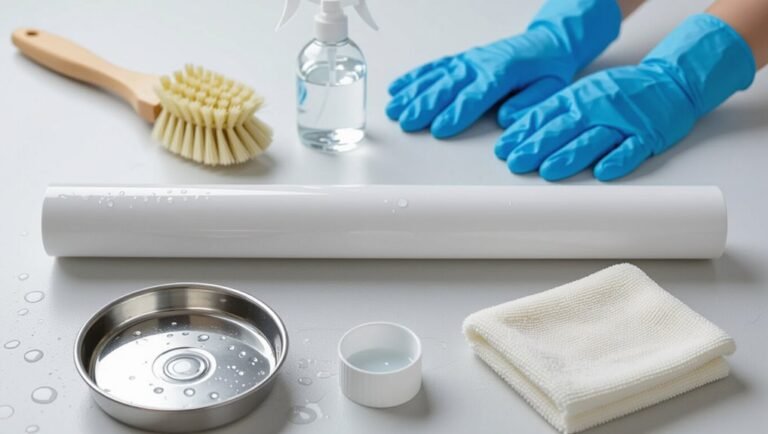
Tools for ABS Pipe Work (DIY Kit)
A basic DIY ABS pipe kit equips a homeowner with the essential tools to measure, join, and secure plastic drain lines without professional help. The kit focuses on accuracy and reliable fittings, streamlining repairs and small installations.
Components are compact and selected for common tasks, facilitating clean cuts, proper solvent welding, and firm mechanical connections. Recommended items include:
- Measuring tape and marker for precise lengths.
- Plastic pipe cutter or fine-tooth saw for smooth edges.
- ABS cleaner and solvent cement for chemical bonding.
- Slip couplings, primer, and clamps for secure joins and temporary fixes.
Safety Precautions When Working With ABS Pipe
When handling ABS pipe, workers should use appropriate personal protective equipment such as gloves, eye protection, and respirators when solvents are in use.
Work areas require proper ventilation to reduce inhalation of fumes from cement and primer.
Cutting and bonding must follow safe practices—secure pipe before cutting, use tools with guards, and allow adhesives to cure per manufacturer instructions.
Personal Protective Equipment
Wearing appropriate personal protective equipment (PPE) minimizes injury risks and exposure to fumes, shavings, and impact hazards encountered during ABS pipe work. Workers should select gear based on cutting, joining, or solvent use.
Essential items protect eyes, lungs, hands, and hearing while maintaining dexterity for fittings and measurements.
- Safety glasses or goggles to shield against chips and splatter.
- N95 or cartridge respirators for short-term solvent or dust exposure.
- Cut-resistant gloves to prevent lacerations from tools and rough edges.
- Hearing protection when operating power saws or rotary tools.
Proper Ventilation Practices
Proper respiratory and air-quality controls complement personal protective equipment by reducing inhalation of solvent vapors and plastic dust generated during cutting, sanding, and solvent-welding of ABS pipe. Workers should assess ventilation needs, prioritize natural cross-ventilation, and use local exhaust or portable fans when indoors. Mechanical systems must direct contaminants away from occupants and discharge outdoors. Regular maintenance of filters and ducts preserves effectiveness. Continuous monitoring with sensor badges or real-time meters informs safe re-entry times. Signage and access controls prevent exposure during high-emission tasks.
| Measure | Benefit |
|---|---|
| Natural ventilation | Low cost |
| Local exhaust | Source capture |
| Portable fans | Air movement |
| Monitoring | Exposure data |
| Maintenance | System reliability |
Safe Cutting And Bonding
During cutting and solvent-bonding of ABS pipe, workers must follow strict controls to prevent inhalation of fumes, skin contact with solvent cement, and injuries from tools and flying debris.
Proper PPE, respirators when ventilation is inadequate, and splash-resistant goggles are required.
Clean, dry joints and correct cure times reduce failures.
Tools must be maintained and guards used.
Waste and rags soaked with solvent should be stored in sealed, labeled containers.
- Use NIOSH-approved respirators for solvent vapors.
- Wear nitrile gloves and eye protection.
- Employ blade guards and secure workpieces.
- Follow manufacturer cure times and disposal rules.
Chemical Resistance: What ABS Stands Up To
When exposed to common household and industrial chemicals, ABS pipe demonstrates reliable resistance to many acids, alkalis, and alcohols, though its performance varies with concentration and temperature.
It resists dilute inorganic acids (e.g., hydrochloric, sulfuric at low concentrations) and common bases like sodium hydroxide within moderate concentrations and temperatures.
ABS tolerates many alcohols, glycol, and detergents, but strong oxidizers (nitric acid, chromates) and aromatic hydrocarbons (benzene, toluene) can cause swelling, softening, or stress cracking.
Chemical compatibility charts and testing under expected service conditions guide material selection; chemical exposure limits should inform piping design and maintenance.
UV Exposure and Weathering: Protecting ABS Outdoors
Exposed to sunlight, ABS pipe experiences surface degradation from ultraviolet radiation and the combined effects of heat, moisture, and freeze–thaw cycles, which can cause discoloration, loss of impact strength, and crazing over time. Protective strategies reduce deterioration and extend service life. Suitable measures include coatings, pigments, and physical shielding tailored to application and climate. Maintenance inspects joints and seals for weather-related compromise. Performance monitoring guides replacement schedules.
- UV-resistant coatings: block ultraviolet penetration.
- Carbon black pigmentation: enhances inherent UV stability.
- Physical covers: limit direct exposure and thermal cycling.
- Routine inspection: detect early weathering signs and failures.
ABS Pipe vs. Metal Pipe: Cost and Performance
In comparisons of ABS and metal pipe, material choice hinges on upfront cost, lifecycle expenses, and application-specific performance. ABS typically costs less to purchase and install, resists corrosion, and is lighter, lowering labor and support needs. Metal offers superior temperature tolerance and mechanical strength but incurs higher material, insulation, and corrosion-management expenses. For chemical exposure or where rigidity matters, metal may be preferable; for drainage, vents, and many waste applications, ABS is economical and reliable.
| Factor | Typical Outcome |
|---|---|
| Upfront cost | ABS lower |
| Installation ease | ABS easier |
| Corrosion resistance | ABS superior |
| Strength | Metal higher |
| Thermal tolerance | Metal higher |
Lifespan Expectations for ABS Pipe Installations
Typical ABS pipe installations are expected to provide decades of service under normal indoor conditions, often exceeding 30 years depending on use.
Longevity can be shortened by UV exposure, high temperatures, chemical attack, mechanical stress, or improper joining.
Regular inspection, protection from sunlight and heat, correct installation, and timely repairs help extend service life.
Expected Service Life
When properly installed and maintained, ABS pipe installations commonly provide several decades of reliable service, with many systems reaching 20–50 years depending on application and conditions. Expected service life varies by usage type and environmental exposure. Typical performance reflects material toughness, joint integrity, and appropriate design. Predicted lifespan helps owners plan inspections, replacements, and budgets.
- Residential drain-waste-vent: 20–40 years typical.
- Commercial plumbing: 25–50 years with routine upkeep.
- Buried or encased runs: similar to above if protected.
- Temporary or high-stress uses: shorter service intervals recommended.
Factors Reducing Longevity
Several common factors can markedly shorten an ABS pipe system’s expected lifespan, reducing decades of service to years if unaddressed.
Chemical exposure to solvents or strong acids causes embrittlement and stress cracking.
UV sunlight degrades surface polymers when pipes are improperly stored or exposed.
Mechanical damage from crushing, impact or over-tightened fittings introduces cracks and weak points.
Excessive thermal cycling induces expansion–contraction fatigue at joints.
Improper installation depth or backfill leads to point loads and abrasion.
Soil movement or seismic activity can misalign joints.
Biological growth and corrosive soils may attack fittings and seals, accelerating failure.
Maintenance To Extend Life
Extending an ABS pipe system’s service life relies on regular, targeted maintenance that addresses known degradation mechanisms and installation stresses. Routine inspection, prompt repair of joints, and protection from UV and solvent exposure preserve material integrity. Cleaning to prevent buildup and avoiding mechanical strains extend function. Scheduled records guide proactive replacement before failure.
- Inspect joints, supports, and seals annually for leaks or movement.
- Clean drains and vents to prevent chemical or particulate accumulation.
- Replace UV‑exposed sections or apply protective coating when outdoor use occurs.
- Document interventions and monitor performance to inform timely component renewal.
Environmental Impact and Recyclability of ABS Pipe
In evaluating ABS pipe, its environmental footprint centers on raw material sourcing, energy use during production, and end-of-life handling.
ABS is petroleum-derived; extraction and polymerization consume fossil resources and energy, producing greenhouse gases. Manufacturing efficiencies and recycling programs can reduce impacts, but additives and contamination complicate reuse.
Post-consumer ABS pipe is technically recyclable through mechanical reprocessing or chemical recycling, yet collection rates vary and mixed plumbing waste may limit recovery.
When incinerated, ABS releases energy but emits CO2 and potentially hazardous compounds.
Lifecycle comparisons favor durable, low-maintenance ABS in many applications, provided recycling streams and responsible disposal exist.
Building Code Considerations for ABS Pipe
Building code requirements for ABS pipe vary by jurisdiction and determine where and how the material may be installed.
Important considerations include local approvals, permitted applications, and specific provisions for fire resistance and venting configuration.
Compliance with these codes guarantees safe operation and avoids costly corrections during inspection.
Local Code Requirements
Frequently, local building codes dictate specific requirements for ABS piping that affect its selection, installation, and inspection. Jurisdictions may vary on permitted uses, pressure ratings, joint methods, and required certifications. Compliance guarantees safety, system performance, and approval during inspections.
- Verify local code editions and amendments before specifying ABS.
- Confirm approved applications (drainage, waste, vent vs. prohibited uses).
- Use certified fittings, adhesives, and installer qualifications per code.
- Maintain accessible runs, proper support spacing, and documented inspection records.
Designers and contractors should consult authority having jurisdiction early to prevent rework and guarantee compliance.
Fire And Venting
After confirming code editions and permitted uses, attention shifts to fire-resistance and venting provisions that affect ABS installations.
Codes often restrict ABS in concealed locations or require firestopping where penetrations pass through rated assemblies. Approved fittings, collars, and intumescent materials must be used to restore fire-resistance ratings.
Venting rules focus on slope, sizing, and connection to stack vents to prevent trap siphonage and sewer gas entry; some jurisdictions limit ABS for exposed vents above specified heights or temperatures.
Inspectors verify compatibility with mechanical and fire codes, ensuring installation details, clearances, and listed products meet adopted standards and manufacturer guidance.
When Inspectors Allow or Reject ABS Pipe Installations
When do inspectors accept ABS pipe installations, and when do they require changes? Inspectors evaluate installations against code, materials, and workmanship. Acceptances occur when the system meets standards; rejections follow visible defects or noncompliance.
Common inspection triggers include:
- Improper joints or solvent-weld technique causing leaks.
- Unsupported runs, incorrect slope, or improper hangers.
- Use in prohibited locations (e.g., exposed outdoor sunlight without protection).
- Incorrect fittings, transitions to incompatible materials, or missing approvals.
Documentation, labeling, and tested repairs influence decisions. Corrections must address the specific violation to achieve final approval; partial fixes may prompt reinspection.
Cost Breakdown: Buying ABS Pipe and Fittings
A basic cost breakdown separates raw material expenses from labor and installation fees.
Material costs vary by ABS grade and pipe diameter, with larger diameters and specialty fittings commanding higher prices.
Labor charges depend on installation complexity, access, and local contractor rates.
Material And Diameter Costs
In comparing ABS pipe costs, material type and diameter are the primary drivers of price per foot and per fitting. Different resin grades, wall thicknesses and certification levels influence base material price; larger diameters require more resin and sturdier fittings, raising unit cost. Market availability and demand for specific sizes also affect pricing.
Typical purchasing considerations include:
- 1/2–1 in.: low cost, minimal material usage.
- 1¼–2 in.: moderate cost, common for drains.
- 3–4 in.: higher cost, increased wall and fitting size.
- Specialty sizes/coatings: premium pricing due to limited supply.
Labor And Installation Fees
Across different projects, labor and installation fees typically constitute a larger portion of total ABS piping costs than the materials themselves, driven by hourly labor rates, crew size, site complexity, and required specialized work such as sewer tie-ins or fire-stopping.
Labor expenses vary with local wage scales, permit and inspection requirements, and project duration.
Accessibility, demolition, routing complexity, and coordination with other trades increase hours and subcontractor needs.
Trained installers reduce rework but command higher rates.
Additional charges may include testing, insulation, hangers, and site cleanup.
Accurate bids itemize labor hours, prevailing wages, and contingency allowances to prevent cost overruns.
How to Estimate Material Needs for an ABS Project
When planning material quantities for an ABS pipe project, the estimator should first define the system layout, including pipe runs, fittings, and fixtures, then calculate linear footage and count of each fitting type to establish precise material lists.
The estimator verifies pipe diameters, calculates extra length for waste and offsets, and factors in joints, couplings, traps, and supports.
Allowances for adhesives, primer, and fasteners are included.
Contingency of 5–10% compensates for damage and cuts.
Use manufacturer cut sheets and drawings to cross-check counts and lengths before procurement.
- Measure runs
- Tally fittings
- Add accessories
- Apply contingency
Best ABS Pipe Brands and Manufacturers
Many manufacturers produce ABS pipe, but a few brands consistently stand out for quality, availability, and code compliance. Leading names are known for consistent dimensions, material certification, and warranty support. Professionals favor manufacturers offering wide size ranges, fittings compatibility, and clear technical data. Consider product testing records, regional availability, and customer service when selecting a brand. Smaller specialty manufacturers can supply niche fittings or custom lengths. Evaluate third-party certifications and local plumbing code approvals. The table below summarizes categories to weigh when comparing brands.
| Brand Type | Strengths | Notes |
|---|---|---|
| Major | Availability | Widespread stock |
| Specialty | Custom parts | Niche fittings |
| OEM | System matches | Manufacturer systems |
| Value | Cost-effective | Basic warranty |
Where to Buy ABS Pipe: Online and Local Options
Purchasers can find ABS pipe through local plumbing supply stores that offer professional-grade products and advice.
Big-box retailers provide convenient, budget-friendly options and immediate availability for common sizes.
Online specialty suppliers expand choice with broader inventories, technical datasheets, and shipping for hard-to-find items.
Local Plumbing Supply Stores
Local plumbing supply stores serve as convenient neighborhood sources for ABS pipe, offering hands-on access to fittings, sizes, and expert advice that online listings cannot replicate.
Staff can confirm stock, recommend compatible parts, and demonstrate jointing techniques.
Pricing often reflects professional-grade inventory and occasional trade discounts.
Proximity enables immediate pickup for urgent repairs, and returns are typically handled faster than distant vendors.
Consider these practical aspects when choosing a supplier:
- Inventory depth and specialty fittings available.
- Access to experienced staff for installation guidance.
- Trade pricing, warranties, and return policies.
- Immediate pickup versus delivery lead times.
Big-Box Retailers
At large home-improvement chains, shoppers find a broad, standardized selection of ABS pipe and fittings, often organized by size and application for straightforward comparison.
These retailers stock common diameters, couplings, adapters, and connector pieces suitable for residential drainage and venting. Pricing is competitive and clear, with frequent promotions and bulk discounts for contractors.
Customer return policies, visible UPC pricing, and POS inventory checks simplify planning. In-store staff can assist with basic compatibility questions, though expertise varies.
For specialty sizes or code-specific components, shoppers may be directed to local suppliers; availability is strongest for everyday, DIY-oriented needs.
Online Specialty Suppliers
For specialized or hard-to-find ABS pipe and fittings, online specialty suppliers offer a broader inventory than general retailers, including obscure diameters, code-specific components, and high-performance variants for commercial or industrial projects.
They supply manufacturer datasheets, compatibility details, and extended warranties, aiding specification and compliance.
Shipping solutions, bulk discounts, and custom cutting or fabrication services cater to contractors and engineers.
Customer support often includes technical consultation and sourcing for discontinued parts.
- Niche inventories for codes and classes
- Technical documentation and certification
- Custom cutting, fabrication, and kitting
- Nationwide shipping and bulk pricing
Common Misconceptions About ABS Pipe
Many misconceptions about ABS pipe stem from outdated information or confusion with other plastics; these misunderstandings can affect material selection and installation decisions.
Common errors include assuming ABS is universally unsuitable for outdoor use despite UV-resistant coatings and proper installation practices.
Another frequent belief is that ABS cannot handle temperature variations; in reality, it performs adequately within specified ranges but requires correct fittings and anchors.
Some think ABS and PVC are interchangeable for all systems; compatibility, solvent welding versus cementing, and code approvals differ.
Finally, concerns about longevity often overlook manufacturer warranties and documented service lives when installed per guidelines.
Advantages of ABS Over Other Plastic Pipes
Compared with other plastic piping materials, ABS offers a distinct balance of impact resistance, dimensional stability, and ease of installation that makes it well suited for many drainage and waste applications.
Advantages include predictable performance, reduced joint failure, and long service life in appropriate environments.
- Lower brittleness at low temperatures, reducing fracture risk during handling and operation.
- Consistent wall thickness and dimensional tolerance, simplifying fittings and alignment.
- Faster solvent-weld and mechanical joining, cutting labor time on site.
- Good resistance to common household chemicals and abrasion, extending useful life with minimal maintenance.
Disadvantages and Limitations of ABS Pipe
What limitations does ABS present in certain installations? ABS can be vulnerable to prolonged sunlight exposure, causing surface degradation and embrittlement without protective coating.
It has lower chemical resistance than some engineered plastics, limiting use with strong solvents, fuels, or certain industrial effluents.
Thermal tolerance is moderate; high-temperature applications may require alternative materials.
Acoustic performance and rigidity differ from PVC or metal, affecting vibration or noise-prone systems.
Joining methods rely on solvent welding or mechanical fittings, which can be less suitable where specialized sealing is required.
Building codes and regional approvals sometimes restrict ABS for specific potable-water or fire-suppression uses.
Winter and Freezing: Protecting ABS Pipe
When temperatures drop, exposed ABS pipes should be wrapped with appropriate insulation to reduce freeze risk.
Maintaining a minimal ambient heat in unheated spaces helps prevent pressure buildup and cracking.
Regular monitoring for ice formation and prompt thawing of any frozen sections reduce the chance of pipe failure.
Insulate Exposed Pipes
During winter months, exposed ABS pipes face increased risk of freezing and bursting, so proper insulation is vital to maintain system integrity and prevent costly damage. Insulation reduces heat loss, prevents condensation, and limits freeze-related stress on joints. Selection should consider pipe diameter, exposure, and local temperatures; closed-cell foam and fiberglass with vapor barriers are common choices. Installation must guarantee continuous coverage and secure seams to avoid gaps where cold can penetrate.
- Measure runs precisely and choose suitable thickness.
- Use materials rated for plumbing and low moisture absorption.
- Seal joints with compatible tape or mastic.
- Inspect annually before cold season.
Maintain Minimal Heat
In cold months, maintaining a minimal, consistent heat level around exposed ABS piping prevents freezing by keeping water temperature above the freeze point and reducing thermal stress on joints.
Controlled warmth can be supplied by low-wattage heat tape, thermostatically controlled cable, or by routing pipe near conditioned spaces.
Heat sources should be installed per manufacturer instructions to avoid overheating or damage to ABS.
Monitoring ambient temperature and using a thermostat to activate heat only when needed conserves energy.
Regular inspection guarantees fittings remain secure and insulation complements the heat source, minimizing freeze risk without excessive energy use.
Monitor For Ice
After applying minimal heat to exposed ABS piping, routine checks for ice formation help confirm those measures are effective.
Visual inspections and touch tests reveal early frost, while temperature logs correlate conditions with protective measures. Prompt action prevents cracking and joint failure.
Recommended steps include:
- Inspect exposed runs daily during cold snaps for white frost or rigid sections.
- Record ambient and pipe surface temperatures to identify trends.
- Remove slim ice with warm cloths; never use open flames.
- Increase heat or add insulation where recurrent icing is observed.
Consistent monitoring preserves serviceability and reduces emergency repairs.
Long‑Term Maintenance Tips for ABS Systems
Regularly scheduled inspections and simple preventive measures help guarantee ABS piping systems remain reliable and trouble‑free over decades.
Technicians should check joints, hangers, and supports for signs of movement, cracking, or loosening, and confirm proper slope and alignment to prevent pooling.
Cleanouts and accessible fittings merit periodic clearing to avoid buildup of grease and debris.
Use noncorrosive, manufacturer‑approved cleaners and avoid solvents or mechanical tools that can damage ABS walls.
Replace aged or brittle sections proactively and document all maintenance actions.
Promptly address leaks and external impacts to minimize deterioration and extend service life.
Transitioning Between ABS and PVC (How to Adapt)
When joining ABS to PVC, careful selection of interface methods and materials prevents chemical incompatibility and mechanical failure.
A solvent-welded joint is inappropriate; instead use approved mechanical adapters, changeover couplings, or solvent-cement alternatives rated for mixed materials.
Consider thermal expansion differences and support spacing to avoid stress.
Make certain sealing materials resist solvents present in both systems.
Follow manufacturer instructions and local codes; pressure testing after assembly verifies integrity.
Typical adaptation steps include:
- Choose a listed ABS-to-PVC transition coupling.
- Clean and deburr pipe ends.
- Use recommended gaskets or primers when specified.
- Secure proper clamps and supports prior to testing.
Retrofit Ideas Using ABS Pipe in Older Homes
In retrofit projects for older homes, ABS pipe offers a cost-effective, durable option for repairing or updating drain, waste, and vent systems while minimizing disruption to existing structures.
Installations often replace corroded cast iron runs with ABS using slip couplings and short drop sections, preserving original routes.
ABS adapts well to tight crawlspaces and can be routed through existing chases without major demolition.
It suits basement bathroom additions and isolated fixture tie-ins where compatibility with existing vents is required.
Proper support, slope, and solvent-welded joints guarantee long-term performance, while inspection access remains straightforward for future maintenance.
Cost‑Saving Strategies for ABS Plumbing Jobs
By prioritizing material selection, planning, and proper installation techniques, contractors can substantially reduce the overall cost of ABS plumbing jobs without sacrificing longevity.
Economical choices include buying in bulk, matching pipe sizes to flow needs, and using fittings that simplify assembly.
Efficient planning minimizes waste and repeat trips.
Proper solvent welding and support spacing prevent failures that cause costly repairs.
- Standardize components to lower inventory and purchase costs.
- Prefabricate assemblies offsite to reduce on‑site labor time.
- Inspect fittings and joints during installation to avoid rework.
- Train crews on ABS best practices to improve first‑time quality.
When to Call a Professional Plumber for ABS Issues
For homeowners and contractors alike, recognizing signs that exceed routine maintenance helps determine when an ABS plumbing problem requires a professional plumber. Persistent leaks, corrosion around fittings, repeated clogs despite proper snaking, or sewage odors indicate issues beyond DIY repair.
Structural damage, such as cracked or crushed ABS runs under floors or within walls, and visible joint separation demand immediate expert assessment. Professionals should also be engaged for code‑compliant alterations, sewer line replacements, or when diagnostic tools (camera inspection, pressure testing) are needed.
Emergency situations—major bursts or contamination risks—require prompt licensed intervention to protect property and health.
Quick Checklist for Buying and Installing ABS Pipe
A concise checklist helps buyers and installers make certain ABS pipe selection and placement meet performance, safety, and code requirements. The checklist emphasizes material grade, correct sizing, compatible fittings, and installation environment considerations.
Inspectors verify join methods, support spacing, and proper slope. Purchasing prioritizes certified stock from reputable suppliers and confirmed pressure ratings.
Installation requires clean cuts, deburred edges, solvent assessment where applicable, and protection from UV and heat sources. Final testing includes pressure or water tests and visual inspection for leaks. Documentation of materials, certifications, and test results completes the compliance record.
- Confirm material grade and size
- Check compatible fittings
- Verify support and slope
- Perform pressure/water test
Key Questions to Ask Before Starting an ABS Project
What conditions will the system need to handle? Project planners should assess temperature ranges, pressure loads, chemical exposure, UV exposure, and soil or burial conditions.
Which codes and permits apply? Verify local plumbing codes, fire ratings, and inspection schedules.
What flow rates and pipe sizes are required? Calculate peak and sustained flows to select appropriate diameters and fittings.
Is compatibility with existing materials necessary? Confirm solvent-weld, junction fittings, and adhesive types.
What is the budget and lifecycle expectation? Balance initial cost, maintenance, and replacement intervals.
Who will install and maintain the system? Guarantee trained personnel and documented procedures.
Conclusion
Like a reliable backbone in a home’s hidden plumbing forest, ABS pipe combines toughness and simplicity to carry waste and vent air with steady, unglamorous grace. Its material strengths, sensible cost, and clear installation rules make it a practical choice for many projects, though comparisons with PVC and CPVC reveal distinct paths. With the right questions and occasional pro help, ABS keeps systems flowing smoothly—quietly doing the heavy lifting behind the scenes.