How to Wrap a Hose: Simple, Tangle-Free Techniques for Storage and Transport
To effectively wrap a hose for tangle-free storage and transport, start by draining and inspecting it. Use the over-under technique for medium hoses or figure-eight for long ones. Short hoses can be stored on hooks or small reels. Secure the coils with straps or clips, and consider protective sleeves for the fittings. For optimal organization, wall reels and carts can be useful. Regular checks and gentle cleaning will help extend the life of your hose. Continue reading for detailed step-by-step methods, recommended tools, and troubleshooting tips.
Quick solution for wrapping a hose neatly and tangle-free
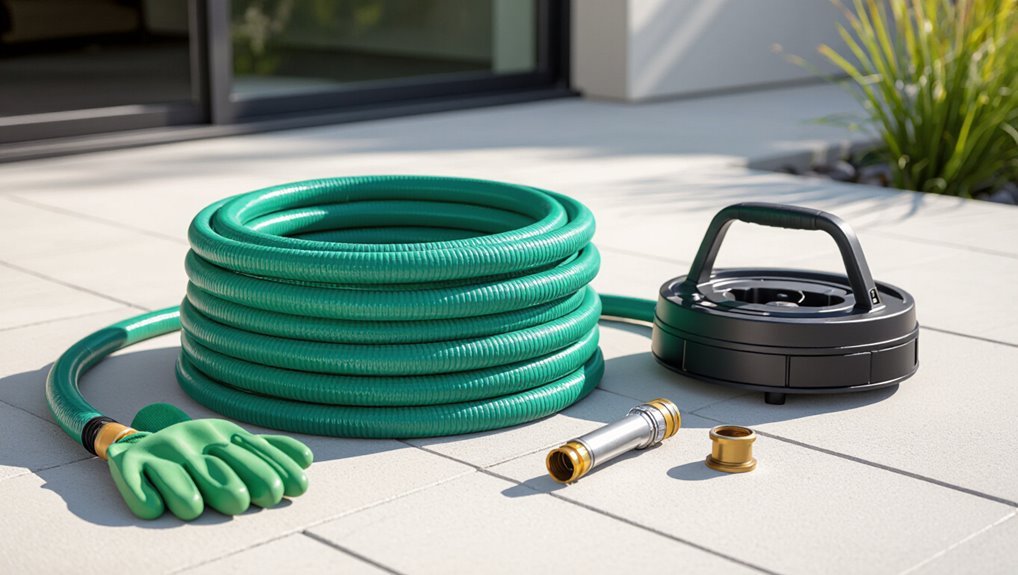
A single, consistent coil around a fixed elbow or hose reel provides a fast, reliable method for keeping a hose neat and tangle-free.
Shorter hoses suit simple wall-mounted hooks or compact reels, while longer hoses benefit from larger reels or figure-eight wraps to prevent kinks.
Choice of method should match hose length and available storage to guarantee quick handling and longevity.
One-sentence method for fast, reliable wrapping
Coil the hose around the arm or a fixed hub with consistent loop size, then tuck the free end under the final wrap to secure it—this single-step technique yields a neat, tangle-free roll that can be deployed quickly.
The method answers how to wrap a hose simply: maintain tension, avoid crossing loops, and use the tuck to lock the bundle for compact, reliable storage and rapid redeployment.
Best option depending on hose length and storage needs
Following the single-step tuck method, choice of wrapping style should be guided by hose length and available storage:
Short hoses (up to ~25 feet) work well with arm or hub coils that keep loops small and secure.
Medium hoses (25–50 feet) benefit from larger, even loops or an over-under technique to prevent kinking.
Long hoses (over 50 feet) are best stored on a reel or folded in figure-eight patterns to avoid tangles and reduce strain.
Compact storage, portability, and access frequency determine the final choice.
Why proper hose wrapping matters
Proper hose wrapping prevents kinks, tangles, and premature wear by keeping the tubing aligned and supported.
It also reduces tripping hazards and saves storage space by allowing hoses to be stowed compactly.
Consistent proper wrapping consequently helps extend a hose’s usable lifespan and maintain reliable performance.
Preventing kinks, tangles, and wear
Maintaining a hose with careful wrapping reduces kinks, tangles, and premature wear by keeping its fibers and internal lining aligned and supported.
Proper coils prevent sharp bends, distribute stress evenly, and minimize friction points that degrade material.
Consistent wrapping techniques and gentle handling reduce microcracks, fittings strain, and localized collapse, extending service life and preserving flow efficiency without introducing unnecessary tension or compression.
Safety and space-saving benefits
Safety and efficiency converge when a hose is wrapped correctly, reducing trip hazards, preventing accidental dislodging, and making storage more compact.
Proper wrapping keeps paths clear, eases handling during transport, and allows stacking or hanging to maximize limited space.
Organized hoses occupy less room in sheds or vehicles, simplify inventory, and speed deployment, enhancing workplace and home safety without sacrificing accessibility.
How wrapping extends hose lifespan
Wrapping a hose correctly reduces kinks, abrasion, and stress on fittings, slowing wear that leads to leaks and failure.
Consistent coiling prevents internal cracking from repeated bending, limits UV and dirt exposure by keeping coils off the ground, and eases inspection and maintenance.
Proper storage reduces strain during transport and prolongs elastic and material integrity, delaying replacement and lowering long-term costs.
Tools and materials needed
A concise inventory of tools and materials sets the stage for effective hose wrapping.
Essential hardware includes hose reels, hangers, and carts for organized storage.
Straps, ties, clips, and protective accessories such as wrap sleeves and storage covers guarantee secure, damage-free coiling.
Hose reels, hangers, and carts
Several durable mounting and storage options suit different yards and routines: wall-mounted reels for permanent stations, free-standing carts for mobility, and simple hangers for minimal fuss.
Each balances capacity, durability, and ease of winding. Consider material, size, and mounting surface when choosing.
- Wall reel — space-saving, fixed.
- Cart — portable, larger capacity.
- Hanger — minimal, inexpensive.
Straps, ties, and clips
Many gardeners keep a small selection of straps, ties, and clips on hand to secure hoses for storage and transport.
Durable options prevent kinks and simplify handling. Consider materials, ease of use, and reusability when selecting fasteners.
- Nylon hook-and-loop straps — adjustable, gentle.
- Rubberized bungee ties — stretchy, shock-absorbing.
- Plastic snap clips — quick, low-profile.
Protective accessories (wrap sleeves, storage covers)
Beyond straps and clips, protective accessories add another layer of care for hoses during storage and transport.
Durable wrap sleeves prevent abrasion, insulated covers guard against freezing, and zippered storage bags block dust and UV.
Recommended tools and materials:
- Neoprene or nylon wrap sleeves sized to hose diameter.
- Padded storage covers with ventilation.
- Heavy-duty zip bags for coiled hoses.
Preparatory steps before wrapping
Before wrapping begins, the hose should be completely drained and allowed to dry to prevent mold and freezing.
It should be inspected for cuts, leaks, and embedded debris, and cleaned as needed.
Finally, an appropriate storage location and mounting height should be selected to keep the hose accessible and off the ground.
Drain and dry the hose completely
Drain all remaining water from the hose and allow it to air-dry completely to prevent mold, reduce weight, and guarantee the wrapping material adheres properly.
Elevate one end, open faucets or detach fittings to expel water.
Leave the hose coiled loosely in sun or a ventilated area until fully dry.
Confirm no moisture remains before proceeding to wrap for storage or transport.
Inspect for damage and clean debris
Inspect the hose thoroughly for cracks, kinks, splits, bulges, worn spots, or damaged fittings that could worsen in storage or during transport.
Next, remove dirt, sand, plant material, and insect nests from the exterior and couplings using a soft brush and cloth.
Rinse persistent grime, allow complete drying, and replace or mark compromised sections for repair or retirement before wrapping.
Choose the right storage location and mounting height
Choosing an appropriate storage location and mounting height guarantees the hose remains protected, accessible, and free from stress that causes kinks or premature wear.
Select a shaded, dry spot away from direct sunlight, chemicals, and sharp objects.
Mount at waist to chest height for ergonomic wrapping and unrolling.
Confirm secure brackets or reels, proper clearance, and gentle bends to preserve hose integrity and extend service life.
Step-by-step wrapping methods
The section outlines several practical wrapping methods suited to different hoses and storage needs.
It compares the over-under coil to prevent twists, the figure-eight for long hoses and transport, and the traditional clockwise coil for quick garden storage.
It also covers mechanical options—loading and securing on a reel or cart and using a wall-mounted hanger for yard or garage organization.
Over-under coil method for preventing twists
Begin by holding the hose end and alternating loops formed overhand and underhand to create an over-under coil that naturally cancels kinks and twists.
Continue maintaining consistent loop size, keeping tension gentle to avoid stretching. Complete coils stack neatly; secure with a strap or hook.
To deploy, reverse the sequence, pulling smooth loops free to prevent snags and preserve hose integrity.
Figure-eight wrap for long hoses and transport
Coil the hose in a controlled figure-eight pattern to prevent kinks and distribute weight evenly for transport.
The person forms alternating loops across a central axis, keeping tension moderate and bends broad.
Secure the center with a strap or bungee, leaving couplings accessible.
This method reduces twisting on long lengths, balances load for carrying, and fits compactly in vehicle or trailer.
Traditional clockwise coil for quick garden storage
Wind the hose clockwise into evenly sized loops, keeping each turn flat and snug against the previous one to prevent twists and allow quick deployment.
Maintain consistent loop diameter, work from the nozzle toward the spigot, and smooth kinks as they arise.
Secure the coil with a hook, strap, or Velcro.
Store off the ground, shaded and drained to extend hose life.
Using a hose reel or cart: loading and securing
After forming a tidy clockwise coil for quick storage, shifting the hose onto a reel or cart offers faster deployment and better protection.
The user feeds the coil onto the drum, ensuring even layers to prevent kinks. Secure the hose at the reel’s clip or strap, fasten the cart’s latch, and test the crank or handle for smooth retraction before moving or storing.
Wall-mounted hanger technique for yard or garage storage
Mount a sturdy hanger at a comfortable height on a wall in the yard or garage, then drape the hose in even loops to prevent kinks and strain.
Align loops so weight distributes evenly, securing the end to the hanger or nearby hook.
Check fittings for tightness, keep hanger clear of sharp edges, and position away from sun exposure to prolong hose life and maintain readiness.
Wrapping techniques by hose type and use
Different hose materials and purposes call for specific wrapping approaches to protect function and prolong life.
Lightweight vinyl hoses benefit from loose coils to prevent kinks, while heavy-duty rubber hoses require larger, steady loops to avoid memory and stress.
Soaker and flat hoses are best folded flat or rolled without tight bends, and air/pressure hoses should be coiled with attention to fittings and gradual curves to prevent internal damage.
Lightweight vinyl hoses
When handling lightweight vinyl hoses, users should choose wraps that protect the material without compressing it; vinyl flexes easily and can crease or kink if bound too tightly.
Coil loosely with large-radius loops, secure with soft straps or Velcro that won’t indent, and store off the ground away from heat and sunlight.
Inspect for microcracks before each use and avoid sharp bends.
Heavy-duty rubber hoses
Moving from lightweight vinyl to heavy-duty rubber requires adjusting wrapping technique to account for greater weight, stiffness, and resistance to kinking.
Heavy rubber benefits from wider, looser coils to reduce stress and allow easy unspooling.
Use two-handed support when lifting long lengths, secure with straps or Velcro to prevent sag, and store on sturdy reels or wall brackets to protect fittings and preserve shape.
Soaker and flat hoses
Soaker and flat hoses require a gentler, flatter wrapping approach than round garden hoses to prevent creasing and preserve even water flow.
Lay them flat, remove kinks, and fold in wide, even loops or roll into a loose flat coil.
Secure with soft ties or straps, avoid tight bends, store unstacked to dry fully and prevent mildew or permanent folds.
Air and pressure hoses (compressor hoses)
After explaining flat hose care, attention shifts to air and pressure hoses used with compressors, which demand different handling to protect fittings and maintain safe operation.
Coil using large loops to avoid kinks, secure ends with clips or Velcro, and keep fittings elevated and capped.
Store away from heat and chemicals, inspect for wear before use, and replace damaged hoses promptly.
Packing and transporting hoses without tangles
Proper packing and transport begin with securing coils for vehicle travel to prevent shifting and snags.
For long-distance moves, carrying methods that balance support and flexibility reduce strain and the chance of kinks.
Hose fittings should be protected with caps or padding and fastened to avoid impact damage.
Securing coils for vehicle transport
Begin by coiling the hose in uniform loops of consistent diameter to prevent kinks and uneven weight distribution during transit.
Secure coils with two straps—one near each end of the bundle—and add a third center strap for long lengths.
Place the bundle flat, restrained against movement with non-slip matting, and avoid stacking heavy items atop the hose to prevent crushing and deformation.
Carrying methods for long-distance moves
For long-distance moves, the hose should be packed to minimize movement, abrasion, and tangling by coiling it into consistent, stacked bundles or winding it onto a rigid reel. Each bundle is then secured with durable straps or cable ties and placed in a labeled, cushioned container to prevent shifting during transit.
Handlers should lift containers with proper equipment, stack evenly, and secure them inside transport to avoid compression or rolling.
Protecting hose fittings during transport
Secure hose fittings before transport to prevent damage, contamination, and leaks by covering them with protective caps, plugs, or sleeves and fastening these with tape or shrink-wrap to keep them in place.
Use labeled, resealable bags for small fittings, cushion sharp edges with foam, and separate different sizes to avoid cross-threading.
Inspect seals after unloading and replace compromised covers promptly.
Common mistakes and how to avoid them
Common errors in hose handling include tight coils that introduce kinks, storing hoses with residual water or under tension, and using fasteners that cut or deform the material.
Each mistake shortens hose life and impairs performance if not corrected. The following guidance explains how to prevent these issues with minimal effort.
Tight coils that cause kinks
Tightly coiling a hose may seem space-saving, but it often creates sharp bends that pinch the inner lining and lead to kinks.
Repeated tight loops weaken reinforcement layers, reduce flow, and shorten service life. To avoid damage, use larger-radius coils, gentle overlapping, or a reel.
Inspect for initial kinks and reshape coils before storage to prevent permanent deformation.
Storing hoses under tension or with water inside
Avoid leaving a hose coiled under tension or with water trapped inside, since both practices accelerate wear and can cause burst fittings, mildew, and permanent deformation.
Store hoses drained, depressurized, and loosely looped on wide-diameter reels or hanging hooks. Allow full drying before winter storage.
Inspect for soft spots and fittings after storage. Relieve tension during transport to preserve flexibility and seals.
Using improper fasteners that cut or deform the hose
Using the wrong clamps, zip ties, or sharp-edged brackets can pinch, abrade, or permanently deform a hose, shortening its service life and causing leaks.
Inspect fasteners for smooth edges, use wide straps or padded clips, and opt for reusable, adjustable ties.
Replace metal brackets with cushioned mounts where possible.
Periodic checks prevent unnoticed damage and extend hose longevity.
Maintenance and seasonal care
Maintenance and seasonal care focuses on preserving hose performance between uses.
It covers winterizing by draining and storing hoses indoors, routine inspections and simple repairs, and cleaning or conditioning to prevent stiffness.
Following these steps extends hose life and reduces the need for replacements.
Winterizing hoses: draining and storing indoors
Before temperatures drop below freezing, the hose should be completely drained and coiled for indoor storage to prevent water expansion from causing cracks or burst fittings.
After disconnecting, open both ends to expel remaining water, hang briefly to finish draining, then coil loosely without tight bends.
Store in a cool, dry area away from direct heat, elevated off concrete to reduce moisture exposure.
Periodic inspections and minor repairs
After winter storage and before returning the hose to regular use, a quick inspection helps catch wear that could cause leaks or failure.
The owner should check fittings, crimps, and the entire length for cracks, bulges, or soft spots.
Tighten or replace loose connectors, apply thread sealant where needed, and splice small cuts with approved repair kits to restore safe service.
Cleaning and conditioning to prevent stiffness
Clean and condition the hose to keep the material flexible and extend service life: wash the exterior with mild soap and water to remove dirt, oils, and mineral deposits, rinse thoroughly, then dry completely before storage.
Apply a silicone-based conditioner or commercial rubber protectant sparingly, allow it to penetrate, wipe off excess, and store away from heat and UV to prevent cracking and stiffening.
Quick-reference comparison of storage options
A concise comparison helps readers choose between a reel, a hanger, and a cart based on space, hose length, and mobility needs. The table below summarizes key pros, cons, and best use cases to guide selection. Following that, brief notes highlight when each option is most practical.
| Option | Pros | Best Use Case |
|---|---|---|
| Reel | Neat, protects hose, can be manual or automatic | Fixed outdoor spigot with frequent use |
| Hanger | Inexpensive, space-saving, easy access | Short hoses on walls or under eaves |
| Cart | Portable, holds long hoses, easy to maneuver | Large gardens or multiple watering zones |
| Cons | Cost/maintenance (reel), limited length (hanger), bulk/storage (cart) | Choose by budget, hose length, and mobility needs |
Reel vs. hanger vs. cart: pros, cons, and best use cases
Choosing between a reel, hanger, or cart depends on yard size, hose length, frequency of use, and storage location.
Reels offer neat, tangle-free winding and fast deployment but cost more and may require mounting.
Hangers are inexpensive, space-saving, and suit short hoses; they can cause kinks if overlapped.
Carts transport long hoses easily and reduce wear but are bulkier and pricier.
Tips for choosing the right solution for your setup
Selection should start with yard size and how often the hose is used, since small spaces and occasional watering suit simple coiled storage while large or daily use benefits from more robust systems.
Budget-friendly DIY options can cover many needs with minimal cost, but durability and convenience should be weighed against time invested.
Upgrading to a reel or professional system is recommended when frequent use, longer hose lengths, or strain on connections make simpler solutions impractical.
Matching storage to yard size and frequency of use
When yard size and frequency of hose use are considered together, they determine which storage option will be practical and durable. Small urban plots with occasional watering need compact, low-cost solutions, while large lawns or daily irrigation routines require higher-capacity, weatherproof systems that speed deployment and reduce wear.
Select capacity for hose length, mounting for accessibility, and materials that resist UV and moisture for longevity.
Budget-friendly DIY options
How can a homeowner get durable, space-efficient hose storage without spending much?
Simple DIY options include wall-mounted brackets from scrap wood, PVC pipe cradles, and repurposed cable spools.
Choose materials resistant to moisture and UV, size holders to hose length, and add a swiveling hook or cleat for easy winding.
Prioritize secure mounting and minimal tools for cost efficiency.
When to upgrade to a reel or professional system
At what point does a simple DIY holder stop being enough and a reel or professional system become the smarter investment? Frequent use, heavy or long hoses, limited storage space, or safety concerns justify upgrading.
Choose based on hose length, diameter, mounting needs, rewind type (manual, spring, motorized), durability, and budget.
Commercial reels save time, reduce wear, and improve organization for intensive or professional tasks.
Short troubleshooting guide for wrapped hoses
A brief troubleshooting guide addresses common issues with wrapped hoses, including methods to untangle stubborn knots without causing abrasion or cutting.
It also outlines ways to fix kinks and restore flexibility through gentle heating and bending techniques.
Guidance on evaluating damage and replacing compromised sections or fittings is provided to guarantee safe, reliable operation.
Untangling stubborn knots without damage
Loosen tight coils gently to locate the core tangle before applying force; identifying the knot’s center reduces stress on the hose and prevents kinks.
Work from the knot outward, easing loops apart with fingers rather than pulling. Use a blunt tool to nudge stubborn crossings, supporting adjacent sections to avoid stretching.
Repeat patiently until free, then retake the wrap to guarantee even tension.
Fixing kinks and restoring flexibility
Restore a hose’s suppleness by addressing kinks promptly and methodically.
Inspect wrapped lengths for bends, then straighten by hand and run warm water through the hose to relax material.
For stubborn kinks, gently flex sections back and forth and lay the hose in sunlight or near warm air to soften.
Rewrap loosely to prevent recurrence and test flow before storing.
Replacing damaged sections or fittings
When a hose shows visible damage or fittings leak despite basic adjustments, the next step is to isolate and replace the affected section or connector.
Identify leak origin, depressurize, and cut back to undamaged hose. Use compatible fittings and clamps, then test under pressure for integrity.
- Remove damaged segment
- Install correct connector
- Pressure-test for leaks
Conclusion
Neatly nestled, the nimble nozzle knows no knots: careful coiling conserves space, curbs clutter, and curtails kinks. Bright buckles, brackets, or basic baskets bring balance between backyard bustle and blissful order. Seasonal scrubs, simple swaps, and smart storage sustain serviceable, supple spirals. Confidently chosen contraptions complement garden goals, cultivating calm corners and carefree carrying. Ultimately, consistent care and cautious coiling create clutterless convenience that keeps hoses happy, handy, and humming.