
How to Turn Off Temporary Hold on a Carrier Thermostat Quickly and Safely
To quickly and safely turn off a temporary hold on a Carrier thermostat, simply press the Hold or Cancel button on the device, or tap Cancel in the menu or app. This action will immediately restore your programmed schedule, which you can confirm on the display. For touchscreen or Wi-Fi models, navigate to the settings or schedule area; older units may require pressing RUN or MODE to exit hold. Ensure the display and app indicate that the schedule is active, and check your connectivity if issues arise. Follow the troubleshooting steps below for further assistance.
How to Turn Off Temporary Hold on a Carrier Thermostat Quickly and Safely
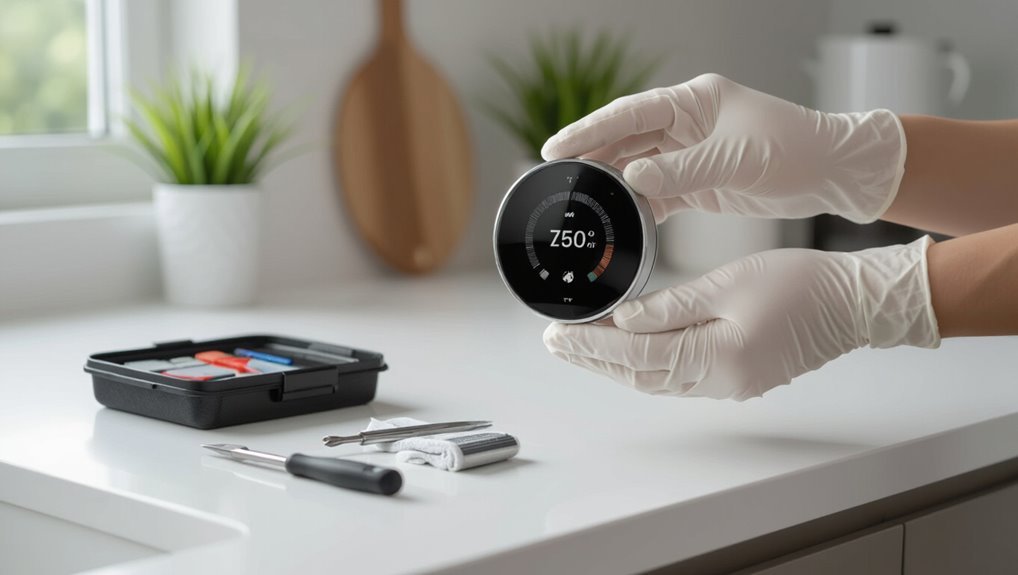
A Carrier thermostat’s temporary hold can usually be canceled immediately using a single on-screen command, providing a fast way to return the system to scheduled control.
This quick one-step method is ideal when an immediate revert is needed and no other settings require adjustment.
For persistent issues or planned schedule changes, a full settings update is the safer and more appropriate approach.
Quick one-step method to cancel a temporary hold right now
Press the thermostat’s Hold or Cancel button once to immediately clear a temporary hold and return the unit to its scheduled program.
This simple action shows how to turn off temporary hold on Carrier thermostat models that support a single-step cancel. No menu navigation or password is needed; the display confirms schedule resumption.
Use it when an immediate return to programmed settings is desired.
When to use the quick method vs. a full settings change
After using the one-button Hold or Cancel option to immediately resume the schedule, users should assess whether a simple cancel suffices or if a deliberate settings change is needed.
The quick method fits brief, temporary overrides or immediate comfort restoration. A full settings change is appropriate for repeated adjustments, new occupancy patterns, energy savings goals, or when programming precise temperature ranges and hold durations.
What Temporary Hold means on Carrier thermostats
Temporary hold overrides the thermostat’s programmed schedule for a single period, unlike permanent hold which replaces the schedule until manually changed.
Scheduled mode follows preset setpoints automatically. It applies the selected temperature setpoint immediately and can suspend or resume heating, cooling, and the fan based on that target.
The distinction helps users understand whether the system will revert to the programmed routine or remain at the chosen setting.
Difference between temporary hold, permanent hold, and scheduled mode
A hold on a Carrier thermostat suspends the programmed schedule to maintain a chosen temperature, but the type of hold determines its duration and how the system returns to the schedule.
Temporary hold keeps one setting until manually cleared or next schedule event.
Permanent hold locks a temperature indefinitely until manually canceled.
Scheduled mode follows preset time and temperature changes automatically.
How temporary hold affects heating, cooling, and fan operation
Engaging a temporary hold on a Carrier thermostat overrides the programmed schedule to maintain the selected temperature until the next scheduled event or manual cancellation.
Heating, cooling, and fan responses follow that setpoint: heat or cool cycles run as needed to reach it.
Fan behavior may remain auto or follow the chosen fan mode.
Normal scheduling resumes afterward without permanent changes.
Identify your Carrier thermostat model and interface
The reader should first identify which Carrier thermostat they have—common types include digital touchscreens, Wi‑Fi models, and basic non‑Wi‑Fi units.
The model number is usually printed on the back of the thermostat or inside the battery compartment; checking this number helps locate the correct user guide.
Noting any firmware or software version (for Wi‑Fi models) can clarify available settings and menu layouts.
Common Carrier thermostat models (digital touchscreen, Wi’Fi, non’Wi’Fi)
When identifying a Carrier thermostat, homeowners should first note the physical interface—digital touchscreen, Wi‑Fi-enabled display, or basic non‑Wi‑Fi keypad—because each model presents hold settings and temporary hold controls differently.
- Digital touchscreens: menu-driven, visible hold icons
- Wi‑Fi models: app and on‑device hold sync
- Non‑Wi‑Fi keypads: manual buttons, simpler hold toggles
- Hybrid displays: limited touch plus button controls
How to find model number and firmware basics
How can a homeowner quickly confirm which Carrier thermostat model they have and whether its firmware is current?
Inspect the device label—remove the faceplate if needed—to find the model number and revision.
For Wi‑Fi units, check settings or the companion app for firmware/version info.
Cross‑reference Carrier support pages or contact customer service to verify latest firmware and upgrade instructions before making changes.
Step-by-step instructions for different Carrier thermostat types
The article now outlines precise, model-specific steps for ending a temporary hold across Carrier thermostats.
It will cover digital touchscreen units with button locations, Wi‑Fi models including both on‑device and mobile app cancellation, and older non‑touch units with physical buttons or dials.
Instructions for locked or restricted‑access models will explain how to disable a hold when controls are secured.
Digital touchscreen Carrier thermostats steps with button locations
Begin by identifying the specific Carrier touchscreen model and locating its main controls—typically a central display, a Menu or Settings icon, and dedicated Hold or Schedule buttons—so the steps that follow map precisely to the thermostat’s layout.
Tap Menu or Settings, select Schedule, then choose Cancel Hold or Resume Schedule.
Confirm changes, exit settings, and verify temperature control returns to programmed schedule.
Carrier Wi’Fi thermostats (including app-based cancel) steps for device and mobile app
When dealing with Carrier Wi‑Fi thermostats, whether canceling a temporary hold directly on the touchscreen or via the Carrier app, users should first confirm the exact model and connection status so the correct procedure is followed.
On-device: open Settings or Hold menu, select Cancel Hold or End Temporary.
In app: choose thermostat, tap Hold/Mode, select Cancel or Resume Schedule, then confirm and verify temperature control returns to schedule.
Older non-touch Carrier thermostats physical buttons and dial instructions
Older non-touch Carrier thermostats use a mix of push buttons, sliders, and rotary dials to set or cancel temporary holds; identifying the model and control layout first helps determine the exact button sequence.
Common steps: press MODE or FAN to wake display, use UP/DOWN or dial to restore schedule temperature, then press RUN or HOLD to clear temporary hold.
Confirm by watching mode indicator.
Lock or restricted access models how to disable hold when controls are locked
Access to locked or restricted Carrier thermostats requires a few specific steps depending on the model and lock type; releasing or clearing a temporary hold typically involves entering a PIN, holding a combination of buttons, or using the installer/service menu.
Consult model documentation, then: enter the administrator PIN, press and hold Menu+Up for five seconds, or navigate to Installer Options → Lock/Unlock → Clear Hold.
If unsuccessful, power-cycle and retry.
How to cancel a temporary hold using the Carrier mobile app or thermostat portal
The Carrier mobile app and thermostat portal provide menus to view any active temporary holds and their scheduled end times.
From these interfaces, a user can cancel a hold remotely and should receive onscreen confirmation that the change has been applied.
If the portal shows the cancellation but the wall thermostat does not update, standard troubleshooting steps include reloading the app, checking Wi‑Fi connection, and restarting the thermostat or app to force a sync.
Navigating the app to locate active holds
One common task when managing a Carrier thermostat is locating and canceling any active temporary holds through the mobile app or web portal.
Users should open the app, sign in, and select the thermostat.
Navigate to the schedule or hold section, where active holds are listed with start, end, and temperature.
Identify the hold to remove and use the provided cancel or clear option.
Cancelling holds remotely and confirming changes
To cancel a temporary hold remotely, the user signs into the Carrier mobile app or web portal, selects the targeted thermostat, and opens the schedule or hold settings to view active holds.
They tap the specific hold, choose “Cancel” or “Resume Schedule,” confirm the action, and await an on‑screen confirmation. A status update or timestamp verifies the change completed successfully.
Troubleshooting if app changes don’t sync with thermostat
If app changes fail to reach the Carrier thermostat, users should first verify connectivity and account linkage before retrying the cancel-hold command; lost sync typically stems from Wi‑Fi dropout, hub issues, or expired session tokens.
Then reboot the thermostat and router, relog into the app, confirm firmware and app updates, and resend the cancel-hold.
Contact Carrier support with device ID if problems persist.
How to verify the hold is successfully removed
After cancelling the temporary hold, the user should check the thermostat display for schedule recovery indicators (such as a “Run Schedule” message or the next programmed setpoint) and absence of a hold icon.
They can then perform quick tests by adjusting the setpoint briefly or forcing a mode change to confirm the HVAC responds as expected.
If the display returns to scheduled setpoints and the system reacts to test changes, the hold has been successfully removed.
What display indicators to check on the thermostat
How can a user confirm the temporary hold is cleared by reading the thermostat display? The display should show current mode (Heat/Cool/Auto), ambient temperature, and the scheduled target temperature rather than a “Hold” or “Temporary” indicator.
Absence of a locked-padlock icon and removal of any colored hold banner confirm release.
Check for resume-to-schedule or next scheduled time to verify.
Testing system response after cancelling hold (quick tests)
Run a few quick checks to confirm the hold is cleared and the system responds to the schedule: set the thermostat to the next scheduled temperature and listen for the system to kick on or off within a minute or two.
Observe the mode and target temperature updating on the display to match the schedule, and verify that room temperature trends toward the setpoint over the following 5–15 minutes.
Absence of constant fan operation, hold banners, or a locked-padlock icon during these steps indicates the temporary hold was successfully removed.
Then confirm remotely (if applicable) via the app, and note any discrepancies for troubleshooting.
Common problems and how to fix them
Common issues when cancelling a temporary hold include an unresponsive or frozen thermostat, holds that reappear after being cancelled, and changes caused by power outages, dead batteries, or resets.
Each problem has specific troubleshooting steps, such as rebooting the unit, checking battery and power connections, and verifying software or schedule settings.
The following section explains likely causes and clear fixes for these scenarios.
Thermostat not responding or frozen during cancel attempt
When a Carrier thermostat becomes unresponsive or appears frozen while attempting to cancel a temporary hold, it typically indicates a software glitch, depleted batteries, or a hardware fault that interrupts input processing.
Troubleshooting steps include replacing batteries, performing a soft reset via the menu or power cycle, checking wiring and display connections, and updating firmware when available.
Contact support if the unit remains nonresponsive.
Hold reappears after cancelling causes and fixes
If cancelling a temporary hold resolves an unresponsive display but the hold returns shortly after, the thermostat is likely reverting to a scheduled program, sensing an active remote control source, or experiencing a software or communication error.
Check schedule settings, disable remote or app controls temporarily, guarantee Wi‑Fi or hub connectivity is stable, and update firmware.
Replace faulty wiring or contact support if issues persist.
Power outages, batteries, and reset impacts on hold settings
Although brief power interruptions and battery failures may seem minor, they can reset temporary holds, revert thermostats to schedule mode, or leave the device stuck displaying a hold state.
Users should check battery level, replace cells with recommended types, and power-cycle the unit.
If holds persist, perform a soft reset per Carrier instructions, verify schedule settings, and contact support before a factory reset to avoid lost configurations.
Safety precautions before changing thermostat settings
Before adjusting the Carrier thermostat, the technician or homeowner should consider whether to switch off HVAC system power to prevent electrical hazards and inadvertent compressor starts.
Power should be cut when accessing wiring or internal controls, but routine mode changes at the thermostat typically do not require turning the system off.
Taking this precaution minimizes the risk of equipment damage and prevents sudden temperature or comfort disruptions.
When to turn off HVAC system power first
When working on a Carrier thermostat, power to the HVAC system should be cut before touching any wiring or internal components to prevent electrical shock and avoid damaging the control board.
Power should be switched off at the thermostat breaker or the system’s service switch, confirming with a multimeter or voltage tester.
Wait several minutes for capacitors to discharge before proceeding.
Avoiding damage to HVAC equipment and comfort issues
Exercise caution to prevent damage to HVAC equipment and maintain indoor comfort when changing thermostat settings.
Technicians and homeowners should adjust setpoints gradually, avoid rapid cycling, and confirm system compatibility with new commands.
Check filters, vents, and condensate lines before modifications.
Monitor system response for unusual noises or performance drops, and consult a professional if errors or persistent comfort issues occur.
Preventing unintended temporary holds
To prevent unintended temporary holds, the article recommends refining regular schedules so manual overrides are needed less often and using vacation modes or smart schedules for predictable absences.
It also suggests creating separate user profiles to limit who can set holds and when.
Finally, it contrasts selectively locking critical settings with allowing general household access to balance control and convenience.
How to adjust schedules to reduce reliance on temporary holds
Review the thermostat’s weekly schedule to identify frequent gaps that prompt users to apply temporary holds.
Adjust setpoints and time blocks to better match habitual occupancy patterns, shortening shifts and eliminating unnecessary off periods.
Create modest comfort bands to tolerate brief absences without holds.
Test changes for a week, then fine-tune start times and temperatures to minimize future manual overrides.
Using user profiles, vacation modes, and smart schedules
When occupants set up distinct user profiles, enable vacation modes, and adopt smart schedules, the thermostat can automatically apply appropriate setpoints without resorting to temporary holds.
Profiles tailor temperature limits per person; vacation mode freezes efficient settings during absences; smart schedules learn patterns and switch modes proactively.
Combined, these features reduce accidental temporary holds, maintain comfort, and preserve energy without manual intervention.
Locking settings vs. allowing household access
Although household members value easy access to comfort controls, balancing open access with locked settings prevents accidental temporary holds that disrupt schedules and waste energy.
Careful restriction—pin locks, restricted touchscreen menus, or app-based permissions—lets administrators maintain schedules while permitting necessary adjustments.
Clear household rules and occasional remote overrides reduce conflicts, preserve efficiency, and guarantee temporary holds remain intentional rather than accidental.
When to contact professional support
If the thermostat displays error codes, the HVAC system cycles erratically, or the home loses consistent temperature control, professional service should be considered.
When contacting Carrier support or an HVAC technician, the homeowner should provide the model number, firmware/version if available, a description of the symptoms, any displayed error codes, and recent actions taken (such as attempts to cancel a temporary hold).
Clear, concise information helps the technician diagnose the issue more quickly.
Signs the thermostat or HVAC system needs technician service
Recognize persistent or unusual problems that go beyond simple user fixes—frequent unexplained cycling, failure to reach set temperatures, erratic touchscreen or connectivity behavior, unusual noises from the HVAC equipment, water leaks or ice buildup, and repeated error codes or system lockouts all indicate the need for professional service.
Immediate technician evaluation is warranted when problems recur, safety risks appear, or basic troubleshooting fails to restore reliable, efficient operation.
What information to provide when calling Carrier support or an HVAC pro
When recurring issues or safety concerns persist despite basic troubleshooting, contacting Carrier support or a qualified HVAC technician is the next step.
Provide clear details to speed diagnosis and repair.
- Thermostat model, firmware version, and installation date
- Exact error messages, blinking LEDs, or warning codes
- Recent troubleshooting steps taken and results
- Date/time and description of symptom occurrences
Quick reference cheat sheet
A concise checklist lists the exact button sequence to cancel a temporary hold for each Carrier thermostat model, enabling quick action without scrolling manuals.
It also highlights common troubleshooting fixes—such as power-cycle, restoring defaults, or checking for active schedules—if the hold will not clear.
Readers are encouraged to use the checklist first and follow the troubleshooting tips only if the simple steps fail.
Short step checklist for cancelling temporary hold by model
Consult the model-specific checklist below to cancel a temporary hold quickly; each entry lists the minimal button presses or touchscreen taps needed to revert to schedule mode for common Carrier thermostat models. Follow the model row, action, confirmation steps precisely.
| Model | Action | Confirm |
|---|---|---|
| Home | Menu → Hold Off | Schedule shown |
| Wi‑Fi | Hold → Cancel | Auto returns |
| Touch | Tap Hold → Resume | Icon clears |
| Pro | Mode → Resume | Schedule active |
Troubleshooting quick fixes
Start with the simplest checks to resolve most temporary-hold issues quickly: verify the thermostat display shows hold or manual mode, confirm the schedule is enabled in settings, guarantee the system is in the correct mode (heat/cool/auto), and power-cycle the thermostat if it is unresponsive.
- Check batteries and wiring connections.
- Restore default schedule if corrupted.
- Update thermostat firmware.
- Inspect HVAC system power and breakers.
Conclusion
In conclusion, disabling a temporary hold on a Carrier thermostat restores scheduled control swiftly and safely, like sliding a key back into a lock to reopen routine. Users should confirm model type, follow the model-specific steps or app/portal process, observe safety checks, and avoid accidental holds by adjusting permissions or schedule settings. If issues persist, contact professional support for diagnostics to guarantee system integrity and comfort continuity.
