How to Find the UEF on Your Water Heater: Step-by-Step Guide
To find the UEF (Uniform Energy Factor) on your water heater, look for the data plate or manufacturer label, where it is listed as a decimal value indicating the unit’s efficiency. Inspect all sides of the heater for this label, and make sure to note the model and serial numbers, taking a photograph for your records. If the plate is missing or hard to read, you can look up the model number on the manufacturer’s website or access archived spec sheets. Alternatively, contacting customer support can provide assistance. If necessary, you can estimate the UEF based on the water heater’s age, fuel type, and insulation. Further steps will guide you on verification and possible upgrade options.
What UEF Means and Why It Matters for Your Water Heater
The Uniform Energy Factor (UEF) is a standardized measure of a water heater’s efficiency, expressing the fraction of fuel converted into usable hot water.
Higher UEF ratings correspond to lower energy consumption and reduced operating costs over the appliance’s lifetime.
UEF also ties into regulatory efficiency standards and labeling that influence purchase decisions and compliance requirements.
Definition of UEF (Uniform Energy Factor)
Uniform Energy Factor (UEF) quantifies a water heater’s overall efficiency by measuring how well it converts fuel into usable hot water while accounting for standby and cycling losses.
The UEF is a standardized rating allowing comparisons across models, fuel types, and sizes.
Homeowners checking labels or manuals learn how to find UEF on water heater for informed replacement or selection decisions.
How UEF Affects Energy Use and Operating Costs
After locating a water heater’s UEF on its label or manual, homeowners can use that number to predict how much energy the appliance will consume and what it will cost to operate.
A higher UEF indicates greater efficiency, reducing fuel or electricity use per gallon of heated water.
Comparing UEFs helps estimate annual energy consumption and operating expenses for informed purchasing and budgeting decisions.
Regulatory and efficiency standards related to UEF
Manufacturers, regulators, and consumers rely on the Uniform Energy Factor (UEF) as a standardized metric that links appliance design to federal and state efficiency rules.
UEF determines compliance with Department of Energy standards, influences ENERGY STAR qualification, and guides rebate eligibility.
Policymakers use UEF thresholds to phase out inefficient models, while utilities and contractors reference it for incentive programs and consumer guidance.
Quick Way to Locate the UEF on Your Water Heater
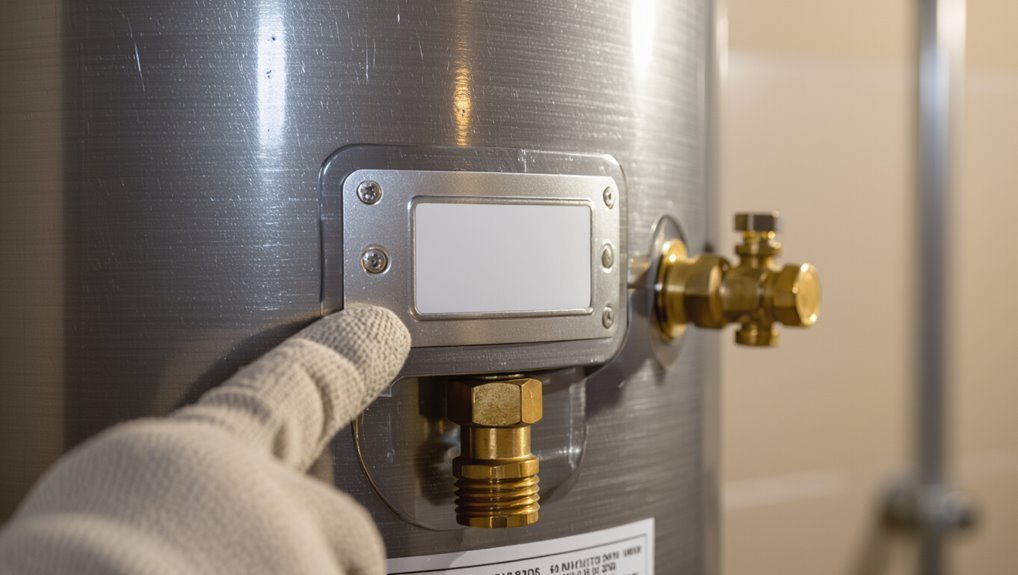
The easiest place to find the UEF is on the water heater’s data plate or manufacturer label, usually near the model and serial number.
The UEF is listed as a numeric value and may appear alongside older metrics like EF or an Energy Star badge, so readers should compare labels to spot the UEF specifically.
Examples of common label layouts include a compact table with “UEF” in a column, an emissions/efficiency block, or an attached yellow EnergyGuide sticker that highlights comparable energy figures.
Where to look on the water heater label or data plate
Finding the UEF on a water heater starts with examining the appliance’s label or data plate, typically mounted on the side or front near the top or control area.
Inspect the plate for sections labeled “Performance,” “Ratings,” or “Efficiency.” The UEF typically appears near capacity and recovery specs, printed as a decimal (e.g., 0.92).
Check both metal plate and adhesive stickers.
How UEF is displayed versus other efficiency metrics (EF, Energy Star)
After locating the data plate, it helps to know how UEF appears relative to older or alternative efficiency labels.
The UEF is shown as a numeric value (e.g., 0.88) labeled “UEF” or “Uniform Energy Factor.”
Older EF values may appear nearby; they use different scales.
Energy Star presence is indicated by a logo or note, not a UEF number, so both can coexist on the plate.
Visual examples of common label layouts
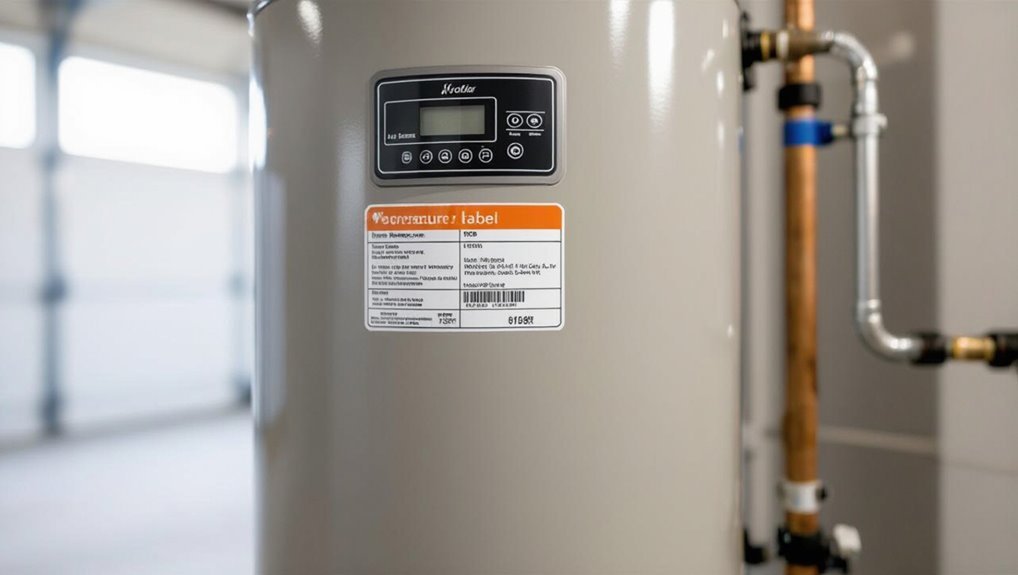
When inspecting common water heater labels, readers will typically see a compact block containing model information, capacity, and one or two efficiency figures—UEF is usually set apart with a clear label like “UEF” or “Uniform Energy Factor” and a decimal value (for example, 0.88).
While older EF numbers or Energy Star logos appear nearby but use different formats or icons.
Visual layouts often group UEF near annual energy use.
Step-by-Step Guide to Finding the UEF Physically
Before inspecting a water heater, the reader is advised to gather basic tools and follow safety precautions such as shutting off power or gas and wearing gloves.
The inspection should include checking data plates on the front, sides, and back, consulting the user manual or manufacturer documentation, and noting differences between gas, electric, and heat pump models.
These steps prepare the reader to locate the UEF and record the correct model-specific information.
Tools and safety precautions before inspecting the unit
Gather the necessary tools and observe safety precautions to guarantee a secure, efficient inspection of the water heater.
Recommended tools include a flashlight, gloves, safety goggles, non-contact voltage tester, adjustable wrench, and a small mirror.
Shut off power and water supply, allow the tank to cool, ventilate the area, and use a buddy or notify household members before starting.
Inspecting the front, side, and back data plates
Start by visually scanning the heater’s accessible faces—front, both sides, and the back—for metal or adhesive data plates and labels that list model, serial number, and efficiency ratings.
Note any UEF, EF, or ENERGY STAR markings. Photograph plates for clarity, record printed numbers, and check smaller stickers near controls or burners.
Wipe away dust to reveal faded print before leaving.
Checking the user manual and manufacturer documentation
Consulting the user manual and manufacturer documentation provides a reliable route to the Uniform Energy Factor (UEF) when the data plates are missing or unclear.
Manuals, spec sheets, and online product pages often list UEF or efficiency ratings. Model and serial numbers help verify matches.
If documentation lacks UEF, contact manufacturer support with those numbers for confirmation and downloadable technical sheets.
Finding UEF for gas vs. electric vs. heat pump models
If the manual or manufacturer cannot provide a clear UEF, a physical inspection of the water heater can often reveal the needed information—methods differ by fuel and technology.
For gas units, inspect the data plate for standby loss and combustion efficiency codes.
For electric models, check element wattage and tank insulation R‑value.
For heat pump heaters, note COP ratings and supplemental resistance details to estimate UEF.
How to Find UEF if the Label Is Missing or Illegible
If the appliance label is missing or unreadable, the owner can use the model and serial numbers to search manufacturer databases for efficiency specs.
Archived product spec sheets and catalogs available online often list UEF values for older units.
When online resources fail, contacting manufacturer support with photos and the serial/model information usually yields the UEF or guidance.
Using model and serial numbers to search manufacturer databases
Model and serial numbers provide a direct route to a water heater’s original specifications when the UEF label is missing or unreadable.
Entering these identifiers on the manufacturer’s website or contacting support often yields the model’s UEF, capacity, and production date.
Record the exact formatting, include any prefix or suffix, and retain manufacturer responses for verification and future reference.
Looking up archived product spec sheets online
Several online archives and manufacturer PDF libraries host past product spec sheets that often list the Uniform Energy Factor (UEF) even when the unit’s label is missing or illegible.
Search using model name, production year, or series. Prioritize official manufacturer PDFs, trade association databases, and retailer technical pages.
Verify specifications against multiple sources and note variant codes that may affect UEF values.
Contacting manufacturer support with photos and serial numbers
When archived spec sheets and PDF libraries fail to yield a clear UEF, contacting the manufacturer directly is the next practical step.
Provide clear photos of the unit, visible model and serial numbers, and any remaining label fragments. Note purchase date and installation details.
Request UEF or equivalent efficiency rating and documentation.
Keep correspondence records and confirm identity to expedite support and avoid misidentification.
Estimating UEF When Official Data Is Unavailable
When official UEF data cannot be found, the homeowner can estimate efficiency using age, fuel type, and visible insulation to narrow likely performance.
Online calculators and published typical UEF ranges provide quick reference points for common models and fuels.
For greater accuracy or complex systems, a professional energy audit should be considered.
Estimation methods based on age, fuel type, and insulation
Estimating a water heater’s UEF without official documentation relies on a few observable factors—age, fuel type, and insulation—each of which correlates predictably with efficiency.
Older tanks generally yield lower UEFs; gas and electric differ in standby losses and combustion efficiency; added external or built-in insulation raises UEF by reducing heat loss.
Combine these indicators to form a reasoned UEF estimate.
Using online calculators and typical UEF ranges
A variety of online UEF calculators and published typical-range tables provide a practical next step for homeowners who lack official efficiency labels.
These tools estimate UEF from fuel type, age, capacity, and insulation. Use conservative inputs and compare ranges.
Suggested checks:
- Enter fuel type, tank size, and age.
- Select insulation level or jacket presence.
- Compare resulting UEF against typical ranges for similar models.
When to hire a professional energy audit
Why consider a professional energy audit?
A certified auditor can measure actual water use, recovery efficiency, standby losses and insulation performance to estimate UEF when labels or manuals are missing.
They use instruments, diagnostics and local usage patterns to produce a reliable UEF estimate, cost-effective retrofit recommendations, and documentation for rebates or compliance.
Hire one when uncertainty or high energy costs exist.
Comparing UEF to Other Energy Ratings
The section compares UEF with legacy Energy Factor (EF) values and Energy Star criteria to clarify what each metric measures and why UEF is now preferred.
It also explains how UEF percentages should be interpreted across different tank sizes and water heater types, noting that larger tanks and certain technologies shift expected ranges.
Readers are guided to use these comparisons when evaluating efficiency claims and selecting models.
UEF vs. Energy Factor (EF) and Energy Star labels
When comparing water heater ratings, UEF, Energy Factor (EF), and ENERGY STAR labels measure efficiency but differ in calculation methods, test conditions, and applicability; UEF uses standardized recent DOE procedures to yield a single, comparable number across technologies, EF is an older metric still found on some models, and ENERGY STAR identifies units that meet higher performance thresholds for specific categories.
| Rating | Meaning |
|---|---|
| UEF | Modern DOE-based efficiency |
| EF | Legacy efficiency metric |
| ENERGY STAR | Voluntary higher standard |
| Buyer tip | Use UEF for direct comparisons |
How to interpret UEF numbers for different tank sizes and types
Having established that UEF is the standardized metric to prefer over legacy EF and ENERGY STAR badges for direct comparison, understanding how UEF values behave across tank sizes and technologies helps buyers interpret those numbers more accurately.
Smaller tanks often show higher UEF due to lower standby losses; larger tanks may score lower.
Heat pump and condensing models achieve much higher UEFs than basic electric or gas storage units.
How UEF Impacts Replacement and Upgrade Decisions
When planning a replacement, the installer or homeowner should check minimum recommended UEF levels for new installations in their region to guarantee compliance and baseline efficiency.
They should weigh the higher upfront cost of units with superior UEF against projected energy savings and typical payback periods.
Finally, the choice of tank, tankless, or heat pump water heater should match household hot‑water patterns and budget while prioritizing a UEF that delivers practical long‑term value.
Minimum recommended UEF for new installations
Because energy standards and household needs vary, selecting a water heater with an appropriate UEF is a critical step in any replacement or upgrade.
Installers typically recommend meeting or exceeding current federal and local minimums—often around 0.90 UEF for electric and higher for heat pump models—while considering household hot water demand, space constraints, and compatibility with existing systems to guarantee efficiency and performance.
Cost vs. savings: payback considerations for higher UEF units
Compare the upfront cost of higher-UEF water heaters with their projected energy savings to determine payback time.
Calculations should use local energy prices, expected hot water use, and realistic efficiency gains.
Include installation and maintenance differences.
Short payback favors upgrade; long payback suggests keeping the existing unit until failure.
Sensitivity analysis helps assess risk from fuel price or usage changes.
Selecting the right type of water heater based on UEF and household needs
Although UEF is only one factor, it provides a clear metric for matching water-heater types to household needs: higher UEF models (heat pump, condensing, or high-efficiency gas) deliver greater fuel savings for large or continuous hot-water loads, while standard-efficiency electric or gas storage units may suffice for small households with intermittent use.
- Assess household hot-water demand and patterns.
- Compare UEF against fuel type and installation costs.
- Prioritize lifecycle savings, space, and maintenance requirements.
Common Problems and Mistakes When Identifying UEF
Readers often misread labels or mistake UEF for other specifications, which can lead to incorrect comparisons.
They may also overlook add-on components—such as insulation blankets, smart controls, or recirculation pumps—that alter real-world efficiency.
Relying solely on the UEF without accounting for installation, placement, and usage patterns further skews expectations.
Misreading labels or confusing UEF with unrelated specs
How often do homeowners misinterpret the information on a water heater label? Many mistake UEF for unrelated figures like recovery rate, first-hour rating, or tank capacity.
Labels cram multiple metrics; without knowing UEF’s definition, readers pick the wrong number.
Clear guidance reduces errors: locate the UEF field explicitly and ignore similarly named but distinct specs to guarantee accurate efficiency comparisons.
Overlooking add-on components that affect real-world efficiency
After stressing the importance of locating the UEF on the label rather than confusing it with recovery rate or tank capacity, attention must turn to components that sit outside the factory rating but alter real-world performance.
External heat traps, insulating blankets, recirculation pumps, or smart controllers can change delivered efficiency.
Inspect added devices, note their effects, and adjust expectations rather than assuming the UEF alone predicts household results.
Relying solely on UEF without considering installation factors
Mistaking the Uniform Energy Factor (UEF) for a guaranteed measure of in-home performance is a common error; installation variables such as water inlet temperature, venting configuration, pipe insulation, and local climate can all shift actual efficiency away from the rated value.
Technicians and homeowners should evaluate site-specific factors—placement, ducting, combustion air, and maintenance—to reconcile rated UEF with expected energy use and costs.
Practical Tips to Maximize Water Heater Efficiency
Practical maintenance—such as flushing sediments, checking anode rods, and scheduling annual inspections—helps preserve a water heater’s UEF over time.
Simple household changes like low-flow fixtures, shorter showers, and setting a moderate thermostat reduce hot water demand and improve overall efficiency.
Adding insulation to pipes and the tank or considering cost-effective retrofits can further raise the effective UEF without full replacement.
Maintenance steps that preserve UEF performance
Regular maintenance preserves a water heater’s Uniform Energy Factor (UEF) by minimizing heat loss, reducing sediment buildup, and ensuring components operate as designed.
Recommended tasks include annual flushing to remove sediment, inspecting and replacing sacrificial anodes, checking and repairing insulation and jacket, testing and adjusting thermostats, inspecting pressure-relief valves, and scheduling professional tune-ups.
Consistent care sustains efficiency, reliability, and service life.
Simple household changes to reduce hot water demand
Cut back on unnecessary hot water use to lower demand and stretch a water heater’s efficiency.
Simple behavioral tweaks reduce consumption and improve practical UEF outcomes. Suggestions include:
- Shorten showers and install low-flow showerheads.
- Wash clothes in cold or warm water and run full loads.
- Fix leaks promptly and use aerators on faucets.
Insulation and retrofit options to improve effective UEF
Boosting a water heater’s effective UEF often starts with improving its insulation and adding targeted retrofits that reduce standby heat loss and improve delivery efficiency.
Adding an insulated blanket, insulating hot and cold pipes, and sealing drafts around the unit cuts heat loss.
Installing a heat trap, timer, or recirculation pump with demand control optimizes delivery, lowering energy use and raising effective UEF.
Quick Reference Checklist to Find Your Water Heater’s UEF
A concise checklist guides homeowners through each step needed to locate and verify the UEF on their water heater.
It specifies which model numbers, labels, and documentation to inspect and which measurements or photos to record for future reference.
The checklist also recommends storing a simple log of the UEF, installation date, and any maintenance notes for quick access.
Step-by-step checklist for homeowners
Several simple steps guide a homeowner through locating the UEF on a water heater and confirming its value before any purchase or maintenance decision.
A concise checklist guarantees efficient inspection and verification.
- Inspect the rating label or EnergyGuide sticker for the UEF number.
- Note model and serial to cross-check manufacturer specs.
- Photograph label and verify matching documentation before acting.
What information to record for future reference
After photographing the label and confirming model details, homeowners should record a concise set of facts for future reference: the UEF value, make and model, serial number, installation date, fuel type (electric, gas, or heat pump), tank capacity, and any observed discrepancies between the label and manufacturer documentation.
Recommended entries:
- Current UEF and source of verification.
- Full make/model and serial.
- Installation date, fuel type, capacity, and notes.
Conclusion
Determining a water heater’s UEF helps homeowners save energy and costs, and the guide has shown clear ways to locate, estimate, and use that number for smart choices. With labels, serial records, or educated estimates, efficiency becomes measurable—so why accept mystery when clarity can cut bills and carbon? Taking these steps avoids common errors and informs timely replacements or upgrades, ensuring the best balance of comfort, cost, and environmental responsibility.