How to Adjust Swimming Pool Jets for Optimal Flow and Comfort
To optimize swimming pool jets for better flow and comfort, aim and balance the jets to ensure even circulation and minimize dead spots. Begin by turning off the pump and inspecting the fittings. Adjust the directional eyeballs to direct surface water towards the skimmer, promoting even water distribution. Fine-tune fixed returns and use valves or pump speed adjustments to regulate pressure. Keep a record of your settings for future reference. Regular cleaning is essential to prevent blockages and reduce noise. Additionally, follow up with flow measurement techniques, energy-saving tips, and know when to consult a technician for further assistance.
Understanding Pool Jets and Why Proper Adjustment Matters
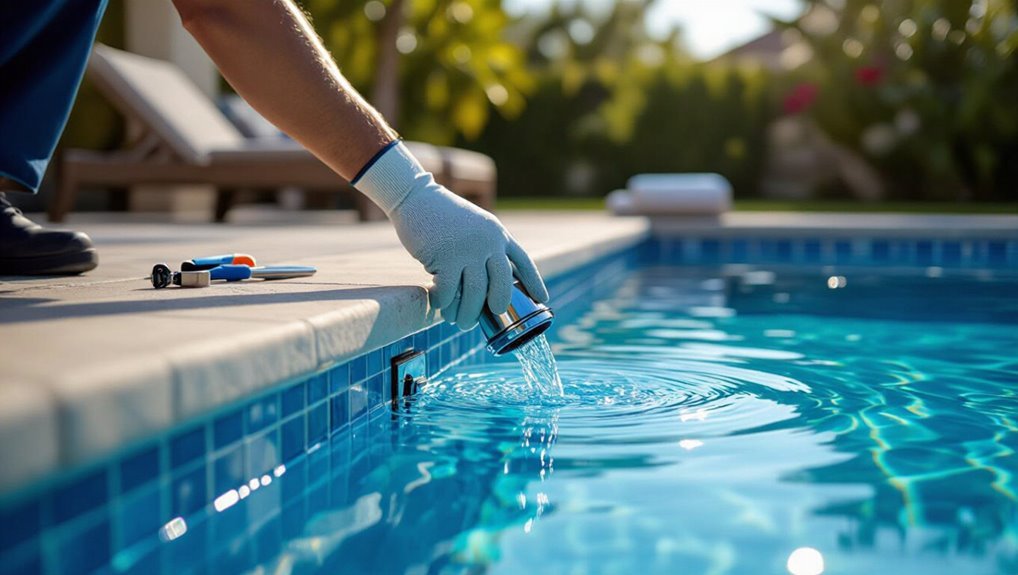
Pool jets are adjustable outlets that direct circulated water and are driven by the pump and plumbing to control flow pattern and velocity.
Properly adjusted jets improve circulation for filtration, enhance swimmer comfort by softening or concentrating streams, and help balance chemical distribution.
Signs that jets need adjustment include weak or uneven flow, excessive surface agitation, or persistent dead spots in the pool.
What pool jets are and how they work
Jets are the small, adjustable outlets in a swimming pool’s circulation system that direct water flow for filtration, heating, and swimmer comfort.
They connect to return lines, use adjustable nozzles or eyeballs to change direction and flow, and respond to pump speed and valve settings.
Knowing plumbing layout and nozzle function helps users understand how to adjust swimming pool jets safely and effectively.
Benefits of correct jet adjustment for flow, comfort, and circulation
After understanding how return outlets connect to the circulation system and how nozzle angle and pump speed affect flow, it becomes clear that proper adjustment influences more than just direction.
Correctly aimed and balanced jets enhance overall circulation, reduce dead zones, improve chemical distribution, and increase filtration efficiency.
They also create comfortable swim currents, minimize turbulence where users relax, and optimize energy use by matching flow to needs.
Common signs your jets need adjustment
How can a swimmer or owner tell when return outlets are misaligned or unbalanced?
Indicators include uneven surface currents, dead spots with poor circulation, strong localized jets causing discomfort, visible debris clustering, difficulty maintaining chemical levels, and noisy or vibrating fittings.
Regular inspection reveals rusty or loose fittings, changed flow patterns after pump service, or swimmers drifting unexpectedly toward one side—signals to adjust jets.
Quick Answer: How to Adjust Pool Jets for Optimal Flow and Comfort
A quick method is to aim each jet away from swimmers and adjust the nozzle to balance flow until circulation feels even and return lines create gentle, non-battering currents.
If jets are stuck, leak, or adjustments don’t restore proper circulation, a technician should be consulted.
This concise guidance frames when simple DIY tweaks suffice and when professional help is warranted.
One-sentence summary of the fastest method
Adjust pool jets by closing the head-to-head valves partially, angling each nozzle toward desired areas, and fine-tuning flow with the return valves until circulation and comfort are balanced.
The fastest method: set valves to equalize pressure, aim returns to promote surface sweep and avoid dead zones, then make small return-valve adjustments while observing skimmer and pool feel, stopping when flow is steady and swimmers are comfortable.
When to call a professional instead
When should a professional be called for pool-jet issues?
A professional should be contacted if jets leak, suffer persistent low pressure after basic adjustments, produce unusual noise or vibration, or if internal repairs (pump, seals, valves) are required.
Also call a technician when electrical faults, recurring clogs, or complex plumbing modifications are suspected to guarantee safety, proper diagnosis, and warranty protection.
Safety and Preparation Before Adjusting Jets
Before any adjustments are made, the pump and related electrical circuits should be turned off and locked out to prevent accidental startup.
The technician assembles necessary tools and supplies—wrenches, screwdrivers, replacement O-rings, and a flashlight—so work proceeds efficiently.
A careful inspection of jets, fittings, and nearby equipment checks for leaks, cracks, or loose components that must be addressed before touching the jets.
Turn-off procedures for pumps and electrical safety
Power down the pool system completely and isolate electrical sources before any work begins.
Verify breakers and disconnects are labeled and switched off; lockout/tagout if available.
Allow motors and capacitors to fully discharge; wait several minutes and confirm gauges read zero.
Keep electrical panels closed and avoid wet areas.
Test with a non-contact voltage detector to guarantee circuits remain de-energized.
Required tools and supplies
With the system confirmed de-energized and all electrical hazards controlled, assemble the specific tools and supplies needed to adjust pool jets safely and accurately.
Required items include adjustable wrench, pliers, flathead and Phillips screwdrivers, Teflon tape, silicone lubricant rated for pool use, replacement O-rings, clean rags, safety gloves, safety goggles, and a flashlight.
Keep a waterproof container for small parts.
Inspecting jets, fittings, and surrounding equipment
Begin by visually and manually inspecting each return jet, skimmer fitting, and nearby valves and pumps for cracks, corrosion, loose fasteners, or signs of leaks; note any worn O-rings, mineral buildup, or misaligned faceplates that could affect flow or create safety hazards.
Verify electrical covers, pressure gauges, and hose connections are secure. Document issues, isolate power and water, and schedule repairs before adjusting jets.
Step-by-Step Guide to Adjusting Fixed and Directional Jets
The following concise procedure outlines how to identify and adjust the pool’s various jet types for ideal flow and comfort.
The technician first confirms jet types and locations, then adjusts directional nozzles, fine-tunes fixed returns, and finally balances all jets for uniform circulation.
Key actions include:
- Locating and identifying fixed, directional, wall return, and spa jets
- Adjusting directional jets for swimmer comfort and targeted flow
- Fine-tuning fixed jets and returns for even circulation
- Balancing multiple jets to achieve uniform water movement
Locating and identifying different types of jets (fixed, directional, wall return, spa jets)
Identifying pool jets starts by visually scanning the pool perimeter and spa area to note their locations and styles.
Fixed jets are recessed, non-adjustable outlets. Directional jets have inner trim rings or swivels allowing aim.
Wall return jets sit near the waterline, returning filtered water.
Spa jets are larger, grouped and often recessed with adjustable nozzles for higher flow and massage.
Adjusting directional jets for swimmer comfort and targeted flow
Several simple adjustments can transform pool jets from merely functional outlets into personalized comfort and circulation tools.
The installer or owner should angle directional jets to create gentle streams away from swimmers’ faces, concentrate flow for swim-current practice, or disperse it for relaxation.
Make small incremental changes, test in-water comfort, and note effects on circulation; repeat until targeted flow and swimmer comfort are balanced.
Fine-tuning fixed jets and returns for even circulation
One clear pass through every fixed return and directional jet establishes a baseline for balanced circulation.
Technicians note nozzle orientation, flow intensity, and overlap to prevent dead zones.
Adjust returns incrementally, recording each change, then observe surface and underflow patterns.
Prioritize subtle angle shifts and symmetric distribution across pool zones.
Recheck after filtration cycles to confirm consistent, even circulation.
Balancing multiple jets for uniform water movement
Begin by mapping all jets and returns into zones so each nozzle’s contribution to circulation is clear.
Next, adjust directional nozzles to create overlapping flow paths that sweep debris toward skimmers.
Close or partially close overpowered jets and open weaker ones until flow gauges or visual tracers show uniform velocity across zones.
Recheck after pump speed or schedule changes to maintain balance.
Adjusting Flow Rate and Pressure
Adjusting flow rate and pressure begins with manipulating pump speed, valves, and diverter controls to redirect and balance circulation.
Ideal flow can be measured with a flow meter or by observing return jets and skimmer performance, then set to the manufacturer’s recommended range.
Variable-speed pumps and automation systems allow precise programmed adjustments and should be configured to match tested flow targets for efficiency and equipment protection.
Using the pump speed, valves, and diverter controls
Control the pool’s jets by managing pump speed, valves, and diverters to balance flow rate and pressure for ideal circulation and swimmer comfort.
Operators should lower pump RPMs to reduce turbulence, partially close return or zone valves to direct flow, and adjust diverters to fine-tune jet direction.
Small changes minimize stress on equipment while achieving targeted hydraulics and localized comfort.
How to measure and set optimal flow (flow meters and visual checks)
After reducing pump RPMs, trimming return valves, and angling diverters to shape circulation, the next step is to quantify and set the actual flow so jets perform as aimed.
Technicians use inline flow meters or paddlewheel gauges at returns and skimmers, compare readings to target GPM per jet, then fine-tune valve positions.
Visual checks—surface ripple, return plume, and return velocity—confirm comfort and even circulation.
Adjustments for variable-speed pumps and automation systems
Technicians integrate variable-speed pumps and pool automation to precisely match flow and pressure to circulation goals, using scheduled speeds, custom speed ramps, and linked feedback from pressure or flow sensors.
They set baseline low-speed circulation, boost for filtration or cleaners, and program ramping to prevent pressure spikes.
Automation logs performance, triggers alerts for deviations, and enables remote adjustments to maintain ideal jet balance and energy efficiency.
Techniques for Improving Circulation and Reducing Dead Zones
Effective circulation begins with orienting jets to create broad, overlapping flow patterns that sweep the entire pool.
Returns should be positioned and angled to work with skimmers and main drains, promoting surface skimming and bottom turnover.
When needed, directional eyeballs, flow directors, or specialized return nozzles can be added to fine-tune flow and eliminate localized dead zones.
Jet orientation strategies for whole-pool circulation
Orienting pool return jets to create broad, overlapping flow patterns helps sweep debris toward skimmers and drains while minimizing stagnant zones along walls and corners.
Jets should be angled to promote clockwise or counterclockwise circulation, balancing direction changes to avoid eddies.
Vary vertical tilt to mobilize surface and bottom water.
Periodically test and fine-tune orientations after pump speed adjustments for consistent whole-pool turnover.
Positioning returns relative to skimmers and drains
After setting return jets to produce broad, overlapping circulation, attention should turn to their placement relative to skimmers and main drains to maximize cross-pool flow and eliminate dead zones.
Returns should be angled to push water toward skimmers and away from dead corners, staggered vertically or horizontally to promote surface and bottom movement, and balanced so intake and return flow volumes complement each other.
Using additional equipment (directional eyeballs, flow directors, and return nozzles)
Install and fine-tune supplemental return hardware—directional eyeballs, flow directors, and specialized nozzles—to steer jets more precisely and eliminate lingering dead spots.
Technicians select fittings by pool shape and pump capacity, angling outputs to create sweeping circulation toward skimmers and drains.
Adjustable nozzles concentrate or spread flow; flow directors redirect eddies around steps and corners.
Proper placement improves filtration efficiency and swimmer comfort.
Special Considerations for Spa Jets and Swim Spas
Spa jets and swim spa outlets differ from standard pool returns in size, flow rate, and purposed function, so adjustment approaches must reflect those design variations.
Attention should be paid to arranging nozzle angles and flow balance to optimize massage patterns and passenger comfort without creating excessive turbulence.
In swim spas, settings must also prevent overheating and avoid pump strain by managing continuous high-flow operation and monitoring temperature and motor load.
Differences between spa and pool jets
Jets in spas and swim spas differ from standard pool jets in size, flow patterns, and purpose: spa jets prioritize concentrated, high-velocity streams for massage and circulation, while pool jets are sized for broad circulation and skimming.
Spa jets use narrower nozzles, higher pressure, and directional fittings; swim-spa jets combine power and adjustability for current training, requiring reinforced plumbing and specialized pump configurations.
Optimizing massage patterns and comfort
Adjusting nozzle direction, flow intensity, and jet grouping allows users to tailor massage patterns for specific muscle groups and overall comfort.
Rotational and pulsating modes target shoulders, lower back, and calves; alternating sequences reduce local fatigue. Varying turbulence and nozzle spacing balances pressure and spread.
Seat and lounger jets should be coordinated to produce complementary sensations without creating harsh focal points.
Preventing overheating and pump strain in swim spas
Monitor pump load and water temperature closely to prevent overheating and undue strain in swim spas; sustained high flow, closed valves, or low water levels can cause rapid temperature rise and motor stress.
Operators should schedule duty cycles, use thermostatic or flow cutoffs, verify adequate circulation and skimmer function, inspect impellers, and maintain manufacturer-recommended water levels to preserve pump life and safety.
Troubleshooting Common Jet Problems
When jets underperform or behave erratically, the likely causes range from weak pump flow and clogged lines to air leaks and loose fittings.
A systematic troubleshooting sequence—check pump and filter pressure, inspect and clear debris, test for suction leaks, and tighten or replace fittings—usually identifies the issue.
For persistent problems such as cavitation noise or leaking returns, targeted repairs or professional service may be required.
Weak flow: causes and stepwise fixes
Several common issues can reduce jet output, and diagnosing them in order prevents unnecessary work.
Inspect pump basket and skimmer for debris, then clean.
Check filter pressure and backwash or clean cartridge if high.
Verify pump impeller for blockage and guarantee valves are open.
Confirm correct pump speed and suction lines for leaks.
Replace worn seals or impeller as last resort.
Uneven flow or sputtering jets: debris, air leaks, and blockages
Uneven flow or sputtering jets often indicate debris in the return lines, an air leak on the suction side, or partial blockages in the jet fittings or plumbing.
Isolating the cause quickly reduces pump stress and restores consistent pressure. Inspect skimmer and pump baskets, backwash or vacuum lines, and remove visible obstructions.
Test for air leaks at union joints and pump lid; clear or replace clogged fittings.
Noisy jets or vibration: cavitation and loose fittings
Diagnose noisy or vibrating jets promptly, as the sounds usually stem from cavitation caused by restricted water flow or from loose fittings transmitting pump vibration.
Inspect for partially closed valves, clogged impellers, or suction leaks that induce cavitation.
Tighten or isolate fittings, secure mounting hardware, and add vibration dampeners.
If noise persists, consult a technician to evaluate pump alignment and flow rates to prevent damage.
Leaking jets and return fittings: diagnosis and repair options
Inspecting leaking jets and return fittings begins with identifying the leak source and understanding whether the issue is cosmetic, structural, or hydraulic.
Technicians check faceplates, O-rings, unions, and plumbing joints. Small leaks often require seal replacement or tightening; cracked fittings need replacement.
For persistent internal leaks, pressure testing and excavation may be necessary.
Document findings and test after repairs to confirm watertight integrity.
Maintenance Tips to Keep Jets Performing Well
Routine maintenance keeps pool jets reliable and efficient.
Suggested actions include a regular cleaning and inspection schedule, timely replacement of worn gaskets, eyeballs, or fittings, and adjustments for seasonal use and winterizing.
- Clean and inspect jets monthly
- Replace damaged gaskets or fittings as soon as wear is noted
- Swap or repair eyeballs when flow or direction is compromised
- Perform seasonal adjustments and winterize according to local climate
Regular cleaning and inspection schedule
Consistent maintenance preserves jet performance and extends component life; a monthly checklist includes removing debris, brushing faces, and clearing directional nozzles.
Inspect for mineral buildup, biofilm, or loose fittings, and run each jet to verify flow and alignment.
Log findings, note corrective actions, and schedule deeper cleaning quarterly.
Prompt attention to issues prevents performance loss and reduces emergency repairs.
When to replace gaskets, eyeballs, or fittings
Timely replacement of gaskets, eyeballs, and fittings prevents small leaks and flow loss from becoming major repairs.
Replace components showing cracks, hardening, persistent leaks after tightening, or visible corrosion.
Replace missing or warped seals and any eyeball nozzles that no longer hold position or direct flow properly.
Use OEM-compatible parts and document replacements to track lifespan and recurring issues.
Seasonal adjustments and winterizing considerations
Prepare jets for seasonal changes by adjusting flow, securing fittings, and protecting exposed components before cold weather or prolonged inactivity.
Drain lines, remove or winterize removable eyeballs, and gently blow out plumbing to prevent freeze damage.
Apply non-toxic antifreeze where recommended, cap returns and skimmers, and store delicate parts indoors.
Resume inspection and gradual flow restoration upon reopening to verify seals and alignment.
Energy Efficiency and Cost Considerations
Adjusting pool jets affects circulation patterns and pump workload, which in turn influences energy consumption and pump longevity.
Practitioners should balance nozzle direction and flow rates to maintain swimmer comfort while minimizing runtime and filter resistance.
When frequent adjustments fail to yield savings, replacing the pump or jets with more efficient models can be more cost-effective over time.
How jet adjustment impacts energy use and pump life
Altering the angle and flow of pool jets changes how hard the pump must work: diverting multiple jets to high flow increases head pressure and energy draw, while closing or angling jets to reduce circulation in low-need zones lowers pump load and runtime.
Excessive restriction or overworking jets accelerates motor wear, raises maintenance frequency and electricity costs; balanced adjustments extend pump life.
Best practices to balance comfort with lower energy bills
Having noted how jet settings affect pump load and wear, the discussion shifts to practical ways to keep swimmers comfortable while cutting energy use.
Balance is achieved by reducing pump speed during low-use periods, directing jets for efficient circulation rather than maximal turbulence, using timed schedules, and grouping jets for targeted comfort.
Regular maintenance preserves efficiency; minor flow tweaks often suffice without constant high energy consumption.
When upgrading equipment is more cost-effective than frequent adjustments
Consider replacing or upgrading equipment when repeated jet adjustments fail to yield meaningful energy savings or when maintenance costs climb.
Investing in a variable-speed pump, more efficient jet fittings, or improved circulation hardware can lower long-term operating expenses and reduce wear from constant tweaking.
A cost-benefit analysis comparing upfront replacement, expected energy savings, and reduced service frequency helps determine the most economical choice.
Comparison of Common Jet Types and Uses
The section compares wall returns, directional eyeballs, and spa jets by function, recommended flow ranges, and common applications. It outlines typical flow rates and situational uses to guide adjustments and placement. The table below summarizes key distinctions for quick reference.
| Jet Type | Recommended Flow Rate (GPM) | Typical Use Case |
|---|---|---|
| Wall Return | 10–30 | General circulation and surface skimming |
| Directional Eyeball | 5–20 | Targeted circulation and creating currents |
| Spa Jet | 20–60 | Massage, turbulence, and localized high flow |
| Variable/Adjustable | 5–60 | Versatile control for multiple purposes |
Wall returns vs. directional eyeballs vs. spa jets
Many pools include several jet types—wall returns, directional eyeballs, and spa jets—each designed to move water differently for circulation, comfort, or therapy.
Wall returns provide broad, low-profile flow for general circulation.
Directional eyeballs allow targeted surface or depth adjustment to eliminate dead zones.
Spa jets deliver concentrated, high-velocity streams for massage and localized turbulence, often adjustable for angle and intensity.
Recommended flow rates and typical use cases
When evaluating jet selection, flow rate recommendations help match performance to purpose: wall returns typically operate at low flow (3–10 gallons per minute, gpm) per fitting for gentle circulation and surface turnover; directional eyeballs suit medium flow (6–15 gpm) to target and eliminate dead spots without causing strong currents; spa and hydrotherapy jets require high flow (15–40+ gpm) to produce focused, high-velocity streams for massage.
Installers balance pump capacity, piping, and valve tuning to achieve desired feel, efficiency, and coverage while avoiding cavitation or excessive turbulence.
Real-Life Scenarios and Recommended Configurations
The section presents practical jet layouts and settings tailored to common situations, starting with small residential pools where jet placement and angle prioritize efficient turnover and swimmer comfort.
It then contrasts strategies for large or commercial pools, emphasizing coordinated jet arrays and zoning for reliable circulation.
Finally, it covers swim-current and therapy installations, highlighting specialized nozzle types and fine-tuned adjustments for flow strength and direction.
Small residential pool layout: jet placement and settings
A compact residential pool benefits from strategically placed jets that balance circulation, swimmer comfort, and energy efficiency. Positioning intake and return fittings to create a gentle circular flow minimizes dead zones and keeps chemical distribution uniform.
Place returns low and angled along the long wall, intakes opposite and near steps. Use adjustable nozzles for localized comfort and moderate pump speed to reduce turbulence while maintaining turnover.
Large pool or commercial setup: circulation strategy
Scaling up from a compact residential layout, large or commercial pools require a fundamentally different circulation strategy to manage volume, bather load, and regulatory turnover rates.
Design emphasizes multiple dedicated return and suction zones, hydraulic balancing, and zoned pumps to guarantee even turnover.
Redundancy, accessible valves, and clear flow monitoring enable maintenance and compliance, minimizing dead spots and promoting consistent chemical distribution.
Swim-current and therapy setups: specialized adjustments
Designing swim-current and therapy jet systems for real-world pools requires tailoring nozzle placement, flow rates, and control schemes to specific user needs and pool geometry.
Specialists recommend adjustable high-flow nozzles for swim currents, multiple low-speed directional jets for therapeutic massage, separate pump controls, and variable-speed settings.
Safety, easy access to adjustments, and periodic flow testing guarantee effective training or rehabilitation while minimizing turbulence and discomfort.
When to Hire a Professional and What to Expect
Signs such as persistent low flow, unusual noises, or visible leaks indicate a technician is needed.
Readers should prepare questions about diagnostic steps, parts replacement, and whether alignment or pump repairs are included, and request estimates for both labor and materials.
Typical service visits range from brief inspections of 30–60 minutes to multi-hour repairs, with costs commonly from modest diagnostic fees up to several hundred dollars for parts and labor.
Signs you need a technician
Recognize persistent or complex jet problems as triggers for professional help: if jets remain misaligned after basic adjustments, leak around fittings, produce abnormal noise or vibration, or if multiple jets lose pressure suddenly, a technician should be contacted.
Other signs include recurring electrical trips, unexplained pump overheating, visible internal component damage, or sudden water chemistry instability linked to circulation failures.
Questions to ask and services to request
When problems warrant a technician, homeowners should arrive prepared with specific questions and a clear list of services to request.
Ask about diagnosis steps, parts inspection, warranty coverage, estimated timeline, and safety protocols.
Request pump and jet alignment checks, valve adjustments, leak detection, and flow testing.
Confirm written recommendations, parts sources, and post-service maintenance guidance before authorizing work.
Typical costs and time estimates
Costs for professional assessment and repair of pool jets typically range from a modest diagnostic fee to several hundred dollars for parts and labor.
Simple adjustments take under an hour, while complex fixes like pump replacement or plumbing repairs require multiple hours or a day.
Homeowner decisions depend on cost, warranty coverage, and expertise; expect itemized estimates, labor rates, parts marks, and clear timelines before approving work.
Quick Reference Checklist for Adjusting Pool Jets
A concise checklist helps guarantee safe, correct, and lasting jet adjustments.
- Pre-adjustment safety and inspection
- Adjustment steps and verification
- Post-adjustment monitoring and follow-up
- When to call a professional
The checklist is designed for quick reference during routine maintenance and to prompt professional help when needed.
Pre-adjustment safety and inspection
Inspect the pool area and equipment thoroughly before any adjustments are made.
Guarantee power to pumps and heaters is off and locked out, and verify no swimmers are present.
Check jets, fittings, and visible plumbing for cracks, leaks, or corrosion.
Confirm tools and replacement parts are on hand, and document current jet orientations and flow settings for safe, reversible work.
Adjustment steps and verification
Before making any changes, the technician confirms all safety checks are complete and that recorded baseline settings are available for reference; then steps proceed in a logical sequence to adjust, test, and verify each jet.
The technician adjusts nozzle direction, flow rate, and swivel tension one parameter at a time, tests for desired circulation and comfort, documents outcomes, and restores any altered settings if performance degrades.
Post-adjustment monitoring and follow-up
Begin monitoring immediately after adjustments are completed to confirm stability and detect any unintended effects.
The technician records jet direction, flow balance, and pump noise at set intervals (15 minutes, 1 hour, 24 hours).
Check water clarity and chemical levels, reassess swimmer comfort, and log any drift.
If issues arise, revert to prior settings or refine adjustments, then recheck per the same schedule.
Conclusion
Properly adjusted pool jets guarantee circulation, comfort, and energy efficiency, tying together safety, function, and user experience. One should balance flow and direction to suit activities—lap swimming, therapy, or relaxation—while monitoring pressure and equipment wear. If adjustments exceed basic skills, call a pro to avoid wasting time or causing damage. In the end, a few thoughtful tweaks can make a pool feel like a million bucks, keeping swimmers happy and systems healthy.