How to Tell If a Furnace Blower Motor Is Bad: 9 Clear Signs and Fixes
If you’re wondering how to tell if your furnace blower motor is bad, look for these clear signs: unusual noises like grinding, squealing, or rattling; weak or inconsistent airflow; humming or intermittent operation; burning smells; and frequent tripped breakers. Emergency indicators include smoke, sparks, visible overheating, or sudden loss of airflow. To diagnose the issue, inspect filters, capacitors, belts, bearings, and wiring, and test voltage and current. Continue reading for detailed diagnostic steps, repair options, costs, and preventive measures to tackle the problem.
How to Quickly Tell If Your Furnace Blower Motor Is Bad
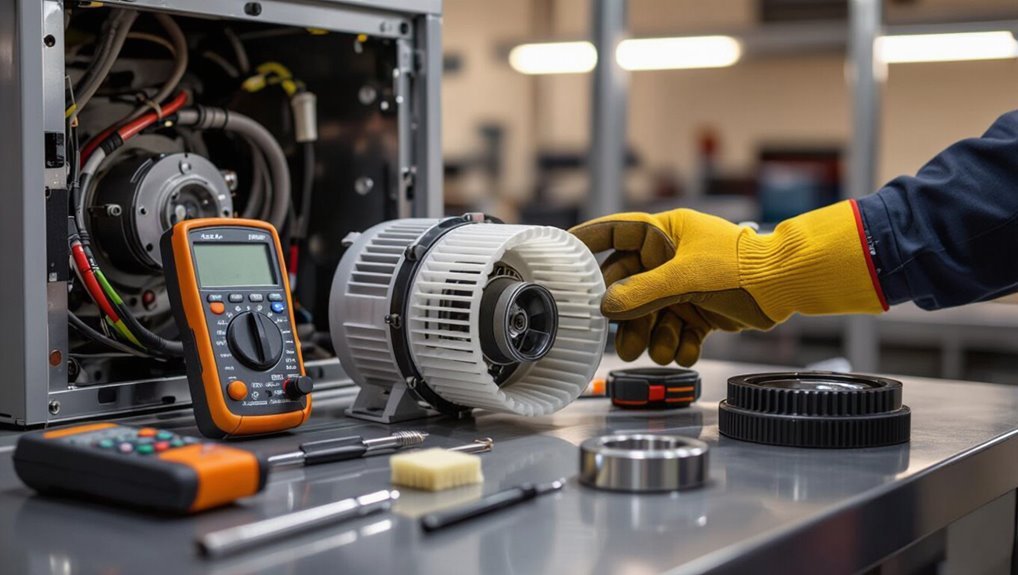
A quick check for a failing furnace blower motor focuses on immediate signs like unusual noises, weak airflow, burning smells, or the blower failing to start.
These observations help determine whether a simple restart or filter change might suffice before contacting a technician.
If the motor emits smoke, sparks, or the system repeatedly trips breakers, it should be treated as an emergency and power should be cut before calling for service.
Immediate signs to check before calling a technician
How can one quickly spot a failing furnace blower motor before calling a technician?
Check for weak or no airflow, unusual grinding or squealing noises, and vibration when the fan runs.
Inspect the air filter and vents for clogs and verify the thermostat and power supply.
If intermittent operation, excessive heat at the furnace, or burning smells appear, schedule professional service.
When the blower motor problem is an emergency
When should a failing blower motor be treated as an emergency?
Immediate attention is required if burning smells, smoke, sparks, tripped breakers, or visible overheating occur.
Also treat sudden complete loss of airflow in freezing conditions as urgent to prevent pipe or system damage.
If any signs suggest electrical hazards or risk to occupants, shut power and call a qualified technician without delay.
How a Furnace Blower Motor Works and Why It Fails
A furnace blower motor uses a motor, blower wheel, bearings, and a control capacitor or module to push warmed air through ductwork.
Failures commonly stem from worn bearings, electrical issues like bad capacitors or wiring, overheating, and buildup of dust that strains the motor.
Typical lifespans range from 10–20 years, with heavy use, poor maintenance, and voltage problems accelerating wear.
Basic components and operation of the blower motor
The blower motor assembly consists of an electric motor, fan wheel (squirrel-cage), mounting housing, capacitor or electronic speed control, and the blower wheel shaft and bearings.
Together they draw air through return ducts, accelerate it via the fan wheel, and push conditioned air into the supply plenum.
The motor receives power and speed signals; bearings support rotation while housing aligns airflow and reduces vibration.
Common causes of blower motor failure
Though generally rugged, blower motors fail for a limited set of mechanical, electrical, and environmental reasons.
Bearings wear or seize, belts fray or slip, and balance issues strain shafts.
Electrical problems include capacitor failure, motor winding shorts, and relay or control board faults.
Environmental contributors are dust buildup, moisture corrosion, and rodent or debris damage that impede cooling and airflow.
Lifespan and factors that shorten motor life
Beyond the common mechanical, electrical, and environmental failures already described, blower motor lifespan varies widely based on design, usage, and maintenance.
Typical service life ranges from 10 to 25 years.
Shortening factors include continuous heavy duty cycles, poor lubrication, clogged filters, voltage irregularities, overheating, moisture, corrosive atmospheres, and deferred repairs.
Regular inspection, filter changes, and proper voltage protectors extend reliable operation.
9 Clear Signs Your Furnace Blower Motor Is Bad
The following signs commonly indicate a failing furnace blower motor and warrant prompt attention.
- No airflow from vents despite furnace running
- Weak or inconsistent airflow
- Loud grinding, squealing, or rattling noises
- Blower motor runs continuously or won’t shut off
Additional indicators include rapid cycling of the furnace and other erratic behaviors that affect comfort and efficiency.
1. No airflow from vents despite furnace running
When a furnace appears to run—pilot lit, burners cycling and thermostat satisfied—but no air emerges from the supply vents, it strongly indicates a problem with the blower motor or its immediate controls.
The system’s fan may have seized, a capacitor failed, or a relay/limit switch prevented motor engagement. Immediate inspection of the blower assembly, electrical connections, and control board is warranted.
2. Weak or inconsistent airflow
Detecting weak or inconsistent airflow from supply vents often signals a failing blower motor or degraded related components. Reduced airflow may manifest as rooms warming slowly, uneven temperatures, or noticeable drops at specific registers.
Causes include motor wear, failing capacitor, obstructed blower wheel, or duct restrictions. Inspect fan function, capacitor voltage, filter condition, and duct integrity; professional testing confirms motor performance and necessary repairs.
3. Loud grinding, squealing, or rattling noises
Listen for persistent grinding, squealing, or rattling coming from the furnace cabinet, as these noises often indicate mechanical failure in the blower motor or its bearings.
Such sounds may signal worn bearings, misaligned or damaged blower wheel, or debris contacting rotating parts. Ignoring them risks further damage and reduced efficiency; prompt inspection, lubrication if applicable, or motor/assembly replacement is recommended.
4. Blower motor runs continuously or won’t shut off
Persistent noises can accompany other operational problems; another clear sign of blower motor trouble is the motor that runs continuously or refuses to shut off.
Continuous operation often indicates a failing relay, stuck relay contacts, faulty control board, thermostat issues, or a motor with worn bearings causing improper speed regulation.
Left unchecked, it increases energy use, accelerates wear, and may cause overheating or premature failure.
5. Furnace cycles on and off rapidly (short cycling)
Short cycling—when the furnace starts and stops in quick succession—is a common indicator that the blower motor or its control components are malfunctioning.
Rapid cycling may result from overheating, failing bearings, a weak capacitor, or an intermittent relay. Symptoms include brief runtime, fluctuating airflow, and uneven temperature.
Diagnosis requires measuring motor current, inspecting wiring and controls, and testing the capacitor and relay for intermittent failure.
6. Burning smell or electrical odor coming from the furnace
A burning or electrical odor from the furnace is a clear warning that the blower motor or its electrical components may be failing.
Persistent smells — acrid, metallic, or like hot insulation — often indicate overheating, worn bearings, melting wiring, or a failing capacitor.
Immediate shutdown and professional inspection are advised to prevent fire, further damage, or hazardous fumes.
7. Tripped breakers or blown fuses associated with the furnace
Following reports of burning smells, another common electrical symptom is breakers tripping or fuses blowing when the furnace runs.
Repeated trips often indicate motor electrical faults, shorted windings, or excessive current draw from bearing failure. Homeowners should note frequency and timing, avoid repeatedly resetting, and call a qualified technician to diagnose circuit loads, inspect the blower motor, and replace or repair faulty components to prevent hazards.
8. Visible motor overheating or excessive vibration
Visible signs of motor overheating—discolored or melted insulation, a scorched odor, or heat-stressed paint—and pronounced vibration are clear indicators of a failing furnace blower motor.
Persistent heat can degrade windings and bearings, causing uneven rotation and increased noise.
Excessive vibration often signals imbalance, worn mounts, or bearing failure; these conditions warrant immediate inspection and typically require motor repair or replacement to prevent further damage.
9. High energy bills after blower issues begin
When blower problems start, energy bills often rise because the motor must run longer or work harder to move the same amount of air. Increased runtime, reduced airflow from worn bearings or dirty components, and electrical inefficiencies all translate directly into higher power consumption.
Monitoring utility bills alongside performance changes helps pinpoint motor-related causes. Technician diagnostics can confirm inefficient draw, worn parts, or misalignment requiring repair or replacement.
How to Diagnose the Blower Motor: Step-by-Step Checks
Before performing any checks on a furnace blower motor, basic safety precautions should be confirmed and power must be isolated.
A concise sequence of steps follows, focusing on:
- visual inspection of the motor, fan, and wiring;
- checking the air filter, vents, and ductwork;
- testing the thermostat and control board signals;
- measuring voltage and current at the motor (basic multimeter guide).
Each step is designed to quickly identify common faults and determine whether further repair or professional service is needed.
Safety precautions before any inspection
Several basic safety steps must be taken before any inspection to protect both the technician and the equipment: disconnect power at the furnace switch and circuit breaker, wait for moving parts to stop, wear insulated gloves and eye protection, and guarantee adequate lighting and ventilation.
Confirm power is off with a tester, keep flammable materials away, secure loose clothing, and use a stable ladder or platform when accessing the unit.
Visual inspection: motor, fan, and wiring
With power confirmed off and safety gear in place, the technician proceeds to a systematic visual inspection of the blower assembly.
The motor housing, fan blades, mounts, and belt (if present) are examined for cracks, rust, oil leaks, bent blades, or debris.
Wiring, connectors, and insulation are checked for scorch marks, loose terminals, or fraying that indicate electrical faults.
Checking the air filter, vents, and ductwork
Begin by inspecting the air filter, supply and return vents, and accessible duct runs for blockages, excessive dust, or damper misalignment that can restrict airflow and mimic motor failure.
Replace dirty filters, clear obstructions, and realign dampers.
Check for disconnected or crushed ducts and loose vent grilles.
Restoring proper airflow often resolves performance issues before declaring a blower motor defective.
Testing the thermostat and control board signals
Test the thermostat and control board signals next to determine whether the furnace is receiving the correct command to run the blower.
Verify thermostat mode and setpoint, inspect wiring for loose or corroded connections, and confirm the control board’s indicator LEDs and relay clicks during a call for fan.
Document any inconsistent or absent control signals before proceeding to motor-level electrical checks.
Measuring voltage and current at the motor (basic multimeter guide)
Having confirmed that the thermostat and control board are issuing proper fan commands, the next step is to measure voltage and current at the blower motor to verify it is receiving power and drawing appropriate load.
With power off, connect a multimeter for voltage across motor terminals; restore power and record AC voltage.
Use a clamp ammeter or inline meter to check current against nameplate ratings.
Inspecting capacitors and relays for failure
Inspect capacitors and relays early in the troubleshooting sequence, since both components commonly fail and produce symptoms similar to a bad blower motor.
Visually check capacitors for bulging, leaking, or corrosion and test capacitance with a meter.
Inspect relay contacts for pitting or stuck positions and verify coil operation.
Replace any failed capacitor or relay before condemning the motor.
How to isolate blower motor vs. other HVAC issues
After ruling out capacitors and relays, the next step is to isolate the blower motor from other HVAC components to determine whether it is the root cause of running issues.
Disconnect power, remove blower access panel, visually inspect wiring and bearings.
Manually spin the blower to check smoothness.
Test motor with a multimeter for continuity and resistance.
Swap known-good thermostat signal to confirm.
Repair and Fix Options: When to Repair vs Replace
The section outlines practical repair and replacement choices for a faulty furnace blower motor, distinguishing simple homeowner tasks—like cleaning and belt replacement—from professional repairs.
It explains when replacing a capacitor or bearings can restore function versus when persistent noise, excessive heat, or frequent failures indicate full motor replacement.
A brief cost comparison frames the decision, weighing parts and labor against the expected remaining life of the motor.
Minor fixes you can do yourself safely
Homeowners can handle a handful of straightforward blower motor tasks safely, provided they follow basic precautions and consult the furnace manual.
Tasks include cleaning accumulated dust from the blower wheel and housing, tightening accessible mounting screws, lubricating serviceable motor bearings per manufacturer guidance, and replacing a clogged air filter.
Always cut power before working and stop if unfamiliar tools or complex wiring are required.
When capacitor replacement solves the issue
Consider capacitor replacement when the blower motor hums, struggles to start, runs intermittently, or draws noticeably more current while the motor and wiring otherwise appear intact.
A failing start/run capacitor often prevents proper torque; replacement is inexpensive and commonly restores function.
Technicians test capacitance and voltage under load, confirm correct microfarad rating and voltage, then replace the capacitor rather than the motor if tests indicate capacitor failure.
Bearing and belt repairs vs. motor replacement
Evaluate bearings and belts first when a furnace blower shows noise, wobble, or reduced airflow but the motor electrical tests normal.
If bearings are worn or belts glazed, replacement or lubrication and belt tensioning often restores function at lower cost.
Consider motor replacement only if mechanical fixes fail, parts are unavailable, or repair cost approaches new motor price; document findings and compare labor and parts.
Signs it’s time to replace the blower motor entirely
When should the blower motor be replaced outright?
Replacement is warranted when motors seize, produce burning smells, smoke, or sustained loud grinding despite lubrication.
Persistent overheating, frequent electrical tripping, failed capacitor tests, or age beyond expected lifespan with recurring failures justify full replacement.
If repairs are short-lived or safety is compromised, replacement prevents further damage and restores reliable operation.
Cost comparison: repair vs replacement
One key factor in deciding between repairing a furnace blower motor and replacing it outright is the total cost over time: immediate repair expenses (parts, labor, and diagnostic fees) should be weighed against replacement price plus expected future maintenance and energy savings. A cost-benefit review compares upfront cost, lifespan, efficiency, and warranty to guide the economically sensible choice.
| Option | Consideration |
|---|---|
| Repair | Lower upfront |
| Replace | Higher upfront |
| Repair | Shorter lifespan |
| Replace | Longer lifespan |
| Both | Check warranty and efficiency |
Step-by-Step Guide to Replacing a Furnace Blower Motor
A concise walkthrough outlines the tools and parts required, steps to prepare the furnace safely, and how to remove the old motor while recording key measurements.
It then covers installing the replacement motor, reconnecting wiring correctly, and securing all components.
Finally, it describes post-installation testing and any necessary adjustments to guarantee reliable operation.
Tools and parts needed
Several essential tools and parts are required before beginning a furnace blower motor replacement to guarantee a safe, efficient procedure.
Necessary items include a replacement motor compatible with the furnace model, blower wheel (if damaged), mounting hardware, capacitor, and terminal connectors.
Tools: multimeter, nut drivers, screwdrivers, socket set, pliers, wire strippers, electrical tape, vacuum, and work light.
Preparing the furnace and ensuring safety
With tools and replacement parts assembled, attention turns to preparing the furnace and establishing safety protocols before any work begins.
Power must be shut off at the breaker and the furnace switch labeled. Allow components to cool. Disconnect thermostat to prevent accidental starts.
Wear gloves and eye protection. Verify adequate lighting and ventilation. Keep a clear workspace and a fire extinguisher nearby.
Removing the old motor and extracting measurements
Begin by confirming the furnace remains de-energized and that the service panel has cooled; then remove the access panels to expose the blower assembly.
Disconnect belt or wheel, note pulley alignment, and unfasten motor mounting bolts.
Label and photo terminals before detaching wiring.
Extract motor, measuring shaft diameter, mounting footprint, electrical ratings, rotation direction, and blower wheel size for accurate replacement.
Installing the new motor and reconnecting wiring
Install the replacement motor by positioning it in the mounting footprint, aligning the shaft and pulley (or belt wheel) to the blower wheel, and securing the mounting bolts to the manufacturer’s torque or snug specifications.
Reattach the belt or pulley, restore ground and line connections per wiring diagram, reconnect capacitor leads to correct terminals, verify strain reliefs, insulate splices, and tighten terminal screws to factory torque.
Post-installation testing and adjustments
Power is restored only after a final visual check and all safety measures are in place. The technician then initiates a controlled test sequence to confirm the new blower motor functions correctly.
Observations include startup behavior, noise, vibration, amperage draw, and airflow. Speed settings and belt tension (if applicable) are adjusted, electrical connections rechecked, and operational cycles verified to meet manufacturer specifications before closing access panels.
Preventive Maintenance to Extend Blower Motor Life
A concise preventive maintenance plan helps maximize blower motor life and prevent premature failures.
It should cover a recommended schedule for inspections, proper air filter types and replacement intervals, and basic tasks like lubrication, belt alignment, and cleaning.
The plan should also specify when to call a professional for thorough HVAC maintenance and safety checks.
Recommended maintenance schedule
Regular, scheduled checks greatly reduce the risk of premature blower motor failure by catching wear, lubrication needs, and electrical issues before they escalate.
Inspecting belts, bearings, and connections quarterly during peak seasons and biannually otherwise is recommended.
Annual professional tune-ups should include amp draw, capacitor testing, and cleaning.
Promptly address identified issues to maintain efficiency and extend motor lifespan.
Air filter types and replacement frequency
Selecting the correct air filter type and replacing it on an appropriate schedule are key steps in preventing excess strain on a furnace blower motor. Filters that trap more particulates reduce dust buildup on blades and coils, lowering amp draw and wear.
MERV 6–13 ratings suit most homes; higher MERV increases restriction. Check monthly, replace every 1–12 months based on MERV, occupancy, pets, and manufacturer guidance.
Lubrication, belt alignment, and cleaning tips
Several simple maintenance tasks — lubrication, belt alignment, and thorough cleaning — greatly reduce wear on a furnace blower motor and help maintain efficiency.
Apply manufacturer-recommended oil to accessible bearings annually, inspect and adjust or replace worn belts for correct tension and tracking, and remove dust buildup from blades, housing, and vents.
Regular, careful upkeep minimizes vibration, overheating, and premature failure.
When to schedule professional HVAC maintenance
When should a homeowner call a professional for HVAC maintenance to preserve blower motor life?
A technician should be scheduled annually for inspection, cleaning, capacitor and relay checks, and airflow testing.
Sooner service is advised if unusual noises, reduced airflow, higher energy bills, or frequent cycling occur.
Timely professional maintenance prevents premature motor failure, extends service life, and reduces costly emergency repairs.
Troubleshooting Checklist for HVAC Technicians
The troubleshooting checklist presents a standard diagnostic flowchart outlining the sequence of tests technicians should perform, from power and control checks to motor and capacitor verification.
It highlights common pitfalls and frequent misdiagnoses to help avoid wasted time and unnecessary parts replacement.
The section concludes with concise parts and replacement recommendations tailored to different motor types.
Standard diagnostic flowchart (sequence of tests)
A clear, stepwise diagnostic flowchart guides technicians through progressively targeted tests—starting with basic power and control checks, advancing to motor and capacitor assessments, and ending with circuit-level measurements—so faults are isolated efficiently and without unnecessary component replacement.
It lists sequence: verify voltage and fuses, confirm control signals and thermostat operation, test capacitor and motor windings, inspect bearings and rotor, then analyze wiring, relays, and PCB traces.
Common pitfalls and misdiagnoses
Moving from the stepwise flowchart to common pitfalls highlights where technicians most often misread symptoms or skip key checks.
Common errors include blaming the motor without verifying capacitor, ignoring airflow restrictions, misinterpreting bearing noise as electrical failure, skipping voltage and amp measurements, and failing to confirm control signal integrity.
Each missed check leads to unnecessary replacements or repeat service calls.
Parts and replacement recommendations by motor type
Because motor types dictate different failure modes and replacement parts, technicians should match recommendations to the specific blower motor category—PSC (permanent split capacitor), ECM (electronically commutated motor), shaded-pole, or multi-speed induction—before ordering components.
PSC needs compatible capacitors and bearings; ECM requires OEM or programmable controls and harnesses; shaded-pole often means direct replacements; multi-speed units need correct speed taps, capacitors, or compatible multi-speed motors.
Cost, Warranties, and When to Call a Professional
Typical cost ranges for diagnosis, repair, and replacement vary by region and system age, so homeowners should expect quotes and a written estimate before work begins.
The technician should be asked about parts and labor warranties, expected lifespan of the repaired or replaced motor, and proof of licensing and insurance.
When costs are high, warranties are unclear, or the homeowner lacks confidence in the estimate, hiring a qualified, licensed HVAC professional is recommended.
Typical cost ranges for diagnosis, repair, and replacement
Estimate costs for diagnosing, repairing, or replacing a furnace blower motor vary widely based on labor rates, parts, and the unit’s age.
Typical diagnostic fees run $50–$150.
Minor repairs (capacitor, bearings) often cost $100–$350.
Motor replacement typically falls between $300–$900 including labor.
High-efficiency or hard-to-access units can exceed these ranges; taxes and disposal fees may apply.
What to ask your HVAC tech and warranty considerations
After reviewing likely diagnostic and repair costs, homeowners should prepare a short list of questions to ask the HVAC technician and check warranty details before authorizing work.
Ask about diagnosis steps, itemized estimates, parts warranty length, labor guarantees, and expected timeline.
Confirm whether third-party parts void existing warranties and request written estimates and warranty documentation.
Call a professional if safety or major component failure is suspected.
How to choose a qualified technician
How should a homeowner select a qualified technician to inspect or replace a furnace blower motor?
A qualified technician should be licensed, insured, and experienced with the specific furnace brand.
Compare written estimates, labor and parts warranties, and emergency service fees.
Choose technicians with verifiable references and online reviews.
Call a professional immediately for unusual noises, burning smells, smoke, or complete blower failure.
Quick Reference: Symptoms, Likely Causes, and Immediate Actions
When a furnace blower motor shows trouble, a few clear symptoms point to specific causes and immediate steps to take; this quick reference lists common signs, likely faults, and safe first actions to assess or contain the problem.
| Symptom | Likely Cause | Immediate Action |
|---|---|---|
| No airflow | Blower motor failure | Check power, reset breaker |
| Weak airflow | Dirty filter/blower | Replace filter, inspect fan |
| Noise/vibration | Loose bearings | Shut off, schedule service |
Conclusion
A homeowner notices a quiet hum that once warmed their kitchen; a neighbor’s sudden silence matches the sputter from the vent across the street. Coincidence or not, these echoes trace the same failing blower motor: diminished airflow, odd smells, and intermittent stops. Acting on the signs—diagnose, tighten, clean, or replace—prevents frozen coils and costly breakdowns. Prompt attention restores comfort and avoids the shared, avoidable misery of night-time cold and last-minute repairs.