
How to Do a Backflow Test: Step-by-Step Guide for Homeowners and Plumbers
A backflow test is essential for ensuring that backflow prevention assemblies effectively stop non-potable water from contaminating the potable water supply. To perform a backflow test, the tester will isolate the device, relieve pressure, connect a calibrated gauge, and follow the specific test sequences outlined by the manufacturer for devices like RPZs, double check valves, or vacuum breakers. If any issues arise, necessary cleaning, parts replacement, and retesting will be conducted, along with official reporting to local authorities. Proper documentation, including photos and certification, is crucial for demonstrating compliance and securing insurance coverage. For detailed procedures, required tools, and sample logs, continue reading.
What a backflow test is and why homeowners need it
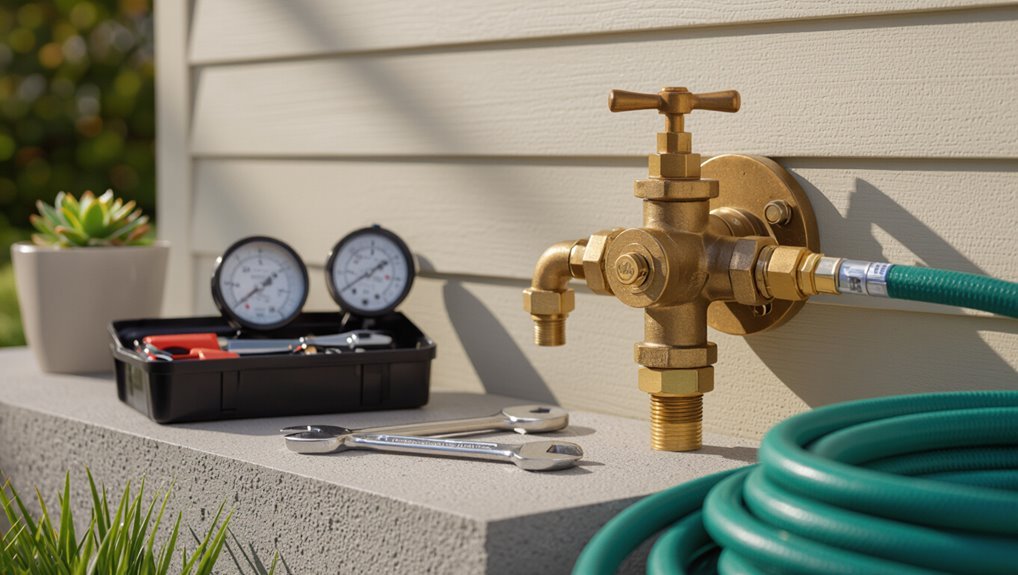
A backflow test verifies that a backflow prevention assembly — a mechanical device that stops contaminated water from flowing backward into the potable supply — is functioning correctly.
Homeowners need regular testing because failed assemblies pose health risks, can violate local codes, and may affect insurance coverage.
Testing frequency and reporting requirements vary by jurisdiction, with many areas mandating annual inspections or certification.
Definition of backflow and backflow prevention assemblies
Backflow occurs when non-potable water reverses direction and contaminates the clean water supply, typically due to pressure changes in the plumbing system.
Backflow prevention assemblies, such as double check valves and reduced pressure zone devices, stop reversal and protect potable lines.
Understanding these devices and how to do a backflow test enables homeowners and plumbers to identify failures and schedule maintenance or repairs promptly.
Health, legal, and insurance reasons to test backflow preventers
Because contaminated water can enter a home’s potable supply when pressure conditions change, testing backflow preventers is essential to protect health, comply with regulations, and satisfy insurance requirements.
Regular certified tests verify device integrity, prevent illnesses from cross‑contamination, document compliance for authorities and insurers, and reduce liability exposure.
Failure to test risks citations, coverage denial, and public health consequences.
Typical testing requirements and frequency by jurisdiction
Most municipalities and water authorities mandate periodic testing of backflow preventers, but the specific intervals—often annually, sometimes every two years, or upon installation and after repairs—vary by jurisdiction and by device type. Local rules define tester certification, reporting, and penalties. Homeowners should verify requirements with their water authority and schedule certified inspections accordingly.
| Requirement | Common Interval |
|---|---|
| Residential RPZ | Annual |
| Commercial RPZ | Annual |
| Double check | 1–2 years |
| After repair/installation | Immediate test |
Types of backflow prevention devices commonly found in homes
Common residential backflow prevention devices include Reduced Pressure Zone (RPZ) assemblies, Double Check Valve Assemblies (DCVA), Pressure Vacuum Breakers (PVB), and Atmospheric Vacuum Breakers (AVB).
Each type has distinct appearance and typical installation locations that help with identification. Recognizing the device by its shape, valves, and where it connects to the plumbing is essential before testing.
Reduced Pressure Zone (RPZ) assemblies
A Reduced Pressure Zone (RPZ) assembly is a mechanical backflow preventer designed to protect potable water by creating a protected chamber of lower pressure between two independently acting check valves and a relief valve.
If either check fails or downstream pressure exceeds upstream pressure, the relief valve opens to discharge water and prevent contamination from moving back into the supply.
RPZs are used where high hazard cross-connections exist, require annual testing, and must be installed with accessible drains and shutoffs.
Double Check Valve Assembly (DCVA)
Double check valve assemblies (DCVAs) consist of two independently acting spring-loaded check valves in series with test cocks and shutoff valves, providing reliable backflow protection by preventing reverse flow through redundant mechanical closure.
They suit low-to-moderate hazard applications, require periodic testing via test cocks, tolerate brief pressure variations, and are compact for meter- or service-line installations where an RPZ is unnecessary.
Pressure Vacuum Breaker (PVB) and Atmospheric Vacuum Breaker (AVB)
While DCVAs rely on dual spring-loaded checks for redundancy in pressurized lines, Pressure Vacuum Breakers (PVBs) and Atmospheric Vacuum Breakers (AVBs) provide simpler, valve-based protection against back-siphonage for many residential applications.
PVBs include a spring-loaded relief and test ports for periodic testing; AVBs are non-pressurized, rely on an internal float valve, and must be installed downstream of shutoff valves.
Identifying your device by appearance and location
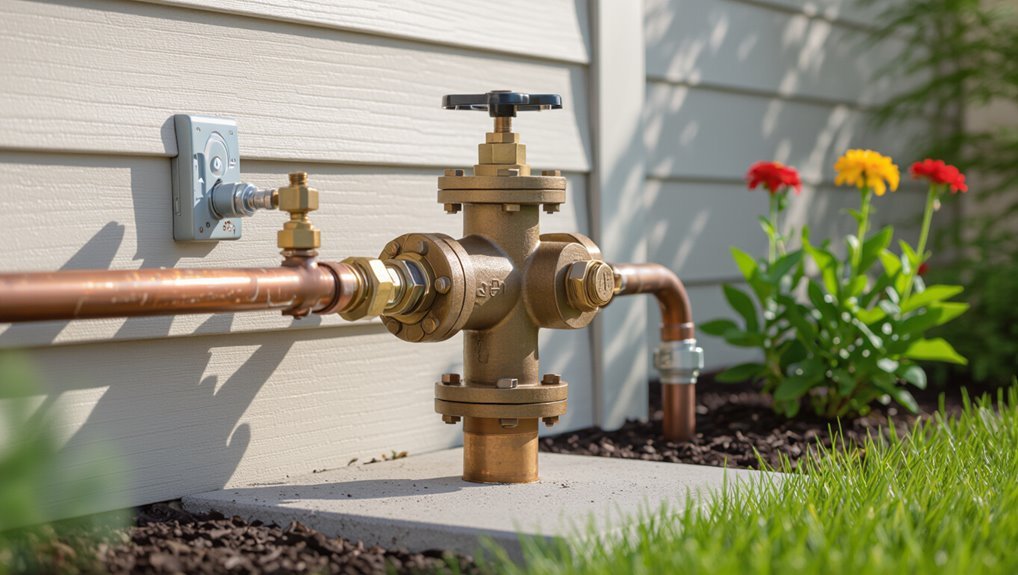
Recognizing common backflow prevention devices by sight and placement helps homeowners and testers determine which unit is installed and how it should be accessed for inspection or maintenance.
Typical residential devices include double-check valves (compact, inline near main shutoff), pressure vacuum breakers (tall, above-ground near irrigation lines), and atmospheric vacuum breakers (small, hooded on downstream piping).
Location and shape guide testing procedures.
When to schedule a backflow test
Routine testing is usually required at set intervals and may shift with seasonal factors such as freeze risk or peak usage.
Immediate testing should follow events like repairs, renovations, or nearby water main work that could compromise device integrity.
Property owners should verify local testing schedules, permit needs, and reporting rules with municipal authorities or the utility.
Regular testing intervals and seasonal considerations
Because backflow assemblies protect potable water from contamination, they must be tested at consistent intervals and scheduled with seasonal factors in mind.
Testing frequency typically follows local codes—commonly annually—but high-risk sites may require semiannual checks.
Schedule tests before freeze seasons and after extreme weather to prevent damage-related failures.
Coordinating with utility availability and peak usage periods optimizes reliability and compliance.
Events that trigger immediate testing (repairs, renovations, water main work)
Schedule immediate testing whenever work or damage could alter system pressure or introduce contaminants.
After repairs to backflow assemblies, plumbing replacements, irrigation modifications, or building renovations, testing verifies integrity.
Water main breaks, valve replacements, or significant excavation that disturbs lines also require prompt tests.
Emergency repairs following flooding, contamination events, or pressure loss mandate verification before restoring normal service to guarantee cross-connection protection.
How to confirm local testing requirements and permits
After emergencies or any work that may affect system pressure, the property owner or responsible party must also confirm local testing rules and any permit obligations before arranging a backflow test.
They should check municipal codes, utility requirements, and plumbing department guidance, verify required certifications for testers, confirm filing deadlines and permit fees, and schedule tests within mandated timeframes to guarantee compliance and avoid fines.
Tools and equipment needed for a DIY backflow test
The section outlines the essential components of a backflow test kit, including test gauge assemblies and the need for recent calibration.
It also lists necessary personal protective equipment and common plumbing tools required for safe, accurate testing.
It finishes by noting clear situations when a certified tester should be contacted instead of attempting a DIY test.
Required test kit components and calibration
Several essential items are required for a DIY backflow test: a calibrated test kit with pressure gauges, a differential gauge or test cocks compatible with the assembly, hose connectors and fittings that match the system, leak-free hoses, and appropriate seals or adapters.
Calibration certificates should be current; gauges must read accurately across expected ranges. Replacement parts, spare fittings, and a calibration comparison reference are also recommended.
Personal protective equipment and basic plumbing tools
A tester’s safety kit should include eye protection, chemical-resistant gloves, and hearing protection when working near noisy equipment, plus a high-visibility vest if on a public right-of-way.
Essential tools include adjustable wrenches, channel-lock pliers, a screwdriver set, tubing cutters, thread seal tape, a manometer or calibrated test gauge, spare test kit fittings, and a flashlight for confined spaces.
When to call a certified tester instead
When should a homeowner attempt a DIY backflow test versus calling a certified tester?
A certified tester is recommended if local regulations require certification, if the assembly is complex, if previous failures occurred, or if specialized gauges and calibration are needed.
Call a pro for uncertain diagnoses, stubborn valves, potential contamination risks, or when documentation and permits must be provided to authorities.
Step-by-step backflow test procedure for common assemblies
The procedure begins with preparing the site, isolating the assembly, and shutting off the water to guarantee safe, accurate testing.
Technicians then follow specific test sequences for common assemblies—measuring and recording pressures for a Double Check Valve Assembly (DCVA), a Reduced Pressure Zone (RPZ) assembly, and a Pressure Vacuum Breaker (PVB).
Recorded readings are compared to manufacturer and regulatory limits to determine pass/fail and document required repairs.
Preparing the site and shutting off water
Before any gauges are attached or valves operated, the technician secures the work area and isolates the assembly to prevent water flow and protect downstream systems.
They verify access, remove debris, and guarantee adequate lighting. Appropriate personal protective equipment is worn.
Shutoff valves are identified and slowly closed, then locked or tagged.
Downstream fixtures are opened to relieve pressure and confirm isolation before testing proceeds.
Testing a Double Check Valve Assembly (DCVA)
With the assembly isolated and pressure relieved, the technician proceeds to test a Double Check Valve Assembly (DCVA) following a standard sequence of gauge attachment, valve manipulation, and differential pressure readings.
Tests confirm check integrity and proper seat operation; failures prompt repair or replacement per code. The process is methodical, recorded, and verified before restoring service.
- Attach test cocks and gauges
- Record inlet pressure
- Operate isolation valves sequentially
- Measure differential across each check
- Document results and tag assembly
Testing a Reduced Pressure Zone (RPZ) assembly
Begin testing a Reduced Pressure Zone (RPZ) assembly by isolating the device and relieving pressure. Then attach test cocks and calibrated gauges to the inlet, between the two checks, and at the outlet.
The tester records inlet pressure, differential across first and second check valves, and relief valve opening. Repair or replace components if readings fail specifications.
- Verify isolation valves
- Check gauge zeroes
- Measure inlet pressure
- Record differential readings
- Inspect relief valve operation
Testing a Pressure Vacuum Breaker (PVB)
After completing isolation and gauge checks on an RPZ, the tester proceeds to assess a Pressure Vacuum Breaker (PVB) using a similar method adapted to the PVB’s single-check and spring-loaded air inlet assembly.
The technician isolates inlet/outlet, attaches test kit, cycles the air inlet, checks valve seating under flow, and verifies no continuous leak before reassembling and restoring system pressure.
- Isolate inlet and outlet
- Attach test kit
- Cycle air inlet
- Observe valve seating under flow
- Confirm no continuous leak
Recording readings and interpreting results
Record readings methodically and log each gauge value, test point, and observed behavior immediately to guarantee an accurate record of the assembly’s performance.
The tester compares readings to manufacturer and local standards, notes leak or differential failures, and timestamps results.
Any out-of-range or fluctuating values prompt retest, troubleshooting, repair, or certification denial.
Final reports include signatures, serial numbers, and corrective actions taken.
How to troubleshoot common test failures
When a backflow test fails, technicians first identify common causes specific to DCVAs, RPZs, and PVBs—such as seat leakage, worn springs, or debris—and note whether the issue is field-serviceable or requires component replacement.
Next, they apply appropriate field fixes (cleaning, adjusting, or replacing small parts) and escalate to replacement when repairs cannot restore proper operation.
All actions, parts changed, and the results of any retesting are recorded on the test report to meet regulatory and owner documentation requirements.
Common failure causes for DCVA, RPZ, and PVB
Diagnose common failure causes for DCVA, RPZ, and PVB by focusing on pressure differentials, valve seating, and debris or corrosion that impede proper operation.
DCVAs often fail due to worn check springs or trapped debris.
RPZ failures frequently stem from relief valve malfunction or differential loss.
PVBs commonly suffer from seat erosion, foreign particles, or scaling.
Regular inspection pinpoints cause.
Field fixes vs. repairs that require replacement
Differentiate between field fixes and replacements by evaluating whether a failed backflow assembly can be restored to specification through cleaning, part replacement, or adjustment versus when structural damage, extensive corrosion, or compromised internal geometry necessitate full replacement.
Technicians inspect seats, seals, springs, and pilot tubing; perform targeted part swaps and calibration if effective.
Replace assemblies when leak paths, irreparable corrosion, or deformities prevent reliable sealing or operation.
How to document repairs and retesting requirements
Document repairs and retesting requirements precisely to maintain regulatory compliance and guarantee system safety.
The tester logs defect details, parts replaced, technician name, date, and test instrument readings. Include photos and serial numbers when applicable.
Note whether a field repair or full replacement occurred, and specify mandated retest interval and authority notifications.
Maintain copies for owner and local water authority records.
Hiring a professional backflow tester
When hiring a professional backflow tester, the homeowner should verify the tester’s current certification and proof of liability insurance.
The tester will perform calibrated checks, record measured values, and provide a signed report detailing results and any recommended repairs.
Costs should be compared to the time, tools, and potential liability of a DIY approach to determine the most economical and compliant option.
How to verify tester certification and insurance
Before hiring a professional backflow tester, confirm that the tester holds current certification and carries appropriate insurance.
Request copies of certification, license numbers, and proof of liability and workers’ compensation coverage.
Verify credentials with the issuing authority or state registry.
Confirm policy limits meet local requirements.
Keep records of documentation and expiration dates for future compliance and audits.
What to expect from a professional test and report
After verifying credentials and insurance, the property owner should understand what a professional backflow tester will do on-site and what the final report will contain.
The tester will inspect the assembly, perform pressure and relief tests, document readings, note defects, and attempt minor adjustments.
The written report lists test results, serial numbers, pass/fail status, required repairs, recommended actions, and tester signature.
Comparing costs: DIY vs. licensed tester
Compare the costs of a DIY backflow test and hiring a licensed tester by weighing equipment, time, liability, and compliance expenses. A DIY saves on service fees but requires purchasing tools, learning procedures, and assuming risk of incorrect results or code violations. A licensed tester brings expertise, certification, and liability coverage, often saving time and preventing costly rework or fines.
| Item | DIY | Licensed |
|---|---|---|
| Tools | Buy | Provided |
| Time | High | Low |
| Risk | Higher | Lower |
| Cost predictability | Low | High |
| Compliance certainty | Uncertain | Assured |
Reporting, compliance, and record-keeping after the test
After the test, the tester completes required official forms or submits results through the municipality’s digital portal to certify device performance.
Copies of reports and maintenance records are stored securely and calendar reminders are set for future testing and repairs.
Failure to report or maintain records can trigger fines, mandatory repairs, or water service restrictions enforced by local authorities.
Completing official test forms and digital submissions
Complete and accurate documentation is essential once the backflow test is finished.
The tester records device details, readings, observed failures, repairs, and tester certification on official forms or municipal portals. Entries must match meter and permit numbers, include date/time, and legible signatures.
If submitting digitally, upload calibrated test gauge photos and PDFs, confirm receipt, and retain confirmation numbers for compliance audits.
Storing records and reminders for future tests
When test results and supporting documents are finalized, they should be organized and retained in a way that guarantees easy retrieval for audits and future inspections.
Copies—paper and encrypted digital—must include tester credentials, device serials, readings, and repair records.
Establish standardized file names, cloud backups, and a calendar reminder system tied to jurisdictional retest intervals.
Maintain records for the mandated retention period.
Consequences of non-compliance and enforcement actions
Maintaining organized, accessible test records also supports fulfilling reporting obligations and demonstrating compliance; failure to do so can trigger a range of enforcement responses.
Agencies may issue fines, compliance orders, service shutdowns, or remediation mandates.
Repeat or severe violations can lead to license suspension, legal action, or public notices.
Prompt corrective measures and accurate submissions typically mitigate penalties and restore regulatory standing.
Tips for maintaining backflow prevention devices to avoid failures
A concise seasonal maintenance checklist helps guarantee valves, seals, and test ports are inspected and winterized promptly.
Technicians watch for signs of wear—corrosion, leaking, reduced spring tension—and replace components before they fail.
Long-term planning addresses device upgrades and property changes to maintain compliance and system resilience.
Seasonal maintenance checklist
Seasonal maintenance for backflow prevention devices focuses on quarterly inspections and timely servicing to prevent failures caused by temperature swings, debris, and wear.
A concise checklist guides homeowners and plumbers through routine tasks and scheduling to guarantee reliable operation.
- Verify valve housings are clean and unobstructed
- Check winterization and insulation
- Test relief ports and drains
- Record test dates and results
- Schedule professional annual inspection
Signs of wear and when to replace components
Several telltale signs indicate a backflow prevention device or its components need attention: persistent leaks, unusual pressure changes, difficulty actuating valves, corrosion or pitting on metal parts, worn rubber seals, and visible sediment or debris obstructing ports.
Immediate inspection should follow detection; replace damaged seals, corroded springs, or cracked housings.
Document findings, use manufacturer parts, and schedule professional replacement when function cannot be reliably restored.
Long-term planning for device upgrades and property changes
Noticing wear or recurring failures should prompt consideration of longer-term planning for device upgrades and changes to the property’s plumbing that could prevent future backflow incidents.
Owners and technicians should assess system age, code updates, and usage patterns, prioritize proactive replacement of obsolete assemblies, plan for protected locations, budget for certified devices, and document upgrades and inspections to reduce failure risk and guarantee regulatory compliance.
Example test log templates and sample filled report
The article presents a blank test log template to standardize data collection during backflow inspections.
It also includes a sample completed test report with annotations that explain each entry and typical interpretations.
These resources aim to streamline recordkeeping and improve test consistency.
Blank test log template
A blank test log template provides a standardized form for recording backflow assembly details, test results, and corrective actions, ensuring consistent documentation across inspections. The template lists fields for inspector, location, device type, serial number, test pressures, pass/fail, repairs, and signatures for clear traceability.
| Field | Entry |
|---|---|
| Inspector | |
| Location | |
| Device Type | |
| Serial No. | |
| Result/Notes | |
Sample completed test report with annotations
Following the blank test log template, a sample completed report with annotations demonstrates how each field should be filled, what values are acceptable, and how to interpret results and repair notes.
The example displays device info, test pressures, pass/fail markings, observed leaks, corrective actions, parts replaced, technician signature, and date.
Clear annotation links common errors to corrective steps and documentation best practices.
Additional resources and references
The section lists authoritative places to check for local codes, certified testing organizations, and reliable parts suppliers to guarantee compliance and proper equipment.
It also points to recommended books, industry standards, and step‑by‑step instructional videos for technicians seeking practical guidance.
Readers are directed to cross‑reference multiple sources to confirm current requirements and best practices.
Where to find local codes, certification bodies, and parts suppliers
Because backflow prevention requirements vary by jurisdiction, locating current local codes, accredited certification bodies, and reliable parts suppliers is a necessary first step before testing or repairs.
Consult municipal websites, state plumbing boards, and water utilities for code text and permit rules. Verify certified tester lists and supplier inventories for approved parts.
- Municipal code portals
- State plumbing boards
- Water utility regulations
- Accredited certifying agencies
- Local parts distributors
Recommended reading and instructional videos
A concise set of books, standards, and demonstration videos helps testers build both foundational knowledge and practical skills for backflow assembly inspection and repair.
Recommended resources include authoritative manuals, local code compilations, and stepwise video demos covering test procedures, valve repair, and recordkeeping.
Suggested materials:
- Cross-connection control manuals (AWWA, state guides)
- Backflow test procedure videos
- Manufacturer repair tutorials
- Local code summaries
- Certification prep guides
Conclusion
Like a faithful sentinel beside a household spring, the backflow test stands between clean water and creeping contamination. The homeowner or plumber, methodical as a clockmaker, reads gauges, records results, and preserves paperwork—each action a careful stitch in a protective tapestry. Regular maintenance and timely testing keep valves singing and pressures balanced, transforming fragile fixtures into a steady bulwark that guards health, compliance, and the quiet assurance of safe water flowing onward.
