
How to Size a Furnace: Expert Guide to Choosing the Right Capacity for Your Home
To size a furnace effectively, you need to match its BTU output and airflow to your home’s heat loss. This ensures efficient and reliable heating while preventing issues like short cycling and uneven temperatures. While general guidelines suggest 25–60 BTU per square foot, a precise Manual J load calculation performed by a technician is recommended for accuracy. Additionally, consider factors such as AFUE efficiency, ductwork condition, and any future renovations. Follow the upcoming practical steps and verification methods to maintain optimal furnace performance over time.
How to Determine the Right Furnace Capacity for Your Home
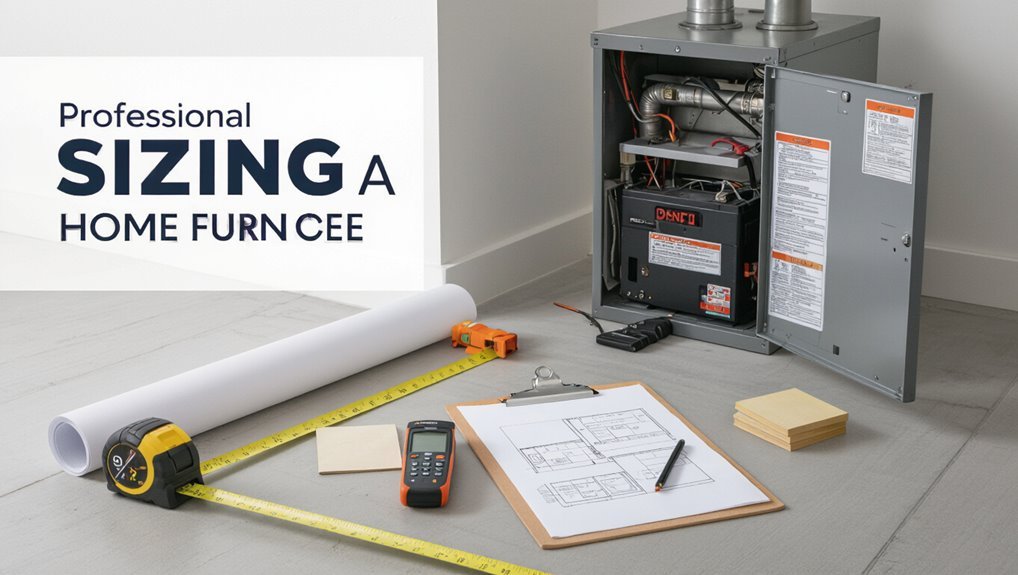
A simple starting point is to match furnace capacity to typical home sizes and regional climate—smaller, well-insulated homes in mild climates often need lower BTU ratings, while larger or poorly insulated homes in cold climates require higher capacity.
General sizing charts can guide most homeowners, but they are only approximations.
A professional load calculation should be sought when the home has unusual construction, major additions, or persistent comfort problems.
Quick recommendation based on common home sizes and climates
When selecting a furnace, homeowners can use quick guidelines that match typical house sizes and regional climate zones to estimate required capacity in BTUs per hour.
These rules of thumb provide a fast starting point before performing a detailed load calculation.
For example, mild climates: 30–40 BTU/ft²; moderate: 40–50 BTU/ft²; cold: 50–60 BTU/ft².
These estimates aid how to size a furnace initially.
When to consult a professional
Why consult a professional? A technician evaluates insulation, building orientation, window efficiency and local climate, then performs Manual J load calculations to determine accurate heating requirements.
Professional assessment is advised for complex layouts, recent renovations, multi-zone systems, or persistent comfort issues. Their recommendation prevents oversizing or undersizing, optimizes efficiency, guarantees code compliance, and aligns equipment selection with long-term performance.
Key Concepts You Must Know Before Sizing a Furnace
Before selecting a furnace, the reader should understand what capacity (BTU/h) signifies and why matching it to the home matters.
It is also important to distinguish rated heating capacity from efficiency (AFUE), and to recognize how temperature rise and airflow influence required sizing.
Finally, the difference between overall heat loss and instantaneous heat load must be considered to guarantee the chosen unit performs correctly.
What furnace capacity (BTU/h) means and why it matters
Furnace capacity, measured in British Thermal Units per hour (BTU/h), quantifies the rate at which a furnace can deliver heat to a space; it is the primary metric used to match a heater’s output to a building’s heat loss.
Correct capacity guarantees consistent indoor temperatures, adequate recovery after cold setbacks, and prevents short cycling or undersized units that struggle in design conditions.
Difference between heating capacity and efficiency (AFUE)
Heating capacity and AFUE describe two distinct aspects of a furnace’s performance: capacity (BTU/h) is the maximum heat output available to meet a building’s load, while AFUE (annual fuel utilization efficiency) is the percentage of fuel energy converted to heat over a year.
Capacity determines sizing; AFUE indicates operating cost and fuel use.
Both matter: one guarantees comfort, the other affects long‑term efficiency and expenses.
How temperature rise and airflow affect sizing
Two linked factors—temperature rise and airflow—directly determine how a furnace must be sized: temperature rise is the required increase in air temperature across the heat exchanger to meet the load, while airflow (measured in cubic feet per minute) controls how much heated air is delivered to the space.
Together, they set the sensible heat output (BTU/h) a furnace must provide. Proper matching guarantees efficient, safe operation.
Impact of heat loss vs. heat load
After establishing how temperature rise and airflow combine to set a furnace’s sensible output, attention shifts to distinguishing heat loss from heat load—two related but different measures that govern sizing decisions.
Heat loss quantifies steady heat escape through envelope, informing required continuous output.
Heat load accounts for transient gains, internal sources, and design margins; both guide capacity selection to guarantee comfort without oversizing.
Step-by-Step Guide to Sizing a Furnace
The guide proceeds through five practical steps to determine the correct furnace size.
It begins by collecting home details (square footage, ceiling height, insulation, windows, orientation) and establishing the local design temperature and climate zone.
A Manual J heat load calculation is then performed with inputs for occupants and envelope, adjusted for duct losses and system efficiency, and used to select the furnace BTU rating and AFUE.
Step 1 Gather home information (square footage, ceiling height, insulation, windows, orientation)
Accurate furnace sizing begins with collecting key home details: total square footage, ceiling heights, insulation R-values, window types and area, and building orientation.
Record conditioned versus unconditioned spaces, floor-by-floor areas, attic and wall insulation levels, window glazing and solar exposure, and construction age.
These measurable inputs form the foundation for a reliable heat loss calculation and guarantee appropriate capacity selection.
Step 2 Determine local design temperature and climate zone
With the home’s physical characteristics documented, attention turns to the external factors that drive heating demand: local design temperature and the climate zone.
The design temperature—typically a low percentile winter value—sets required heating capacity during coldest conditions.
Identify climate zone via regional maps or building codes; this informs insulation expectations, equipment sizing norms, and safety margins used when determining appropriate furnace capacity.
Step 3 Perform a Manual J heat load calculation (overview of inputs)
Now comes the Manual J heat-load calculation, which translates building data and climate inputs into the heating capacity required to maintain comfort.
It quantifies heat losses and gains using inputs: floor area, ceiling height, insulation R-values, window areas and orientations, infiltration rates, interior gains, thermostat setpoints, and local design temperature.
Results specify required sensible and latent capacity for the space.
Step 4 Adjust for duct losses and system efficiency
Proceed to account for duct losses and the appliance’s efficiency once the Manual J output is established.
Apply a percentage for distribution losses—typically 5–20% depending on duct condition, length, and insulation.
Then divide the required delivered heat by the furnace’s AFUE-equivalent operational efficiency to determine input demand.
Include fan heat and any auxiliary losses for a realistic system sizing buffer.
Step 5 Select appropriate furnace BTU rating and AFUE
The installer should translate the adjusted heat-delivery requirement into a concrete furnace model by choosing a BTU input rating that matches or slightly exceeds the calculated demand while selecting an AFUE that balances seasonal efficiency, fuel cost, and budget.
Consider equipment staging, modulation, and manufacturer performance curves; higher AFUE reduces fuel use but increases upfront cost.
Verify warranty, local incentives, and combustion safety certifications before purchase.
Step 6 Match furnace capacity to ductwork and blower airflow (CFM)
Balance furnace capacity with the duct system and blower airflow to confirm the unit can deliver the calculated heat load without undue pressure drop or noise.
Technicians verify required CFM from load (typically 400–450 CFM per ton for cooling; heating uses similar airflow targets), compare blower curves, and assess duct sizing, static pressure, and register distribution to guarantee system efficiency and comfort.
Simplified Sizing Methods and When to Use Them
Simplified methods offer quick estimates for furnace size when a full heat load calculation is impractical.
Common approaches include rule-of-thumb multipliers by square footage, referencing manufacturer sizing charts, and using online calculators.
Each method has trade-offs in accuracy and applicability, so selection should match the project’s complexity and risk tolerance.
Rule-of-thumb sizing by square footage (common multipliers)
Although not a substitute for a full load calculation, rule-of-thumb sizing by square footage offers a quick, rough estimate of furnace capacity using simple multipliers tied to climate and home characteristics.
Common guidelines range from about 25–35 BTU per square foot in mild climates to 40–60 BTU in cold regions; adjustments consider insulation, ceiling height, and window area for better approximations.
Using manufacturer sizing charts
After a quick square-footage estimate has provided a rough target, manufacturer sizing charts offer a more refined, yet still simplified, method for matching furnaces to homes.
These charts cross-reference capacity ranges with climate zones, insulation levels, and home square footage. They help narrow model selection quickly but assume typical construction and occupancy; deviations still require professional measurement or manual heat-load calculations.
Online calculators: pros and cons
How well do online furnace-sizing calculators work for a homeowner seeking guidance? They offer quick, user-friendly estimates based on basic inputs (square footage, climate, insulation).
Pros: convenient, free, and helpful for initial planning.
Cons: simplified assumptions omit heat loss specifics, room-by-room variation, and installation factors.
Results should guide preliminary choices but not replace professional heat-loss calculations.
Comparison of Furnace Types and How They Affect Sizing
Different equipment types change sizing needs through efficiency, output characteristics, and control options. The comparison below highlights key contrasts that affect load calculations and selection. Readers should consider fuel source, staging, and hybrid arrangements when translating heat requirements into equipment capacity.
| Type Category | Impact on Sizing |
|---|---|
| Gas vs Electric | Fuel and AFUE/efficiency alter required input/output capacities. |
| Staging & Speed | Single-, two-stage, variable-speed units affect part-load performance and cycling, influencing recommended size. |
Gas furnaces vs. electric furnaces
Choosing between gas and electric furnaces hinges on fuel availability, efficiency, installation constraints, and the impact each type has on required heating capacity.
Gas furnaces deliver higher output BTUs per unit and often heat faster, reducing required capacity in cold climates.
Electric furnaces have nearly 100% electrical efficiency but lower heat density, potentially necessitating higher rated capacity and different ducting or distribution considerations.
Single-stage, two-stage, and variable-speed furnaces
Furnace operation modes — single-stage, two-stage, and variable-speed — influence not only comfort and efficiency but also the practical sizing and performance margins required for a home.
Single-stage delivers full output, often prompting slight oversizing for peak cold.
Two-stage provides reduced high/low output for steadier heat.
Variable-speed modulates continuously, allowing closer right-sizing, improved humidity control, and lower short-cycling risk.
Heat pumps vs. furnaces for mixed systems
After outlining how single-stage, two-stage, and variable-speed furnaces affect runtime and load-matching, the focus shifts to how those furnace characteristics compare with heat pumps when used together in mixed heating systems.
Mixed systems pair a heat pump for efficient mild-weather heating with a furnace for cold snaps; sizing prioritizes heat pump capacity for base load and furnace backup capacity to cover peak design load reliably.
Common Sizing Mistakes and How to Avoid Them
Common sizing mistakes can undermine comfort, efficiency, and equipment lifespan if not recognized and corrected. This section outlines typical errors—oversizing, undersizing, and neglecting distribution and building envelope factors—and offers practical ways to address them.
Readers will learn to spot warning signs, evaluate risks, and apply targeted fixes.
- Oversizing: signs (short cycling, uneven humidity), consequences (wasted energy, increased wear), and corrective actions (right-sizing, adding zoning or controls)
- Undersizing: risks (inadequate heat, constant operation) and solutions (selecting proper capacity, supplementing with auxiliary heat)
- Ignoring ductwork, insulation, and ventilation: impacts on load calculation and efficiency, plus steps to assess and improve these systems
Oversizing: signs, consequences, and corrective actions
Why does oversizing occur, and how can homeowners recognize it before incurring costs?
Oversizing often stems from estimation errors, conservative contractor bids, or ignoring load calculations.
Signs include short cycling, uneven humidity, higher energy bills, and noisy startups.
Consequences cover increased wear, reduced comfort, and wasted energy.
Corrective actions: perform Manual J, consult qualified HVAC pros, consider zoning, or install right-sized equipment.
Undersizing: risks and solutions
While oversizing forces short cycles and wasted energy, installing a furnace that is too small creates its own set of problems.
It struggles to reach set temperatures, runs continuously, increases wear, raises energy bills, and causes uneven comfort.
Solutions include accurate heat-load calculations, choosing a properly rated unit, consulting HVAC professionals, and considering modest capacity increases only after verified load reassessment.
Ignoring ductwork, insulation, and ventilation factors
How often do installers size a furnace without evaluating the home’s ductwork, insulation, and ventilation—and then wonder why performance falls short?
Ignoring these factors yields uneven heating, higher energy use, and premature equipment stress.
Proper sizing requires duct leakage testing, insulation R‑value assessment, and ventilation analysis.
Coordinated evaluation guarantees capacity matches actual load, improves comfort, and reduces operating costs.
Practical Considerations When Choosing a Furnace
When selecting a furnace, consideration should be given to whether its capacity will accommodate planned renovations or future additions to the home.
Buyers must weigh upfront purchase price against efficiency ratings and projected long-term operating costs.
Warranty terms, brand reliability, and availability of local service technicians are also key factors in ensuring sustained performance and support.
Matching furnace capacity to future renovations or additions
Any homeowner planning renovations should account for potential changes in heating demand before selecting a furnace.
Anticipated additions, finished basements or increased glazing can raise load requirements; conversely, improved insulation may lower them.
Consult load calculations reflecting planned work, allow modest capacity margin for flexibility, and document assumptions so future upgrades or resale reflect accurate system sizing decisions.
Balancing initial cost, efficiency, and long-term operating cost
Having accounted for planned renovations and their impact on heating load, homeowners must also weigh upfront price against efficiency and projected operating expenses.
Higher-efficiency models cost more initially but reduce fuel bills and may recover cost over time.
Evaluate fuel type, local energy prices, expected usage, and payback period.
Balance budget constraints with lifecycle cost to select the most economical, appropriate capacity and efficiency.
Warranty, brand reliability, and local service availability
Although technical specifications and installation quality determine performance, warranty terms, brand reputation, and the availability of local service often dictate long-term satisfaction and total ownership cost.
Buyers should compare warranty length, coverage details, and transferability. Established brands with strong distributor networks simplify parts and repairs.
Local certified dealers and responsive service reduce downtime and unexpected expenses, making reliability and support key selection criteria.
How to Verify Proper Furnace Sizing After Installation
After installation, the installer should measure the temperature rise across the furnace to confirm it matches the manufacturer’s specified range.
Airflow and static pressure should be checked to verify the system is delivering the correct CFM without excessive resistance.
Finally, monitoring system cycling and occupant comfort over several days helps confirm the furnace is neither oversized nor undersized for the space.
Measuring temperature rise across the furnace
Why measure the temperature rise across a furnace? Technicians confirm the furnace adds the correct temperature difference between return and supply air.
Measure with accurate thermometers at return and supply plenum, averaged after steady operation.
Compare to manufacturer’s rated temperature rise range. Deviations indicate incorrect burner adjustment, heat exchanger issues, or duct/leak problems requiring diagnosis and correction.
Checking airflow (CFM) and static pressure
Begin by measuring the furnace’s airflow in cubic feet per minute (CFM) and the system’s static pressure to verify the unit moves the desired volume of air through the ductwork.
These metrics directly affect heat distribution, efficiency, and equipment longevity. Technicians compare measured CFM to design targets, guarantee static pressure stays within manufacturer limits, and adjust blower speed or dampers to correct discrepancies.
Monitoring system cycling and comfort levels
A technician should observe the furnace’s cycling pattern and occupants’ reported comfort to confirm sizing: short cycling, unusually long run times, or persistent hot/cold spots indicate an over- or undersized unit or improper airflow, while steady cycles and even temperature distribution signal a correctly matched system.
The technician documents cycle durations, runtime percentages, and thermostat differentials, correlating findings with zoning, insulation, and duct design to recommend adjustments.
Maintenance and Seasonal Tips to Maintain Efficient Heating
Routine maintenance of filters, ducts, and burners is essential to preserve a furnace’s rated capacity and efficiency.
Homeowners should consider recalibrating or re-evaluating furnace sizing after significant changes such as additions, major insulation upgrades, or altered occupancy patterns.
Adopting energy-saving behaviors—thermostat setbacks, sealing drafts, and efficient ventilation—can lower required heating capacity and extend system lifespan.
Regular filter, duct, and burner maintenance
Several simple maintenance tasks—changing filters, inspecting ducts, and cleaning burners—substantially preserve furnace efficiency and indoor air quality when performed on a regular schedule.
Filters should be replaced or cleaned every 1–3 months; ducts inspected for leaks, blockages, and insulation gaps annually; burners cleaned and adjusted before winter.
These actions reduce energy use, improve heat delivery, and extend equipment lifespan with minimal cost.
When to recalibrate or re-evaluate sizing due to changes in the home
Maintaining clean filters, tight ducts, and properly tuned burners helps preserve a furnace’s performance, but changes to the home can alter heating needs enough to warrant a sizing recheck.
Significant events—finished basements, additions, window replacements, major insulation upgrades, or new HVAC zones—should prompt a heat-load reassessment.
Seasonal comfort issues or escalating fuel use despite maintenance also justify professional recalibration and potential capacity adjustments.
Energy-saving behaviors that reduce required capacity
Although a home’s calculated heating capacity sets a baseline, occupant habits and simple efficiency measures can lower peak demand and reduce the need for oversized equipment.
Implementing targeted behaviors maintains comfort while cutting load and fuel use. Small upgrades and routine practices often shift sizing needs enough to justify smaller systems.
- Upgrade thermostat scheduling and use setbacks
- Seal drafts and insulate strategic areas
- Maintain vents, filters, and balanced airflow
Cost Estimates and Incentives
Typical upfront costs vary by capacity and fuel type, with smaller gas furnaces generally less expensive than high-capacity or electric models.
Operating costs are shown through climate-specific examples that compare seasonal fuel use and projected annual expenses.
Available rebates, tax credits, and utility incentives for high-efficiency units can greatly reduce net purchase and ownership costs.
Typical price ranges by capacity and fuel type
Costs for furnaces vary widely based on capacity (measured in BTUs), fuel type (natural gas, oil, propane, or electric), and efficiency, with entry-level units at lower capacities and simpler fuel systems often starting in the low hundreds for parts but reaching several thousand dollars installed for high-capacity, high-efficiency systems.
Typical ranges: small electric or propane units $500–$1,500; midrange gas or oil $1,500–$4,000; premium systems $4,000–$8,000+.
Estimated operating cost examples for different climates
When evaluating operating costs across climates, seasonal heating demand and fuel prices are the primary determinants of annual expense.
In mild coastal regions, a high-efficiency gas furnace may cost $200–$500 yearly; in cold inland climates, costs rise to $800–$2,000 depending on insulation and run hours.
Electric resistance heating often doubles fuel costs compared with gas or heat pumps under similar conditions.
Available rebates, tax credits, and utility incentives for high-efficiency furnaces
Where can homeowners find savings to offset the higher upfront price of a high-efficiency furnace?
Federal tax credits, state incentives, and local utility rebates often reduce costs; ENERGY STAR or ENERGY STAR Most Efficient models may qualify.
Manufacturers sometimes offer promotions.
Eligibility, amounts, and application processes vary by region; verify current programs through government websites, utility providers, or HVAC contractors before purchasing.
Checklist Before Purchasing or Installing a Furnace
Before purchasing or installing a furnace, the homeowner should assemble essential paperwork and a concise set of questions to guarantee accurate sizing and a transparent process.
A clear checklist helps installers work efficiently and spot problematic bids or practices. Noting common red flags ahead of time reduces the risk of costly mistakes or unsafe installations.
- Documents and measurements to have ready for an installer (floor plans, insulation levels, window types, existing ductwork dimensions)
- Questions to ask HVAC contractors (equipment efficiency, warranty details, exact scope of work, and how load calculations are performed)
- Red flags to avoid during quotes and installations (vague estimates, unusually low prices without documentation, pressure to sign immediately)
Documents and measurements to have ready for an installer
A concise set of documents and accurate measurements streamlines the furnace installation process and helps guarantee correct sizing.
Homeowners should provide floor plans, square footage by zone, ceiling heights, insulation R-values, window counts and types, and recent utility bills.
Include existing equipment specifications, duct layout sketches, and access points.
Accurate data enables precise load calculations and avoids costly oversizing or undersizing.
Questions to ask HVAC contractors
Why ask specific questions?
Prospective buyers should verify contractor licensing, insurance, and references; request detailed load calculation methodology; confirm recommended furnace model, efficiency ratings, and exact capacity; ask about installation timeline, warranty coverage, and maintenance requirements; obtain a written, itemized estimate and change-order policy; clarify ductwork modifications, permits, and post-installation testing procedures before purchasing or scheduling installation.
Red flags to avoid during quotes and installations
How can a buyer tell when a quote or installation warrants suspicion?
Warning signs include vague or absent written estimates, pressure to purchase immediately, unusually low bids, refusal to perform a Manual J load calculation, missing permits, unclear warranties, or subcontractor-only work without credentials.
Unexpected change orders, poor communication, and lack of references also indicate risk.
Verify licenses, documentation, and detailed scope before proceeding.
Conclusion
In the end, the right furnace stands like a polite butler: neither an overbearing steamroller nor a shivering mouse. Homeowners, armed with calculations and common sense, avoid the comedy of overheated rooms and icebox bills. Proper sizing guarantees comfort without drama—an obedient appliance that hums predictably, consumes sensibly, and spares the wallet tragic theatrics. Treat the selection like matchmaking, not roulette, and winter becomes a quietly well-managed opera.
