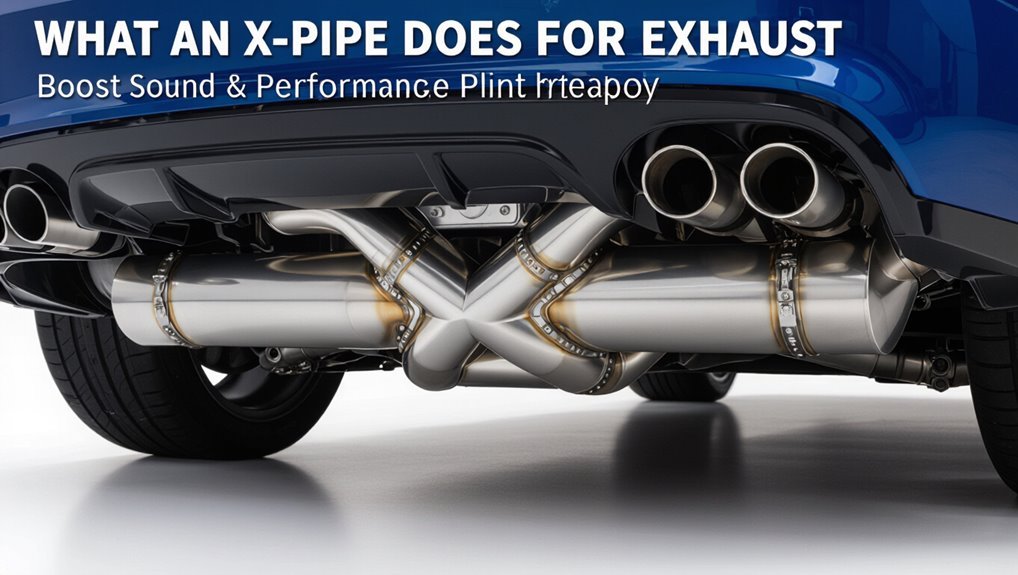
What an X-Pipe Does for Exhaust: Boost Sound & Performance
An X-pipe enhances exhaust performance by connecting opposing exhaust banks, allowing pressure waves to interact and smooth out spiky pulses. This equalization reduces average backpressure, improving scavenging during valve overlap, which can lead to better midrange torque, quicker throttle response, and a slight horsepower increase, depending on the engine design. Additionally, it modifies the exhaust sound, softening rasp and producing a cleaner, higher-pitched tone with decreased decibel peaks. The overall effects can vary based on cam timing, header geometry, and mufflers, with placement, diameter, and tuning further influencing the results.
What Search Intent Does “What an X‑Pipe Does” Satisfy?
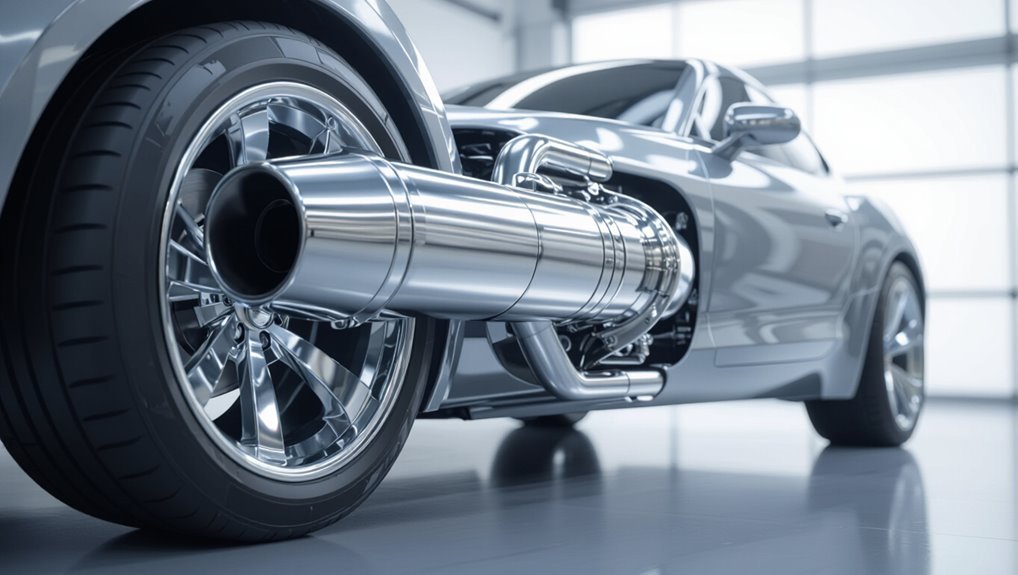
What does a query like “what an X‑pipe does” reveal about the searcher’s intent? It signals an informational intent: the user seeks explanation of function, benefits, and effects rather than buying immediately.
The query likely comes from an owner, enthusiast, or mechanic comparing exhaust components, wanting concise technical distinctions (flow balance, scavenging, sound character) and practical outcomes (efficiency, backpressure changes).
Ancillary intents include researching modification feasibility, compatibility, and performance tradeoffs.
Content satisfying this intent should prioritize clear definitions, measurable effects, and guidance on when an X‑pipe is appropriate, enabling informed decisions without presuming prior expertise.
Quick Answer: What an X‑Pipe Does for Exhaust
Although sometimes subtle, an X‑pipe crosses and merges the two exhaust headers to equalize pulse timing between banks, promoting smoother scavenging and reducing backpressure peaks. It typically produces a milder, higher‑pitched tone compared with H‑pipes or straight pipes, while improving exhaust flow dynamics for many V‑configured engines.
The result can be modest horsepower and torque gains across midrange RPMs, improved throttle response, and marginal fuel efficiency benefits under certain conditions. Installation often reduces exhaust drone and harmonizes sound between cylinders. Outcomes depend on engine design, cam timing, and overall exhaust geometry; results are vehicle‑specific rather than universal.
How an X‑Pipe Works: The Crossover Explained
The X‑pipe uses a central crossover to let exhaust pulses from opposite banks interact and influence each other.
Proper pulse phase alignment at the crossover encourages beneficial pressure wave crossing that smooths flow and reduces backpressure.
This interaction is key to the X‑pipe’s gains in scavenging and midrange power.
Pulse Phase Alignment
By channeling exhaust pulses between both banks, an X-pipe uses crossover geometry to align pressure waves so that expansions and compressions cancel at the junction, smoothing flow and reducing backpressure.
Pulse phase alignment times arrivals from opposing cylinders so rarefaction and compression peaks meet out of phase, diminishing interference that would stall scavenging.
This controlled phase relationship improves exhaust velocity and steadies manifold pressure during valve overlap, aiding cylinder evacuation.
Proper X-pipe placement and pipe lengths tune the phase match across an RPM band, balancing performance gains with a refined exhaust tone while avoiding abrupt pressure reversals that harm flow.
Pressure Wave Crossing
In the X-pipe’s crossover section, pressure waves from opposing exhaust headers intersect and exchange momentum, creating controlled interference that alters local pressure gradients.
This interaction evens pulse energy between banks, reduces peak backpressure, and smooths flow changes.
It subtly shifts scavenging timing, improving cylinder evacuation without harsh resonance.
- Equalization: Wave crossing balances pulses, cutting pressure spikes and improving flow continuity.
- Scavenging boost: Constructive interference enhances exhaust draw at targeted RPM ranges.
- Sound refinement: Destructive interference softens dominant frequencies, yielding a smoother, higher‑pitched tone.
The result is measurable efficiency gain and a more refined exhaust character.
Exhaust Scavenging and How an X‑Pipe Changes It
An X‑pipe alters exhaust scavenging by rearranging pressure waves between the two banks to improve pulse timing. This more consistent phasing helps draw spent gases from the cylinders more efficiently.
The result is lower backpressure and a potential gain in engine responsiveness.
Improved Pulse Timing
When engine exhaust pulses from each bank meet and cross within an X‑pipe, their timing shifts in a way that promotes scavenging: opposing pressure waves cancel partially, creating a lower-pressure window at the collector that helps draw spent gases from the cylinder and pull a fresh intake charge into the combustion chamber.
This altered pulse timing evens exhaust flow, smooths wave interactions, and advances the phase relationship between pulses so scavenging occurs more consistently across RPM range.
The result is steadier cylinder evacuation and improved filling without changing cam or intake timing.
- More consistent pulse phase
- Smoother wave interaction
- Enhanced cylinder filling
Reduced Backpressure
Building on how X‑pipe pulse timing evens flow and boosts scavenging, an X‑pipe also lowers backpressure by promoting cross‑flow and pressure equalization between banks. This reduces residual pressure in cylinders at valve overlap, improving exhaust scavenging and allowing fresher intake charge. The result is crisper throttle response, modest torque gains in the midrange, and reduced pumping losses. An X‑pipe smooths transient spikes and balances flow pulses so neither bank traps excess exhaust. Improved flow efficiency can complement camming and header tuning, but gains depend on engine design, displacement, and exhaust geometry; empirical testing confirms varying benefits.
| Effect | Result |
|---|---|
| Pressure equalization | Reduced backpressure |
| Improved scavenging | Better volumetric efficiency |
| Smoother pulses | Crisper response |
| Engine-dependent | Variable gains |
How Scavenging Translates to Horsepower and Torque
Linking exhaust scavenging to measurable gains requires understanding how improved cylinder evacuation alters the intake charge and combustion process.
Efficient scavenging reduces residual gases, allowing a denser fresh charge, crisper flame propagation, and more complete combustion. That sequence raises peak pressure and expands the useful portion of the power stroke, converting thermal energy into torque. At higher engine speeds the effect compounds as pulse timing enhances evacuation consistency, yielding horsepower gains without changing displacement. Measured improvements depend on tuning, cam timing, and intake design, but scavenging is a fundamental pathway to converting flow efficiency into real-world torque and power gains.
- Increased volumetric efficiency
- Stronger power stroke
- Better high-rpm breathing
When an X‑Pipe Can Reduce Low‑End Torque
Improved scavenging and higher peak pressures often explain X‑pipe benefits at mid and high rpm, but that same pulse interaction can work against low‑end torque in some setups.
At low engine speeds, exhaust pulses are longer and less frequent; an X‑pipe’s crossover can equalize pressures between banks, reducing the strong negative pressure swing that helps draw fresh charge on the next intake stroke. Engines tuned for low‑rpm torque, long runners, or restrictive intake manifolds may lose cylinder filling when that scavenging timing is disrupted. Resulting throttle response and torque feel can soften; careful selection or tuning is required to avoid undesired losses.
Why an X‑Pipe Changes Exhaust Sound Character
How does an X‑pipe alter a V‑engine’s exhaust tone? It balances pressure pulses between banks, promoting smoother scavenging and changing pulse timing. This modifies harmonic content and reduces the raw, choppy character typical of H‑pipes or straight pipes.
- Wave interaction: Cross‑flow blends opposite pulses, canceling some odd harmonics and emphasizing cleaner even harmonics.
- Pulse timing: Altered arrival times shift resonance peaks, producing a higher‑pitched, smoother note.
- Flow continuity: Less turbulence yields steadier exhaust pulses, reducing rasp and producing a more refined, flowing sound.
How Much Sound Change to Expect With an X‑Pipe
An X‑pipe typically produces a noticeable change in tone, smoothing harsh pulses into a more refined growl.
Measurable shifts can occur in both overall decibel level and the dominant frequency content, often reducing low‑end thump while accentuating midrange clarity.
The exact magnitude depends on engine type, pipe dimensions, and the rest of the exhaust system.
Noticeable Tone Change
Frequently, swapping a factory H- or straight pipe for an X-pipe produces a clear but moderate change in exhaust tone: the midrange smooths, the rasp softens, and the overall note often becomes slightly higher-pitched and more refined without dramatically increasing loudness.
Listeners note a subtler, more musical character rather than raw aggressiveness. Expect perceptible but not radical alteration; vehicle age, engine tuning, and muffler design influence results.
Typical impressions include improved balance between banks and cleaner burbles during throttle shifts. Practical observations often focus on perceived sophistication rather than sheer volume.
- Smoother midrange
- Reduced rasp
- Slightly brighter timbre
Decibel And Frequency Shift
Having noted the tonal smoothing an X-pipe brings, attention turns to measurable changes in sound level and spectrum. An X-pipe typically reduces peak decibel readings by 1–4 dB compared with H-pipe or straight-through setups, depending on engine displacement, cam timing and muffler design.
More pronounced is the spectral shift: even-order harmonics are emphasized while harsh odd-order spikes diminish, producing a cleaner midrange and fewer high-frequency peaks. Measured frequency content shows energy redistributed toward lower harmonics, reducing perceived roar without large overall loudness loss.
Real-world results vary; dyno and in-vehicle acoustic testing quantify exact decibel and frequency shifts.
X‑Pipe vs H‑Pipe: Key Differences
Compare X‑pipe and H‑pipe designs by focusing on how each balances exhaust flow, scavenging, and sound character. The X‑pipe promotes cross‑flow between banks, improving scavenging and smoothing pulses for higher‑rpm power and a quieter, higher‑pitched tone. The H‑pipe maintains more independent flow, preserving low‑end torque and a throaty, classic rumble.
Packaging, backpressure, and resonance differ: X favors flow and balance, H favors character and low‑end response. Choice depends on desired sound and mid/high versus low torque tradeoffs, not engine type specifics.
- Flow and scavenging
- Tone and resonance
- Backpressure and packaging
Which Engines Benefit Most From an X‑Pipe
Interest centers on which engine designs gain the most from an X‑pipe. Crossplane V8s typically benefit through improved scavenging and reduced exhaust pulse interference, enhancing midrange torque and smoothing power delivery.
High‑revving inline‑four engines can also see gains in top‑end power and a less abrupt exhaust note when paired with an X‑pipe.
V8 Crossplane Engines
For many road‑going and performance applications, V8 crossplane engines gain the clearest benefits from an X‑pipe setup. The crossplane crank creates uneven exhaust pulses between banks; an X‑pipe evens flow, reduces backpressure spikes, and smooths scavenging.
Gains appear as improved midrange torque, crisper throttle response, and a less choppy, more exotic exhaust note without losing character.
- Increased scavenging efficiency improves midrange torque and responsiveness.
- Smoother exhaust pulse interaction reduces resonance peaks and drone.
- Broadened powerband while retaining the V8’s tonal identity for street and track use.
High‑Revving Inline‑Fours
Why consider an X‑pipe on a high‑revving inline‑four? Engineering-focused drivers find benefits in engines that rely on precise exhaust scavenging at high RPM. Inline‑fours with close firing intervals and short header lengths gain improved pulse tuning from an X‑pipe, smoothing pressure waves and reducing backpressure spikes.
The result can be a slightly broader power band, crisper throttle response, and a less peaky midrange. Audiophiles also notice a cleaner, higher‑pitched tone rather than a raw bark. Best candidates are lightweight, naturally aspirated or minimally boosted performance fours that spend significant time above mid‑range RPM.
X‑Pipe Effects on Turbo vs Naturally Aspirated Engines
When comparing turbocharged and naturally aspirated engines, an X-pipe affects exhaust flow and scavenging differently due to distinct pressure dynamics and pulsation patterns; naturally aspirated engines often see clearer midrange gains from improved scavenging and smoother exhaust note, while turbocharged setups primarily benefit in reduced backpressure and more even flow to the turbos, with acoustic changes largely masked by turbine noise.
- Naturally aspirated: improved pulse timing, stronger midrange torque, and a refined, higher‑pitch tone.
- Turbocharged: reduced exhaust backpressure, more consistent turbine feed, and marginal audible change.
- Packaging: fitment and routing determine real‑world gains.
Pipe Diameter & Length: Effects on X‑Pipe Performance
Pipe diameter affects flow velocity and scavenging, with larger diameters favoring high‑rpm power while smaller tubes aid low‑end torque.
Pipe length alters pulse timing and resonance, shifting where the X‑pipe smooths pressure waves and boosts scavenging.
Best sizing thus depends on engine displacement and planned powerband to match flow capacity and tuning frequency.
Diameter Effects On Flow
Engineers and tuners evaluate pipe diameter and length because they directly govern gas velocity, backpressure, and the timing of pressure waves within an X‑pipe, which together determine scavenging efficiency and torque characteristics.
Diameter changes alter flow regime: smaller diameters raise gas velocity and midrange torque but increase backpressure at high RPM; larger diameters reduce restriction for peak power but can weaken scavenging at low RPM.
Shifting between diameters affects pulse interaction in the crossover.
Material, bends, and collector sizing modify these effects.
Choice depends on engine displacement, cam timing, and targeted powerband.
- Small diameter — better midrange response, higher backpressure.
- Large diameter — peak power, lower restriction.
- Compromise sizing — balanced torque and top‑end.
Length Influences Resonance
Although often considered secondary to diameter, pipe length plays a primary role in tuning resonance and the timing of pressure waves within an X‑pipe system. Length determines standing wave nodes, affects scavenging timing between banks, and shifts the frequency content that reaches the cabin. Shorter runs favor higher resonant frequencies and quicker transient response; longer runs lower pitch and enhance midrange torque pulse reinforcement. Designers balance length to achieve desired sound and pressure wave interaction without matching engine displacement specifics. The table summarizes length effects and tradeoffs.
| Length | Acoustic effect | Performance tradeoff |
|---|---|---|
| Short | Higher pitch | Faster response |
| Medium | Balanced tone | Versatile tuning |
| Long | Lower pitch | Improved mid torque |
Matching To Engine Size
Several factors determine the ideal combination of diameter and length for an X‑pipe relative to engine displacement and cylinder count. The X‑pipe must balance flow and scavenging pulses: larger displacement or more cylinders favor increased diameter for reduced backpressure, while shorter lengths shift power toward higher rpm. Matching preserves pulse timing and resonance used for scavenging; mismatches harm torque or top‑end power. Designers choose dimensions to complement cam timing, intake characteristics, and desired powerband. Practical selection weighs weight, packaging, and noise.
Examples of considerations:
- Cylinder count versus pipe cross‑section.
- Displacement influencing diameter scaling.
- Length tuning for target rpm range.
Crossover Angle & Shape: Why Geometry Matters
When placed at an ideal angle and shaped to promote smooth flow, the crossover becomes the defining element that controls scavenging efficiency and backpressure balance in an X-pipe system. Geometry determines how pressure waves meet and cancel; shallow angles encourage gradual merging, reducing turbulence, while sharper intersections can induce reflections that raise backpressure.
Cross-sectional shape—ovalized versus circular—affects velocity distribution and pulse timing, influencing cylinder evacuation consistency. Symmetry between limbs ensures equalized flow between banks. Properly designed geometry maximizes scavenging at targeted RPM bands without sacrificing low-end response, making precise angle and contour selection critical for measured performance gains.
Where to Place the X‑Pipe in Your Exhaust System
Placed thoughtfully along the midsection of the exhaust, the X-pipe should sit where pulse timing and pressure equalization most effectively enhance scavenging—typically between the headers and the mufflers, at a distance that allows primary pulses to develop but before excessive backpressure accumulates.
The ideal location balances length, routing, and ground clearance while considering vehicle packaging and catalytic converter placement.
Installation should avoid tight bends or proximity to heat-sensitive components.
Practical choices vary by engine tune and tube diameter; minor adjustments shift midrange torque and tone without major fabrication.
- Central midpipe — preserves pulse separation.
- Ahead of mufflers — maximizes scavenging.
- Clearance zone — protects components.
How X‑Pipe Design Influences Exhaust Heat Distribution
By routing and merging the two exhaust streams, an X-pipe redistributes thermal energy between banks so that heat is more evenly spread along the midsection of the system. Design variables — crossover location, angle, diameter, and length — govern mixing efficiency and residence time, altering temperature gradients.
A centrally placed, smooth junction encourages balanced flow and reduces hot spots downstream, aiding catalytic converter and muffler longevity. Conversely, abrupt junctions or mismatched diameters produce uneven heating and localized thermal stress.
Material choice and wall thickness affect heat retention and dissipation. Properly engineered X-pipes promote uniform exhaust temperatures, improving component durability and predictable thermal behavior.
How Backpressure Interacts With an X‑Pipe
An X‑pipe alters pulse timing to reduce the intensity of individual pressure waves between the engine banks.
This smoothing of pulses can lower overall backpressure, allowing exhaust gases to exit more freely.
Reduced backpressure promotes improved scavenging efficiency, aiding cylinder filling and exhaust evacuation.
Reduced Pulses, Lower Backpressure
In an X‑pipe system, exhaust pulses from opposite banks intersect and partially cancel, smoothing the flow and reducing peak pressure spikes that contribute to backpressure. This moderation of pressure transients lowers average resistance in the downstream pipe, allowing gases to exit more freely without relying on elevated manifold pressure.
The effect is most noticeable during steady cruise and midrange acceleration, where pulse overlap is regular. Reduced peaks also lessen reflected waves that can impede cylinder emptying.
Net result: a calmer exhaust column, modestly lower backpressure, and more consistent downstream flow characteristics that support improved engine responsiveness.
- Lower peak pressures
- Reduced reflected waves
- Smoother downstream flow
Improved Scavenging Efficiency
Through controlled reduction of backpressure, an X‑pipe enhances scavenging by allowing exhaust pulses to evacuate cylinders more completely during valve overlap. The improved flow balance promotes fresher intake charge entry, raising volumetric efficiency and smoothing torque delivery. By mitigating residual gases, combustion quality improves, aiding throttle response and fuel efficiency. The effect depends on pulse timing, manifold design, and engine speed; benefits are most notable where overlap timing aligns with pulse extraction. Engineers consider these interactions when tuning piping length and crossover location to optimize scavenging without sacrificing midrange performance.
| Parameter | Effect |
|---|---|
| Backpressure | Reduced |
| Pulse timing | Balanced |
| Volumetric efficiency | Increased |
| Torque delivery | Smoothed |
When an X‑Pipe Improves Horsepower and When It Won’t
Frequently, an X-pipe increases horsepower when exhaust pulses from paired cylinder banks are timed so that scavenging and backpressure reduction occur at mid-range and high RPMs; conversely, it will not help — and can even hurt low-end torque — when engine tuning, cam profile, or unequal pulse timing prevent effective pressure equalization.
Effectiveness depends on engine architecture, valve timing, and existing piping. In some V-engines with even firing order benefits appear; in others misaligned pulses negate gains.
Consider accompanying changes before assuming improvements.
- Matching: compatible firing order and equal-length headers.
- RPM range: designed gains occur above certain revs.
- Tuning: fueling and timing must be optimized.
How to Measure Gains After Installing an X‑Pipe
Evaluation begins with baseline recordings: capture sound levels and performance metrics before installation.
After fitting an X‑pipe, repeat the same sound measurements and track metrics such as lap times, acceleration runs, and fuel consumption for direct comparison.
Consistent measurement procedures and controlled conditions guarantee that observed changes reflect the X‑pipe’s effects rather than external variables.
Measure Before/After Sound
How can one reliably quantify the change in exhaust tone after installing an X-pipe? Objectivity requires consistent procedures: identical engine conditions, same microphone placement, and comparable background noise. Use a decibel meter for SPL and a smartphone or recorder for spectral analysis. Compare idle, cruise, and wide‑open throttle recordings. Note perceived character changes—smoother midrange, reduced drone—alongside numbers.
- Record baseline and after under identical conditions.
- Measure SPL and capture audio for FFT/spectrum comparison.
- Log position, RPM, gear, and ambient noise to validate comparisons.
Track Performance Metrics
When evaluating track performance after installing an X‑pipe, objective, repeatable measurements are essential. Lap times, sector splits, and consistency are primary metrics; use a GPS-based logger for accuracy. Record ambient conditions, tire pressure, and fuel load to normalize results. Monitor engine parameters (RPM, boost if applicable), and use video telemetry to correlate driver inputs. Conduct multiple runs to reduce variance and calculate mean and standard deviation. Compare before/after data statistically to confirm gains.
| Metric | Tool | Purpose |
|---|---|---|
| Lap time | GPS logger | Overall performance |
| Sector split | Timing box | Identify strengths |
| Consistency | Std. deviation | Reliability of gains |
Dyno Testing: What to Look for After Fitting an X‑Pipe
After fitting an X‑pipe, a dyno session quantifies changes in power delivery, torque curve shape, and overall engine behavior across the RPM range. Observers focus on steady, repeatable runs, comparing baseline and post‑mod graphs to spot shifts in peak horsepower, torque timing, and midrange responsiveness.
Temperature, intake conditions, and gear selection are controlled to isolate exhaust effects. Data aids decisions about further hardware or calibration without discussing tuning specifics.
- Peak changes: note magnitude and RPM of horsepower/torque gains.
- Curve shape: look for smoother midrange and widened power band.
- Repeatability: confirm consistent results across multiple runs.
Do You Need ECU Tuning After Installing an X‑Pipe?
Data from dyno testing often informs the next question: whether the engine control unit should be retuned following an X‑pipe installation.
An X‑pipe can alter exhaust flow enough to change scavenging and backpressure characteristics, modestly affecting fuel trim and timing under load.
Retuning is not always required for safe operation, but targeted ECU adjustments can optimize power gains, throttle response, and torque curves revealed by dyno runs.
Decisions hinge on vehicle make, stock tune conservatism, and whether supporting mods exist.
Professional tuning after measuring real-world or dyno data yields the clearest balance of reliability and performance improvement.
How X‑Pipes Affect Emissions and O2 Sensors
An X‑pipe can alter oxygen sensor readings by changing exhaust pulse timing and gas mixing, which may influence air‑fuel calculations.
These changes carry potential emissions compliance risks if they cause catalytic converters to perform outside regulatory parameters.
Proper sensor placement and awareness of pre‑ versus post‑cat O2 locations are consequently important when installing an X‑pipe.
Effects On O2 Readings
When integrated into an exhaust system, an X-pipe alters the pressure waves and gas flow balance between cylinders, which can change the scavenging characteristics and the oxygen content reaching downstream sensors.
This modification often smooths exhaust pulses, producing more consistent O2 sensor readings but can also shift short-term voltage fluctuations.
Engine control modules adapt via closed-loop feedback, adjusting fuel trims to restore target air–fuel ratios.
Monitoring devices may record reduced oscillation amplitude and slightly different lambda averages, depending on sensor position and tuning.
Practical impacts depend on piping geometry, engine load, and sensor placement.
- Smoother pulse patterns
- Altered short-term voltages
- Adjusted fuel trims
Emissions Compliance Risks
At times, fitting an X‑pipe can unintentionally change downstream oxygen sensor readings enough to affect emissions compliance.
Altered exhaust scavenging and pulse timing can shift air‑fuel ratios measured by downstream O2 sensors, potentially triggering check engine lights or failed tailpipe tests.
Vehicles with closed‑loop control may compensate, masking issues during inspection but increasing transient emissions.
Compliance risk depends on vehicle diagnostics sensitivity, regulatory thresholds, and whether catalytic converter efficiency is impacted.
Owners should consider that tuning, catalytic condition, and sensor response interact; undocumented changes can create noncompliant states.
Professional evaluation minimizes risk and guarantees modifications meet local emissions laws.
Sensor Placement Considerations
Positioning oxygen sensors relative to an X‑pipe materially influences the signals received by the engine control unit and emissions testers. The crossover blends exhaust pulses, altering O2 sensor readings and transient response. Incorrect placement can trigger adaptive fueling corrections, false fault codes, or failed emissions checks. Proper strategy maintains accurate feedback while preserving X‑pipe benefits.
- Upstream sensors: preserve cylinder-specific readings; keep them close to headers to avoid pulse mixing.
- Downstream sensors: monitor catalytic converter efficiency; place after the X‑pipe but before excessive mixing dilutes signals.
- ECU tuning: recalibrate sensor thresholds and learn tables after relocating sensors to prevent drivability issues.
Bolt‑On X‑Pipe vs Custom‑Fabricated Crossover
Between a bolt‑on X‑pipe and a custom‑fabricated crossover, the choice centers on fitment, performance tuning, and cost.
A bolt‑on unit offers straightforward installation, predictable flow characteristics, and factory‑matching hangers; it suits common platforms and preserves warranty benefits where applicable.
A custom‑fabricated crossover permits tailored pipe diameters, merge angles, and material choices to optimize scavenging, balance backpressure, and achieve specific tone or power targets.
Fabrication handles unique chassis constraints and aftermarket headers more cleanly but raises labor and design expense.
Decision factors include desired gains, installation skill, available routing space, and willingness to invest in tuning after modification.
How to Pick the Right X‑Pipe for Your Car’s Layout
How should the X‑pipe be chosen to match a vehicle’s underbody, exhaust routing, and planned use? Selection depends on clearance, bends, and intended objectives. Measure available space, note suspension and drivetrain proximity, and map the factory routing to avoid heat or contact points. Consider flow characteristics appropriate for cruising versus high‑rpm power, and choose flange styles that align with existing piping to minimize adapters.
- Match diameter and taper to engine output and desired torque/power curve.
- Verify physical fit: hangers, bends, and ground clearance.
- Plan installation complexity: bolt‑on versus minor fabrication.
Common X‑Pipe Materials and How They Affect Results
Common X-pipe materials—stainless steel, mild steel, and titanium—each bring distinct trade-offs to performance and longevity.
Stainless steel is prized for corrosion resistance and long-term durability, while mild steel offers lower upfront cost but requires more maintenance and may rust.
Titanium reduces weight and can improve throttle response, though it carries a higher price and different sound characteristics.
Stainless Steel Durability
Stainless steel grade and construction materially influence an X‑pipe’s longevity and performance. Corrosion resistance, wall thickness, and weld quality determine durability under heat cycles and road exposure. Proper alloys resist pitting and maintain flow geometry, preserving sound character and backpressure benefits.
- 304 vs 409: 304 offers superior corrosion resistance and longer life; 409 is lighter‑duty but adequate in milder environments.
- Wall thickness: thicker walls improve rigidity and thermal mass, reducing deformation from heat but add weight.
- Weld quality and fitment: continual leak‑free joints maintain scavenging efficiency and consistent acoustic tuning over time.
Mild Steel Cost Tradeoffs
Economy often dictates the choice of mild steel for X‑pipe construction, as its lower material and fabrication costs make it attractive for budget builds and short‑term applications.
Mild steel provides adequate acoustic merging and flow characteristics when properly dimensioned, yielding expected sound smoothing and modest performance gains.
Tradeoffs include susceptibility to corrosion, shorter service life, and potential for weld degradation under high heat, increasing long‑term maintenance. Surface treatments can delay rust but add cost.
For owners prioritizing initial expense over longevity, mild steel is practical; for those seeking lasting resilience, alternative alloys may be preferable.
Titanium Weight Benefits
Titanium’s low density gives X‑pipe assemblies a distinct weight advantage: compared with mild steel or even many stainless alloys, a titanium X‑pipe can reduce system mass substantially, improving vehicle unsprung and overall weight distribution.
The material’s strength-to-weight ratio permits thinner tubing without sacrificing durability, aiding throttle response and handling.
Corrosion resistance extends service life while heat retention reduces catalytic warm‑up time slightly.
Cost and fabrication complexity remain tradeoffs; nevertheless, weight savings often justify premium pricing for performance-focused builds.
- Reduced mass: better handling and acceleration.
- Durability: high fatigue resistance.
- Thermal behavior: affects emissions device efficiency.
Cost Ranges: Budget to High‑End X‑Pipe Options
When considering X-pipe upgrades, buyers will encounter a wide price spread that reflects materials, construction quality, and brand reputation. Entry-level X-pipes, often made from thinner stainless or aluminized steel, are affordable and suit basic applications but may sacrifice longevity and fitment precision.
Mid-range units use 16–18 gauge stainless, offering improved corrosion resistance, weld quality, and smoother flow characteristics. High-end options employ T304 or T316 stainless, mandrel bends, TIG welding, and precision flanges; some integrate resonators or balance tubes for tailored tone.
Installation complexity and adapter needs also influence overall cost beyond the part price.
Legal and Warranty Considerations for X‑Pipe Swaps
Regarding legal and warranty considerations for X‑pipe swaps, owners should verify emissions regulations, local noise ordinances, and manufacturer warranty terms before modifying the exhaust. Compliance prevents fines and emissions test failures; documented factory parts and certified installers can preserve warranty coverage. Liability and resale implications merit attention.
- Check state and local emissions laws plus noise limits; noncompliance can require removal and penalties.
- Review vehicle warranty language about aftermarket exhaust components and whether dealer service may deny coverage for unrelated failures.
- Keep receipts, install documentation, and emissions waivers to support compliance and potential warranty claims.
Which Aftermarket Brands Make Reliable X‑Pipes
After confirming legal and warranty implications, the next practical step is selecting a reputable manufacturer for an X‑pipe swap.
Established brands like Borla, Flowmaster, MagnaFlow, and Corsa are frequently cited for consistent fitment, durable stainless steel construction, and validated flow characteristics.
Boutique makers such as ARH, Roush, and aFe offer model-specific designs and performance tuning.
Buyers should cross-reference material grade, weld quality, and available dyno data while considering backing warranties and dealer support.
Community forums and independent reviews help verify claims.
Prioritizing proven track records reduces risk and streamlines achieving desired sound and performance gains.
Bolt‑On vs Custom: Installation Skill and Tools Required
In choosing between a bolt‑on X‑pipe and a custom fabrication, the decisive factors are the installer’s experience and the availability of specialized tools.
Bolt‑on units suit technicians with basic hand tools and a lift; they require alignment, fastening, and occasional gasket replacement.
Custom X‑pipes demand metalworking skills: measuring, mandrel bending, welding, and fitting to unique chassis constraints.
Time, access to a TIG or MIG welder, tube bender, and fabrication bench determine feasibility.
Cost trades off against precision; professionals can deliver complex routing and optimized flow, while DIYers benefit from simplicity and reduced fitment risk.
- Bolt‑on: basic tools, quicker
- Custom: welding, bending
- Tradeoffs: cost vs fit
Step‑By‑Step Checks During X‑Pipe Install
What checks should be made at each stage to guarantee a correct X‑pipe installation? A concise checklist assures fit, seal, alignment, and safety. Inspect flanges and hangers for corrosion; test mock fit, then tighten progressively; verify centerline alignment; check clearance to chassis and suspension at full droop; run engine and inspect for leaks and vibration. Final torque and heat‑cycle recheck complete the process.
| Stage | Quick Check |
|---|---|
| Pre‑fit | Parts, gaskets, hardware |
| Mock fit | Alignment, hanger positions |
| Tighten | Torque sequence, hand‑tight then spec |
| Clearance | Suspension, driveline, heat shields |
| Final | Run, leak, vibration check |
Common Installation Mistakes and How to Avoid Them
When installing an X‑pipe, several recurring mistakes account for most fitment and performance issues; recognizing these common errors early prevents leaks, rattles, and premature component wear. Proper flange alignment, secure hangers, and correct weld technique are essential. Poor alignment strains joints, loose hangers allow movement, and cold or contaminated welds fail.
Measuring twice, mocking up before finalizing, and using anti-seize or proper gaskets preserve integrity. Avoid overtightening fasteners that warp flanges. Professional torque specs and corrosion-resistant hardware extend life. Visual inspection and a short road test reveal immediate problems before they worsen.
- Misaligned flanges
- Inadequate hanger support
- Improper welding or sealing
Troubleshooting Unwanted Drone After an X‑Pipe Install
Why does an X‑pipe sometimes create an intrusive drone even when fitment appears correct? The phenomenon stems from resonance, harmonics, and interaction with remaining exhaust geometry. Diagnosis requires isolating variables: engine speed, cabin reflections, and minor leaks. Common remedies include adjusting pipe length, adding resonators, or sealing joints. Calibration should focus on frequencies producing most annoyance rather than blanket loudness reduction. Below is a concise diagnostic checklist:
| Issue | Action |
|---|---|
| Resonance peak | Change pipe length |
| Harmonic coupling | Add resonator |
| Leak at joint | Reseat and seal |
| Cabin reflection | Add insulation |
| RPM-specific drone | Tune engine mapping |
How to Combine an X‑Pipe With Muffler Choices
How should an X‑pipe be paired with a muffler to achieve a desired balance of tone, flow, and drone control? An X‑pipe smooths pulses; muffler choice refines tone, backpressure, and resonance. Matching requires attention to core size, chambering, and packing to preserve scavenging while shaping sound without inducing drone.
- Straight‑through mufflers: maintain flow and brighter tone, best with larger X‑pipe tubing to avoid restriction.
- Chambered/baffled mufflers: mellow midrange, can complement X‑pipe balance but risk pockets that create low‑frequency drone.
- Glass‑packed/packed mufflers: moderate sound attenuation, helpful to tame harshness while retaining performance benefits.
How to Test Before and After: Sound and Performance Checklist
What measurements and observations will validate the effect of an X‑pipe and muffler combination? A concise checklist covers objective and subjective metrics.
Measure decibels at idle, cruise, and wide‑open throttle using a smartphone app or SPL meter, noting measurement distance and angle.
Log 0–60 and quarter‑mile times, or use GPS‑based performance apps for acceleration and trap speed.
Record exhaust gas temperatures and backpressure if equipment permits.
Compare fuel consumption over identical routes.
Capture audio samples before and after for blind listening tests.
Note drone presence at cruising RPM, throttle response, and any vibration changes.
Maintain consistent environmental conditions.
Real‑World Owner Experiences: Common Reports & Caveats
Drawing from numerous owner reports, common outcomes after installing an X‑pipe and new mufflers include a smoother, higher‑pitched exhaust tone, reduced low‑frequency drone at steady cruising RPMs, and modest gains in midrange torque with improved throttle response; however, results vary by vehicle, stock exhaust layout, and muffler design.
- Many note clearer, raspy character under acceleration but subdued cabin drone on highway cruises.
- Some observe measurable midrange torque improvements; others see negligible power changes depending on tuning and backpressure.
- Fitment, weld quality, and muffler choice frequently determine satisfaction; improper installation can introduce leaks or unwanted harmonics.
Scenarios Where an X‑Pipe Is Not the Right Choice
Although an X‑pipe can tame drone and smooth the midrange for many V‑configurations, it is not universally appropriate. Owners seeking a raw, muscular lope often prefer H‑pipes or straight pipes to preserve uneven exhaust pulses and deeper low‑end character.
Vehicles with unequal bank lengths or complex factory manifolds may gain little from an X‑pipe and could suffer fitment issues or increased backpressure. Emissions equipment, noise regulations, or cruise‑control and drone sensitivity also rule out X‑pipe swaps. Budget constraints, desired tuning outcomes, and the specific engine’s pulse timing determine whether an X‑pipe is the best choice.
Conclusion
An X‑pipe offers clear tradeoffs between sound and performance, balancing exhaust pulses to boost midrange torque and smooth the tone. When chosen and paired with compatible mufflers, it can yield measurable gains and a refined growl without harshness. Owners report noticeable differences but also note limitations based on engine type and tuning. Is an X‑pipe the best upgrade for every build, or simply one effective tool among many to shape power and sound?