Where to Buy PVC Pipe: Top Stores & Online Suppliers Near You
Homeowners and contractors can buy PVC pipe at various places including big-box stores, local hardware shops, plumbing supply houses, agricultural dealers, and online marketplaces. Big-box retailers typically offer common sizes, cutting services, and easy pickup options. Plumbing wholesalers and specialty suppliers provide higher-grade options, certified fittings, and expert advice. For agricultural needs, dealers stock pressure-rated and UV-stabilized lines. If you’re looking for odd sizes or bulk orders, online sellers and direct manufacturers are great options. Continue reading for guidance on matching sizes, schedules, and the best suppliers for your needs.
Quick Answer: Where to Buy PVC Pipe Near You
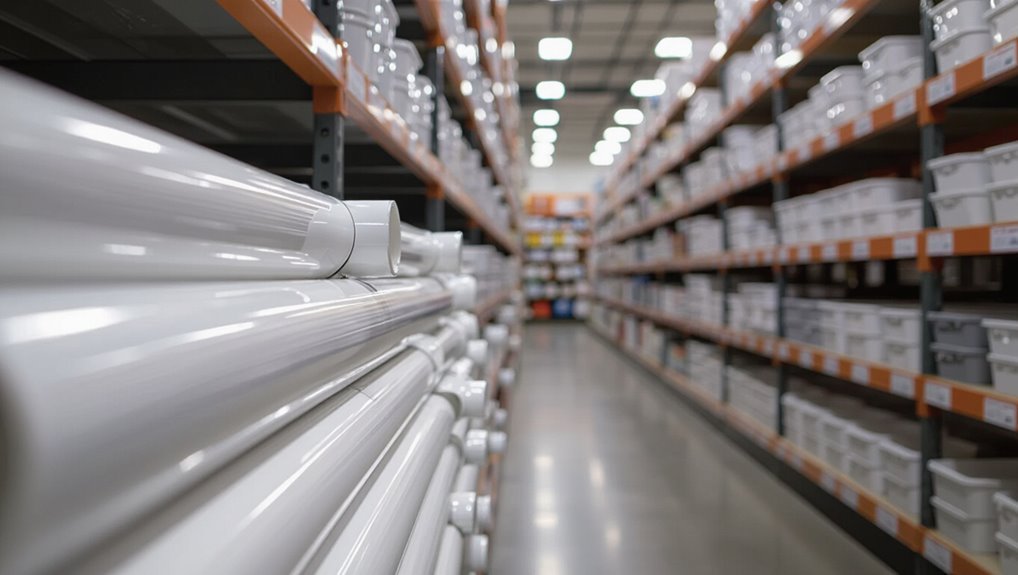
For quick, local access to PVC pipe, shoppers commonly turn to big-box home improvement stores, plumbing supply houses, and hardware chains, where standard diameters and lengths are stocked and staff can help with fittings and codes.
These retailers often offer immediate pickup, basic cutting services, and accessible return policies.
Independent plumbing supply stores provide broader specialty inventory and technical advice for contractors.
Local hardware stores suit small repairs and odd-sized needs.
Online suppliers and marketplaces expand options for uncommon sizes or bulk orders, with shipping and delivery choices.
Comparing price, availability, and service speeds helps determine the best nearby source.
Which PVC Pipe Types and Schedules to Choose First
Buyers should first consider common pipe schedules like Schedule 40 and Schedule 80, which indicate wall thickness and pressure capacity.
Next, selection should be guided by application-based types—pressure-rated PVC for water lines, CPVC for hot water, and conduit-grade for electrical runs.
Matching schedule and type to the planned use simplifies purchasing and guarantees safety and code compliance.
Common Pipe Schedules
When selecting PVC pipe, understanding common schedules — primarily Schedule 40 and Schedule 80 — helps match wall thickness and pressure capacity to the job’s demands; Schedule 40 suits most residential plumbing and irrigation, while Schedule 80 offers thicker walls for higher-pressure or industrial applications.
Users should note nominal diameter versus actual dimensions, as schedules maintain diameter but change wall thickness. Pressure ratings decrease with temperature; consult manufacturer tables for safe limits.
Lightweight, lower-cost Schedule 40 is adequate for many DIY projects. Schedule 80 provides added mechanical strength and is preferable where impact, high pressure, or longer service life are concerns.
Application-Based Types
With application and environment guiding the choice, the first step is to match pipe type and schedule to the system’s function—pressure-bearing water lines typically call for Schedule 40 PVC for residential use or Schedule 80 where higher pressure or mechanical stress is expected, while nonpressure drainage, waste, and vent systems use thinner-walled DWV (or sewer-and-drain) PVC; outdoor, buried, or potable-water applications may require UV-resistant, thicker-walled, or NSF-listed compounds.
Installers should prioritize compatibility with fittings, solvent cement, and local code.
For irrigation, use pressure-rated conduit; for chemical or high-temperature service, select CPVC or specialized formulations.
How to Match PVC Pipe Sizes and Fittings
The guide explains that matching PVC fittings begins with the pipe’s outside diameter, since many fittings are specified by OD rather than nominal size.
It notes that users should confirm compatible schedules because wall thickness affects the OD and pressure rating.
Clear measurement and matching of both OD and schedule prevent leaks and guarantee proper fit.
Matching Outside Diameter
To match PVC pipe sizes and fittings, focus on outside diameter (OD) rather than nominal size: fittings are molded to accept a specific OD, so two pipes labeled the same nominal size can still differ if one is Schedule 40 and the other is Schedule 80.
Measure OD with calipers or compare manufacturer specifications. Use fittings sized to that OD or adapters designed to bridge between different ODs.
For slip fittings and socket connections, confirm the socket ID matches the pipe OD. For threaded fittings, guarantee thread dimensions correspond to the pipe’s OD-based thread standard to avoid leaks or mechanical failure.
Choosing Compatible Schedules
Understanding PVC schedules is essential when matching pipe to fittings because schedule determines wall thickness and hence outside diameter for the same nominal size.
The buyer must verify schedule numbers (e.g., Schedule 40, Schedule 80) and consult manufacturer dimension charts to confirm outside diameters match the planned fittings.
Solvent-weld and threaded fittings are usually labeled by nominal size and expect consistent OD; mixing schedules can cause leaks or improper fit.
For retrofits, measure OD directly and select fittings rated for the pipe’s pressure class.
When uncertain, choose fittings from the same brand or supplier to guarantee compatibility and reliable performance.
Best Big‑Box Stores for PVC Pipe (Home Depot, Lowe’s, Ace)
Many homeowners and contractors prefer big‑box retailers for PVC pipe because they combine broad selection, predictable pricing, and nationwide availability.
These stores stock common sizes, fittings, and solvent cements, making them convenient for repairs and straightforward projects. Staff can often point to stocked brands and basic compatibility, while return policies and standardized labeling reduce uncertainty.
Pricing tiers and occasional in‑store promotions make comparison shopping simple.
For specialty grades or obscure fittings, big boxes may fall short, but for routine plumbing, irrigation, and DIY tasks they remain a reliable, accessible option with broad physical presence and consistent service.
Home Depot: PVC Types, Sizes, and Pickup Options
Home Depot builds on the big‑box strengths by offering a wide range of PVC types—schedule 40 and 80 pressure pipe, DWV, conduit, and irrigation—across common diameters from 1/2 inch to 6 inches and beyond for some applications.
The retailer stocks fittings, primers, cement, and specialty items like CPVC and pressure-rated couplings.
Online inventory shows aisle and bay locations for many stores, facilitating quick in‑store pickup.
Same‑day pickup and contactless curbside options are widely available, with order tracking and the ability to reserve large items or request load‑out assistance for long lengths at most locations.
Lowe’s: PVC Range, Delivery, and Curbside Pickup
At Lowe’s, shoppers can find a broad selection of PVC products—including schedule 40 and 80 pressure pipe, DWV, conduit, and irrigation tubing—across common diameters from 1/2 inch up through 6 inches, plus specialty items like CPVC and pressure-rated fittings.
The store lists stock and prices online, often indicating aisle and bay locations for in-store pickup.
Delivery options include home shipping for small lengths and contractor delivery for bulk orders, with fees varying by distance and order size.
Curbside pickup is available via order-ahead, typically ready within hours, subject to store inventory and seasonal demand.
Ace Hardware: Local Stock and Small‑Store Advantages
Ace Hardware often stocks common PVC pipe sizes and fittings at neighborhood stores, making same‑day pickup practical for small projects.
Staff members typically offer hands‑on assistance with product selection and can suggest compatible parts or local contractors.
This combination of local availability and knowledgeable service suits quick repairs or last‑minute needs.
Local Store Availability
In many neighborhoods, Ace Hardware stores keep a modest but well-chosen assortment of PVC pipe and fittings tailored to immediate household and light‑trade needs.
Local store availability typically includes common diameters, short lengths, elbows, couplings, and solvent cement.
Inventory varies by location; seasonal demand and nearby contractor activity influence stock levels.
Smaller footprints mean fewer specialty sizes and limited pressure‑rated lines, but frequent restocking and quick access offset that for urgent repairs.
Customers can check online inventory or call ahead to confirm specific items.
Price points align with convenience, and returns follow standard store policies.
Helpful Staff Assistance
How can a quick conversation save a trip to a bigger supplier? Staff at Ace Hardware often know exact stock, compatible fittings, and local alternatives, sparing extra travel. Their practical suggestions and small‑store flexibility turn uncertainty into a single stop.
| Familiar face | Faster fix |
|---|---|
| Knows inventory | Saves time |
| Recommends swaps | Avoids delays |
| Holds items | Reduces stress |
The personable service suits DIYers who value guidance over browsing. Staff can measure needs, suggest substitute sizes, or order specialty PVC quickly. This local assistance makes small stores efficient, reassuring, and unexpectedly resourceful.
Plumbing Supply Shops for Pro‑Grade PVC Pipe
For contractors and serious hobbyists seeking pro‑grade PVC, plumbing supply shops offer the specialized fittings, higher‑pressure schedule materials, and technical guidance that big‑box stores typically do not.
These shops stock industrial-grade SCH 80 and CPVC options, commercial solvent cements, pressure-rated fittings, and adapter varieties for complex systems. Staff typically have installation experience and can advise on code-compliant selections, pressure ratings, and compatible primers.
Small-quantity purchases, cut-to-length services, and access to less common diameters or materials are common. Prices may be higher, but product quality, inventory depth, and professional support make plumbing supply shops the preferred source for demanding projects.
Ferguson and Plumbing Wholesalers for PVC Pipe
Moving from independent plumbing shops to larger wholesalers highlights a different buying experience: Ferguson and similar national plumbing wholesalers combine wide inventories with trade-focused services.
These wholesalers stock extensive PVC pipe sizes, fittings, valves, and certified pressure-rated products for residential and commercial projects. Account holders access trade pricing, bulk discounts, credit terms, and volume ordering tools; non-account buyers can purchase retail.
Technical support, code-compliant product lines, and expedited job-site delivery are common.
Online catalogs include detailed specifications, lead-free and NSF listings, and cross-reference search.
For contractors and serious DIYers seeking reliability, wholesalers balance availability, documentation, and logistics better than smaller outlets.
Grainger and Industrial Suppliers for Heavy‑Duty PVC
Grainger and similar industrial suppliers focus on industrial-grade PVC pipe suited for higher pressure, chemical resistance, and specialized fittings.
Their catalogs emphasize heavy‑duty options and provide detailed specifications for wall thickness, pressure ratings, and material grades.
These vendors also accommodate bulk ordering and a wide range of sizes, making them practical for large commercial or infrastructure projects.
Industrial-Grade Pipe Options
When industrial-strength durability and certified specifications are required, buyers turn to industrial suppliers that stock heavy‑duty PVC pipe rated for high pressure, chemical resistance, and long service life. Industrial-grade options include schedule 80, CPVC, NSF‑certified lines, and reinforced profiles for mechanical stress. Suppliers like Grainger provide technical datasheets, compatibility charts, and traceable lot information. Selection emphasizes temperature ratings, joint types, and chemical compatibility rather than retail convenience. Warranty and aftermarket support are common. Pricing reflects testing and certification. Specification-driven procurement favors vendors offering in-stock sizes and expedited shipping to meet project timelines.
| Feature | Benefit |
|---|---|
| Schedule 80 | Higher pressure rating |
| CPVC | Elevated temperature use |
| NSF certified | Potable water safe |
| Reinforced | Improved impact resistance |
| Datasheets | Traceable specs |
Bulk Ordering & Sizing
For large projects requiring industrial‑grade PVC, procurement focuses on accurate sizing, lead times, and volume discounts to align materials with engineering specifications and installation schedules.
Grainger and other industrial suppliers offer product catalogs with SDR, schedule, diameter, and pressure ratings, plus cut‑to‑length services and certification documentation.
Bulk ordering tools calculate quantities, palletization, and freight options; negotiated terms can include staged deliveries to match installation phases.
Buyers confirm compatibility with fittings, solvent cements, and testing requirements.
Lead times and minimum order quantities affect project sequencing; requesting samples and material test reports reduces risk before committing to large purchases.
Local Hardware Stores That Stock PVC Pipe
At neighborhood hardware stores, customers can usually find common PVC pipe sizes, fittings, and basic tools for cutting and joining, making them a convenient first stop for small plumbing or DIY projects.
Staff often provide quick guidance, and stores stock pressure-rated, schedule 40, and conduit options suitable for household tasks.
Inventory varies by location, so calling ahead saves time.
Prices are competitive for single items, and returns or exchanges are simpler than online orders.
Local stores also offer essential adhesives, primer, and sandpaper needed to complete installations cleanly and safely.
- Common sizes and fittings
- Cutting and joining tools
- Adhesives and primers
- Staff advice and returns
- Limited bulk quantities
Builders’ Merchants and Regional Suppliers for PVC
Builders’ merchants and regional suppliers offer trade counter options that cater to both tradespeople and DIYers needing PVC pipe in varying quantities.
Independent merchants often provide expert advice, flexible ordering, and competitive pricing compared with large chains.
Many regional suppliers also run delivery services that handle bulk orders and timed drops to job sites.
Local Trade Counter Options
Among local options, trade counters run by builders’ merchants and regional suppliers are often the quickest way to source PVC pipe in small to medium quantities. Staff typically offer practical guidance, cut-to-size services, and immediate pickup, saving time versus ordering online.
Stock varies by location, so calling ahead helps confirm sizes, pressure ratings, and fittings. Trade accounts or loyalty pricing may be available for repeat buyers. These counters suit installers, DIYers, and small contractors needing same-day materials without bulk minimums.
- On-hand stock for common diameters
- Cut-to-length service
- Knowledgeable staff advice
- Small-quantity purchases allowed
- Possible trade pricing options
Independent Merchant Advantages
In many regions, independent builders’ merchants and regional suppliers offer advantages over big-box chains by combining specialized product ranges with personalized service.
These merchants stock niche PVC sizes, fittings, and adhesives favored by tradespeople, plus technical knowledge about pressure ratings, solvent welding, and code compliance.
Staff often advise on material selection, cutting tolerances, and inventory planning for small contractors.
Pricing can be competitive for bulk or repeat customers, with flexible sourcing when items are unavailable locally.
The merchant model emphasizes local relationships, quicker problem resolution, and product familiarity, benefiting projects that need tailored solutions rather than generic offerings.
Regional Delivery Services
For many contractors and DIYers, regional delivery services provided by builders’ merchants and local suppliers bridge the gap between on-site needs and warehouse inventory, offering scheduled drops of PVC pipe and fittings directly to job sites.
These services emphasize rapid turnaround, route optimization, and knowledge of local codes, reducing downtime and handling.
Regional suppliers commonly provide staged deliveries, short-run cuts, and return pickup, with account billing and credit for contractors.
They balance cost with convenience, often matching prices from larger chains while adding personalized service and technical assistance for installs and material selection.
- Faster local delivery windows
- Job-site staging options
- Short-run cutting services
- Returns and pickup coordination
- Contractor account billing
Farm & Ranch Stores Stocking Outdoor‑Grade PVC Pipe
Across rural supply aisles and tack rooms, farm and ranch stores frequently carry outdoor‑grade PVC pipe designed for agricultural projects like irrigation, livestock watering systems, and greenhouse frames.
These retailers stock schedule 40 and schedule 80 options, fittings, couplers, and solvent cement suited to outdoor exposure and pressure requirements. Staff often advise on sizing, pressure ratings, and frost considerations for field use.
Bulk lengths, cut-to-size services, and compatible valves or brass adapters are common. Availability favors standard diameters, with seasonal demand influencing inventory.
Prices are competitive for local pickup, and warranty or return policies vary by dealer.
Online Marketplaces With Wide PVC Pipe Selection
Online marketplaces offer extensive selections of PVC pipe spanning multiple brands and sizes, making comparison shopping straightforward.
Buyers should consider shipping options and costs, since long or heavy lengths can change total price and delivery feasibility.
Return policies and manufacturer warranties vary by seller and can affect long‑term value and risk.
Product Variety And Brands
Large e-commerce marketplaces aggregate a wide range of PVC pipe types and brands, making them a convenient starting point for buyers seeking variety.
They typically offer schedule 40 and 80, conduit, CPVC, flexible and pressure-rated lines from major manufacturers and smaller specialty makers.
Product pages list specifications, certifications, dimensions and material grades, aiding comparisons.
Customer reviews and Q&A reveal real-world performance.
Filters narrow searches by diameter, length, pressure rating and color.
Pricing tiers span economy to premium brand options, and bundled listings simplify bulk purchases for contractors or DIYers.
- Schedule 40 and 80 pipes
- CPVC and conduit options
- Flexible and pressure-rated lines
- Major and specialty brands
- Size, grade, and certification filters
Shipping Options And Costs
When purchasing PVC pipe from broad marketplaces, shipping choices and associated costs vary by seller, pipe dimensions, and delivery speed. Marketplaces typically offer standard ground, expedited, and freight options; long lengths or large diameters often require freight shipping with higher fees and possible lift-gate or residential delivery surcharges. Sellers may combine items into a single shipment or charge per-piece handling.
Buyers should compare listed ship rates, estimated delivery windows, and carrier options before purchase. Free-shipping thresholds and marketplace promotions can reduce costs, but expedited timelines, oversized items, and remote addresses commonly increase total shipping expenses.
Return Policies And Warranties
After evaluating shipping terms and costs, buyers should review return policies and warranties to understand recourse for damaged, defective, or incorrect PVC pipe shipments.
Online marketplaces vary: some offer free returns within a set window, others require seller-approved claims and proof.
Warranties may cover manufacturing defects but exclude installation damage or UV exposure.
Restocking fees, return shipping costs, and time limits affect total cost and convenience.
Document condition on arrival and save packaging.
For third-party sellers, check marketplace mediation procedures and seller ratings before purchase to guarantee timely resolution and warranty honor.
- Note return window and policy type
- Verify warranty coverage specifics
- Save photos and order records
- Check seller ratings and dispute options
- Confirm restocking or shipping fees
Amazon vs. Big Retailers: Delivery Speed Comparison
Often Amazon outpaces major big-box retailers on delivery speed, leveraging dense fulfillment networks and same-day or next-day options in many metro areas. Amazon’s strength is rapid door-to-door service and broad carrier partnerships; big retailers often rely on centralized warehouses and store pickup, which can add delay. Pricing, stock levels, and geographic reach affect actual wait times. For urgent small PVC fittings, Amazon frequently wins; for large or specialty lengths, big retailers’ scheduled deliveries can be comparable. Customers should compare estimated delivery dates and local store pickup availability before ordering.
| Emotion | Impression |
|---|---|
| Relief | Fast arrival |
| Frustration | Backorders |
| Confidence | Clear ETA |
| Impatience | Delays |
| Assurance | Pickup option |
Big Online Retailers That Ship Long PVC Lengths
Several large online retailers maintain inventory and shipping options specifically for long PVC lengths, balancing warehouse stock, carrier partnerships, and freight services to reach contractors and DIYers who need 10-foot, 20-foot, or custom-cut pipes.
They offer standardized SKUs, dimensional shipping rates, and drop-shipping to job sites, often providing tracking, liftgate delivery, and return policies for damaged lengths. Pricing varies by quantity and freight class; online product pages typically list available cut-to-length or full-stick options.
Customer support and shipping estimates help plan installations and budgeting without contacting manufacturers directly.
- Wide selection of lengths and schedules
- Freight and parcel shipping choices
- Cut-to-length services
- Site delivery options
- Online inventory visibility
Manufacturer Direct: When to Buy From PVC Brands
Large online retailers handle logistics and convenience for long PVC orders, but buying direct from manufacturers can make sense when specifications, volume pricing, or customization matter. Manufacturers offer technical support, tighter tolerances, custom lengths, color matching, and direct warranties. Projects requiring large, repeated runs or nonstandard fittings often benefit from manufacturer quotes. Lead times and minimums should be confirmed; sometimes minimum order quantities or tooling fees apply. Direct relationships aid procurement for contractors and engineers seeking spec-grade material. Compare lead times, delivery options, and after-sales service before committing to a manufacturer.
| Benefit | When to Choose | Consideration |
|---|---|---|
| Custom lengths | Nonstandard runs | Tooling fees |
| Volume pricing | Bulk projects | MOQ |
| Spec-grade | Engineering specs | Lead time |
| Warranty | Long-term use | Return policy |
| Technical support | Complex installs | Availability |
eBay and Used Parts: Discounted PVC Pipe Options
eBay and other marketplaces can yield discounted PVC pipe through used listings and surplus lots, often at a fraction of new prices.
Buyers should inspect item descriptions and photos for wear, size markings, and material type to confirm suitability.
Verifying sellers via feedback scores, return policies, and direct questions about provenance reduces the risk of unsuitable or misrepresented parts.
Used Pipe Listings
Searching used listings can yield substantial savings for PVC pipe buyers willing to inspect condition and verify specifications. Listings on auction and classified platforms often include surplus, offcuts, and reclaimed runs sold at reduced prices.
Buyers should note dimensions, pressure ratings, joint types, and any visible damage. Local pickup can lower costs and allow hands-on inspection; shipping may be limited for long lengths.
Warranties are rare, so assess return options and seller reputation before purchase.
- Surplus commercial cuts
- Reclaimed or salvaged sections
- Short lengths and offcuts
- Mixed-diameter lots
- Bulk pallet deals
Seller Verification Tips
After finding promising used listings, buyers should verify sellers and listings before committing to a purchase. Check seller ratings, review counts, and recent feedback for consistency; high ratings with substantive comments indicate reliability.
Inspect listing photos for clear measurements, end conditions, and identifying marks; request additional images or a short video if unclear. Confirm material type and schedule (e.g., PVC vs. CPVC) and ask about cleaning or decontamination.
Review return policy, shipping costs, and payment protections; prefer platforms offering buyer protection. Where possible, compare identical items across listings to gauge fair pricing and spot suspiciously low offers.
What PVC Schedules and Materials You Should Look For
When choosing PVC pipe, buyers should prioritize the correct schedule and material grade for the application: schedule numbers (e.g., SCH 40, SCH 80) indicate wall thickness and pressure capacity, while material types (uPVC, CPVC, PVC-U, PVC-O) determine temperature tolerance, chemical resistance, and flexibility. The right combination reduces failures and maintenance. Consider pressure ratings, sunlight/UV exposure, chemical compatibility, and operating temperature. For potable water, use certified potable-grade materials. For industrial use, favor higher schedules or CPVC where heat or solvents are present.
- SCH 40: common, moderate pressure
- SCH 80: thicker, higher pressure
- CPVC: higher temperature
- PVC-O: more flexible
- uPVC: general-purpose, UV-sensitive
How to Match Size and Fittings Before You Buy
Before purchasing, the buyer should measure the pipe’s outside diameter to confirm it matches the planned fittings.
They must also verify the pipe schedule and pressure rating to guarantee system compatibility.
Finally, choosing fittings made for the same material and size prevents leaks and installation problems.
Measure Pipe Outside Diameter
Measuring the outside diameter (OD) of a PVC pipe is the most reliable way to guarantee fittings will match, because many fittings are sized to fit that OD rather than the nominal pipe size. A caliper or tape measure records OD; measure at several points to detect ovality. Compare OD to fitting specifications or manufacturer charts.
For fittings labeled by OD (slip or compression types), match directly. For nominal-sized fittings, use conversion charts to secure compatibility. Record OD, material type, and wall condition before purchase to avoid returns or fit issues.
- Use calipers for accuracy
- Measure at multiple points
- Note scratches or deformation
- Consult manufacturer charts
- Record measurements before buying
Match Schedule And Pressure
How can a buyer guarantee a PVC pipe and its fittings will withstand the intended pressure and service conditions? Buyers must verify pipe schedule (wall thickness) and corresponding pressure ratings for the material and temperature.
Confirm the nominal size matches pressure-class tables: Schedule 40 and 80 differ in allowable working pressure. Check manufacturer datasheets for hydrostatic ratings at operating temperature.
Factor in transient pressures and safety margins. Make sure advertised fittings list compatible schedule or pressure class to avoid weak joints.
When sourcing, keep documentation (cut sheets, UPC markings) to confirm the purchased components meet specified pressure and application requirements.
Choose Compatible Fittings
Several simple checks guarantee fittings will mate correctly with PVC pipe: confirm the pipe’s nominal size and schedule, verify whether fittings are socket- or threaded-type, and match joining methods (solvent weld, gasketed push-fit, or mechanical coupler).
The buyer should inspect markings on pipe and fitting, consider pressure and temperature ratings, and select compatible materials (PVC, CPVC, or ABS) to avoid chemical or thermal mismatch.
Thread standards (NPT vs BSP) and gasket types matter for leak-free assemblies.
Proper measurement and specification checks prevent returns and failures.
- Verify nominal size and schedule
- Choose correct joining method
- Match material types
- Confirm thread standard
- Check pressure/temperature ratings
Buying PVC for Irrigation: Specialty Suppliers to Try
For homeowners and contractors focused on irrigation, specialty suppliers offer PVC specifically rated for buried lines, drip systems, and high-flow emitters that general hardware stores may not stock.
These vendors—irrigation distributors, landscape-supply houses, and agricultural co-ops—carry pressure-rated PVC, UV-stabilized options, and fittings sized for emitters, valves, and manifolds.
They provide technical guidance on pressure loss, pipe sizing, and installation best practices, plus bulk discounts and custom-cut lengths.
Online irrigation retailers add spec sheets and compatibility charts.
Buyers should verify NSF/ANSI listings, warranty terms, and return policies before assuring long-term system reliability.
Buying PVC for Drainage and Sewer: Approved Vendors
For drainage and sewer projects, buyers should prioritize suppliers that stock local code-compliant fittings and pipes.
Only certified sewer‑grade PVC, clearly labeled and traceable to manufacturer specifications, meets most municipal requirements.
Confirming vendor certifications and municipal acceptance before purchase reduces the risk of failed inspections or costly replacements.
Local Code-Compliant Suppliers
When purchasing PVC pipe for drainage and sewer work, homeowners and contractors should prioritize suppliers that stock materials certified to local plumbing and building codes; approved vendors typically provide listings of compliant products and relevant certification numbers.
Local code-compliant suppliers verify stock against regional standards, maintain traceable documentation, and offer guidance on permitted fittings and joint methods.
They often coordinate with inspectors and provide receipts containing model and batch identifiers for inspections. Choosing such suppliers minimizes rework, guarantees permit approval, and reduces liability by supplying traceable, documented materials that meet municipal requirements.
- Municipal-approved plumbing supply houses
- Licensed builders’ merchants
- Regional plumbing cooperatives
- Authorized distributor branches
- Local trade-only wholesalers
Certified Sewer-Grade PVC
In selecting certified sewer-grade PVC, buyers should verify that pipes carry recognized standards marks (such as ASTM D3034, ASTM F679, or CSA B182.2) and manufacturer certification numbers to guarantee suitability for sanitary and storm sewer applications.
Reputable vendors supply documentation, traceability stamps, and compliance data sheets; municipal utilities and engineered specifications often list approved manufacturers.
Buyers should confirm gasket types, wall stiffness (SDR or class), and joint performance for required depths and loads.
Online suppliers, specialty plumbing warehouses, and manufacturer distributors typically stock certified fittings and couplers.
Always retain certification records for inspections and warranty claims.
Where to Buy CPVC and Schedule 80 PVC Specifically
Among specialty plumbing suppliers, big-box retailers, and online marketplaces, CPVC and Schedule 80 PVC are most reliably found through vendors that cater to higher-pressure, temperature-sensitive, or commercial applications. Suppliers often stock certified CPVC for hot-water use and thicker-walled Schedule 80 for industrial or electrical conduit needs. Buyers should check certification markings, pressure ratings, and temperature limits.
Trade distributors, plumbing supply houses, and industrial suppliers usually offer fuller ranges and technical support. Online industrial marketplaces list detailed specs and cut-to-length services. Local code compliance and availability influence selection.
- Plumbing supply houses
- Industrial pipe distributors
- Electrical supply stores
- Big-box home centers
- Online industrial marketplaces
Comparing Prices: Local Store vs. Online Total Cost
Having identified where CPVC and Schedule 80 PVC are commonly stocked, the next consideration is comparing total costs between purchasing locally and ordering online. Local purchases often yield immediate pickup, no shipping, and easier returns, but in-store unit prices can be higher.
Online suppliers frequently offer lower per-foot prices and wider selection; however, shipping, handling fees, minimums, and delivery lead times increase total cost. Buyers should calculate unit price plus ancillary charges, include tax differences, and factor time or labor costs for transport. Price comparison tools, coupon codes, and small-order shipping thresholds help determine the most economical option.
When Bulk or Contractor Packs Make Sense
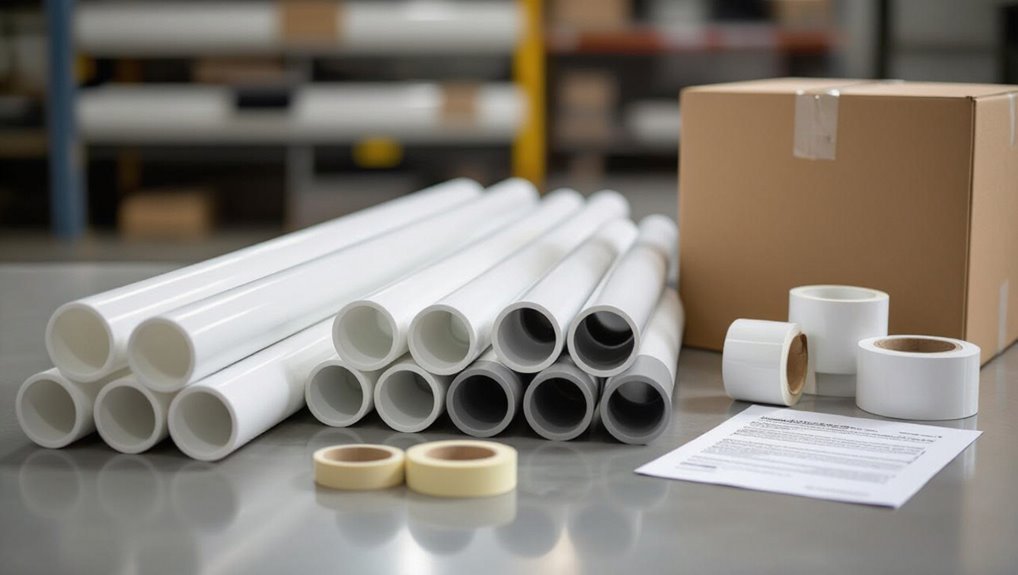
Contractor packs and bulk rolls become cost-effective when project scale, material turnover, or frequent repeat jobs justify lower unit prices and simplified logistics.
Purchasing in bulk suits contractors, maintenance teams, and builders who consume consistent lengths and standard diameters.
Savings appear on unit cost, fewer reorders, and reduced packaging waste.
Inventory management benefits from predictable stock levels and faster job turnaround.
Risks include storage needs, potential overbuy, and tying capital in unused material.
Buyers should weigh project schedules, storage capacity, and variability in specifications before committing to bulk purchases.
- Large, recurring projects
- Multiple crews or sites
- Standardized pipe sizes
- Limited supplier access
- Predictable lead times
Delivery Options and Costs for Long PVC Shipments
For long PVC shipments, delivery choice and cost hinge on length, quantity, and site access: oversize pallets or individual sticks often require flatbed trucks or specialized long‑load carriers, which carry higher freight rates, permit and escort needs, and stricter loading restrictions than standard LTL shipments.
Carriers quote by linear feet, weight, and overlength fees; liftgate, decking, and tarping add charges. Residential drops, narrow driveways, and urban delivery windows increase costs.
Consolidated shipments lower per‑unit freight; white‑glove unloading raises it.
Buyers should request detailed quotes, check carrier long‑load policies, and schedule deliveries when site conditions minimize special handling fees.
Same‑Day Pickup and Curbside Options to Save Time
Frequently, same‑day pickup and curbside service provide the fastest way to obtain PVC pipe for urgent projects, combining online ordering or phone reservations with quick in‑store retrieval or curbside handoff.
Retailers streamline selection by showing stock levels online, reserving common diameters and lengths, and offering real‑time notifications when orders are ready.
Customers save time by bypassing aisles and confirming load‑out requirements in advance.
Staff can stage heavier items for safer loading.
Policies vary by store, so confirming appointment windows and vehicle access instructions minimizes delays and makes certain a smooth, contactless transaction.
- Check online stock before ordering
- Reserve preferred sizes or kits
- Opt for text/email pickup alerts
- Note vehicle/cargo space needs
- Bring order confirmation and ID
Returns, Cut‑To‑Length Policies, and Restocking Fees
Retailers typically enforce clear return and cut‑to‑length rules for PVC pipe because custom cuts and opened packaging affect resaleability and safety.
Policies generally allow full returns of unused, unopened lengths within a specified window; open or cut pieces are often nonreturnable or accepted only with a restocking fee.
Cut‑to‑length services may carry per‑cut charges and minimums; customers should confirm whether returns are permitted for custom cuts.
Restocking fees, when applied, are usually a percentage of purchase price or a flat fee to cover inspection and repackaging.
Clear receipts and original packaging expedite any approved returns.
What to Ask Suppliers About UV‑Resistant PVC
When evaluating UV‑resistant PVC, buyers should ask suppliers about the material’s specific UV stabilization—whether it uses UV absorbers, hindered amine light stabilizers (HALS), or surface coatings—and request documentation on the expected service life and performance under local sunlight exposure.
The inquiry should cover warranty terms tied to UV degradation, recommended installation orientation and shading, and evidence from accelerated weathering tests.
Suppliers should also clarify colorfastness, pigment stability, and maintenance needs.
Compare lab data to local conditions and ask for case studies or references showing long‑term outdoor installations.
- Type of UV stabilizer used
- Accelerated weathering results
- Warranty scope and exclusions
- Color and pigment stability
- Field references or case studies
Check Certifications and Code Compliance Before Buying
Checking certifications and code compliance is a critical step before purchasing PVC pipe, as regulatory approvals and industry standards determine whether a product is legally and technically suitable for the planned application.
Buyers should verify NSF, ASTM, CSA, or local building-code markings and confirm pressure, temperature, and chemical compatibility ratings.
For plumbing, fire, or potable water use, required listings and installation instructions must match jurisdictional codes.
Contractors and inspectors may request documentation; suppliers should provide data sheets and traceability.
Noncompliant materials risk failed inspections, voided warranties, and safety hazards.
Prioritize certified products and consult local authorities when in doubt.
Cheap PVC Sources for DIY Projects
Many hobbyists and home improvers find affordable PVC for DIY projects by tapping a mix of big-box stores, local plumbing supply yards, and online marketplaces.
Sources vary by price, selection, and cut fees; comparison shopping yields the best deals. Salvage yards and community tool swaps can provide used sections for noncritical uses.
Buying in bulk or during sales reduces per-foot costs. Simple fittings and solvent cement often cost less when purchased alongside pipe.
- Big-box retailers for standard sizes and frequent discounts
- Local plumbing suppliers for better cuts and advice
- Online marketplaces for bulk and specialty lengths
- Salvage yards for reclaimed pieces
- Wholesale clubs for volume pricing
Eco‑Friendly Alternatives and Where to Source Them
Although PVC remains common for its cost and availability, eco‑minded builders increasingly seek alternatives that reduce fossil‑fuel content, off‑gassing, and landfill burden.
Alternatives include HDPE (recyclable, durable), CPVC made with fewer additives, polypropylene (PP) for chemical resistance, and bioplastic blends from PLA or recycled PET for light‑duty uses.
Reclaimed PVC and certified recycled PVC reduce virgin material use.
Sources: specialized plumbing suppliers, sustainable building merchants, online recyclers, and municipal salvage centers.
Certifications to check: recycled content declarations, NSF/ANSI standards, and low‑VOC labels.
Pricing and local availability vary; suppliers often list material origin and environmental data.
Where to Find Rare Sizes, Custom Cuts, and Specialty Fittings
Specialty PVC needs often require turning to niche suppliers and fabrication shops rather than big-box retailers.
Vendors offering custom cuts, metric sizes, solvent-weld assemblies, and reinforced or chemically resistant formulations are best sourced from specialty distributors, online custom-cut services, and industrial suppliers.
Clear communication of dimensions, pressure ratings, and material grade guarantees correct fulfillment.
Lead times and minimum orders vary; request samples when feasible.
Consider shops that provide CNC routing, solvent welding, or heat bending for complex shapes.
- Industrial PVC distributors with custom cut services
- Online shops offering one-off lengths
- Fabrication shops with CNC and heat bending
- Manufacturer direct-order programs
- Specialty chemical-resistant PVC suppliers
Local Installers and Contractors Who Supply PVC Pipe
For homeowners and businesses needing ready-to-install PVC, local plumbers, irrigation contractors, and HVAC installers often stock common pipe sizes, fittings, and the specific adhesives and seals required for on-site work.
These professionals can supply short runs, emergency replacements, and compatible components matched to existing systems. Purchasing through contractors may include cutting, primer/cement application, and warranty on workmanship.
Availability varies; some specialize in agricultural or pool-grade PVC, while others carry pressure-rated plumbing lines. Buyers should verify material grade, schedule, and connection type before purchase.
Records of previous projects and supplier relationships can indicate reliability and lead times.
Tips to Negotiate Price on Large PVC Orders
When negotiating price on large PVC orders, buyers should lead with clear specifications—material grade, schedule, diameter, length, and required fittings—to remove ambiguity and give suppliers a precise basis for cost comparisons.
The negotiating party then focuses on volume discounts, delivery windows, return policies, and payment terms. Comparing multiple bids reduces leverage loss; bundling related items and committing to repeat purchases often secures better rates.
Request written quotes and ask about manufacturer rebates or seasonal promotions. Maintain professionalism and flexibility to trade minor concessions for lower unit prices.
- Ask for tiered volume pricing
- Confirm freight and handling charges
- Propose longer lead times
- Offer consolidated payments
- Request warranty inclusions
Read Product Listings to Avoid Mislabeled PVC Pipe
How can a buyer tell if a listing accurately describes PVC pipe? A careful reader reviews specifications: material grade (PVC-U, PVC-C), schedule or SDR, nominal and actual diameter, wall thickness, pressure rating, and temperature limits.
Product photos should show markings on the pipe; absence of markings warrants caution. Confirm standards referenced (ASTM, ISO, CSA) and check length per piece and packaging.
Read seller notes for proposed use—pressurized systems, drainage, electrical conduit—and avoid listings that mix applications. When details are sparse, request manufacturer data sheets or batch identification to verify authenticity before purchasing.
Quick Checklist: Choose the Right Supplier for Your Project
In selecting a PVC pipe supplier, prioritize vendors who provide complete technical documentation, clear product markings, and transparent sourcing information; these indicators reduce risk and streamline verification for the project.
The checklist helps compare options quickly, focusing on specifications, lead times, and post-sale support. Verify certifications, matching grades to application, and confirm return policies. Assess logistics capability for delivery size and timing. Prefer vendors with traceability and responsive technical contacts to resolve discrepancies.
- Confirm material grade and pressure rating
- Check certification and test reports
- Review delivery schedules and freight terms
- Validate warranty and return policy
- Assure available technical support
Conclusion
Finding PVC pipe need not be a treasure hunt: a quick scan of big‑box stores, specialty suppliers, and local contractors usually yields the right schedule and fittings. Readers should match pipe type and size to code, inspect listings for accurate material and pressure ratings, and compare pickup, shipping, and bulk discounts before buying. With preparation and a short checklist, sourcing PVC becomes as simple as following a clear map to the correct supplier.