What Is VC Pipe? Quick Guide to Uses, Sizes & Installation Tips
VC pipe is a type of rigid vinyl chloride tubing commonly used for electrical conduit and low-pressure plumbing applications, such as drains, vents, and irrigation systems. It is favored for its low cost, resistance to corrosion, and ease of installation. However, it is not suitable for high-pressure potable mains, strong solvents, or prolonged exposure to UV light without protection. When selecting VC pipe, ensure that the sizes align with nominal PVC schedules and that they match the necessary fittings, slope, and hanger spacing. Joints should be secured using solvent cement or rubber seals and must be tested for integrity. For detailed guidance on codes, selection, and installation tips, continue reading.
Quick Answer: What VC Pipe Is and When to Use It
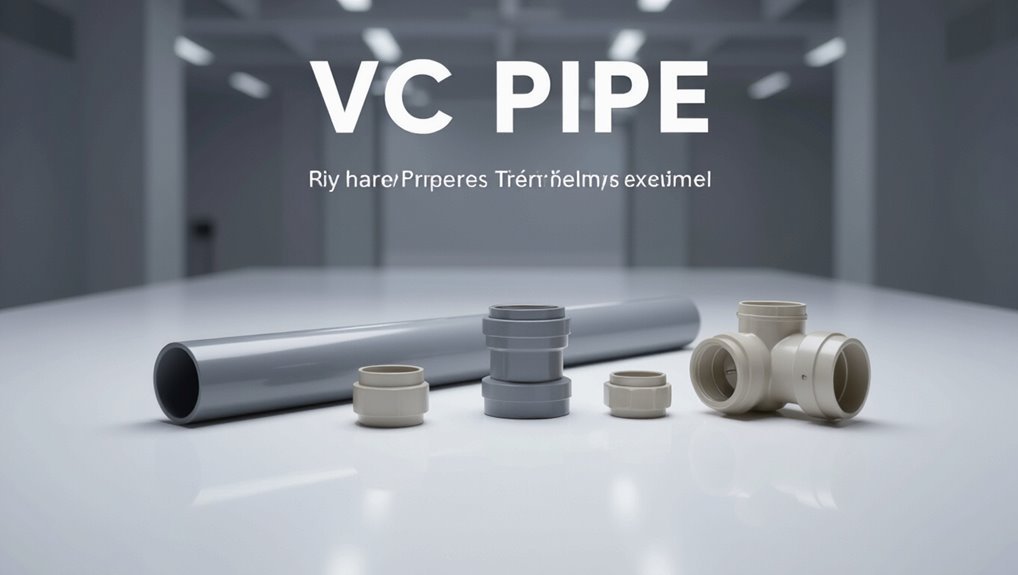
VC pipe is a rigid plastic conduit made from vinyl chloride (PVC) formulated for electrical and low-pressure plumbing applications; it protects wiring and carries fluids where corrosion resistance, low cost, and ease of installation are priorities.
It suits indoor nonpressurized drainage, venting, conduit for electrical runs, and irrigation lines where temperatures and pressures remain moderate.
Selection depends on schedule (wall thickness), diameter, fitting compatibility, and local codes.
Installation favors solvent cement joints or mechanical couplings, with proper support spacing and thermal expansion allowances.
It is unsuitable for high-pressure potable water mains, solvent-sensitive chemicals, or prolonged UV exposure without protection.
Why It’s Called “VC” (Name History and Regional Terms)
In tracing the term’s origins, the abbreviation “VC” emerges from historical shorthand for vinyl chloride-based pipe, adopted by manufacturers and tradespeople for brevity and stamped into industry catalogs and codes.
Over decades, regional dialects and supplier labels shortened or varied the name—VC, V.C., and sometimes simply “vinyl” in informal speech—while standards bodies retained VC in parts lists.
In some countries trade names and translations produced related tags (e.g., letters reflecting local language equivalents), creating divergent but recognizable terms.
The concise VC label persisted because it balanced technical specificity with ease of use across markets and documentation.
VC Materials vs PVC: Composition, Strength, Heat & Chemical Resistance
Compared side-by-side, materials labeled VC and standard PVC share a vinyl chloride backbone but differ in formulation details that affect mechanical properties and resistance to heat and chemicals.
VC often denotes a rigid blend optimized for drainage and outdoor durability, incorporating stabilizers, impact modifiers, or fillers that raise stiffness and UV tolerance.
Standard PVC formulations span rigid (uPVC) to flexible grades with plasticizers; flexibility improves impact resistance at low temperatures but lowers maximum service temperature.
Chemical resistance varies by additive package: both resist many acids and alkalis, yet solvents, aromatic hydrocarbons, and strong oxidizers attack certain PVC/VC variants, so selection matches environment.
Code and Permit Rules: Where VC Pipe Is Allowed or Restricted
The guide reviews how local building codes determine where VC pipe may be used and where it is restricted.
It summarizes typical permit requirements for installation, inspection, and documentation.
Readers are directed to consult municipal authorities and code books for jurisdiction-specific rules.
Local Building Codes
Regarding local building codes, jurisdictions vary widely in how they classify, permit, or restrict the use of vinyl chloride (VC) pipe for plumbing and industrial applications, with rules influenced by safety standards, chemical compatibility, and proposed service.
Authorities review material listings, applicable model codes (IPC, UPC, IBC), and local amendments to determine acceptability.
Some areas limit VC to nonpotable systems, drains, or venting; others prohibit it where heat, pressure, or solvent exposure is expected.
Inspectors may require certified fittings, labeling, and installation methods.
Contractors should consult local code officials and referenced standards before specifying VC to make certain compliance.
Permit Requirements
In many jurisdictions, permit requirements for vinyl chloride (VC) pipe hinge on the proposed service, installation location, and applicable model codes or local amendments: potable water, high‑temperature, high‑pressure, chemical service, and buried or concealed installations commonly trigger stricter review or outright restrictions.
Authorities often require submittal of product listings, pressure/temperature ratings, chemical compatibility data, and manufacturer installation instructions.
Inspections may verify joint type, support spacing, firestopping, and burial depth.
Some areas prohibit VC in potable systems or mandate approved alternatives. Applicants should consult local code officials early, obtain written approvals for exceptions, and document compliance during permitting.
VC Pipe Sizes and Marking Guide
When organizing VC pipe inventories, a concise sizing and marking scheme guarantees installers identify conduits quickly and correctly.
VC pipe is commonly produced in nominal diameters with stamped or printed markings indicating material type, nominal size, pressure rating, and manufacturing standard.
Color coding and banding simplify field identification; labels should resist weather and solvent exposure.
Accurate records pair physical markings with inventory lists showing length, fittings, and planned application.
Regular audits confirm markings remain legible and compliant.
Clear, consistent marking reduces installation errors and speeds maintenance operations.
- Nominal size, material, and standard
- Pressure rating and production code
- Color bands and durable labels
VC Pipe Sizing: Drains, Vents and Soil Stacks
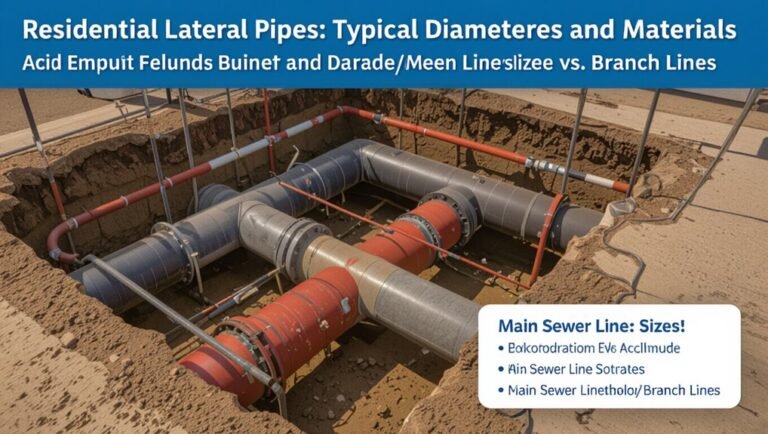
For drains, vents, and soil stacks, VC pipe sizing must match fixture demand, drainage slope, and code-minimum diameters to guarantee proper flow and trap protection.
Designers calculate fixture unit loads, combine branch demands, and select pipe diameters that prevent siphonage and backflow.
Horizontal drain runs require slope considerations—too flat invites solids; too steep accelerates flow and risks trap loss.
Vents must be sized and placed to equalize pressure and allow proper cleanout access.
Soil stacks serve multiple fixtures vertically and need capacity for concurrent flows plus cleanout fittings.
Local plumbing codes dictate minimum sizes and testing requirements.
Choosing Fittings: Couplings, Adaptors and Glue‑In vs Rubber Seals
Among the practical choices that determine long-term performance, fittings — couplings, adaptors, and the decision between glue‑in and rubber‑seal connections — govern joint strength, leak resistance, and serviceability. Selection favors matched materials and sizes; solvent‑weld (glue‑in) joints give permanent, rigid seals best for concealed, fixed runs, while rubber‑seal (compression) fittings allow movement, easier replacement, and vibration tolerance. Couplings join like pipes; adaptors bridge sizes or materials. Consider pressure, thermal expansion, and access for maintenance when choosing. Properly rated fittings reduce failure risk and simplify future alterations without compromising flow or venting.
- Solvent‑weld: permanent, high strength
- Rubber‑seal: flexible, serviceable
- Adaptors: material/size bridge
Tools & Materials for Cutting, Joining and Supporting VC
The section outlines essential cutting and measuring tools alongside the joining and support materials commonly used with VC pipe. It describes saws, cutters, measuring devices and the adhesives, seals, clamps and hangers needed for secure assemblies.
Practical selection criteria and common pitfalls are highlighted to guide proper tool and material choice.
Cutting And Measuring Tools
When preparing VC pipe, accurate measurement and clean cutting are essential to assure proper fit, secure joints, and leak-free performance.
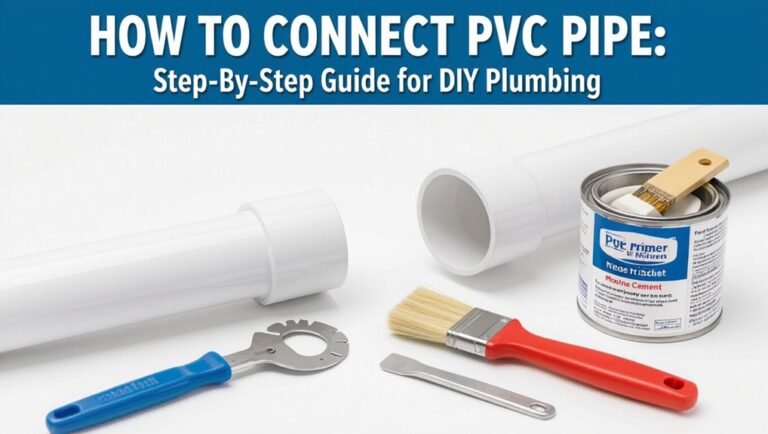
Essential tools include a tape measure for precise lengths, a fine-tooth hacksaw or PVC cutter for straight cuts, and a deburring tool or file to remove burrs and chamfer edges.
A square or combination square assures end faces are perpendicular.
Marking with a permanent marker and using a cutting guide or miter box increases consistency.
Safety equipment—gloves and eye protection—protects from shavings.
Proper tool selection reduces rework and improves joint integrity for long-term system reliability.
- Tape measure and marker
- PVC cutter or hacksaw
- Deburring tool and square
Joining And Support Materials
Accurate cutting and finished pipe ends set the stage for reliable joints and stable runs; the next focus is on the materials and tools used to join and support VC pipe. Solvent cement, primer, rubber gaskets, and appropriate clamps guarantee leak-free connections and vibration control. Pipe hangers, cushioned straps, and spacers prevent sagging and stress. Torque-limited wrenches and deburring tools preserve fittings. Selection aligns with pipe size, environment, and code.
| Material | Tool | Feeling |
|---|---|---|
| Solvent cement | Torque wrench | Confidence |
| Cushioned strap | Deburring tool | Relief |
| Rubber gasket | Pipe hanger | Assurance |
Step‑by‑Step: Cutting, Preparing and Joining VC Pipe
How does one reliably cut, prepare, and join VC (vinyl-coated) pipe to achieve leak-free connections and correct alignment? The procedure begins with accurate measurement and marking. Use a fine-toothed saw or tubing cutter to make a square cut; deburr and remove coating only where joint materials contact.
Dry-fit components to confirm alignment and required support spacing. Clean mating surfaces with recommended solvent or primer; apply adhesive or insert gasket per manufacturer directions.
Hold joints in alignment until set; inspect for excess adhesive and wipe away. Test assemblies under low pressure before commissioning.
- Measure twice, cut once.
- Deburr and clean.
- Dry-fit, then bond and test.
Solvent‑Welding vs Mechanical Couplings: Pros & Cons
For joining VC pipe, two principal methods—solvent‑welding and mechanical couplings—offer distinct advantages and limitations that influence strength, speed, serviceability, and suitability for different environments.
Solvent‑welding chemically fuses joints, yielding a rigid, leak‑resistant connection ideal for permanent runs; it requires clean cutting, priming, and curing time and is difficult to dismantle.
Mechanical couplings provide rapid, reversible joins and accommodate slight misalignment or movement; quality varies by design and they add bulk and potential leak points if improperly installed.
Choice depends on permanence, access for maintenance, vibration or thermal movement, and code or manufacturer recommendations.
Routing, Hangers and Required Slope for Drain Lines
Routing of VC drain lines should prioritize the most direct path that avoids conflicts with structure and utilities while allowing access for maintenance.
Proper hanger selection and spacing are required to support the pipe, control deflection, and prevent sagging.
Maintaining the specified slope for gravity drainage guarantees reliable flow and prevents pooling or backflow.
Routing Path Planning
When planning the routing path for vent and drainage piping, the designer must balance shortest runs, access for maintenance, and compliance with slope and hanger standards; this guarantees proper flow, prevents backflow and sedimentation, and minimizes stress on connections.
The routing plan prioritizes directness while avoiding structural conflicts, high-traffic zones, and thermal movement constraints. It locates cleanouts, traps, and vents for serviceability and groups runs to reduce fittings. Coordination with other trades and future upgrades is considered. Material transitions and support spacing are noted without repeating hanger/slope specifics reserved for the next section.
- Minimize fittings and bends
- Secure service access
- Coordinate with structure
Hangers And Slope
Establishing proper hanger placement and consistent slope is essential to guarantee uninterrupted gravity flow, limit sagging, and reduce stress at joints.
Hangers should be spaced per code and manufacturer guidance—typically every 3–4 feet for horizontal VC runs and closer near fittings.
Support must prevent deflection while allowing thermal movement; use cushioned straps or adjustable hangers.
Maintain a minimum slope (commonly 1/4 inch per foot for drains) toward the outlet; steeper slopes can cause noise and erosion, flatter slopes allow deposits.
Verify slope with a level during installation and recheck after support tightening to confirm continuous, self-clearing flow.
Common Installation Mistakes and How to Avoid Them
Installers frequently encounter a handful of predictable errors that compromise system performance and safety; recognizing these common mistakes—improper pipe sizing, inadequate support and anchoring, poor alignment at fittings, and neglecting corrosion protection—lets teams prevent costly rework and downtime.
Personnel should verify sizing against flow and pressure requirements, follow manufacturer spacing for hangers, and use proper anchors to control thermal movement.
Joint alignment must be checked before final assembly to avoid stress and leaks.
Corrosion risks require compatible materials and protective coatings.
Documentation and brief field checks reduce human error and guarantee consistent installation quality.
- Verify sizing and pressure ratings
- Maintain hanger spacing and anchors
- Check alignment and apply corrosion protection
Inspecting VC Pipe Work: Leak Signs and Testing Tips
After confirming correct sizing, supports, alignment, and corrosion protection, inspectors turn attention to detecting leaks and validating system integrity.
Visual cues include dampness, staining, blistering, mineral deposits, or solvent-weld residue around joints and fittings.
Audible signs — dripping, hissing, or unusual flow noise — warrant close examination.
Pressure testing follows: hydrostatic testing at specified pressures and durations or pneumatic tests with strict safety protocols. Use calibrated gauges and record results.
Dye or tracer additives help locate slow leaks.
Document findings, tag defects, and recommend corrective actions. Photographic evidence and test reports support warranty and compliance records.
Maintenance and Minor Repairs to Extend VC Life
Regularly scheduled inspections and simple corrective actions markedly extend the service life of VC piping by preventing small issues from becoming system failures.
A maintenance regimen includes cleaning sediment from traps, tightening loose clamps, and applying compatible sealants to small joint weeps. Technicians should document observations, date repairs, and verify system pressure after work.
Corrosion-prone areas receive focused attention; protective coatings are retouched as needed. Minor pinhole leaks are patched with epoxy wraps or band clamps until planned shop repairs occur.
Routine flushing reduces buildup; valves and supports are exercised to make certain alignment and eliminate stress concentrations.
- Clean and flush lines regularly
- Patch small leaks promptly
- Exercise valves and tighten supports
When to Replace VC Pipe and Retrofit Upgrade Options
When visible deterioration, recurrent leaks, or repeated repairs begin to outpace effective maintenance, replacement of VC pipe should be scheduled to restore system integrity and reduce long‑term costs.
Replacement criteria include extensive corrosion, compromised joints, persistent odor or discoloration, and inability to meet pressure or flow requirements. Prioritize sections with structural failure or health risks.
Retrofit options: relining with cured‑in‑place pipe (CIPP) for minimal excavation, pipe‑bursting to install new HDPE or PVC in existing alignment, and sliplining for oversized host pipes.
Selection depends on access, budget, pipe condition, and service restoration needs; professional inspection and material compatibility testing are advised.
Conclusion
VC pipe remains a practical choice for many residential drain and vent applications. Curiously, about 60% of older homes in some regions still use VC or similar vibro-concrete lines, underscoring its enduring presence. Durable yet limited by code and heat resistance, VC performs well when correctly sized, joined, and inspected. Routine testing and timely repairs prolong service; replacement or retrofit should be considered when cracking, frequent leaks, or code conflicts appear.