PVC 1 1/2 Vs 1 1/2? Know the OD of 1 1/2 PVC Pipe Fast
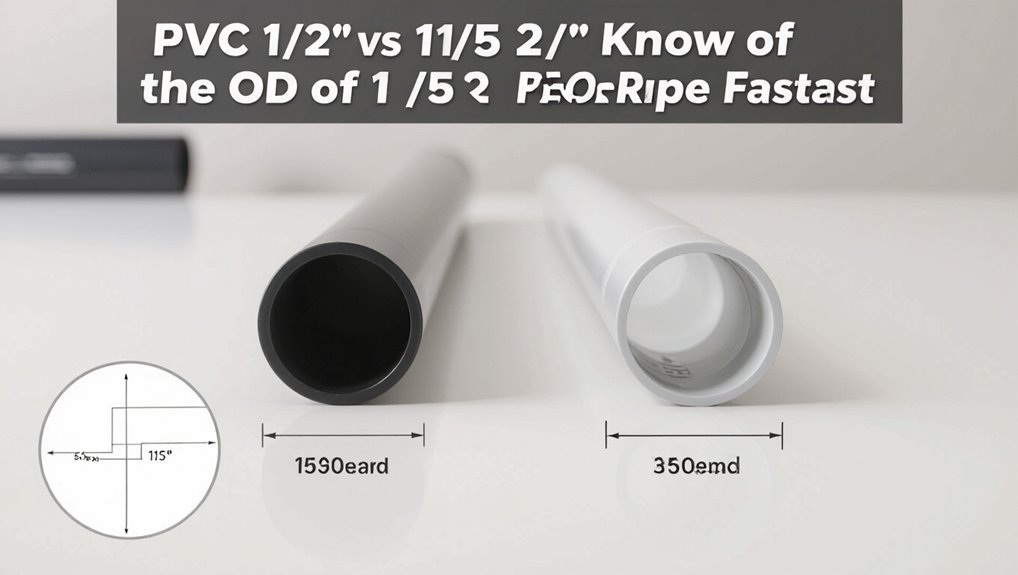
The outside diameter (OD) of nominal 1½″ PVC pipe is 1.900 inches (48.26 mm). Both Schedule 40 and Schedule 80 pipes share this same OD, differing only in wall thickness—Schedule 40 has a thickness of approximately 0.145 inches, while Schedule 80 measures around 0.200 inches. This difference affects the internal diameter and pressure ratings of the pipes. Fittings for 1½″ PVC are designed to accommodate this OD, allowing most sockets to fit both schedules. When selecting a schedule, consider factors such as pressure, temperature, and code requirements. More information on dimensions, fittings, and troubleshooting is provided below.
Quick Answer: OD of 1½ PVC (Schedule 40 & 80)
In practical terms, the outside diameter (OD) of a nominal 1½-inch PVC differs by schedule: Schedule 40 measures 1.900 inches OD, while Schedule 80 retains the same OD of 1.900 inches but has thicker walls and a smaller internal diameter.
The quick answer: both schedules share identical OD, ensuring compatibility with fittings sized for 1½-inch OD.
The operational difference lies in wall thickness and pressure rating, with Schedule 80 offering greater strength and reduced flow area.
Installers choose based on pressure, chemical resistance, and code requirements rather than OD differences, since OD remains constant.
Printable Reference: Nominal, OD, ID (1½ PVC)
A printable reference sheet clarifies the difference between nominal size and the actual outside and inside diameters for 1½-inch PVC.
It lists the standard OD and ID values for Schedule 40 and Schedule 80 so users can compare nominal labeling to measurable dimensions.
Simple measuring instructions for OD and ID are included to guarantee accurate field verification.
Nominal Versus Actual
How do nominal, outside, and inside dimensions relate for 1½-inch PVC fittings and pipe? The article explains that “1½-inch” is a nominal designation, not the measured outside or inside diameter.
Manufacturers specify an actual outside diameter (OD) that fits industry-standard fittings; the inside diameter (ID) varies with wall thickness (schedule).
Consequently, fittings are matched to nominal size, relying on standardized ODs and socket dimensions rather than the nominal label.
This distinction prevents confusion when selecting components: nominal identifies the system size, OD determines mating compatibility, and ID defines flow capacity.
Awareness of these terms guarantees correct part selection without measurement ambiguity.
Measuring OD And ID
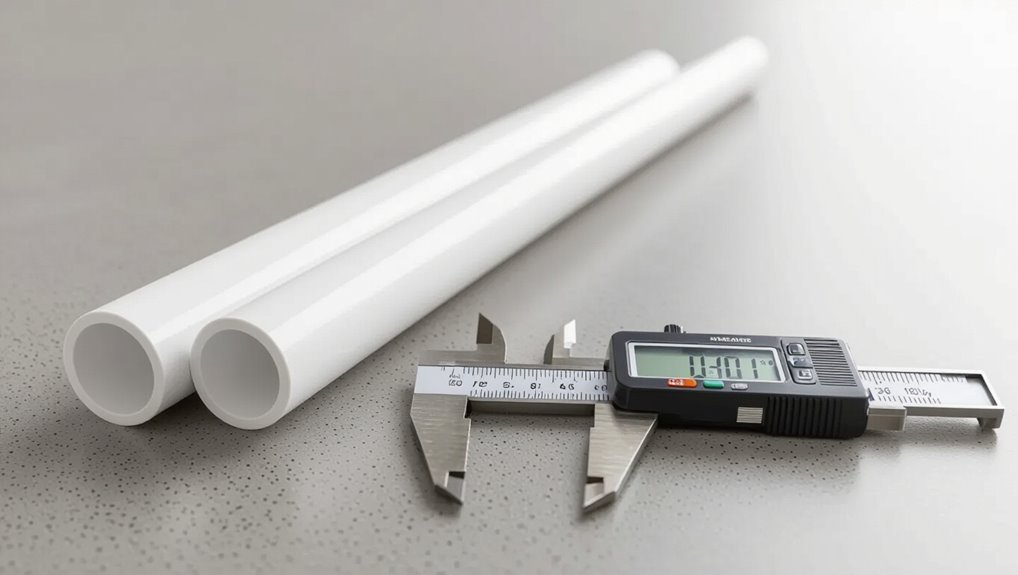
For quick, reliable fits, measurements must distinguish nominal size from actual outside and inside diameters. The technician measures OD across the exterior, using calipers for accuracy, then records the figure to compare with manufacturer tables.
ID is measured across the bore, often with inside calipers or gauge rods; when inaccessible, wall thickness is measured and subtracted from OD to compute ID. Temperature and pipe deformation affect readings, so measurements are taken at room temperature and on straight sections.
Documentation pairs nominal designation with measured OD and ID, ensuring correct couplings, fittings, and flow calculations.
Exact OD & Wall for 1½ PVC : Schedule 40
For Schedule 40 1½-inch PVC, the nominal size does not equal the actual outer diameter, so clarification between nominal vs actual dimensions is essential.
The actual outer diameter is a fixed measurement used for fittings and should be stated explicitly.
Wall thickness specifications for Schedule 40 determine the inner diameter and pressure capacity and must be referenced from manufacturer or ASTM tables.
Nominal Vs Actual
What exactly do the nominal dimensions on a 1½‑inch PVC Schedule 40 designation represent compared with the pipe’s measured outside diameter and wall thickness? The nominal size is a convenient label tied to historical flow capacity, not the physical outside measurement.
For 1½‑inch Schedule 40 PVC the actual outside diameter is larger than the nominal size, while the internal diameter is reduced by the wall thickness.
Wall thickness for Schedule 40 is standardized, determining pressure capability and inner bore. Manufacturers publish both nominal and actual dimensions; installers reference nominal size for fittings but rely on actual OD and wall data for engineering and compatibility.
Outer Diameter Measurement
Regarding the outer diameter measurement, the 1½‑inch Schedule 40 PVC has a published outside diameter (OD) of 1.900 inches (48.26 mm) with a standard wall thickness of 0.145 inches (3.68 mm), which yields an internal diameter (ID) of approximately 1.610 inches (40.90 mm) before accounting for any manufacturing tolerances. The measurement standard simplifies fittings and compatibility checks; professionals confirm OD for joining and run tolerance checks. Practical inspection uses calipers at multiple points to detect out-of-round conditions. The table below summarizes key dimensions and quick references.
| Dimension | Inches | Millimeters |
|---|---|---|
| OD | 1.900 | 48.26 |
| Wall | 0.145 | 3.68 |
| ID | 1.610 | 40.90 |
Wall Thickness Specs
Typically, the Schedule 40 1½‑inch PVC pipe specifies an exact outside diameter of 1.900 inches (48.26 mm) with a nominal wall thickness of 0.145 inches (3.68 mm).
This combination yields an internal diameter near 1.610 inches (40.90 mm), affecting flow area and hydraulic performance.
Wall thickness tolerances follow ASTM D1785, ensuring consistent pressure ratings and structural integrity for common plumbing and irrigation uses.
Manufacturers may report slight variations within accepted tolerance ranges; installers should verify markings and datasheets.
For fittings and joining, the standardized OD and wall permit predictable socket depths, solvent weld strength, and compatibility across compliant Schedule 40 products.
Exact OD & Wall for 1½ PVC : Schedule 80
Focusing on Schedule 80 1½-inch PVC, the exact outside diameter (OD) measures 1.900 inches while the standard wall thickness is 0.200 inches, dimensions that distinguish it from Schedule 40 and affect pressure ratings, fittings compatibility, and flow characteristics.
The heavier wall reduces internal diameter compared with thinner schedules, yielding higher burst pressure and altered hydraulic capacity. Fabricators and engineers use these precise measurements for material selection, joint design, and system calculations. Manufacturers list Schedule 80 dimensions in specifications to guarantee interchangeability of fittings and consistent performance. Verification with product datasheets is recommended for critical applications.
Why Nominal Size ≠ Actual OD
Why does a 1½‑inch PVC pipe not measure 1.5 inches across? The article explains that “nominal” is a label tied to flow capacity and historical iron-pipe sizes, not the actual outside diameter. Manufacturers standardize actual dimensions so fittings match; wall thickness varies by schedule, changing internal diameter while OD stays near a standard. Buyers should note nominal size for compatibility but consult specification tables for precise OD and wall values. The table below summarizes key distinctions succinctly.
| Term | Meaning | Relevance |
|---|---|---|
| Nominal | Label | Compatibility |
| OD | Actual outside | Fitting match |
| ID | Inside space | Flow rate |
| Schedule | Wall thickness | Strength |
How to Measure Pipe OD, ID, and Wall at Home
With nominal sizes explained, practical measurement lets a homeowner confirm what fittings and connectors are required.
A caliper yields the most accurate outer diameter (OD); place it across the pipe’s widest external span and read to the nearest 0.01 inch.
For inside diameter (ID), use an inside caliper or measure circumference with a tape, then divide by pi.
Wall thickness equals (OD − ID) / 2; measure at multiple points to detect unevenness.
If only a ruler is available, average several measurements and allow a small tolerance.
Record results and compare to manufacturer tables before purchasing.
Which Fittings Match 1½ PVC OD?
When matching fittings to a 1½-inch PVC outer diameter (OD), the key is distinguishing nominal pipe size from actual measurements: a nominal 1½” PVC pipe typically has an OD around 1.900″ for Schedule 40, while CPVC and sewer/solid-wall variants may differ.
Fittings specified for 1½” nominal PVC (Schedule 40) are designed to accept that OD; solvent-weld couplings, tees, elbows, and hubs list nominal size rather than measured OD.
For nonstandard walls or CPVC, select fittings rated for the specific material and schedule.
Adapters and transition connectors accommodate mismatched IDs/ODs; verify manufacturer dimensions before purchase.
Slip‑Fit vs Threaded Joints: Why OD Matters
Slip‑fit connections require the pipe OD to match the fitting bore closely for proper insertion and mechanical support.
Threaded joints, by contrast, need sufficient OD clearance to engage threads without binding and to allow thread compound or tape for sealing.
Both joint types depend on tight tolerances and correct OD to guarantee a leak‑free, durable connection.
Slip Fit Compatibility
How does outer diameter affect whether a 1 1/2 schedule PVC will join with a socket or require threaded fittings? The outer diameter determines slip-fit clearance; nominal 1 1/2-inch PVC has a specific OD that matches corresponding sockets. If OD aligns with socket inner diameter, solvent welding or push-fit works. If OD exceeds socket tolerance, threaded or adapter fittings become necessary. Manufacturers’ tolerances and schedule (e.g., Schedule 40 vs 80) alter OD slightly, so verification is required before assembly.
| Component | Fit outcome |
|---|---|
| Exact OD match | Slip-fit solvent weld |
| Slightly oversized | Adapter or threaded fitting |
Threaded Connection Clearance
After confirming whether a pipe will enter a socket, the next consideration is how outer diameter influences the choice between slip-fit solvent-welded joints and threaded connections.
Outer diameter determines thread engagement depth, required clearance in female fittings, and compatibility with standard NPT or BSP thread profiles. Slight OD variations can prevent proper thread start or leave insufficient crest-to-root contact, reducing mechanical strength.
Threaded fittings demand consistent OD within tolerance bands; slip-fit joints tolerate minor OD differences since adhesive fills gaps. Selection consequently hinges on whether the measured OD matches threaded fitting specifications or is better suited to solvent-welded assembly.
Sealing And Tolerance
When joining PVC pipe, outer diameter directly affects the sealing strategy and permissible tolerances for both solvent-weld and threaded assemblies.
The slip-fit approach relies on precise OD-to-ID interference for proper solvent welding; excessive OD variance prevents adequate solvent contact and weakens the bond.
Threaded joints tolerate more axial play but require correct OD to match male/female thread form and engagement depth; undersized OD reduces thread strength, oversized OD impedes full engagement and sealing.
Proper measurement, specification compliance, and controlled fabrication tolerances assure reliable seals.
Selection between slip-fit and threaded depends on required leak resistance, mechanical load, and permissible manufacturing variance.
How 1½ PVC OD Compares to Copper & CPVC
Compared side-by-side, 1½-inch PVC (nominal) with its 1.900-inch outside diameter differs conspicuously from common copper and CPVC sizes in both physical dimensions and fitting compatibility.
Copper nominal 1½-inch is uncommon; more typical copper types are labeled by nominal trade sizes and have smaller ODs (e.g., 1¼-inch copper OD ≈ 1.660″.) CPVC follows copper-like OD conventions, often matching copper fittings.
Consequently, PVC 1½” cannot directly mate with copper/CPVC without adaptor fittings. Threaded adapters, solvent-weld to male iron pipe adapters, or brazed/soldered adaptors are required.
Installers must note OD mismatch when planning connections and selecting adapters.
Pressure Ratings Tied to Wall Thickness (Sched 40 Vs 80)
Bound to the wall thickness of the material, pressure ratings for PVC are primarily determined by schedule: Schedule 40 and Schedule 80 share the same nominal outside diameters but differ in internal diameter and wall thickness, with Schedule 80 having thicker walls and thus higher pressure capacity at a given temperature. The distinction affects allowable working pressure, longevity under cyclical loads, and suitability for higher-temperature or pressurized systems. Designers choose Schedule 80 where safety margins or mechanical stresses demand them; Schedule 40 suffices for many gravity and lower-pressure applications.
| Property | Effect |
|---|---|
| Wall thickness | Increases strength |
| Internal diameter | Reduces flow area |
| Pressure rating | Higher for Sched 80 |
| Temperature tolerance | Improves with thickness |
Common Retrofit Issues: Gaps, Leaks, and Older Pipes
Retrofit projects frequently encounter gaps and misalignments where new 1 1/2-inch PVC fittings meet older pipe runs, creating pathways for leaks and compromising joint integrity.
Technicians often face material incompatibility: vintage PVC formulations, nylon-lined connectors, or brittle SDR pipes that resist solvent welding.
Dimensional drift from temperature changes and previous repairs produces uneven seating and stress points.
Improper adapters or oversized couplings mask misfit but invite movement and seepage.
Assessment requires measuring OD, checking wall condition, and pressure-testing joints before finalizing connections.
Remediation may include corrective adapters, precision cutting, and replacing short sections of degraded pipe to make certain reliable seals.
Practical Uses: Drains, Irrigation, and Pool Plumbing
The comparison of PVC 1 1/2 nominal sizes prompts a practical look at where each fits in drain and irrigation systems, where inner diameter and schedule affect flow and trap compatibility.
Attention also shifts to pool return fittings, which require precise outer diameter and socket sizing to guarantee leak-free connections and correct flow rates.
Evaluating these applications highlights when dimensional differences matter for installation and performance.
Drain Line Compatibility
How well do 1 1/2-inch and 1.5 PVC pipes perform in common drain-line roles such as household waste stacks, irrigation runs, and pool return or skimmer lines? Compatibility depends on nominal sizing, OD, and system standards; both labels usually reference the same nominal pipe size, but fittings, slope, and flow requirements dictate selection. Installers should confirm SDR/pressure class and local plumbing codes before joining components.
Consider mechanical adapters when mixing schedules or brand ODs. Key practical points:
- Verify OD and wall thickness against fittings and adapters.
- Match flow capacity and slope to application.
- Use approved solvent weld or gasketed couplings.
Pool Return Fittings
For pool return fittings, proper matching of nominal size, outside diameter, and pressure/schedule is essential to guarantee leak-free, hydraulically efficient connections between pump, return lines, and in-wall fittings. The installer evaluates OD, socket vs. spigot, thread types, and flow rates to prevent imbalance and suction issues. Adapters, unions, and bulkhead fittings bridge mismatches; chemical resistance and UV stability guide material choices. Correct cementing or mechanical seals reduce maintenance. Torque limits and alignment protect face seals. Routine inspection of joints and skimmer returns ensures longevity and safety.
| Component | Function | Notes |
|---|---|---|
| Return eyeball | Flow direction | Adjustable |
| Union | Service access | Match OD |
| Bulkhead | Wall penetration | Seal carefully |
| Adapter | Size connection | Minimize restriction |
| Valve | Flow control | Pressure rated |
Where to Buy 1½ PVC and What to Verify on the Label
When purchasing 1½-inch PVC pipe, buyers should start with reputable sources — plumbing supply stores, big-box home centers, and specialized online retailers — to guarantee consistent sizing and material quality.
Labels should be checked for nominal size, actual OD, schedule (40/80), and material grade (PVC‑U, CPVC).
Also confirm pressure rating and certification marks (ASTM, NSF).
Returns and office stock policies matter for replacements.
- Verify nominal vs. actual dimensions listed.
- Confirm schedule and pressure rating for the intended application.
- Look for certification marks and manufacturing date codes for traceability.
Quick Troubleshooting Checklist for Fit Problems
Having trouble getting 1½‑inch PVC to fit as expected? A concise checklist identifies common causes and fixes. Measure OD and socket depth; confirm schedule and SDR compatibility. Check for debris, burrs, or old adhesive; clean and chamfer edges. Verify coupling type—slip, threaded, or junction—and use correct primer and cement. Make certain parts are fully seated and allowed proper cure time before testing.
| Issue | Quick fix |
|---|---|
| Incorrect OD | Re-measure, buy correct schedule |
| Debris/burrs | Clean and chamfer |
| Wrong coupling | Replace with matching type |
| Poor adhesive | Use proper primer/cement |
| Incomplete seating | Reassemble and cure |
Conclusion
In the grand, unforgiving world of pipes, the 1½‑inch PVC’s true outside diameter—1.900 inches for both Schedule 40 and 80—refuses to be reduced to casual naming. Plumbers, homeowners, and DIY heroes alike bow to this stubborn reality when retrofitting drains, sprinklers, or pool returns. Knowing the precise OD and wall thickness prevents catastrophic gaps, melodramatic leaks, and endless fittings scavenger hunts, turning frantic improvisation into calm, competent installation.