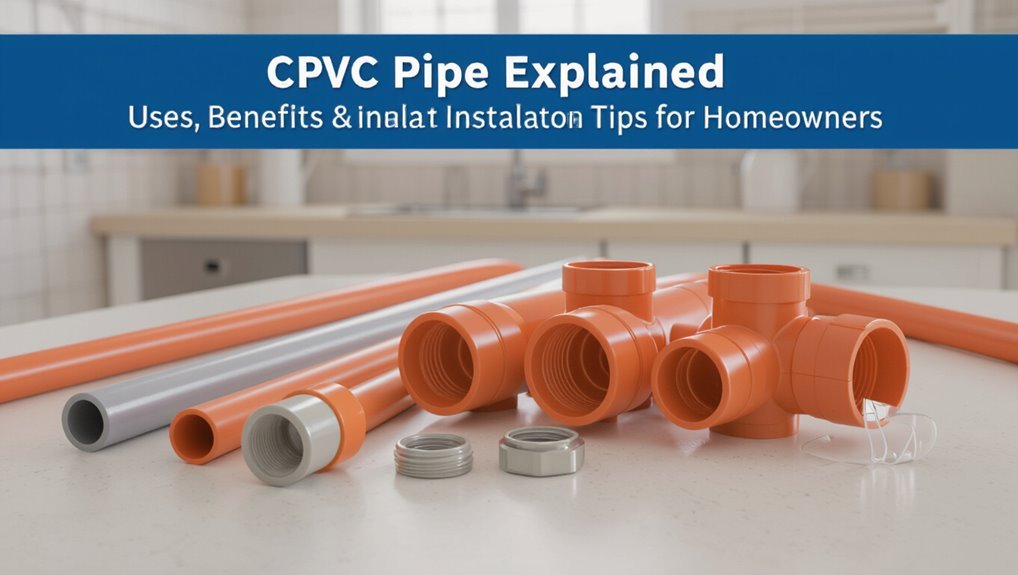
CPVC Pipe Explained: Uses, Benefits & Installation Tips for Homeowners
CPVC (Chlorinated Polyvinyl Chloride) is an ideal choice for residential plumbing, particularly for hot and cold water lines, due to its ability to withstand higher temperatures and resist corrosion. It employs solvent-welded joints with CPVC-rated cements and requires UV protection and proper support spacing. With correct installation and maintenance, CPVC pipes can last for decades. For repairs, simply cut back to a sound section of pipe and use solvent welding for new fittings. This guide provides essential tips for practical installation, maintenance, and adherence to plumbing codes.
What CPVC Is and How It Differs From PVC
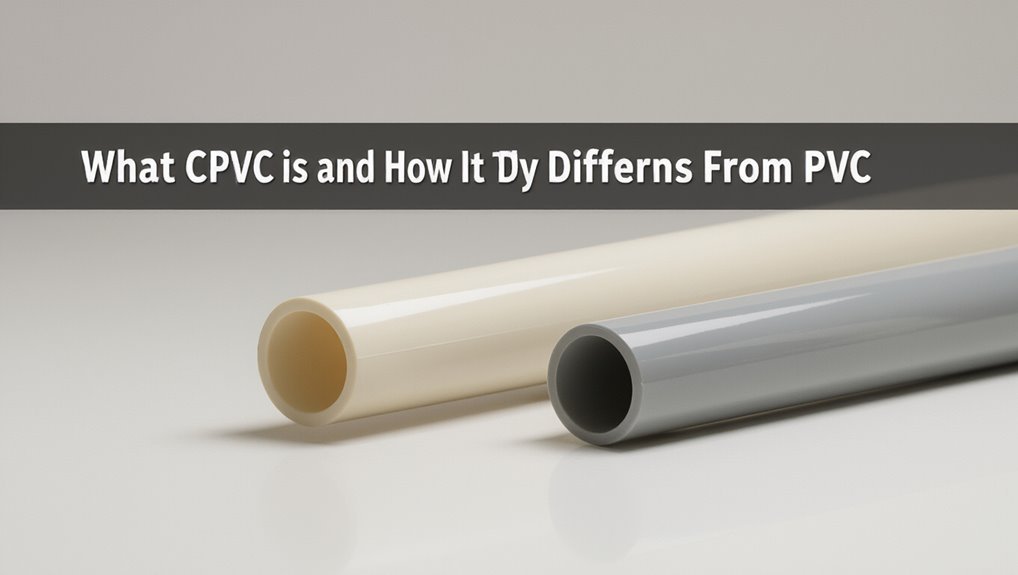
Compared with PVC, chlorinated polyvinyl chloride (CPVC) is a thermoplastic created by adding chlorine to the PVC polymer, which raises its heat resistance and alters its chemical properties; as a result, CPVC withstands higher temperatures and is better suited for hot-water plumbing and industrial applications where PVC would soften or deform.
CPVC’s molecular structure increases rigidity and improves chemical resistance versus PVC, enabling use with hotter fluids and some corrosive environments. It remains compatible with many PVC fittings when specified, but differing fusion and solvent-cement procedures are required.
Temperature ratings, pressure tables, and approved joining methods distinguish CPVC installations from PVC.
CPVC Pros and Cons : Quick Decision Guide
The section compares CPVC’s durability and expected lifespan against alternatives to help readers weigh long-term performance.
It also summarizes upfront costs and typical maintenance needs so budget and service implications are clear.
Together these points aim to support a quick, practical decision on whether CPVC suits a given application.
Durability And Longevity
In many residential and commercial installations, CPVC is valued for resisting corrosion, scale, and chemical degradation, which helps preserve flow capacity over decades.
Its thermal stability sustains pressure performance in hot-water systems, while UV exposure remains a weakness unless protected.
Properly joined fittings and solvent-welded seams minimize leak risk; mechanical stress and impact can cause cracking if not supported.
Compatible with common plumbing chemicals, CPVC avoids metallic corrosion and galvanic issues.
Expected service life commonly exceeds 50 years under recommended conditions.
Routine inspection for mechanical damage and avoidance of prolonged sunlight extend functional longevity without costly interventions.
Cost And Maintenance
Frequently, installers and building managers weigh CPVC’s upfront costs against its low maintenance demands to decide if it’s the right piping choice.
Material and installation expenses typically exceed basic PVC but remain lower than copper; labor can rise if solvent-welding or solvent cement techniques are unfamiliar.
Long-term savings come from reduced corrosion, fewer leaks, and minimal replacement frequency.
Routine maintenance is simple: inspect joints, clear sediment-prone sections, and protect from UV exposure.
Chemical compatibility should be reviewed to avoid solvent damage.
Common Household Uses: Hot, Cold, and Irrigation
Homeowners commonly choose CPVC for both hot and cold water lines as well as irrigation because it resists heat, chemical degradation, and corrosion while remaining easy to install. It serves potable water distribution, supplying bathrooms, kitchens, and laundry with reliable, taste-neutral flow.
Cold-water runs use the same material for continuity and reduced joint types. Outdoor irrigation systems benefit from CPVC’s chemical tolerance to fertilizers and pesticides, and its smooth bore minimizes pressure loss.
Compatibility with standard solvent-cement fittings simplifies repairs and system extensions. Properly supported runs and protection from prolonged UV exposure guarantee durable, low-maintenance performance in household applications.
CPVC Temperature & Pressure Limits
CPVC’s maximum continuous operating temperature typically approaches 200°F (93°C), a limit that governs its suitability for hot-water systems.
Pressure ratings vary by pipe size and schedule, with smaller diameters generally sustaining higher pressures at a given temperature.
Because allowable pressure decreases as temperature rises, manufacturers provide temperature-pressure charts to determine safe service conditions.
Maximum Operating Temperatures
When exposed to heat and internal pressure, chlorinated polyvinyl chloride (CPVC) exhibits specific temperature–pressure limits that dictate safe operating conditions; manufacturers and standards organizations define those limits through long-term hydrostatic stress-rupture testing and short-term burst testing. CPVC typical maximum continuous service temperature is about 200°F (93°C); above this, material strength and longevity decline. Design must consider fluid temperature, ambient heat, and insulation. Operating near maximum requires pressure derating. Periodic inspection for softening, deformation, or accelerated aging is advised. Conservative engineering margins and adherence to manufacturer guidance guarantee reliable, long-term performance.
| Parameter | Typical Limit | Notes |
|---|---|---|
| Continuous Temp | 200°F (93°C) | Service limit |
| Short-term Temp | ~210–220°F | Elevated stress |
| Derating | Required near max | See manufacturer guidelines |
Pressure Ratings By Size
Presenting CPVC pressure ratings by pipe size clarifies how allowable internal pressures decrease with higher temperatures and smaller diameters.
Manufacturers publish tables showing nominal pipe size, schedule or SDR, and corresponding pressure ratings at specified temperatures (commonly 73°F).
Larger diameters typically carry lower pressure ratings due to wall-thickness-to-diameter ratios; conversely, smaller sizes sustain higher pressures.
Common residential CPVC sizes (½” to 2″) have published working pressures usable for potable hot and cold water within their temperature limits.
Installers and designers must reference manufacturer charts and applicable codes to select sizes meeting system pressure requirements without assuming uniform ratings across diameters.
Temperature-Pressure Interaction
Having established that pressure ratings vary by size, attention must turn to how temperature alters those allowable pressures for CPVC systems. CPVC’s strength decreases with higher temperature, so maximum working pressure falls as water temperature rises. Designers consult manufacturer charts to select appropriate pipe and schedule for planned service temperatures. Thermal effects also influence long-term creep and joint integrity; allowances guarantee safety margins. Regular inspections and avoiding sustained near-limit temperatures extend service life. Practical selection balances expected temperature, pressure, and safety factor to prevent deformation or failure.
| Temperature (°F) | Relative Pressure Capacity |
|---|---|
| 70 | 100% |
| 120 | 75% |
| 160 | 50% |
| 200 | 30% |
When Not to Use CPVC (Code, Chemistry, Environment)
In certain installations CPVC is not an appropriate choice due to code restrictions, chemical incompatibilities, or environmental conditions that exceed its material limits. Authorities may prohibit CPVC in concealed commercial risers, outdoor UV-exposed runs, or where fire codes demand metallic piping.
Strong solvents, aromatic hydrocarbons, or highly chlorinated solutions can attack CPVC, causing swelling, crazing, or failure.
Extremely high continuous temperatures or burial in aggressive soils accelerates degradation, embrittlement, and joint loss.
- Codes banning CPVC evoke frustration when plans must change.
- Chemical incompatibility provokes anxiety over unseen damage.
- Harsh environments create dread of premature system failure.
How to Size CPVC for Hot and Cold Systems
When selecting CPVC pipe for hot and cold systems, sizing must balance flow requirements, pressure loss, temperature-related derating, and code-imposed minimums; engineers calculate required diameters from fixture or equipment flow rates, account for reduced allowable pressure at elevated temperatures, and consider velocity limits to minimize noise and erosion.
Calculations use fixture units or known GPM, applying Hazen-Williams or equivalent head loss formulas to select a nominal size meeting pressure drop limits over run length.
Temperature derating reduces allowable working pressure for hot lines, often necessitating larger diameters.
Final selection must comply with local plumbing codes and manufacturer tables.
Choose the Right CPVC Fittings
Selecting appropriate fittings requires matching each fitting type to its intended application, whether for straight runs, branches, or shifts to other materials.
The chosen fittings must be rated for the system’s maximum pressure and temperature.
Installers should use solvent cement specified as compatible with CPVC to guarantee reliable joints.
Match Fitting To Application
For each CPVC installation, choosing fittings that match the system’s pressure rating, temperature range, and chemical exposure is essential to guarantee long-term performance and safety. Selection must consider joint type (solvent-weld, threaded, or mechanical), compatibility with conveyed fluids, and local code requirements. Durability, ease of installation, and maintenance needs influence fitment choice. Proper material grades and certified manufacturers reduce leak risk and costly failures. Installers should verify dimensional standards and planned use before purchase, assuring seamless integration with existing plumbing and minimizing downtime.
- Choose confidence: certified fittings
- Avoid regret: match materials
- Assure peace: inspect compatibility
Verify Pressure And Temperature
To verify pressure and temperature, installers must confirm that chosen CPVC fittings meet or exceed the maximum operating pressure and temperature of the system under expected service conditions. Inspect manufacturer ratings, ASTM/CSA standards, and temperature derating charts. Consider continuous hot-water temperatures, intermittent spikes, and system pressure with thermal expansion. Select fittings with appropriate pressure class and material certification; document ratings on plans. Avoid oversizing or underspecifying fittings that could weaken joints. Regularly review local codes for hydrostatic requirements. Use the table below to compare common rating categories against typical domestic system conditions.
| Rating Type | Typical Value |
|---|---|
| Cold water | 150 psi |
| Hot water | 100 psi |
| Max temp | 200°F |
Use Compatible Solvent Cement
Why is solvent cement compatibility critical when joining CPVC fittings? Proper cement chemically fuses CPVC parts, ensuring joint strength, leak resistance, and longevity. Incompatible adhesives can cause weak bonds, stress cracking, or dissolved material, risking failures and costly repairs.
Manufacturers specify CPVC-rated solvent cements and primers; using them preserves pressure ratings and chemical resistance. Installers should verify certification, match cement to pipe size and service (hot water or corrosive fluids), and follow set and cure times precisely.
- Fear of leaks — choose certified CPVC cement.
- Relief of a proper bond — follow instructions.
- Pride in lasting, safe plumbing.
Tools & Materials for a DIY CPVC Install
A concise kit of the right tools and materials makes a CPVC DIY installation efficient and reliable.
Essential items include CPVC pipe and fittings rated for potable water, compatible solvent cement and primer, clean cloths, and appropriate thread sealant for metal connections.
Tools: a pipe cutter or fine-tooth saw, deburring tool or reamer, measuring tape, marker, adjustable wrench, and a brush applicator for cement.
Safety gear—gloves, eye protection, and a respirator when using solvents—is required.
Spare couplings, unions, and pressure-rated hangers simplify repairs and layout.
Choosing quality components and correct sizes prevents leaks and code issues.
Cutting, Deburring, and Test-Fitting CPVC
Begin by measuring and marking each CPVC length precisely, then cut squarely with a pipe cutter or fine-tooth saw to guarantee proper seating in fittings.
After cutting, remove burrs and shaving with a deburring tool or utility knife to prevent leaks and make certain clean, full insertion.
Dry-fit all pieces and fittings, confirming alignment, support spacing, and rotation before permanently joining.
Test-fitting reveals miscuts, stress points, or interference early, saving time and frustration.
- Clean cuts reassure confidence.
- Smooth edges reduce anxiety about leaks.
- Successful dry-fits bring satisfying control.
How to Solvent-Weld CPVC Safely
With careful preparation and proper ventilation, solvent-welding CPVC creates a durable, leak-free joint by chemically fusing the pipe and fitting.
Workers should wear gloves, eye protection, and a respirator if ventilation is limited.
Clean surfaces of debris and chamfer pipe ends; apply primer where required.
Use the manufacturer’s recommended solvent cement, brushing an even coat to both pipe and fitting.
Insert fully with a quarter-turn to distribute cement, hold for the specified tack time, then avoid movement until initial set.
Dispose of rags safely, store solvents securely, and follow local codes and manufacturer cure-time guidance.
Pressure-Test & Inspect CPVC Before Finishing
After solvent joints have set, the system should be pressure-tested to verify integrity before walls are closed or finishes applied.
The installer slowly raises pressure to the specified test level, monitors gauges for stability, and watches fittings and joints for leaks.
Any drop in pressure or visible seepage mandates repair and retest.
A thorough visual inspection follows: check alignment, support spacing, and absence of scoring or heat damage.
Documentation of test results protects homeowners and contractors.
Final approval permits finishing.
Emotional reassurance comes from confidence in a watertight system and the relief of avoiding later, disruptive repairs.
- Pride in workmanship
- Relief at certainty
- Confidence in safety
Common Installation Mistakes to Avoid
Avoiding common installation mistakes is essential to guarantee CPVC systems perform reliably and meet code. Installers should cut squarely, deburr, and avoid overusing solvent cement; improper joints and inadequate support cause stress and leaks. Thermal expansion requires proper spacing and straps; tight fastening induces deformation. Mixing incompatible glues or fittings compromises seals. Observe pressure ratings, avoid excessive bending, and protect from UV exposure. Properly route away from heat sources and maintain clear access for inspection.
| Mistake | Consequence | Prevention |
|---|---|---|
| Poor cuts | Leaks | Use proper cutters |
| Inadequate support | Sagging | Follow spacing guidelines |
| Wrong cement | Joint failure | Use approved products |
How to Repair a Leak or Replace a CPVC Section
Begin by isolating the affected run and relieving system pressure to prevent water flow while work proceeds. The technician locates the leak, cuts back to sound CPVC with a fine-tooth saw, deburrs, and measures for a replacement coupler or new section. Solvent welding requires clean, primed surfaces and correct cure time; threaded fittings need compatible tape or sealant. After assembly, restore pressure slowly and inspect for seepage. If damage is extensive or near joints, consider replacing the entire branch.
- Relief: calm urgency, prevent damage.
- Precision: restore trust in system integrity.
- Confidence: guarantee lasting repair.
Maintenance Checklist to Extend CPVC Lifespan
A basic maintenance checklist helps preserve CPVC performance and prevent premature failures. It emphasizes routine visual inspections to catch discoloration, joint stress, or mounting issues early.
It also recommends seasonal system flushing to remove sediment and minimize chemical buildup that can accelerate wear.
Routine Visual Inspections
Regularly scheduled visual inspections form the foundation of CPVC maintenance, enabling early detection of leaks, discoloration, joint stress, and support failures before they escalate.
A detached observer notes fittings, fasteners, and exposed runs for hairline cracks, softening, or staining that indicate chemical attack or slow seepage.
Attention to hanger spacing and thermal movement signs prevents sagging and joint strain.
Document findings with dates and photos to track progression; prioritize repairs that threaten structural elements or finishes.
Prompt, minimal interventions preserve system life and homeowner peace of mind.
- Discover hidden risks
- Prevent costly surprises
- Preserve household comfort
Seasonal System Flushing
Visual inspections often reveal signs that warrant more proactive intervention, and seasonal system flushing provides a practical next step to remove sediment, mineral buildup, and stagnant water that can accelerate CPVC degradation.
Technicians or homeowners should isolate branches, open faucets and hose bibs, and flush cold and hot lines until clear. Use inline strainers at supply inlets and consider brief chlorination where bacterial growth is suspected, followed by thorough rinsing. Inspect fittings and supports during flushing for leaks or movement.
Schedule flushing at least biannually, or after prolonged vacancy, documenting flow clarity and any corrective actions to extend CPVC service life.
Cost Comparison: CPVC vs PEX vs Copper (Sample Job)
Often homeowners and contractors weigh material and labor costs when choosing between CPVC, PEX, and copper for a typical 2,000 sq ft residential repipe; this sample-job comparison isolates material prices, installation time, and customary labor rates to provide a clear baseline for cost differences.
CPVC typically shows lower material cost and moderate labor due to solvent-weld joints; PEX offers mid-range material cost with faster installation and lower labor bills; copper carries highest material and labor costs because of soldering and fittings.
The comparison highlights trade-offs of upfront expense, perceived longevity, and installation disruption.
- Relief at lower upfront CPVC cost
- Confidence in PEX speed
- Concern over copper expense
When to Call a Pro : Questions to Ask Your Plumber
When should a homeowner call a professional plumber for CPVC, PEX, or copper work? A professional is recommended for system design, code compliance, major reroutes, or uncertain leak sources. Ask about licensing, experience with the chosen material, warranty, timeline, and permit handling. Confirm diagnostic methods, pricing structure, and cleanup. Request references and proof of insurance.
| Question | Why it matters |
|---|---|
| License & insurance | Guarantees legal, covered work |
| Material experience | Reduces installation errors |
| Warranty & permits | Protects homeowner and property |
Conclusion
Homeowners weighing CPVC now face a quiet hinge moment: its heat resistance and affordability often win, yet chemical sensitivity and code limits whisper caution. A small drip could mean a simple repair—or start a chain requiring replacement, permits, or different materials. Before cutting a pipe, consider pressure, exposure, and long-term plans; the right choice can save money and trouble, the wrong one might force an unexpected, costly redo.