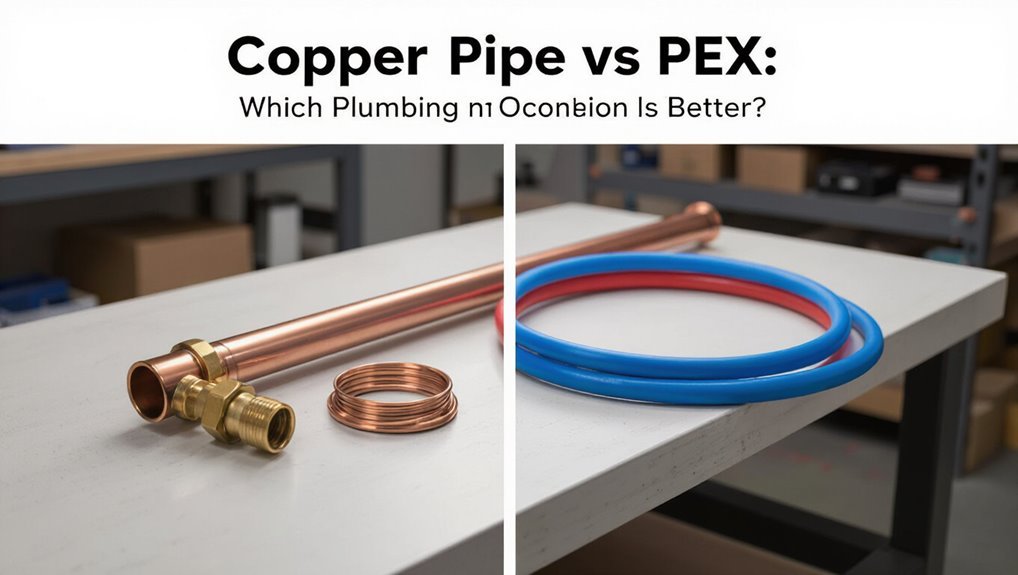
Copper Pipe vs PEX: Which Plumbing Option Is Better?
When comparing copper and PEX for plumbing, the choice depends on your specific priorities. Copper offers long-term durability, excellent thermal conductivity, and predictable corrosion behavior, but it comes at a higher cost and requires skilled soldering for installation. On the other hand, PEX is more flexible, quicker to install, and generally more affordable. It is resistant to corrosion and freeze damage, but has temperature limitations and limited recycling options. Ultimately, factors such as water chemistry, installation access, freeze risk, and local code will determine which material is the best fit for your project. For practical comparisons, installation tips, and retrofit guidance, read on.
Quick Decision Framework: When to Pick Copper vs PEX
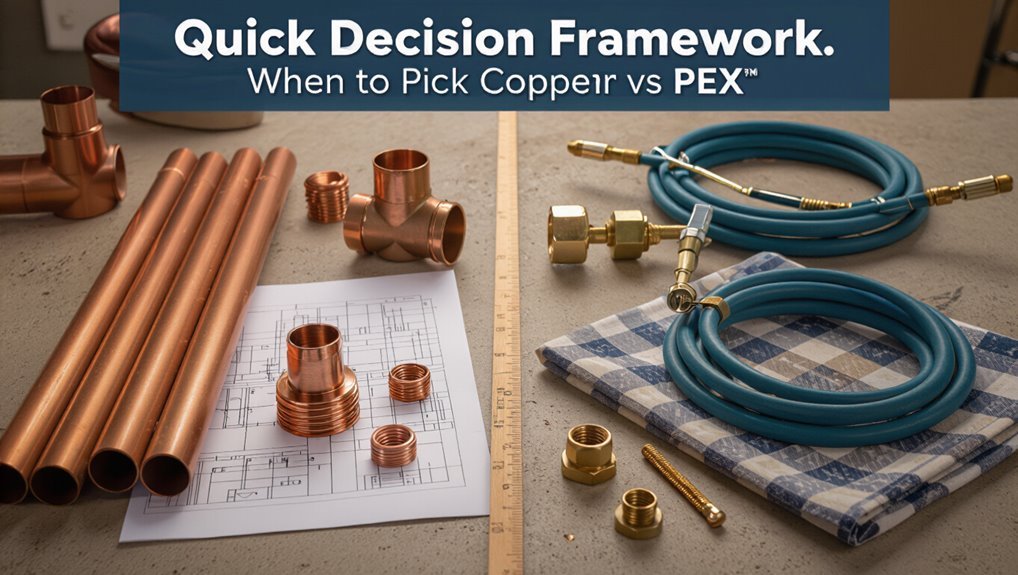
Typically, choosing between copper and PEX hinges on three practical factors: water quality and temperature, installation environment, and long-term maintenance priorities.
The framework evaluates corrosion risk and mineral content—copper may suit neutral, treated supplies while PEX tolerates acidic or soft water. Temperature needs guide selection: high-temperature or exposed runs can favor copper; flexible PEX excels in convoluted or retrofit paths.
Installation constraints—access, freezing potential, and required fittings—affect labor and time. Maintenance and lifespan considerations balance durability, repairability, and resale perceptions. Cost, code compliance, and contractor familiarity complete the decision matrix for informed selection.
Copper Piping: How It Works and Ideal Uses
Copper piping combines a naturally corrosion-resistant metal with reliable mechanical joints, making it a durable choice for many plumbing systems.
Its high thermal conductivity also promotes efficient heat transfer for hot water delivery and compatibility with heat-based applications like hydronic heating. These properties guide the selection of copper when longevity and thermal performance are priorities.
Corrosion Resistance Benefits
Resistant to many common forms of degradation, copper piping offers strong corrosion performance because its oxide layer and patina slow further metal loss and help prevent leaks over time.
Copper resists galvanic attack when properly isolated from dissimilar metals and when appropriate fittings and dielectric materials are used.
It tolerates varying water chemistries better than many metals, reducing pinhole leaks and joint failures in typical residential and commercial systems.
Routine inspection and maintenance detect early deterioration from aggressive water or stray electrical currents.
These characteristics make copper a durable choice where long-term integrity and predictable corrosion behavior are priorities.
Heat Conductivity Advantages
A highly conductive metal, copper transfers heat quickly and evenly along the length of a pipe, enabling efficient heat exchange in plumbing systems.
This thermal behavior reduces temperature loss between heater and fixture, improving delivery of hot water and lowering energy demands.
Copper’s conductivity benefits radiant heating and boiler loops where rapid, predictable heat transfer is required.
It also shortens recovery time for hot water recirculation systems.
However, conductivity can cause unwanted heat gain in cold lines unless insulated.
PEX Piping: How It Works and Ideal Uses
PEX piping is made from flexible cross-linked polyethylene that simplifies installation by reducing joints and accommodating curves.
Its flexibility suits long runs and retrofit work where rigid pipe would be difficult to route.
Users should note PEX has defined temperature and pressure limits that influence suitability for high-heat or high-pressure applications.
Flexible Installation Benefits
With minimal fittings and long, continuous runs, installation time and potential leak points are reduced when using cross-linked polyethylene (PEX) piping. Its flexibility allows bends around obstacles, fewer joints, and simplified routing through walls and crawl spaces.
Installers often cut and secure PEX faster than rigid copper, reducing labor costs and disruption. Manifold-based systems enable individualized branch lines, simplifying repairs and future modifications.
The material’s lightweight nature eases handling and transport on job sites. Overall, these flexible installation benefits make PEX well suited for retrofit projects, complex layouts, and situations where reduced access and speed matter.
Temperature And Pressure Limits
Handles typical residential temperatures and pressures, cross-linked polyethylene (PEX) is rated to perform safely under a defined range that governs its ideal uses. PEX commonly withstands continuous operating temperatures up to about 200°F (93°C) for short periods and is typically rated for 180°F (82°C) at reduced pressures.
Standard pressure ratings are around 80–100 psi at 180°F and 160–200 psi at 73°F (23°C), depending on type and manufacturer. These limits favor hot and cold domestic water systems but require adherence to manufacturer specifications, local codes, and protection from heat sources and UV exposure to maintain long-term integrity and safety.
Connections and Reliability: Solder, Compression, Crimp, and Push-Fit
Frequently, the choice of connection method determines both immediate ease of installation and long-term durability; soldered joints, compression fittings, crimp rings, and push-fit connectors each present distinct trade-offs in skill required, leak resistance, repairability, and suitability for various pipe materials.
Soldered copper provides proven, permanent bonds resistant to high temperatures but demands proper cleaning and flux. Compression fittings simplify joins without heat but can loosen under vibration or repeated disassembly. Crimp rings on PEX create reliable, low-profile seals when installed correctly yet require ring integrity. Push-fit connectors offer fastest serviceability and compatibility with both copper and PEX, though they may be bulkier and costlier.
Tools, Skill Level, and Installation Time for Copper vs PEX
Typically, choosing between copper and PEX hinges on differences in tools, installer skill, and time required for completion.
Copper demands pipe cutters, deburring tools, flux, soldering torch or brazing gear, and often more precise measuring and fitting; soldered joints require practiced technique and safety precautions.
PEX installation uses tubing cutters, crimp or clamp tools, and sometimes expansion kits or push-fit fittings; connections are quicker and more forgiving, reducing leak risk from poor technique.
Upfront Materials and Installation Costs Compared
The comparison begins with upfront material costs, where PEX typically has a lower purchase price than copper.
Labor and installation expenses can shift the balance, since copper often requires more skilled soldering and longer installation time.
Long-term cost factors—such as maintenance, repairs, and service life—also influence the overall value and should be weighed alongside initial expenses.
Material Purchase Price
Comparing upfront costs for copper pipe and PEX focuses on two components: the price of materials and labor required for installation.
Material purchase price typically favors PEX: tubing costs per foot are lower than equivalent copper, and fittings for PEX tend to be less expensive. Copper pricing fluctuates with metal markets, often making short-term costs higher. PEX is sold in coils, reducing joints and requiring fewer fittings overall. Valves, manifolds, and connectors vary by brand and quality, affecting totals.
For budgeting, material-only estimates usually show PEX as the more economical choice in most residential scenarios.
Labor And Installation
Installers generally spend less time routing and joining PEX than copper, which translates into lower labor bills for most residential jobs. PEX’s flexibility reduces fittings and soldering, accelerates runs through framing, and often allows fewer access cuts.
Copper requires precise soldering or brazing, additional fittings, and sometimes coring or sleeving where pipes pass through studs, increasing installation time. Tooling differs: PEX crimp or expansion tools are quick; copper needs torches and joint preparation.
For retrofit work, PEX often minimizes demolition. Local code and installer experience affect bids, but overall upfront labor favors PEX in typical home installations.
Long-Term Cost Factors
One key factor in long-term plumbing costs is the difference between upfront material and installation expenses for copper versus PEX. Copper demands higher material costs and skilled soldering or brazing labor, raising initial outlay. PEX offers lower material prices and faster, simpler installation with fewer fittings, reducing contractor hours.
Over time, maintenance, repair frequency, and longevity influence total cost: copper resists UV and higher temperatures but may corrode in aggressive water, while PEX resists scale and is flexible but can be damaged by rodents or UV. Homeowner preferences, local labor rates, and warranty terms determine ultimate value.
Longevity and Durability: Fittings, Joints, and Failure Drivers
Both copper and PEX systems derive most of their long-term performance from the quality of fittings and joints and from the specific failure mechanisms that act on those connections. Copper relies on solder, compression, or press fittings; PEX uses crimp, clamp, or push-fit connections. Corrosion, dezincification of brass, mechanical fatigue, and improper installation are primary failure drivers for copper. PEX failures stem from UV exposure, abrasion, improper clamps, and chemical attack. Regular inspection and correct installation mitigate risks. Comparative summary:
| Aspect | Common issues |
|---|---|
| Copper fittings | Corrosion, joint leaks |
| PEX fittings | Clamp failure, UV damage |
Freeze Resistance and Flexibility: Copper vs PEX
Typically, freeze resistance and flexibility are key considerations when choosing between copper and PEX for plumbing: copper is rigid and conducts heat well, making it more prone to freeze-related bursting in exposed runs, while PEX’s flexibility allows it to expand and contract as ice forms, reducing rupture risk.
Installers note that PEX can be run with fewer fittings and around obstacles, minimizing joints that might fail during freeze-thaw cycles.
Copper requires careful insulation and may need slope or drains to prevent trapped water. In cold climates, PEX often offers simpler protection strategies, though installation quality remains decisive.
Corrosion, Mineral Buildup, and Water-Quality Concerns
Freeze behavior and material flexibility affect more than burst risk; they also influence how metals and resins interact with water over time.
Copper resists bacterial growth and maintains water taste but can leach copper in acidic or soft water, raising metallic taste and health concerns if concentrations climb. Mineral-rich hard water deposits scale inside copper, reducing flow and heat transfer.
PEX resists corrosion and scale, preserving flow and minimizing metallic leaching, yet certain formulations can impart plastic odors or permit low-level VOCs initially. Both require appropriate water chemistry control, filtration, and certified materials to protect water quality over long-term service.
Pressure and Temperature Limits for Each Material
How do copper and PEX compare when subjected to the pressures and temperatures of residential and commercial plumbing systems? Copper tolerates higher continuous temperatures (up to ~400°F for short periods) and sustained pressures typical of commercial systems; PEX is rated for 200°F at lower pressures and commonly 73–100 psi at 180°F. Ambient freezing behavior differs: copper can burst from ice expansion more readily than flexible PEX. Selection depends on maximum system temperature, pressure, and code limits.
| Material | Max Continuous Temp | Typical Pressure Rating |
|---|---|---|
| Copper | ~400°F (short) | High (commercial-rated) |
| PEX | 200°F | Moderate (varies by type) |
Can You Mix Copper and PEX? Best Practices
Mixing copper and PEX is common in modern plumbing, but it requires correct coupling methods and attention to code to guarantee long-term integrity.
Adaptor fittings approved for both materials—brass, push-fit, or dielectric unions—prevent galvanic corrosion and make certain reliable seals. Installers should follow manufacturer instructions, use appropriate clamps or crimp rings for PEX, and avoid direct burying of dissimilar metals without isolation.
Maintain accessible transition points for inspection. Local codes may mandate specific fittings, support spacing, or grounding considerations when integrating copper and PEX.
When done per code and best practices, mixed systems deliver flexibility and durability without compromising performance.
Typical Maintenance, Repair Frequency, and Patching Methods
Regularly, both copper and PEX systems require routine inspection and simple maintenance to prevent leaks and extend service life.
Visual checks for corrosion, discoloration, loose fittings, and support spacing are standard; PEX requires inspection for kinks, UV exposure, and secure crimps.
Repair frequency depends on water quality, installation quality, and usage patterns; copper often needs fewer interventions in stable conditions, while PEX repairs are typically simpler and faster.
Patching methods differ: small copper pinholes use soldering or epoxy, larger sections require cutting and replacing fittings; PEX patching commonly uses compression or crimp couplings and section replacement.
Common Failure Modes and How to Prevent Them
Having outlined maintenance practices and typical repairs, attention turns to the specific failure modes that affect copper and PEX systems and the measures that reduce their likelihood.
Copper commonly suffers corrosion, pinhole leaks from aggressive water chemistry, galvanic corrosion at dissimilar-metal joints, and mechanical damage from freezing or impact.
PEX can experience UV degradation, kinking, slow-acting chemical attack from incompatible fittings, and freeze-induced splitting.
Prevention includes water quality testing, dielectric unions, proper support and insulation, avoidance of direct sunlight exposure, correct bending radii, using approved fittings and barriers where metals join, and routine inspections to catch early deterioration.
Code, Permit, and Insurance Considerations by Region
Across jurisdictions, plumbing codes, permit requirements, and insurance guidelines shape which materials and installation methods are acceptable for copper and PEX systems. Local building codes may restrict PEX types, require dielectric fittings for copper, or mandate specific fastening and support practices.
Permit scopes and inspection frequency vary, influencing labor cost and scheduling. Insurance policies sometimes prefer one material over another based on perceived longevity or failure history, affecting coverage and premiums. Professionals should verify regional standards before selection.
- Confirm local code listings and approved fittings.
- Check permit triggers and inspection checkpoints.
- Review insurer statements on material acceptability.
Copper vs PEX for Potable Water and for Radiant Heating
When evaluating copper and PEX for potable water supply and radiant heating, the two materials diverge in thermal performance, corrosion resistance, installation complexity, and long-term maintenance needs.
Copper offers excellent heat conduction for radiant systems, resists temperature-related deformation, and is inherently bacteriostatic for potable lines, though it can corrode in aggressive water.
PEX provides flexibility, fewer joints, and superior freeze resistance, reducing leak risk and installation time; its lower thermal conductivity requires higher flow or closer tubing spacing in radiant floors.
Long-term considerations include lifespan, chemical compatibility, and inspection access, with system design dictating the most suitable material choice.
Retrofitting Older Homes: Choosing Copper or PEX
In older homes, choosing between copper and PEX for a retrofit hinges on existing wall and floor access, water quality, and budgetary constraints: copper may be preferred where visible runs and high-temperature tolerance are required, while PEX offers faster installation and fewer joints in spaces that are difficult to open.
The decision often balances longevity, corrosion risk, and disruption. PEX reduces demolition and labor; copper suits exposed or high-pressure sections.
Consider water chemistry tests, local code, and expected service life when planning.
Typical retrofit considerations include:
- Access difficulty and required demolition
- Water quality and corrosion potential
- Long-term maintenance and replacement costs
Noise, Heat Loss, and Insulation Tips for Both Materials
For retrofit projects, plumbing noise, heat loss, and insulation needs differ noticeably between copper and PEX: copper transmits sound and heat rapidly, often requiring more acoustic and thermal insulation on exposed runs, while PEX dampens vibration and retains heat better but still benefits from insulation where pipes pass through unheated spaces. Recommendations focus on placement, materials, and fastener isolation. Use foam or fiberglass for thermal protection and rubberized or split-sleeve products for noise control. Maintain continuous coverage through cavities and seal penetrations. Periodic inspection makes certain insulation integrity and addresses convective losses or structure-borne noise early.
| Issue | Practical tip |
|---|---|
| Noise | Isolate with rubber clamps |
| Heat loss | Use closed-cell foam |
| Exposed runs | Add acoustic wrap |
| Cold spaces | Insulate fully |
| Fasteners | Use vibration pads |
Environmental Impact and Recyclability: Which Is Greener?
Beyond acoustic and thermal performance, material lifecycle characteristics heavily influence the environmental cost of choosing copper or PEX. Copper production demands high energy and mining, but yields a durable, long-lived product with established recycling streams. PEX requires less energy to manufacture and offers flexibility, yet it is derived from fossil fuels and has limited, less-common recycling options. End-of-life handling and transportation emissions alter overall footprints; installation longevity and leak rates also matter.
- Copper: high embodied energy, strong recyclability
- PEX: lower production energy, constrained recyclability
- Lifecycle impacts: driven by durability, maintenance, and disposal
Final Recommendation Matrix: Choose by Project Type and Priorities
Usually a concise decision matrix helps align plumbing choice with project goals, weighing cost, durability, installation constraints, and environmental priorities.
For new construction prioritizing longevity and resale, copper rates high for durability and perceived value despite higher cost.
For renovations with limited access and faster install, PEX excels via flexibility and lower labor expense.
For cold climates where freeze resistance matters, PEX reduces burst risk; for visible runs and hot-water efficiency, copper offers thermal benefit.
For environmentally focused projects, recycled copper or longer-lived copper may appeal, while PEX suits budget-limited, rapid-deploy installations.
Prioritize trade-offs to match project specifics.
Conclusion
When weighing copper versus PEX, homeowners should match material to situation: copper for durability, heat resistance, and resale appeal; PEX for flexibility, lower cost, and easier retrofit work. Both have pros and cons in connections, noise, and environmental footprint, so pick based on budget, skill level, and long-term priorities. In short, don’t throw the baby out with the bathwater—choose copper where longevity matters and PEX where practicality and access rule the day.