How to Turn Off Your Boiler for Summer: A Simple Step-by-Step Guide
To turn off your boiler for summer, follow these straightforward steps to disable central heating while maintaining hot water and frost protection. First, switch off the thermostat and heating schedule, then set the boiler to summer or hot-water-only mode. If there are any external heating circuits, isolate or drain them. Next, inspect for leaks, check the pressure, and turn off the fuel or electrical supply according to the manufacturer’s instructions. Always adhere to safety and legal guidelines, and keep your service records handy. For detailed steps, safety tips, and troubleshooting advice, continue reading.
What “turning off your boiler for summer” means and when to do it
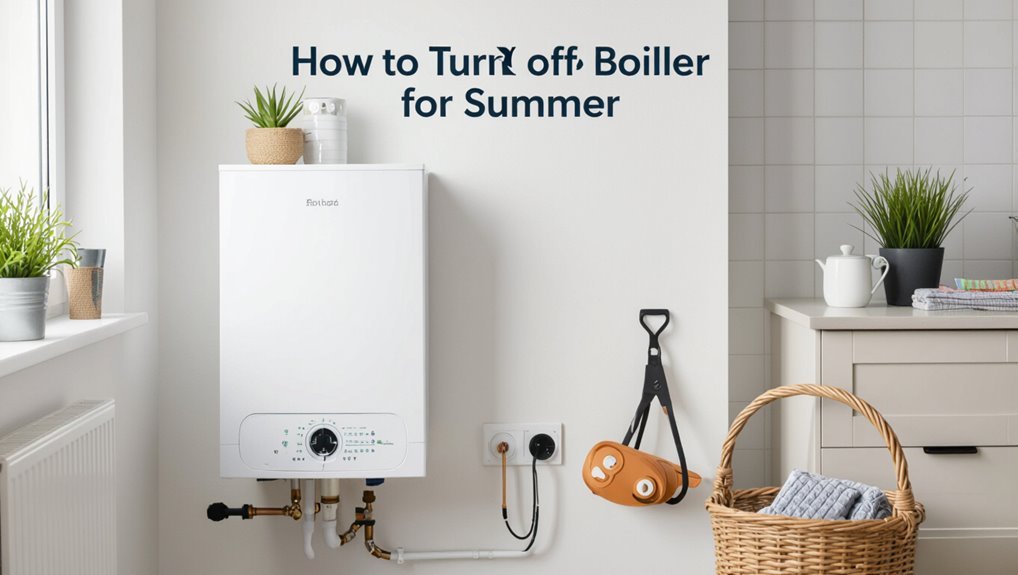
Turning off a boiler for summer generally means switching off the central heating function while leaving occasional hot water settings or frost protection intact.
Homeowners typically do this when outdoor temperatures remain consistently warm and no heating is needed, indicated by stable room temperatures and no risk of frozen pipes.
Exceptions include properties with elderly occupants, hydronic towel rails, or system-specific maintenance requirements that call for the boiler to remain active.
Why homeowners shut down boilers in warm months
Although central heating systems are primarily associated with cold weather, many homeowners choose to shut off their boilers during warm months to save energy and reduce wear, especially when no radiators or underfloor heating are needed.
Reasons include lower fuel bills, reduced maintenance needs, and fewer fault risks.
Guides on how to turn off boiler for summer emphasize simple, safe shutdown steps and timer adjustments.
Signs it’s safe and appropriate to switch off your boiler
Many homeowners can safely switch off their boiler for the summer once outdoor temperatures consistently stay high and central heating is not required.
Signs it’s appropriate include no scheduled heating use, thermostat settings remaining low, radiators cold to touch, and prolonged warm weather forecasts.
Additionally, absence of vulnerable occupants needing constant hot water and readiness to perform basic restart checks indicate a suitable time to power down.
When you should not turn off the boiler (exceptions)
If household needs for hot water, frost protection, or scheduled maintenance remain, the boiler should not be switched off for the summer.
Exceptions include homes requiring continuous hot water, properties vulnerable to freezing pipes, elderly or medical needs, and systems under warranty that mandate regular operation.
Also avoid shutdown when contractor or manufacturer advice recommends seasonal upkeep or periodic cycles to preserve components.
Quick, step-by-step shutdown checklist (direct answer)
A concise shutdown checklist lists required tools and safety items first, then provides four clear actions: turn off the thermostat and heating schedule, switch the boiler to off or summer mode, isolate and drain any external systems if needed, and turn off the fuel supply where appropriate.
The sequence should be followed step by step to minimize risk and prevent damage. If unsure about any step, a qualified technician should be consulted before proceeding.
Tools and safety items to have ready
Several essential tools and safety items should be gathered before beginning the boiler shutdown: adjustable wrench, screwdriver set, pressure gauge or thermometer, drain pan, hose, and personal protective equipment (gloves, safety glasses).
Also include a flashlight, bucket, towels, and a carbon monoxide detector.
Confirm isolation valves are identifiable and have labels.
Keep manufacturer manual and emergency contact information accessible.
Step 1: Turn off the thermostat and heating schedule
With tools and safety items prepared, proceed to disable the heating controls before working on the boiler.
The thermostat should be set to “off” or lowest temperature and any timed heating schedules cancelled.
For programmable units, confirm overrides and battery-backed programs are cleared.
Document settings for autumn restart.
Verify radiators are cool and no heat call is active before continuing to the boiler.
Step 2: Switch boiler to off or summer mode
Switch the boiler control to the off position or select “summer”/“hot water only” mode to stop central heating while allowing domestic hot water if required.
Confirm settings on the boiler control panel or programmer, then wait for the burner to cease.
Check indicator lights or display for standby status.
Note any error codes and consult the manual if unexpected warnings appear.
Step 3: Isolate and drain external systems if needed
Isolate and drain any external heating circuits or summer-use systems that could freeze or stagnate during the off-season: close the isolation valves feeding garden taps, pool heaters, underfloor heating manifolds, and external radiators; open drain points or fitted drain taps; and collect discharged water into a bucket or drain hose.
Verify drains are clear, label closed valves, and flush until water runs clean; reseal and secure hoses.
Step 4: Turn off fuel supply (gas/electric) where appropriate
Shut off the boiler’s fuel supply following the manufacturer’s instructions and local regulations: close the gas isolation valve at the appliance (or at the meter if instructed) or turn off the dedicated electrical isolator/circuit breaker feeding the boiler.
Verify the valve or breaker is fully closed/locked where possible, label the isolation for clarity, and consult a qualified technician if unsure or if gas work is required.
Step 5: Check for and secure circulation pumps and timers
Inspect the boiler’s circulation pumps and timers to guarantee they are stopped, secured, and set for summer conditions.
Verify pumps are switched off and isolated or locked where possible.
Disable automatic schedules on timers or set to off.
Secure wiring and covers, check for leaks or unusual sounds, and note any maintenance needs.
Leave controls accessible for seasonal reactivation.
Step 6: Document settings for restart
Record the boiler’s current settings, controls, and component states clearly to guarantee a smooth restart.
Note thermostat setpoints, timer programs, pump positions, valve orientations, pressure reading, and any override switches.
Photograph control panels and label wires if altered. Store notes with the user manual and take a dated snapshot.
Keep a concise checklist for reopening: restore timers, confirm pressure, and test operations.
Preparing the boiler and heating system before shutdown
Before shutting the boiler for summer, a brief inspection should check for leaks, corrosion, and worn components that could worsen during inactivity.
The homeowner must decide whether to flush or bleed radiators or leave the system sealed, and to protect pipes and the unit against unexpected cold snaps or frost.
Finally, consider how hot water needs differ between combi and system boilers and take appropriate steps to preserve or isolate the hot-water supply.
Inspecting for leaks, corrosion, and wear
A thorough visual and tactile check of the boiler and connected pipes can reveal leaks, corrosion, or worn components that should be addressed before shutdown.
Inspect joints, valves, pump seals, pressure relief areas, condensate traps, and visible insulation. Note discoloration, rust, dampness, or brittle hoses.
Document findings, tighten loose fittings, and arrange professional repair for any significant corrosion, leaks, or compromised safety parts.
Flushing or bleeding radiators vs leaving them sealed
Decide whether to flush or bleed radiators based on system condition and local climate, since trapped sludge or air can cause corrosion or uneven heating during the off-season while sealed systems risk stagnation.
Owner should inspect valve operation, note cold spots, and consider a powerflush for heavy buildup.
Bleeding vents removes air; flushing restores flow.
Record actions and plan maintenance before shutdown.
Protecting against cold snaps and frost risk
When temperatures can still drop unexpectedly, the homeowner should take steps to protect the boiler and pipework from frost damage by maintaining minimal heat, insulating vulnerable components, and ensuring drainage paths are clear.
They should leave the thermostat at a low frost-protection setting, fit foam insulation on exposed pipes, protect external condensate and stopcock areas, and verify condensate and drain routes are unobstructed before shutdown.
Handling hot water requirements (combi vs system boilers)
Because hot-water needs differ and boiler types store or produce domestic hot water differently, homeowners must address hot-water arrangements before shutting down for summer.
For combi boilers, verify timer/temperature settings and confirm instant hot-water function remains active if desired.
For system or regular boilers with cylinders, maintain cylinder thermostats or use immersion heater schedules; drain only if instructed by a professional.
Safety precautions and regulatory considerations
Before shutting down for summer, attention must be paid to safety and legal issues such as isolating the gas supply and contacting a Gas Safe engineer if any doubt exists.
The electrical supply should be turned off correctly to avoid shock or damage, and owners should be aware that unauthorised DIY adjustments can affect warranties or contravene regulations.
Professional assistance is recommended whenever uncertainty, gas work, or complex electrical isolation is involved.
Gas safety: isolating supply and contacting a Gas Safe engineer
Turn off the gas supply at the meter and isolate the boiler before any maintenance or seasonal shutdown to eliminate immediate ignition risks.
After isolation, verify no gas odour and label valves.
Do not attempt appliance repairs; contact a qualified Gas Safe engineer for inspections, pressure checks and reconnection.
Keep records of service and comply with local regulations to guarantee legal and safe restoration of supply.
Electrical safety: isolating power correctly
Having isolated the gas supply, attention should then move to the electrical supply to guarantee the boiler is completely de-energised before any work or long-term shutdown.
Power should be turned off at the dedicated circuit breaker or isolator switch; confirm using a non-contact voltage tester.
Lock-off or label the breaker to prevent accidental re-energisation.
If uncertain, engage a qualified electrician.
Legal and warranty implications of DIY shutdowns
While a homeowner may legally switch off a boiler for seasonal non-use in many jurisdictions, doing so without understanding applicable regulations, gas safety rules, or the terms of any service contract can have consequences; improper shutdowns, undocumented work, or failure to notify relevant parties may void warranties, breach insurance conditions, or leave the owner liable for subsequent damage.
Documentation, adherence to manufacturer instructions, and keeping records of any maintenance protect warranty and insurance rights.
When to call a professional
When should a professional be contacted before attempting a boiler shutdown?
A qualified technician should be called if the system is complex, under warranty, connected to gas mains, or equipped with sealed or pressurised components.
Also seek professional help when safety devices or controls are unfamiliar, leaks or corrosion are present, or local regulations require certified intervention.
Documentation and permits may be necessary.
Common mistakes to avoid when turning off your boiler
Common errors when shutting down a boiler for summer can compromise hot water supply and connected appliances if not anticipated.
Failing to drain or isolate external heating devices, missetting timers or frost thermostats, and ignoring low-pressure or frozen condensate pipe issues are frequent oversights.
Addressing these points prevents damage and guarantees reliable service when the system is restarted.
Forgetting the hot water supply needs
If homeowners neglect the hot water requirements before shutting down a boiler for summer, they may find basic tasks—washing dishes, showering, or running laundry—disrupted or dependent on temporary solutions.
A detached review notes the need to assess alternative hot water sources, schedule usage, inform household members, and consider leaving the water heater on or using point-of-use electric heaters to avoid inconvenience.
Not draining or isolating external heating appliances
After considering hot water needs, attention should turn to external heating appliances connected to the boiler—such as underfloor heating manifolds, towel rails, garage heaters, or secondary radiators.
Failure to isolate or drain these can allow trapped water to expand, freeze, corrode valves, or damage pipework.
Properly isolate, drain or flush each circuit and label isolation points to prevent summer deterioration and simplify recommissioning.
Incorrectly turning off timers or frost thermostats
Mistaking timers or frost thermostats for simple on/off switches can leave a boiler vulnerable during summer: disabling the main heating schedule without checking frost protection settings may allow pipes to freeze on cold nights.
Leaving a frost stat active but misconfigured can cause unnecessary short cycling that stresses components.
Check and document timer settings, confirm frost stat setpoint, and test functions before leaving the system unattended.
Overlooking low-pressure or condensate pipe issues
Neglecting boiler low-pressure warnings or blocked condensate pipes can leave a system unable to restart or cause water to back up and damage components during the summer shutdown.
Technicians or owners should check pressure gauges and top up following manufacturer guidance, inspect condensate drains for ice, debris or sagging runs, and clear or repair blockages.
Ignoring these steps risks costly repairs and corrosion.
How to restart your boiler in autumn step-by-step
The restart procedure begins with straightforward pre-start safety checks and a visual inspection of the boiler and pipework.
Next, fuel and electrical supplies are restored, the system is re-pressurised and radiators are bled as needed.
Finally, the boiler is run through initial tests while monitoring for faults and unusual noises or leaks.
Pre-start safety checks and visual inspection
Begin by performing a careful visual inspection and basic safety checks before any restart attempts.
Check for visible damage, corrosion, leaks, loose fittings, and pests.
Make certain vents and flues are clear of obstructions and insulation remains intact.
Confirm pressure and condensate drains show no obvious faults.
If anything abnormal is found, do not proceed; contact a qualified engineer for assessment.
Restoring fuel and electrical supplies
After confirming no visible faults, attention turns to restoring the boiler’s fuel and electrical supplies in preparation for autumn start-up.
The technician reopens the gas isolation valve or reconnects the oil supply, checks for leaks or odours, and restores mains power at the isolator.
Control switches and timers are set to standby.
Any tripped breakers are reset cautiously; professional help is arranged if anomalies persist.
Re-pressurising the system and bleeding radiators
Open the filling loop and monitor the boiler pressure gauge until it reaches the manufacturer’s recommended level (typically 1–1.5 bar when cold).
Then close the loop and secure the isolating valves.
Next, work clockwise from the lowest radiator: slightly open bleed valves until air escapes, then close when water flows steadily.
Recheck pressure and top up if necessary, avoiding overpressurisation.
Running initial tests and checking for faults
With the system repressurised and radiators bled, the boiler is ready for a controlled restart and initial checks to confirm safe operation.
Restore power and pilot, observe startup noises, flame stability, and pressure behavior.
Check for leaks, unusual smells, and error codes on the display.
Verify hot water and heating demand response.
If faults appear, shut down and consult a Gas Safe engineer immediately.
Maintenance and storage tips during summer shutdown
During summer shutdown, owners are advised to schedule a professional service and visual inspection to identify wear and note any parts due for replacement.
Short-term care should include clearing and insulating condensate and waste pipes to prevent blockages or frost damage in cool nights.
Clear records, labels and a checklist of replaced or outstanding items will speed a safe, efficient restart.
Scheduled servicing and inspection recommendations
Although boilers are less active in summer, scheduling a professional inspection and basic maintenance before shutdown guarantees safe, efficient operation and prevents corrosion or component failure while idle.
A certified technician should check pressure, seals, controls, burners, and safety devices, replace worn parts, and document recommendations.
Arrange servicing documentation and a follow-up plan to address repairs before restart in autumn.
Short-term care for condensate and waste pipes
When preparing a boiler for summer shutdown, attention to condensate and waste pipes prevents blockages and freeze-related damage while the system is idle.
Inspect visible runs for debris, clear traps and gullies, and flush condensate drains with warm water to remove sediment.
Confirm outdoor pipe insulation remains intact and slope is correct.
Cap or protect exposed ends to deter pests and ingress.
Record-keeping and labeling controls for easy restart
Compile clear records and label controls to guarantee a smooth and safe boiler restart after summer shutdown.
Note settings, valve positions, fuel and water isolation points, sensor calibrations, and maintenance actions. Affix durable labels to switches, drains, and service ports.
Store manuals, receipts, and inspection notes together with photographs of original configurations.
Maintain a dated log to track changes and assist technicians during restart.
When to replace parts during the off-season
Inspect components during the off-season to identify wear that is best addressed before restart; replacing vulnerable parts while the system is idle reduces downtime and prevents emergency repairs once heating demand returns.
Prioritize consumables (filters, seals, gaskets), corroded fittings, failing pumps, and sensors.
Schedule replacements and source parts early.
Store spares in a dry, labeled container and document installation dates for future reference.
Cost, energy, and environmental considerations
The article examines whether switching off a boiler for summer yields meaningful energy and cost savings or only marginal reductions.
It considers how complete shutdowns can affect appliance lifespan and raise the risk of repairs versus leaving systems dormant with minimal maintenance.
Finally, it outlines eco-friendly alternatives—such as seasonal thermostatic adjustments and low-power standby modes—that balance savings and system health.
Potential energy savings vs negligible benefits
Weighing potential energy savings against negligible benefits requires evaluating boiler type, household hot-water use, and local fuel prices.
For some systems, switching off during warm months yields measurable fuel and emissions reductions; for others, standby losses or reheat demands offset gains.
Homeowners should compare estimated seasonal consumption, billing rates, and simple payback to determine whether shutdown delivers meaningful savings.
Impact on appliance lifespan and repair risk
Beyond cost and fuel-effectiveness, shutting a boiler for summer carries implications for equipment longevity and the likelihood of repairs.
Extended inactivity can lead to corrosion, seals drying or sticking, and sediment settling, increasing failure risk when restarted. Conversely, reduced runtime lessens wear on moving parts and burners.
Periodic maintenance and proper winterization balance preservation with minimizing unforeseen repair costs.
Eco-friendly alternatives to full shutdown
While a full shutdown can seem straightforward, operators can adopt eco-friendly alternatives that trim fuel use and emissions without risking equipment issues. Options include seasonal setback schedules, low-temperature or frost-protection modes, and targeted zone control, each offering different trade-offs in cost savings, energy consumption, and carbon output.
Choosing depends on building occupancy, control complexity, and upfront versus ongoing savings; monitoring verifies actual reductions.
Comparison of shutdown steps for common boiler types
Different boiler types require distinct shutdown steps to guarantee safety and prevent damage during the summer months. The following table summarizes key actions for common units and can guide a concise checklist for each type. A professional should be consulted if any specific controls or plumbing configurations are unclear.
| Boiler type | Typical shutdown actions |
|---|---|
| Combi boilers | Isolate gas, turn off power, close water inlet and bleed domestic taps |
| System boilers | Isolate boiler power, close zone valves, drain external cylinders if fitted |
| Heat-only (regular) boilers | Turn off boiler and pump, close feed and expansion tank valves, drain radiator loops if necessary |
Combi boilers
Combi boilers require a slightly different shutdown approach than system or conventional boilers because they provide both central heating and on-demand domestic hot water from a single compact unit. The shutdown sequence isolates heating, leaves water for taps, and turns pilot or electronic ignition off. Common steps: set thermostat off, close external gas if needed, consult manual.
| Step | Action | Note |
|---|---|---|
| 1 | Turn thermostat off | Stops heating call |
| 2 | Preserve DHW | Check manual |
| 3 | Isolate gas/power | If advised |
System boilers
Having outlined the shutdown steps for combi boilers, the focus shifts to system boilers, which handle central heating and store hot water in a separate cylinder. Shutdown requires isolating the boiler, turning off the programmer, draining system if necessary, and maintaining frost protection for the cylinder. Compare steps below:
| Step | Action | Note |
|---|---|---|
| 1 | Isolate boiler | Close valve |
| 2 | Turn off timer | Set to off |
| 3 | Drain loop | If required |
| 4 | Protect cylinder | Frost setting |
| 5 | Service check | Inspect seals |
Heat-only boilers (regular)
While simpler in design than combi or system boilers, heat-only (regular) boilers require a distinct shutdown approach because they rely on a separate hot-water cylinder and a gravity-fed cold-water storage tank. The procedure emphasizes isolating cylinder valves, draining if needed, closing tank feed, and turning off the boiler and timer to prevent pump run-on.
| Step | Action | Note |
|---|---|---|
| 1 | Isolate cylinder valves | Prevents backflow |
| 2 | Close tank feed | Stops cold supply |
| 3 | Turn off boiler/timer | Avoids unnecessary cycling |
Troubleshooting checklist for problems after shutdown
After restarting the system, the homeowner should check for common post-shutdown faults such as no hot water, low pressure or visible leaks after re-pressurising, and boilers that trip or display error codes.
Any persistent knocking or unusual noises should be noted and correlated with these symptoms.
If basic checks do not resolve the issue, a qualified engineer should be contacted for diagnosis and repair.
No hot water after restart
If a boiler restart yields no hot water, a focused troubleshooting checklist helps isolate the cause quickly.
Verify power and thermostat settings, guarantee the boiler’s hot water mode is selected, and confirm pilot ignition or electronic spark function.
Check external valves to domestic hot water cylinder, inspect timer/programmer, and reset fault codes per manufacturer instructions.
If unresolved, call a Gas Safe engineer.
Low pressure or leaking after re-pressurising
A restart that restores heating but still shows low pressure or persistent leaks requires a separate, systematic check.
Inspect visible pipework, radiators, valves and the boiler’s pressure gauge for obvious drips or corrosion.
Confirm filling loop isolation valves are fully closed after re-pressurising.
Bleed radiators to remove trapped air.
If pressure continues to fall or leaks persist, advise contacting a Gas Safe engineer for a sealed-system diagnosis.
Boiler trips or error codes on restart
When restarting the boiler, trips or error codes indicate the system has detected a fault and should not be ignored; consult the boiler’s manual for the specific code and follow a calm, stepwise troubleshooting process.
Check supply power, reset per manufacturer instructions, inspect visible pipework, confirm adequate pressure, and guarantee condensate drains are clear.
If codes persist, contact a qualified engineer for diagnosis and repair.
Persistent knocking or unusual noises
Detecting persistent knocking or other unusual noises after a shutdown signals mechanical or hydraulic issues that require prompt, methodical investigation.
The technician should isolate causes: check for trapped air, loose pipework, failing pump bearings, or kettling from limescale.
Inspect mounting brackets, expansion vessel pressure, and flow rates.
If uncertainty remains or work involves gas or sealed components, engage a qualified heating engineer for safe diagnosis and repair.
Quick-reference printable checklist
A concise printable checklist helps guarantee the boiler is handled safely and correctly for summer storage.
It should cover pre-shutdown preparations, clear shutdown steps, and a restart checklist for autumn inspection and testing. The list should be easy to follow and suitable for taping to a service log or fridge.
- Pre-shutdown checklist: inspections, parts to protect, and documentation
- Shutdown steps: order of operations, valve positions, and power isolation
- Restart checklist for autumn: pressure checks, bleed radiators, and test fires
Pre-shutdown checklist
Prepare a concise checklist that guides homeowners through essential steps before shutting down the boiler for summer.
The checklist guarantees safety, prevents damage, and readies the system for inactivity without detailing shutdown actions.
- Verify fuel/electric supply is stable and note meter/state.
- Inspect for leaks, corrosion, and unusual odors; document findings.
- Schedule maintenance or service if any issues are found prior to shutdown.
Shutdown steps
With the pre-shutdown checklist complete and any issues addressed, proceed to a concise, printable shutdown checklist that walks through each action in order.
Follow each step precisely to guarantee safety and preservation.
- Turn thermostat to off or summer mode; set frost protection if available.
- Shut fuel/energy supply and isolate boiler valves.
- Drain condensate and low-point drains, then record settings and lock controls.
Restart checklist for autumn
Begin the autumn restart by verifying the system area is clear, controls are accessible, and all summer isolation and lockout tags are removed.
Inspect pipework for damage, restore power and fuel, and confirm ventilation and condensate drains are unobstructed.
Run a controlled start, check pressures and temperatures, and monitor for leaks or faults.
- Restore power, fuel, and controls
- Verify valves and vents
- Test alarms and safety devices
Conclusion
When the heating season ends, one should shut the boiler down thoughtfully: “a stitch in time saves nine.” Completing the shutdown checklist, isolating fuel and power, and draining or protecting vulnerable components prevents damage and saves energy. Following safety guidance and manufacturer instructions minimizes risk; consulting a professional when unsure avoids costly mistakes. With care and attention now, the system will stay reliable and ready for the next cold season.