How to Size Gas Pipe: Quick Guide for Homeowners & DIYers
To properly size gas pipe for your home, you need to match the pressure to the required flow (measured in CFH). Start by verifying the inlet pressure and converting your appliance BTU ratings to CFH based on the fuel type. Next, calculate the total simultaneous demand for all appliances. Select the appropriate pipe material and diameter using sizing tables to ensure minimal pressure drop, allowing each appliance to receive its necessary operating pressure. Remember to factor in fittings, pipe length, elevation changes, and regulator impacts. Follow a straightforward three-step check as outlined in the guide to ensure accuracy in your gas pipe sizing.
Quick Answer: Pressure vs. Flow and 3‑Step Sizing Workflow
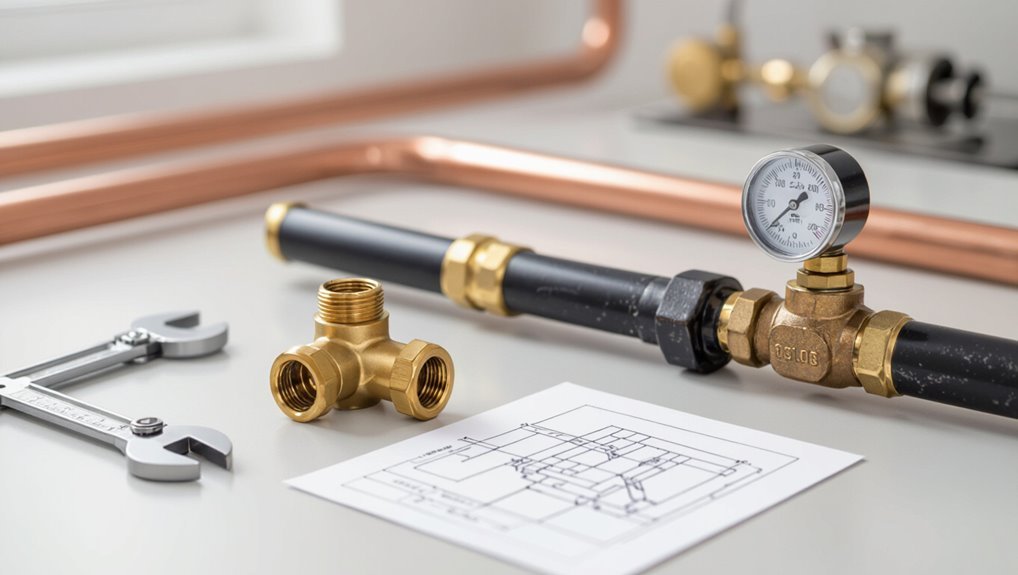
When designing gas piping, the key distinction is between pressure, the driving force measured in inches of water column or PSI, and flow, the volume delivered measured in cubic feet per hour; understanding their relationship enables accurate sizing.
The technician assesses available supply pressure, totals appliance flow demand, and selects pipe size to limit pressure drop within acceptable limits.
Step 1: verify supply pressure and regulator settings.
Step 2: sum appliance demand using manufacturer CFH ratings and apply applicable diversity or simultaneous-use factors.
Step 3: choose pipe material and diameter from tables or charts, then calculate expected pressure drop and adjust as needed.
Which Gas Are You Sizing For: Natural Gas or Propane?
Which fuel is being sized—natural gas or propane—determines required pipe diameters, pressure settings, and allowable pressure drop because the fuels differ in energy content, specific gravity, and typical delivery pressures.
Natural gas (methane) has lower energy per volume and lighter specific gravity than propane, so higher volumetric flow is needed for the same heat load; distribution pressures are typically lower.
Propane delivers more energy per cubic foot and is denser, often supplied at higher pressures from tanks, allowing smaller pipe for equivalent heat.
Accurate sizing must use the correct gas properties and typical supply pressure to select pipe and regulator arrangements.
Choose Units: BTU, CFH, PSI, Inches Water Column
Why choose specific units for gas sizing? The article explains that consistent units prevent errors when calculating demand and capacity.
BTU quantifies heat output per appliance; convert appliance ratings to BTU to total system load.
CFH (cubic feet per hour) expresses volumetric flow at standard conditions; use CFH tables or convert BTU to CFH using fuel-specific factors.
PSI and inches water column (in. w.c.) measure pressure; in. w.c. is common for low-pressure residential systems.
Choosing and sticking to appropriate units guarantees correct table selection, accurate conversions, and reliable pipe sizing without mixing incompatible measures or assumptions.
How Inlet Pressure Affects Pipe Sizing
Inlet pressure is the starting gas pressure at the meter or regulator and sets the available head for distribution.
It directly affects achievable flow rates and consequently the required pipe size to deliver target BTU or CFH.
Accurate pressure drop calculations use the inlet pressure, expected flow, and pipe characteristics to determine acceptable velocity and sizing.
Inlet Pressure Basics
Gas supply pressure at the point where piping enters a system sets the available driving force for flow and consequently determines the pipe sizes required to deliver required volumes without excessive pressure drop.
Higher inlet pressure permits smaller diameter piping for the same load because more energy is available to overcome frictional losses; lower inlet pressure requires larger diameters to maintain service.
Inlet pressure must be measured or specified in consistent units and referenced to the downstream operating pressure.
Regulators, elevation, and source characteristics influence available pressure.
Accurate inlet pressure data is essential for selecting pipe sizes, fittings, and safety margins during design.
Impact On Flow
Available supply pressure directly sets the driving head for flow and thus governs the relationship between pipe diameter, allowable pressure drop, and achievable volumetric flow rate.
Higher inlet pressure permits smaller diameters for a given appliance load because more driving force offsets frictional losses; lower inlet pressure requires larger diameters to maintain required flow without unacceptable service pressure.
Supply pressure limits also determine how many fixtures can run simultaneously before service degrades.
Designers select pipe sizes that guarantee appliances receive minimum operating pressure at peak demand, accounting for regulator settings and elevation changes, while preserving safety margins and code-required minimum pressures.
Pressure Drop Calculations
Because supply pressure sets the driving head, pressure drop calculations translate that head into permissible losses along the service and branch piping so appliances receive minimum operating pressure under peak demand.
The designer determines inlet pressure, required appliance pressures, and combined demand flow (BTU/hr or cubic feet per hour).
Using flow tables or the Darcy-Weisbach/engineering formulas, allowable pressure loss per foot is computed, guiding pipe diameter selection.
Longer runs, high flows, or low inlet pressure increase required diameter.
Regulators, fittings, and elevation changes add losses and must be included.
Iteration verifies chosen sizes meet code minimums and maintain acceptable pressure at all outlets.
How to Measure Appliance Demand in BTU/hr
The technician first records each appliance’s gas rating from nameplates or manufacturer specifications.
Ratings expressed in cubic feet per hour or watts are converted to BTU/hr using standard conversion factors.
Once all appliances are in BTU/hr, the technician sums concurrent loads per applicable code to determine total demand.
Identify Appliance Ratings
Determine each appliance’s heat input in BTU per hour (BTU/hr) by consulting its rating plate, manufacturer documentation, or product specifications. The technician records the nameplate BTU, model, and input type (natural gas or LP). If plate information is missing, use manufacturer lookup or service manuals. Note whether the value is gross input or net output; use the input rating for sizing. List all appliances, including ranges, water heaters, furnaces, fireplaces, and outdoor grills. Keep entries precise to avoid oversizing. Use the table below to organize findings before summing total demand.
| Appliance | BTU/hr |
|---|---|
| Range | 0 |
| Water heater | 0 |
| Furnace | 0 |
| Fireplace | 0 |
Convert Units To BTU/hr
Convert appliance inputs expressed in various units into BTU per hour to allow direct comparison and accurate sizing; common source units include watts, kilowatts, cubic feet per hour, and therms.
The installer converts each appliance rating to BTU/hr using standard factors: 1 W = 3.412 BTU/hr, 1 kW = 3412 BTU/hr, 1 therm = 100,000 BTU, and natural gas cubic feet use supplier energy content (typically ~1,020 BTU/ft³).
Record converted BTU/hr values clearly.
Verify manufacturer labels and local utility tables for exact conversion factors.
Use the summed BTU/hr per appliance for subsequent sizing calculations.
- Convert units precisely
- Verify source factors
- Record BTU/hr values
Add Concurrent Loads
After listing each appliance’s input in BTU/hr, the installer adds concurrent loads to reflect how many appliances are likely to operate at the same time; this produces a realistic demand figure rather than a simple sum of all appliances.
The installer applies accepted diversity factors or tables from local code to reduce total input where simultaneous operation is unlikely. For example, water heaters and ovens rarely run together at full input, so their combined demand may be less than the sum.
The adjusted demand becomes the design load used to size pipe and regulator capacity, ensuring safe pressure and adequate flow under typical household conditions.
Convert Appliance Ratings to CFH
Once the appliance inputs are collected, they must be translated into a common flow unit—cubic feet per hour (CFH)—so all loads can be summed and the pipe sized correctly. Appliance ratings appear as BTU/hr, CCF, or LPG in gallons; convert each to CFH using standard conversion factors (1 CF of natural gas ≈ 1,000 BTU; propane gallon ≈ 91,500 BTU).
Divide the appliance BTU/hr by the appropriate BTU per CF to get CFH. Apply manufacturer correction factors where specified. Record CFH per appliance, then sum concurrent loads for sizing calculations.
- Identify rating units and convert.
- Use correct BTU/CF factor.
- Sum concurrent CFH.
How to Read a Gas Pipe Sizing Chart
With appliance loads expressed as CFH and totaled, the next step is interpreting a gas pipe sizing chart to choose a pipe that will deliver the required flow at acceptable pressure loss.
A chart lists pipe diameters, lengths, and maximum CFH capacity for a specified inlet pressure and allowable pressure drop. Locate the total CFH on the chart column, follow horizontally to the shortest practical pipe length or expected run, then read the minimum diameter that supports the load.
If multiple materials or fittings apply, adjust for equivalent length. Confirm chart assumptions match system pressure and local code before final selection.
Using a Sizing Table for Common Household Appliances
When planning residential gas piping, a sizing table for common household appliances lets the installer match each appliance’s CFH requirement to a pipe diameter and length, simplifying layout decisions and ensuring adequate pressure.
The table lists typical appliances (furnace, water heater, range) with their nominal CFH and recommended pipe sizes for specified run lengths.
Using the table, the planner totals CFH for grouped runs, checks cumulative demand against allowed lengths, and selects the largest required diameter where multiple appliances share a branch.
- Identify each appliance CFH from manufacturer data.
- Sum demands for shared branches.
- Cross‑reference totals with the table.
How to Size a Single Run to One Appliance
To size a single run to one appliance, the technician first confirms the appliance’s required BTU input.
Next, the installer measures the actual length of the proposed run to account for pressure loss.
Finally, the chosen pipe material is checked to verify its capacity matches the required BTU and length.
Determine Appliance BTU
One essential step in sizing a single gas run is determining the appliance’s input in BTU per hour, because that value sets the required capacity of the pipe and regulator. The installer locates the appliance data plate or manual, reads the maximum input rating in BTU/hr, and confirms whether listed values are per burner or total.
For appliances with adjustable settings, use the highest continuous rating. If multiple inputs are listed (e.g., LPG and natural gas), pick the appropriate fuel type. Record the BTU value for reference when selecting pipe size and regulator capacity.
- Read the data plate
- Use max continuous BTU
- Note fuel type
Measure Pipe Length
Starting at the regulator or meter and following the pipe’s planned route, the installer measures the total developed length — including vertical rises, horizontal runs, and equivalent lengths for fittings — because accurate length determines pressure drop and required pipe size.
The installer notes each section and counts fittings, applying standard equivalent lengths for elbows, tees, valves and appliance connectors.
For single-run sizing to one appliance, the cumulative developed length is paired with the appliance BTU and supply pressure on sizing charts or calculators.
Documenting endpoints, measurement units, and assumptions guarantees correct selection and simplifies inspections or future modifications.
Check Pipe Material
Material selection is the next critical check: the installer verifies the pipe type—black steel, galvanized, CSST, copper, or polyethylene—because each material has different allowable pressure, sizing tables, and connector requirements that affect capacity and code compliance.
The chosen material determines flow capacity, maximum length for a given appliance load, and connector type; corrosion resistance and mechanical protection needs also influence routing and supports.
The installer consults manufacturer data and local code, adjusts allowable pressure drop, and selects the nominal pipe size that meets the appliance’s BTU/hr over the measured run.
- Confirm material-specific sizing tables and pressure limits.
- Verify compatible fittings and connectors.
- Account for corrosion, protection, and local code.
How to Size a Branch Line for Multiple Appliances
When sizing a branch gas line that will serve multiple appliances, the designer must calculate the combined demand, account for pressure drop along the run, and apply the applicable code tables or formulas to determine the required pipe size.
Each appliance’s input (in BTU/hr or kW) is converted to the code’s measurement units and summed.
Apply diversity only where code allows; many jurisdictions require full connected load.
Determine allowable pressure loss per length, then select a pipe size that keeps pressure at the farthest appliance within limits.
Include fittings, elevation, and appliance inlet pressure in calculations and document assumptions for inspection.
Trunk‑and‑Branch Layout: Planning the Main and Branches
Lay out the trunk-and-branch gas system to balance flow efficiency and accessibility: configure a central trunk to carry the majority of supply pressure and branch off to appliances at logical intervals, minimizing unnecessary long runs and excessive fittings.
The planner estimates cumulative demand, selects trunk diameter for head loss limits, and positions branches to reduce pressure drop.
Keep branches short, use gradual shifts, and allow access for isolation valves and future changes.
Account for layout obstacles and venting needs.
Document lengths and sizes for each run to verify compliance with codes and to simplify permit review.
- Size trunk for total demand and acceptable drop.
- Keep branches short and direct.
- Place accessible isolation valves.
Size a Kitchen Range and Cooktop
The installer first confirms the combined BTU rating of the kitchen range and any separate cooktop to establish the demand at the appliance connection.
Next, the installer compares that required BTU and the run length to local code tables or manufacturer charts to select the proper pipe size and material.
Proper sizing guarantees adequate supply pressure and avoids appliance underperformance or safety issues.
Determine Required BTU
How much gas a kitchen range or cooktop requires depends on its total BTU rating, which manufacturers list in the product specifications. The required BTU equals the sum of all burners, oven(s), and any additional gas features. Determine whether the appliance rating is for natural gas or propane; conversions affect required input. Consider continuous load and diversity—most installations use nameplate BTU for supply calculations. Compare the total BTU to available service capacity and downstream demand to make certain adequacy. Document the calculated total for permits and sizing calculations.
- Sum burner and oven BTUs.
- Verify gas type and convert if needed.
- Record total BTU for sizing.
Select Appropriate Pipe
With the total BTU established, the next step is selecting pipe that will deliver that capacity at acceptable pressure drop.
The designer compares appliance BTU to pipe charts for natural gas or propane, accounting for length, fittings, and elevation.
For a typical kitchen range and separate cooktop, use the longest run from the meter to the furthest appliance.
Choose pipe material (CSST, black iron, copper) allowed locally and size to keep inlet pressure within appliance specs.
If multiple appliances operate simultaneously, size for combined load.
When uncertain, consult local code tables or a licensed gas fitter to verify compliance.
Size a Gas Water Heater
Sizing a gas water heater requires matching the appliance’s input rating and BTU demand to the supply piping and gas meter capacity so the unit can reach and sustain its required recovery and peak draw without pressure drop.
The technician calculates total BTU based on heater input, simultaneous-use factor, and run length.
Pipe size charts and pressure-drop tables determine minimum diameter; longer runs or high-demand homes may require upsizing or a dedicated supply.
Verify meter and regulator capacity before installation.
Proper venting and local code compliance are confirmed separately.
- Confirm heater input (BTU/hr)
- Calculate equivalent length and pressure drop
- Select pipe size per chart
Size a Gas Furnace or Boiler
After determining the water heater’s input and the home’s simultaneous BTU demand, attention turns to furnaces and boilers, which typically impose higher continuous and peak loads on the gas supply.
Calculate the appliance input rating (BTU/hr) from manufacturer data. Add this to other concurrent loads to establish peak demand.
Use local code tables or a gas pipe sizing chart to select pipe diameter and material for the required length and allowable pressure drop.
Account for venting type (sealed combustion vs. atmospheric) and appliance manifold pressure.
When in doubt, consult a licensed plumber or HVAC technician for final sizing and permit compliance.
Size a Fireplace, Log Lighter, or Gas Insert
For a fireplace, log lighter, or gas insert, the technician first confirms the appliance input in BTU/hr from the manufacturer’s rating.
Next the installer measures the total run length from the meter or manifold to the appliance, including vertical and fitting equivalents.
Finally a suitable pipe material is selected and sized to carry the required capacity over that run while meeting local code and pressure-drop limits.
Determine Appliance Input
Determining an appliance’s input begins with identifying the total BTU demand of the fireplace, log lighter, or gas insert to be installed. Manufacturer specifications list maximum and nominal BTU ratings; use the higher value for sizing supply capacity. Confirm whether multiple appliances share a common supply and add their BTUs. Include accessory loads such as blowers or pilot lights if they draw gas.
- Read the appliance data plate and installation manual for listed BTU input.
- Sum BTU requirements for all connected units and accessories.
- Record fuel type (natural gas or propane) and pressure requirements for accurate pipe sizing.
Measure Run Length
With the appliance BTU total established, the next step is to measure the gas pipe run length from the meter or supply tap to the fireplace, log lighter, or gas insert location.
Measure along the intended route, following walls, through framing, and around obstacles to capture realistic piping length.
Include vertical rises, drops, and any dedicated branch runs.
For multiple appliances, measure each branch from the common supply.
Record distances in feet and round up to the next whole foot.
Note locations of potential shutoffs and unions.
Accurate run length ensures correct pressure drop calculations and proper pipe sizing.
Choose Pipe Material
Selecting the appropriate pipe material is a critical step in sizing gas lines for a fireplace, log lighter, or gas insert, as material properties affect allowable pressure drop, durability, installation methods, and compatibility with fittings and appliances. The installer assesses common options—black steel, corrugated stainless steel (CSST), and flexible copper—against local code, fuel type (natural gas or propane), routing needs, and connection types.
Corrosion resistance, joint reliability, and thermal expansion influence final choice. Proper material selection minimizes leaks, pressure loss, and future maintenance. Consult codes and manufacturer instructions to confirm approved materials for the specific appliance.
- Black steel
- CSST
- Flexible copper
Size Outdoor Grills, Heaters, and Fire Pits
Calculate the combined gas demand of outdoor grills, patio heaters, and fire pits by totaling each appliance’s maximum BTU rating and accounting for simultaneous use.
Then select pipe sizes that maintain required pressure at the farthest appliance, using the gas supplier’s available pressure and standard pressure-drop charts.
Include allowances for fittings, length, and elevation changes.
For multiple outlet runs, split branches so no run exceeds capacity; balance loads to avoid undersizing.
Verify regulator capacity and meter limits before finalizing.
When in doubt, consult local code tables or a licensed gas fitter to confirm sizing and guarantee safe installation.
Size High‑BTU Appliances and Dryers
When sizing gas pipe for high‑BTU appliances and dryers, the appliance BTU rating must be identified first to establish required flow.
The designer should account for simultaneous demand when multiple high‑BTU units may run at once to avoid pressure drop.
Finally, select a pipe diameter that meets the combined BTU load and run length per code tables and pressure‑loss calculations.
Determine Appliance BTU Rating
Identify each appliance’s maximum input rating in BTU per hour, since high‑BTU equipment and clothes dryers often demand considerably larger supply capacity than standard fixtures. Inspect manufacturer labels, data plates, or manuals for “input” or “max BTU/hr.” Record ratings for ranges, water heaters, furnaces, and dryers. Use listed values rather than estimated heat output. Note fixed or adjustable settings that change maximum input. Keep a concise equipment list with model numbers and BTU ratings for pipe sizing calculations or when consulting a professional.
- Check appliance data plate.
- Note model and max BTU/hr.
- Record for sizing reference.
Account For Simultaneous Demand
After listing each appliance’s maximum BTU input, determine how many high‑demand units might operate at the same time and size the main and branch piping accordingly.
Evaluate likely simultaneous use patterns—cooktop burners with oven, water heater plus dryer, furnace plus supplemental heater—and add their BTU loads for concurrence.
Consider diversity only where appliances rarely run together; otherwise assume full load.
Include dryers and any high‑BTU outdoor equipment.
Use the combined concurrent BTU total when checking capacity tables or consulting a professional.
Document assumptions so future changes or additions can be reevaluated without redoing the whole load calculation.
Choose Appropriate Pipe Diameter
For high‑BTU appliances and clothes dryers, select pipe diameters that minimize pressure drop while matching the combined concurrent BTU load calculated earlier.
The installer evaluates run length, fittings, and inlet pressure to determine the minimum pipe size that maintains required appliance pressure.
Use charts or software referencing local code tables; upsizing can prevent future issues.
Verify adequate capacity for peak demand and consider a dedicated branch for high‑BTU loads.
Coordinate with appliance specifications and local code authority.
- Compare BTU demand to pipe capacity tables.
- Account for length and fittings pressure loss.
- Prefer next larger standard size if marginal.
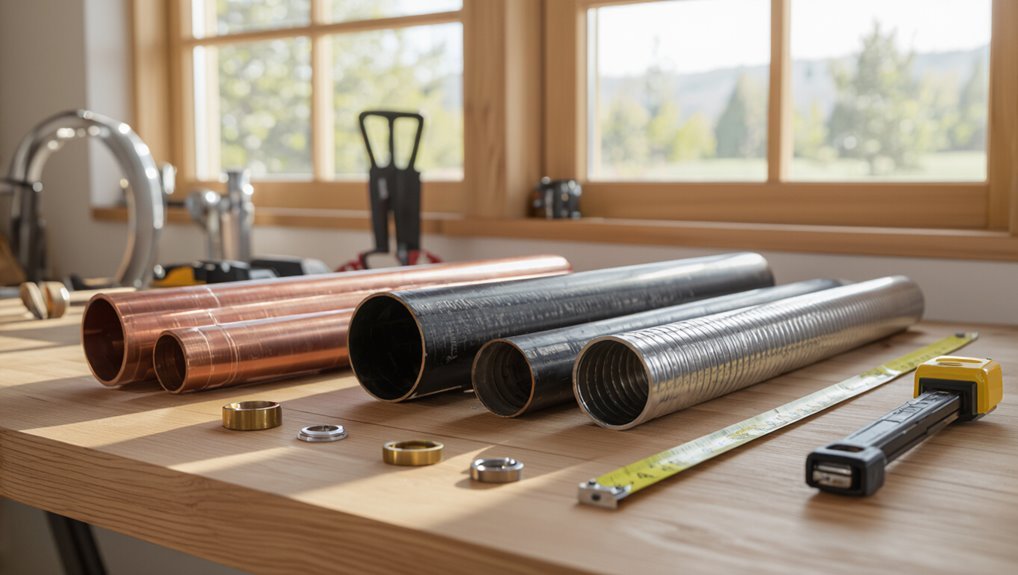
Pick Pipe Materials: Black Iron, CSST, Copper (Code & Pros/Cons)
When selecting pipe material for a natural gas system, considerations of code compliance, installation environment, and long-term performance determine whether black iron, corrugated stainless steel tubing (CSST), or copper is most appropriate.
Black iron offers durability and cost-effectiveness for fixed runs but requires threaded fittings and corrosion protection.
CSST is flexible, reducing joints and installation time, though bonding and lightning considerations and local code restrictions apply.
Copper, where permitted, resists corrosion and is easy to join, but some jurisdictions prohibit it for gas and it may be more expensive.
Selection should follow local codes, appliance requirements, and qualified installer guidance.
Nominal vs. Inner Diameter: What the Sizes Mean
The article next clarifies the distinction between a pipe’s nominal size and its actual inside diameter, as these terms are not interchangeable.
Nominal size is a label used for ordering and compatibility, while the inside diameter determines the gas flow capacity and pressure drop.
Understanding the difference helps assure correct pipe selection and accurate capacity calculations.
Nominal Size Meaning
Nominal size is a standardized label used for gas pipe that does not equal the pipe’s actual inner diameter; instead it refers to a historical or nominal dimension tied to fitting compatibility and wall thickness. The term helps match pipes and fittings across materials and standards (e.g., NPT, IPS, CTS) without quoting exact flow area.
For installers and homeowners, understanding nominal size prevents mismatched connections and guarantees correct capacity choices. Manufacturers publish nominal-to-actual dimension tables and pressure ratings; consult those for planning.
Attention to nominal sizing avoids installation errors while leaving precise flow calculations to measurements of internal geometry.
- Compatibility
- Standardization
- Reference sizing
Inside Diameter Differences
In comparing nominal size and inside diameter, one must recognize that the label on a pipe is a compatibility designation rather than a literal measurement of flow area. The nominal size reflects historical standards and fittings compatibility; the actual inside diameter (ID) varies by material, wall thickness, and manufacturing tolerances.
For gas piping, installers consult ID or published flow tables, not nominal labels, when calculating capacity and pressure drop. PVC, steel, and CSST with the same nominal size can have different IDs, altering flow. Accurate measurement or manufacturer data guarantees correct sizing, proper appliance performance, and code-compliant installations.
Calculate Equivalent Length for Fittings and Valves
When accounting for pressure loss, fittings and valves are converted into an equivalent length of straight pipe that produces the same frictional effect; this simplifies sizing calculations by allowing all losses to be summed as lengths rather than separate localized drops.
The equivalent length values depend on fitting type, size, flow direction and pipe material; tables in codes or manufacturer data provide typical feet/meters per fitting.
To size a run, the planner adds equivalent lengths to actual run length, then uses that total with flow rate and allowable pressure drop to select pipe diameter.
- Identify fittings and valves in the run.
- Look up equivalent lengths.
- Sum and apply to sizing charts.
How Fittings and Valves Reduce Allowable Length
Fittings add to a pipe run’s effective length through their equivalent length values, which are typically expressed in feet of straight pipe.
Valves introduce additional pressure drop beyond that of fittings, reducing the allowable overall length for a given flow and pressure.
Together these factors must be summed and compared to the maximum permissible length when sizing gas piping.
Fittings Equivalent Length
For gas piping, each elbow, tee, valve, or other fitting imposes additional head loss equivalent to a specific length of straight pipe; this “equivalent length” is added to the actual run length to determine the total allowable length for safe, code-compliant sizing.
Codes and manufacturer tables list equivalent lengths for common fittings by pipe size. Designers sum actual pipe length plus equivalents to select pipe diameter that meets flow and pressure drop limits. Incorrectly ignoring fittings can undersize piping, reducing appliance performance.
Practical calculations always include fitting equivalents and any offsets for meter or regulator setups.
- Check code/manufacturer tables
- Sum actual + equivalent lengths
- Size pipe to the total allowable length
Valve Pressure Drop
Valves impose measurable pressure losses that must be converted into equivalent lengths and added to the total run, just like elbows and tees. The guide quantifies common valve types (ball, gate, globe) as equivalent pipe lengths at typical flows. Installers should add these values to piping length before checking capacity; multiple valves stack. Partially open valves, regulator pilots, and safety shutoffs increase loss disproportionately and warrant conservative sizing. Use manufacturer data when available. Routine practice uses ball valves as low-loss, globe valves as high-loss. Record calculations to justify selections and avoid undersized systems.
| Valve Type | Typical Loss | Equivalent Length |
|---|---|---|
| Ball | Low | 2–10 ft |
| Globe | High | 20–50 ft |
Account for Long Runs and Pressure Drop
When gas must travel long distances from the meter to appliances, the resulting pressure drop becomes a critical factor in pipe sizing because reduced pressure can impair appliance performance or require larger pipe diameters to maintain flow.
Calculations estimate pressure loss per foot based on flow rate, pipe material, diameter, and velocity.
Designers compare calculated drop to allowable limits and increase diameter or add parallel runs when necessary.
Practical checks include avoiding undersized branches, grouping high-demand appliances, and planning future loads.
Allowance for fittings and valves is essential since each adds equivalent length and increases cumulative pressure drop.
- Calculate pressure loss accurately.
- Upsize or add runs.
- Include fittings’ equivalent length.
Account for Elevation and Altitude Corrections
Accounting for elevation and altitude requires adjusting gas pipe sizing to reflect changes in atmospheric pressure and the increased work required to deliver the same mass of gas to higher elevations. At altitude, lower ambient pressure reduces gas density, so flow volume must increase to supply equivalent energy; this can require larger pipe or higher pressure at the source.
Codes and manufacturer tables provide altitude correction factors or derating multipliers for capacity. Apply the appropriate factor to the calculated required flow or allowable pipe capacity, then recheck pressure drop over the run. Document assumptions: elevation, temperature, gas type, and correction source.
Choose Regulator and Meter Capacity for Your Load
Before selecting regulators and meters, determine the steady-state and peak gas demand of the installation, expressed in the same units used by sizing charts (typically cubic feet per hour or cubic meters per hour), and include any simultaneous-use factors and future expansion allowances.
The regulator must match inlet pressure, deliver required outlet pressure at peak flow, and have adequate relief capacity.
Meter sizing should reflect peak demand plus margin; oversizing reduces accuracy, undersizing restricts flow.
Consider appliance diversity, expected growth, and local code requirements.
Verify manufacturer capacity curves and consult utility when loads approach standard meter limits.
- Match capacities to peak demand
- Include expansion margin
- Confirm manufacturer/utility ratings
How to Locate and Read Your Gas Meter Capacity
The reader should first locate the gas meter on the property and note any data stamped or printed on its body.
Next, the capacity plate or nameplate must be read to identify flow capacity, pressure ratings, and meter size.
These values are then used to confirm the meter can supply the calculated load or to determine if a larger meter is required.
Find Meter Data
When locating a gas meter, start by identifying its physical placement—typically near the exterior wall, in a basement, or inside a utility closet—then note the meter’s model and serial number, inlet/outlet sizes, and any stamped capacity ratings or pressure markings; these markings, along with the meter index (which shows volume passed) and the regulator’s maximum allowable operating pressure, provide the core data needed to determine the meter’s capacity.
Inspect visible tags, adhesive labels, and casting marks.
Photograph details for reference.
Record current index reading.
Consult utility documentation or customer service if markings are unclear.
- Capture model/serial and markings
- Note inlet/outlet sizes
- Photograph and record readings
Read Capacity Plate
A capacity plate mounted on the meter body or regulator housing provides the definitive information needed to verify gas delivery limits.
The plate lists manufacturer, model, maximum flow rate (in cubic feet per hour or m³/h), inlet and outlet pressures, and calibration details.
To read it, clean the surface, note units and pressure reference (inches WC or psi), and record the maximum continuous and intermittent capacities.
Compare these values to calculated demand for the property.
If the plate is missing or unreadable, consult utility records or meter serial number lookup.
Never exceed the plate’s rated flow without utility approval.
Balance Loads to Avoid Undersized Runs
In planning gas distribution, balancing appliance loads across branches prevents individual runs from becoming undersized and guarantees each segment delivers adequate pressure and flow. The designer reviews BTU demands, groups nearby appliances, and allocates capacity so no branch exceeds its allowable load.
Prioritization guarantees critical appliances receive stable supply; longer runs get larger mains to reduce pressure drop. Periodic verification against code tables and expected simultaneous use refines the layout. If branches approach capacity, redistributing appliances or adding parallel runs maintains safety and performance without upsizing the entire system.
- Calculate and group BTU loads.
- Check run lengths and pressure drop.
- Redistribute or add branches.
Size Flexible Connectors and Appliance Connectors
Flexible connectors and appliance connectors require separate consideration because their length and construction can affect flow capacity and safety.
Code limits on flexible connector length and specific sizing tables for appliance connectors should be applied to guarantee adequate gas supply.
The installer must match connector size to appliance input and adhere to manufacturer and code requirements.
Flexible Connector Length Limits
When sizing gas piping systems, installers must account for the maximum allowable lengths of flexible connectors and appliance connectors because excessive length increases pressure drop and can impair appliance performance.
Flexible connector limits vary by material, diameter, and local code; common values range from 3 to 6 feet for appliance connections and longer lengths for specific welded or stainless assemblies if rated.
Installers should use manufacturer data and code tables, minimize fittings and bends, and avoid using long flex as a substitute for proper piping.
Regular inspection guarantees no kinks or damage that would further restrict flow.
- Check manufacturer and code limits
- Minimize bends and fittings
- Inspect for kinks or damage
Appliance Connector Sizing
Appliance connector sizing requires matching the connector’s internal diameter and length to the appliance’s gas demand and the available inlet pressure so that pressure drop remains within manufacturer and code limits.
The installer selects connector size from appliance input (BTU/h or kW) and the gas pressure category (low or medium).
Use manufacturer charts or standard sizing tables to determine maximum allowable length for a given diameter.
Consider appliance orientation, fittings, and potential appliance shutoff valves that add equivalent length.
Flexible connectors must be listed for the gas type, replaced if damaged, and routed to avoid kinks, excessive bends, or heat exposure.
Sizing for Future Expansion and Spare Capacity
Reasonable spare capacity in a gas distribution system allows for predictable additions and reduces the need for costly rework. Designers typically size mains and branches with modest oversizing—often one pipe size larger than immediate demand—so future appliances can be added without pressure loss.
Planning should consider probable load growth, accessible routing for extensions, and local code limits. Oversizing trade-offs include material cost versus disruption risk. Monitor installed pressures and document capacity for future contractors. When uncertain, consult a licensed gas fitter or engineer to balance present economy with future flexibility.
- Consider one-size-up piping
- Account for probable load growth
- Preserve accessible routing
Use Online Gas Pipe Sizing Calculators Safely
Often builders and installers rely on online gas pipe sizing calculators, but these tools should be used cautiously and never as the sole authority; they provide quick estimates based on input assumptions and simplified flow tables, not a substitute for code compliance, field measurements, or professional judgment.
Users should verify inputs—gas type, pressure, appliance load, length units—and confirm the calculator’s standards and safety factors.
Treat results as preliminary guidance only. Cross-check with local code tables, manufacturer specs, and a licensed professional when installations approach limits or involve multi-appliance systems.
Retain documentation of assumptions and calculations for inspection and future reference.
Quick Manual Sizing Check Without Charts
When precise charts are unavailable, a quick manual sizing check uses basic principles—pressure drop, pipe length, gas type and total demand—to verify that a selected diameter is plausibly safe; by estimating flow rate in BTU/hr (or cubic feet per hour), converting to equivalent gas velocity, and comparing against conservative velocity limits and acceptable pressure loss over the run, a technician can detect obvious under-sizing before final calculations or a professional review.
The method is a sanity check, not a substitute for code compliance. Use known appliance input totals, estimate equivalent length, and prefer upsizing when uncertain.
- Estimate flow and equivalent length.
- Compute velocity and pressure loss.
- Compare to conservative limits; upsize if marginal.
How to Test Pressure and Flow After Installation
After installation, verification begins with pressure gauge checks at key points to confirm supply and downstream pressures meet design values.
Next, flow rate verification guarantees appliances receive required gas volumes under operating conditions.
Any deviations are recorded and corrected before the system is placed into service.
Pressure Gauge Checks
Technicians routinely verify gas pressure and flow with calibrated gauges and flow meters to confirm the installation meets code and appliance requirements.
Pressure gauge checks focus on static and working pressures at manifold and appliance inlets, confirming regulator function and absence of leaks.
Readings are recorded and compared to manufacturer and local code tolerances.
Tests use appropriate fittings and isolation to prevent appliance operation during measurement.
Any deviation prompts inspection of regulators, pipe sizing, or obstructions.
Documentation and photos are kept for compliance and future service.
- Measure static pressure before appliance operation.
- Measure working pressure under typical load.
- Compare readings to code and specs.
Flow Rate Verification
How should flow rate verification be conducted to guarantee the system delivers required gas volume under real conditions?
The inspector connects a calibrated flow meter or a test appliance at the outlet, opens supply valves, and records steady-state flow and pressure.
Readings are compared to appliance demand and code minimums.
Leakage is checked by monitoring pressure drop during sustained flow.
If flow falls short, the operator isolates sections, retests, and inspects for restrictions, undersized piping, or regulator issues.
Corrections are made, and final verification repeated.
All results, instruments used, and corrective actions are documented for compliance and future reference.
Detect Leaks and Perform a Safe Soap Test
Begin by shutting off the gas supply and ventilating the area to eliminate any accumulated gas before testing; a safe soap test requires no open flames, good airflow, and ignition sources removed.
The inspector mixes a mild soap solution, applies it to fittings, joints, and valves, then slowly restores low pressure. Bubbles indicate leaks; mark those points and shut off gas immediately.
Small leaks may be tightened or fittings resealed; major leaks require a licensed technician. After repairs, repeat the soap test and pressure check.
Keep children and pets away, and document findings for future reference.
- Inspect visually first.
- Apply soap solution.
- Repair and retest.
Troubleshoot Low Burner Flame and Poor Performance
When burners show a weak flame or appliances perform poorly, the technician first checks gas pressure at the regulator and appliance inlet to confirm adequate supply.
Burner ports and orifices are inspected for clogs, corrosion, or misalignment that restrict flow.
Venting and airflow paths are verified to make certain proper combustion air and safe exhaust removal.
Check Gas Pressure
Why is the burner flame weak or uneven? A technician checks gas pressure to confirm supply meets appliance requirements. Low inlet pressure or excessive pressure drop through undersized piping causes reduced flame height, slow heating, or intermittent ignition. Measuring pressure with a manometer at the appliance inlet identifies supply and operating pressures. Compare readings to appliance specifications; note differences between natural gas and propane. If pressure is low, investigate pipe sizing, fittings, and regulators upstream rather than burner hardware. Corrective actions may include resizing piping, replacing clogged components, or adjusting regulators—performed by qualified personnel to assure safety and code compliance.
- Measure inlet and operating pressure
- Compare to appliance spec
- Investigate piping, fittings, regulators
Inspect Burner Ports
How can clogged or damaged burner ports affect flame quality and appliance performance? Clogged or eroded ports restrict gas flow, causing weak, yellow, or uneven flames and reduced heat output. Inspect ports visually, using a soft brush or needle to clear debris; avoid enlarging holes. Check for corrosion, warped components, or soot buildup and replace parts if damage is present. After cleaning, test flames for steady blue color and proper height. Record observations and corrective actions for future maintenance.
| Issue | Cause | Action |
|---|---|---|
| Yellow flame | Partial blockage | Clean ports |
| Uneven flame | Debris | Reposition burner |
| Low heat | Erosion | Replace burner |
| Soot | Incomplete combustion | Inspect ports |
Verify Venting And Airflow
Could inadequate venting be the hidden cause of a weak burner flame? Confirming proper venting and airflow is essential when troubleshooting low flame or poor appliance performance. Restricted air intake, blocked chimneys, or clogged vent screens reduce oxygen, causing yellow, sputtering flames and incomplete combustion.
Technicians examine inlet vents, exhaust paths, and room ventilation to guarantee combustion air meets manufacturer specifications. If ventilation is insufficient, recommend clearing obstructions, installing dedicated combustion air ducts, or consulting a pro for ventilation upgrades. Always shut off gas before inspecting vents and follow safety codes to prevent carbon monoxide risks.
- Check inlet vents
- Clear exhaust paths
- Add combustion air
Plan Routes to Minimize Fittings and Length
When laying out gas piping, the planner prioritizes routes that reduce fittings and overall run length to preserve flow capacity and lower pressure drop. The planner maps the shortest practical path from the meter or manifold to appliances, favoring straight runs and gentle bends.
Fewer elbows and tees mean less equivalent length and higher effective capacity; each fitting’s equivalent length is counted when calculating pipe size. Consolidating appliance branches and locating appliances near mains minimizes lateral runs.
The planner also considers future additions, avoiding complex routing that would complicate expansion. Accurate measurements and fitting counts guarantee correct sizing and reliable performance.
Choose Pipe Supports, Clearances, and Protection
Select supports and maintain clearances that protect the gas piping, guarantee proper load distribution, and allow access for inspection and maintenance. Supports should be spaced per code, secure fittings without point loading, and permit thermal movement.
Keep pipes away from heat sources, electrical conductors, and combustible materials; maintain access panels where valves and joints require inspection. Use noncorrosive hangers, vibration isolators, and saddle supports for long runs.
Protect exposed low pipes from accidental impact and avoid routing through areas prone to moisture accumulation. Document support locations and clearance distances for future work and inspections.
- Follow code spacing and materials
- Provide inspection access
- Prevent mechanical damage
Protect Buried Runs and Outdoor Piping
For buried and outdoor gas piping, corrosion, physical damage, and environmental stresses must be anticipated and mitigated through appropriate materials, bedding, and protective measures. Pipe selection favors coated steel, polyethylene, or cathodically protected systems rated for buried service.
Install trenches with uniform bedding sand, maintain minimum cover depths per code, and avoid sharp rocks or debris. Provide mechanical protection at road crossings and where landscaping or vehicles may contact lines. Use approved galvanized or polyethylene sleeves where pipes penetrate foundations.
Include accessible shutoffs and tracer wire above nonmetallic pipe. Follow local codes and manufacturer instructions for joints, backfill, and marking to assure longevity.
How to Document Calculations for Inspectors
In presenting gas-sizing calculations to an inspector, the installer should provide a clear, concise package that includes assumptions, inputs, step-by-step calculations, and references to code sections and manufacturer data.
The document should state design pressure, supply source, demand in BTU/hr or cubic feet per hour, pipe lengths and fittings with equivalent lengths, and chosen sizing tables or equations.
Results must show selected pipe sizes and pressure drop checks.
Attach appliance data sheets and calculation worksheets (hand or spreadsheet) and highlight any deviations or safety margins.
Sign, date, and include contact information for follow-up.
- Summary sheet with key inputs and results
- Detailed step-by-step worksheet
- Supporting manufacturer and appliance documentation
Building Codes and Local Rules That Affect Sizing
Building codes and local regulations set the minimum requirements for gas piping materials, allowable pressure drops, installation methods, venting, and appliance clearances that directly determine acceptable pipe sizing and layout.
Jurisdictions may adopt national model codes with amendments, require permits, plan reviews, and specific inspection points.
Local rules can mandate pressure testing, approved fittings, maximum run lengths, and restrictions on concealed or exterior routing.
Utilities sometimes impose service-pressure limits or meter-set configurations affecting downstream sizing.
Installers must verify municipal ordinances, utility requirements, and any homeowners’ association rules before sizing.
Noncompliance can cause delays, rework, or rejection at final inspection.
National Fuel Gas Code Basics for Sizing
After confirming applicable local codes and utility requirements, attention turns to the National Fuel Gas Code (NFPA 54/ANSI Z223.1) as the standardized guide for sizing gas piping.
It establishes methodology: calculate total appliance demand, apply demand factors, and select pipe size from tables based on gas type, pressure, and length.
The Code emphasizes pressure drop limits, installation materials, fittings’ equivalent lengths, and corrections for temperature or altitude.
Designers must follow its tables and formulas rather than ad-hoc guesses.
Proper application guarantees safety, adequate appliance performance, and regulatory compliance without relying on informal rules.
- Calculate demand
- Use tables/formulas
- Limit pressure drop
Permits, Inspections, and Required Paperwork
Prior to any excavation, trenching, or connection to a utility, the project must secure the required permits and submit documentation for inspection to the authority having jurisdiction. Required paperwork typically includes permit applications, gas piping diagrams, materials lists, and appliance load calculations. Inspections verify compliance with local code and the National Fuel Gas Code; failures require corrective actions before concealment. Applicants should allow lead time for review and schedule sequential inspections: rough-in, pressure test, and final. Records of approvals must be retained. Fees and specific submittal requirements vary by jurisdiction; consult the local building department early to avoid delays.
| Document | Purpose |
|---|---|
| Permit application | Authorizes work |
| Piping diagram | Shows layout and sizing |
| Test report | Confirms pressure integrity |
When to Hire a Licensed Gas Contractor
Recognize situations where a licensed gas contractor is required: any work involving new service connections, alterations to main gas lines, meter relocations, complex multi-appliance systems, or projects that trigger local permit and inspection requirements should be performed by a licensed professional.
A licensed contractor guarantees code compliance, accurate pipe sizing for combined loads, safe leak testing, and proper documentation for permits and utilities.
Homeowners benefit from liability protection and warranty-backed work.
Consider hiring for unclear capacity calculations, work beyond branch piping, or when utilities refuse to connect without certified installation.
- Code-triggering alterations
- Multi-appliance or main-line work
- Utility or permit requirements
What DIYers Can Legally and Safely Do
What can a knowledgeable homeowner responsibly tackle when working with gas piping? A competent DIYer may perform appliance swaps, replace flexible connectors, and reconnect shutoff valves on existing, accessible lines provided local codes permit.
Tasks should include obtaining permits, following manufacturer instructions, using approved materials, and pressure-testing small sections with proper gauges. Homeowners must notify inspectors when required and keep records.
They should avoid altering meter sets, main service lines, or concealed underground piping. When in doubt about code interpretation, leak diagnostics, or complex routing, hiring a licensed gas contractor guarantees compliance and safety.
Common Sizing Mistakes Homeowners Make
When working on gas piping, homeowners commonly underestimate the impact of appliance BTU demands, run length, and fitting count, leading to undersized lines that cause poor performance or unsafe pressure drops. Mistakes often stem from assuming existing pipe is adequate, ignoring grouped appliance loads, or using online charts without matching units and local code pressures. Incorrect material choice and failing to account for future additions also create undercapacity. Simple measurement errors of run length and fitting equivalents amplify sizing errors. Verification by calculation or professional review prevents repeated corrections and reduces safety risks.
- Misreading capacity charts
- Ignoring fittings and run length
- Planning for single-appliance loads
Estimate Material and Labor Cost for a Sizing Change
After identifying sizing errors that require correction, the next step is to estimate the material and labor costs for upsizing or reworking the gas line. The estimator lists required pipe, fittings, valves, connectors, and sealants; checks local unit prices; and factors in disposal and permit fees. Labor hours are calculated by task: cutting, threading, routing, support installation, pressure testing, and finishing. Contingency of 10–20% is added for unexpected access issues. Comparison of DIY versus licensed contractor costs and code compliance obligations informs the decision to proceed.
| Item | Typical Cost |
|---|---|
| Pipe & fittings | $50–$300 |
| Labor/hr | $40–$120 |
| Permits | $20–$200 |
| Contingency | 10–20% |
Final Sizing Checklist for Inspection and Handover
For the final sizing checklist prior to inspection and handover, the inspector or contractor verifies that the as-built gas piping matches the approved plans and calculation sheet, all fittings and valves are correctly labeled and supported, pressure test records are complete and within code limits, and clearance, routing, and appliance connections meet local regulations.
A concise checklist confirms safety and compliance: verifying pipe sizes, minimum slopes, and material types; confirming regulator and meter placement; guaranteeing accessible shutoffs and adequate support.
Documentation is gathered: test reports, permit sign-offs, and as-built drawings.
Any discrepancies must be corrected before certification.
- Verify physical installation vs. plans
- Confirm pressure test and documentation
- Guarantee accessible valves and clearances
Resources and Sample Worksheets (Charts, Conversions)
With the final inspection checklist completed and documentation assembled, attention shifts to practical resources and ready-to-use worksheets that streamline sizing calculations and field checks.
A compact packet should include standard pipe sizing charts (GPH/BTU to pipe diameter), common conversion tables (inches↔mm, psi↔kPa, BTU↔kW), and sample load worksheets with step-by-step entries for demand, equivalent length, and derating.
Include blank pressure-drop tables, quick-reference tables for natural vs. LP gas, and a checklist for measurement verification.
Digital templates (spreadsheet and printable PDF) and links to code references help guarantee accurate, repeatable results during installation and inspection.
Conclusion
Like a river guided into channels, proper gas piping directs heat safely and efficiently through a home. Homeowners who measure demand, respect pressure, and follow sizing steps transform a confusing maze into a dependable flow. Avoid common mistakes, document choices, and confirm with local codes so the system sings rather than sputters. With clear checks and honest estimates, the finished installation stands as a steady, well‑tuned instrument of comfort and safety.