How to Reset Noritz Tankless Water Heater: Step-by-Step Troubleshooting Guide
To reset your Noritz tankless water heater, you can either turn off the power at the breaker for 30–60 seconds or press and hold the control-panel reset button for 5–10 seconds. For a full manual reset, also shut off the gas and water. Before proceeding, check the vents, filters, and for any leaks. After resetting, restore the gas, water, and power, then run hot water to ensure proper ignition and a steady flame. If you notice any persistent error codes, take note of them and contact a technician for assistance. More detailed steps and code guidance are available below.
How to Reset a Noritz Tankless Water Heater: Quick Guide
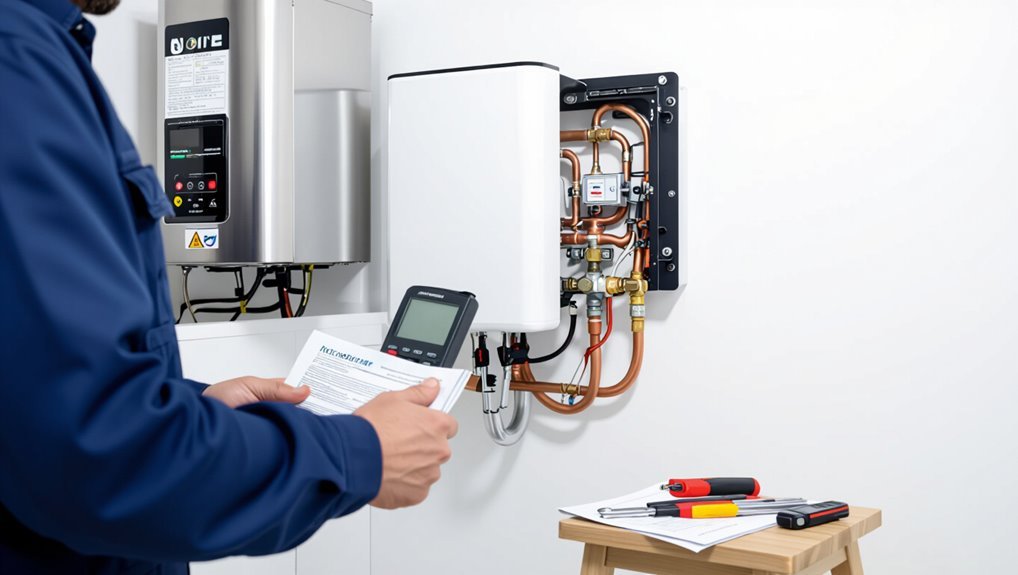
A Noritz tankless unit can usually be reset by turning the power off for 30 seconds and then restoring it, or by using the unit’s control panel reset button if present.
A reset is appropriate for transient errors like ignition failures or minor electronic glitches that appear after a power surge.
Persistent faults, repeated error codes, water leaks, or lack of hot water after a reset should prompt contacting a qualified technician.
One-sentence reset summary for Noritz models
Reset Noritz tankless models by pressing and holding the unit’s reset button (or cycling power) until the display clears.
Then verify error codes are gone and restart the heater per the manufacturer’s instructions.
This concise one-sentence summary helps readers recall how to reset Noritz tankless water heater basics: power-cycle or use the reset button, confirm error clearance, and follow restart sequence to restore normal operation.
When you should try a reset versus calling a technician
After following the basic reset steps and confirming error codes clear, determine whether the issue is likely simple or requires professional attention.
Attempt a reset for intermittent faults, minor error-code returns, or after power interruptions.
Call a technician when persistent faults recur, ignition or gas supply problems exist, water leaks appear, error codes indicate hardware failure, or safety concerns persist.
Safety and warranty considerations favor professional service.
Safety Precautions Before Resetting
Before attempting a reset, the user should cut power and shut off the gas supply following manufacturer procedures to prevent electrical shock or leaks.
They must verify adequate ventilation and remove or secure any flammable materials near the unit.
Required tools and protective gear—insulated gloves, eye protection, and a suitable wrench—should be assembled and inspected beforehand.
Power and gas shutoff steps
Shut off the unit’s electrical supply and close the gas valve to eliminate the risk of ignition or electric shock while working on a Noritz tankless water heater.
Confirm power is off at the breaker and label the switch.
Turn the gas supply lever perpendicular to flow and verify with a gas meter or audible silence.
Keep a wrench handy for valve operations.
Ventilation and flammable materials checklist
When preparing to reset a Noritz tankless water heater, confirm the area is well-ventilated and free of flammable materials to prevent accumulation of combustion gases or ignition sources.
Verify that vents and intake openings are unobstructed. Windows or exhaust fans should provide fresh air circulation if the unit is in an enclosed space.
Ensure all combustible items—paints, solvents, aerosols, rags—are removed or stored at a safe distance per the manufacturer’s clearance guidelines.
Inspect surrounding surfaces for residues or leaks and make certain combustible storage cabinets remain closed and distant from the appliance before proceeding.
Tools and protective gear needed
Because handling a gas-fired appliance involves both electrical and combustion hazards, the technician should gather specific tools and personal protective equipment to reduce risk and allow a safe reset.
Required items include insulated screwdrivers, adjustable wrench, multimeter, and flashlight.
PPE comprises safety goggles, heat-resistant gloves, long sleeves, and a respirator if ventilation is poor.
A non-contact gas leak detector is recommended.
Identify Your Noritz Model and Error Code
The technician locates the Noritz model and serial number on the unit’s rating plate or documentation to confirm compatible reset procedures.
The display panel and troubleshooting guide are then used to read the current error code and match it to common diagnostics.
Finally, codes are classified into those that can be cleared by a reset and those indicating a fault requiring repair or professional service.
Locating the model number and serial number
Before attempting any diagnostics, identify the Noritz unit by locating its model and serial number—these codes determine compatible parts, error-code interpretations, and reset procedures.
Inspect the heater’s exterior label, typically on the side or bottom panel. For indoor units, check behind the access cover.
Record both codes precisely and photograph the label for reference during parts ordering, warranty checks, and technical support.
Reading the display and common error codes
How can a quick glance at the Noritz display save time diagnosing issues? The display shows model-specific codes; noting them directs troubleshooting.
Common indicators include ignition faults, temperature sensor errors, water flow issues, and system lockouts.
- F1/F2: ignition or flame problem
- E1/E2: sensor or thermistor fault
- P1/P2: water flow or pressure issue
- LO: system lockout or safety shutdown
Which codes require reset vs. repair
Although many Noritz error codes can be cleared with a simple reset, distinguishing between codes that signal transient faults and those indicating component failure is essential.
Transient codes (e.g., flow interruption, low gas pressure) often respond to reset after correcting conditions.
Persistent codes (ignition failure, heat exchanger, sensor faults) require inspection, replacement, or professional service.
Refer to the model’s manual for code-specific actions.
Step-by-Step Reset Procedure for Noritz Tankless Water Heaters
The reset process for Noritz tankless heaters can follow several clear sequences depending on the issue and model.
Typical steps include an electronic reset via the control panel, a manual power-cycle using the breaker or power cord, and specific procedures for cycling the gas valve and water supply.
Model-specific notes (for NR, EZ, and other series) should be checked before proceeding to guarantee correct button presses and safety steps.
Basic electronic reset (control panel method) step sequence
Begin by locating the heater’s control panel and ensuring the unit has power; this reset method uses the onboard buttons to clear electronic faults without tools.
Press and hold the reset or “Set” button for 5–10 seconds until the display flashes.
Release, wait 30 seconds for reboot, then cycle a hot water tap to confirm normal operation.
Record any persistent error codes.
Manual power-cycle reset (breaker and power cord) step sequence
Power-cycle the Noritz unit by cutting and restoring its electrical supply to clear faults that a simple control-panel reset may not resolve.
Turn off the circuit breaker supplying the heater, wait 30–60 seconds, then switch it back on.
If the unit uses a detachable power cord, unplug it instead, wait the same interval, and reconnect.
Observe LED indicators and restart normal operation.
Gas valve and water supply reset sequence step sequence
After restoring electrical power, attention should turn to the gas valve and water supply sequence to guarantee safe ignition and proper flow.
Close the water inlet, confirm gas supply is off, wait one minute, then open gas slowly to specified pressure.
Open water inlet gradually, bleed air at fixtures, verify steady flow and correct pressure.
Observe ignition; check for leaks.
Model-specific notes (NR series, EZ series, etc.)
While core reset steps are consistent across Noritz tankless models, certain NR, EZ, and other series require brief model-specific adjustments to guarantee proper operation and diagnostic accuracy.
Technicians should consult model manuals for panel differences, error codes, and jumper locations.
- NR series: separate DIP/jumper for diagnostics
- EZ series: simplified front-panel reset button
- Older models: manual gas valve sequence
- Vented units: vent pressure checks
Post-Reset Checks to Confirm Successful Restart
After resetting the unit, one should run hot water at a faucet to confirm ignition and steady flame operation.
Next, inspect all visible connections and the area beneath the heater for leaks or abnormal sounds.
Finally, monitor the display for any returning error codes over the next few cycles to guarantee the restart remained stable.
Running water and ignition verification steps
One should confirm water flow and ignition immediately following a reset to verify the Noritz tankless heater has restarted correctly.
The technician opens a hot tap, observes steady flow, and watches the unit for ignition indicators: burner flame through viewing port, control panel status lights, and startup sounds.
If flow is stable and ignition engages promptly, normal operation is indicated.
Checking for leaks and unusual noises
How should a technician proceed to confirm there are no leaks or abnormal sounds following a reset?
The technician inspects visible plumbing joints, valves, and the unit base for drips, tightens fittings if needed, and uses a dry paper towel to detect moisture.
While the unit runs, they listen for hissing, banging, or grinding, noting source and timing for further mechanical or flow investigation.
Monitoring for recurring error codes
Monitor the unit’s display and control panel closely for at least several complete heat cycles to confirm that any prior error codes do not reappear.
Record codes, timestamps, and operating conditions if faults recur.
Compare against the manual to assess severity and likely causes.
If the same error returns, cease use and contact Noritz-certified service.
Persistent new codes also warrant professional diagnosis.
Troubleshooting Common Problems When Resetting Fails
When a reset does not restore normal operation, common failure modes include persistent error codes tied to specific sensors or valves, a dead display indicating power issues, ignition failures or weak flame, and ongoing water temperature fluctuations.
The technician should read and record any error codes, verify electrical supply and control board indicators, and inspect ignition and gas components.
Targeted checks of flow sensors, gas pressure, and temperature sensors narrow the cause and guide corrective actions.
Persistent error codes and likely causes
Several recurring error codes can indicate that a simple reset will not resolve a Noritz tankless water heater’s problem; these codes typically point to specific mechanical, electrical, or system issues that require diagnosis.
Common persistent codes and likely causes include:
- Overheat or high-temperature shutdown: blocked heat exchanger or flow sensor failure
- Ignition failure: gas supply or ignition module fault
- Flame loss: burner or gas valve issues
- Water pressure/failure: closed valve or pump malfunction
No power or dead display diagnostics
Begin by confirming that the heater shows no signs of power—no lights, no display, and no control response—before proceeding to diagnostics.
Check breaker and external switch, verify outlet voltage, inspect power cord and connections, and test remote controller batteries.
If wired, confirm internal fuses and terminal tightness.
Replace faulty components or call a qualified technician if mains power is present but unit remains unresponsive.
Ignition failure and flame issues
If the unit powers up but fails to ignite or exhibits a weak, unstable flame, the problem lies in the ignition sequence, fuel delivery, or combustion sensing components.
Inspect ignition electrodes, pilot assembly, and spark continuity.
Verify gas valve operation and supply pressure.
Check flame sensor cleanliness and alignment.
Examine venting for obstructions and confirm proper air intake.
Replace faulty sensors or valves as needed.
Water temperature fluctuation after reset
Variability in water temperature after a reset often indicates issues with sensor calibration, flow control, or residual system states rather than a single component failure.
The user should verify inlet/outlet sensor connections, clean or replace the flow sensor, and confirm correct temperature setpoints.
Check for air in lines, partially closed valves, and mineral buildup.
If fluctuations persist, consult Noritz support or a qualified technician.
When to Perform Maintenance Before Resetting
Before attempting a reset, the heater should be checked for maintenance issues that can mimic system faults, such as scale buildup and sediment in the heat exchanger.
Air intake and exhaust vents must be inspected and cleaned to guarantee proper combustion and airflow.
Filters and sensors should be examined and replaced if necessary to rule out component failures before proceeding with a reset.
Descaling and sediment issues that mimic faults
When mineral buildup or trapped sediment restricts flow or triggers false error codes, maintenance should precede any attempt to reset the Noritz tankless water heater.
Descaling the heat exchanger and flushing accumulated debris from inlet strainers and filters can restore proper flow and sensor readings.
Failure to remove deposits may cause repeated faults and unnecessary resets; schedule routine descaling based on water hardness and usage.
Cleaning air intake and exhaust vents
Mineral buildup and sediment can mirror failures caused by restricted airflow, so inspecting and cleaning the air intake and exhaust vents should be part of the pre-reset checklist.
Remove obstructions, clear lint, leaves, or nests, and guarantee vent caps rotate or open freely.
Use a soft brush or vacuum; avoid damaging screens or seals.
Verify unrestricted airflow before attempting a system reset.
Inspecting and replacing filters and sensors
Several routine checks of filters and sensors should be completed prior to resetting a Noritz tankless water heater.
Inspect inlet water and combustion air filters for debris; clean or replace if clogged.
Verify flame, thermistor, and flow sensors for corrosion, loose connectors, or damage.
Replace faulty components per manufacturer specifications.
Document maintenance and guarantee power and gas are off before performing replacements.
When to Call a Professional
If the unit exhibits gas leaks, unusual combustion odors, or other safety-critical combustion issues, a qualified technician should be contacted immediately.
Repeated need to reset the heater after following troubleshooting steps indicates a deeper fault that merits professional diagnosis.
Additionally, warranty terms or the requirement for certified service for certain repairs should prompt the owner to engage an authorized Noritz service provider.
Safety-critical gas or combustion problems
When signs of gas leaks, persistent combustion odors, yellow or sooty burner flames, repeated ignition failures, or unexplained carbon monoxide alerts appear, immediate professional intervention is required.
A certified technician should inspect fuel lines, ventilation, burners, and safety controls.
Do not operate the unit. Evacuate if necessary, ventilate the area, and contact emergency services for suspected gas or CO exposure before scheduling repairs.
Repeated resets without resolution
After addressing signs of gas or combustion hazards and ensuring safety, attention turns to persistent unit behavior: repeated resets that fail to restore normal operation.
Such recurrence suggests deeper faults—control board, gas valve, ignition system, or sensor failure.
Recommend stopping further resets to avoid damage; document error codes and recent symptoms, then contact a qualified HVAC or certified Noritz technician for diagnosis and repair.
Warranty and certified service considerations
Because warranty terms, safety risks, and technical complexity overlap, owners should involve certified Noritz technicians whenever diagnostic steps exceed basic troubleshooting or the unit shows persistent faults tied to components covered under warranty.
Professionals protect coverage, perform authorized repairs, document service for claims, and guarantee compliance with safety and local codes.
Contact Noritz support or an authorized dealer before voiding warranty or attempting invasive repairs.
Preventive Tips to Reduce Future Resets
A simple preventive routine can reduce the frequency of resets for a Noritz tankless water heater.
This includes following the manufacturer’s maintenance schedule, using appropriate water treatment or filtration to limit scale, and tracking error codes and reset events in a log.
Consistent attention to these items helps identify trends and address issues before they trigger repeated resets.
Regular maintenance schedule for Noritz units
Several simple routine checks performed quarterly and annually can keep a Noritz tankless water heater operating reliably and reduce the likelihood of inconvenient resets.
A concise maintenance schedule includes inspection, cleaning, and component checks to prevent issues.
- Quarterly: inspect vents, filters, and outlet connections
- Annually: flush scale and descaler check
- Annually: check gas line and combustion
- Annually: test safety devices and electrical connections
Recommended water treatment and filtration
Following the maintenance steps above, attention to water quality and filtration can markedly reduce scale build-up and mineral-related malfunctions that often trigger resets.
Install a sediment pre-filter and, where water hardness exceeds 7–10 grains/gal, a water softener or electronic descaler.
Consider inline scale-inhibiting filters and routine filter replacement.
Periodic water hardness testing and professional treatment assessment optimize longevity and performance.
Monitoring and logging error occurrences
Begin logging each reset and error code with date, time, operating conditions, and any visible symptoms to create a clear sequence for analysis.
Record frequency, duration, water temperature, flow rate, recent maintenance, and corrective actions. Use a dedicated notebook or digital log with searchable entries.
Review logs monthly to identify patterns, recurring faults, or environmental triggers and schedule targeted inspections before failures escalate.
Quick Reference Tables
The article provides quick reference tables summarizing common Noritz error codes with recommended first actions to expedite troubleshooting.
Separate tables list reset methods by model and by scenario for rapid application.
These concise charts are designed to guide users to the appropriate next step before seeking professional service.
Common Noritz error codes and recommended first actions
What should be checked first when a Noritz tankless unit displays an error code? Inspect power, gas, venting, and water supply; note the code and consult manual. Quick table of common codes and immediate actions:
| Code | Likely Cause | First Action |
|---|---|---|
| E103 | Ignition failure | Check gas supply |
| E120 | Overheat | Turn off, inspect flow |
| E6 | Combustion | Verify venting |
| E1 | Thermistor | Check connections |
Reset methods by model and scenario
Several concise reset pathways cover Noritz tankless models and common scenarios, grouped here for quick reference. The table below lists model families versus typical reset steps; users should verify power/gas and consult manuals when codes persist. Follow model-specific power-cycle, control-panel reset, or diagnostic-clear procedures as indicated; professional service is advised for persistent faults.
| Model/Scenario | Reset Method |
|---|---|
| NR Series — no heat | Power-cycle, hold reset |
| EZ Series — error code | Control-panel clear |
| LP conversion issues | Gas shutoff/reset |
| Persistent faults | Service call/replacement |
Conclusion
To sum up, the Noritz tankless water heater reset guide equips the reader with clear steps and safety checks to restore reliable hot water. Like a mariner consulting a sextant in a digital age, one may follow model-specific diagnostics, perform cautious resets, and carry out post-reset inspections. Routine maintenance and timely professional help prevent recurring faults. Ultimately, informed, measured actions minimize downtime and extend the unit’s service life for household comfort.