How to Remove Calcium Buildup on Toilet Bowl Quickly and Safely
To quickly and safely remove calcium buildup from your toilet bowl, use undiluted white vinegar or a citric-acid solution. Apply it to the affected areas, let it sit for one hour, then scrub with a nylon brush or wet pumice. For stubborn deposits, repeat the process. If necessary, you can use commercial limescale removers, but be sure to follow safety guidelines. Always rinse thoroughly and wear gloves and eye protection. For ongoing maintenance tips and stronger solutions, continue reading.
What Causes Calcium Buildup in Toilet Bowls and Why It Matters
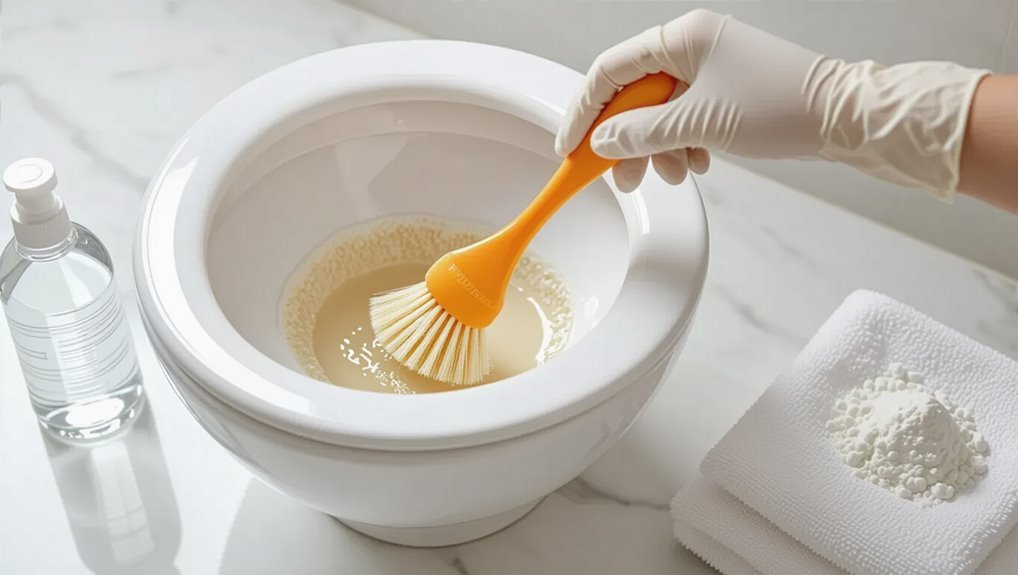
Hard water rich in calcium and magnesium leaves mineral deposits that accumulate as hard, chalky limescale on toilet surfaces.
These calcium deposits can harbor bacteria, impair flushing and damage plumbing, and also create unsightly rings and discoloration.
Identification relies on texture and location—hard, crusty buildup near the waterline indicates limescale, while soft, colored stains often have organic or iron-based causes.
How hard water and minerals create limescale
Mineral-rich water flowing through pipes leaves behind microscopic crystals—primarily calcium carbonate and magnesium compounds—that gradually accumulate as a hard, chalky deposit known as limescale.
Over time, dissolved minerals precipitate when water evaporates or cools, binding to porcelain and fixtures.
Understanding this buildup helps homeowners approach how to remove calcium buildup on toilet bowl effectively, choosing chemical or mechanical methods suited to mineral composition and severity.
Health, plumbing, and appearance impacts of calcium deposits
Because calcium and related mineral deposits form persistent, abrasive layers inside toilet bowls, they affect more than appearance: they can harbor bacteria, impede flushing efficiency, and accelerate wear on plumbing fixtures.
Stubborn buildup reduces bowl capacity, forces more frequent and aggressive cleaning, promotes odors, and can corrode metal components and seals, increasing repair needs and water waste while undermining hygiene and aesthetic standards.
How to identify calcium versus other stains
Having noted the health, plumbing, and appearance problems caused by persistent deposits, it is important to distinguish calcium buildup from other common toilet stains to choose the right remedy.
Calcium appears as hard, white to off-white crusty rings or nodules, often near the waterline. Rust is reddish-brown; mold or organic biofilm is black or green and slimy.
Test with vinegar: calcium softens.
Quick, Safe Methods to Remove Calcium Buildup (Immediate Actions)
Practical, immediate options for removing calcium include simple household treatments and cautious mechanical approaches.
Recommended tactics cover a vinegar soak, a baking soda-and-vinegar scrub, properly following label directions for commercial limescale removers, and careful use of a pumice stone on porcelain.
Each method carries specific safety tips and precautions to protect fixtures and skin.
Vinegar soak method
Soak the affected areas with white vinegar to dissolve calcium deposits without harsh chemicals. The toilet bowl should receive undiluted vinegar, left to sit for at least one hour; stubborn buildup may need several hours or overnight.
After soaking, gently agitate with a soft brush and flush. Rinse surfaces thoroughly.
- Use undiluted white vinegar
- Allow extended soak time
- Scrub gently with soft brush
- Flush and rinse thoroughly
Baking soda and vinegar scrub method
Combine baking soda and white vinegar to create a fizzy, mildly abrasive cleaner that breaks up calcium deposits without harsh chemicals.
Sprinkle baking soda on stains, pour vinegar to fizz, let sit a few minutes, then scrub with a toilet brush or pumice. Rinse thoroughly and repeat if needed.
- Sprinkle baking soda
- Add white vinegar
- Wait, then scrub
- Rinse and repeat
Commercial limescale removers safe usage and precautions
Choose a commercial limescale remover labeled for toilet use and follow the manufacturer’s directions precisely to confirm effectiveness and safety.
The user should wear gloves, secure room ventilation, and avoid mixing chemicals. Rinse thoroughly after treatment and store products securely away from children and pets.
- Wear chemical-resistant gloves and eye protection
- Ventilate the bathroom well
- Do not mix cleaners or bleach
- Rinse surfaces and dispose per label
Using a pumice stone safely on porcelain
Gently rubbing a wet pumice stone against porcelain can remove stubborn calcium deposits without harsh chemicals when done correctly.
It should be used wet, with light pressure, avoiding glazed damage. Test hidden area first. Rinse frequently to inspect progress and discard worn stones.
- Wet stone and surface
- Use light, steady strokes
- Test discreet spot first
- Rinse and inspect often
Deep-Removal Techniques for Stubborn or Thick Buildup
For thicker, stubborn calcium deposits, stronger approaches are required that combine chemical and mechanical methods.
Options include citric acid or lemon-based treatments, borax and vinegar pastes, and enzyme-based cleaners that break down mineral-organic matrices.
When scrubbing or using tools, precautions and correct techniques minimize porcelain damage and personal injury.
Citric acid or lemon-based treatments
Citric acid and lemon-based treatments offer a potent, natural option for dissolving thick calcium deposits in toilet bowls. They work by acidifying and softening mineral scale, allowing easier removal with brushing and rinsing.
Appropriate concentrations and contact time improve results while minimizing surface damage.
- Apply powdered citric acid or fresh lemon juice
- Let sit 30–60 minutes
- Scrub with nonabrasive brush
- Rinse thoroughly
Borax and vinegar paste application
Combine borax and vinegar into a thick paste to attack stubborn calcium deposits that resist milder treatments.
Apply to affected areas, let sit 30–60 minutes, scrub with a nonabrasive brush, then rinse thoroughly. Repeat if needed.
Use gloves and ventilation; avoid mixing with bleach.
- Apply paste directly to buildup
- Allow adequate dwell time
- Scrub gently, rinse well
- Wear protective gear
Enzyme-based cleaners and how they work
Enzyme-based cleaners break down mineral deposits and organic residues by using specialized enzymes that target the proteins and biofilms binding calcium scale. This allows the buildup to loosen and dissolve without harsh acids.
These products slowly digest organic binders, improving rinse-away and preventing regrowth when used per instructions.
- Safe for many surfaces
- Works over hours to days
- Requires contact time
- Biodegradable enzymes
Mechanical removal tools and safety tips
After enzyme cleaners have softened scale, stubborn or thick calcium deposits often still require physical scraping and abrasion to be fully removed.
Use sturdy plastic scrapers, pumice stones kept wet, nylon bristle brushes, and adjustable sink augers for deep crevices.
Wear gloves, eye protection, and a mask; ventilate the area; avoid metal tools that can scratch porcelain; test methods on small areas first.
- Sturdy plastic scraper
- Wet pumice stone
- Nylon bristle brush
- Adjustable sink auger
Products Comparison: Effectiveness, Safety, and Cost
When choosing a product to remove calcium buildup, homeowners should weigh three practical criteria—cleaning effectiveness, user safety, and overall cost—to balance performance with risks and budget. Comparisons favor acidic cleaners for scale, enzymatic for safety, and pumice for spot removal; price varies.
| Product Type | Strengths/Drawbacks |
|---|---|
| Acid cleaners | Very effective / corrosive |
| Enzymatic | Safe / slower |
| Pumice | Targeted / abrasion |
Step-by-Step Routine to Remove and Prevent Recurrence
This section outlines a concise routine for tackling calcium deposits, beginning with preparing the toilet and selecting appropriate personal protective equipment.
It then presents a sequential treatment plan for heavy buildup, from initial softening to mechanical removal and rinsing.
Finally, it provides a compact daily and weekly maintenance checklist to prevent recurrence and preserve fixture condition.
Preparing the toilet and personal protective equipment
Begin by clearing the area and ventilating the bathroom: open a window or run an exhaust fan, remove rugs and toiletries near the toilet, and place a towel or tray under the tank to catch drips.
Wear appropriate PPE and prepare tools.
- Gloves: chemical-resistant, snug fit
- Eye protection: goggles or face shield
- Mask: respirator or surgical mask for fumes
- Towels and bucket ready
Sequential treatment plan for heavy buildup
Although stubborn deposits may require repeated effort, a systematic, step-by-step routine guarantees safe and effective removal and reduces recurrence. The plan progresses from inspection and mechanical loosening, through targeted chemical treatment and agitation, to neutralization, flushing, and preventive maintenance.
A concise routine: inspect, loosen scale, apply appropriate cleaner, neutralize and rinse.
- Inspect and assess severity
- Scrape and brush loose scale
- Apply descaler, let sit, agitate
- Neutralize, flush, dry, and monitor
Daily and weekly maintenance checklist to prevent calcium buildup
A concise daily and weekly checklist helps prevent calcium buildup by keeping mineral deposits from establishing a foothold and by catching early signs of scaling before they require intensive treatment.
A homeowner or custodian follows brief routines: quick flush-and-brush daily, vinegar spray weekly, deep clean monthly, and check water-softening systems.
- Daily: brush under rim and bowl
- Weekly: vinegar soak and scrub
- Monthly: pumice or descaler spot-check
- Monitor: inspect tank and softener performance
Troubleshooting Common Problems
If stains persist after following the routine, the article outlines stronger cleaning options and safe mechanical methods for removal.
It also explains how to protect porcelain, finishes, and tank seals from abrasive chemicals and tools.
Guidance is provided on recognizing repair needs and when to contact a plumber or replace worn components.
Stains that won’t come off next steps
When stubborn calcium stains resist standard cleaning, escalate the approach methodically: try repeated applications of a stronger descaler, allow longer dwell time, and agitate with a nylon brush or pumice stone designed for porcelain.
If deposits persist, consider professional lime-scale removal services or consult a plumber to assess mineral-rich water sources and recommend filtration or routine maintenance to prevent recurrence.
Avoiding damage to toilet surfaces and seals
After exhausting stronger descalers and mechanical scrubbing, attention should turn to protecting the toilet’s surfaces and seals during further treatment.
Use nonabrasive cleaners, soft brushes, and diluted solutions to avoid scratching glaze. Protect rubber gaskets and silicone with water-only rinses; avoid prolonged acid contact.
Test any product on an inconspicuous area first and follow manufacturer guidelines to preserve finish and prevent leaks.
When to call a plumber or replace components
How should one decide whether professional help or replacement is needed for a toilet showing persistent calcium buildup?
Assessment should consider recurring deposits despite proper cleaning, damaged glazing, compromised seals, leaky components, or mineral-clogged supply lines.
If issues persist, a plumber can diagnose hidden problems and recommend replacing corroded fill valves, flappers, or the bowl itself.
Prioritize safety, cost, and long-term reliability.
Natural vs Chemical Cleaners: Safety and Environmental Considerations
The article compares natural cleaners like vinegar, citric acid, and baking soda—effective for mild calcium stains and lower in toxicity—against stronger commercial acids and bleach-based products that remove heavy buildup but carry greater health and environmental risks.
It notes specific hazards from mixing acids and bleach and emphasizes proper ventilation, protective gloves, and careful storage to reduce exposure.
Guidance on safe disposal recommends diluting residues, following local waste rules, and avoiding down-the-drain pours of concentrated chemicals.
Pros and cons of natural cleaners (vinegar, citric acid, baking soda)
While natural cleaners like vinegar, citric acid, and baking soda lack some of the rapid, heavy-duty action of commercial acids, they offer effective, low-toxicity options for dissolving light to moderate calcium deposits with minimal environmental impact.
Advantages: inexpensive, biodegradable, safe for septic systems, gentle on porcelain.
Limitations: slower action, may require soaking or repeated applications, less effective on thick, aged scale compared to stronger agents.
Risks of harsh chemicals (acidic cleaners, bleach combinations)
Because harsh chemical cleaners can react unpredictably, they pose several safety and environmental risks that merit careful consideration.
Corrosive acids and bleach mixtures can emit toxic fumes, damage surfaces, and cause burns or respiratory harm. They may harm septic systems, aquatic life, and sewage infrastructure.
Residue persistence and accidental mixing increase hazard potential, so cautious selection and strict adherence to labels are advised.
Safe disposal and ventilation guidance
Following the warnings about reactive cleaners, guidance on ventilation and disposal helps minimize health and environmental harm when removing calcium deposits.
Guarantee adequate airflow, open windows, and run exhaust fans during and after cleaning.
Neutralize and dilute chemical residues per label instructions; never mix products.
Collect solids or scoured paste in sealed bags and dispose according to local hazardous-waste rules to prevent contamination.
Tips for Hard Water Homes: Long-Term Prevention Strategies
Homes with hard water benefit from long-term strategies that prevent calcium buildup before it starts.
Installing water softeners or point-of-use filters, choosing fixtures and hardware with limescale-resistant finishes, and adopting simple habits—such as drying bowl rims and reducing standing water—can all reduce deposits.
These measures, used together, lower maintenance needs and extend the life of toilet components.
Water softeners and filter options
Many households with hard water benefit from installing water softeners or targeted filtration systems to reduce mineral buildup that causes calcium deposits in toilets.
Options include whole-house ion-exchange softeners, salt-free conditioners, point-of-entry sediment filters, and reverse osmosis for drinking water.
Selection depends on water hardness, budget, maintenance tolerance, and local water chemistry; professional testing guides best choice.
- Whole-house ion-exchange softeners
- Salt-free conditioners
- Point-of-entry sediment filters
- Reverse osmosis for drinking water
Routine fixtures and hardware to reduce limescale buildup
Install and maintain hardware designed to minimize limescale accumulation to keep bathroom fixtures functioning and easier to clean.
Routine fixtures and hardware reduce mineral deposits through material choice, flow control, and replaceable parts.
Recommended options include:
- Chrome or stainless steel fittings resistant to scaling
- Low-flow aerators to limit mineral deposition
- Replaceable cartridge valves for easy descaling
- Magnetic/scaling-prevention devices as supplemental measures
Behavioral habits that minimize calcium formation
Alongside choosing and maintaining hardware, everyday habits play a major role in slowing calcium buildup in hard-water households.
Regular flushing after low-use periods, limiting evaporation by closing lids, avoiding prolonged water standing, using mild acid cleaners weekly, wiping damp areas dry, and promptly repairing drips all reduce mineral concentration.
Monitoring water usage patterns and scheduling periodic deep cleans prevent stubborn limescale formation.
Quick Reference: Best Methods by Severity
A concise table of methods organized by severity helps users choose the fastest effective option:
| Severity | Recommended Method |
|---|---|
| Light | Vinegar soak and brush |
| Moderate | Lime remover gel or pumice |
| Heavy | CLR soak and repeat treatment |
| Severe | Professional descaling or replacement |
This reference guides selection by buildup level, balancing speed, safety, and required effort for effective calcium removal.
Conclusion
Like a ship’s crew repairing rigging before a storm, homeowners can tackle toilet calcium with steady, sensible measures: swift dab treatments for fresh deposits, stronger scrubs or CLR-like agents for stubborn growths, and routine softening or vinegar cycles to prevent relapse. Attentive maintenance keeps porcelain gleaming and plumbing flowing, transforming a recurring nuisance into a simple chore—quietly reclaimed, much as calm returns after weathering a short, predictable squall.