
How to Reset Navien Tankless Water Heater 2: Step-by-Step Troubleshooting Guide
To reset your Navien tankless water heater, start with a soft reset using the control panel. If issues persist, power-cycle the unit by turning it off for 30–60 seconds. Use a factory reset only as a last resort after saving your settings. Remember that specific button combinations may vary for NPE and combi units. If problems continue, further troubleshooting or professional service may be required.
What a Reset Does on a Navien Tankless Water Heater
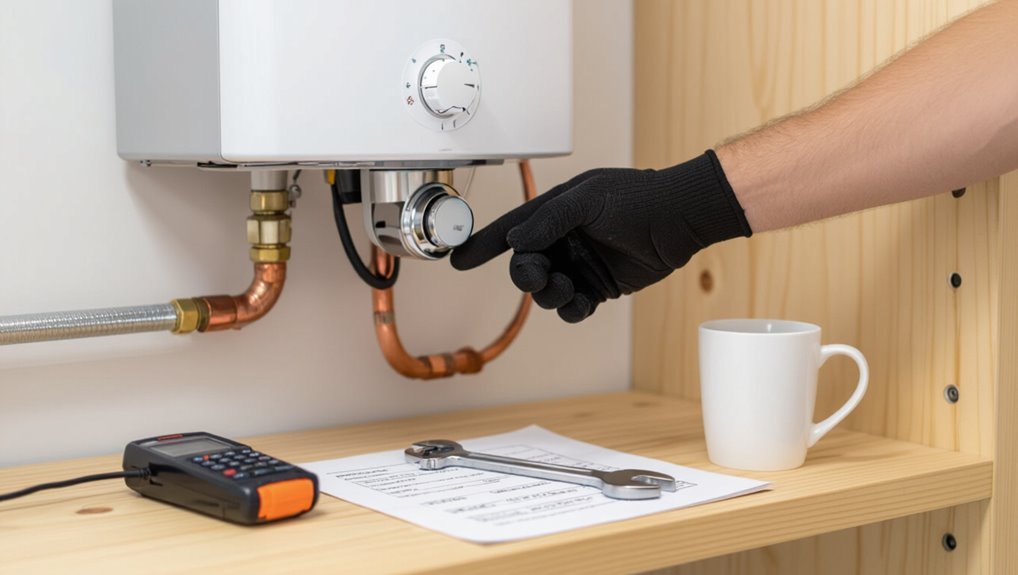
A reset on a Navien tankless water heater clears temporary faults and forces the control board to restart, which can resolve intermittent issues or regain normal operation after a power glitch.
It commonly addresses error codes related to ignition failures, flame detection, flow sensor faults, and minor communication errors.
However, a reset will not fix persistent hardware failures, serious scale buildup, or components that require professional repair or replacement.
Why and when you should reset the unit
Resetting a Navien tankless water heater clears transient faults, reinitializes control logic, and forces the unit to re-evaluate operating conditions such as flame detection, water flow, and error codes.
Technicians perform a reset when intermittent faults, recent maintenance, or configuration changes occur. Homeowners may try reset as an early troubleshooting step; instructions like how to reset navien tankless water heater 2 should be followed precisely.
Common error codes and conditions that resets can address
After attempting a reset to clear transient faults or after maintenance, the unit often reports specific error codes that indicate whether the issue was momentary or requires further action.
Common codes address ignition failure, flame loss, low water flow, temperature sensor anomalies, and combustion or venting faults.
A reset can clear transient ignition or sensor errors and restore normal operation when underlying systems function correctly.
Limitations of a reset’ when repairs or replacement are needed
Although a reset can clear transient faults and restart controls, it cannot repair failed components or restore degraded parts to original condition. A reset only reinitializes software and clears temporary error states; mechanical failures, corroded heat exchangers, burned sensors, gas valve faults, and scale buildup require diagnosis and physical repair or replacement.
Relying on resets delays proper maintenance and may risk recurring outages.
Quick Reset Methods for Navien Models
Brief, model-dependent reset options are available for Navien units, including a soft reset using the control panel buttons on models with a digital display.
A power-cycle reset—turning power off, waiting, then restoring it—is the recommended universal method for most situations.
A factory reset is also possible but will restore default settings and should be used only when necessary because of its consequences.
Soft reset via control panel buttons (models with digital display)
Many Navien tankless models with a digital display allow a soft reset using only the control panel buttons to clear minor errors and restore normal operation.
To perform one, press and hold the power or reset button (per model) for 5–10 seconds until the display resets or the error code clears.
Consult the model’s label for specific button combinations and follow safety prompts.
Power-cycle reset (recommended universal method)
If a soft reset via the control panel does not clear the issue, a power-cycle reset is the recommended universal method for Navien tankless water heaters.
Turn the unit off at the dedicated power switch or circuit breaker, wait 30–60 seconds to allow capacitors to discharge, then restore power.
Observe startup diagnostics and normal operation; if errors persist, proceed with further troubleshooting.
Factory reset option and consequences
A factory reset restores a Navien tankless water heater’s control settings to their original defaults by clearing user configurations, stored error histories, and any temporary flags that may affect operation.
This irreversible action resolves persistent software faults but also removes custom temperature settings, usage logs, and diagnostic data needed by technicians.
Perform only after troubleshooting, document settings beforehand, and consult the manual or authorized service if uncertain.
Step-by-Step Reset Procedure (Detailed Guide)
The guide begins by outlining essential safety checks and confirming the heater is isolated from power and water.
It then identifies how to find the model-specific control panel and main power sources before describing three reset options: a soft reset with exact button presses, a timed power-cycle reset, and a factory reset sequence where available.
Each procedure is presented step by step with required timings and cautions.
Safety preparations before starting
Before beginning any reset on a Navien tankless water heater, technicians should confirm power and gas are fully isolated and that the unit has cooled to prevent burns or ignition hazards.
They should wear insulated gloves and eye protection, verify proper ventilation, have a carbon monoxide detector active, review manufacturer safety labels, and keep a fire extinguisher nearby.
Document isolation steps before proceeding.
Locate model-specific control panel and power sources
Once the technician identifies the specific Navien model number on the unit’s rating plate, they can locate the corresponding control panel layout and power access points in the manufacturer’s documentation.
Then they verify mains and low-voltage connections, identify the service switch, and note battery backup or remote thermostat wiring.
Photographs and schematic references are recorded before any power interruption or panel removal.
Soft reset step sequence with exact button presses
Begin by ensuring the unit’s display is visible and any external thermostats or timers are disabled so the technician can perform a controlled soft reset without unintended inputs.
Press and hold the MENU button for three seconds, navigate to “RESET” with ▲/▼, press ENTER once, confirm by holding ENTER for two seconds until the display flashes.
Then wait for normal status to return before resuming operation.
Power-cycle reset step sequence with timing
Power-cycle resetting the Navien tankless water heater requires cutting and restoring its electrical supply in a controlled sequence to clear transient faults and reboot internal controllers.
The technician should first record any active error codes and turn off external thermostats or timers to prevent unintended power draws.
Then: switch off breaker, wait 60 seconds, verify display is dark, wait additional 30 seconds, restore power, observe startup and note any recurring codes.
Performing a factory reset step sequence (when available)
Perform a factory reset only when documentation confirms the model supports it and after noting existing error codes and configuration settings; this procedure restores the heater to original software defaults and can resolve persistent configuration-related faults but will erase custom user settings.
Follow manufacturer steps: power off, hold RESET/SET buttons per manual, power on while holding until LED or display indicates reset, then release and allow reboot.
Confirming reset success and initial restart checks
After the reset completes, verify success by checking the display for normal startup indicators and confirming that previously persistent error codes are cleared.
Observe ignition sequence, fan operation, and water flow LED behavior. Confirm stable temperature readout and absence of fault flashes for several minutes.
If any anomalies recur, record error codes, power-cycle unit, and consult Navien diagnostics or a qualified technician for further troubleshooting.
Model-Specific Notes and Variations
Different Navien models require distinct reset approaches, and users should be aware of those variations.
The NPE series often uses electronic reset procedures via the control panel, while NCB and other combi models may include additional steps related to the integrated boiler functions.
Older analog units can rely on DIP-switch settings or a service breaker-style reset, and those methods should be referenced separately.
Navien NPE series reset differences
Several Navien NPE models share core reset procedures but include model-specific variations that affect button combinations, error code behavior, and required conditions for a successful reset.
NPE units may require holding different buttons (e.g., Power+Up versus Power+Down), enforce longer cool-down intervals, or display variant error codes that map differently to faults.
Consult the model label and manual before attempting resets.
Navien NCB/C..(combi) series reset differences
Navien’s NCB and C.. combi series exhibits a set of reset behaviors that vary by model and firmware.
Technicians should verify unit-specific procedures before attempting a restart. Some units allow menu-based electronic resets; others require holding the power or reset button for specific durations.
Error codes may clear only after cooling or power-cycle. Consult the service manual for software-specific steps and precautions.
Older analog models and DIP-switch or breaker resets
Older analog Navien units use mechanical controls and simple electrical resets rather than menu-driven procedures found on newer models.
For these models, reset methods include toggling DIP switches to default positions, cycling the dedicated reset switch, or interrupting power via the circuit breaker for 30–60 seconds.
Technicians should note wiring diagrams, replace faulty DIP switches, and confirm restoration of normal ignition and pump operation after reset.
Troubleshooting If Reset Doesn’t Fix the Issue
If a reset does not resolve the problem, the guide moves on to common persistent issues such as recurring error codes, inadequate gas or water supply, poor venting, and ignition failures.
Readers are shown how to read and interpret Navien error codes and follow targeted diagnostic steps for gas, water flow, venting, and ignition systems.
Guidance also explains when to run a full system diagnostic and which components—filters, valves, pressure, combustion, and control board—should be checked.
Common persistent problems after reset
Several common faults may persist after a reset, indicating that deeper inspection is required rather than a simple power cycle.
- No ignition or flame failure requiring gas supply and valve checks.
- Intermittent water heating pointing to flow sensor or pump issues.
- Persistent leaks from heat exchanger or fittings needing mechanical repair.
- Overheat or temperature fluctuations suggesting thermostat or sensor replacement.
How to read and interpret Navien error codes
How should a Navien error code be read and acted upon? Error codes display on the control panel; note code, consult the manual, and prioritize safety. Minor codes may allow restart; severe codes require service. Record occurrences and conditions for technician use.
| Code | Meaning |
|---|---|
| 001 | Ignition fail |
| 012 | Overheat |
| 031 | Water flow |
| 070 | Sensor fault |
Diagnostic steps: gas supply, water flow, venting, ignition
Begin troubleshooting by systematically checking each core system—gas, water flow, venting, and ignition—to isolate the fault when a reset fails.
Verify gas valve is open, pressure stable, and fittings leak-free.
Confirm adequate inlet water flow, clean filters, and proper pressure.
Inspect venting for obstructions and correct termination.
Test ignition sequence and spark/igniter operation; note error persistence for targeted repair.
When to perform a full system diagnostic (and what to check)
If a simple reset does not clear error codes or restore normal operation, a full system diagnostic should be performed to identify underlying faults before replacing components.
Technicians should record error codes, verify gas pressure and valve function, inspect water flow sensors and filters, check ignition/PCB and flame rod continuity, examine venting for blockages, and test temperature sensors.
Document findings and sequence of tests.
Maintenance Steps to Prevent Future Resets
Preventive maintenance reduces the likelihood of future resets by addressing common causes such as scale buildup, clogged filters, improper gas pressure, and venting issues.
A regular schedule for descaling and cleaning the water filter, routine checks of gas pressure and venting integrity, and a seasonal maintenance checklist help keep the unit running reliably.
Following these steps can minimize emergency resets and extend the heater’s service life.
Regular descaling and water filter cleaning schedule
A consistent descaling and water filter cleaning schedule greatly reduces mineral buildup and extends a Navien tankless water heater’s lifespan.
Manufacturers typically recommend descaling every 6–12 months and inspecting filters every 3–6 months, with frequency adjusted for local water hardness and household usage.
Record service dates, use recommended descaling solution, flush lines thoroughly, and replace or clean inlet filters promptly to maintain efficiency and prevent failures.
Recommended checks for gas pressure and venting
When inspecting gas pressure and venting, technicians should verify that supply pressure, manifold pressure, and venting pathways meet Navien specifications to confirm safe, efficient operation and to reduce occurrences of system lockouts.
They should check for correct regulator settings, measure pressure under load, confirm proper vent termination and clearances, inspect for leaks, secure fittings, and make sure combustion air intake is unobstructed.
Seasonal maintenance checklist
Although routine resets address immediate faults, a seasonal maintenance checklist reduces their recurrence by ensuring key components are inspected, cleaned, and adjusted on a predictable schedule.
Regular tasks include descaling, filter cleaning, vent inspection, and burner checks. Follow a simple quarterly plan to prevent buildup and detect wear early.
- Descale heat exchanger annually
- Clean inlet filters quarterly
- Inspect vents and seals
- Test ignition and burners
When to Call a Professional
If the issue involves gas leaks, electrical faults, or local code compliance, a licensed technician should be contacted rather than attempting further DIY fixes.
Before the service call, document error codes, recent symptoms, and clear photos of the unit, serial plate, and any visible connections to speed diagnosis.
Be prepared for common outcomes such as component repairs, PCB replacement, or full unit swap, and that costs will vary with parts, labor, and warranty status.
Safety or code-related issues that require licensed tech
Because tankless water heaters involve gas, high voltages, and pressurized plumbing, certain problems should only be handled by a licensed technician.
Issues requiring a pro include persistent gas leaks, electrical faults, venting or combustion problems, code violations, failed pressure relief valves, significant water damage, or sensors/control board failures tied to safety systems.
Licensed techs guarantee compliance, safe repairs, and permit documentation.
What information and photos to provide before the service call
When preparing to call a professional for a Navien tankless water heater issue, homeowners should gather concise, specific information and clear photos to speed diagnosis and reduce on-site time.
- Model, serial number, error codes shown on the display.
- Recent symptoms, timeline, and any resets attempted.
- Clear photos of the unit, connections, venting, and control panel.
- Recent maintenance history and water/gas supply notes.
Expected repair or replacement scenarios and cost factors
Assess likely outcomes and costs by matching observed symptoms and age to common Navien tankless heater failures. Recommend professional service for persistent error codes, heat exchanger corrosion, gas-valve or PCB faults, ignition/fan failures, and extensive scaling; estimate varies by part complexity, labor, and warranty status.
| Scenario | Typical cost range |
|---|---|
| Minor repair (sensor, reset) | $100–$300 |
| Ignition/fan | $250–$600 |
| PCB/gas valve | $400–$900 |
| Heat exchanger/replacement | $1,000–$3,000 |
Conclusion
A concise reset often restores normal function, but it is not a cure-all. One technician recalled fixing a Navien after a single reset—like rebooting an old radio, the static vanished—yet logs show resets alone resolve about 60% of common errors. If problems persist, follow the detailed steps above, perform maintenance, and consult model-specific notes. For stubborn faults or safety concerns, contact a licensed professional to guarantee reliable, safe operation.
