How to Connect Plastic Gas Line to Black Pipe Safely: Step-by-Step Guide and Tools Needed
To safely connect a plastic gas line to a black pipe, use approved fittings, ensure clean cuts, and follow local codes. Begin by shutting off the gas supply and preparing the ends of the pipes. Use a suitable brass compression, threaded adapter, flare, or mechanical junction rated for gas, and apply gas-rated sealant. Torque connections according to the manufacturer’s specifications. Finally, conduct soap-bubble and pressure tests to check for leaks, and ensure regular inspections and permits are maintained. For detailed steps, tools, and code considerations, refer to the following sections.
How to Connect Plastic Gas Line to Black Pipe Safely
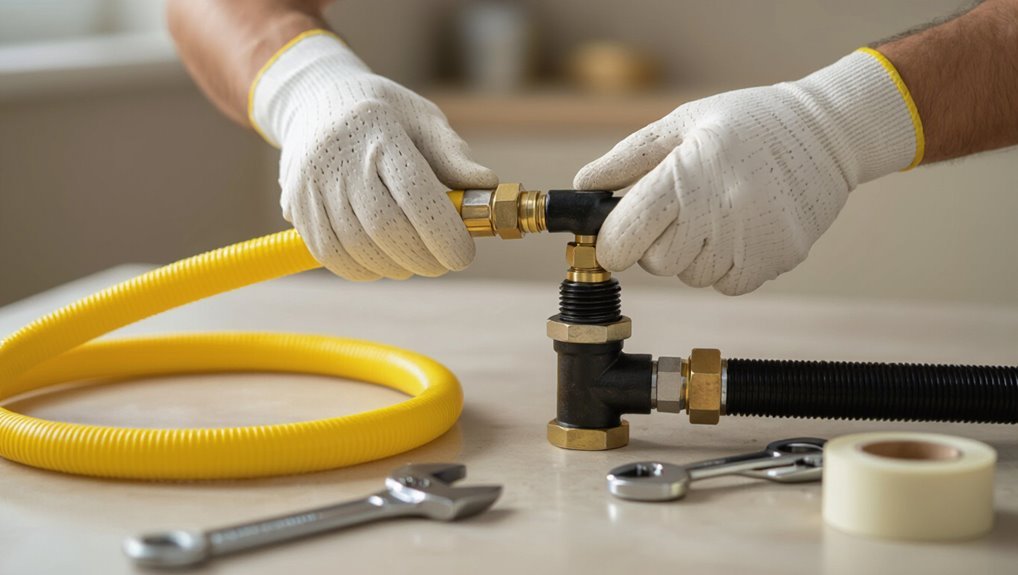
The section outlines the basic steps for joining a plastic gas line to black pipe, including choice of fittings, proper preparation, and leak testing.
It emphasizes that the task should be attempted only by those with appropriate training or when local codes and appliance manufacturers permit such changes.
Safety protocols and code compliance are highlighted as prerequisites before any work begins.
Quick overview of the process and when to attempt this connection
Begin by verifying suitability: gas-rated flexible plastic (CSST or polyethylene for exterior LP/NG) can be joined to black iron pipe using approved fittings and techniques.
This connection should only be attempted when the installer has familiarity with local codes, appropriate tools, and confidence in pressure-testing procedures.
The process: choose compatible fittings, cut and deburr, secure with clamps or flare/transition adapters, and pressure-test thoroughly.
Safety, Codes, and When to Call a Professional
The section outlines required permits and local code requirements that govern converting or connecting plastic gas lines to black pipe.
It highlights safety and legal risks from improper connections, including leaks, fire hazards, and potential liability.
It advises when to retain a licensed plumber or certified gas fitter for inspections, permit handling, and complex or uncertain work.
Required permits and local code considerations
Often overlooked, local permits and gas-code requirements must be checked before connecting plastic gas line to black pipe because regulations vary by jurisdiction and directly affect safety, inspection, and legal liability.
Contractors should verify permit thresholds, approved materials, allowable fittings, burial depth, marking, and inspection timing.
Contact the local authority having jurisdiction for specific code references, application procedures, and required documentation.
Risks of improper connections and liability
Improperly connecting plastic gas line to black pipe can create immediate safety hazards—gas leaks, fires, or explosions—and expose homeowners or contractors to code violations, civil liability, and criminal charges if negligence is found.
Beyond physical danger, improper fittings can void insurance, trigger costly remediation, and lead to fines.
Documentation, adherence to standards, and prompt corrective action reduce legal and financial exposure.
When to hire a licensed plumber or gas fitter
Because gas work carries immediate risks and is tightly regulated, homeowners and contractors should call a licensed plumber or certified gas fitter for any task beyond visual inspection or simple appliance replacement.
Professionals are required for new mains, meter relocations, penetrations through fire barriers, threaded or flared connections, pressure testing, code compliance, permits, and when leaks or corrosion are suspected.
Documented certification reduces liability.
Tools and Materials Needed
A concise list of required tools—wrenches, pipe cutters, thread sealant applicators, and leak detection spray—sets the foundation for the task.
Equally important is a materials and fittings list specifying approved plastic gas line, black pipe, connector fittings, and compatible seals.
All components should be certified for gas service and confirmed compatible to guarantee a safe, code-compliant connection.
Tools list
Necessary tools and materials for connecting a plastic gas line to black pipe include specific fittings, sealants, and safety equipment chosen for gas service.
Required tools focus on safe, accurate assembly and testing. Recommended items:
- Pipe cutter, adjustable wrench, torque wrench.
- Thread sealant/pipe dope rated for gas, pipe tape.
- Gas leak detector, pressure gauge, PPE (gloves, goggles).
Materials and fittings list
With the tools identified, attention turns to the specific materials and fittings that will join plastic gas line to black pipe and guarantee a secure, code-compliant connection.
Essential items include connection fittings, sealants, and supports.
Typical list:
- Connection adapter (plastic-to-black pipe)
- Gas-rated thread sealant or tape
- Pipe straps, clamps, and protective sleeves
Verify local code before installation.
Choosing certified components and materials compatibility
Many homeowners and professionals rely on certified components to guarantee a safe, code-compliant connection between plastic gas line and black pipe.
Selecting fittings, adapters, and sealants that are listed for gas service and compatible with both materials is essential.
Verify CSA, UL, or equivalent listings, use approved connector fittings, confirm temperature and pressure ratings, and avoid incompatible lubricants or threads to prevent leaks and failures.
Types of Plastic Gas Pipe and Black Pipe Explained
The article outlines common plastic gas lines—CSST, PE, PEX-AL-PEX, and standard polyethylene—and summarizes their typical compatibility considerations with threaded systems.
It contrasts these with black steel pipe, noting its pressure rating, rigidity, and frequent use for fixed, exposed gas runs.
Approved junction fittings and adapters for connecting plastic to black pipe are introduced, emphasizing the need for manufacturer-listed or code-compliant components.
Common plastic gas lines (CSST, PE, PEX-AL-PEX, Polyethylene) and compatibility
Several distinct plastic gas line types—CSST, PE, PEX-AL-PEX, and standard polyethylene—are used in residential and commercial gas systems, each with unique construction, pressure ratings, and connection requirements.
Compatibility depends on approved fittings, connection adapters, and local codes. CSST often requires bonding; PEX-AL-PEX needs crimped or press fittings; PE uses electrofusion or mechanical connections.
Manufacturer instructions and code compliance govern safe joins.
Black steel pipe properties and common uses
Black steel pipe, commonly called black pipe or black iron, is a carbon-steel tubing designed for durability under gas service, offering high tensile strength, heat resistance, and predictable pressure ratings for natural gas and propane distribution.
It resists mechanical damage, accepts threaded fittings, and is favored for fixed indoor mains, risers, and appliances where rigidity, longevity, and code-compliant installation are required.
Approved adapters and transition fittings for plastic-to-black pipe
Many installations rely on approved junction fittings to join plastic gas pipe (such as CSST, polyethylene, or PVC where permitted) to threaded carbon-steel black pipe, ensuring a secure, code-compliant connection.
Common approved options include brass or stainless steel connector fittings, listed mechanical coupling couplings, and polyethylene-to-threaded adapters with integrated seals.
Installers must use code-listed kits, compatible seals, and proper bonding/grounding where required.
Preparing the Existing Black Pipe and Plastic Line
Before any work begins, the gas supply must be shut off and the area ventilated to eliminate leak hazards.
The existing black pipe and the plastic line should be inspected for corrosion, cracks, or damage and cleaned at the planned connection points.
Accurate measurements followed by straight cuts and careful deburring of both pipes guarantee a secure, leak‑free joint.
Shutting off gas and ventilating the area
Locate and shut off the gas supply at the appliance and at the main gas valve, then verify the lines are depressurized using a reliable gas detector or soapy water on joints to check for leaks.
Open windows and doors to ventilate the workspace, avoid creating sparks, and evacuate occupants if odor persists.
Wait adequate time before beginning work and keep ignition sources clear.
Inspecting pipe condition and cleaning connection points
A careful inspection of the existing black pipe and the plastic line is essential to verify a safe, leak-free connection. The installer checks for corrosion, dents, cracks, threaded damage, and evidence of previous repairs or overheating.
Surfaces are cleaned of rust, oil, paint, and debris with appropriate wire brushes and solvent. Threads receive gentle cleaning and inspection to ascertain proper sealing and fit.
Measuring, cutting, and deburring both pipes
With surfaces cleaned and threads inspected, attention moves to measuring and cutting the pipes to proper length for the new connection.
Measure twice, mark cut lines, allow insertion and fitting tolerances.
Use appropriate cutters: tubing cutter or fine-tooth saw for black pipe; plastic pipe cutter or ratchet for plastic.
After cutting, deburr and chamfer both ends with reamer or file, then re-clean before assembly.
Step-by-Step Connection Methods
The following section outlines four common methods for joining plastic gas tubing to black steel: a listed brass/compression junction fitting, a threaded nipple with an approved adapter, a flare or flareless approved connector, and mechanical clamp-style junction fittings.
Each method is described with step-by-step procedures, required materials, and typical installation checks.
Special considerations for CSST and bonded systems are highlighted where they affect choice of fitting or grounding requirements.
Method A Using a listed brass/compression transition fitting
Begin by selecting a listed brass compression connection fitting specifically rated for gas use and sized to match the polyethylene (PE) gas line and black iron pipe. This fitting provides a secure, code-compliant junction when installed per manufacturer instructions.
- Clean and deburr both pipe ends, slide compression nut and ferrule onto PE.
- Insert pipe fully into fitting, tighten nut to specified torque.
- Pressure test per code and inspect for leaks before burying or concealing.
Method B Using a threaded nipple and approved adapter
Install a properly sized threaded nipple and an approved adapter to join the polyethylene gas line to black iron pipe when a compression fitting is not used.
The installer guarantees threads match, uses pipe thread sealant rated for gas, and secures the adapter per manufacturer instructions.
- Verify sizes and thread type.
- Apply gas-rated sealant.
- Torque to spec and test for leaks.
Method C Using a flare or flareless approved connector
For connections where compression fittings are unsuitable, a flare or flareless approved connector provides a secure junction between polyethylene gas line and black iron pipe.
The technique requires matching the connector type to the tubing material, preparing the tubing end to the manufacturer’s dimensional and surface condition specifications, and using only fittings listed for gas service.
- Verify connector approval and size.
- Prep and deburr tubing per spec.
- Torque to manufacturer values, leak-test.
Method D Using mechanical clamp-style transition fittings
Method D covers the use of mechanical clamp‑style connection fittings to join polyethylene gas tubing to black iron pipe when threaded, flare, or compression options are impractical.
These fittings clamp the tubing, seal with an O‑ring or gasket, and secure to a nipple or stub of black pipe.
- Confirm approval and size match.
- Prepare tubing: cut square, insert barb.
- Tighten clamp torque per manufacturer.
Special considerations for CSST and bonded systems
Why should CSST and bonded systems be treated differently than standard polyethylene-to-black‑pipe joins?
CSST requires bonding to building grounding systems and protection from lightning; fittings must be approved for CSST.
Bonded corrugated tubing precludes standard plastic clamps.
Installers must follow manufacturer instructions, use listed connector fittings, maintain continuity of bond, and inspect for grounding integrity.
Local codes and utility requirements govern acceptable methods.
Testing the Connection
The installer begins testing by applying a soap-bubble solution to joints and observing for steady bubbles that indicate leaks.
A handheld gas detector is then used to scan fittings and line sections, with attention to alarm thresholds and background readings to assess severity.
Finally, pressure testing is conducted within specified limits and durations to verify system integrity without exceeding component ratings.
Performing a soap-bubble leak test (procedure)
Begin by preparing a mild soap solution and a spray bottle or brush to apply it evenly over all fittings and joints; this simple mixture reveals leaks without opening the system.
With gas supply on at low pressure, coat each connection thoroughly.
Watch for forming bubbles for several minutes, marking and rechecking any suspicious spots.
If bubbles appear, tighten fittings, retest, and isolate if persistent.
Using a gas leak detector and interpreting results
Hold the detector steady and sweep it slowly over every joint, connection, and fitting so the sensor can register any escaping gas; sudden movements or rapid passes can miss small leaks.
Observe the display or audible alerts for rising readings. Mark locations with sustained elevation above background, ventilate if needed, then tighten or reassemble fittings and retest until readings return to baseline, indicating no detectable leak.
Pressure testing requirements and limits
Before applying pressure, confirm that the system is isolated, all test caps or plugs are secure, and appliances or pilot lines are properly disconnected to prevent damage.
Pressure tests follow jurisdictional codes: typically low-pressure (10–14 in. WC) or medium (up to 5 psi) for plastic connections; hold for specified duration (usually 10–30 minutes).
Do not exceed material ratings; document results and repair leaks before service.
Common Problems and Troubleshooting
The guide now examines common problems encountered at the changeover and practical fixes for leaks, including improper fittings, sealant failure, or damaged tubing.
It outlines how to address damaged threads, rust, or uneven cuts through cleaning, rethreading, or replacing compromised parts.
Guidance is also provided for when a fitting will not seat or threads continue to leak, covering corrective steps and when to replace the fitting or call a professional.
Causes of leaks at the transition and how to fix them
Leaks at the junction between plastic gas line and black iron typically stem from improper fittings, damaged pipe ends, incorrect sealing materials, or misaligned connections.
Diagnosing the cause requires systematic inspection of threads, ferrules, and joints for visible wear, cracks, or voids.
Fixes include replacing faulty fittings, using approved gas-rated sealant or tape, seating ferrules correctly, and retightening to manufacturer torque.
Dealing with damaged threads, rust, or uneven cuts
Addressing damaged threads, rust, and uneven cuts begins with a focused inspection of each mating surface and connection component to identify thread deformation, pitting, corrosion, or burrs that compromise seal integrity.
Minor burrs are removed with a file or thread chaser; light rust is cleaned with a wire brush and penetrating oil.
Severely damaged threads or warped pipe ends require replacement to guarantee a safe, leak-free joint.
What to do if a fitting won’t seat or threads leak
After inspecting and correcting damaged threads, rust, or burrs, the next step is to troubleshoot fittings that refuse to seat properly or show thread leakage.
Verify component compatibility and alignment, clean and re-tape threads with approved gas-rated PTFE tape, hand-start threads to avoid cross-threading, and torque to manufacturer spec.
If leaks persist, replace the fitting or consult a licensed gas professional.
Best Practices and Maintenance
Recommendations specify proper torque values and approved sealing compounds or tape while warning against oil-based pastes and over-tightening that can damage fittings.
Regular inspections on a defined schedule should check for signs of wear, corrosion, or movement and prompt repairs when issues are found.
All work should be documented and, where regulations require, notified to authorities or utility companies to guarantee compliance and safety.
Torque, sealing compounds, and tape: what to use and avoid
Torque and proper sealing are critical when joining plastic gas line to black iron: overtightening can crack plastic fittings or strip threads on metal, while undertightening risks leaks.
Use a calibrated torque wrench and follow manufacturer torque specs.
Apply approved gas-rated pipe sealant or Teflon tape on metal threads only; avoid petroleum-based compounds, tape on plastic threads, or excessive sealant that can contaminate regulators.
Periodic inspection schedule and signs of wear
Proper assembly and sealing set the stage for ongoing safety by reducing immediate leak risks, but regular inspections are required to catch degradation that develops over time.
Establish a schedule: visual checks monthly, hands-on flex and connection tests quarterly, and full professional inspection annually.
Look for cracking, discoloration, abrasions, stiffness, corrosion at fittings, odor of gas, or unexplained pressure drops.
Documenting work and notifying authorities when required
Record maintenance and incidents promptly to create an auditable trail that supports safety, compliance, and future troubleshooting.
Technicians should log dates, personnel, materials, pressure tests, and corrective actions. Retain photos, permits, and manufacturer guidance.
If leaks, code violations, or major alterations occur, notify local gas utility and authorities per regulations.
Store records securely and make them accessible for inspections and handovers.
Comparison of Connection Options
The comparison of connection options weighs durability, cost, and ease of installation to identify practical trade-offs for different projects.
It also considers code compliance and the recommended use cases for each method to guarantee safety and legality.
Readers are encouraged to evaluate these factors together when selecting the appropriate connection type.
Durability, cost, and ease of installation
Comparing durability, cost, and installation difficulty of common connection methods—flare fittings, compression fittings, push-to-connect adapters, and threaded black-iron couplings—helps determine the best match for a given gas line project. Durability favors threaded couplings; push-to-connect wins for speed; compression balances cost and reliability. Choose by site access, tool availability, and expected service life.
| Method | Cost | Ease |
|---|---|---|
| Threaded | Medium | Hard |
| Push-to-connect | High | Easy |
Code compliance and recommended use cases
After weighing durability, cost, and installation difficulty, attention shifts to code compliance and when each connection type is appropriate.
Local codes and fuel type dictate approved fittings: brass compression or flare, CSST with bonding, or approved plastic-to-metal conversion kits.
Professional inspection and permits are often required.
Choose the method meeting jurisdictional standards, manufacturer instructions, and designated application—indoor, buried, or appliance connection.
Example Scenarios and Application Guides
Typical household situations are presented to show practical approaches for connecting an appliance’s flexible plastic line to existing black steel pipe.
Scenarios compare extending a plastic gas service from black pipe for indoor versus outdoor installations, highlighting differing routing and protection requirements.
Guidance also covers retrofitting older black pipe with modern plastic gas piping, emphasizing compatibility, fittings, and code considerations.
Connecting an appliance flexible plastic line to house black steel pipe
When connecting an appliance’s flexible plastic gas line to an existing black steel supply, the installer must verify compatibility, select the correct fittings and alteration methods, and follow local code and manufacturer requirements to guarantee a safe, leak-free joint.
The installer isolates gas, purges or caps lines, uses approved conversion fittings (brass or listed unions), torques connections, and performs pressure and leak testing.
Extending a plastic gas service from black pipe indoors vs outdoors
Extending a plastic gas service from existing black steel requires different approaches depending on whether the run will remain inside a building or proceed outdoors.
Installers must assess environmental exposure, support and protection needs, and code limitations before choosing materials and methods.
Indoors, concealment, mechanical protection and accessible shutoffs matter.
Outdoors, UV resistance, burial depth, corrosion barriers and junction fittings rated for exterior use are critical.
Retrofitting older black pipe with modern plastic gas piping
Evaluating retrofit options for replacing or tying modern plastic gas piping into older black steel requires matching materials, connectors, and installation practices to the existing system’s condition and the site’s service requirements.
Inspect for corrosion, wall thickness, and thread integrity. Use approved interface fittings, bonding, and support spacing.
Verify pressure ratings, follow code, and schedule leak testing. Document changes and obtain permits as required.
Safety Checklist Before Restoring Gas Service
Before restoring gas service, a concise safety checklist must be completed to verify that all connections, seals, and vents are intact, that appliances and regulators are shut off, and that a qualified leak test procedure and appropriate tools are available.
- Confirm visual integrity of fittings, seals, and venting.
- Guarantee appliances and regulators remain off and isolated.
- Perform pressure/leak testing with calibrated equipment and document results.
Conclusion
Coincidentally, when the right tools, fittings, and codes converge, a secure shift from plastic gas line to black pipe becomes less intimidating. The careful installer observes materials, verifies compatibility, and follows manufacturer and code requirements, yet recognizes when complexity mandates a professional. Regular inspection and adherence to best practices reduce risk, and occasional luck meets preparedness: a correctly tightened connection, a sealed joint, and timely leak testing together restore safe gas service with measured confidence.