
How to Tell If Your Hot Water Recirculating Pump Is Working: Quick Tests and Troubleshooting
To determine if your hot water recirculating pump is functioning properly, check for warm water quickly arriving at fixtures, light humming or vibrations from the pump, and warmth in the return line. Conduct quick tests by timing how long it takes for hot water to reach your taps, feeling for vibrations at the pump, and checking the warmth of the pipes leading to the loop. You can also use an infrared thermometer or listen for consistent operation sounds. If issues arise, troubleshoot by examining power supply, timers, valves, and potential air in the lines. Continue reading for detailed step-by-step tests and solutions.
What a Hot Water Recirculating Pump Does and Why It Matters
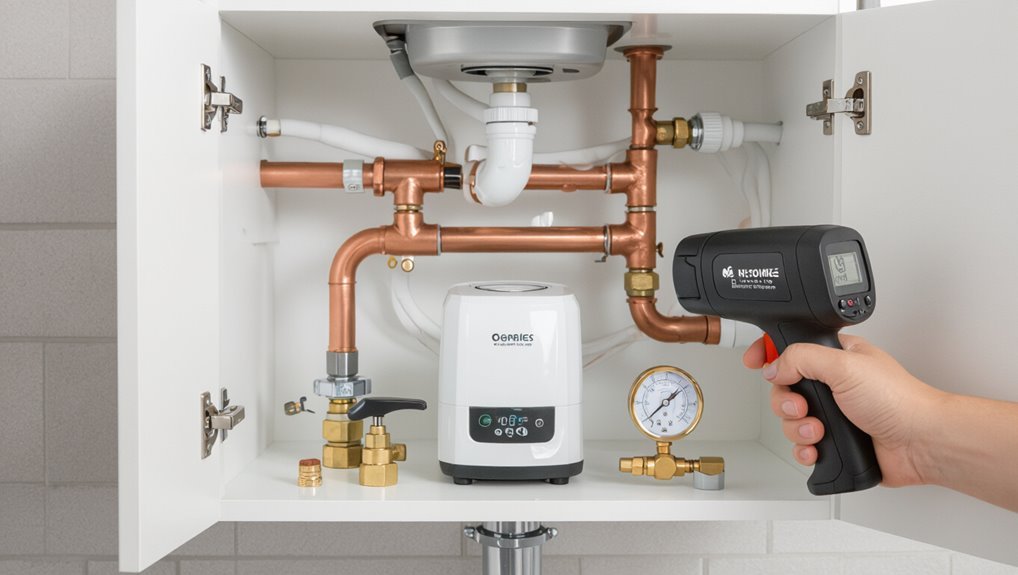
A hot water recirculating pump keeps warm water moving through a home’s plumbing so hot water arrives quickly at fixtures without long waits.
Systems vary from simple dedicated return lines to demand-activated or integrated pump-and-timer controls, and pumps range from small inline units to larger circulators.
When functioning properly, these pumps conserve water, reduce energy waste, and improve convenience for occupants.
How recirculating systems work in homes
Many homes use a hot water recirculating system to keep warm water immediately available at fixtures, reducing wait times, water waste, and energy lost from repeatedly reheating cold water in pipes.
The system circulates hot water through a dedicated loop or via the cold line return, driven by a pump and controlled by timers, sensors, or thermostats—helpful context for how to tell if hot water recirculating pump is working.
Common types of recirculating pumps and controls
With the basics of how recirculating systems move warm water and reduce waiting time established, attention turns to the specific pumps and control strategies that make them work.
Typical pump types include dedicated loop pumps, under-sink compact pumps, and retrofit on-demand units.
Controls span timers, thermostat-based circulators, and motion or app-activated on-demand modules, each balancing responsiveness, energy use, and installation complexity.
Benefits of a functioning recirculating pump
Because it maintains a constant supply of hot water at fixtures, a properly functioning recirculating pump cuts wait times, reduces wasted water, and improves household convenience.
It conserves energy by minimizing repeated heating cycles, lowers utility bills, and prolongs appliance lifespan by preventing corrosion and sediment buildup.
Reliable operation supports comfort, hygiene, and efficient water use across bathrooms, kitchens, and laundry areas.
Quick Signs Your Recirculating Pump Is Working
A few quick checks can confirm that a recirculating pump is operating as expected.
Warm water arriving almost instantly at the faucet, subtle humming or vibration near the pump, and visible movement or condensation on the pump housing and adjacent pipes are immediate clues.
Additionally, illuminated indicator lights or status messages on the control panel provide direct confirmation.
Immediate indicators at the faucet
How can one tell at a glance if a hot water recirculating pump is doing its job?
At the faucet, water should reach hot within seconds after opening. Temperature rises steadily without long cold delays, and flow is immediate rather than sluggish.
Minimal wasted water runs down the drain before warmth appears, indicating effective loop circulation and consistent hot delivery to fixtures.
Audible and vibration clues near the pump
Listen for a steady, low hum and feel for subtle vibration near the pump housing; these are the simplest indicators that the recirculating motor and impeller are running.
Irregular rattles, grinding, or pronounced buzzing suggest bearing wear, cavitation, or loose mounting. A consistent, faint vibration with no odd noises usually indicates normal operation; louder or intermittent sounds warrant inspection or professional service.
Visual cues on pump housing and plumbing
Visual inspection of the pump housing and adjacent piping often reveals immediate clues about recirculating pump function: a uniformly warm housing, steady water flow indicators (like flow meters or clear hoses), and dry, intact fittings suggest proper operation, while coolant stains, wet spots, cracked seals, or visibly loose connections point to leaks or malfunction.
Additionally, absence of corrosion, proper alignment, and no pooling beneath the unit reinforce normal performance.
Indicator lights and control panel signals
Curious indicators on the pump’s control panel offer the quickest confirmation that a recirculating pump is active: steady green LEDs, a blinking status light that follows the manufacturer’s pattern, or a digital display showing run time or flow rate all signal normal operation.
Absence of lights, error codes, or unexpected colors (red/amber) suggests faults. Consult the manual for code meanings and reset or call service if unresolved.
Fast Tests You Can Do Now (No Special Tools)
A few quick checks can help confirm whether the recirculating pump is doing its job without any tools.
Measure hot-water wait times at several fixtures and note how long the faucet temperature takes to change from cold to hot.
Also listen and feel around the pump and return line for flow and warmth to identify circulation.
Hot-water wait-time test at multiple fixtures
How long does it take for hot water to arrive at different fixtures can reveal whether a recirculating pump is functioning; testing wait times at several faucets and showers provides a quick, tool-free check of system performance.
- Note elapsed seconds until steady hot flow at each fixture.
- Compare upstairs versus downstairs times.
- Repeat after pump idle period and after pump run cycle.
- Long, inconsistent waits suggest pump, loop, or check-valve issues.
Faucet temperature-change timing method
When did the water temperature begin to shift after the tap was opened?
The observer times from tap opening until consistent hot water arrives. Short response (seconds) suggests recirculation active; long delay implies inactive or intermittent operation.
Repeat at several fixtures, note differences, and compare against expected response for the system.
Record times to inform further troubleshooting or technician assessment.
Listening and feeling for flow at the pump and lines
Where can one best detect the telltale sounds and sensations of moving water?
Near the pump housing and along accessible supply and return pipes.
Listen for steady hums, rattles, or water rush; place a hand lightly on pipes to feel vibration or gentle flow warmth changes without measuring temperature.
Sudden silence or lack of vibration suggests stalled or inactive circulation needing further inspection.
Check for warmth along the return line
A quick, hands-on check for warmth along the return line can indicate whether the recirculating pump is moving hot water back toward the heater.
Feel along accessible sections, starting near fixtures and toward the boiler. A consistently warm return means circulation; cold spots or a cool entire line suggest no flow or a stuck valve.
Repeat after pump cycles to confirm.
Simple Tool-Assisted Tests
Next, simple tool-assisted tests narrow down causes with measurable checks.
An infrared thermometer can trace hot-water circulation while a toggle or non-contact tester verifies pump power.
Handheld pressure/flow gauges and a multimeter for pump speed and voltage provide objective performance data.
Using an infrared thermometer to trace hot-water circulation
An infrared thermometer quickly maps temperature differences along supply and return lines, revealing whether hot water is circulating as planned.
The inspector scans pipe surfaces from fixture to pump, noting warm supply and cooler return gaps. Consistent temperature drop along the loop indicates flow; uniform warmth or cold spots suggests stagnation or bypass.
Record readings at intervals for comparison and troubleshooting.
Using a toggle or non-contact voltage tester on pump power
How can a simple voltage tester quickly confirm whether a recirculating pump is receiving power? A toggle or non-contact voltage tester checks voltage at the pump wiring or junction box without disassembly.
If the tester indicates live power when the pump should run, electrical supply is present; if not, wiring, breaker, or switch faults are likely.
Always follow safety procedures and isolate circuits before detailed inspection.
Pressure and flow checks with a handheld gauge
After verifying power to the recirculating pump with a voltage tester, a handheld pressure and flow gauge provides a direct, tool-assisted method to assess hydraulic performance.
The technician connects the gauge to an accessible port, notes static pressure, starts the pump, and records dynamic pressure and flow rate.
Deviations from expected values indicate restrictions, air, check valve issues, or failing impeller performance requiring targeted inspection.
Checking pump speed and voltage with a multimeter
Use a multimeter to verify that the recirculating pump receives the correct voltage and to measure its operating speed via RPM or frequency readings.
Test AC voltage at the motor terminals, comparing to nameplate values.
Measure frequency or use a tachometer adapter for RPM.
Note fluctuations, drops under load, or intermittent supply.
Record readings for trend comparison and troubleshooting.
Diagnosing Common Problems and What They Mean
Common failure patterns point to specific causes and remedies: the pump running without delivering hot water often indicates a check valve or bypass issue, while a pump that does not run at all suggests power, wiring, or motor failure.
Intermittent operation, short cycling, loud noises or grinding typically signal air in the line, failing bearings, or a misconfigured controller.
Visible leaks, corrosion, or signs of overheating require immediate attention to prevent pump and system damage.
Pump runs but no hot water at fixtures
When the recirculating pump runs but faucets and showers remain cold, the issue usually lies between the pump and the fixtures rather than with the pump motor itself.
Check for closed or partially closed isolation valves, clogged check valves, obstructed lines, airlocks, or a malfunctioning thermostatic bypass.
Inspect zone valves and plumbing layout for incorrect connections or cross-connections causing cool return flow.
Pump not running at all
A recirculating pump that fails to run at all typically points to electrical, control, or mechanical faults rather than flow problems; diagnosing the cause requires checking power supply and wiring, the thermostat or control relay, motor condition, and any safety switches or overloads.
Inspect circuit breaker, fuses, and wiring for faults, verify control signals, test motor windings and capacitor, and replace failed components.
Intermittent operation or short cycles
After checking for a dead pump, attention should shift to intermittent operation or short cycling, which often signals issues distinct from complete failure.
Causes include faulty control circuits, failing motor capacitors, thermostat or sensor malfunctions, air trapped in the line, or stuck check valves.
Diagnostic steps: monitor run intervals, test voltage consistency, inspect control settings, bleed air, and verify valve movement to isolate the fault.
Loud noises, rattling, or grinding
Listen for persistent loud noises, rattling, or grinding from a recirculating pump as these sounds usually indicate mechanical issues that require prompt attention.
Such noises often stem from worn bearings, a failing motor, loose mounting, or debris trapped in the impeller.
Immediate inspection is advised to prevent damage; recommended actions include isolating power, checking mounts, and scheduling professional service for bearing or motor replacement.
Leaks, corrosion, or overheating signs
Several visible clues — dripping joints, greenish mineral deposits, or discolored insulation — point to leaks, while flaky metal, pitted surfaces, or rust stains indicate corrosion and warn of weakening components.
Overheated pumps may feel hot, emit burnt odors, or show melted wiring or blistered paint. Any of these signs justify immediate shutdown, inspection, and replacement of compromised seals, fittings, or the pump unit.
Step-by-Step Troubleshooting and Fixes
The following steps guide a systematic check of power and control settings, including resetting or replacing timers, thermostats, or remotes.
They also cover bleeding trapped air, inspecting and replacing check and balancing valves, and routine lubrication, cleaning, and basic pump maintenance.
Each item is presented so the reader can diagnose, perform safe fixes, or know when to call a professional.
Verify power and control settings
Before inspecting wiring or timers, confirm that the pump and its control components are receiving power and set correctly; a simple power issue or misconfigured control is the most common cause of a non‑functioning recirculating system.
Check circuit breaker, inline fuse, and visible wiring for faults.
Verify controller mode, clock settings, and any occupancy or motion sensor status before proceeding to more invasive diagnostics.
Resetting or replacing the timer/thermostat/remote
Begin by powering down the pump’s control unit and any associated timers or remotes to guarantee a safe, controlled reset process.
Perform a factory reset per manufacturer instructions, then power up and reprogram schedules/temperatures.
If intermittent faults persist, replace the faulty timer, thermostat, or remote with compatible units.
Verify operation by initiating a manual run cycle and observing pump response.
Bleeding air and clearing trapped air pockets
Bleed trapped air from the recirculating line to restore steady flow and eliminate noise, reduced hot-water delivery, or intermittent heating caused by air pockets.
Isolate pump, open high-point bleeder valves or nearby fixtures, run pump briefly, close bleeders as steady water flows. Repeat until sputtering stops.
Check expansion tank pressure and system vents; remove remaining pockets by cycling pump and bleeding again.
Checking and replacing check valves and balancing valves
Inspect the check valves and balancing valves to confirm proper flow direction, full closure, and correct balancing under operating conditions.
Verify no backflow with a pressure test, listen for chatter, and confirm balancing valve settings match system documentation.
Replace leaking, stuck, or corroded valves with compatible parts.
After replacement, recheck flow rates and temperatures to make certain the recirculation loop functions as planned.
Lubrication, cleaning, and simple pump maintenance
Routine lubrication, cleaning, and basic maintenance keep a hot water recirculating pump operating efficiently and prevent premature failure.
This section outlines concise, safe steps to service bearings, remove debris, and perform simple checks that homeowners or technicians can complete without major disassembly.
Isolate power, drain minimal system volume, clean inlet strainer, remove debris, lubricate motor shaft per manufacturer, tighten fittings, restore power, and verify smooth operation and quiet running.
When to replace the pump or motor
When persistent noise, loss of flow, electrical faults, or repeated failures persist after cleaning, lubrication, and simple repairs, replacement of the pump or motor should be considered.
Age, corrosion, seized bearings, burned windings, or impeller damage that reduce efficiency justify replacement.
Verify compatibility, warranty, and energy ratings, then choose a direct-swap or upgraded unit.
Professional installation guarantees correct wiring, seals, and system balancing.
When to Call a Professional
If basic troubleshooting does not resolve the issue, a professional should be contacted to address safety and warranty concerns.
Licensed technicians are needed for complex electrical work, plumbing modifications, or integration with broader heating systems.
Immediate professional assessment is warranted when persistent failures, extensive corrosion, or repeated breakdowns suggest full system replacement.
Safety and warranty considerations
A homeowner should prioritize safety and warranty terms before attempting repairs on a hot water recirculating pump.
Inspect warranty documentation to avoid voiding coverage; note required service providers and authorized parts.
For any uncertainty about gas, water shutoffs, or sealed components, stop work and contact the manufacturer or a licensed technician.
Document actions and communications to support future claims or repairs.
Complex electrical, plumbing, or system integration issues
Several situations warrant calling a licensed professional: evidence of electrical faults (tripped breakers, burning smells, exposed wiring), signs of significant plumbing failure (persistent leaks, low pressure, backflow, or damage to piping), or any integration with home automation, boilers, or gas-fired systems that requires coordination across trades.
A pro evaluates wiring, pressure dynamics, pump controls, check valves, and safety interlocks, preventing hazards and preserving warranties.
Signs that indicate full system replacement
Recognize when piecemeal repairs no longer suffice: repeated pump failures, chronic corrosion of the recirculation loop, widespread piping deterioration, or an outdated system that cannot meet current demand are clear indications that full system replacement should be considered.
A professional evaluates overall efficiency, safety hazards, code compliance, and lifecycle costs, recommending replacement when repairs are uneconomical, performance remains poor, or long‑term reliability is compromised.
Preventive Maintenance Tips to Keep Your Pump Working
A concise preventive plan helps extend pump life and avoid unexpected failures.
Routine inspections on a seasonal schedule, specific winterizing steps, and periodic budgeting for replacements or upgrades are key components.
The following tips outline practical checks, off-season care, and cost planning.
Recommended inspection schedule
Routine inspections should occur at regular intervals to catch wear, leaks, and performance changes before they cause failures.
Inspect monthly for visible leaks and unusual noises.
Test flow and check temperature differentials quarterly.
Verify electrical connections and timer settings biannually.
Replace worn seals or filters as needed.
- Monthly: visual and noise check
- Quarterly: flow/temperature test
- Biannual: electrical/timer review
- As needed: seal/filter replacement
Seasonal checks and winterizing advice
Preparedness helps prevent freeze damage and guarantees steady performance as seasons change.
Technicians inspect insulation on exposed pipes, verify pump and valve operation, and confirm automatic controls function before cold spells.
Drain or circulate vulnerable lines, add heat tape where appropriate, and test backup power for smart circulators.
Record findings and schedule follow-ups to address wear, leaks, or reduced flow before temperatures drop.
Budgeting for replacement and upgrades
When planning long-term care for a hot water recirculating system, owners should allocate funds for predictable replacements and targeted upgrades based on pump age, runtime, and service history.
Budgeting includes estimating motor or control replacements, plumber labor, and parts, plus a contingency for unexpected failures.
Prioritize energy-efficient models and smart controls when funds allow to reduce operating costs and extend system life.
Comparison of Common Recirculating Pump Features
Although recirculating pumps share the same basic purpose—delivering hot water quickly to fixtures—their features vary in ways that affect performance, efficiency, and user convenience. Models differ by activation method, check valves, flow rate, and mounting. Choosing depends on plumbing layout and control preference.
| Feature | Typical options |
|---|---|
| Activation | Timer, thermostat, motion sensor |
| Flow control | Fixed, variable |
| Check valve | Integrated, external |
| Mounting | Inline, dedicated return |
HH4: Energy usage, noisy vs. quiet models, and typical lifespans
How much energy a hot water recirculating pump uses, how loudly it runs, and how long it lasts are key factors that determine operating cost, user comfort, and replacement timing.
Efficient models draw 5–100 watts depending on duty cycles; timers and sensors cut consumption.
Quieter pumps use better bearings and insulation; noise ratings often listed in dB.
Typical lifespan ranges from 5 to 15 years with proper maintenance.
Quick Troubleshooting Checklist for Homeowners
A concise checklist helps homeowners quickly identify common problems with a hot water recirculating pump before calling a professional.
Inspect for leaks, listen for unusual noises, verify power and timer settings, and check flow at fixtures. If issues persist, record symptoms and photos for a technician.
- Confirm power and timer
- Check for visible leaks
- Listen for grinding or humming
- Test hot water flow
Conclusion
Like the saying goes, “A stitch in time saves nine.” Homeowners who monitor their hot water recirculating pump regularly catch small issues before they grow, ensuring fast, reliable hot water and lower waste. Simple checks—listening for odd noises, feeling pipe warmth, and running brief tool-assisted tests—reveal most problems. When diagnostics point to wear, clogging, or electrical faults, timely maintenance or professional service restores efficiency and extends the pump’s useful life.
