How to Repair a Foghorn System: Step-by-Step Troubleshooting and Maintenance Guide
To effectively repair a foghorn system, start by checking the power supply, fuses, and control logic. Next, inspect the air supply, valves, and horn diaphragms for any leaks or signs of wear. Conduct systematic checks for issues like intermittent faults, distorted tones, or vibrations. Regular maintenance should include lubrication, corrosion protection, and timely parts replacement. Always adhere to safety procedures and consult OEM manuals for complex repairs. Detailed diagnostics and maintenance steps are provided in subsequent sections for thorough guidance.
What a Foghorn System Is and How It Works
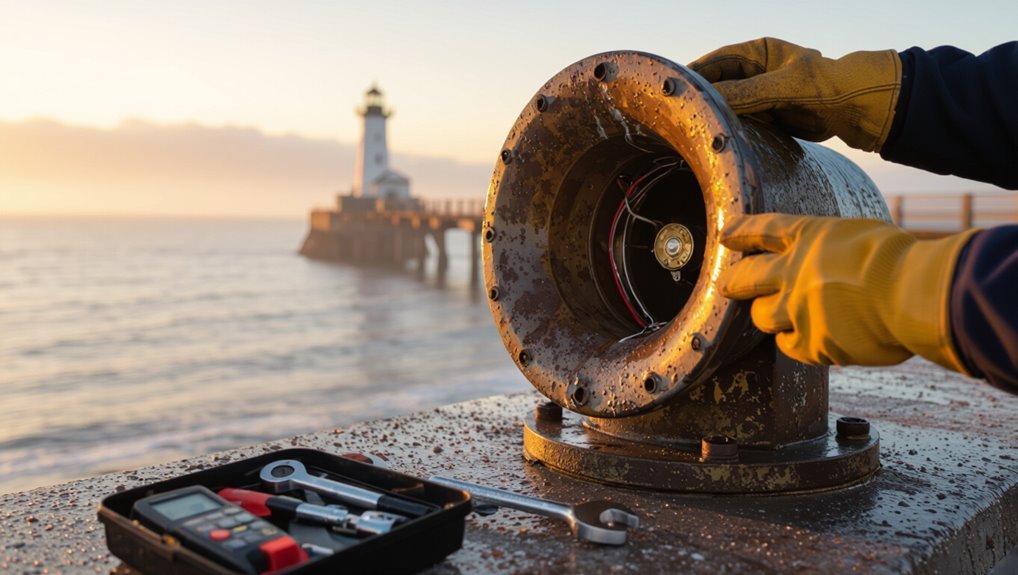
A foghorn system is an audible navigation aid installed at coastal points, harbors, and waterways to warn vessels during low-visibility conditions.
It comprises a sound-producing horn, an air compressor or blower, a control panel and power supply, and sensors that trigger and regulate signals.
Systems vary by horn design and sound-generation technology—mechanical, compressed-air, and electronic—each with specific maintenance needs.
Purpose and typical locations of foghorn systems
Because fog severely reduces visibility, foghorn systems provide a reliable audible warning to prevent collisions and aid navigation when visual cues are obscured.
They mark hazardous coastlines, harbor entrances, bridges, and shipping channels, often installed on buoys, lighthouses, piers, and vessels.
Maintenance guides explain where technicians focus and outline how to repair foghorn system components to maintain consistent signaling and safety.
Core components (horn, air compressor/blower, control panel, power supply, sensors)
Foghorn systems consist of several interdependent components—the acoustic horn, an air compressor or blower, a control panel, a power supply, and environmental sensors—that together generate, regulate, and time the audible signal.
The horn converts pressurized air to sound; compressors supply and regulate airflow; control panels manage timing and diagnostics; power supplies guarantee continuous operation; sensors trigger activation based on visibility, tides, or manual input.
Common foghorn types and technologies
With the component overview established, attention moves to the varieties of fog signal systems and the technologies that drive them.
Common types differ by sound generation, power, and control methods:
- Air-driven diaphone and horn systems with compressors.
- Electric sirens using motors and rotors.
- Electronic loudspeakers with synthesized tones.
- Hybrid systems combining pneumatic and electronic controls for redundancy.
Quick Diagnostic Checklist for Faulty Foghorn Systems
Before beginning any work, the inspector verifies safety gear, site access permissions, and compliance with maritime and local regulations.
A concise set of rapid audible and visual tests is then performed to classify the failure mode—electrical, acoustic, or mechanical.
Finally, the technician confirms availability of essential troubleshooting tools and replacement parts to proceed without delay.
Safety and regulatory checks before inspection
Although audible warning devices are often treated as peripheral equipment, operators must verify safety interlocks, permit status, and applicable regulations prior to any diagnostic work.
This checklist guarantees authorized access, de-energized circuits, appropriate lockout/tagout, PPE availability, and compliance with maritime or local noise and signaling rules.
Confirm documentation, crew notifications, confined-space permits, electrical isolation, and environmental permits before physical inspection begins.
Rapid audible and visual tests to determine failure mode
Start by performing quick audible and visual checks to isolate the failure mode: listen for tone, volume, and continuity of sound while observing the horn assembly, control panel indicators, wiring connections, and any mechanical linkages.
- Intermittent tone or dropouts indicating loose connections or failing amplifier.
- Distorted or muffled sound suggesting diaphragm or horn damage.
- No sound with power indicator on suggesting driver or relay fault.
- Visible corrosion, frayed wires, or mechanical obstruction.
Tools and equipment needed for troubleshooting
After the quick audible and visual checks identify likely failure modes, a concise set of tools and test equipment guides the troubleshooting process.
The technician assembles handheld instruments, safety gear, and replacement parts to verify electrical, pneumatic, and mechanical systems efficiently.
- Multimeter, clamp meter, insulation tester
- Pressure gauge, portable air supply, leak detector
- Torque wrench, insulated hand tools, spares kit
- PPE: gloves, hearing protection, safety goggles
Step-by-Step Troubleshooting Procedure
The technician begins by verifying power and control signals before moving through systematic checks.
Next steps include inspecting the power supply, fuses, and breakers, then testing the control panel, timers, and activation logic.
Finally, the procedure covers assessment of the air supply—compressors, blowers, tanks, valves—and inspection of the horn assembly components such as diaphragms, reeds, and mechanical linkages.
Step 1 Verify power and control signals
Verify that the foghorn’s electrical supply and control signals are present and within specification before proceeding to mechanical or acoustic checks.
Technicians should observe indicator lights, measure voltage at control terminals, confirm grounding continuity, and verify remote command inputs or automation interfaces.
Document nominal values and any deviations.
If signals are absent or out of range, isolate the control circuit and tag equipment for further investigation.
Step 2 Inspect and test power supply, fuses, and breakers
Begin by isolating power to the foghorn and visually inspecting the supply panel, fuses, and breakers for signs of damage, overheating, corrosion, or loose connections.
Measure incoming voltage with a multimeter, test fuse continuity, and operate breakers to confirm trip function.
Replace any compromised components with correct ratings, tighten terminals, and document readings before restoring power for subsequent diagnostics.
Step 3 Check control panel, timers, and activation logic
Inspect the control panel and its timers to confirm correct wiring, settings, and logical sequencing of activation signals.
Verify program schedules, relay operation, and input/output mapping against schematics.
Test manual overrides, interlocks, and fault indicators.
Check for corrosion, loose connectors, and firmware version.
Record anomalies, reset defaults if needed, and document changes for subsequent diagnostics.
Step 4 Assess air supply system: compressors, blowers, tanks, and valves
When evaluating the air supply system, the technician should methodically assess compressors, blowers, storage tanks, and valve assemblies to isolate pressure, flow, and control faults.
Inspect compressor oil, belts, motors, and filters for wear, verify blower operation and inlet conditions, check tank integrity and drain moisture, confirm pressure settings and relief valves, and test solenoids and actuators for responsiveness under load.
Step 5 Examine horn assembly: diaphragms, reeds, and mechanical linkages
Careful observation guides the technician through the horn assembly, focusing on diaphragms, reeds, and mechanical linkages to identify wear, misalignment, or damage that alters tone and volume.
Inspect diaphragms for cracks, tears, or stiffening; check reed edges for nicks and corrosion; verify linkage pivots, springs, and fasteners move freely without play.
Document findings and replace or adjust faulty parts.
Step 6 Test wiring, connectors, and grounding for corrosion or shorts
Having identified physical wear and linkage issues in the horn assembly, the technician next moves to the electrical path: testing wiring, connectors, and grounding for corrosion, shorts, or open circuits.
Visual inspection, continuity and insulation resistance checks, and voltage verification under load locate faults. Corroded terminals are cleaned or replaced, loose crimps tightened, and grounding continuity restored to prevent intermittent failures and safety hazards.
Step 7 Use systematic isolation to pinpoint electrical vs. pneumatic faults
Begin isolating systems by dividing the foghorn into its electrical and pneumatic subsystems and applying controlled tests to each path independently.
Inspect valves, compressors, and supply lines for pressure integrity while energizing coils, relays, and control circuits separately.
Use meters and pressure gauges to confirm live signals versus airflow.
Document results, mark faulted components, and proceed with targeted repairs or replacements.
Step 8 Perform functional test under load and environmental conditions
Execute a full functional test with the foghorn operating under expected load and realistic environmental conditions to verify repairs and uncover issues only evident in service.
Observe acoustic output, duty cycle, and timing against specifications.
Monitor electrical current, pressure stability, and temperature.
Record anomalies, intermittent faults, or degraded performance.
Repeat tests across wind, humidity, and tidal conditions to confirm reliability before returning to service.
Common Problems and How to Fix Them
The section outlines frequent foghorn failures and targeted remedies across electrical, pneumatic, mechanical, and environmental domains.
It covers no-sound conditions with electrical diagnostics, weak or distorted output with pneumatic and mechanical fixes, and intermittent operation tied to wiring, controls, or sensors.
It also addresses excessive noise or vibration through mounting and structural repairs, and restores function after moisture, salt corrosion, or other environmental damage.
No sound produced electrical causes and remedies
When a foghorn falls silent, electrical faults are often the culprit and can usually be diagnosed through systematic checks of power delivery, control circuits, and actuator components.
Inspect supply voltage, fuses, breakers, and wiring for continuity and corrosion.
Verify control relay and timer operation, test solenoids/valves for coil resistance, and check connectors.
Replace faulty modules, tighten connections, and retest under load.
Weak or distorted sound pneumatic and mechanical solutions
Addressing weak or distorted foghorn output requires focusing on pneumatic pressure, airflow paths, and the mechanical integrity of sound-producing components.
Inspect compressors, reservoirs, and pressure regulators for leaks, wear, or insufficient output. Clean and align horns, diaphragms, and valves; replace warped reeds or cracked diaphragms.
Confirm intake filters and piping are unobstructed and resonators are intact to restore proper tone and volume.
Intermittent operation wiring, control, and sensor troubleshooting
Many intermittent foghorn failures trace to wiring faults, control logic glitches, or faulty sensors that provide false trigger signals.
Inspect connections for corrosion, frayed insulation, and loose terminals. Verify power stability and grounding.
Test control relays, timers, and PLC inputs for proper sequencing. Confirm sensor calibration, clean optics or diaphragms, and replace failing units.
Document findings and retest under varied environmental conditions.
Excessive noise or vibration mounting and structural repairs
Examine mounting points and surrounding structures systematically to identify sources of excessive noise or vibration in a foghorn installation.
Inspect bolts, brackets, dampers, and bases for looseness, fatigue, or cracks.
Tighten or replace fasteners, add isolation pads or vibration mounts, reinforce framing, and weld or brace fractured members.
Balance rotating components and retune resonant panels to eliminate amplified vibration and rattles.
Moisture, salt corrosion, and environmental damage fixes
Corrosion and weather exposure progressively degrade foghorn components, compromising performance and safety if left unchecked.
Inspect housings, terminals, and fasteners for pitting, flaking paint, and electrochemical damage.
Remove rust, apply corrosion inhibitors, and replace irreparably damaged connectors with marine-grade stainless steel.
Reseal enclosures with appropriate gaskets and marine sealant, guarantee drainage, and schedule regular rinsing to remove salt deposits.
Compressor/blower failures and replacement guidelines
Diagnose compressor and blower issues promptly, since failures commonly manifest as reduced output, unusual noise, overheating, or intermittent operation that can render a foghorn unreliable.
Inspect belts, bearings, motor brushes, and wiring; check pressure and airflow.
Clean or replace corroded parts, balance rotors, and verify seals.
Replace units when repair costs exceed 50% of replacement price or when performance remains unstable after service.
Maintenance and Preventive Care Schedule
A concise maintenance schedule guarantees foghorn reliability by specifying daily and weekly visual and functional checks alongside monthly mechanical and pneumatic inspections.
Quarterly electrical and control system tests and an annual overhaul with recommended parts replacement help prevent failures.
Regular lubrication, corrosion protection, and weatherproofing steps are required to extend component life and maintain performance.
Daily and weekly visual and functional checks
Routine daily and weekly visual and functional checks keep a foghorn system reliable and safe.
Technicians inspect exterior housings, lenses, and mounts for damage; verify power indicators and battery charge; test automatic activation and manual controls; and confirm audible output at prescribed distances.
Record findings, note trends, and flag anomalies for prompt corrective action.
- Exterior condition
- Power and batteries
- Control and activation
- Sound output
Monthly mechanical and pneumatic inspections
Once every month, technicians perform thorough mechanical and pneumatic inspections to guarantee the foghorn’s moving parts, valves, hoses, and pressure systems operate within specification.
They document wear, verify seals, and confirm regulator and reservoir pressures, replacing components as needed to prevent failure.
- Inspect actuator linkages and bearings for play
- Check valve seating and leak paths
- Examine hoses for abrasion or swelling
- Verify pressure relief and gauge calibration
Quarterly electrical and control system tests
Why perform quarterly electrical and control system tests? Regular tests verify circuitry, controllers, sensors, and backup power functionality to prevent failures and guarantee signal reliability.
Actions include:
- Inspect wiring, terminals, and corrosion.
- Test control logic, relays, and timers.
- Verify sensor calibration and signal integrity.
- Exercise backup batteries and automatic transfer switches under load.
Annual overhaul and parts replacement recommendations
1 annual overhaul provides a systematic opportunity to replace wear items, verify component tolerances, and update assemblies to manufacturer specifications to guarantee long-term foghorn reliability.
- Replace diaphragms, gaskets, and seals per hours or visual wear.
- Inspect and test solenoids, valves, and air delivery tubing.
- Swap aged control boards and connectors with certified spares.
- Record part serials, torque settings, and test outcomes in maintenance logs.
Lubrication, corrosion protection, and weatherproofing steps
Begin routine lubrication and corrosion-control measures at the start of each maintenance cycle to preserve moving parts, electrical contacts, and exposed metal surfaces.
Apply marine-grade lubricants to bearings, linkages, and valves; use dielectric grease on connectors.
Clean and neutralize salt deposits, then coat with corrosion inhibitors.
Inspect seals, replace deteriorated gaskets, and guarantee housings are weatherproofed and vented to prevent condensation.
Parts, Tools, and Replacement Guidance
The section outlines essential spare parts to stock—such as diaphragms, seals, valves, and compressor components—and criteria for selecting compatible replacement horns and compressors.
It also lists recommended tools and diagnostic instruments for on-site troubleshooting and repair.
Guidance is provided on evaluating wear and damage to determine when repair is feasible versus when full component replacement is warranted.
Common spare parts to keep on hand
A small inventory of critical spares and hand tools greatly reduces downtime when a foghorn system fails; priority items include diaphragms, solenoid valves, pressure regulators, control relays, and gasket kits, plus basic tools such as wrenches, screwdrivers, a multimeter, and thread sealant.
- Diaphragm and gasket sets
- Solenoid valve assemblies
- Pressure regulator modules
- Electrical relays and fuses
Selecting compatible replacement horns, diaphragms, and compressors
Choose replacement horns, diaphragms, and compressors that match the original system’s mechanical, acoustic, and pressure specifications to guarantee reliable performance and prevent damage.
Confirm bolt patterns, flange sizes, diaphragm materials, operating pressure ranges, and electrical ratings against the manufacturer’s data plate or schematic before ordering.
Verify compatibility with mounting hardware, inlet/outlet fittings, and control valves.
Prefer OEM or certified equivalents and document part numbers and warranty terms.
Recommended tools and diagnostic instruments
Begin by assembling a concise set of hand tools, power tools, and diagnostic instruments tailored to foghorn systems to enable safe, accurate inspection and repair.
Essential items include corrosion‑resistant wrenches, multimeter, clamp meter, pressure gauge, and portable analyzer. Safety gear and spares expedite work.
- Hand and power wrench set
- Multimeter and clamp meter
- Pressure/vacuum gauges
- Portable audio/spectrum analyzer
When to repair vs. replace major components
With the basic toolkit and diagnostic instruments in place, decisions about repairing versus replacing major foghorn components hinge on measurable criteria: age, failure mode, repair cost relative to replacement, availability of parts, and impact on safety or regulatory compliance.
Prioritize replacement for structural, corrosion, or obsolete electronic failures; repair when sealed bearings, diaphragms, or modular electronics are serviceable and cost-effective.
Document outcomes and retain spares.
Safety, Compliance, and Documentation
The author outlines applicable regulatory standards, audible range requirements, and site-specific compliance obligations for foghorn installations.
Safe working procedures for confined spaces and elevated platforms are summarized alongside recommendations for operator and maintenance staff training.
Finally, the need for thorough recordkeeping—maintenance logs, incident reports, and test results—is emphasized to guarantee traceability and regulatory proof.
Regulatory standards and audible range requirements
Regulatory standards and audible range requirements define the minimum performance, testing, and documentation obligations for foghorn systems to guarantee they provide effective warnings under varied environmental conditions.
Authorities specify decibel levels, frequency characteristics, range metrics, test intervals, and recordkeeping.
Compliance requires calibrated measurements, environmental correction factors, and certification of repairs.
Noncompliance risks legal penalties and compromised navigational safety.
Safe working procedures for confined or elevated installations
Several critical precautions apply when accessing confined spaces or elevated platforms to service foghorn systems: personnel must be trained and certified for confined-space entry and working at height, use appropriate PPE, fall-arrest and retrieval systems, atmospheric monitoring, permit-to-work procedures, and establish lockout/tagout.
Guarantee adequate ventilation, communication, emergency rescue plans, tool tethering, and supervision. Compliance with site-specific safety policies and regulations is mandatory.
Recordkeeping: maintenance logs, incident reports, and test results
Maintaining accurate maintenance logs, incident reports, and test results guarantees traceability of work, supports regulatory compliance, and enables timely identification of recurring faults in foghorn systems.
Records should be consistent, timestamped, and stored securely for audits. Summaries aid trend analysis and corrective actions.
- Equipment ID, date, technician, task
- Detailed fault description and resolution
- Test parameters, results, and signatures
- Incident severity, corrective measures, follow-up
Training recommendations for operators and maintenance staff
Accurate records create a foundation for targeted training by revealing common faults, procedural gaps, and recurring safety issues in foghorn systems.
Training should cover standardized operating procedures, emergency shutdown, basic diagnostics, and lockout/tagout.
Include hands-on workshops, periodic competency assessments, and refresher courses aligned with regulations.
Maintain documented curricula, attendance, and evaluation results to support compliance and continuous improvement.
Troubleshooting Scenarios and Real-World Examples
The section presents three practical troubleshooting scenarios: saltwater corrosion after a storm with a stepwise resolution, intermittent fog signal caused by power surges with diagnosis and repair, and compressor failure at a remote lightstation with emergency workarounds.
Each case outlines observed symptoms, key diagnostic checks, and prioritized corrective actions. Readers are encouraged to compare these examples to their own installations and apply the procedural steps that match their conditions.
Scenario: Saltwater corrosion after storm stepwise resolution
After a severe storm, saltwater intrusion commonly accelerates corrosion in foghorn systems, compromising electrical contacts, diaphragms, and mounting hardware.
This scenario outlines a stepwise approach to assess damage, prevent further deterioration, and restore reliable operation.
Inspect visually, document affected components, isolate power, clean corrosion with appropriate solvents and brushes, replace pitted parts, apply marine-grade anti-corrosion coatings, test operation, and schedule follow-up inspections.
Scenario: Intermittent fog signal during power surges diagnosis and fix
Diagnose intermittent fog signal failures during power surges by systematically isolating electrical causes and verifying mechanical integrity.
Inspect surge protector, main breaker, and wiring for loose connections or burnt contacts.
Test voltage stability with a recorder during storm simulations.
Examine control relays, solenoids, and timers for contact pitting.
Replace faulty surge suppression, tighten terminals, and recalibrate control logic.
Confirm consistent operation under simulated surge conditions.
Scenario: Compressor failure at remote lightstation emergency workarounds
Several practical contingency steps help keep a remote lightstation operational when its compressor fails: isolate the compressor circuit to prevent further damage, switch to backup pressurization methods, and prepare for a controlled shutdown of noncritical systems to conserve air and power.
Technicians assess portable compressors, manual bellows, and stored air cylinders. They prioritize foghorn cycles, log conditions, and coordinate expedited parts shipment and scheduled repairs.
Cost Estimates and Budget Planning
Typical cost ranges for common foghorn repairs and parts are outlined to inform realistic budgeting.
The discussion contrasts planned preventive maintenance budgets with reserves for emergency repairs.
Funding and procurement considerations for public installations, including grant opportunities and procurement rules, are also addressed.
Typical cost ranges for common repairs and replacements
Estimate repair costs by grouping common foghorn failures into categories—electrical, mechanical, control-system, and structural—since each has distinct labor and parts profiles. Typical ranges: minor electrical repairs $100–$600, mechanical overhaul $500–$4,000, control-module replacement $300–$2,500, structural patching $200–$3,000. Reference table:
| Issue | Low | High |
|---|---|---|
| Electrical | $100 | $600 |
| Mechanical | $500 | $4,000 |
Budgeting for preventive maintenance vs. emergency repairs
When balancing long-term reliability against the risk of sudden failures, organizations should compare the predictable costs of scheduled preventive maintenance with the often higher and less predictable expenses of emergency repairs.
Budgeting should allocate routine maintenance funds, reserve contingency for unforeseen breakdowns, and use historical failure data to set thresholds.
Prioritizing inspections reduces emergency frequency and overall lifecycle costs.
Funding and procurement considerations for public installations
Having allocated funds for preventive maintenance and contingency reserves, planners must next translate operational needs into concrete cost estimates and procurement strategies for public foghorn installations.
Costing should include equipment, installation, permitting, training, and lifecycle replacements.
Procurement must follow public tender rules, evaluate warranties, maintenance contracts, and total cost of ownership, and prioritize transparent bidding, vendor qualification, and budgetary approvals.
Additional Resources and Supplier Contacts
The section lists key manufacturer manuals and technical bulletins that should be consulted for model-specific procedures and safety notes.
It also outlines situations where hiring certified technicians is advisable and how to verify their credentials.
Finally, it provides contacts for reliable spare-parts suppliers and recommended brands for common foghorn components.
Manufacturer manuals and technical bulletins to consult
Consulting the original manufacturer manuals and current technical bulletins is essential before attempting any foghorn repairs, as they contain model-specific schematics, wiring diagrams, parts lists, and safety procedures that override generic guidance.
The documents guide safe, compliant troubleshooting and specify approved replacement parts, torque settings, and calibration steps.
- OEM service manual
- Wiring and schematic bulletin
- Parts and serial catalog
- Safety and retrofit notices
Professional services: when to hire certified technicians
When should a certified technician be engaged for foghorn repairs?
A certified technician is required for complex electrical faults, compressed-air system overhauls, structural horn realignment, safety-critical failures, regulatory compliance checks, and after major corrosion or collision damage.
Hire professionals for warranty-covered work, inaccessible installations, or when in-house personnel lack specific training, certifications, or calibrated diagnostic equipment.
Spare parts suppliers and recommended brands
Because reliable components determine long-term performance, spare parts for foghorn systems should be sourced from suppliers with proven marine-grade certifications and a track record in navigational-aid equipment.
Recommended brands emphasize corrosion resistance, IP ratings, and compatibility with legacy units. Maintain OEM part numbers, stock critical items, and verify warranty policies.
- Ross Engineering (OEM horns)
- MarineSignal Co.
- Seacert Controls
- HarborTek Parts
Conclusion
In the dim poststorm hush, the battered foghorn stands reborn—its voice no longer a meek cough but a triumphant, tectonic bellow that could rouse sleeping harbors and shame thunder. Through meticulous diagnostics, stubborn wrenching, and ritualized maintenance, the system’s soul is coaxed back into thunderous service. Repairing a foghorn becomes mythic labor: equal parts science and reverent craft, turning corrosion and silence into resolute, ear-splitting vigilance for mariners yet to come.