How to Pick a Tankless Water Heater: 7 Steps to Choose the Right Model
To choose the right tankless water heater, start by determining the peak simultaneous flow rate (GPM) and the necessary temperature rise for your home. Match these requirements with the unit’s rated output. Next, consider the fuel type and venting options suitable for your space. Decide between point-of-use and whole-house models, and evaluate whether you prefer condensing units for better efficiency. Keep local fuel costs and building codes in mind, along with installation constraints, water quality, and maintenance needs. Always refer to the manufacturer’s sizing charts and warranty details to prevent undersizing. Follow these steps for a comprehensive selection process.
How to Choose the Right Tankless Water Heater: Quick Recommendation
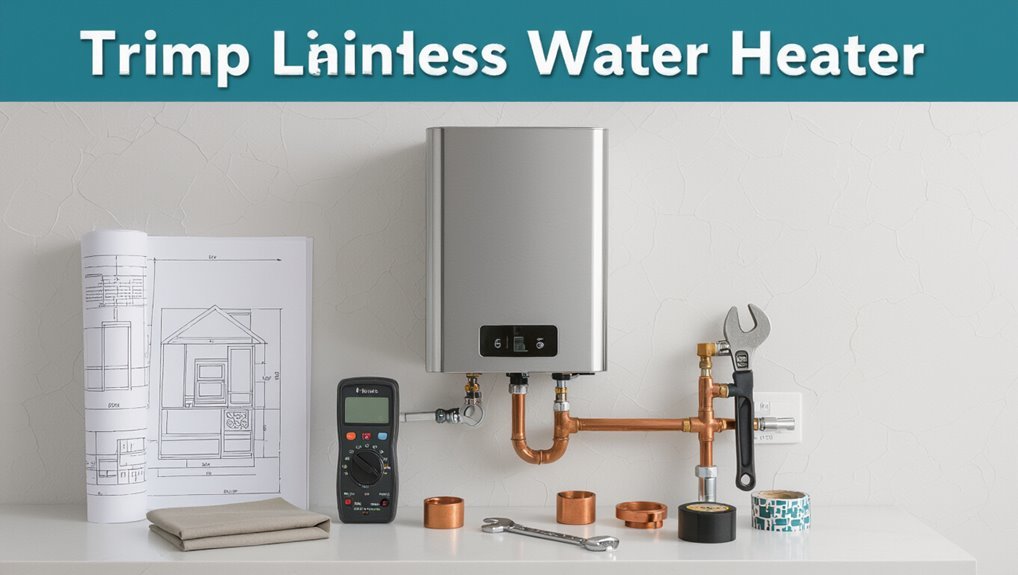
Recommended models can be grouped by use case—compact point-of-use units for single fixtures, small-home units for 1–2 bathrooms, whole-house systems for larger families, and high-capacity models for heavy simultaneous demand.
For immediate selection, match the unit’s peak flow rate and temperature rise to the household’s highest expected simultaneous demand.
Choose the smallest unit that meets those two criteria to minimize cost and energy waste.
Best picks by use case (small home, large family, whole-house, point-of-use)
For different household sizes and needs, specific tankless models consistently deliver the best combination of flow rate, efficiency, and reliability.
For small homes, compact electric point-of-use units suffice; large families benefit from high-capacity gas whole-house systems; whole-house electric models suit moderate demand with space constraints; point-of-use units reduce lag at fixtures.
Guidance on how to pick a tankless water heater centers on matching capacity to peak demand.
One-sentence selection rule to apply now
When selecting a tankless water heater now, match the unit’s maximum flow rate and temperature rise to the household’s peak simultaneous demand.
Choose a gas whole‑house model for high flow/large families, an electric whole‑house for moderate demand and limited venting, and compact point‑of‑use electrics to serve single fixtures.
Prioritize verified performance specs, local fuel availability, installation constraints, and budget to finalize the ideal model.
Tankless Water Heater Basics You Need to Know
A tankless, or on-demand, water heater heats water only when a tap is opened, using a heat exchanger instead of a storage tank.
Models differ by fuel and design—gas (natural or LPG), electric, and high-efficiency condensing units—each with tradeoffs in flow rate, efficiency, and venting.
Installations range from compact point-of-use units at a single fixture to whole-house systems sized to supply multiple outlets.
What a tankless (on-demand) water heater is and how it works
Tankless, or on-demand, water heaters heat water directly as it flows through the unit instead of storing hot water in a tank.
A heat exchanger raises temperature instantly when a tap opens; flow sensors and controls activate heating only as needed.
Continuous hot water is provided without standby losses, while output depends on incoming temperature and maximum flow rate, requiring proper sizing for household demand.
Main types: gas (natural/LPG) vs electric vs condensing
Because household needs and installation constraints vary, on-demand units are offered in several main types—gas (natural gas or LPG), electric, and condensing models—each with distinct fuel requirements, performance characteristics, and installation considerations.
Gas units deliver higher flow and faster recovery but need venting and gas lines.
Electric units are simpler and quieter but require substantial electrical capacity.
Condensing models reclaim heat for higher efficiency.
Common installation styles: point-of-use vs whole-house
Many installations fall into two clear categories: point-of-use units that heat water at or near the fixture, and whole-house systems designed to supply multiple outlets.
Point-of-use models offer fast response, minimal pipe heat loss, and compact installation for single fixtures.
Whole-house systems handle higher combined flow rates, centralize maintenance, and require greater fuel, venting, or electrical capacity and higher initial cost.
Key Specifications to Compare
Selecting a tankless water heater requires comparing several key specifications that determine real-world performance.
Important factors include flow rate (GPM) and household demand calculations, required temperature rise based on inlet water and desired output, and energy efficiency ratings (EF, UEF) that affect operating costs.
Additionally, buyers should consider recovery/performance under simultaneous use and the availability and cost of the chosen fuel source.
Flow rate (GPM) and how to calculate household demand
How much hot water a household needs at once is determined by the combined flow rates of the fixtures likely to run simultaneously, measured in gallons per minute (GPM).
To calculate demand, list typical simultaneous fixtures, note each fixture’s GPM (shower ~2.0, sink ~1.0, dishwasher ~1.5), and sum them.
Choose a unit with continuous GPM equal to or slightly above that total.
Temperature rise and matching inlet temperature to needs
Temperature rise is the difference between incoming groundwater temperature and the desired hot-water output, and it determines how much heating power a tankless unit must deliver.
Buyers should measure winter inlet temperatures, set target outlet temps for fixtures, then select a model whose maximum temperature rise at the required flow rate meets those needs.
Account for simultaneous demands and local climate variance.
Energy efficiency metrics (EF, UEF) and operating cost implications
Why compare ratings like Energy Factor (EF) and Uniform Energy Factor (UEF)? These metrics quantify a unit’s efficiency: higher values indicate less fuel or electricity wasted.
UEF replaces EF with standardized testing across flow rates, enabling fair comparisons. Selecting higher UEF models reduces annual operating costs, especially with frequent use, and helps estimate payback periods when weighing upfront price versus long-term savings.
Recovery rate and performance under simultaneous use
When facing multiple simultaneous demands, a tankless water heater’s recovery rate — typically expressed as gallons per minute (GPM) at a given temperature rise — determines whether it can sustain desired flow and temperature.
Buyers should compare rated GPM at realistic temperature rises, consider peak combined fixture demand, and verify manufacturer charts for simultaneous-use scenarios to avoid drops in temperature or insufficient flow during heavy household use.
Fuel source availability and cost considerations
Flow capacity and fuel must be evaluated together: even a unit with sufficient GPM can be uneconomical or impractical if the available energy source is costly, unreliable, or incompatible with the installation.
Consider local fuel types (gas, propane, electric), utility rates, supply reliability, and installation complexity.
Factor lifetime operating costs, venting and electrical upgrades, rebates, and emissions; choose the option with lowest total cost and feasible supply.
7 Practical Steps to Select the Right Model
The selection process can be broken into clear, actionable steps that move from demand assessment to technical choices.
Key initial actions include:
- Create a fixture-use profile and measure incoming groundwater temperature.
- Match required flow rate with temperature rise and choose fuel/venting.
- Decide between condensing and non-condensing units based on efficiency and budget.
Step 1 Assess your hot water demand: create a fixture-use profile
Because accurate sizing depends on peak simultaneous use, the homeowner should compile a fixture-use profile listing each hot water outlet, its typical flow rate, and the times those fixtures are likely to run together.
The profile tallies fixtures (showers, sinks, appliances), assigns flow rates (gpm) and duration, and identifies overlapping events to calculate peak gallons per minute needed for proper tankless selection.
Step 2 Measure incoming groundwater temperature for accurate sizing
Several measurements are required to size a tankless heater accurately, beginning with the incoming groundwater temperature.
The installer records winter and summer inlet temperatures using a calibrated thermometer at the main cold-water supply. These values determine required temperature rise for desired hot-water outputs.
Local climate data or on-site readings guarantee correct energy sizing and prevent undersized units, improving performance and efficiency.
Step 3 Choose the appropriate flow rate and temperature rise combination
With inlet temperatures established, attention shifts to matching required flow rates with the necessary temperature rise to deliver consistent hot water.
The installer calculates combined fixture demand (GPM) and the desired output temperature, then selects a unit whose maximum flow at that temperature rise meets or exceeds demand.
Factor in simultaneous use and a modest safety margin for performance stability.
Step 4 Select fuel type and ventilation requirements
Once flow and temperature needs are defined, the next decision is fuel type and corresponding venting, since those choices determine installation cost, placement options, and long-term operating expenses.
Gas units require combustion air and proper venting—direct, power, or concentric—affecting exterior placement and chimney work.
Electric units avoid vents but need sufficient electrical service and might have higher operating costs depending on local rates.
Step 5 Decide on condensing vs non-condensing based on efficiency and budget
How much emphasis should be placed on long‑term efficiency versus upfront cost when choosing between condensing and non‑condensing tankless water heaters?
The decision balances higher initial expense and greater efficiency of condensing units against lower purchase cost of non‑condensing models.
Consider expected energy savings, local fuel prices, maintenance needs, and payback period to determine which aligns with budget and lifecycle goals.
Step 6 Evaluate installation constraints: electrical supply, gas line, venting, and space
After weighing efficiency versus upfront cost, attention turns to practical installation limits that determine which models will actually fit and perform in a given home.
Inspect electrical capacity, gas-line size and pressure, venting options and clearances, and available mounting or closet space.
Verify local codes and utility hookups; confirm whether upgrades or professional installation are required before final selection.
Step 7 Factor in warranty, reliability, and maintenance needs
A warranty and a track record of reliability can determine long-term ownership costs and user satisfaction when choosing a tankless water heater.
Buyers should compare warranty length, coverage for heat exchangers and labor, and transferability.
Investigate brand reliability via reviews and failure rates.
Consider recommended maintenance—descaling frequency, filter cleaning—and factor service availability and costs into total cost of ownership.
Installation and Site Preparation Considerations
Installation and site requirements strongly influence the choice and performance of a tankless water heater.
Gas models require proper venting and clearance while electric units demand sufficient panel capacity and appropriate wiring.
Additionally, water quality controls (filtration/descaling) and strategic placement to reduce pipe run and heat loss should be planned before purchase.
Venting options and clearance requirements for gas units
Venting decisions for gas tankless water heaters dictate both safety and performance, requiring planners to weigh direct-vent, power-vent, and category-specific options against site constraints.
Proper termination placement, approved materials, and slope for condensate are essential.
Clearance requirements around units, combustion air provisions, and local code compliance determine feasible locations.
Professional evaluation guarantees safe exhaust routing and maintenance access.
Electrical panel capacity and wiring needs for electric units
Electrical demand is the primary constraint when planning for an electric tankless water heater. The installer must verify service amperage, available breaker slots, and main panel capacity.
Many units require 100–200+ amp circuits, multiple dedicated breakers, and proper wire gauge and conduit. Coordination with an electrician may require panel upgrades, permit approval, and adherence to local electrical codes for safe, reliable operation.
Water quality issues: scale, hard water, and recommended filtration/descaling
Because minerals in hard water quickly accumulate in heat exchangers, tankless water heaters are especially vulnerable to scale buildup that reduces efficiency and can cause premature failure.
Regular water testing, whole-house softeners or point-of-entry filtration, and scheduled descaling (vinegar or manufacturer-recommended chemicals) preserve performance.
Install inline sediment filters and follow service intervals specified by flow, hardness level, and manufacturer to extend lifespan and maintain warranty.
Placement best practices for minimizing pipe lag and heat loss
Reducing scale and maintaining efficient heat exchange are only part of preserving a tankless water heater’s performance; placement plays a major role in how quickly hot water reaches fixtures and how much energy is lost en route.
Install units close to main demand zones, minimize piping length and bends, insulate hot and cold lines, avoid unconditioned spaces, and consider multiple units or recirculation loops for large homes to reduce lag.
Cost Breakdown and Lifetime Economics
A concise financial snapshot helps readers weigh upfront and ongoing expenses when choosing a tankless water heater. The table below sketches typical purchase/installation ranges, annual operating cost comparisons for gas versus electric units, and rough payback periods versus traditional storage heaters.
| Item | Gas | Electric |
|---|---|---|
| Purchase + Install | $800–$3,500 | $700–$2,500 |
| Estimated Annual Operating Cost | $200–$450 | $300–$700 |
| Typical Payback vs Tank | 3–10 years | 5–12 years |
Typical purchase and installation cost ranges by type
When comparing tankless water heaters, buyers should evaluate upfront purchase prices and installation expenses by technology and capacity, since these determine the short-term outlay and influence long-term cost-effectiveness.
Gas-fired units typically have higher installation costs due to venting and gas-line work but lower operating costs in many regions, while electric models often cost less to install yet may incur higher energy expenses over time.
Typical single-point electric units range $300–700 plus modest installation, whole-house electrics $800–2,500 plus panel upgrades.
Condensing gas models cost $900–2,500; non-condensing $600–1,800.
Installation for gas can add $500–3,000 depending on venting and permits.
Estimated annual operating cost comparison (gas vs electric)
Beyond upfront purchase and installation, annual operating costs are a key determinant of a tankless heater’s lifetime economics.
Gas models generally offer lower energy costs per year where natural gas prices are favorable, despite slightly higher maintenance.
Electric units have higher energy bills but lower service needs and simpler installation.
Regional fuel prices, household hot-water demand, and unit efficiency determine the effective annual expense.
Payback period vs storage tank heaters
Comparing payback periods between tankless and storage tank water heaters requires quantifying all relevant costs—purchase, installation, annual energy, maintenance, and expected lifespan—and translating them into a simple cumulative cash-flow timeline.
Tankless units often have higher upfront but lower operating costs and longer lifespans. The payback depends on fuel prices, usage patterns, incentives, and replacement timing; sensitivity analysis clarifies when breakeven occurs.
Comparing Popular Models and Features
When comparing popular tankless water heater models, attention centers on practical features that affect performance, convenience, and installation. A concise checklist—modulating burners, remote controls/Wi‑Fi, recirculation compatibility, size/footprint, noise level, and aesthetics—helps buyers weigh trade-offs. The table below summarizes key considerations at a glance.
| Performance | Convenience | Installation/Design |
|---|---|---|
| Modulating burners (efficiency/noise) | Remote control / Wi‑Fi (user control) | Size / footprint (space constraints) |
| Recirculation compatibility (hot water speed) | Noise level (comfort) | Aesthetics (visible placement) |
Feature checklist: modulating burners, remote controls, Wi-Fi, recirculation compatibility
Efficiency and convenience often hinge on a few key features: modulating burners for steady output, remote controls for user access, Wi‑Fi for diagnostics and updates, and recirculation compatibility for reduced wait times.
Buyers should verify modulation range, control simplicity, app functionality, and pump compatibility.
Consider warranty impacts and energy savings projections.
Prioritize features that match household usage patterns and serviceability.
Size/footprint, noise level, and aesthetics to consider
Size, noise, and appearance often determine whether a tankless water heater fits into a home as seamlessly as it performs. Installers and homeowners should evaluate physical footprint, measured sound levels under typical load, and exterior finishes relative to the designated location.
Compact units save space but may need specific venting. Compare dB ratings, mounting options, and color/cover choices to minimize visual and acoustic impact.
Common Problems and How to Avoid Them
Common problems with tankless water heaters often stem from improper sizing, inadequate venting or combustion setup on gas units, and mineral buildup that shortens lifespan.
These issues can cause insufficient hot-water flow, temperature drops, safety hazards, and the cold‑water sandwich effect.
Preventive steps—correctly sizing the unit, following venting and combustion guidelines, regular descaling, and using tempering or buffering options—can minimize failures and maintain performance.
Under-sizing leading to insufficient flow or temperature drop
If a tankless water heater is undersized for the household’s peak demands, it will struggle to deliver adequate flow or maintain set temperatures during simultaneous fixtures.
This causes lukewarm showers, slow recovery, and homeowner frustration.
Properly calculate peak flow rates and required temperature rise, choose a unit with sufficient GPM at that rise, and allow margin for future needs to prevent performance shortfalls.
Venting and combustion issues for gas units
When improperly vented or poorly adjusted, gas tankless water heaters can produce incomplete combustion, backdrafting, or excessive condensate that damage the unit and endanger occupants.
Addressing vent sizing, material, termination, and combustion air supply during installation prevents these issues.
Regular inspection verifies proper draft, sealed connections, correct slope, and corrosion-free chimneys.
Professional setup and CO monitoring guarantee safe, efficient operation.
Mineral buildup and shortened lifespan’ preventive measures
Because hard water deposits restrict heat exchanger flow and reduce heat transfer efficiency, mineral buildup is a leading cause of reduced performance and premature failure in tankless water heaters.
Regular descaling with manufacturer-recommended vinegar or commercial solutions, installing a water softener or scale inhibitor, and scheduling annual maintenance preserve efficiency and lifespan.
Monitoring flow and temperature helps detect early scaling.
Cold-water sandwich phenomenon and mitigation options
Beyond mineral buildup concerns, another common issue with tankless systems is the cold-water sandwich: brief surges of cold water between hot bursts during intermittent use.
This occurs when residual hot water is followed by a short cold interval before the heater reengages.
Mitigations include tempering tanks, recirculation loops, flow-control valves, or programmable controllers to maintain continuous activation and reduce temperature swings.
Maintenance, Warranty, and Service Considerations
A clear maintenance plan and a few routine DIY checks—such as flushing the unit and inspecting filters—help preserve efficiency and prevent scale buildup.
Warranties vary in scope and duration, so readers should watch for exclusions, prorated terms, and requirements that could void coverage.
Guidance is provided on which tasks are appropriate for a homeowner and which require a licensed technician.
Recommended maintenance schedule and DIY checks
Regular, scheduled maintenance preserves efficiency and extends the life of a tankless water heater.
Owners should flush scale annually (or more in hard-water areas), clean inlet filters quarterly, inspect venting and condensate drains semiannually, and check for leaks or error codes monthly.
Keep service records and replace sacrificial anodes or components per manufacturer intervals; consult a licensed technician for major repairs.
What warranties typically cover and red flags in warranty terms
Having a clear maintenance record supports warranty claims, but owners should also understand what typical warranties actually cover and what to watch for in the fine print.
Warranties usually cover defects in heat exchangers and parts for limited periods; labor is often excluded or limited.
Red flags: prorated coverage, voiding for mineral buildup, mandatory professional service, short claim windows, and unclear transferability.
When to hire a professional vs DIY troubleshooting
When should a homeowner attempt troubleshooting and when is it wiser to call a professional?
Minor issues—resetting error codes, checking gas/electric supply, clearing inlet filters—suit confident owners with basic tools.
Complex problems—gas line, combustion, major leaks, venting, persistent error codes, or warranty-covered repairs—require licensed technicians.
Choosing professional service protects safety, warranty validity, and guarantees proper diagnosis and compliance with local codes.
Final Checklist Before Purchase
Before committing to a model, the reader should run through a concise pre-purchase checklist to guarantee a smooth installation and long-term performance.
- Confirm site readiness items (gas/electrical capacity, venting, clearances).
- Prepare questions for manufacturers and installers (installation specifics, performance expectations, service response).
- Collect documents to keep after installation (manuals, permits, warranty).
Site readiness items to confirm
Though the decision to install a tankless water heater is nearly complete, a concise site readiness check guarantees the unit will fit, function, and comply with local codes.
Confirm available clearance, mounting surface, and venting path; verify gas service size or electrical capacity and breaker location; secure proper water pressure and filtration; locate condensate drain and freeze protection; confirm permits and access for future maintenance.
Questions to ask manufacturers and installers
What specific performance, installation, and support details should be confirmed with manufacturers and installers before committing to a purchase?
Ask for exact flow rate and temperature rise data for expected conditions, venting and clearance requirements, fuel and electrical specifications, installation timeline and responsibilities, warranty scope and claim process, recommended maintenance schedule, parts availability, and installer certification or references to guarantee compliance and long-term serviceability.
Documents to keep after installation (manuals, permits, warranty)
After confirming performance specs, installation responsibilities, and warranty terms with manufacturers and installers, the buyer should assemble a set of post-installation documents to protect the investment and simplify future service.
Include the owner’s manual, installer notes, system schematics, local permits, inspection certificates, warranty paperwork with registration proof, and receipts.
Store originals and digital copies in an accessible, labeled folder for service and resale.
Real-World Scenarios and Sizing Examples
The article now presents concise, real-world sizing examples to translate theory into practical choices.
Example A covers appropriate unit size and models for a 1–2 person apartment.
Example B outlines whole-house specs for a family of four, while Example C addresses vacation-home needs and intermittent-use considerations.
Example A: 1 to 2 person apartment sizing and model choice
For a 1–2 person apartment, sizing a tankless water heater focuses on matching peak simultaneous demand—typically a shower plus a sink—while accounting for local incoming groundwater temperature.
This scenario usually requires a unit capable of delivering about 2.5–4 gallons per minute (GPM) with a heat rise of 50–70°F.
Choose a compact electric or small gas model, verify flow curves, and confirm venting and fuel availability.
Example B: Family of 4 whole-house sizing and recommended specs
Sizing a tankless system for a family of four hinges on peak concurrent demand—typically two showers running while a dishwasher or washing machine operates—and the local ground or incoming water temperature.
Calculate required flow (gpm) and desired temperature rise, then select a unit delivering that gpm at the temperature rise.
Recommend 7–10 gpm capacity, condensing gas or high‑output electric models, and 0.96+ EF efficiency.
Example C: Vacation home / intermittent use considerations
Moving from a full‑time household to a vacation property shifts priorities from peak continuous flow to standby losses, freeze protection, and intermittent demand patterns.
For intermittent use, choose a compact, energy‑efficient unit with low standby draw or consider a hybrid with recirculation timer.
Prioritize freeze mitigation, remote monitoring, and corrosion-resistant components.
Right‑sized capacity should cover occasional simultaneous showers and kitchen use without oversizing.
Conclusion
After pages of careful sizing, flow-rate calculations, and brand comparisons, the buyer finally revels in liberation: endless hot water, infinite choices, and a stack of manuals. Ironically, the chosen tankless unit promises simplicity while demanding permits, precise venting, and a professional’s touch. Contentment arrives as a modest, humming appliance—proof that minimalism can require maximal effort. At last, hot water—and a new appreciation for how uncomplicated things truly are.