Where to Buy PVC Pipe Near Me: Local Stores, Prices & Tips
If you’re looking to buy PVC pipe locally, you can find it at big-box home centers, neighborhood hardware stores, plumbing supply houses, and farm or irrigation shops. These stores typically carry standard Schedule 40 lengths and common fittings at competitive prices. Independent suppliers often have contractor-grade options, specialty sizes, and trade discounts available. For irrigation or saltwater resistance, check with garden and marine suppliers. Before making a purchase, it’s a good idea to check online stock, bring a sample for compatibility, and confirm the schedule and solvent compatibility. Continue reading for specific store tips and price comparisons.
Quick Local Options for PVC Pipe Near Me
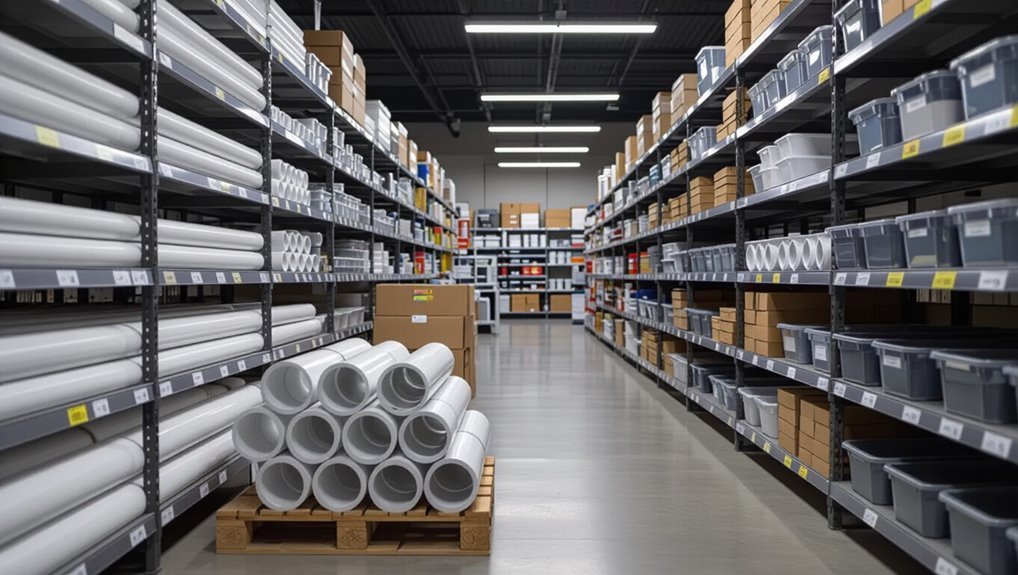
For quick local options, shoppers can check major hardware chains, neighborhood plumbing supply stores, and big-box home improvement centers that commonly stock a range of PVC pipe sizes and fittings for residential projects.
These outlets typically offer standard diameters, pressure-rated schedules, and basic connectors; staff can assist with sizing and compatibility.
Independent plumbing suppliers may carry specialty items and bulk discounts for small contractors.
Local garden centers sometimes stock irrigation-specific PVC and fittings.
Price, availability, and return policies vary by store, so buyers should compare receipts and part numbers.
Carrying a sample or exact measurements guarantees proper replacement and reduces returns.
Best Way to Search: Google Maps and Store Locators
For quickly locating nearby PVC pipe, using Google Maps provides real-time results, directions, and user reviews.
Manufacturer and retailer store locators can confirm specific stock and sizing before a trip.
Combining both methods saves time and reduces surprises at the store.
Use Google Maps
Searching Google Maps provides the quickest way to locate nearby stores that carry PVC pipe, showing exact addresses, hours, and customer ratings in one place. The map view highlights distance and real-time traffic, while search filters narrow results by store type and open status. Reviews and photos reveal stocked brands and aisle locations, reducing wasted trips. Directions integrate with navigation apps for seamless pickup.
- Check recent reviews for stock mentions and price notes.
- Use “near me” plus diameter or part type for precise results.
- Save favorite stores to compare prices and returns quickly.
Try Store Locators
Alongside mapping tools, store locators on retailer websites provide a focused way to find PVC pipe availability, allowing users to filter by product type, diameter, in-store stock levels. These locators often show aisle locations, unit counts, and pickup or delivery options, saving time compared with calling multiple stores.
For best results, enter a ZIP code, apply product filters, and verify stock timestamps. National chains, local hardware suppliers, and plumbing specialty sites commonly offer this feature.
If stock appears low, set alerts when available or reserve online for in-store pickup. Always confirm pricing and return policies before purchase.
Top Local Sellers: Big-Box, Hardware, Plumbing, Farm Stores
Buyers can compare PVC pipe options at big-box home centers, which typically stock a wide range of sizes and brands.
Local hardware and specialty plumbing stores often offer expert advice and uncommon fittings.
Farm and agriculture suppliers provide heavy-duty and irrigation-grade PVC suited for outdoor and livestock applications.
Big-Box Home Centers
Big-box home centers combine wide selection with convenient locations, making them primary stops for most PVC pipe needs. They stock varied diameters, fittings, and lengths, often in bulk; competitive pricing and standard warranties appeal to DIYers and contractors.
Availability and return policies tend to be consistent across chains, while seasonal promotions can lower costs. Staff usually assist with basic cutting and compatibility questions, though specialized advice may be limited.
- Reliable inventory levels for common sizes and fittings
- Competitive pricing, bulk discounts, and frequent promotions
- Limited specialty guidance; best for standard residential applications
Local Hardware Stores
After checking larger chains for standard sizes, many shoppers turn to local hardware stores for more personalized service and niche items.
Independent stores often stock short-run lengths, specialty fittings, and less-common diameters that big-box outlets omit. Knowledgeable staff can recommend appropriate pressure ratings, solvent cements, and installation tips, and they may cut pipe to length on request.
Prices vary but can be competitive when factoring in convenience and reduced waste. Returns and warranty handling are typically straightforward.
For projects requiring expert advice or uncommon components, a neighborhood hardware store frequently provides faster, more flexible solutions than larger retailers.
Farm & Ag Suppliers
Farm-and-ag supply centers serve as a practical middle ground between large retailers and specialty shops, stocking a broad selection of PVC pipe, fittings, and irrigation accessories tailored to agricultural and rural needs.
They offer durable schedule 40 and 80 options, bulk discounts, and knowledgeable staff familiar with farmwater systems and livestock applications.
Local branches often carry conversion parts and repair kits for quick fixes.
- Practical pricing for larger projects and recurring purchases
- Parts and advice for irrigation, troughs, and drainage
- Quick-access inventory for emergency repairs and seasonal work
Where Big-Box Home Centers Stock PVC Pipe
In major home centers, PVC pipe is typically grouped in the building materials aisle alongside other plumbing supplies, often on long horizontal racks or vertical displays organized by diameter and schedule.
Sections often include fittings, solvent cement, primers, and cutting tools nearby for one-stop shopping. Longer lengths may be stored overhead or in a lumber/long-goods area; contractors’ packs and pre-cut sections can appear near checkout or in a designated PVC bin.
Signage usually indicates pressure ratings (SCH 40, SCH 80), irrigation versus DWV, and common diameters. Staff-assisted counters and online in-store pickup further simplify locating specific sizes and quantities.
Where Local Hardware Stores and Independents Carry PVC
For many local hardware stores and independent suppliers, PVC pipe is kept in a compact but clearly labeled plumbing aisle or a dedicated rack near other pipe and fittings.
Staff often know stock intimately, offering measured cuts, small-quantity packs, and niche sizes not always on big-box shelves.
Prices can be competitive for common diameters; specialty items may vary.
Shoppers benefit from asking about local brands, leftover short lengths, and seasonal stock changes.
Typical offerings include:
- small-cut services and fittings for DIY repairs
- mixed-length inventory and occasional discounted remnants
- regional brands and specialty adhesives tailored to local codes
Finding Plumbing Supply Houses for Contractor-Grade PVC
At plumbing supply houses, contractor-grade PVC is stocked to meet professional specifications and bulk needs, with full-size pipe runs, pressure-rated fittings, and certified solvent cements that surpass typical retail offerings. Professionals find trade pricing, technical advice, and access to specialty sizes and code-compliant materials. Purchasing often requires an account or proof of business; many stores offer delivery and cut-to-length services. Inspectors and contractors rely on clearer labeling and manufacturer certifications available at these houses. Compare warranties, pressure ratings, and socket types before buying to guarantee project compatibility and long-term performance.
| Feature | Typical Offerings | Benefit |
|---|---|---|
| Sizes | 1/2″–6″+ | Fits commercial systems |
| Fittings | Schedule 40/80 | Higher pressure |
| Cements | Certified | Code compliance |
| Services | Cutting/Delivery | Saves time |
| Accounts | Trade pricing | Lower per-unit cost |
Buying PVC at Farm & Irrigation Stores for Landscaping
When used for landscaping and irrigation, PVC from farm and irrigation stores emphasizes practical sizes, UV-resistant formulations, and fittings suited to outdoor water systems. Customers find pipes sold in common irrigation diameters, threaded adapters, and pressure-rated schedules for sprinkler lines. Staff often advise on layout, valve placement, and frost protection. Prices balance durability and volume discounts for long runs. Warranty and return policies vary; check chemical compatibility if herbicides or fertilizers contact piping.
- Choose pressure-rated PVC for mains and schedule 40 for lateral lines.
- Prefer UV-stabilized white or gray pipe for exposed runs.
- Confirm compatibility with local irrigation fittings and valves.
Specialty and Marine Suppliers for Unusual PVC Types
Specialty and marine suppliers stock PVC grades not commonly found at general hardware stores, including high-pressure formulations for hydraulic or industrial use.
They also carry marine-grade PVC designed to resist saltwater corrosion, UV exposure, and biofouling for boat and dock applications.
Shoppers seeking these unusual types should consult supplier specifications and certifications to confirm suitability for pressure ratings and marine environments.
High-Pressure PVC Options
Seek out specialty and marine suppliers for PVC stocked in higher-pressure ratings, unusual diameters, or reinforced formulations not commonly found at big-box stores. These vendors supply CTS, DR-rated, and chemically enhanced pipes designed for pump systems, industrial headers, and high-head irrigation.
Buyers should verify pressure-class markings, temperature limits, and compatible fittings. Installation guidance and certification/traceability are often available from suppliers. Pricing reflects material grade and testing. Compare local specialty shops, online marine houses, and industrial distributors for availability and lead times.
- Confirm pressure rating and test documentation
- Match fittings and solvent/cement standards
- Ask about custom lengths and reinforcement options
Marine-Grade PVC Types
After reviewing high-pressure and reinforced PVC options, attention shifts to marine-grade formulations tailored for saltwater exposure, UV endurance, and vibration resistance.
Marine-grade PVC includes chlorinated PVC (CPVC) blends, UV-stabilized compounds, and flexible PVC with added plasticizers for shock absorption.
Specialty and marine suppliers stock fittings, solvent cements rated for saline conditions, and hose-grade tubing for bilge and livewell systems.
Buyers should seek ASTM or ISO marine certifications and inquire about anti-fouling additives.
Pricing tends higher than standard PVC; small-run suppliers and marine chandleries offer both off-the-shelf and custom-cut lengths for boat and dock applications.
Online Retailers That Deliver PVC Pipe to You
Online retailers frequently make PVC pipe easy to purchase and ship, offering a wider selection of sizes, schedules, and materials than many local stores. They list specifications, pressure ratings, and customer reviews, and often provide calculated shipping or curbside options.
Lead times vary; some sellers offer same-day fulfillment through distributed warehouses.
- National chains: consistent stock, predictable shipping, clear return policies.
- Specialty suppliers: niche grades (marine, CPVC), technical support, bulk discounts.
- Marketplaces: broad choices, variable seller reliability, compare ratings and shipping costs.
Buyers should check seller ratings, return rules, and shipping damage policies before ordering.
How to Decide Which PVC Pipe Type and Size You Need
Choosing the correct PVC pipe begins with matching the pipe’s function and required pressure rating to the application, whether for irrigation, drainage, or pressurized water lines.
Next, select the appropriate diameter and wall thickness (schedule) to guarantee flow capacity and strength under the expected load.
Consulting pressure charts and local code requirements helps narrow the options to the right type and size.
Function And Pressure Rating
When selecting PVC pipe, function and pressure rating determine the appropriate material, schedule (wall thickness), and diameter for an application; irrigation, potable water, drainage, and compressed-air systems each demand specific pressure capacities and fittings.
The choice hinges on maximum operating pressure, temperature, chemical exposure, and whether the system is buried or exposed. Manufacturers stamp pressure ratings (psi) and temperature limits; matching these to system demands prevents failure.
Consider safety margins and local code requirements. Inspect fittings and joints for rated compatibility.
- Match pipe pressure rating to peak system pressure.
- Verify material compatibility with fluids.
- Follow codes and manufacturer installation limits.
Diameter And Wall Thickness
For a reliable PVC installation, diameter and wall thickness must be chosen to balance flow requirements, pressure capacity, and structural stiffness: diameter controls volumetric flow and friction losses, while wall thickness (schedule or SDR) determines pressure rating and resistance to external loads.
Selection begins by matching required flow rate and allowable head loss to internal diameter; next verify maximum operating pressure against the pipe’s pressure class.
Consider external loads, burial depth, and thermal expansion when choosing wall thickness.
Standard sizes simplify fittings and availability.
When in doubt, consult manufacturer charts or a qualified plumber to guarantee safety, longevity, and code compliance.
Schedule 40 Vs Schedule 80 Vs DWV: What to Choose
In comparing Schedule 40, Schedule 80, and DWV PVC, the key differences are wall thickness, pressure rating, and purpose: Schedule 40 offers standard strength for most residential pressure applications, Schedule 80 has thicker walls and higher pressure capacity suited to industrial or high-stress situations, and DWV (Drain-Waste-Vent) is designed for gravity drainage with thinner walls and no pressure rating.
Selection depends on application, code, and budget.
Consider these practical distinctions:
- Schedule 40: economical, common for water supply and irrigation.
- Schedule 80: heavier, for higher pressure or mechanical protection.
- DWV: used exclusively for non-pressurized drainage systems.
White vs Gray vs CPVC: When to Pick Each One
After choosing the appropriate schedule or DWV type based on pressure and application, deciding between white PVC, gray PVC, and CPVC focuses on material formulation, temperature tolerance, and code allowances.
White PVC is common for cold-water, potable and drainage systems; it’s affordable and UV-sensitive unless painted or protected.
Gray PVC (often electrical conduit or schedule-specific) is used where color-coding or sunlight resistance differs; verify pressure ratings before plumbing use.
CPVC tolerates higher hot-water temperatures and is permitted by many codes for domestic hot-water lines, at higher cost and with compatible solvent cements.
Match pipe type to temperature, code, and chemical exposure.
How to Measure PVC Pipe Lengths and Fit on Site
The installer begins by measuring the full pipe run, accounting for fittings, offsets, and any required slope to make certain accurate length.
On-site cutting techniques—using a PVC cutter, miter saw, or fine-tooth handsaw—are chosen based on pipe diameter and access, with burrs deburred and ends squared before assembly.
Careful measurement and clean cuts reduce waste and make certain joints fit properly during installation.
Measuring Pipe Run Lengths
With a tape measure and a clear plan, measuring pipe run lengths becomes a straightforward step in on-site PVC work. The technician records start and end points, notes fittings and offsets, and adds allowances for joints and burial depth.
Measurements are taken along the installed path, following bends and supports, and verified twice to prevent material waste. Markings on pipe and a sketch keep layout consistent. Consider thermal expansion and local code minimum cover when totaling lengths.
- Verify run by following actual route, not straight-line distance
- Include fittings and joint gaps in final length
- Recheck measurements before ordering materials
On-Site Cutting Techniques
Having verified run lengths and marked layout points, the crew moves to on-site cutting and fitting, where accurate measurement, clean cuts, and proper deburring determine fit quality. Technicians use a tape measure plus pencil marks, allowing small allowances for fittings and solvent cement.
A miter box or tubing cutter yields straight ends; a hacksaw requires a guide to avoid angled cuts. After cutting, a deburring tool or round file removes burrs and chamfers the edge for smooth insertion.
Dry-fit assemblies confirm alignment before solvent cement. Final checks include measuring assembled runs and verifying slopes for drainage, ensuring reliable performance.
What Fittings, Couplers, Glue and Primer You’ll Need
Several essential items are required for joining and sealing PVC pipe correctly: fittings (elbows, tees, adapters), couplers for length changes or repairs, and the solvent cement and primer rated for the pipe’s schedule and application.
Installation requires compatible diameter and schedule markings, plus thread sealant for threaded adapters.
Safety gear—gloves and ventilation—protects from fumes.
Proper storage of adhesives prevents skin contact and evaporation.
- Choose fittings matching pipe material and pressure rating.
- Use primer where codes or manufacturer recommend; allow proper dwell times.
- Select solvent cement formulated for the specific PVC type and ambient temperature.
Price Checklist: Compare Per-Foot and Per-Piece Costs
A clear price checklist helps shoppers compare PVC pipe costs by converting bulk rolls and individual pieces to a consistent per-foot basis and noting per-piece prices for fittings and specialty lengths.
The checklist records material grade, diameter, schedule, and advertised length to compute per-foot cost.
It logs per-piece prices for elbows, tees, couplers, caps, and threaded adapters.
Sales tax, delivery, and disposal fees are noted separately.
Discounted multipacks and pre-cut lengths are listed with unit and per-foot comparisons.
Final columns summarize the best per-foot value and the best per-piece deal for commonly used fittings.
When Bulk Buying Saves Money and How to Negotiate
Buyers save most by purchasing PVC pipe in bulk when project scale, consistent specifications, and storage capacity align with quantity discounts. Bulk buying reduces per-foot cost, minimizes repeated trips, and secures uniform batches; it benefits contractors and large DIY projects.
Negotiation strategies include asking for tiered pricing, requesting free or reduced shipping for large orders, and leveraging competitor quotes. Evaluate lead times and return policies before committing. Consider supplier relationships for future discounts.
- Confirm exact specs and allowable tolerances.
- Calculate total landed cost including transport and handling.
- Request written confirmation of price breaks and delivery terms.
How to Check Store Inventory Online and by Phone
After confirming bulk pricing and delivery terms, checking store inventory quickly prevents delays and overordering.
Shoppers should search retailer websites for SKU, diameter, and schedule filters; real-time stock indicators and store-specific availability pages are most reliable.
If online status is unclear, call the store’s hardware or plumbing department, cite SKU or product description, and request aisle or bin location to avoid searching.
Note cutoff times for same-day pickup and whether items are flagged as “online only.”
Record the associate’s name and time of call.
Cross-check online cart holds or reserve options before leaving to make sure the item is available.
Questions to Ask Staff When Buying PVC in Person
Shoppers should ask staff to confirm the pipe diameter and schedule to make sure proper fit and pressure rating.
They should also request the manufacturer’s recommended solvent cement and primer for the specific PVC type.
Staff can clarify compatibility and any special installation notes.
Pipe Size And Schedule
When selecting PVC in person, asking about pipe size and schedule is essential to make certain proper fit and performance; customers should be prepared to specify inside diameter (ID), outside diameter (OD), and the application to get the correct wall thickness (schedule) for pressure or structural needs.
Staff should confirm nominal size versus actual dimensions, compatibility with fittings, and whether schedule 40, 80, or specialized profiles are required.
Also inquire about pressure ratings and temperature limits. Consider asking for labeling that shows ASTM/ANSI standards and working pressure.
Typical questions include:
- Which schedule matches this system?
- Is this nominal size the actual OD/ID?
- What pressure rating applies?
Recommended Solvent Cement
Several specific questions about solvent cement help make certain a reliable PVC joint: staff should be asked which brand and formulation (e.g., all-purpose, PVC-only, or heavy-bodied for large diameters) they recommend for the pipe schedule and fittings being used, what the cure and set times are at the expected job temperatures, whether a primer is required or included, and if the cement meets relevant standards (ASTM D2564 or equivalent) and pressure ratings.
| Question | Typical Answer | Importance |
|---|---|---|
| Formulation | PVC-only / heavy-bodied | High |
| Cure time | Fast / slow | Medium |
| Primer | Required / included | High |
| Standards | ASTM D2564 | High |
| Pressure | PSI rating | High |
How to Inspect PVC Pipe Quality Before You Buy
Before purchasing PVC pipe, a buyer should perform a concise visual and tactile inspection to confirm material integrity and correct specifications. The inspector checks for uniform wall thickness, stampings indicating schedule and material grade, and absence of cracks, warping, or discoloration. Ends should be square and free of burrs; joints and fittings purposed for fusion should seat cleanly. Smell can indicate contamination. Verify dimensions against project requirements and compare weight and stiffness to known samples.
- Confirm printed markings: material type, schedule, manufacturer.
- Look for surface defects: scratches, pits, soft spots.
- Test fit with intended fittings for a snug, even connection.
Delivery, Pickup and Transport Tips for Long PVC Pipe
After confirming pipe quality and correct dimensions, attention turns to handling long PVC during delivery and pickup to prevent damage and guarantee safe transport.
Use a rigid cart or cradles to support length, avoiding sagging. Secure pipes with non-abrasive straps and place padding at contact points.
For roof or truck-bed transport, use overhang flags and follow local load regulations. Hire store delivery for bulky lengths when possible; verify carrier equipment and insurance.
For DIY pickup, bring a helper, measure vehicle capacity beforehand, and protect interior from scratches. Unload promptly and store horizontally on flat supports to maintain straightness.
Cutting PVC and Solvent-Welding: Step-by-Step for Beginners
The section outlines basic cutting techniques for achieving straight, burr-free PVC cuts using saws or pipe cutters.
It then summarizes the solvent-welding steps—cleaning, priming, applying solvent cement, and proper joint alignment—to guarantee a secure bond.
Practical tips for safety and fit-checking are included to help beginners avoid common mistakes.
Cutting Techniques
Cutting PVC and solvent-welding require straightforward tools and careful technique to create strong, leak-free joints. The process begins with measuring, marking squarely, and selecting an appropriate cutter—handsaw for large diameters, ratchet cutter for small. Support the pipe to prevent deformation, cut steadily, and deburr both inner and outer edges. Clean surfaces before any adhesive contact. Practice on scrap to gain consistent, square cuts and smooth edges.
- Square, clean cuts guarantee proper fit and seal.
- Controlled cutting prevents warping and stress cracks.
- Deburring and cleaning improve joint strength and adhesive action.
Solvent-Welding Steps
Preparing to solvent-weld, a beginner should assemble tools, fittings, and adhesive, confirm clean, square cuts, and work in a well-ventilated area.
The process begins by dry-fitting pieces to guarantee proper alignment and depth marks on the pipe. Deburr and chamfer the pipe end, then clean both surfaces with a suitable PVC primer or cleaner.
Apply primer where required, then coat the inside of the fitting and the outside of the pipe with solvent cement evenly. Immediately push the pipe fully into the fitting with a quarter-turn twist to distribute cement.
Hold alignment for recommended set time, wipe excess, and allow cure before pressurizing.
Common Mistakes That Waste PVC and How to Avoid Them
Often, inexperienced installers make avoidable errors that lead to wasted PVC and higher project costs. Common mistakes include imprecise measuring, improper joint preparation, and rushing cuts. Each error increases scrap, rework, or leaks. To minimize waste, follow layout plans, double-check measurements, and mark cuts clearly.
Clean and deburr mating surfaces before solvent application and allow proper curing time. Avoid unnecessary fittings by planning runs and purchasing slightly extra rather than excessive amounts. Consider these focal steps:
- Measure twice, cut once: confirm lengths and angles before cutting.
- Prep consistently: clean, deburr, and dry joints for stronger bonds.
- Plan runs: minimize fittings and offcuts through layout optimization.
Tools and Supplies You’ll Need for PVC Projects
A list of essential hand tools, adhesives, and accessories helps guarantee clean cuts and secure joins for any PVC project.
Typical items include a PVC cutter or saw, deburring tool, primer, cement, and appropriate fittings and clamps.
Knowing which supplies to buy nearby saves time and prevents costly mistakes.
Essential Hand Tools
Several basic hand tools are indispensable for most PVC projects: a PVC cutter or fine-tooth hacksaw for clean cuts, a deburring tool or utility knife to remove burrs, a tape measure and pencil for accurate layout, and adjustable pliers or a wrench for fittings.
A square and level guarantee straight runs; marker and clamps aid temporary positioning.
Proper gloves and safety glasses protect during cutting and handling. Choosing durable, ergonomic tools speeds work and improves joints. Consider tool size to match pipe diameters and workspace.
- Measure twice, cut once: accuracy saves materials.
- Clean, deburred edges guarantee snug fits.
- Right grip reduces slippage.
Adhesives And Accessories
With clean, accurately cut pipe and the right hand tools in place, the next focus shifts to adhesives and accessories that make joints reliable and systems durable.
Solvent cement and primer formulated for PVC guarantee chemical fusion; select schedule-appropriate formulations and follow manufacturer cure times. Apply primer where required, then a consistent coat of cement, assembling fittings quickly for proper set. Use thread sealant or PTFE tape for threaded connections and PVC-compatible adhesive for specialty fittings.
Sandpaper, deburring tools, clamps, and alignment guides improve fit. Keep clean rags, gloves, and a ventilation plan. Store adhesives per label to preserve shelf life.
Safety Tips for Handling and Cutting PVC Pipe
Regularly following basic safety practices prevents common injuries when handling and cutting PVC pipe. Workers should wear eye protection, gloves, and a dust mask; secure the pipe before cutting; and use the correct blade or saw. Dispose of shavings and solvent-soaked rags promptly to reduce fire and inhalation risks. Ventilate enclosed spaces when solvent cement is used. Inspect tools and pipe for defects, and keep a first-aid kit nearby.
- Protect eyes and lungs: goggles and masks prevent debris and fumes exposure.
- Stabilize and mark cuts: reduces slips and inaccurate cuts.
- Use proper disposal: prevents hazards from fumes and flammable waste.
Local Code and Permit Checks That Affect PVC Use
After covering safety practices for handling and cutting PVC, attention should turn to how local building codes and permit requirements govern where and how PVC can be used.
Municipal codes dictate approved pipe types for potable water, drainage, irrigation, and underground installations; some jurisdictions ban PVC for specific applications or require CTS/SDR ratings.
Permit processes often require plans showing materials, joints, and burial depth; inspections verify compliance.
Contractors should consult local codebooks or building departments before purchase.
Failure to obtain permits or meet code can lead to rework, fines, or rejected inspections, so verification before installation is essential.
Seasonal Demand: When PVC Is Scarce or Cheaper
Seasonally, PVC availability and price fluctuate according to construction cycles, weather-driven demand, and material supply shifts.
Retailers adjust stock before peak building seasons; cold months may slow production, raising lead times and prices. Buyers planning projects benefit from timing purchases when inventories swell after major build seasons or when distributors clear excess stock.
- Monitor local contractor activity to predict nearby demand spikes.
- Compare spring/summer markup versus winter clearance opportunities.
- Watch supplier notices for resin feedstock shortages that tighten supply.
Timing purchases and watching supplier signals can reduce cost and avoid scarcity for local PVC needs.
Eco-Friendly Disposal and Recycling Options for PVC Scraps
Planning purchases around seasonal supply also affects how surplus or offcut PVC is managed at job sites and by homeowners. Reuse is prioritized: leftover lengths are stored, labeled, and repurposed for future repairs or small projects.
When disposal is necessary, local recycling centers and specialized plastic recyclers that accept rigid PVC are recommended over curbside bins; checking facility acceptance policies prevents contamination. Some municipalities offer construction waste drop-off or take-back programs through retailers.
For non-recyclable scraps, responsible landfill disposal with minimal contamination is advised. Contractors are encouraged to minimize offcuts through careful planning and to document recycling options used.
How to Read PVC Product Labels and Manufacturer Specs
When evaluating PVC product labels and manufacturer specifications, buyers should focus on the key markings that indicate material type (PVC-U, PVC-C), pressure rating (SDR or PSI), schedule/class (SCH 40, SCH 80), size (nominal and actual OD/ID), temperature limits, and applicable standards or certifications (ASTM, ISO, NSF).
Labels often include production date, compound code, and manufacturer identifier; specs list mechanical properties and anticipated uses.
Interpreting these guarantees compatibility with system pressure, chemical exposure, and temperature.
Key checklist items include:
- Confirm material type and certification for potable or chemical service.
- Match pressure/temperature ratings to application.
- Verify true dimensions against fittings and installation tolerances.
Price-Check Checklist to Use While Comparing Stores
For a straightforward price comparison, shoppers should assemble a checklist that captures unit price, quantity breaks, shipping and handling, return fees, and any applicable taxes or environmental disposal surcharges. The checklist should note pipe diameter, schedule/pressure rating, length options, and whether fittings or adhesives are included or sold separately. Record discounts, price-match policies, and membership or contractor pricing. Include delivery lead times, minimum order requirements, pallet or freight charges, and restocking fees. Verify warranty terms and manufacturer rebates. Finally, compare effective per-foot cost after all adjustments to identify the true lowest-cost source.
Quick Nearby-Search Prompts to Find PVC Sellers Fast
How quickly can someone locate nearby PVC suppliers using targeted search prompts? The article outlines concise query templates that direct attention to store type, material specs, and immediate availability. These prompts save time and surface relevant options: big-box retailers, specialty plumbing shops, and surplus yards. Users are advised to add location modifiers and urgency terms for refined results. Sample searches emphasize diameter, schedule, and pickup options to filter inventory. Strategic phrasing yields maps, hours, stock notes, and contact links, enabling efficient decision-making without unnecessary browsing.
- “PVC pipe near me 1-inch schedule 40 pickup”
- “plumbing supply store PVC inventory open now”
- “surplus building materials PVC fittings local”
Conclusion
Finding PVC pipe nearby becomes as simple as flipping a well-worn map: neighborhoods, big-box chains, hardware independents and specialty plumbing or farm stores line up like familiar landmarks. Shoppers compare labels, sizes, pressure ratings and prices, use store locators or quick search prompts, and plan for eco-conscious scrap disposal. With checklist in hand, buying PVC feels efficient and steady, guiding decisions with the calm assurance of a seasoned helper at the back of the aisle.