How to Remove Limescale From Shower Head Without Vinegar: 7 Effective Alternatives
Homeowners can effectively remove limescale from shower heads without using vinegar by employing several safe alternatives. Mechanical scrubbing with a soft brush can clear light deposits. A baking soda paste helps dissolve scale and polish finishes. Soaking in citric acid or lemon juice effectively removes moderate buildup without harsh odors. For small spots, a cream of tartar paste works well. For stubborn scale, commercial descalers containing sulfamic or phosphoric acids can be used as directed. Regular rinses and the use of filters can help prevent future buildup. Further guidance provides detailed step-by-step methods and necessary precautions.
Quick solution overview for removing limescale without vinegar
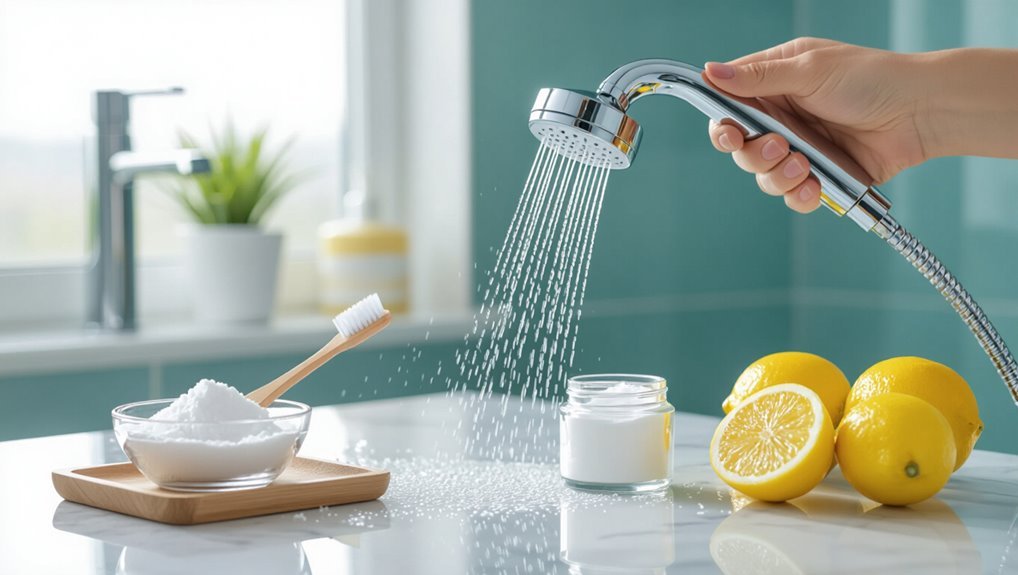
Several direct, fast methods—mechanical scrubbing, baking soda paste, citric acid soak, or commercial descalers—are outlined for quick limescale removal.
Each option is paired with guidance on when it is most appropriate, such as using scrubbing for light deposits, citric acid for moderate buildup, and commercial products for stubborn scale.
The following sections explain application steps, risks, and time required to help select the best alternative.
Direct, fast methods summarized
Apply quick mechanical and chemical options to dislodge limescale from a shower head without vinegar: use a citric-acid cleaner, a commercial descaler, or a baking-soda paste combined with hot water; alternate with brisk brushing using an old toothbrush or a soft brass brush to clear nozzles.
For rapid results, detach the head and soak it in the chosen solution for 15–60 minutes, then flush and scrub until water flows freely.
When to choose each alternative
When speed and convenience matter, choose a citric-acid cleaner or commercial descaler for short, effective treatments; opt for a baking-soda paste and hot water when dealing with light buildup or when a gentler, non-acid option is preferred.
Detach the head for soaking whenever deposits are dense or nozzles remain blocked after surface brushing. Choose needle poking or ultrasonic cleaning for persistent microblockages, polishing for finishes.
Why avoid vinegar and how limescale forms
Many homeowners avoid vinegar because its acidity can damage finishes, rubber seals, and some metal alloys when used repeatedly.
Limescale is a hard, chalky deposit of calcium carbonate left behind by hard water. It adheres to shower heads through repeated mineral precipitation and bonding to microscopic surface irregularities.
Common reasons people avoid vinegar
Several homeowners hesitate to use vinegar on shower heads because its acidic nature can interact with certain metals, finishes, and internal rubber parts, potentially causing discoloration, corrosion, or deterioration over time.
Additional concerns include lingering odors, allergy or sensitivity reactions, and the risk of damaging seals or adhesives.
Preference for gentler or non‑acidic alternatives also drives avoidance.
What limescale is and how it adheres to shower heads
Concerns about vinegar’s acidity lead some to seek alternatives, but understanding what limescale is and how it bonds to shower heads clarifies why removal can be tricky.
Limescale is primarily calcium carbonate deposited from hard water. It adheres through mineral crystallization and microscopic pores, forming stubborn, alkaline films on metal and plastic surfaces.
Mechanical agitation or chelating agents disrupt this bond more effectively than weak acids alone.
Preparation and safety before cleaning
Before beginning, the writer lists the required tools and materials—such as soft brushes, nonabrasive cleaners, and sealable bags—to guarantee an efficient process.
They recommend basic safety precautions and protective gear, including gloves and eye protection, to prevent skin or eye irritation.
A small, inconspicuous spot test on the shower head finish is advised to confirm compatibility before applying any treatment more broadly.
Tools and materials checklist
A concise list of tools and materials helps guarantee the descaling task proceeds efficiently and safely.
The following essentials cover common vinegar-free methods and simple disassembly needs.
- Rubber gloves
- Soft-bristled brush or old toothbrush
- Plastic bag or container for soaking
- Baking soda, citric acid, or commercial descaler
- Microfiber cloth for drying and inspection
Safety precautions and protective gear
With tools and materials assembled, attention turns to safety precautions and protective gear to minimize injury and damage.
The cleaner should wear nitrile gloves, eye protection, and a mask when using powders or sprays.
Guarantee good ventilation and protect nearby surfaces with drop cloths.
Turn off water and check for electrical fixtures.
Keep chemicals labeled and out of children’s reach.
How to test a method on your shower head finish
How can one verify that a chosen cleaning method is safe for the shower head finish?
Test on an inconspicuous area: apply a small amount of solution, wait recommended time, then blot dry.
Inspect for discoloration, dulling, or texture change. If none appear, proceed to clean the entire head.
If damage shows, rinse immediately and select a milder alternative or consult manufacturer guidance.
Method 1 Baking soda and water paste
This method uses a simple paste made from baking soda and a small amount of water, with proportions adjusted until a thick, spreadable consistency is reached.
The paste is applied to the limescale, left to sit for a prescribed dwell time, then scrubbed or worked into stubborn deposits before rinsing.
After thorough rinsing, the fixture is polished with a soft cloth to remove residue and restore shine.
Materials and proportions
For the baking soda and water paste method, gather plain baking soda and cold water in roughly a 3:1 ratio by volume—three parts baking soda to one part water—to form a thick, spreadable paste; adjust slightly if needed so the mixture holds its shape without being dry or runny.
Also prepare a soft brush or old toothbrush, a small bowl for mixing, and disposable gloves to protect skin.
Step-by-step application and dwell time
Begin by applying the thick baking soda paste directly to the shower head, covering all visible mineral deposits and crevices with a generous, even layer.
Use a soft brush or gloved finger to work the paste into nozzle openings without forcing it into internal passageways.
Allow the paste to dwell 15–30 minutes for mild buildup, up to 1 hour for heavier limescale, keeping the area moist.
Rinsing and final polishing
Once the paste has sat the appropriate time, rinse it away thoroughly with warm water while gently scrubbing any remaining spots with a soft brush or an old toothbrush.
Use a steady stream to help flush loosened mineral particles from nozzle openings without forcing water backwards into the fittings.
Dry the face and edges with a microfiber cloth, inspect spray holes, and polish chrome or plastic surfaces for a streak-free finish.
Method 2 Citric acid solution
Citric acid dissolves limescale by chelating calcium deposits, making it effective on mineral buildup without harsh alkalis.
A typical mixture uses one to two tablespoons of powdered citric acid per cup of warm water, applied by soaking the shower head or wiping with a cloth for several minutes before rinsing.
It is safe on most metal and plastic fixtures but should be tested on plated surfaces and avoided on natural stone or untreated grout to prevent damage.
How citric acid works on limescale
One simple, effective way to dissolve limescale is with a citric acid solution, which reacts chemically with the mineral deposits to break them down.
Citric acid chelates calcium and magnesium ions, converting insoluble carbonates into soluble salts and carbon dioxide.
This weak organic acid penetrates porous buildup, loosening scale without harsh oxidation, making subsequent rinsing and mechanical removal easier and safer for fixtures.
Mixing ratios and application steps
Prepare a clear citric acid solution by dissolving 2–3 tablespoons (30–45 g) of powdered citric acid per 500 mL of warm water for light to moderate scale, or 4–5 tablespoons (60–75 g) per 500 mL for heavier deposits; mix until fully dissolved and pour into a container large enough to submerge the shower head or to fill a plastic bag for spot application.
Submerge or secure the bag, soak 30–60 minutes, then scrub nozzle holes with a soft brush and rinse thoroughly.
Suitable surfaces and precautions
Surfaces with durable metal finishes—stainless steel, chrome, and brass—generally tolerate diluted citric acid solutions without damage.
In contrast, porous, decorative, or soft finishes such as unsealed brass patina, antique coatings, painted surfaces, and some plastic trims can discolor or etch.
Always test an inconspicuous area, use low concentrations, limit contact time, rinse thoroughly, and wear gloves and eye protection to prevent corrosion and skin irritation.
Method 3 Lemon juice or fresh lemon
Lemon juice and fresh lemon work best on light to moderate limescale where natural citric acid can break deposits without strong chemicals.
Application typically involves rubbing cut lemon or applying juice to the affected areas and allowing a 10–30 minute dwell time before rinsing or light scrubbing.
Compared with pure citric acid solutions, lemon is gentler and pleasantly scented but less concentrated and may require more effort for heavy buildup.
When lemon is effective
Use lemon juice when limescale deposits are light to moderate and recent, or when the shower head’s finish is solid and uncoated.
Lemon’s mild acidity dissolves fresh mineral build-up without harsh chemicals. It suits routine maintenance, smaller fixtures, and chrome or stainless surfaces.
Avoid lemon on delicate plated, lacquered, or antique finishes where acidity might dull or etch protective coatings.
Application technique and dwell time
Apply fresh lemon juice directly to the limescale, working in small sections and ensuring contact with all affected areas.
Allow juice to sit 10–20 minutes for light buildup; extend to 30–60 minutes for heavier deposits. Reapply if surface dries.
Agitate with a soft brush or cloth after dwell time, then rinse thoroughly.
Repeat treatment once if residue persists.
Pros and cons compared with citric acid
Compared with pure citric acid, fresh lemon juice offers a milder, readily available option that combines acidity with natural oils and fragrance.
However, it generally delivers slower limescale removal, less predictable concentration, and potential staining from pigments or oils.
It is safer on some finishes and pleasant smelling, yet requires longer soak, larger volumes, and may leave residues needing rinsing; effectiveness varies.
Method 4 Cream of tartar paste
A paste made from cream of tartar mixed with a little water can be spread over nozzles and left to sit to break down mineral deposits.
The abrasive-but-mild formula suits spot treatment on brass or chrome finishes but may be less effective on heavy, baked-on limescale.
Care should be taken to rinse thoroughly and avoid prolonged contact on delicate plated surfaces.
Making and applying the paste
When combined into a thick paste, cream of tartar and a small amount of water create an abrasive, mildly acidic mixture effective at dissolving limescale.
The user should measure roughly two tablespoons of cream of tartar and add water a few drops at a time until the desired consistency is reached.
Apply with a soft cloth or old toothbrush, cover treated areas, let sit 15–30 minutes, then scrub and rinse thoroughly.
Best uses and limitations
After rinsing away the paste, cream of tartar performs best on moderate, surface-level limescale and on chrome, stainless steel, and ceramic finishes where light abrasion is safe.
It is not suited for delicate plated surfaces, soft plastics, or heavily mineralized buildup. Multiple applications may be needed; test an inconspicuous spot first.
Rinse thoroughly and avoid prolonged scrubbing to prevent finish dulling.
Method 5 Commercial descalers (acid-based, non-vinegar)
Commercial descalers typically contain acids such as sulfamic, citric (concentrated formulations), or phosphoric, each marketed in liquid, gel, or tablet forms.
Selection should match the shower finish—mild acids for chrome and brass with manufacturer approval, and non‑acidic or low‑strength options for plastic—to avoid corrosion or discoloration.
Users should follow label instructions for application time, wear protective gear, rinse thoroughly, and neutralize residues with a baking soda solution or fresh water as recommended.
Types of commercial descalers and active ingredients
Explore a range of non-vinegar descalers formulated to dissolve limescale quickly and safely. Commercial options use acids (citric, lactic, sulfamic), chelating agents, or mild surfactants. Labels indicate concentration and safety precautions. Choose based on material compatibility and ventilation needs; follow instructions and PPE guidance to avoid damage or irritation.
| Type | Typical Active Ingredient |
|---|---|
| Acid-based | Sulfamic acid |
| Food-grade | Citric acid |
| Organic acid | Lactic acid |
| Chelator | EDTA |
| Surfactant blend | Nonionic agents |
How to choose a product for chrome, brass, plastic finishes
Select a descaler by matching its active ingredient and pH to the fixture material and manufacturer recommendations: sulfamic and citric acids are effective on chrome and brass at controlled concentrations, while stronger acids or high acidity formulations can etch plated surfaces and discolor some brass alloys.
Plastic components generally tolerate milder organic acids (citric, lactic) or chelators like EDTA but may soften or craze if solvents or high surfactant levels are present.
Choose labeled materials compatibility, low‑acid options for plated finishes, and test inconspicuously before full use.
Safe application and neutralization steps
After choosing a descaler based on active ingredient and material compatibility, attention turns to correct application and neutralization to prevent damage and guarantee safety.
Apply product per label: dilute if required, avoid prolonged contact, and keep ventilation. Rinse thoroughly after recommended dwell time.
Neutralize residues with a mild alkaline solution if instructed. Dispose of waste per local regulations and store chemicals securely.
Method 6 Using a toothbrush and mechanical agitation
Method 6 outlines mechanical removal of limescale using brushes and hand tools suited for non-chemical cleaning.
It covers selecting stiff nylon toothbrushes, brass or plastic picks, and small scrub brushes, plus how to disassemble most shower heads to access internal parts.
The section concludes with clear steps for reassembling the fixture and testing for leaks.
Best brushes and tools for no-chemical removal
Mechanical agitation with simple tools can remove most limescale from a shower head when chemicals are undesirable or unavailable.
Recommended tools focus on abrasion, reach, and protection:
- Soft-bristle toothbrush for nozzle surfaces
- Nylon scrub pad for gentle abrasion
- Small wire brush for stubborn deposits
- Plastic dental pick for crevices
- Microfiber cloth for final wipe and polishing
How to disassemble a shower head for thorough cleaning
Once surface deposits have been loosened with brushes and picks, removing the shower head from its arm allows full access to internal passageways and the faceplate for more thorough cleaning.
Using an adjustable wrench with a cloth protects finishes; note thread direction.
Separate the faceplate, O-rings, and filters.
Inspect for mineral buildup, soak removable parts in descaling solution alternatives, and scrape residues with a toothbrush.
Reassembly and testing for leaks
Reassemble the shower head by replacing filters, O-rings, and the faceplate in their original order, ensuring each component seats flush and threads align without cross-threading.
Tighten hand-tight, then snug slightly with a wrench using a cloth to protect finishes.
Run water, inspect joints and spray pattern for drips or irregular flow.
If leaks appear, retighten or reseat seals, then retest.
Method 7 Dishwasher tablet soak
Dishwasher tablets contain alkaline cleaners and enzymes that help break down mineral deposits, making them effective against limescale.
The method typically involves dissolving a tablet in warm water, soaking the removed shower head for a short period, then brushing and rinsing to remove loosened residue.
Users should check manufacturer guidance and test on non-coated or softer materials first, since strong detergents can damage finishes or seals.
Why dishwasher tablets work
Harnessing a tablet’s blend of alkaline builders, enzymes, and mild acids breaks down mineral deposits and organic grime, making it effective against limescale on shower heads. Surfactants lift loosened residues, while chelating agents bind calcium and magnesium for easier removal. Effervescence aids penetration into jets and crevices. Rinseable residues leave surfaces cleaner and less prone to rapid re‑scaling.
Step-by-step soaking and scrubbing process
With an understanding of why dishwasher tablets remove scale, the practical soaking-and-scrubbing routine follows a clear sequence: prepare the tablet solution, submerge the shower head or its removable parts, allow sufficient soak time for the tablet’s agents to act, then mechanically agitate deposits with a brush before rinsing and inspecting jets.
After soaking, scrub nozzles, flush thoroughly, reassemble, and test spray patterns.
Risks and material compatibility
Consider potential risks before using a dishwasher tablet soak: the alkaline and bleaching agents can damage soft metals, plated finishes, rubber seals, and electronic components if exposure is prolonged or concentrated.
Test on an inconspicuous area, dilute tablet residue thoroughly, limit soaking time, and avoid contact with plastic flow restrictors or LED components.
Rinse and inspect seals; replace compromised parts.
Comparing effectiveness, cost, and safety of each alternative
A concise comparison summarizes results, required time, estimated cost, and surface safety for each descaling option in a quick table.
Recommendations follow for typical situations — strong acid or mechanical methods for heavy hard-water buildup, and gentler vinegar or tablet soaks for delicate finishes.
This allows readers to match effectiveness and expense to their shower head material and severity of limescale.
Quick comparison table of results, time, cost, and surface safety
The table below summarizes common limescale-removal methods by their effectiveness, required time, estimated cost, and surface safety, allowing quick comparison of trade-offs for different shower-head materials and levels of buildup. A concise comparison follows, highlighting practical trade-offs without recommending specific choices.
| Method | Effectiveness | Safety |
|---|---|---|
| Citric acid | High | Moderate |
| Baking soda paste | Medium | High |
| Commercial descaler | High | Variable |
Recommended choices for common scenarios (hard water, delicate finishes)
When dealing with hard water, delicate finishes, or a combination of both, recommended choices balance scale-removal power against finish safety and cost:
Citric acid solutions and commercial descalers offer the strongest limescale dissolution for heavy buildup but vary in finish compatibility and price, while baking-soda-based pastes and gentle vinegar-soaked methods trade some effectiveness for lower risk to chrome, brushed, and plated surfaces and generally lower cost.
Citric acid: high effectiveness, moderate cost, test on finishes.
Commercial descalers: very effective, higher cost, follow label.
Baking soda paste: mild, cheap, safe.
Gentle vinegar soak: moderate, low cost, use cautiously on sensitive coatings.
Preventing future limescale buildup
Preventing limescale buildup focuses on regular care, hardware changes, and small daily habits.
Recommended steps include simple weekly or monthly cleaning routines, installing water-softening systems or inline filters, and adopting minor behavioral changes like wiping the shower head after use or reducing hot-water use.
Combined, these measures can greatly slow future deposits and extend the lifespan of the fixture.
Weekly and monthly maintenance routines
Routine care keeps limescale from gaining a foothold on a shower head: simple weekly rinses and a monthly soak or descaling treatment interrupt mineral buildup before it hardens.
- Rinse spray nozzles weekly and wipe dry.
- Clear aerator screens gently.
- Run hot water briefly weekly to loosen deposits.
- Monthly soak in citric acid or commercial descaler.
- Inspect for uneven spray and repeat treatment as needed.
Installing water-softening options and filters
Install water-softening solutions and point-of-use filters to reduce the mineral load that causes limescale, cutting maintenance needs and extending fixture life.
Whole-house softeners remove calcium and magnesium via ion exchange; salt-free conditioners alter mineral crystallization.
Inline shower filters trap sediments and chlorine, improving water quality.
Select system capacity, flow rate and certification for designated use, and schedule cartridge or resin replacement per manufacturer guidance.
Small behavioral changes to reduce buildup
Adopt simple daily habits to keep limescale from accumulating on a shower head: wipe down surfaces with a squeegee or microfiber cloth after use, run a brief hot-water flush weekly to dislodge early deposits, and open aerators or spray holes periodically to check for blockage.
Encourage shorter showers, avoid leaving hard-water tools wet, and schedule monthly inspections to catch mineral buildup before it hardens.
Troubleshooting stubborn or recurring limescale
If limescale returns quickly or heavy deposits persist after a first treatment, repeating the process or combining chemical and mechanical methods is reasonable.
Persistent buildup, cracked nozzles, or permanently blocked outlets may indicate irreversible damage and the need to replace the shower head.
For extensive scaling or delicate fixtures, professional descaling services offer stronger treatments and warranty-safe solutions.
When to repeat treatment or combine methods
When initial descaling yields only partial results or limescale returns within weeks, repeating treatment or combining mechanical and chemical methods becomes necessary; persistent deposits often indicate thicker buildup, mineral-rich water, or an underlying flow issue that a single brief soak cannot resolve.
Repeat cycles (soak, brush, rinse) every few days, escalate to stronger non-acid descalers, and add regular maintenance rinses to prevent recurrence.
Signs of irreversible damage and when to replace the shower head
Persistent or recurring limescale can eventually cause damage beyond what cleaning can fix; identifying irreversible problems helps decide whether repair attempts are worthwhile or replacement is necessary.
Signs include pitted or corroded metal, permanently clogged nozzles after thorough mechanical cleaning, cracked or warped plastics, reduced water pressure localized to the head, and visible mineral deposits embedded in finishes.
If present, replace the unit.
Professional descaling options
Consider professional descaling services for shower heads that resist DIY methods or for recurring limescale that signals a broader plumbing issue.
Technicians use commercial descalers, mechanical cleaning tools, ultrasonic baths, or chemical neutralization tailored to fixture materials. They can inspect pipes, recommend water-softening solutions, and provide warranties.
Obtain quotes, verify certifications, and ask about environmental and surface-safe options before scheduling service.
Final inspection and maintenance checklist after cleaning
Run a thorough final inspection to confirm all limescale has been removed and the shower head functions correctly.
After reassembly and testing, follow this concise maintenance checklist to preserve performance and prevent recurrence:
- Check spray pattern and water pressure for blockages.
- Inspect seals and connections for leaks.
- Wipe surfaces dry to inhibit mineral buildup.
- Schedule gentle descaling every 3–6 months.
- Record cleaning date for reference.
Conclusion
To summarize, the guide empowers readers with seven vinegar-free limescale remedies—from baking soda paste to citric acid—emphasizing safety and prevention. Importantly, about 85% of U.S. households experience hard water, making these tips widely relevant. By following preparation, step-by-step methods, and post-cleaning checks, users can restore shower heads and reduce recurrence. Consistent maintenance and informed product choice guarantee long-term performance, saving time and avoiding corrosive or ineffective solutions.