
How to Read a Cubic Foot Water Meter: Step-by-Step Guide for Accurate Usage
To accurately read a cubic foot water meter, follow these steps: Look at the odometer-style register, noting the black-and-white numbered wheels from left to right, and observe the sweep hand for fractional readings. Record the meter’s serial number, date, time, and any visible damage. To calculate water usage, subtract earlier readings from later ones, compute averages, and conduct static tests for leaks. Take photos for your records and contact the utility if you notice any discrepancies. Further troubleshooting steps are provided below.
What a Cubic Foot Water Meter Is and Why Accurate Reading Matters
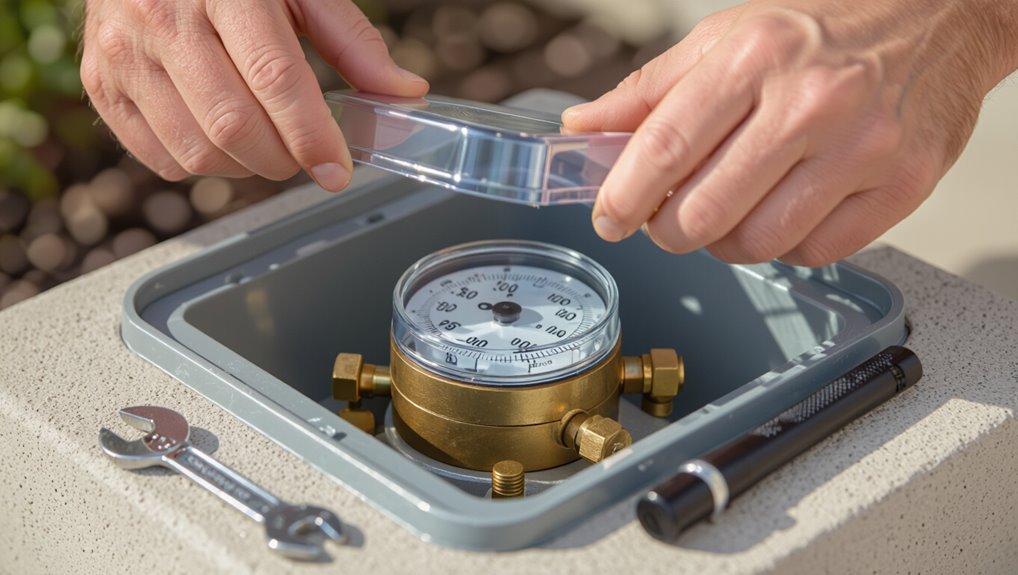
A cubic foot water meter measures the volume of water passing through a supply line in cubic feet and is commonly used by utilities for residential and commercial billing.
Consumption recorded by the meter is converted into billing units and multiplied by the utility’s rate structure to determine charges.
Inaccurate readings can lead to overbilling or underbilling, disputed accounts, and financial or operational impacts for both homeowners and businesses.
Definition and common uses of cubic foot water meters
Cubic foot water meters measure the volume of water passing through a pipe in units of cubic feet, providing a standard method for quantifying household, commercial, and industrial consumption.
These meters are used for metering potable supply, irrigation, and process water.
Proper installation, routine inspection, and knowing how to read a cubic foot water meter guarantee reliable data for conservation, maintenance, and operational planning.
How consumption is measured and billed
Meters record the volume of water that passes through the service line in cubic feet, which utilities convert into billing units and charges.
Readings are compared to previous readings to determine usage over the billing period. Utilities apply rates, fixed fees, tiers, or seasonal adjustments to that usage.
Accurate meter readings guarantee billed consumption matches actual flow, enabling predictable billing and resource tracking.
Consequences of incorrect readings for homeowners and businesses
Incorrect readings can cause significant financial, operational, and legal consequences for both homeowners and businesses. Overstated usage leads to inflated bills and budget strain; understated readings risk unpaid liabilities, disputes, and fines.
Operational impacts include inaccurate conservation efforts, faulty leak detection, and disrupted billing cycles. Regulatory noncompliance or contractual breaches may result from persistent errors, harming reputation and triggering corrective costs.
Identifying Your Meter Type and Components
Readers should first determine which type of cubic-foot meter they have—manual dial, digital, or remote—so they know what display to expect.
They should then identify key components such as the register, dials or odometer, sweep hand, serial number, and nearby shutoff valve.
Finally, they should locate the meter (indoors or in a pit) and guarantee safe, unobstructed access before attempting any reading.
Common meter types that display cubic feet (manual dial, digital, remote)
A household water meter can take several forms—manual dial, digital face, or a remote-reading unit—each displaying usage in cubic feet but showing that information differently.
Manual dials use rotating hands and numbered wheels; digital meters present numeric readouts, sometimes with decimal precision.
Remote units transmit readings via radio or network to a utility. Selection depends on accuracy, access, and billing systems.
Key meter parts: register, dials/odometer, sweep hand, serial number, shutoff
Having noted the common meter types, attention turns to the specific parts that convey readings and control flow.
The register shows total cubic feet; dials or odometer provide incremental digits; a sweep hand indicates fractions between whole units; the serial number identifies the device for records; an inline shutoff valve allows flow isolation.
Each component aids accurate reading and maintenance.
How to find the meter location and access it safely
Several common locations house a water meter: the basement near the main water line, an exterior wall or crawlspace, or a covered pit at the property line.
Locate the lid or access panel, clear debris, and use a screwdriver or wrench as needed.
Verify meter type visually, note orientation, and confirm proper lighting.
Wear gloves and avoid stepping on covers.
Quick Visual Guide to Reading a Cubic Foot Water Meter
The section presents a compact visual walkthrough for reading a cubic foot water meter, beginning with the odometer-style register and showing how to read each digit in sequence.
It then explains the meanings of the dial faces and the sweep hand for finer measurements.
Finally, it covers how to interpret digital displays and unit indicators to confirm total usage.
Reading the odometer-style register step by step
Begin at the meter face and focus on the odometer-style register: the black-and-white numbered wheels read left-to-right and show whole cubic feet, while the red dial or small red hand indicates fractions; record only the numbers on the black wheels for an initial reading, then note the red indicator if a more precise fraction is needed.
Read and write digits in order, ignoring nonnumeric markers.
Interpreting dial faces and the sweep hand
A quick visual scan of a cubic-foot water meter focuses on the dial faces and the sweep hand to determine flow and fractional usage at a glance.
The dial faces show tenths, hundredths and smaller increments; numerals indicate cumulative volume.
The sweep hand rotates rapidly for low flows, signaling small fractions of a cubic foot and confirming movement or leaks when steady motion appears despite no known usage.
How to read digital displays and unit indicators
When equipped with a digital display, a cubic-foot water meter presents totalized volume and subunit readings in clear numeric fields and often labels the units (cubic feet, tenths, gallons) beside each figure.
Users should first note the primary numeric readout for cumulative usage, then check smaller or color-coded digits for fractional values and any unit indicators to guarantee correct interpretation.
Verify units, decimal placement, and mode icons.
Step-by-Step Instruction: Recording an Accurate Meter Reading
Before approaching the meter, the reader should gather a notepad, pen or camera, and observe basic safety such as clearing the area and avoiding wet connections.
First, record the whole cubic-foot digits, then note any fractional dials or decimal tenths/hundredths to capture the exact reading.
Finally, log the date, time, and meter serial number and convert the recorded value into billing units if the utility uses different units.
Preparation: what tools and safety steps to take
Several basic tools and simple safety steps are necessary to confirm an accurate and safe meter reading: a flashlight for dark meter boxes, a cloth or brush to clear debris, a pen and paper or smartphone for recording numbers, and work gloves to protect hands from sharp edges or contaminants.
Inspect the area for hazards, verify stable footing, avoid touching exposed wiring, and wash hands after handling the meter.
Step 1 Read and record the whole cubic feet digits
Locate the meter face and focus on the black or white dials and the row of large, non‑decimal digits—these show whole cubic feet.
Read left to right, noting each whole-digit value. Record the sequence exactly as displayed, ignoring any colored or small decimal wheels.
Write the number, date, and time. Double-check for smudges or obstructions before finalizing the entry.
Step 2 Interpret fractional digits (tenths, hundredths) if present
After recording the whole cubic feet digits, attention turns to the smaller dials or colored wheels that indicate fractional readings.
The reader notes tenths and hundredths by observing needle positions or colored numbers, reading clockwise values and estimating between marks when needles fall between graduations.
Record fractions as decimals (e.g., .3, .07) and append them to the whole cubic feet total for an accurate measurement.
Step 3 Note date/time and meter serial number
Record the exact date and time of the reading and copy the meter serial number to guarantee the entry can be verified and matched to the correct account.
Include time zone if relevant. Note AM/PM or use 24-hour format.
Record serial number exactly as stamped, including letters and dashes.
Store this information with the reading for auditability and future comparisons.
Step 4 Convert reading into billing units if needed
With the date, time, and serial number documented, the next task is converting the raw meter readout into the billing units used by the utility.
Determine whether the meter displays cubic feet, gallons, or cubic meters.
Apply any multipliers printed on the dial or face (for example, x100 or x0.1).
Record the converted value in the same units the bill uses for direct comparison.
Converting Meter Readings and Calculating Usage
The section explains how to turn successive meter readings into daily, weekly, and monthly usage figures by subtracting and dividing over the appropriate time interval.
It also covers common unit conversions, such as cubic feet to gallons, and how to convert between metric and imperial units.
Finally, it outlines a simple method for estimating cost using local rate structures and tiered pricing.
How to calculate daily, weekly, and monthly water usage from readings
To determine daily, weekly, or monthly water use, compare two meter readings taken at the start and end of the period and subtract the earlier reading from the later one; the difference equals volume used.
Divide that volume by the number of days for average daily use, multiply daily average by seven for weekly estimate, or sum daily readings across the month for total monthly consumption.
Converting cubic feet to gallons and other units
Many water meters register volume in cubic feet, so converting those readings into gallons—or liters and cubic meters when needed—lets users understand consumption in familiar units. Multiply cubic feet by 7.4805 for gallons, 28.3168 for liters, 0.0283168 for cubic meters. Use the table below for quick reference.
| Unit | Factor | Example |
|---|---|---|
| Gallons | 7.4805 | 10 cf → 74.805 gal |
| Liters | 28.3168 | 10 cf → 283.168 L |
Estimating cost based on local rate structures
Converting volume readings into familiar units enables straightforward cost estimates once local rate structures are known.
The reader converts measured cubic feet to billing units, applies tiered or flat rates, adds fixed service charges, and includes taxes or surcharges.
For seasonal or tiered billing, calculate each tier separately.
Round to cents, compare against previous bills to verify accuracy and detect anomalies.
Verifying Accuracy and Troubleshooting Discrepancies
To verify a meter’s accuracy, readers are shown how to run a static leak test and a simple flow test using known fixtures and the meter’s low-flow indicator.
The text outlines common signs of a faulty meter—such as unexplained high readings, a stuck dial, or a spinning register with all water off—and when to notify the utility.
It also recommends recording and comparing consecutive readings to spot sudden spikes that indicate leaks or measurement errors.
How to check for leaks using the meter (static test and flow test)
A simple static test and a dynamic flow test together reveal whether a household water system is leaking or if the meter reading is in error. The static test checks for flow when all fixtures are off, while the flow test measures low-rate and running-use flow to identify hidden or intermittent leaks.
For static: record meter, stop all water, recheck after 30–60 minutes.
For flow: note low-flow dial movement and compare against expected appliance or fixture rates.
Common signs of faulty meters and when to call the utility
Recognize unusual meter behavior—such as steady dial movement with all water off, erratic leaps in readings, or sudden unexplained jumps in consumption—as potential signs of a faulty meter rather than household leaks.
Additional indicators include frozen or stuck registers, physical damage, moisture inside the case, or inconsistent responses to known flows.
If suspected, contact the utility for inspection, testing, and possible replacement.
Recording and comparing consecutive readings to identify spikes
Begin by recording the meter reading at a consistent time each day or week and logging the numbers digitally or on paper for easy comparison.
Compare consecutive readings to calculate usage rates, flagging sudden increases.
Verify suspected spikes by rechecking the meter, inspecting fixtures for leaks, and reviewing household activity.
If unexplained spikes persist, contact the utility for further testing or meter replacement.
Preventing Reading Errors and Common Mistakes
Readers often misread rotating dials, ignore overflow digits on digital displays, or mix up units, leading to billing discrepancies.
Clear procedures—consistent reading position, timestamped photos, and use of a simple checklist—help produce repeatable, auditable measurements.
Suspected billing errors should be documented with the meter ID, prior readings, and supporting photos, then reported to the utility with a concise summary of findings.
Typical user mistakes when reading dials and digital meters
Misreading a water meter often stems from assuming all dials and displays work the same way; users commonly misinterpret dial direction, ignore small sweep hands, or mistake test/auxiliary readouts for the main register.
Additional typical errors include reading mirrored or reverse-numbered faces, overlooking zeroing or rollover positions, confusing units (gallons versus cubic feet), and relying on intermittent or low-contrast digital screens.
Tips to ensure consistent, auditable readings
Several simple practices considerably reduce errors and create an auditable trail when taking water meter readings.
Consistent technique, clear timestamps, and verification steps support reliable records.
- Record date, time, and reader initials
- Photograph the meter and surrounding reference
- Use the same read order each time
- Double-check suspicious or borderline digits
- Log anomalous conditions (leaks, obscured dials)
How to document and report suspected billing errors
Document suspected billing errors promptly and systematically to protect consumers and streamline resolution.
An observer should record date, time, meter serial number, reading, photo evidence, and comparison to historical usage.
Notify the utility via documented channels, retain copies of correspondence, and request confirmation and investigation timelines.
If unresolved, escalate to regulatory authorities with collected evidence and a clear chronology to support dispute resolution.
Using Technology and Records to Track Consumption
Many households pair mobile apps and time-stamped photos with manual readings to create a reliable log of water use.
Smart meters and remote reading options can automate data collection and alert users to sudden changes.
A simple spreadsheet charting monthly readings makes trends and anomalies easy to spot.
Mobile apps and photos for logging meter readings
Leverage smartphone tools to simplify regular meter logging: dedicated apps and timestamped photos create a clear, verifiable record of readings that supports tracking usage, spotting leaks, and sharing data with utilities.
Users should choose apps that allow manual entry, photo attachment, and exportable logs. Consistent filenames, geotags, and backup to cloud storage guarantee organized, retrievable records for comparison and billing disputes.
Smart meter features and remote reading options
Smart meters provide automatic, frequent readings and two-way communication between a property and the utility, enabling near real-time monitoring, remote billing, and automated outage and leak alerts.
They often include encrypted wireless transmission, configurable reporting intervals, and integration with utility dashboards.
Remote disconnects, firmware updates, and diagnostic data help utilities manage supply and detect anomalies while preserving meter reading accuracy and reducing manual visits.
Creating a simple spreadsheet to monitor trends
Following the overview of remote reading capabilities, a basic spreadsheet offers a low-cost way to collect, visualize, and analyze usage data received from a smart meter or manual reads.
It records readings, calculates consumption, and highlights trends for conservation decisions.
- Date and meter reading
- Consumption (difference)
- Daily/weekly average
- Graph of usage
- Notes on anomalies
When to Contact Your Water Utility and What to Expect
When unusual readings, visible damage, persistent leaks, or suspected meter failure occur, the customer should notify the water utility so a technician can inspect the installation or replace the meter.
When disputing a bill, the customer should provide recent meter readings, photographs, billing history, and any log of indoor usage or repairs to support the claim.
The utility’s reply often includes an initial review, a scheduled on-site inspection within a stated response window, and outcomes ranging from billing adjustment to meter repair or replacement.
Situations that require utility inspection or meter replacement
Several clear signs indicate that a utility inspection or meter replacement is needed: unexplained spikes or drops in usage, visible damage to the meter or box, persistent reading errors, or suspected tampering.
Additional triggers include continuous leaks with normal readings, meter age exceeding expected lifespan, inconsistent flow versus appliance use, or audible mechanical noise.
The utility will inspect, test, and replace defective meters per policy.
Information and evidence to provide when disputing a bill
If a customer believes a water bill is incorrect, they should gather concise, relevant documentation before contacting the utility.
Provide recent meter readings, photographs of the meter face and unit number, billing history, noted usage anomalies, and any repair or plumbing invoices.
Include contact information and account number.
Present timelines and correlate readings with household occupancy or known leaks to support the dispute.
Typical utility response times and possible outcomes
Utilities typically acknowledge billing disputes within a few business days and provide an initial timeline for investigation.
However, full resolution can take from a week to several billing cycles depending on issue complexity.
Customers may receive meter tests, adjusted bills, payment plans, or denied claims.
If unresolved, escalations include supervisor review, formal appeals, or independent testing.
Documentation and follow-up improve outcomes.
Safety, Maintenance, and Legal Considerations
Before attempting to read or service a meter, one should follow basic safety measures for outdoor pits and basement access, including proper lighting, protective gloves, and caution around valves and wiring.
Routine maintenance—such as clearing debris, checking for leaks, and ensuring lids or boxes close properly—helps prevent damage and is typically the homeowner’s responsibility unless otherwise specified by the utility.
Understanding legal rights and responsibilities about meter access, tampering, and billing disputes clarifies who may enter the property, who must perform repairs, and how to contest charges.
Safe practices when accessing outdoor or basement meters
Many homeowners and maintenance workers encounter outdoor or basement water meters during routine checks, and approaching them requires attention to safety, property boundaries, and local regulations.
Individuals should wear gloves, sturdy footwear, and eye protection; use a flashlight for low light; avoid confined-space entry alone; respect utility markers and locked covers; notify the utility before intrusive actions; and secure the area to prevent slips, trips, or contamination.
Routine maintenance tasks and who is responsible
Assigning routine maintenance of water meters involves clear delineation between homeowner responsibilities, utility company duties, and licensed contractors, with each party bound by safety and legal standards.
Homeowners handle visual inspections, frost protection, and reporting leaks.
Utilities perform calibrated testing, replacements, and metadata management.
Licensed contractors undertake complex repairs, backflow device service, and work requiring permits, ensuring compliance and documented completion.
Legal rights and responsibilities regarding meter access and billing
Any property owner, tenant, or utility must understand the legal framework that governs meter access and billing, because it defines who may enter premises, under what conditions meters can be tested or sealed, and how disputes over consumption or charges are resolved.
Laws specify notice, consent, warrant requirements, and utility obligations for accurate billing, meter records, and appeal procedures; noncompliance can prompt remedies, penalties, or adjusted charges.
Conclusion
Clear, concise readings are the compass guiding households through the unseen currents of water use; by learning meter parts, following step-by-step checks, and noting numbers faithfully, users gain control and avoid surprises. Vigilance against common mistakes—paralleling a ship’s lookout—keeps consumption honest, while digital tools and timely utility contact act as lifelines. With routine maintenance and record-keeping, accurate cubic-foot readings become simple, reliable stewardship of a shared resource.
