How to Identify NIBCO PEX: 7 Simple Ways to Tell If Your Pipes Are NIBCO PEX
To identify NIBCO PEX pipes, look for printed markings that indicate the brand, PEX type, size, and pressure ratings. Additionally, check for color coding (red, blue, gray, or white) and molded NIBCO logos on fittings. Ensure that the measured outside diameter and wall thickness align with NIBCO specifications. Inspect crimp rings, clamps, and part numbers for manufacturer marks. Using a flashlight and calipers can help document any faded markings. If you still have questions, further steps are available for verification, repair options, and warranty considerations.
What NIBCO PEX Is and Why Identification Matters
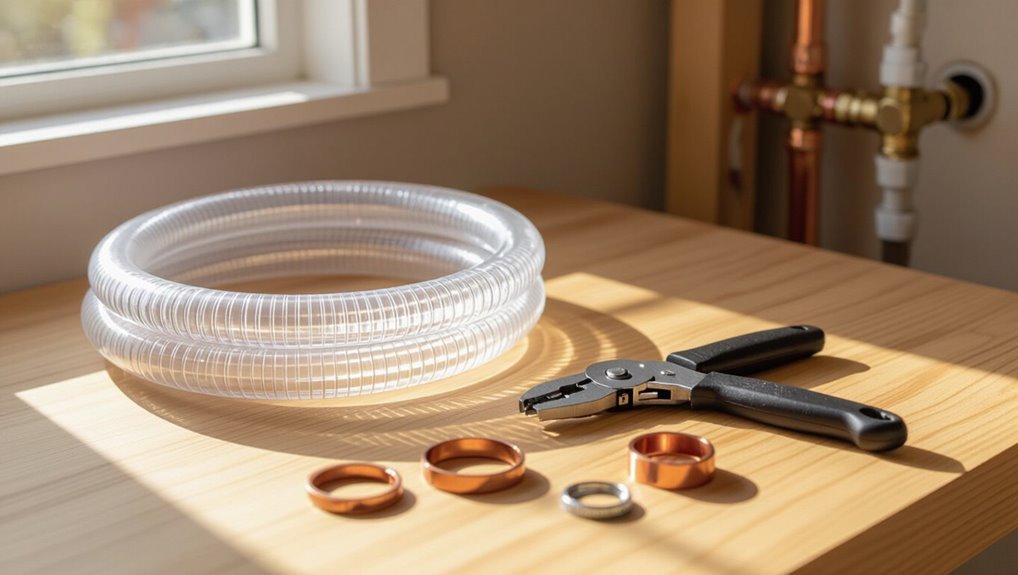
NIBCO is a long-established plumbing manufacturer that produces cross-linked polyethylene (PEX) tubing for both residential and commercial applications such as potable water distribution, radiant heating, and chilled-water systems.
Recognizing NIBCO PEX by markings, color, or fittings helps guarantee correct installation practices and compatibility with system components. Proper identification also affects safety, warranty coverage, and regulatory compliance, making accurate brand recognition important for contractors and inspectors.
Overview of NIBCO as a Manufacturer
A long-established manufacturer of valves, fittings, and piping systems, NIBCO produces cross-linked polyethylene (PEX) tubing used in residential and commercial plumbing and radiant-heating applications.
The company emphasizes quality control, material standards, and traceability.
Customers and installers seeking how to identify NIBCO PEX benefit from NIBCO’s consistent markings, product documentation, and authorized distribution, aiding verification and warranty support.
Common uses of NIBCO PEX in residential and commercial plumbing
Following the overview of the company’s manufacturing and marking practices, identification of NIBCO PEX becomes important when considering where and how the tubing is used.
NIBCO PEX commonly serves potable water distribution, radiant floor heating, snow melt systems, and hydronic heating in residential and commercial settings.
It also appears in plumbing branches, manifold systems, and retrofit projects due to flexibility and corrosion resistance.
Safety, warranty, and compliance reasons to identify brand
Because plumbing materials directly affect system performance and liability, correctly identifying the brand of PEX tubing is essential for safety, warranty validity, and regulatory compliance.
Accurate identification guarantees compatible fittings, prevents premature failures, and supports proper installation practices. It preserves warranty claims, aids code inspections, and documents materials for insurance.
Misidentification can void warranties, create safety hazards, and lead to costly repairs or noncompliance penalties.
Quick Visual Checklist to Identify NIBCO PEX
A concise visual checklist helps confirm whether a PEX line is NIBCO by focusing on a few key identifiers.
Observers should note common color schemes, examine wall markings and imprint styles for NIBCO branding or codes, and inspect connector and fitting features that match the manufacturer’s designs.
Together these cues allow quick, reliable field identification.
Common color schemes used by NIBCO
When identifying NIBCO PEX by sight, color bands and jacket hues provide the quickest clues; red typically denotes hot water, blue cold water, and white or gray indicates general-purpose or potable lines.
Additional colors include orange for radiant or special applications and black for UV-resistant or insulation-covered runs.
Color coding aids rapid system mapping but should be confirmed against job documentation and local codes.
Typical wall markings and imprint styles
Beyond color cues, printed markings along the tube provide definitive identification.
NIBCO PEX typically features repetitive imprints including brand name, PEX type (e.g., PEX-B), size, manufacturing date code, pressure/temperature ratings, and applicable standards (ASTM/CSA).
Markings are evenly spaced, legible, and often in contrasting ink.
Absence or inconsistent printing suggests non-NIBCO or aftermarket product.
Connector and fitting characteristics unique to NIBCO
Connectors and fittings offer clear visual cues for distinguishing genuine NIBCO PEX from generic alternatives.
NIBCO fittings often carry stamped logos, part numbers, and consistent brass finish. Crimp and press rings match NIBCO dimensions and tolerances; O-ring grooves and barb profiles are uniform.
Plastic inserts, clip colors, and packaging labels further confirm authenticity when compared side-by-side with known NIBCO examples.
Seven Practical Methods to Confirm NIBCO PEX
Several reliable approaches exist to verify whether PEX tubing is manufactured by NIBCO; these methods combine visual identification, markings, documentation, and simple tests to provide confirmation.
Inspect manufacturer stamps and color codes, compare wall thickness and dimensions, check part numbers against NIBCO catalogs, examine fittings for brand logos, review purchase invoices or packaging, use a magnet to rule out metal reinforcement, and consult NIBCO customer support for serial verification.
##
The discussion now shifts to observable markings and hardware that help confirm a pipe’s origin.
Key visual and dimensional cues include:
- pipe imprints and stamped text
- branded fittings or part numbers
- color, finish, and measured OD/ID
- fastening rings, clamps, or expansion-style fittings
These cues together narrow identification to NIBCO’s specifications and components.
1 Read the Pipe Imprint and Stamping
Legible markings on NIBCO PEX pipe provide the quickest, most reliable identification method.
Inspect the sidewall for stamped information: material designation (PEX), size, SDR or CTS rating, manufacturing date code, temperature/pressure ratings, and ASTM or NSF standards.
NIBCO pipes typically include clear alphanumeric imprints along their length; consistent, evenly spaced stamps indicate factory marking rather than aftermarket labels.
2 Look for NIBCO Logos or Part Numbers on Fittings
Check fittings for molded NIBCO logos, part numbers, or trademark symbols, since these cast or stamped identifiers are quick confirmation of brand compatibility.
Inspect brass, poly, and plastic fittings at joints and manifolds. Note embossing styles and numeric codes; cross-reference visible part numbers with NIBCO catalogs or online resources.
Missing or ambiguous markings warrant further verification or supplier inquiry.
3 Inspect Color Coding and Material Finish
Several visible cues help distinguish NIBCO PEX from other brands: color-coded tubing (commonly red for hot, blue for cold, and white or natural for potable/neutral) and consistent material finishes on fittings and pipe surfaces.
Inspect uniform color saturation, smooth extrusion lines, and matching finish between crimp rings and fittings. Inconsistent hues, rough textures, or mismatched metals suggest non-NIBCO components.
4 Measure Pipe Dimensions and Compare to NIBCO Specs
Measure the pipe’s outside diameter, wall thickness, and fitting dimensions with calipers or a micrometer to confirm conformity to NIBCO’s published specifications.
Record measurements and compare to NIBCO nominal sizes, SDR values, and tolerance ranges.
Note any deviation beyond published tolerances.
Photodocument measured points and markings to support identification and cross-reference against official NIBCO technical data sheets for validation.
5 Identify Crimp Rings, Clamps, or Expansion Features Specific to NIBCO Systems
When inspecting NIBCO PEX installations, attention should be paid to the specific crimp rings, clamp types, and expansion fittings used, as these components often carry manufacturer markings, unique profiles, or dimensional features that distinguish NIBCO systems from generic assemblies.
Inspect for NIBCO-stamped stainless steel rings, proprietary multi-layer clamp profiles, and expansion tool marks matching NIBCO expansion fittings; note consistent material finish and factory tolerances.
6 Check Installation Documentation or Packaging
After examining rings, clamps, and expansion fittings for NIBCO identifiers, the inspector should review any available installation documentation or packaging for definitive confirmation.
Manuals, job tickets, boxes, and labels often list brand, model, manufacturing codes, and UPCs.
Cross-check these details against visible pipe markings and installation dates to corroborate origin.
Retain copies for records and future reference.
7 Contact NIBCO with Photos or Part Numbers for Verification
Contact NIBCO with clear photos of markings, fittings, and any packaging, or provide part and lot numbers to obtain authoritative verification.
NIBCO customer service reviews images and identifiers to confirm manufacturer, material, and production details.
Include installation context, measurements, and where purchased for faster response.
Expect confirmation, guidance on compatibility, or instructions for further inspection or returns based on their assessment.
How to Compare Identified Features Against Other PEX Brands
Begin by lining up the identified NIBCO PEX features—markings, fittings, wall thickness, and color coding—against the same attributes on competitor brands to see where they match or diverge.
Note unique stamp formats, trademarked logos, and extrusion patterns.
Compare fitting styles (crimp vs. press), measured wall dimensions, and color hues.
Record discrepancies to support identification or further verification steps.
##
Comparative inspection highlights key differences in imprint format, fitting styles, and system components to distinguish NIBCO PEX from other brands. Quick side-by-side checks can efficiently rule out competitors by focusing on those specific markers. The following table summarizes the primary checkpoints for rapid comparison.
| Checkpoint | What to look for |
|---|---|
| Imprint format | Font, spacing, and certification codes |
| Fitting styles | Crimp vs. expansion, material finish |
| System components | Manifolds, valves, and accessory design |
| Quick checks | Visual code match, connector type, component fit |
Key differences: imprint format, fitting styles, and system components
When distinguishing NIBCO PEX products, three primary areas reveal compatibility and installation differences: the imprint format printed on the pipe, the style of fittings used (crimp, clamp, expansion, or push-to-connect), and the broader system components such as manifolds, valves, and connection adapters.
NIBCO typically uses clear manufacturer codes, proprietary fitting geometries, and branded manifold/valve assemblies, aiding identification and ensuring correct component matching.
Quick side-by-side checks to rule out competitors
After checking imprint codes, fitting styles, and system components, a few quick side-by-side checks can rapidly eliminate common competitor products.
Inspect wall thickness, color hue, and flexible memory—NIBCO often has consistent dimensions, a distinct cream or tan shade, and predictable coil return.
Compare connection beads and crimp ring fit; mismatched tolerances or unusual markings usually indicate non‑NIBCO manufacture.
Tools and Techniques for Accurate Identification
A concise kit—flashlight, mirror, tape measure, digital calipers, camera or smartphone, and a portable material tester—is recommended for inspecting NIBCO PEX piping and fittings.
Clear photography of markings and close-ups of serial or part numbers, with scale and even lighting, aids accurate identification and recordkeeping.
Digital calipers are useful for dimension verification while material testers confirm polymer type when markings are absent or ambiguous.
Recommended tools for inspecting piping and fittings
Inspectors should equip themselves with a concise set of tools—calipers, spectral or handheld XRF analyzers, magnification lenses, tubing cutters, and pressure-testing pumps—to verify material composition, dimensions, markings, and joint integrity.
Supplementary items include torque wrenches for fitting checks, non-destructive thickness gauges, dye-penetrant kits for microcrack detection, clean cloths, and LED inspection lights to guarantee accurate, repeatable assessments without damaging components.
How to take clear photos and capture serial/part numbers
Photograph equipment and lighting must be selected to render markings legible and distortion-free: a camera or smartphone with manual focus, macro capability, and at least 12 MP resolution, paired with a ring or directional LED light to eliminate shadows and glare, yields the sharpest images of pipe surfaces and stamped or printed serial/part numbers.
Use a tripod, include a ruler for scale, shoot multiple angles, and record text in notes.
When to use digital calipers and material testers
Clear, well-lit images and recorded part numbers often indicate when visual identification suffices. However, there are cases where dimensional verification and material characterization are required.
Digital calipers and material testers offer definitive data when markings are worn, ambiguous, or when fit and specification compliance must be confirmed.
Use calipers to measure outer diameter, wall thickness, and tolerance. Use material testers (FTIR, hardness) to confirm polymer type and grade.
Troubleshooting Common Identification Challenges
Identifying NIBCO PEX pipes can be complicated when factory markings are faded or missing, when aftermarket fittings or mixed-system installations obscure original components, or when weathering, paint, or insulation covers identifying marks.
Technicians should systematically inspect joints, trace lines back to accessible runs, and compare material characteristics to distinguish probable NIBCO products.
When uncertainty remains, documenting findings and consulting manufacturer records or lab testing provides verification.
Faded or missing markings
When PEX pipe markings fade or are missing entirely, technicians must rely on alternative cues to determine whether a pipe is a NIBCO product.
Visual inspection for faint embossing, color consistency, wall thickness, and characteristic NIBCO fitting interfaces can help.
Photographic magnification and careful measurement of diameter and stiffness provide corroborating evidence.
Documenting findings and consulting manufacturer records completes identification.
Aftermarket fittings and mixed-system installations
Faded markings can compel a technician to examine joints and fittings for additional clues, but aftermarket components and mixed-system installations introduce their own complications.
Non‑OEM fittings, crimp rings, or conversion adapters may obscure brand identifiers and alter material appearance.
Careful inspection of connection types, stamping on metal adapters, and compatibility marks helps differentiate original NIBCO PEX from retrofits and mixed plumbing assemblies.
Weathering, paint, or insulation covering identifying marks
Many installations feature sections of PEX whose printed identifiers are obscured by weathering, paint overspray, or wrapped insulation, forcing technicians to rely on secondary cues.
Inspect fittings, color coding, and pipe dimensions; NIBCO often uses specific stamping on exposed ends.
Check cut ends, crush or compression marks, and internal wall feel.
Document findings and photograph areas before removing insulation for verification.
What to Do After Confirming NIBCO PEX
Once NIBCO PEX has been confirmed, repair and replacement options should be evaluated for material compatibility and approved fittings.
Findings should be documented clearly for homeowners, contractors, and inspectors, including photos, markings, and any part numbers.
A licensed plumber should be engaged for complex work or code questions, and NIBCO support contacted for product-specific technical guidance.
How confirmation affects repairs, replacements, and compatibility
After confirming that pipes are NIBCO PEX, homeowners and plumbers can make informed decisions about compatible fittings, repair methods, and replacement timelines.
Confirmation guides choice of crimp, clamp, or push-fit connectors, appropriate repair sleeves, and whether localized fixes or full runs are necessary.
It also clarifies material compatibility, pressure and temperature limits, warranty considerations, and scheduling to minimize disruption and cost.
How to document findings for homeowners, contractors, or inspectors
Document the findings in a clear, concise report that identifies the confirmed NIBCO PEX sections, their locations, pipe sizes, connection types, visible damage or wear, and any relevant markings (brand, material grade, manufacturing date or codes).
Include dated photos with labels, a simple diagram or map, measurements, test results (pressure/leak checks), recommended next steps, and contact information for the inspector.
When to involve a licensed plumber or contact NIBCO support
When confirmed as NIBCO PEX, the inspector should immediately evaluate whether observed issues—such as visible cracking, discolored fittings, active leaks, pressure loss, or nonconforming installations—warrant escalation to a licensed plumber or reaching out to NIBCO support for technical guidance and warranty concerns.
If safety or water damage is present, recommend immediate plumbing intervention; for product questions or warranty eligibility, advise contacting NIBCO with photos and serial details.
Preventive Tips to Make Future Identification Easier
Installers are advised to label pipe runs and record the brand and installation date in project notes to simplify later identification.
Keeping spare fittings and original packaging together with the job record preserves manufacturer details for replacements.
Regular seasonal inspections to clean and protect printed markings will help maintain legibility over time.
Best practices for labeling and recording pipe brand at installation
Labeling and recording the pipe brand at installation prevents confusion later and speeds future repairs or inspections.
Installers should apply durable, legible labels at accessible points, note brand, size, installation date, and installer initials.
Enter details into a job file or digital record with photos and location map.
Use standardized abbreviations and store records with the property maintenance documentation for easy retrieval.
Storing spare fittings and retaining packaging information
Keeping a small, organized supply of spare fittings and preserving original packaging helps guarantee accurate identification and compatibility during future repairs.
Store fittings with labels, part numbers, and purchase receipts in a dry, accessible container.
Retain cutoff samples of pipe with stamped markings when possible.
Document storage contents in a simple inventory log to speed sourcing and prevent mismatches during maintenance.
Seasonal maintenance checks to preserve markings
Schedule brief, seasonal inspections to verify that pipe markings remain legible and intact.
Technicians note fading, abrasion, or chemical damage and document locations with photos.
Apply gentle cleaning to remove grime and avoid solvents that erase ink.
Where markings are compromised, mark nearby accessible surfaces with permanent labels noting manufacturer, size, and install date.
Maintain a dated inspection log for future reference.
Quick Reference: Printable Identification Checklist
A one-page checklist condenses the essential visual cues and markings needed to identify NIBCO PEX pipes, enabling quick, consistent assessments in the field.
It lists brand stamps, color codes, size indicators, material designations (PEX, PEX-B, PEX-AL-PEX), and common accessory markings alongside a brief verification flow to confirm authenticity.
The printable sheet uses icons for stamp location, color legend, size reference, and a pass/fail verification box.
##
Maintenance considerations focus on preserving the integrity and identification markings of NIBCO PEX pipes over time.
Routine inspection, gentle cleaning, and avoiding abrasive contact help maintain labels and material. Proper support prevents kinks and stress.
Recommended practices include:
- Visual checks for printed markings and discoloration
- Gentle wipe with mild detergent
- Correct clip spacing and padding
- Immediate repair of abrasions or crushing
Conclusion
Like a steady river hidden beneath a city, confirmed NIBCO PEX carries the quiet promise of continuity and care. Identifying its marks and colors becomes a map, guiding custodians toward safety and longevity. Each stamped code is a compass point; each fitting a bridge. With this knowledge, the plumbing network transforms from opaque maze to readable current, empowering decisions that protect homes and honor the unseen flow that sustains daily life.