
How to Find the MERV Rating on Your Air Filter: Quick Steps and Tips
To find the MERV rating on your air filter, check the frame, media, or original packaging for a printed rating or model code. If it’s unlabeled, identify the filter type (fiberglass, pleated, electrostatic), note its pleat density and thickness, and then compare it with product listings or contact the manufacturer. Keep in mind that while higher MERV ratings capture smaller particles, they may also reduce airflow and require more frequent changes. Follow the step-by-step methods, look for visual clues, and consider our buying guidance for more assistance.
What MERV Rating Means for Your Air Filter
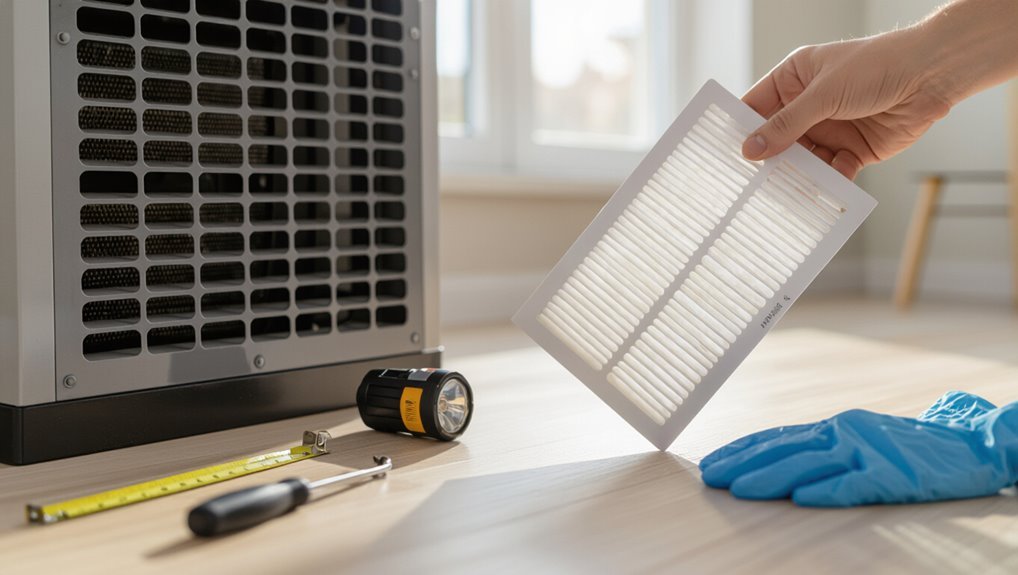
MERV stands for Minimum Efficiency Reporting Value and rates a filter’s ability to capture airborne particles on a scale from 1 to 16.
Higher MERV numbers trap smaller particles (from coarse dust and pollen at low ratings to fine smoke and bacteria at high ratings).
The chosen MERV impacts indoor air quality and can influence HVAC airflow, energy use, and system wear.
Definition of MERV and how the scale works
A filter efficiency scale developed by ASHRAE, MERV (Minimum Efficiency Reporting Value) quantifies an air filter’s ability to capture particles of different sizes, with higher numbers indicating finer filtration.
The scale runs roughly from 1–20, grading filters by laboratory test results. To determine a specific unit’s rating, inspect packaging or the filter frame; guidance on how to find MERV rating on filter aids selection.
What particle sizes different MERV ratings capture
When selecting a filter, understanding the particle size ranges each MERV tier captures helps match filtration to needs: low ratings (1–4) trap large particles like pollen and dust mites, mid-range filters (5–13) remove finer particulates such as mold spores, pet dander, and smoke, and high ratings (14–20) capture very small aerosols including bacteria and some viruses.
Specific capture ranges:
1–4: >10 µm;
5–8: 3–10 µm;
9–12: 1–3 µm;
13–16: 0.3–1 µm;
17–20: <0.3 µm.
How MERV affects indoor air quality and HVAC performance
Because filter efficiency governs both pollutant removal and airflow resistance, choosing the appropriate MERV rating directly influences indoor air quality and HVAC performance.
Higher MERV values trap finer particles, reducing allergens and contaminants, but can increase pressure drop. Excessive restriction may reduce system airflow, lower efficiency, raise energy use, and stress components.
Balanced selection optimizes contaminant control while maintaining proper airflow and equipment longevity.
Quick Ways to Find the MERV Rating on an Existing Filter
Start by inspecting the frame and media of the filter for printed MERV numbers or labels, often found along the edge or on the cardboard frame.
If no explicit rating appears, check the manufacturer code or model number stamped on the filter and cross-reference it with the maker’s online specs to interpret the MERV value.
When available, consult the original packaging or instruction sheet, which typically lists the confirmed MERV rating.
Where to look on the filter for printed ratings
Locating a MERV rating on an existing air filter typically requires inspecting the frame and pleated media for printed labels or stamps; manufacturers usually place the rating near the brand name, model number, or along the gasket edge.
Also check cardboard end caps, foil strips, and adhesive labels on the outer frame.
Small print may appear on the inner pleats or printed on a corner of the mesh.
Interpreting manufacturer codes and model numbers
If printed ratings or labels are not visible on the frame or media, the filter’s model number and manufacturer code often hold the key to its MERV rating.
Users should record the full code, then search the manufacturer’s online database or specification sheet.
Alphanumeric segments often indicate efficiency class; cross-referencing with product pages or third-party catalogs typically reveals the corresponding MERV value.
Using filter packaging or instruction sheets to confirm MERV
One simple way to confirm a filter’s MERV rating is to check the original packaging or the instruction sheet that came with the unit; manufacturers typically print the rating, or include a specification table, on those materials.
If packaging is unavailable, archived manuals online or retailer product pages often reproduce the same specs.
Record the listed MERV for replacement and compatibility decisions.
Step-by-Step Method to Determine MERV When It’s Not Labeled
When a filter lacks a MERV label, one reliable approach is to identify the filter type and material—fiberglass, pleated, or electrostatic—since construction strongly suggests likely efficiency ranges.
Next, measure the filter and note any model numbers to match dimensions and specifications found in online product listings.
If uncertainty remains, contacting the manufacturer or the original retailer can provide confirmation or an official MERV rating.
Identifying filter type and material (fiberglass, pleated, electrostatic)
Identifying the filter type is the essential first step in estimating a MERV rating for an unlabeled air filter.
Visual and tactile cues distinguish fiberglass (thin, flat, low-density), pleated synthetic/fiber (folded surface, higher density), and electrostatic (sometimes glossy or charged, attracts dust).
Note frame rigidity and media thickness; these correlate with filtration efficiency and likely MERV ranges.
Matching dimensions and model to online specs
Begin by measuring the filter’s length, width, and thickness precisely and noting any stamped model numbers or brand markings on the frame; these concrete details are the keys to matching the unit to manufacturer specifications online.
Next, search manufacturer websites and retailer listings using those dimensions and codes. Compare media type and pleat count, and record matched MERV listings or equivalent performance data for verification.
Contacting manufacturer or retailer for verification
If direct labeling or online matches fail, contacting the manufacturer or retailer provides the most reliable verification route.
Gather the filter’s exact dimensions, any model or lot numbers, photos of the frame and media, and purchase details before reaching out so the responder can confirm MERV or provide equivalent performance specifications.
Provide concise questions, request test reports or datasheets, and record the representative’s name and response for future reference.
Visual and Physical Clues to Estimate MERV
A few visual and physical cues can help estimate an air filter’s MERV when a label is absent. Observers note pleat density, media thickness, and surface area as primary indicators, and recognize that low, medium, and high MERV filters have distinct appearances and construction.
Simple home checks—holding the filter up to light, inspecting dust capture patterns, and observing how quickly particles build up—offer quick, rough confirmation.
Pleat density, thickness, and surface area indicators
Pleat density, thickness, and total filter surface area offer quick visual and tactile clues that correlate with MERV performance: tightly spaced, numerous pleats and thicker media generally indicate greater particulate capture capacity, while sparse, shallow pleats suggest lower efficiency.
Inspect pleat count per linear inch, media depth, and folded area; more surface area usually means longer life and improved filtration under similar airflow conditions.
Common characteristics of low, medium, and high MERV filters
Filters fall into three broad visual/physical categories—low, medium, and high MERV—each with distinct, observable clues:
Low-MERV filters are thin, coarse, and loosely pleated;
medium-MERV show tighter pleats, denser media, and firmer frames;
high-MERV appear very dense, fine-fiber or electrostatically charged, with deep pleats and robust construction.
Labels or manufacturer codes often accompany higher-rated models.
Quick tests you can do at home to gauge filtration (light test, dust accumulation)
Several simple at-home checks can help estimate a filter’s effectiveness without specialized equipment.
Hold the filter to a light source: less light passing through suggests denser media and higher particle capture.
Inspect both sides for visible dust buildup; heavy accumulation on the downstream side indicates good capture but increased resistance.
Feel texture: finer, stiff fibers suggest higher performance than thin, loose media.
How to Read and Use MERV Information for Buying Decisions
Readers can use MERV ranges to match filters to household needs—MERV 6–8 for typical homes, 8–11 for pets or mild allergies, and 12–16 for significant allergy, asthma, or sensitive environments.
They should weigh higher MERV ratings’ improved particle capture against potential reductions in HVAC airflow and consult system specifications before upgrading.
Guidance on when to choose a higher MERV versus a standard filter helps balance indoor air quality goals with equipment performance.
Recommended MERV ranges for homes, allergies, pets, and sensitive environments
Typically, homeowners should choose MERV ratings based on household needs: basic homes often do well with MERV 6–8, while those with allergies or pets may benefit from MERV 8–11.
Sensitive environments—such as homes with immunocompromised occupants or medical settings—may require MERV 13 or higher; balancing filtration efficiency with HVAC compatibility and airflow is essential when making a selection.
For most residences, MERV 6–11 covers everyday concerns, MERV 12–13 suits higher risk situations, and MERV 14+ is generally reserved for specialized facilities.
How to balance filtration efficiency and HVAC airflow
Balance filtration efficiency against HVAC airflow by matching a filter’s MERV rating to the system’s capacity and household needs: higher MERV values capture finer particles but increase resistance to airflow, which can reduce system efficiency, raise energy use, and strain older or undersized fans.
Assess system specifications, consult manufacturer guidance, and consider periodic filter checks; choose the highest MERV the system will handle without compromising airflow.
When to choose a higher MERV vs. standard filters
After evaluating a system’s ability to handle higher resistance, homeowners can decide whether a higher MERV filter is worth the trade-offs.
Higher MERVs suit allergy sufferers, households with pets, or those near pollution sources, offering finer particle capture.
Standard filters preserve airflow and energy efficiency for typical homes.
Consult HVAC specs; professional assessment guarantees compatibility and balanced indoor air quality versus system strain.
Comparing MERV with Other Filtration Ratings
MERV provides a standardized measure of particle-capture efficiency, but HEPA, MPR, and FPR use different test methods and scales that can yield non-equivalent results.
Comparing these ratings helps determine when a HEPA-certified unit or a manufacturer-specific MPR/FPR score is more appropriate for a given indoor air need.
Consider alternative ratings or certifications when specific particle sizes, medical settings, or HVAC compatibility are priorities.
MERV vs. HEPA vs. MPR vs. FPR
Many homeowners and facility managers compare MERV, HEPA, MPR, and FPR to understand how well different filters remove airborne particles and which standard applies to their needs. MERV rates particle capture across sizes; HEPA denotes very high efficiency; MPR and FPR are manufacturer scales emphasizing different particle ranges. Choose by required efficiency, HVAC compatibility, and pressure drop.
| Rating | Typical use |
|---|---|
| MERV | HVAC systems |
| HEPA | Cleanrooms, medical |
| MPR | Consumer filters |
| FPR | Retail grading |
When alternative ratings or certifications matter
Although basic particulate-capture ratings provide a useful baseline, alternative certifications become important when specific contaminants, regulatory requirements, or performance conditions are at stake.
Employers, healthcare facilities, and sensitive homes may prefer HEPA, ASHRAE, or EN-tested filters for proven removal of viruses, allergens, or smoke.
Certifications address efficiency, pressure drop, and test methods, guiding choices beyond simple MERV comparisons.
Common Mistakes and Pitfalls When Checking MERV
Many people mistakenly equate a pleated appearance with a high MERV rating, which can lead to incorrect assumptions about filtration performance.
They may also overlook frame size and fit, causing bypass and reduced effectiveness even with the correct filter media.
Additionally, relying on aftermarket labels or unclear packaging can produce confusion about the actual MERV rating.
Assuming pleated means high MERV
Pleated air filters often look more effective, which leads some consumers to equate pleating with a high MERV rating. However, pleats only increase surface area and do not guarantee finer particle capture.
Relying on appearance risks selecting filters with low filtration efficiency despite deep pleats. Buyers should check manufacturer specifications or labeling for the actual MERV rating rather than assuming performance from construction alone.
Overlooking frame size or fit issues
Mistaking pleat style for filtration performance is only one error; another common oversight is ignoring frame size and fit.
Filters that don’t seal properly allow bypass, rendering a high MERV rating ineffective. Users often overlook warped frames, incorrect depth, or loose installation.
Proper measurement and ensuring a snug, continuous seal are essential to achieve rated filtration performance and prevent leakage.
Relying on aftermarket labels or unclear packaging
A surprising number of consumers assume labels on replacement filters reflect certified MERV ratings, but aftermarket stickers and vague packaging can be misleading or entirely incorrect.
Buyers should verify manufacturer documentation or third‑party test reports rather than trusting generic claims. Unclear packaging may omit testing conditions, particle size ranges, or certification bodies, causing inappropriate selections that compromise filtration performance and HVAC function.
Maintenance, Replacement Frequency, and Monitoring
MERV rating influences how quickly an air filter loads with particles and consequently affects recommended replacement intervals.
Regardless of MERV, visible dirt, airflow reduction, or increased allergy symptoms indicate a need for immediate replacement.
Simple steps—such as following manufacturer schedules, pre-filter use, and checking monthly—can extend filter life without compromising performance.
How MERV rating impacts replacement schedule
Because higher-efficiency filters capture smaller particles and load with debris faster, their rating directly influences how often they require replacement or inspection.
Higher MERV filters (13–16) typically need more frequent checks—often monthly—while midrange filters (8–12) may last 2–3 months.
Low MERV (1–7) commonly function for 3–6 months.
HVAC usage, indoor air quality, and manufacturer guidance adjust intervals.
Signs your filter needs replacing irrespective of MERV
Several clear signs indicate a filter needs replacing regardless of its MERV rating: visible dirt buildup, dark discoloration, or sagging media.
Reduced airflow, increased dust on vents, and rising allergy symptoms also signal replacement.
Unusual odors from the system, higher energy bills, or more frequent HVAC cycling warrant inspection.
Routine checks confirm condition; replace when performance or cleanliness declines.
Tips for extending filter life safely
Extend filter life by combining regular maintenance with smart replacement timing and simple monitoring routines.
The homeowner inspects filters monthly, gently vacuuming surface dust and ensuring proper airflow.
Replacement follows manufacturer guidelines or sooner if loading, odors, or pressure drops occur.
Use reminders, keep returns and ducts clean, and avoid washing nonwashable filters.
Proper HVAC service preserves filter performance and indoor air quality.
Practical Tips for Homeowners and Renters
Homeowners and renters should record the MERV rating of each installed filter and keep that information with appliance records for straightforward future replacements.
They can purchase verified MERV-rated filters from reputable HVAC suppliers, manufacturer websites, or certified retailers that list lab-tested specifications.
When hiring HVAC service, asking which MERV ratings are compatible with the system and whether technicians verify filter fit and performance helps guarantee proper selection.
How to note and record MERV for future replacements
When replacing or inspecting filters, note the MERV rating, filter size, and installation date so future replacements match the system’s needs.
Record details in a simple log: model, MERV, size, date. Store records digitally and on the furnace. Review before purchases and share with roommates or landlords.
- Keep a dated spreadsheet
- Photograph filter labels
- Label filter frames
- Set calendar reminders
Where to buy verified MERV-rated filters
Finding verified MERV-rated filters requires choosing sources that provide clear specifications, reliable labeling, and a track record of authenticity.
Homeowners and renters should buy from manufacturer websites, certified HVAC retailers, and major home improvement stores with verified product data.
Look for listings that include MERV values, test reports, or third-party certifications.
Avoid unmarked or generic filters from unknown sellers.
Questions to ask when hiring HVAC service regarding filter selection
After selecting a verified MERV-rated filter, prospective clients should prepare specific questions for HVAC technicians to guarantee the chosen filter matches the system and indoor needs.
Ask about system compatibility, airflow impact, recommended MERV range, installation and sealing, maintenance frequency, replacement cost, and warranty effects.
Request verification of performance, testing procedures, and written recommendations tailored to occupancy, pets, allergies, and ventilation.
Quick Reference Checklist Before Installing a New Filter
Before installing a new air filter, a concise checklist helps guarantee proper fit and system performance.
The homeowner should verify filter size, chosen MERV rating, compatibility with the HVAC unit, and any airflow impact. They should also confirm safety guidelines and warranty implications when changing filter types.
- Verify exact filter dimensions and frame type
- Confirm MERV rating is appropriate for the system and indoor needs
- Check that the filter is compatible with the HVAC model and won’t restrict airflow
- Review safety instructions and any warranty restrictions before installation
Confirming size, MERV, compatibility, and airflow considerations
A short checklist helps guarantee a new filter fits both physically and functionally: verify the exact dimensions stamped on the old filter or the unit’s manual, confirm the chosen MERV rating aligns with the HVAC system’s manufacturer recommendations, check filter frame and slot compatibility to prevent gaps or improper sealing, and consider how a higher-efficiency filter will affect airflow and fan load to avoid reduced performance or strain on the system.
Choose a filter meeting size, MERV, and airflow balance; consult system specifications and professional advice if uncertain.
Safety and warranty considerations when changing filter type
Several simple checks help protect safety and warranty coverage when changing filter types: verify the furnace or HVAC manual for approved MERV limits, confirm filter frame and cabinet clearances to avoid airflow restriction, inspect seals and placement to prevent bypass, check for manufacturer voiding clauses, and guarantee professional installation or documentation if required to maintain warranty and safe operation.
Resources and Tools to Verify MERV Ratings
Manufacturers’ and retailers’ websites, product labels, and online databases can be used to cross-check a filter’s stated MERV rating and confirm test data.
Mobile apps and searchable catalogs simplify comparisons across brands and models.
For unclear or conflicting information, a professional HVAC technician should be consulted for verification and system-appropriate recommendations.
Helpful manufacturer and retailer websites
Many reliable manufacturer and retailer websites provide searchable product pages, specification sheets, and customer support resources that make verifying an air filter’s MERV rating straightforward.
Users can locate model numbers, downloadable datasheets, and FAQs showing tested MERV values. Reputable sellers list filtration performance, dimensions, and replacement guides.
Cross-referencing manufacturer pages with retailer listings reduces mislabeling risk and aids confident purchasing decisions.
Apps, databases, and labels to cross-check ratings
While online product pages are useful, independent apps, centralized databases, and on-package labels offer quick ways to cross-check an air filter’s claimed MERV rating.
Users can verify certifications, compare models, and spot inconsistencies before purchase.
- Mobile apps that scan UPCs and display tested ratings
- Manufacturer/dealer databases with certified specs
- AHRI or similar third-party listings
- On-package UL or performance labels with test references
When to seek professional HVAC advice
When should a homeowner consult an HVAC professional about MERV ratings and filter selection?
A professional is advised when system compatibility is uncertain, airflow drops, unusual noise occurs, or chronic indoor air quality problems persist.
They can verify true MERV performance, recommend appropriate filtration without harming the system, perform duct inspection, and suggest upgrades or alternative solutions like whole-house filtration or ventilation improvements.
Conclusion
After consulting the sacred temple of HVAC labeling, the reader is gently reminded that indoor air quality is apparently a matter of heroic toil and arcane alphabet soup. With MERV ratings decoded, the homeowner can smugly select filters like a connoisseur of dust, while vents applaud. Yet the true satire remains: paying attention to a thin pleated rectangle once every few months single-handedly sustains domestic bliss, or at least prevents dramatic sneezing.
