
How to Choose an Accent Table: A Practical Guide to Size, Style, and Placement
When choosing an accent table, focus on height, size, material, and placement to enhance both function and aesthetics. Aim for 18–24 inches of clearance for traffic flow, with the tabletop close to sofa-arm height. Select shapes and finishes that complement your room—opt for round or narrow designs in tight spaces, and wood for warmth or metal and glass for a modern touch. Additionally, consider any storage needs and multifunctional features. These practical choices will improve circulation and visual appeal in your space.
Why Choosing the Right Accent Table Matters for Your Space
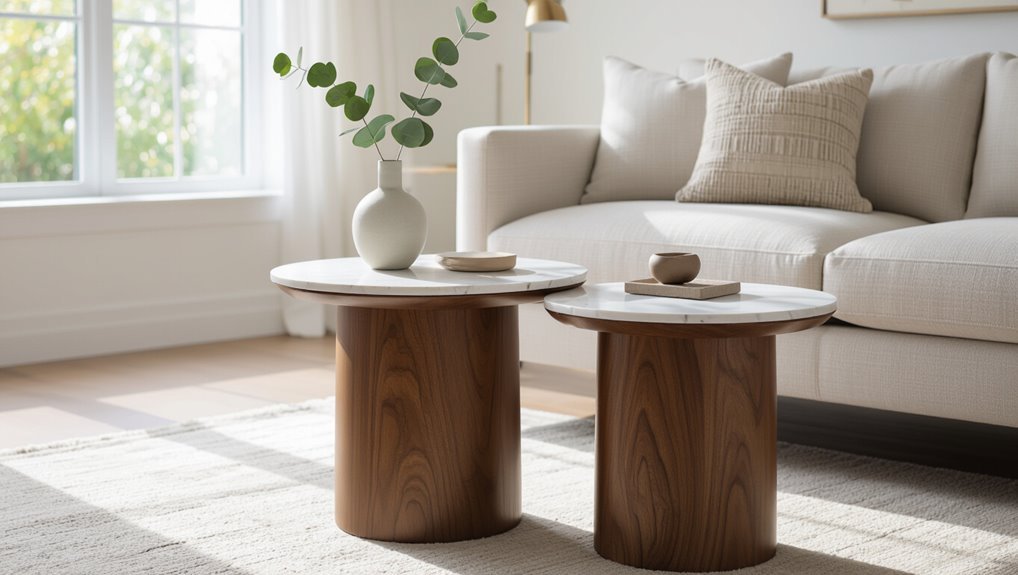
Selecting the appropriate accent table influences room function and flow by defining pathways and providing purposeful surfaces.
Its size, shape, and placement determine visual balance, scale, and focal points within the space.
Beyond aesthetics, accent tables serve practical roles for display, storage, and everyday surfaces.
How an accent table affects room function and flow
Because an accent table occupies both physical and visual space, it directly shapes how people move through and use a room.
Thoughtful selection—how to choose an accent table—considers pathways, reachability, and task needs. Appropriate height, compact footprint, and placement near seating support function without obstruction.
Misjudged size or location can impede circulation, reduce usability, and create awkward traffic patterns in otherwise efficient layouts.
Visual impact: balance, scale, and focal points
A single accent table can anchor a room’s visual composition by providing scale, balance, and a clear focal point; its proportions relative to surrounding furniture determine whether the space feels cohesive or disjointed.
Consider height, mass, and negative space to maintain equilibrium with sofas, chairs, and rugs.
Contrast in shape or finish can draw attention without overpowering overall harmony.
Common uses: display, storage, surface, and decorative purposes
Having established how scale and balance shape a room’s composition, attention turns to what an accent table actually does within that framework.
It functions as display for art or plants, discreet storage for magazines and remotes, a convenient surface for drinks or lamps, and a decorative element reinforcing style.
Choice affects utility and cohesion, so selection aligns form, finish, and planned use.
Quick Guide to Picking an Accent Table (Direct Answer)
A simple rule guides the choice: match table height to surrounding seating, keep scale proportional to the room, and position for unobstructed flow.
A fast checklist follows—measure available space, allow at least 30–36 inches of traffic clearance, and confirm the table’s style complements existing decor.
This quick guide equips readers to make a confident, practical selection.
One-sentence decision rule for size, style, and placement
How should one choose an accent table?
One sentence: select a table whose height aligns with adjacent seating, whose scale complements surrounding furniture without crowding walkways, and whose material and finish echo existing room textures and colors to reinforce the desired style.
Prioritize proportion, circulation space, and cohesive visual weight so the piece feels deliberate rather than mismatched or obstructive.
Fast checklist: measurements, traffic clearance, and style match
When choosing an accent table, the checklist focuses on three practical anchors: exact measurements to confirm height and surface area, traffic clearance to preserve at least 18–24 inches of walkway, and a style match that ties material, finish, and scale to existing pieces.
- Measure height relative to seating and adjacent surfaces
- Check 18–24″ clearances for walkways
- Confirm tabletop footprint fits the zone
- Match material, color, and finish
- Maintain proportional scale with nearby furniture
Measure First Determining the Right Size and Proportions
Before selecting a shape or finish, measurements of walls, gaps between furniture, and corner spaces should be taken to guarantee proper fit.
Standard height and diameter ranges for side, end, and console tables guide the basic dimensions to evaluate. Proportions should then be checked against sofa height, chair arms, and bed scale so the table reads as balanced and functional.
How to measure available space: walls, between furniture, and corners
Although seemingly simple, measuring the targeted spot is essential to guarantee an accent table fits both functionally and visually; notes should include wall-to-wall width, depth from the wall into the room, and clearances between adjacent furniture or architectural features.
Measure available floor space, aisle widths, and corner diagonals. Record obstruction heights (radiators, switches) and allow walking clearance.
Sketch dimensions to confirm proportional relationships.
Standard height and diameter guidelines for side, end, and console tables
With measured clearances and a sketched footprint in hand, attention shifts to standard heights and diameters that determine comfort and scale for side, end, and console tables. Typical side tables: 22–28″ high, 16–24″ diameter; end tables: 20–26″ high, 18–30″ square/round; consoles: 28–36″ high, 10–20″ deep.
| Type | Height | Diameter/Depth |
|---|---|---|
| Side | 22–28″ | 16–24″ |
| End | 20–26″ | 18–30″ |
Scaling with furniture: sofa height, chair arms, and bed proportions
Successful scaling hinges on aligning accent-table heights and proportions to surrounding furniture—sofa seat height and armrest level, chair arm dimensions, and bed frame height all guide comfortable reach and visual balance.
Measure seat and arm heights; choose tables within two inches of arm level for sofas and chairs.
For beds, select bedside tables matching mattress height plus functional surface clearance for lamps and essentials.
Selecting the Best Shape and Footprint
The choice of shape—round, square, rectangular, or oval—affects traffic flow, surface area, and how pieces pair with surrounding furniture.
Nesting and modular tables are noted for adapting to changing needs and tight spaces without sacrificing style.
Base types such as pedestal or tripod influence stability and the table’s visual weight, guiding placement and use.
Round vs. square vs. rectangular vs. oval: pros and cons
How should a room’s flow and function guide the choice between round, square, rectangular, or oval accent tables?
Round tables soften traffic, reduce collisions, and suit conversational clusters.
Square tables provide symmetry and corner-friendly placement.
Rectangular tables bridge gaps, fit alongside sofas, and offer extra surface.
Oval tables combine flow with elongated surface, easing movement while maximizing usable top without sharp corners.
Nesting tables and modular options for flexible arrangements
Consider nesting tables and modular sets when flexibility and efficient footprints are priorities: their varied shapes and staggered sizes allow furniture to adapt to shifting needs—expanding for guests, tucking away to free circulation, or reconfiguring into task-specific groupings—while preserving proportional balance and sightlines within a room.
Select finishes and heights that layer visually; prioritize lightweight, durable materials for easy rearrangement and coherent scale.
Pedestal and tripod bases: stability and visual lightness
When stability must be paired with a sense of airiness, pedestal and tripod bases deliver: a single central column or three slender legs concentrate support while minimizing visual clutter, allowing tabletops to appear to float and traffic paths to remain unobstructed.
These forms suit compact spaces, emphasize tabletops, and simplify cleaning; choose proportions and materials that balance load, scale, and the room’s visual weight.
Matching Materials and Finishes to Your Decor
The discussion turns to how material choices and finishes shape a room’s mood and function.
Wood species and stains contribute warmth and perceived weight, while metal, glass, and acrylic offer modern, airy, or reflective effects.
Mixed-material designs and sustainably sourced options provide balance and an eco-conscious alternative.
Wood types and stains: warmth and weight
Wood species and stain selection determine an accent table’s visual temperature and perceived mass: oak and walnut lend a substantial, grounded presence with warm amber or deep chocolate stains, while maple and ash appear lighter and airier in pale or natural finishes.
Select grain, hardness, and stain opacity to complement room scale and existing wood tones; darker finishes read heavier, lighter ones recede.
Metal, glass, and acrylic: modern, airy, and reflective choices
Metal, glass, and acrylic offer a contrasting vocabulary to timber—metal provides crisp lines and industrial weight, glass introduces transparency and reflection, and acrylic delivers similar clarity with lighter mass and greater impact resistance.
Such materials suit minimalist, contemporary, or urban interiors; finishes range from matte to polished. They visually expand small rooms, support bold geometric forms, and require different care than wood to maintain clarity and finish.
Mixed materials and sustainable options
When paired thoughtfully, mixed materials can balance texture, weight, and color to create accent tables that feel deliberate rather than piecemeal. Designers often combine timber with metal or stone with glass to harmonize warmth, structure, and visual lightness.
Sustainable options prioritize reclaimed wood, FSC-certified timber, recycled metals, and low-VOC finishes, ensuring longevity, reduced environmental impact, and cohesive aesthetics without compromising durability.
Styling and Surface Considerations
Consideration of surface styling balances functional use with decorative intent, asking how many items are necessary versus purely ornamental.
Thoughtful layering—for example a tray anchoring a lamp, a small stack of books, and a plant—creates visual order and purposeful hierarchy.
Practical protection and upkeep, including coasters, appropriate finishes, and simple maintenance routines, preserve both appearance and durability.
How much surface clutter is functional vs. decorative
A single well-curated cluster of items on an accent table strikes the balance between utility and visual appeal; too many objects overwhelm scale and function, while too few can make the surface read unfinished.
Prioritize daily essentials—a coaster, small dish, or remote—paired with one decorative piece.
Maintain clear negative space for usability and quick cleaning; rotate decor seasonally.
Layering with tray, lamp, books, and plants
Several layered elements—tray, lamp, books, and a small plant—create a hierarchy of form and function on an accent table, guiding the eye while keeping essentials accessible.
- Balance scale: low tray, mid books, tall lamp
- Vary textures for contrast
- Use odd numbers for interest
- Keep circulation clear for use
- Rotate seasonal plants for freshness
Protecting surfaces: coasters, finishes, and maintenance tips
Protecting an accent table begins with simple, intentional choices—coasters to buffer moisture and heat, a compatible finish to resist stains and scratches, and a maintenance routine to preserve appearance over time.
Select felt or rubber coaster bases, apply sealant suited to the material, dust regularly with a soft cloth, address spills immediately, and use mild cleaners.
Periodic reconditioning maintains durability and value.
Placement Strategies for Different Rooms
Placement choices for accent tables vary by room, from flanking sofas or filling the gap between chairs to substituting for a coffee table in the living room.
In bedrooms they function either as bedside surfaces or as low-profile pieces at the foot of the bed.
In entryways and hallways narrow consoles provide style and utility, while compact, multifunctional tables offer practical solutions for small apartments.
Living room placements: flanking sofas, between chairs, and as coffee table substitutes
An accent table can anchor seating arrangements and clarify traffic flow in a living room when used to flank a sofa, sit between chairs, or replace a traditional coffee table.
Placed beside a sofa, it balances proportions and holds light or drinks.
Between chairs it defines conversation; as a coffee-table substitute it promotes openness, offers surface variety, and adapts to scale and movement.
Bedroom placements: beside bed versus at foot of bed
When used beside the bed, an accent table functions as an immediate bedside surface for a lamp, phone, and nightly essentials; when placed at the foot of the bed, it becomes a visual anchor that can offer seating, storage, or display without crowding the sleep zone.
Beside-bed tables prioritize reachability and scale; foot-of-bed pieces emphasize proportion, circulation, and multiuse—benching, baskets, or trays.
Entryway and hallway uses: console styling and narrow table tips
How might a narrow accent table redefine an entry or hallway without impeding traffic? A slim console anchors the space, offering a landing spot for keys, mail, and a lamp while preserving circulation.
Styling balances function and aesthetics: mirror above for depth, a tray for essentials, and lower shelf baskets for shoes or umbrellas.
Scale, placement, and unobtrusive lighting guarantee harmony.
Small-space and apartment solutions
Moving from hallways to compact homes, narrow accent tables can be rethought to suit studio flats, tiny kitchens, and micro bedrooms where floor space is limited.
Wall-mounted, foldaway, or slim-legged designs preserve circulation. Multipurpose surfaces with storage, built-in charging, or nesting pieces maximize utility.
Proportions should align with door swings and seating; choose light finishes to reduce visual weight and maintain openness.
Choosing Style to Complement Your Interior Design
Selecting an accent table begins with matching its silhouette and materials to the room’s dominant style—clean lines and metal for modern, tapered legs for mid-century, carved wood for traditional, distressed finishes for rustic, and exposed hardware for industrial.
Designers may choose cohesion to reinforce a theme or introduce contrast to create a focal point, depending on the desired visual impact.
Thoughtful color and texture choices should either complement the existing palette or provide a calculated accent that ties the scheme together.
Aligning accent table style with common design themes: modern, mid-century, traditional, rustic, industrial
Which design language dominates a room determines the accent table’s role and acceptable forms.
For modern spaces choose minimalist lines, glass or lacquer finishes.
Mid-century favors tapered legs and warm woods.
Traditional rooms suit carved details and rich veneers.
Rustic needs reclaimed wood, distressed textures.
Industrial works with metal frames, exposed hardware and utilitarian proportions for cohesive integration.
Creating contrast or cohesion: when to match and when to stand out
How should an accent table relate to its surroundings: by blending in or by creating deliberate contrast? The decision hinges on room intent.
For cohesive calm, mirror predominant forms, scale, and finish to reinforce style continuity.
To inject interest, introduce a singularly different silhouette, material, or proportion that complements without clashing.
Balance guarantees the table reads as purposeful, not accidental.
Color and texture decisions to enhance room palette
Color and texture choices for an accent table should act as deliberate extensions of the room’s palette, either reinforcing dominant hues and finishes or offering a calibrated counterpoint that elevates nearby surfaces.
Select materials—matte wood, glossy metal, textured stone—that echo or punctuate fabrics and flooring.
Use a restrained accent color or subtle texture contrast to unify layers, balance visual weight, and guide sightlines.
Functionality and Storage Options
Functionality often determines which accent table best fits a room, from drawers and open shelves to concealed compartments for clutter.
Some designs serve multiple roles—storing cocktails, hiding charging stations, or incorporating pet-friendly features—while others prioritize mobility with casters, lightweight frames, or foldable panels.
Evaluating these storage and use options helps match the table to daily needs and spatial constraints.
Accent tables with drawers, shelves, or hidden storage
Storage options transform an accent table from decorative surface to practical furniture, and choices between drawers, open shelves, and concealed compartments shape both appearance and daily use.
Drawers hide small clutter, maintaining a tidy silhouette; open shelves display books or baskets for accessible organization; concealed compartments preserve valuables or electronics without altering room style.
Material and hardware affect durability and visual weight.
Multi-use tables: cocktail storage, charging stations, and pet-friendly features
Beyond basic drawers and shelves, some accent tables combine multiple practical features to serve specific lifestyle needs: hidden compartments sized for cocktail tools and bottles, integrated USB and wireless charging surfaces for phones and tablets, or low-height ledges and wipeable materials for pet bowls and resting spots.
Design choices balance aesthetics and function—secure bottle storage, accessible cable management, durable finishes, and stable surfaces that protect floors and accommodate pets.
Mobility: casters, lightweight designs, and foldable options
Consider mobility as a deliberate design choice that expands an accent table’s usefulness: casters enable easy repositioning for cleaning or entertaining, lightweight materials make occasional relocation less effort, and foldable constructions allow compact storage when not in use.
Mobility increases flexibility across rooms, supports multiuse setups, and accommodates changing needs; choose durable hardware, balanced weight, and secure locks to prevent tipping or unwanted movement.
Budgeting and Where to Shop
A practical plan for budgeting clarifies what to expect at various price points, from economical mass-produced tables to higher-end solid wood or designer pieces.
Retail options range from local furniture stores and online marketplaces to vintage shops and thrift stores, each offering different trade-offs in selection, condition, and price.
Consider commissioning a custom or handmade table when specific dimensions, materials, or craftsmanship justify a higher investment.
Price ranges and what to expect at different budgets
When planning a purchase, understanding typical price tiers helps set realistic expectations and directs where to shop.
Budget options ($30–$150) offer basic materials and simpler designs.
Mid-range ($150–$600) provides better construction, varied finishes, and designer touches.
High-end ($600+) delivers premium materials, craftsmanship, unique designs, and longer warranties.
Allocate budget based on durability, style priority, and planned lifespan.
Best places to buy: local stores, online retailers, vintage and thrift
Though budget and style goals differ, shoppers can compare three main sources—local stores, online retailers, and vintage/thrift outlets—each offering distinct trade-offs in price, selection, and risk.
Choices hinge on immediacy, return policies, and uniqueness.
- Local showrooms: try before buying, immediate pickup
- Online: vast selection, variable shipping
- Big-box: predictable pricing
- Boutiques: curated styles
- Thrift/vintage: one-of-a-kind, inspect for wear
When to invest in custom or handmade pieces
Shoppers who have weighed local, online, and vintage options may find reasons to contemplate custom or handmade accent tables for specific needs that mass-market pieces don’t meet.
Custom work suits awkward dimensions, unique materials, or cohesive design schemes; it supports artisans and higher craftsmanship.
Budgeting should account for design fees, materials, and lead time.
Commission when fit, finish, or provenance matter more than price.
Common Mistakes and How to Avoid Them
Many homeowners make choices that unintentionally disrupt a room’s flow by selecting tables that are too large or too small.
Others prioritize style at the expense of function, or vice versa, resulting in pieces that look good but don’t work, or work well but clash with the decor.
Overlooking maintenance and durability needs often leads to premature wear or costly replacements.
Oversized or undersized tables that disrupt flow
When an accent table is either too large or too small for its setting, it immediately upends circulation and visual balance; pathways tighten, seating arrangements feel awkward, and the eye can’t settle.
Selection should consider scale, clearance, and function: allow 18–24 inches between seating, maintain 30–36 inch walkways, and choose proportions that echo nearby furniture to restore flow without crowding or appearing lost.
Choosing style over function or vice versa
Why prioritize one at all? Designers warn against sacrificing usability for looks or vice versa. An accent table should balance form and function: assess daily needs, surface area, and traffic patterns, then select materials and shapes that fulfill those requirements while complementing decor.
Test placement and proportions virtually or with tape before purchase to prevent costly aesthetic or practical regrets.
Ignoring maintenance and durability needs
Balancing style and function is only part of the decision; durability and upkeep often determine whether an accent table remains useful and attractive over time.
Buyers should assess material resilience, finish protection, and ease of cleaning. Consider everyday wear, household habits, and repairability.
Choosing low-maintenance woods, sealed surfaces, or durable metals prevents premature replacement and preserves appearance with minimal effort.
Quick Decision-Making Flowchart for Choosing an Accent Table
A concise flowchart guides the selection process by moving through four clear steps: define function and location, take measurements and check clearances, choose shape, material, and storage needs, then complete a final styling and purchase checklist.
Each step prompts specific, actionable questions to prevent mismatches between the table and its designated space.
The result is a fast, practical path from need to confident purchase.
Step 1: Define function and location
Where will the accent table live, and what will it primarily do there? The reader assesses room function—entryway, sofa side, bedroom corner—and assigns primary tasks: display, surface for drinks, lamp support, storage catchall.
Consider traffic flow and adjacent furniture to guarantee purpose aligns with location. Prioritize the single most frequent use to guide style and durability choices without measuring yet.
Step 2: Take measurements and check clearances
Having established the table’s primary role and placement, the next move is to take accurate measurements and verify clearances so the piece fits and functions without obstructing movement.
Measure surrounding distances: walkway width, sofa arm height, and distance from other furniture.
Confirm minimum clearance for traffic (typically 18–24 inches) and access to doors or drawers.
Note ceiling height for tall items.
Step 3: Choose shape, material, and storage needs
Several quick choices narrow the options: select a shape that complements surrounding furniture, pick materials suited to style and durability, and decide whether built-in storage is needed.
Choose round for flow, square for symmetry, or narrow for tight spaces. Prefer hardwood or metal for longevity; glass or lacquer for lightness.
Include drawers or shelves only if functional storage is required.
Step 4: Final styling and purchase checklist
At this final stage, the shopper checks appearance, function, and logistics against a concise checklist: confirm scale with surrounding furniture, verify surface and leg materials for durability and maintenance, decide on necessary storage features, test planned tabletop weight and stability, compare price and warranty, and note delivery dimensions and assembly requirements before purchasing.
- Confirm dimensions and sightlines
- Assess material care needs
- Validate weight capacity
- Compare returns and warranty
- Schedule delivery and assembly
Maintenance and Care Tips to Extend Lifespan
Maintenance guidance focuses on appropriate cleaning methods for each material—gentle wood cleaners and polish, nonabrasive metal care, streak-free glass solutions, and vacuuming or spot-cleaning upholstery.
Routine seasonal checks for humidity effects, protective finishes, and tightened fittings help prevent long-term damage.
Quick repairs such as reattaching loose legs, touching up scratches, or replacing pads can greatly extend an accent table’s lifespan.
Cleaning by material: wood, metal, glass, and upholstery
Careful cleaning tailored to each material—wood, metal, glass, and upholstery—preserves an accent table’s appearance and structural integrity.
Use a soft, dry cloth for dusting wood; mild soap and damp cloth for sticky spots, then dry.
Wipe metal with a damp cloth, dry immediately to prevent corrosion.
Clean glass with streak-free cleaner.
Vacuum upholstery and spot-clean with appropriate fabric cleaner.
Seasonal care and quick repair fixes
After routine cleaning by material, seasonal care and quick repair fixes help prevent small issues from becoming lasting damage.
Rotate placement away from direct sunlight and heating vents seasonally.
Tighten loose screws, touch up scratches with appropriate markers or wax, and reapply protective finishes annually.
Inspect joints for wobble, address upholstery stains promptly, and store delicate pieces in climate-controlled spaces during extreme weather.
Real-World Examples and Layout Ideas
The section presents three curated living room layouts paired with specific accent table recommendations to illustrate scale, function, and style choices.
It then examines bedroom and entryway case studies that show before-and-after placements and practical adjustments.
Readers are guided to compare these examples with their own spaces to inform confident selections.
Living room scenarios: three curated layouts with table recommendations
When planning living room layouts, three distinct scenarios illustrate how an accent table can define function and flow:
- Anchor a sofa with a narrow console behind for lamps and mail.
- Flank a fireplace with matching side tables for symmetry and display.
- Insert a round table between armchairs to encourage conversation.
- Use a slim corner pedestal for plants without crowding traffic.
- Choose nesting tables for flexible surface needs.
Bedroom and entryway case studies with before-and-after considerations
Shifting focus from living room scenarios to smaller, more intimate zones, the case studies examine how an accent table reshapes function and first impressions in bedrooms and entryways.
Examples contrast cluttered surfaces with streamlined solutions: a narrow bedside table adding nightly lighting and storage, and a slim console establishing a drop zone with tray and hooks.
Before-and-after photos highlight scale, circulation, and styling choices.
Final Quick Reference Table for Choosing an Accent Table
A concise checklist summarizes key decisions—size, style, material, function, and placement—so buyers can match an accent table quickly to their space and needs. The quick reference lists compact guidance: room type, ideal height, style cue, material choice, and dominant function to streamline selection and avoid common mistakes.
| Room | Height | Function |
|---|---|---|
| Living | 22–26″ | Surface |
| Entry | 28–34″ | Drop zone |
| Bedroom | 20–28″ | Nightstand |
| Small space | ≤22″ | Narrow/stackable |
Conclusion
Choosing an accent table becomes a quiet act of refinement, allowing a room to breathe without shouting for attention. Selections that respect scale, shape, and surface whisper cohesion into a space, suggesting careful stewardship rather than ostentation. With modest upkeep, materials age with dignity; placements invite use without commanding it. Ultimately, the right table serves as a discreet companion to daily life, offering function and charm in softly calibrated measure.
