How to Stop Boiler Short Cycling: 9 Easy Fixes to Prevent Wear and Cut Energy Bills
To stop boiler short cycling, which wastes fuel and stresses components, you can implement several effective fixes. Common causes include oversized boilers, faulty controls, air in the system, low water volume, and clogged returns. Start by checking runtime logs, temperature differences, pressure stability, and cycle counts. Simple solutions include adjusting the thermostat, bleeding radiators, modifying aquastats, cleaning sensors, and considering the addition of a buffer tank or hydraulic separator. For those seeking more detailed procedures, further steps are provided below.
What causes a boiler to short cycle and why it matters
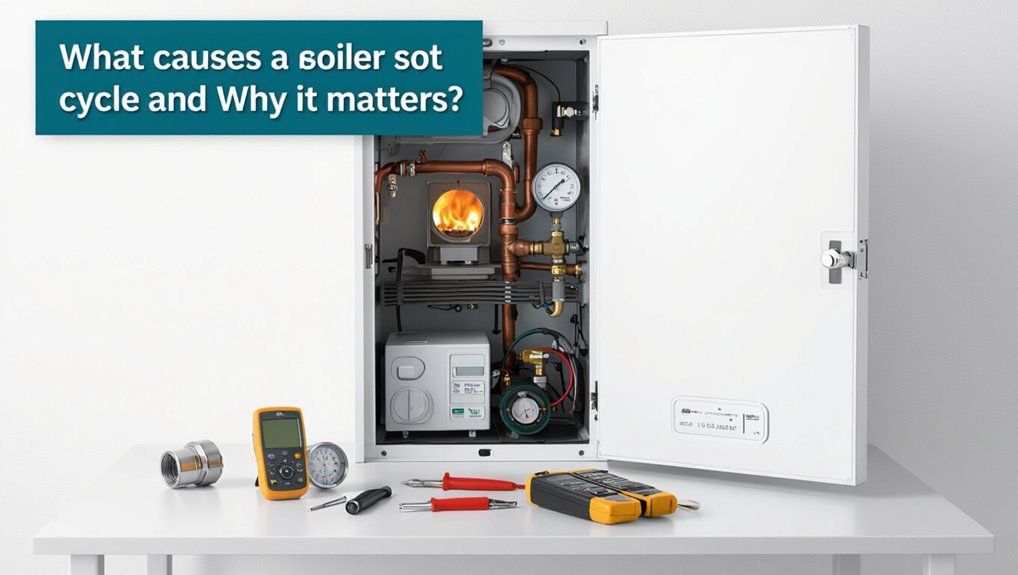
Short cycling occurs when a boiler repeatedly starts and stops before completing a full heating cycle, often triggered by oversized equipment, faulty controls, or poor water flow.
Immediate symptoms include rapid on/off cycling, uneven room temperatures, and frequent burner starts.
Over time this pattern accelerates component wear, reduces fuel efficiency, and raises utility and repair costs.
How short cycling works in boilers
Rapid on-off cycling occurs when a boiler repeatedly starts, reaches operating temperature only briefly, then shuts down and immediately restarts. This can be triggered by oversized equipment, a misadjusted thermostat or aquastat, low system water volume, or clogged piping and returns.
Heat exchanger and burner stress increase, efficiency falls, and component lifespan shortens. Understanding how to stop boiler short cycling guides corrective sizing, controls, and hydraulic fixes.
Common symptoms to recognize immediately
Having identified the mechanical and control-related causes of repeated on-off cycling, it becomes important to recognize the symptoms that indicate a boiler is currently exhibiting this behavior.
Signs include frequent short heating cycles, rapid temperature swings, audible clicking or burner cycling, unexplained pilot relights, thermostat overshooting, and uneven room warmth.
Increased cycling frequency during low demand periods is also indicative.
Long-term risks: wear, efficiency loss, and higher bills
Because cycling that repeatedly forces the boiler to restart more often than it was designed to, components wear faster, combustion efficiency falls, and fuel consumption rises—creating higher maintenance costs and larger utility bills over time.
Bearings, igniters, and valves fail sooner; heat exchangers corrode from thermal stress. Reduced efficiency increases emissions and operating costs, while shortened equipment life raises replacement frequency and capital expenditure.
Quick diagnostic checklist to confirm short cycling
A concise checklist helps confirm whether a boiler is short cycling by recording runtime and off-time patterns over several heating cycles.
Recommended tools include a thermometer, pressure gauge, and a cycle counter or simple tally to quantify starts and stops.
The checklist should also flag when readings exceed safe/normal ranges or when patterns persist despite basic DIY checks, indicating it’s time to call a professional.
Observing runtime and off-time patterns
When short cycling is suspected, observing the boiler’s on and off intervals provides the clearest initial evidence; record multiple cycles over at least 30–60 minutes to establish a pattern.
Note typical run durations, pause lengths, and any immediate restarts after ignition.
Compare observed timing against expected cycles for weather and thermostat settings.
Consistent brief runs with short rests indicate probable short cycling.
Tools and measurements to use (thermometer, pressure gauge, cycle counter)
Having established runtime and off-time patterns, attention turns to the specific instruments that confirm short cycling. A digital thermometer verifies supply and return temperature delta.
A boiler pressure gauge checks for rapid pressure swings or low pressure. A cycle counter or runtime log records starts per hour.
Note timestamps, temperature changes, and pressure trends to distinguish normal modulation from problematic frequent cycling.
When to call a professional vs. DIY checks
How should one decide whether to run a few DIY checks or call a professional?
A quick checklist: confirm rapid on/off cycles, record cycle frequency, check pressure and temperature readings, inspect condensate/drain and vents for blockage, look for error codes and unusual noises.
If cycles exceed safe limits, readings are erratic, leaks exist, or controls show faults, contact a qualified technician.
9 easy fixes to stop boiler short cycling
A concise set of practical fixes can stop most cases of boiler short cycling and restore reliable heating. Key actions include checking controls, removing trapped air, and ensuring proper combustion and pressure settings:
- Adjust thermostat placement and settings
- Increase system temperature differential; bleed radiators and purge air
- Verify boiler pressure, expansion tank charge, and clean flame sensor/electrodes
1. Adjust thermostat settings and placement
Check the thermostat’s setpoint and location before assuming mechanical faults: incorrect temperature settings or placement near drafts, direct sunlight, or heat sources can cause the boiler to reach set temperatures quickly and cycle on and off.
Verify calibration, use a programmable schedule to reduce short cycles from frequent manual changes, and relocate the thermostat to a central, stable spot away from airflow and radiant heat.
2. Increase system water temperature differential (hysteresis)
Increasing the system’s water temperature differential—also called hysteresis—reduces boiler short cycling by widening the temperature band the boiler allows before firing or shutting off.
Technicians can adjust aquastat or boiler controls to increase the deadband, letting the system run longer between cycles. This reduces wear, improves efficiency, and stabilizes room temperatures.
Confirm adjustments match distribution and safety settings to avoid overheating.
3. Bleed radiators and purge air from the system
After widening the temperature differential, attention should turn to trapped air in the heating loop, which commonly causes rapid on/off cycling by reducing effective heat transfer and forcing the boiler to run shorter bursts.
Bleeding radiators and purging mains remove air pockets, restoring steady flow and longer run times.
Use radiator keys and purge valves methodically, starting at highest radiators and venting until water flows.
4. Check and correct boiler pressure and expansion tank charge
Verify boiler pressure and the expansion tank’s air charge, since incorrect values commonly trigger short cycling by causing frequent pressure swings.
Inspect static pressure with a gauge; adjust to manufacturer specifications (typically ~12–15 psi cold for residential systems).
Check expansion tank precharge with a tire gauge and add or release air as needed.
Correct settings stabilize pressure, reduce cycles, and prolong component life.
5. Clean or replace the boiler’s flame sensor and electrodes
Pressure and expansion tank issues are often mechanical causes of short cycling, but electrical ignition components can produce the same symptom; a fouled flame sensor or worn electrodes may fail to consistently detect or create the flame, causing frequent shutdowns and restarts.
Technicians should inspect, gently clean with emery cloth, check electrode gap, and replace corroded parts to restore reliable ignition and longer run cycles.
6. Repair or replace faulty flow switches and zone valves
Inspecting and repairing faulty flow switches and zone valves often resolves short cycling caused by intermittent or incorrect water flow signals.
Technicians should test switches for continuity, verify actuator operation, and check wiring and control logic. Replace sticking or slow zone valves and defective switches.
Properly functioning components guarantee accurate flow detection, prevent frequent boiler starts, reduce wear, and improve system efficiency.
7. Insulate and balance piping and radiator valves
Insulate and balance piping and radiator valves to reduce heat loss and guarantee even water flow, which helps prevent the boiler from cycling on and off frequently.
Apply appropriate insulation to exposed pipes, bleed radiators to remove air, and adjust or install thermostatic/radiator valves so zones receive proportional flow.
Improved hydraulic balance stabilizes return temperatures and run-times, reducing short cycling and improving efficiency.
8. Upgrade or recalibrate controls and aquastat settings
Recalibrate or upgrade boiler controls and the aquastat to reduce unnecessary on/off cycles and achieve steadier run-times.
Modern digital controls, outdoor reset, and smart thermostats allow wider differential settings and optimized temperature curves.
Proper aquastat deadband adjustment prevents rapid restarts.
Commissioning by a qualified technician guarantees settings match system capacity and load patterns, minimizing wear and improving seasonal efficiency without changing hydraulic components.
9. Install buffer tank or hydraulic separator for low-load conditions
Add a buffer tank or hydraulic separator to decouple the boiler from low and variable heating loads, allowing the boiler to run longer cycles and reducing short cycling.
A buffer stores thermal energy, smoothing demand spikes; a hydraulic separator prevents flow interference between circuits.
Both improve boiler efficiency, reduce wear, and lower cycling-related fuel consumption, especially in systems with oversized boilers or intermittent zone demands.
Step-by-step DIY procedures for the most common fixes
The following section presents concise, step-by-step DIY procedures for the most common fixes to boiler short cycling.
It covers safely adjusting thermostat differentials, bleeding radiators and purging trapped air, checking and adjusting boiler pressure and expansion tank precharge, and testing and cleaning flow sensors and basic electrical connections.
Each procedure emphasizes safety checks, required tools, and clear pass/fail indicators to help readers decide when to call a professional.
How to safely adjust thermostat differentials
Many homeowners can reduce boiler short cycling by safely adjusting the thermostat differential, a simple mechanical or digital setting that controls how much temperature must change before the boiler restarts.
Check the current differential, consult the thermostat manual, increase it in small increments (typically 1–2°F/0.5–1°C), monitor runtime and comfort, and revert if oscillation or discomfort occurs.
How to bleed radiators and purge trapped air
Start by locating the highest and/or most distant radiators from the boiler, since trapped air gathers at the system’s top and extremities.
Bleeding and purging follow a systematic order—top-to-bottom and far-to-near—to evacuate air pockets, restore full water circulation, and reduce short cycling.
Turn off heating, allow cooling, place a cloth and container, open bleed valve until steady water flows, close, repeat each radiator.
How to check and adjust boiler pressure and expansion tank precharge
After bleeding radiators and purging trapped air, attention moves to boiler pressure and the expansion tank precharge, since both influence system water volume and cycling behavior.
Verify cold boiler pressure (typically 12–15 psi residential).
Shut system, drain to tank service valve, measure precharge with tire gauge at Schrader valve, and adjust with a pump.
Restore water and recheck pressure and for leaks.
How to test and clean flow sensors and basic electrical connections
Inspecting and testing flow sensors and basic electrical connections can quickly identify common causes of short cycling and can often be resolved with simple DIY steps.
First, power off and isolate the boiler.
Visually inspect wiring, terminals, and sensor housings for corrosion or looseness. Clean contacts with a contact cleaner, gently remove debris from sensors, reconnect tightly, restore power, and verify normal operation.
When short cycling indicates a bigger problem
Persistent short cycling can signal more serious issues such as heat exchanger failure, internal blockages, or an oversized boiler and flawed system design.
Technicians should look for specific signs—unusual noises, soot, fluctuating temperatures, or rapid on/off cycles—that point beyond simple component faults.
When symptoms persist, a diagnostic flowchart helps prioritize inspections and determine whether repair, reconfiguration, or replacement is required.
Signs of heat exchanger failure or blockages
When short cycling stems from internal failures rather than simple control issues, the heat exchanger and flue passages are primary suspects; their deterioration or blockage produces distinct symptoms that signal a more serious repair need.
Signs include persistent soot, unusual odors, reduced heat output despite frequent firing, visible corrosion or cracks, fluctuating water temperatures, and condensate backup.
Professional inspection and replacement may be required.
Indications of oversized boiler or improper system design
If short cycling occurs despite proper maintenance and functioning controls, it can point to an oversized boiler or a mismatched system design; such installations heat the space too quickly, causing frequent on/off cycles that waste fuel and stress components.
Other indicators include short runtime intervals, wide temperature swings, and rooms that feel unevenly heated.
Persistent cycling often signals the need for system resizing or hydraulic balancing.
Diagnostic flowchart for persistent cycling
How should a technician proceed once short cycling suggests a deeper installation or hydraulic issue?
A systematic diagnostic flowchart guides assessment: verify boiler sizing and pump operation, inspect piping layout and zone valves, check differential pressure and air elimination, evaluate control wiring and sensor placement, and perform combustion and return-temperature analysis.
Escalate to design review or replacement when multiple failures indicate chronic mismatch or deterioration.
Parts, tools, and estimated costs for repairs and upgrades
A concise overview of common parts, required tools, and expected costs helps prioritize repairs and upgrades. The table below highlights typical replacements, service options, and payback considerations to guide decisions. Estimated lifespans, DIY vs. professional cost ranges, and potential energy savings are then summarized for comparison.
| Component / Item | Typical Lifespan | Notes on Cost & Payback |
|---|---|---|
| Pump, valves, controls | 5–15 years | DIY parts low-cost; labor raises professional total, modest payback |
| Expansion tank, pressure controls | 5–10 years | Often affordable to replace; quick energy and reliability benefits |
| Thermostat, zoning, efficiency upgrades | 7–20 years | Higher upfront for upgrades; faster payback through reduced cycling and energy use |
Typical replacement parts and lifespan
Common wear items on boilers include circulator pumps, pressure relief valves, expansion tanks, ignition modules, and thermostats, each with distinct lifespans and typical replacement costs.
Circulator pumps: 8–15 years;
PRVs: 5–10 years;
expansion tanks: 7–12 years;
ignition modules: 5–15 years;
thermostats: 5–10 years.
Costs vary by brand and labor but generally reflect these longevity ranges.
Cost ranges for DIY vs. professional service
When evaluating costs for addressing boiler short cycling, homeowners should weigh parts and tools against labor and diagnostic time to decide between DIY fixes and hiring a professional.
Typical DIY expenses: $20–$200 for sensors, thermostats, pressuretrols, seals and basic tools.
Professional service ranges $150–$800+ including diagnostics, parts, and labor.
Complex component replacements or controls upgrades increase professional costs accordingly.
Energy savings and payback estimates after fixing short cycling
Estimate energy savings and payback by comparing pre- and post-repair run-time, fuel consumption, and repair costs: eliminating short cycling typically reduces boiler fuel use by 10–30% depending on severity, system size, and climate, which for an average household can translate to $150–$600 annual savings on gas or oil.
Typical parts cost $20–$400; labor $75–$500. Payback often occurs within 1–4 years.
Preventive maintenance schedule to avoid recurrence
A clear preventive maintenance schedule separates monthly, seasonal, and annual tasks to catch early signs of short cycling before they worsen.
A professional inspection checklist should be followed annually (or after major repairs) to verify controls, sensors, combustion, and safety components.
Consistent record-keeping of system performance, dates, and corrective actions helps identify patterns and justify preventive adjustments.
Monthly, seasonal, and annual tasks
Several straightforward monthly, seasonal, and annual checks form a reliable preventive maintenance schedule to keep a boiler from short cycling.
Monthly: inspect vents, pressure, and condensate drains; verify thermostat accuracy.
Seasonal (before heating/cooling): clean heat exchanger, test controls, bleed radiators, check combustion air.
Annual: flush system, test safety devices, service burners, replace filters and worn components to prevent recurrence.
Professional inspection checklist
Building on routine monthly, seasonal, and annual tasks, a professional inspection checklist provides a systematic, documented approach to identify underlying causes of boiler short cycling and verify corrective actions.
Inspectors should confirm combustion efficiency, thermostat calibration, pressure and temperature differentials, pump and zone valve operation, air vents and condensate traps, flue integrity, control board diagnostics, and safety interlocks.
Recommend follow-up timing and corrective priorities.
Record-keeping tips for system performance
When maintained with consistent, documented entries, a preventive maintenance schedule becomes the primary tool to prevent boiler short cycling by making trends and recurring faults visible.
Records should log dates, runtime hours, temperature differentials, sensor readings, error codes, corrective actions, and technician signatures.
Regular review identifies patterns, informs setpoint adjustments, and schedules targeted repairs, reducing repeat failures and improving efficiency.
Preserve digital backups and standardized forms.
Real-world examples and outcomes
Several brief case summaries illustrate typical resolutions: one system was cured by recalibrating a misreading thermostat, while another required installation of a buffer tank to eliminate rapid cycling.
Post-repair measurements showed reductions in cycling frequency, lower fuel consumption, and improved temperature stability.
Reported equipment lifespan increased in multiple instances after corrective actions.
Short case: resolved with thermostat recalibration
A homeowner reported repeated short cycling—frequent on/off cycles lasting only a few minutes—despite otherwise normal system behavior.
Technician verified stable water temperatures and proper pump operation, then recalibrated the thermostat’s temperature sensor and reset differential settings.
After adjustments, run times lengthened and cycles reduced. Energy use dropped slightly and occupant comfort improved.
No further intervention was required.
Short case: required buffer tank installation
Not every short cycling issue yields to thermostat tweaks; in this case, persistent rapid cycling continued despite correct sensor calibration and differential adjustments.
A hydronic installer recommended a small buffer tank to increase system thermal mass.
After installation, boiler run lengths stabilized and pump cycling reduced.
The retrofit required minimal piping changes and paid off in improved control stability in a modestly sized residential hot-water loop.
Measured energy and lifespan improvements after fixes
Evidence from field retrofits shows measurable reductions in fuel use and longer service lives when short cycling is addressed.
Post-retrofit monitoring commonly reports 10–25% lower fuel consumption, 30–50% fewer cycles per hour, and temperature stability improvements.
Equipment life projections rise by several years due to reduced thermal stress and wear.
Owners also note lower maintenance costs and quicker payback on retrofit investments.
Safety precautions and regulatory considerations
Before any troubleshooting or repairs, the article emphasizes strict lockout procedures along with gas shutoff and electrical isolation to prevent injury or ignition.
It notes the conditions under which local regulations mandate permits or the involvement of certified technicians.
Readers are reminded that compliance with safety codes and proper documentation is essential before returning the boiler to service.
Lockout, gas safety, and electrical isolation steps
Any work on a boiler that involves diagnosing or correcting short cycling should begin with formal lockout procedures and verification of gas and electrical isolation.
Personnel must confirm fuel supply shutoff, tag controls, and isolate the electrical supply at the service switch.
Ventilation and gas detector checks follow.
Only authorized, trained individuals should remove covers, test components, or restore systems, documenting each step for safety compliance.
When permits or certified technicians are required
After lockout, gas isolation, and verification steps have been completed, determining whether permits or certified technicians are required becomes the next procedural consideration.
Local codes often mandate permits for combustion, venting, or major component replacement. Certified technicians should handle gas adjustments, pressure vessel work, and safety control replacements.
Homeowners should verify jurisdictional requirements and document approvals before proceeding to avoid legal, warranty, or safety consequences.
Quick summary: prioritizing fixes to stop short cycling fast
The article highlights highest-impact, low-cost actions—such as checking thermostat setbacks, adjusting differential settings, and flushing air from the system—that should be tried first to stop short cycling quickly.
It then notes when investing in upgrades like larger tanks, improved controls, or a modulating burner becomes cost-effective for persistent problems.
The aim is to prioritize simple fixes before committing to more expensive interventions.
Highest-impact, low-cost actions to try first
Start with a few quick checks that often resolve short cycling without expense: inspect and bleed radiators or baseboards to remove trapped air, verify thermostat placement and batteries, confirm the boiler’s pressure is within the manufacturer’s range, and guarantee the condensate/drain lines and flue are clear.
Then tighten loose wiring, test the low-water cutoff and aquastat settings, and clean or replace inexpensive zone valves and filters.
When investing in upgrades makes sense
A homeowner should consider upgrades when basic checks and low-cost repairs fail to stop frequent short cycling, when recurring service calls become expensive, or when system age and inefficiency suggest deeper issues.
Prioritize replacing failed controls, adding outdoor reset or smart thermostats, upgrading oversized or undersized equipment, and installing buffer tanks.
Choose options with clear payback, certified installers, and warranty protection.
Conclusion
In sum, short cycling is best regarded as the boiler’s discreet plea for attention rather than an outright crisis. Addressing airflow, controls, and pressure with the suggested remedies restores composure, curtails excessive wear, and trims fuel waste. When modest interventions falter, engagement with a qualified technician prevents gentler issues from maturing into costly maladies. A modest regimen of inspection and timely care keeps the system temperate, efficient, and reliably discreet.