
How to Take a Hot Shower When You Have No Hot Water: 8 Safe, Fast Solutions
When you have no hot water, there are several quick and safe solutions to take a hot shower. Start by checking your breakers and pilot lights, and see if other taps have hot water. For immediate relief, you can boil water on the stovetop for sponge baths, use kettle-heated buckets, or try camp shower bags. Mixing hot and cold water in a basin is another option. If you’re looking for faster solutions, consider point-of-use electric tankless units, portable propane shower kits, or inline heaters connected to the showerhead. If these troubleshooting steps don’t resolve the issue, seek professional assistance. Detailed steps and safety tips for each solution are available below.
How to Get a Hot Shower When Your Home Has No Hot Water
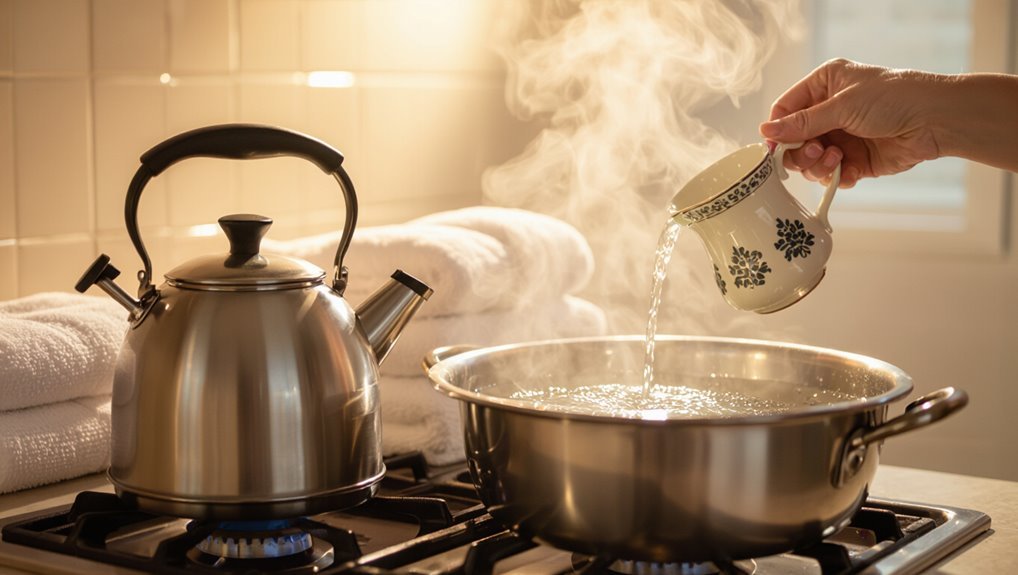
Before attempting any workaround, a brief safety checklist should be completed to shut off electrical or gas supplies and guarantee no scalding risk.
Next, a quick assessment determines whether the lack of hot water affects a single tap or the entire house, which guides the appropriate fixes.
These steps prioritize safety and help identify whether a localized repair or broader system issue is needed.
Fast safety checklist before attempting any workaround
How should someone assess risks quickly before trying a workaround for a cold-water shower?
A brief checklist:
- confirm electrical appliances are off,
- verify gas appliances and pilot lights are stable,
- check for leaks and slippery floors,
- guarantee ventilation if using portable heaters,
- have a phone within reach,
- and avoid improvised open flames.
This guidance aids safe how to take a hot shower with no hot water attempts.
Quick assessment: Is the problem local to one tap or whole house?
Is the lack of hot water confined to a single faucet or affecting the entire house?
The person checks multiple fixtures—kitchen, other bathrooms, laundry—to determine scope.
If only one tap is cold, the issue likely involves that fixture or its supply.
If all outlets lack heat, the problem points to the water heater, power/gas supply, or main shutoff requiring professional diagnosis.
Immediate short-term solutions to create hot water
When hot water is unavailable, a few quick, practical methods can produce warm water for washing and rinsing.
The following list highlights compact, immediate options that rely on common gear and simple precautions. Each approach balances speed, safety, and water control for short-term personal hygiene.
- Heat water on a stovetop or with a portable electric kettle/immersion heater, then mix in a basin for sponge baths or bucket showers.
- Use battery-powered or camp shower bags and portable shower heads for warm rinses and targeted hair washing.
- Employ a hair-washing sink method with a hand-held sprayer or pitcher to control water temperature and flow.
Use a stovetop kettle or pot to heat water
Boil water on a stovetop kettle or in a pot to produce immediate hot water for washing when the household supply is cold.
Use sturdy cookware, fill partially to prevent boiling over, and heat gradually. Transfer carefully to insulated containers or pitchers.
Test temperature before use. Supervise children, keep handles inward, and ventilate the kitchen to avoid steam buildup and accidental scalds.
Mix hot water in a large basin for a sponge bath or bucket shower
After heating water on the stove, a practical next step is to blend that hot water with cooler tap water in a large, heat‑resistant basin to create a safe, comfortable temperature for a sponge bath or bucket shower.
Use a thermometer or wrist test, mix gradually, and keep a ladle for controlled pouring.
Work from cleanest to dirtiest areas and replenish water as needed.
Battery-powered or camp shower bags for warm rinses
Consider battery-powered or solar-heated camp shower bags as quick, portable options for warm rinses when conventional hot water is unavailable.
Battery pumps attach to tanks for pressurized flow; solar bags warm in sun and require timing. These devices suit outdoor or emergency use, delivering modest volumes for rinsing.
Users should monitor temperature, secure fittings, and conserve water to maximize effectiveness.
Use a hair-washing sink method with a hand-held sprayer or pitcher
Use a hair-washing sink method with a hand-held sprayer or a pitcher to get hot water quickly for washing when the main hot supply is unavailable.
Position a basin and adjust faucet temperature to the warmest available. Test on wrist, then tilt head over basin.
Use sprayer or pour gently to rinse, working in sections.
Dry and rewarm as needed.
Portable electric kettle or immersion heater safety and use
If a hand-held sprayer or pitcher isn’t available or a larger volume of hot water is needed, portable electric kettles and immersion heaters offer immediate short-term heating.
Users should place devices on stable, heat-resistant surfaces, avoid contact with standing water, and follow manufacturer wattage and capacity limits.
Unattended operation is unsafe; allow cooling before storage and use a GFCI-protected outlet to reduce shock risk.
Taking advantage of a friend, neighbor, or gym with hot showers
Tap into nearby resources by arranging to use a friend’s, neighbor’s, or gym’s hot shower when home hot water is unavailable.
Coordinate times, confirm cleanliness and access rules, and bring toiletries and a towel. Offer compensation or reciprocity if appropriate.
Respect time limits and facility policies. This immediate option provides reliable hot water without improvisation, minimizing safety risks and disruption.
Faster full-shower options if you can access alternate heat sources
When access to alternate heat sources is possible, faster full-shower solutions can replace improvised methods and provide a more complete wash.
The options vary in setup complexity and safety considerations, so each should be evaluated before use. Common choices include:
- Temporary electric tankless (point-of-use) heater: setup and limitations
- Using a propane or gas camp shower system safely
- Connecting a portable water heater to an existing showerhead
Temporary electric tankless (point-of-use) heater: setup and limitations
Consider installing a temporary electric tankless (point-of-use) heater directly at the shower to deliver near-instant hot water without relying on a central water heater.
These units mount close to the fixture, require dedicated high-current electrical supply, and provide limited flow rates—suitable for short showers.
Users must verify amperage, circuit capacity, and local codes; expect reduced temperature if multiple outlets run simultaneously.
Using a propane or gas camp shower system safely
For faster, full showers without relying on household electric systems, a propane or gas camp shower provides a compact, high-output solution that heats large volumes of water quickly.
Users should operate outdoors or in well-ventilated areas, follow manufacturer instructions, check for leaks, use correct fuel canisters, maintain stable footing, keep flammables away, and monitor carbon monoxide risk with detectors if used near enclosed spaces.
Connecting a portable water heater to an existing showerhead
Tap into existing plumbing by attaching a portable on-demand water heater directly to the shower arm or hose, creating a hot-water source that bypasses the house tank.
Install per manufacturer instructions, secure fittings, and use pressure-rated hoses.
Verify gas or electrical supply, venting, and anti-scald settings.
Test flow and temperature before use.
Shut off and disconnect when finished to prevent leaks or theft.
Diagnosing why you have no hot water and quick fixes
When hot water vanishes, the most likely culprits include a blown pilot light, a tripped breaker, a leaking tank, thermostat failure, or internal issues like sediment and a worn anode rod.
Basic checks—confirming and safely relighting a gas pilot, resetting an electric breaker and thermostat, and inspecting for visible leaks or heavy sediment—can often restore service quickly.
If these quick checks don’t identify or fix the problem, professional inspection is advised to assess tank integrity and internal components.
Common causes: pilot light, tripped breaker, leaking tank, thermostat issues
Diagnosing a lack of hot water starts with a quick, systematic check of the most common culprits: a stalled pilot light on gas heaters, a tripped circuit breaker for electric units, visible leaks in the tank or pipes, and a malfunctioning thermostat.
Inspect breakers, look for pooling or corrosion, feel pipes for cold spots, and monitor temperature settings. Note signs requiring professional repair or replacement.
How to check a gas water heater pilot light and relight safely
If the preliminary checks — breakers, leaks, and thermostat settings — show nothing amiss, the next likely cause on gas units is an extinguished pilot light.
Inspect the pilot assembly: turn gas control to “pilot,” depress the knob, and ignite per manufacturer instructions with a long lighter or built‑in igniter.
Observe a steady blue flame; if it won’t stay lit, shut gas off and call a professional.
How to reset or check an electric water heater breaker and thermostat
Check the electric water heater’s circuit breaker and thermostat early in troubleshooting, since a tripped breaker or a failed high‑limit switch is a common, easily fixed cause of no hot water.
Inspect the breaker panel for a tripped two‑pole breaker; reset it only once.
Locate the thermostat/high‑limit on the tank, press the red reset if visible.
If reset fails, call a qualified electrician.
When to check for leaks, sediment, or anode rod problems
When hot water disappears despite a functioning breaker and thermostat, attention should turn to leaks, sediment buildup, and the sacrificial anode rod—common mechanical causes that progressively reduce tank efficiency or cause total failure.
Inspect visible fittings and floor for leaks, drain a few gallons to check sediment, and test anode condition during maintenance.
Replace corroded rods or flush the tank to restore performance.
When you should call a professional immediately
If any of the following red flags appear, a trained technician should be contacted without delay to avoid danger or further damage.
Immediate professional attention is warranted for clear gas, electrical, or carbon monoxide risks, for heaters showing end-of-life signs, or for loud failures, major leaks, or persistent lack of recovery.
Below are three specific scenarios that require calling a pro.
- Smell of gas, symptoms of carbon monoxide, or exposed electrical hazards.
- Water heater is old, corroded, or shows signs it needs replacement.
- Loud banging, major leaks, or no hot water restoration after basic troubleshooting.
Signs of gas leaks, carbon monoxide risk, or electrical hazards
Because gas, carbon monoxide, and electrical faults can escalate quickly, any strong smell of rotten eggs, persistent headache or nausea near appliances, visible sparking, frayed wiring, or unexplained pilot outages should prompt immediate professional intervention rather than DIY troubleshooting.
Trained technicians can detect leaks, measure CO levels, isolate electrical hazards, and secure systems safely; evacuate and call emergency services if symptoms are acute or gas is suspected.
Water heater age and replacement indicators
A water heater nearing the end of its expected service life or showing clear signs of failure requires immediate professional assessment.
Persistent rust, visible corrosion, frequent small leaks, or water discoloration indicate internal deterioration.
If the unit is beyond its typical 8–15 year lifespan or performance steadily declines despite basic troubleshooting, contact a licensed technician promptly to evaluate replacement options and mitigate potential property damage or safety risks.
Unexpected noises, major leaks, or no recovery after attempts
When a water heater exhibits loud banging, hissing, or continuous rattling, or when a significant leak appears or the unit fails to recover after reset and basic troubleshooting, immediate professional attention is warranted.
A plumber can assess combustion issues, sediment-induced noise, valve failures, or internal tank breaches.
Continuing use risks flooding, scalding, carbon monoxide, or complete system failure; shut off power and water until inspected.
Preventive measures to avoid future no-hot-water situations
To reduce the risk of future no-hot-water events, the article recommends a few practical preventive steps.
These include establishing a routine water heater maintenance schedule, winterizing and insulating hot water lines, and considering installation of a secondary point-of-use heater or upgrading the whole-home system.
Implementing these measures can minimize breakdowns and maintain reliable hot water service.
Routine water heater maintenance schedule
Establishing a routine water heater maintenance schedule reduces the likelihood of unexpected cold showers by catching wear and issues early.
Monthly checks for leaks, pressure relief valve function, and pilot or ignition operation, plus quarterly inspection of anode rods and sediment flushing, keep systems efficient.
Annual professional servicing verifies thermostat accuracy, combustion safety, and overall integrity to prevent failure and extend lifespan.
Winterizing pipes and insulating hot water lines
Routine heater upkeep naturally leads to attention on the distribution system: winterizing pipes and insulating hot water lines prevents heat loss, protects against freezing, and reduces demand on the heater.
Homes benefit from foam sleeve insulation on accessible pipes, sealing drafts around crawlspaces, and adding heat tape where required.
Regular inspections for gaps and worn insulation guarantee continued efficiency and fewer emergency cold-water episodes.
Installing a secondary point-of-use heater or whole-home upgrades
When freezing temperatures or aging equipment threaten hot-water supply, installing a secondary point-of-use heater or upgrading the whole-home system provides a practical safeguard against future interruptions.
Point-of-use units deliver instant, localized hot water for sinks or showers, reducing downtime.
Whole-home upgrades—tankless systems, larger tanks, or improved insulation—boost capacity and reliability.
Professional assessment guarantees correct sizing, installation, and code compliance.
Cost, time, and convenience comparison of each solution
A concise comparison of available options helps readers weigh safety, setup time, cost, and comfort when hot water is unavailable. The following quick-reference table summarizes these factors for common solutions to support rapid decision-making. This comparison emphasizes practical trade-offs so users can choose the best fit for their situation.
| Factor | Notes |
|---|---|
| Safety | Varies by method (risk of burns, slips, CO exposure) |
| Setup time | Ranges from minutes (microwave-heated water) to hours (portable water heater) |
| Cost | Low (bucket bath) to high (rental or replacement systems) |
| Comfort level | Low (cold rinse) to high (temporary heater or shower access) |
Quick-reference: safety, setup time, cost, and comfort level
Several practical alternatives exist for warming up without hot water; each varies in safety, setup time, cost, and comfort. Below is a concise comparison to aid quick choice.
| Option | Notes |
|---|---|
| Portable tankless heater | Moderate cost, fast setup, moderate comfort, safety depends on ventilation |
| Kettle or pot water | Low cost, quick, lower comfort, safe if handled carefully |
| Solar bag or camping shower | Low-medium cost, slow setup, comfortable outdoors, safe with precautions |
Practical tips for staying comfortable when hot water is limited
When hot water is scarce, practical adjustments can make hygiene and comfort manageable.
Efficient routines—short, focused washing and sequencing tasks to use remaining warm water wisely—pair well with products like washcloths, dry shampoo, and cleansing wipes to reduce the need for full showers.
Simple methods for warming towels and clothing, such as using a hot water bottle, heated rack, or brief ironing, help retain warmth after a lukewarm rinse.
Efficient showering routines to conserve warm water
Conserve warm water by planning and streamlining each step of the shower: pre-wet hair and body quickly, lather efficiently, rinse deliberately, and skip nonessential routines like long scalp massages.
Use a timed sequence—wash hair, soap torso, then limbs—so warm water serves prioritized areas.
Turn water off between rinses when feasible, reuse brief warm rinses, and finish with a short final rinse to minimize waste.
Best products to use for cold or lukewarm showers (washcloths, dry shampoo, wipes)
Although hot water may be scarce, selecting a few targeted products can make cold or lukewarm showers quick, comfortable, and hygienic.
Soft washcloths, microfiber towels, and no-rinse body wipes remove sweat and grime efficiently.
Dry shampoo refreshes roots without water.
Foaming no-rinse cleansers and antiseptic hand wipes aid hygiene.
Compact travel bottles and silicone scrubbers minimize water use and speed drying.
How to warm towels and clothing without a dryer
After using no-rinse cleansers or cold showers, warmth from towels and clothing becomes the next priority for comfort and preventing chills.
Warm items quickly by layering damp garments near a radiator, space heater, or hot water bottle (safely placed).
Use an iron, hairdryer, or oven-warmed bricks wrapped in cloth for towels.
Rotate items and avoid direct heat contact to prevent burns or fabric damage.
Step-by-step checklist to follow if you wake up with no hot water
If the morning brings no hot water, a clear, timed checklist helps prioritize actions.
First, immediate steps in the first 15 minutes focus on safety checks and quick fixes; next, short-term solutions over the following hour provide temporary warmth.
Finally, guidance for when to call a professional or replace equipment within 1 to 24 hours outlines escalation and next steps.
Immediate actions (0 to 15 minutes)
Wake up, stay calm, and move through this checklist methodically: confirm that the lack of hot water is not an isolated tap issue by quickly testing other faucets.
Check the water heater’s breaker or pilot light for obvious faults.
Look for posted notices from the building or utility about outages, and gather essentials—towels, a thermometer or cup for testing, and any warm clothing—so preparations are complete within the first 15 minutes.
Test cold tap, isolate valves, document findings, notify building management or landlord, and refrain from using appliances that depend on hot water until the issue is identified.
Short-term solutions (15 to 60 minutes)
Within the next hour, the occupant should move from assessment to pragmatic short-term fixes designed to restore warmth or minimize discomfort:
boil water on stove or electric kettle,
mix hot and cold in a large basin,
use a washcloth for sponge baths,
heat towels briefly,
run a portable water heater or camping shower if available,
limit shower time,
check portable space heater safety,
conserve heated water.
When to escalate to repairs or replacement (1 to 24 hours)
Occasionally, after short-term measures fail to restore reliable hot water, the occupant should escalate to troubleshooting and arranging repairs or replacement within the next 1–24 hours.
This checklist guides diagnosis, safety checks, and decisions about calling a professional versus performing simple fixes.
Inspect breakers, pilot lights, and valves; document symptoms and photos; attempt reset or drain-and-flush if safe.
Contact licensed plumber or HVAC tech with urgency if unresolved.
Conclusion
When the pipes run cold, a kettle’s whistle becomes a small sun, boiling comfort into tin cups and sponge baths. Each quick fix is a bridge of steam across an unexpected chill, tools and timers like oars keeping rhythm against the current of inconvenience. Learning the stove, the tank, the fuse is planting lanterns along a dark path. With knowledge and simple supplies, the household transforms frost into warmth, ready for the next morning.
