How to Flush an EcoSmart Tankless Water Heater: Step-by-Step Descaling Guide
To flush an EcoSmart tankless water heater and remove mineral buildup, follow these steps: First, isolate the power and water supply. Next, attach a submersible pump and two hoses to the service ports. Circulate white vinegar or an approved descaler for 45–60 minutes, then thoroughly flush with fresh water until it runs clear. After flushing, inspect the screens, fittings, and check for any error codes. Finally, run hot-water draws at different flows and document the service. Detailed steps and model notes are available for further guidance.
How to Flush an EcoSmart Tankless Water Heater Safely and Effectively
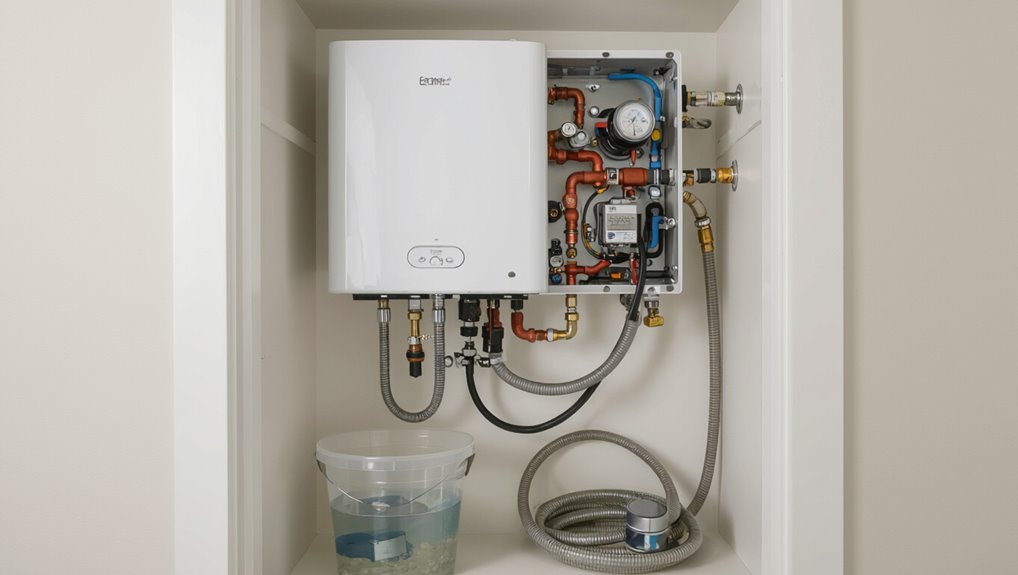
Flushing or descaling an EcoSmart tankless unit removes mineral buildup from heat exchangers and flow passages to restore efficient heat transfer.
Regular descaling preserves performance, reduces energy use and risk of damage, and helps maintain warranty compliance.
Frequency should be set by local water hardness and household use—typically every 6–12 months for hard water and annually for soft water or low-use homes.
What flushing/descaling means for EcoSmart tankless models
Descaling an EcoSmart tankless water heater involves circulating a cleaning solution through the heat exchanger to dissolve mineral buildup, restoring efficiency and preventing overheating or flow restrictions.
The process—how to flush ecosmart tankless water heater—removes scale, clears restricted flow paths, and protects internal components.
It is a focused maintenance procedure targeting limescale accumulation without altering electrical or gas systems.
Why regular descaling matters for performance and warranty
After mineral deposits are removed from the heat exchanger, routine descaling preserves the EcoSmart tankless heater’s designed performance and helps maintain warranty eligibility.
Regular descaling prevents reduced flow, overheating, inefficient heating cycles, and premature component failure.
Documented maintenance supports warranty claims and prolongs lifespan, ensuring consistent energy efficiency and reliable hot water delivery while minimizing repair costs and unexpected downtime.
Recommended frequency based on water hardness and usage
Frequency recommendations depend primarily on measured water hardness and household hot-water demand.
Systems fed by soft water and serving small households may only need descaling every 12–24 months, while hard-water locations or high-demand homes often require service every 3–6 months.
Professional testing or simple test strips guide intervals.
Adjust frequency for well water, mineral buildup, appliance age, and manufacturer warranty requirements.
Tools, Materials, and Preparations Needed
The section lists the essential tools and supplies required to flush an EcoSmart tankless water heater, including a pump, hoses, bucket, and white vinegar or descaling solution.
It also notes optional items—such as hose adapters, a water pressure gauge, and a filter brush—that can simplify the task.
Finally, it outlines safety precautions and recommended personal protective equipment like gloves and eye protection.
Required tools and supplies
Several essential tools and supplies are required to flush an EcoSmart tankless water heater properly: a submersible pump, two lengths of 3/4-inch garden hose or dedicated service valves, a 5-gallon bucket (or larger), white vinegar or a manufacturer-approved descaling solution, rubber gloves, safety goggles, and basic hand tools (adjustable wrench and screwdriver).
- Submersible pump for circulation
- Hoses for inlet/outlet connections
- Bucket to contain solution
- Appropriate descaler (vinegar or approved)
- Personal protective equipment
Optional items that make the job easier
A few optional items can streamline the flush and reduce mess: a pair of quick-connect service valves eliminates hose clamps, a clear/transparent inline filter lets debris be monitored during circulation, a longer hose simplifies reaching a distant drain, and a magnetic drain plug or hose holder prevents accidental disconnection.
- Pump with flow meter to verify circulation
- Inline pressure gauge for monitoring
- Funnel for easy vinegar transfer
- Small bucket for trapped sediment
- Soft-bristled brush for fittings cleaning
Safety precautions and personal protective equipment
Before beginning the flush, users should confirm that power and water supplies are fully isolated and that appropriate personal protective equipment (PPE) is on hand, because tankless units involve electrical components and caustic descaling solutions.
Recommended PPE includes chemical-resistant gloves, splash goggles, long sleeves, and a respirator if ventilation is poor.
Confirm a working fire extinguisher and first-aid kit are nearby.
Pre-Flush Checklist: Inspect and Prepare the Unit
Before flushing, the technician methodically shuts off power and the main water supply. Then, they open accessible faucets to relieve pressure.
They locate and identify inlet/outlet valves, service ports, and the unit filter, noting any mixing valves or water softener bypasses and setting them as needed.
A quick inspection follows to check for leaks, corrosion, or faulty sensors that could affect the flush.
Turning off power and water supply step-by-step
One important step is to shut off the EcoSmart unit’s electrical supply and isolate its cold-water inlet and hot-water outlet to prevent flow during the flush.
Then, turn off the circuit breaker, close the main isolation valves feeding and leaving the heater, and open a nearby hot faucet to relieve pressure.
Verify power is off and no water flows before proceeding.
Locating and identifying valves, service ports, and filter
With power isolated and water flow confirmed stopped, the next step is to locate the unit’s valves, service ports, and inline filter so each component can be accessed for flushing.
Identify the cold and hot shutoff valves, two plastic service ports (usually capped with Schrader-style fittings), and the inlet inline sediment filter.
Note orientations, labels, and any isolation handles before proceeding.
Bypassing components (mixing valve, water softener) if applicable
Preparedness requires verifying and isolating downstream components that could interfere with a flush. The technician confirms presence of thermostatic mixing valves and water softeners, then closes or diverts flow using bypass valves or temporary plumbing to prevent descaling solution entering or being neutralized.
Verify checks of valve positions and secure temporary connections before circulating cleaner, preserving device integrity and treatment effectiveness.
Checking for leaks, corrosion, or sensor issues before flushing
Before circulating descaling solution, the technician inspects the EcoSmart unit and nearby plumbing for signs of leaks, corrosion, or sensor damage that could be worsened by flushing.
Visual and tactile checks target fittings, valves, heat exchanger access points, and wiring connectors. Any compromise prompts repair or isolation.
Confirming intact pressure relief valve and secure electrical connections prevents further damage during the descaling procedure.
Step-by-Step Descaling Procedure
The descaling sequence begins by isolating the heater, connecting a pump and hoses, and preparing an appropriate vinegar or commercial descaling solution in a bucket.
The solution is then circulated through the unit at the recommended pump speed for the specified time before the system is flushed with clean water to remove all residue.
Finally, plumbing and power are reconnected, water is restored, and the system is purged of air.
Step 1 Isolate the heater and attach pump and hoses
Isolate the EcoSmart tankless water heater by shutting off its cold-water supply valve.
Then close the hot-water shutoff to prevent flow during the descaling.
Attach a flushing pump to the service ports or use adapter hoses on inlet and outlet.
Secure hose clamps, route hoses to a drain or bucket, and verify valves are correctly positioned.
Check for leaks before starting circulation.
Step 2 Prepare vinegar or descaling solution and bucket
With the pump and hoses in place and valves confirmed, attention turns to preparing the descaling fluid and collection bucket.
Mix a 4–1 or manufacturer-recommended ratio of white vinegar to water or use a commercial descaler per instructions.
Use a clean, chemical-resistant bucket sized to hold the solution and displaced water.
Wear gloves and goggles; label the bucket to prevent accidental use.
Step 3 Circulate solution through the unit (time, pump speed)
Begin circulating the descaling solution through the heater by starting the pump at a low to moderate speed to prevent splashing and pressure spikes; aim for a steady flow that keeps the solution moving without forcing it through too quickly.
Maintain circulation for 45–60 minutes, monitoring pump temperature and hoses.
Adjust speed if agitation or leaks occur.
Record start and end times for proper dwell.
Step 4 Flush with clean water to remove residue
Flush the system with fresh water to remove all descaling solution and loosened scale, ensuring no chemical residue remains inside the heater or connected lines.
Run a continuous flush through the service valves until the discharge runs clear and pH is neutral if tested.
Inspect inlet and outlet screens, hose connections, and the pump for remaining debris.
Stop when effluent is visibly clean.
Step 5 Reconnect plumbing, restore water and power, and purge air
Reattach the hot and cold service hoses or shutoff valve fittings to the heater, ensuring all connections are tight and that any protective caps or screens are replaced.
Slowly open the inlet and outlet shutoff valves to refill the unit, then restore power per manufacturer instructions.
Cycle hot taps to purge air until steady flow and consistent temperature are achieved.
Check for leaks and proper operation.
Post-Flush Verification and Maintenance Tasks
After flushing, verification guarantees the EcoSmart unit operates at the correct output and maintains consistent water temperature under load.
The technician should inspect all fittings for leaks, review the unit display for any error codes, and document findings.
Finally, perform any required reset procedures and run a final system check before returning the heater to normal service.
How to test for proper operation and temperature consistency
Begin verification by running the heater through a sequence of hot-water draws at representative fixtures to confirm steady ignition, consistent flow, and stable outlet temperatures.
Measure outlet temperature with a thermometer at each fixture, note response time from tap opening to steady heat, and guarantee temperature matches setpoint within ±2°F.
Repeat at low, medium, and high flow rates to verify consistency and responsiveness.
Inspecting for leaks and checking error codes
A thorough visual and electronic check is essential to confirm system integrity and identify any faults following a flush.
The technician inspects all fittings, valves, and pump connections for drips or corrosion, tightens as needed, and verifies no water pools.
The control panel is scanned for error codes; codes are recorded, referenced against the manual, and addressed per troubleshooting guidance.
Reset procedures and final system checks
With leaks addressed and any error codes documented and handled, the technician moves on to reset procedures and final system checks to confirm the EcoSmart unit is operating correctly post‑flush.
They restore power, follow manufacturer reset steps, verify inlet/outlet temperatures, confirm stable flow and pressure, inspect for residual leaks, and monitor for error recurrence during several minutes of operation.
Record maintenance actions and schedule next service.
Troubleshooting Common Problems During or After Flushing
If error codes appear during the flush, the guide recommends consulting the unit’s manual to identify code meanings and following reset or diagnostic steps before proceeding.
Persistent scale or reduced flow after descaling should prompt a repeat flush, inspection of inlet filters and valves, and verification of proper bypass and pump operation.
If problems persist or electrical, gas, or internal component issues are suspected, contact a qualified service technician.
What to do if unit shows error codes during flush
When error codes appear during a flush, consult the heater’s manual for the exact meaning and recommended action, then stop the flushing process to prevent damage. Record the code, document conditions (pump running, water flow), and power-cycle the unit. If code persists, contact EcoSmart support and do not resume flushing until cleared.
| Code | Possible cause |
|---|---|
| E# | Electrical fault |
| F# | Flow/pressure issue |
Handling persistent scale or reduced flow after descaling
After addressing error codes and confirming the unit is clear, attention should turn to persistent scale or reduced flow that remains after a descaling cycle.
Inspect inlet screen and filters, repeat a shorter vinegar or citric acid flush, increase pump circulation time, and run hot water to purge loosened deposits.
Check supply valves for partial closure and verify adequate cold-water pressure before resuming normal operation.
When to call a professional
Although many flushing issues can be resolved with basic inspections and repeat maintenance, certain signs indicate the need for professional service: severe corrosion, persistent low flow despite multiple descalings, error codes that reset but recur, fuel or electrical faults, leaks from internal components, or unusual noises and overheating.
A technician can perform diagnostics, replace damaged parts, and guarantee safe electrical/gas handling and warranty compliance.
Comparison of Descaling Methods and Solutions
The article compares common descaling options for an EcoSmart tankless heater, weighing vinegar against commercial descalers regarding effectiveness and safety.
It also contrasts in-place flushing by the owner with hiring a professional, outlining the main pros and cons of each approach.
Clear criteria—cost, time, risk to components, and environmental impact—frame the comparison.
Vinegar vs. commercial descalers: effectiveness and safety
How does plain white vinegar compare with commercial descalers for removing mineral buildup from an EcoSmart tankless water heater? Vinegar is affordable and safe for occasional flushes but slower and less potent on heavy scale. Commercial descalers act faster and handle stubborn deposits yet can be harsher and require careful handling.
| Vinegar | Commercial descalers |
|---|---|
| Cost-effective | Faster action |
| Mild | More potent |
| Readily available | Chemical precautions |
| Slower on heavy scale | Professional-strength |
| Safer for seals | May void warranties |
Pros and cons of in-place flush vs. professional service
Having weighed vinegar against commercial descalers, attention shifts to whether homeowners should perform an in-place flush themselves or hire a professional service.
Homeowners gain cost savings and control; professionals offer expertise and warranty protection.
Consider risks, time, equipment, and confidence.
- Cost savings
- Technical skill required
- Time investment
- Warranty/insurance coverage
- Reliability and thoroughness
Tips to Reduce Scale Buildup and Extend Unit Lifespan
Recommendations for water treatment and softeners can greatly reduce mineral buildup and protect the EcoSmart unit.
Simple habits—such as periodic inlet filter checks, running a brief flush after long inactivity, and monitoring outlet temperatures—help minimize maintenance frequency.
Keeping a dated maintenance log with receipts and service notes preserves warranty coverage and creates a clear service history.
Water treatment and softener recommendations
Because mineral buildup directly reduces efficiency and shortens component life, proactive water treatment is essential for EcoSmart tankless heaters in hard water areas.
Install a point-of-entry water softener sized for household flow rates to reduce hardness. Consider salt-based or high-capacity ion-exchange systems; template filters and scale inhibitors can supplement protection.
Maintain softener regeneration and test water hardness annually for ideal performance.
Simple habits and checks to minimize maintenance frequency
Beyond installing and maintaining a softener, simple daily and periodic habits greatly reduce scale buildup and extend an EcoSmart tankless heater’s service life.
Regular quick checks prevent problems:
- Inspect inlet filter monthly.
- Monitor flow and temperature drift.
- Use low‑flow fixtures where appropriate.
- Flush if usage or water hardness rises.
- Schedule annual professional inspection for heating elements and connections.
How to document maintenance for warranty and service history
Accurate, dated records of inspections, flushes, filter cleanings, softener service, and any professional visits provide the clearest evidence for warranty claims and help track patterns of scale buildup over time.
Record technician names, service details, parts replaced, and water hardness readings.
Store receipts, photos, and manuals digitally and in hard copy.
Review logs annually to adjust maintenance schedules and support future claims.
Model-Specific Notes and Manufacturer Guidelines
Different EcoSmart models (for example ECO 11 and ECO 27) have specific temperature limits and service requirements that affect flushing frequency and procedures.
Users should follow EcoSmart’s written instructions to avoid voiding the warranty and to guarantee safe operation.
Observing model-specific guidelines and manufacturer recommendations guarantees proper maintenance and preserves warranty coverage.
EcoSmart model considerations (e.g., ECO 11, ECO 27) and temperature limits
EcoSmart offers several tankless models with varying flow rates and heating capacities—most commonly the ECO 11 for point-of-use applications and the ECO 27 for whole-house use—and each model has specific temperature and electrical limits that affect safe flushing procedures.
Technicians should verify model-specific max outlet temperature, recommended bypass flow, and electrical ratings before descaling.
Adhere to temperature caps to prevent element damage.
Warranty implications and following EcoSmart instructions
Because warranty coverage can be voided by improper maintenance, technicians must follow the manufacturer’s descaling procedures and model-specific instructions precisely.
Documentation of service, use of approved chemicals, recommended flow rates, and adherence to safety warnings preserves coverage.
Deviations, unauthorized parts, or undocumented repairs can nullify claims.
When uncertain, contact EcoSmart support for clarification before proceeding to protect both warranty and system integrity.
Quick Reference: Condensed Flush Procedure Checklist
Begin by gathering the required tools and materials: a submersible pump, two hoses, a bucket, a five-gallon container of white vinegar (or descaling solution), adjustable wrench, and safety gloves.
The technician follows a concise checklist to complete the flush efficiently:
- Isolate power and water supply.
- Connect pump and hoses to service valves.
- Circulate vinegar for recommended time.
- Rinse system until clear.
- Restore supply and test operation.
Conclusion
Regular descaling preserves an EcoSmart tankless water heater’s efficiency and longevity, returning performance as reliably as a well-tuned instrument. Following the outlined safety checks, correct tools, and step-by-step flush guarantees mineral deposits are removed without harming the unit. Post-flush verification and routine maintenance confirm proper operation and help prevent future buildup. Adhering to manufacturer guidance and choosing appropriate descaling solutions protects warranty coverage and maximizes years of dependable hot water service.