
Fix PVC Pipe Fast: Simple DIY Steps to Repair Leaks & Cracks
Quick PVC Leak Repair Guide:
To stop a PVC leak quickly, follow these steps:
1. Shut Off Water: Turn off the nearest shutoff valve and open a faucet to relieve pressure.
2. Inspect the Damage: Examine the pipe for pinholes, cracks, or joint failures.
3. Choose Your Repair Method:
- For tiny holes, use epoxy putty or self-fusing tape.
- For larger breaches, wrap the area with fiberglass or install a slip or mechanical coupling after cutting and deburring the pipe.
4. Permanent Fix: If conditions permit, solvent-weld a replacement section for a lasting solution.
Key Takeaways:
- Always relieve pressure before inspection.
- Select the appropriate repair method based on the size of the damage.
- Consider a permanent fix for long-term reliability.
Continue for more detailed step-by-step tips, tools, and safety notes.
Quick Emergency Fixes for a Leaking PVC Pipe (Do This First)
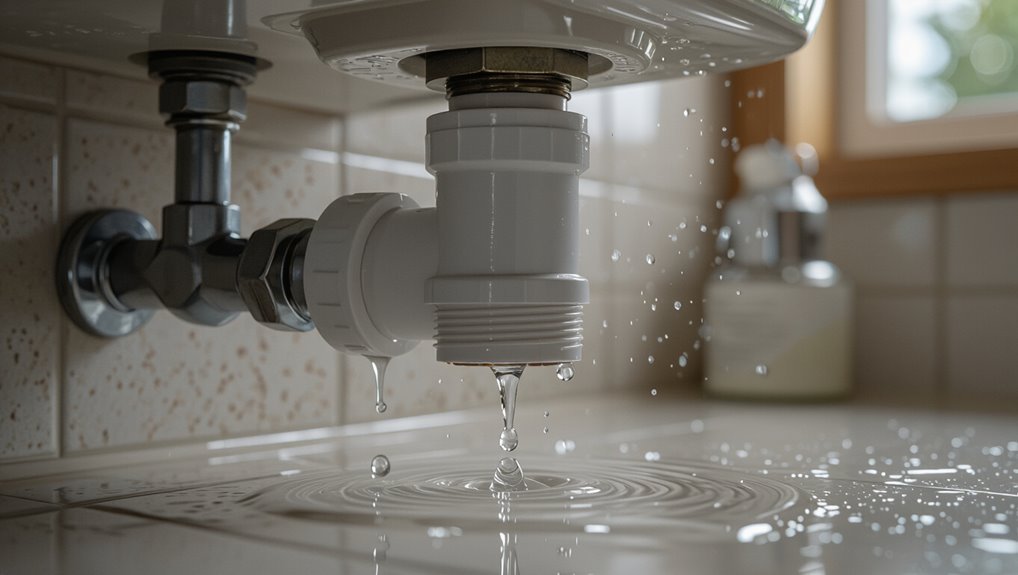
When a PVC pipe begins to leak, the immediate priority is to stop water flow and limit damage: shut off the nearest shutoff valve or the main water supply, then open downstream faucets to relieve pressure.
The observer should dry the area and assess the leak type: pinhole, crack, joint failure.
For temporary containment, apply plumber’s tape around small holes, wrap the section with a rubber patch held by hose clamps, or use an epoxy putty rated for wet conditions.
Larger ruptures require cutting out the damaged segment and capping both ends until permanent repair can be arranged.
Document location and note materials used.
Why Fast PVC Repairs Prevent Water Damage and Extra Cost
Stopping a leak quickly limits water exposure to surrounding materials, preventing soaked insulation, warped wood, mold growth, and electrical hazards that compound repair needs.
Prompt PVC repairs reduce the area and duration of wetting, lowering labor and material expenses for drywall, flooring, and framing replacements.
Early intervention preserves structural integrity and indoor air quality, avoiding costly mold remediation and potential health liability.
Quick fixes also prevent secondary corrosion or damage to nearby metals and fixtures, limiting the need for wholesale system replacement.
How to Tell If a PVC Pipe Leak Is an Emergency
A leak that produces visible water gushing or a spray clearly qualifies as an emergency.
Rapid pressure loss in the system is another sign that immediate action is needed.
Any leak threatening structural elements or electrical systems should be treated as urgent.
Visible Water Gushing
Visible water gushing from a PVC joint or break generally signals an urgent situation that requires immediate attention.
Observers note steady, forceful flow, spraying, or a stream that cannot be contained with a bucket or towel.
This type of leak often causes rapid surface flooding, damage to nearby materials, and visible erosion of soil or bedding.
Immediate steps include isolating the water source at the nearest shutoff, clearing the area to prevent injury, and contacting a qualified plumber if repairs exceed basic temporary measures.
Prompt action minimizes property damage and prevents secondary hazards such as electrical contact or mold growth.
Rapid Pressure Loss
Detecting a sudden drop in water pressure is a key indicator that a PVC pipe leak may be an emergency.
Rapid pressure loss often signals a significant rupture or fast escape of water, requiring immediate attention to prevent flooding, property damage, or interrupted water supply.
Observers should note rate of decline, location clues (sounds, damp areas), and whether multiple fixtures are affected.
Quick isolation of the supply and calling professional help are prudent when loss is abrupt and widespread.
- A hiss and swift loss as a shower sputters into a trickle.
- Water meter spinning despite closed fixtures.
- Wet patches spreading along a basement wall.
Structural Or Electrical Risk
When leaking PVC comes into contact with building structure or electrical systems, the situation can escalate from a plumbing repair to an immediate safety emergency.
Water soaking wooden framing, drywall, or insulation weakens structural integrity, risks mold, and can cause sagging or collapse if left unchecked.
If leaks reach outlets, junction boxes, or wiring, they create shock and fire hazards.
Signs of emergency include rapidly spreading dampness, visible rot, sparking, tripped breakers that persist, or exposed live wiring near moisture.
In such cases, occupants should evacuate the area, shut off water and power if safe, and call professionals immediately.
How to Shut Off Water and Relieve Pressure Safely
The next step explains how to stop water flow and reduce pressure before any PVC repair.
First, locate and close the main shutoff valve or the valve serving the affected branch.
Then turn off nearby fixtures and open a faucet or drain valve to relieve trapped pressure safely.
Locate Main Shutoff Valve
Where is the main shutoff valve and how to reach it quickly are the first priorities before any PVC repair begins; locating that valve and understanding how to close it safely prevents water damage and makes pressure relief straightforward.
One should check near the water meter, garage, basement wall, or where the service line enters.
Identify a gate or ball valve, note its turn direction, and keep a wrench nearby.
After closing, open a faucet to confirm flow stops and relieve pressure.
If unclear, consult a utility map or contact the water provider for valve location and access instructions.
- Basement meter corner
- Garage wall pipe
- Exterior curb box
Turn Off Relevant Fixtures
After the main shutoff has been located and closed, attention should turn to shutting off fixtures that can feed the PVC section being worked on. Identify nearby sinks, toilets, appliances, hose bibs and irrigation zones served by the same branch. Close individual shutoff valves under sinks and behind toilets; shut appliance supply valves. If a fixture lacks a local valve, close its service valve or cap the supply line upstream. Verify positions visually and by attempting to operate fixtures briefly to confirm no flow. Label any valves adjusted for restoration.
Maintain a clean, accessible workspace while proceeding to pressure relief steps.
Relieve Line Pressure Safely
Begin by confirming all relevant shutoff valves are fully closed, then open a nearby faucet or fixture at the highest point on the affected branch to relieve trapped pressure and allow air into the line.
Next, bleed lower fixtures and outdoor spigots to draw water out; a pressure gauge may verify zero PSI. Wear safety glasses and gloves in case residual water ejects.
Cap or plug the section to be repaired once flow stops. Work methodically; pause if pressure persists and recheck valves.
- Water drips from an upstairs sink.
- A basement spigot sputters then clears.
- A pressure gauge reads zero.
How to Locate Hidden PVC Pipe Leaks Without Demolition
With sound, thermal imaging, and dye testing, a hidden PVC leak can be found without tearing out walls or floors. A methodical approach isolates the source: listen for running water with a stethoscope, scan surfaces with an infrared camera for cool spots, or introduce nonstaining dye into the line and watch fixtures. Pressure testing localizes sections. Inspect joints, fittings, and bends where stresses concentrate. Record findings and mark access points before cutting. If uncertain, use sequential isolation to narrow the area. Documentation reduces unnecessary demolition and speeds targeted repair.
| Method | Signal | Typical Use |
|---|---|---|
| Acoustic | Drip/tap | Behind drywall |
| Thermal | Cool patch | Under floors |
| Dye | Colored flow | Fixture tracing |
Essential Tools for Quick PVC Pipe Repairs
A compact toolkit and a selection of sealing materials enable fast, reliable PVC pipe repairs.
Basic hand tools—pipe cutters, adjustable wrench, pliers, and a deburring tool—handle most cut-and-fit tasks.
Solvent cement, primer, waterproof tape, and epoxy putty provide permanent or temporary seals depending on the repair needed.
Basic Hand Tools
Properly equipped, a quick PVC pipe repair relies on a small set of hand tools that cover cutting, joining, measuring, and securing. The list below evokes the practical kit used by a confident DIYer: a sharp cutter, measuring device, cleaning implements, and fastening tools.
Each tool serves a clear purpose—clean cuts, accurate fit, surface prep, and firm connections—minimizing errors and rework. Compact, inexpensive, and easy to store, these basics enable speedy, reliable repairs without specialty machinery.
Preparedness reduces downtime and frustration when a leak appears, turning a potential mess into a short task.
- PVC pipe cutter and deburring tool
- Tape measure and marker
- Utility knife and channel-lock pliers
Sealing Materials
How best to stop a leak quickly often depends on selecting the right sealing materials for the job. The section outlines common options: PVC cement for joints, epoxy for cracks, silicone for temporary seals. Each material’s strengths, cure times, and surface prep requirements are summarized so readers can choose efficiently. Proper selection reduces repeat fixes and water damage.
| Material | Best for | Cure time |
|---|---|---|
| PVC cement | Permanent joint bonds | Minutes |
| Epoxy putty | Small cracks, molded patches | 5–60 min |
| Silicone sealant | Temporary or external sealing | Hours |
Supplies: Primers, Cements, Epoxies, Wraps, and Tapes
Beginning with the right adhesives and sealants, the effectiveness of any PVC repair depends on selecting compatible primers, cements, epoxies, wraps, and tapes that match pipe material, pressure rating, and exposure conditions. The writer notes quality choices: clear PVC primer for proper joint fusion, medium-bodied solvent cement for schedule 40 fittings, and food-grade or potable-water approved products where required.
Epoxy putties fill irregular cracks; fibreglass or resin wraps reinforce under pressure; self-fusing silicone or butyl tape provides temporary stops. Compatibility, cure time, temperature limits, and safety data sheets guide selection to guarantee durable, code-compliant repairs.
- Primer and cement pair
- Epoxy putty
- Wrap or tape
How to Clean and Prep PVC Pipe for a Reliable Repair
Clean and prepare the pipe surface thoroughly before any adhesive or wrap is applied to guarantee a lasting repair.
Remove loose debris, flaking paint, and corrosion with a wire brush or abrasive pad.
Cut away damaged sections to reach solid material.
Degrease with a cloth dampened in isopropyl alcohol or a mild solvent; avoid residues.
Sand the area lightly to create a uniform, slightly roughened profile for better bonding.
Wipe away dust with a clean, dry rag and allow the pipe to air dry completely.
Mark the repair zone clearly and make certain surrounding components remain dry and accessible before proceeding.
Fix Hairline Cracks in PVC Pipe With Epoxy Putty
To repair hairline cracks in PVC pipe, mix a two-part epoxy putty and apply it directly over the cleaned, dry area, pressing firmly to fill the fissure and smooth the surface before it sets. The technician guarantees surrounding pipe is dry, removes loose debris, kneads putty to uniform color, then molds a low-profile patch that conforms to pipe curvature.
After curing, the surface is lightly sanded and inspected for gaps. The repair restores pressure tolerance for small leaks and delays replacement.
- Palms warm putty, sealing a thin white line.
- Fingers press, smoothing a seamless bead.
- Sandpaper refines a flush finish.
Patch Larger PVC Cracks Using Fiberglass Wrap
For larger PVC cracks, the pipe must be cleaned, dried, and lightly sanded to guarantee proper adhesion of repair materials.
The fiberglass wrap is then saturated with resin and tightly wound around the damaged area, overlapping each pass for strength.
Curing time and a final inspection confirm a secure, watertight seal.
Preparing The Surface
Before applying fiberglass wrap, the damaged area should be dry, free of loose debris, and sanded to a dull finish to guarantee adhesion. The technician inspects the crack length and surrounding stress marks, removes flaky paint or residue with a scraper, and dries the pipe thoroughly with a cloth or heat source.
Edges are feathered so the wrap lays flat; oil, grease, and moisture are eliminated with a solvent wipe. A small test area confirms no remaining contamination. Preparedness reduces cure failures and extends repair life.
- Scuffed surface showing uniform dullness.
- Clean, solvent-wiped pipe circumference.
- Crisp, feathered crack edges.
Applying Fiberglass Wrap
With the surface prepared, the technician measures and cuts enough fiberglass cloth to overlap the damaged area by at least one inch on all sides. The cloth is saturated with resin, wrapped smoothly around the pipe, and layered to build strength. Care is taken to avoid air pockets; each pass is compressed and aligned. Curing follows manufacturer times, after which excess is trimmed and sanded for a neat finish. Pressure testing confirms integrity before reinstallation. The method suits larger cracks and mid-span repairs where clamps or epoxy alone are insufficient.
| Step | Purpose |
|---|---|
| Cut cloth | Coverage |
| Saturate | Bonding |
| Wrap | Reinforcement |
| Cure | Strength |
| Test | Validation |
Stop a Leaking PVC Joint With Silicone/Self-Fusing Tape
When a PVC joint begins to weep, silicone or self-fusing tape offers a quick, temporary seal that can stop the leak without disassembling the piping. The area is wiped dry and cleaned; tape is stretched and overlapped tightly, fusing into a seamless rubbery layer that resists pressure and water. This method suits small joint leaks and urgent fixes, not permanent repairs.
Remove old residue, wrap from upstream toward downstream to counter pressure, and smooth layers to eliminate gaps. Check the seal under gradual pressure before restoring full flow.
- gloved hands stretching tape
- tight overlapping layers
- smooth, seamless finish
Replace a Short Damaged PVC Pipe Section With Couplings
Cut out the damaged section and install couplings to restore a short run of PVC pipe.
A clean removal creates square ends; deburr and dry-fit replacement and couplings to confirm alignment.
Apply primer to both pipe ends and coupling interiors, then solvent cement; push the coupling onto one end, rotate slightly, and hold per manufacturer time.
Insert the replacement pipe section into the opposite coupling half, ensuring full insertion depth.
Wipe excess cement and allow cure before pressurizing.
For threaded or compression couplings, follow their sealing procedure and torque limits.
Test under normal pressure, inspect for leaks, and re-support the repaired run.
How to Measure and Cut PVC Pipe for an Exact Fit
For an exact fit, measure from the prepared pipe end to the mark on the replacement piece, account for coupling insertion depths, and transfer the total length clearly before making any cuts.
A tape measure and a square guarantee right angles; note that sockets require additional insertion allowance.
Mark the cut line sharply with a fine permanent marker, sighting around the circumference to keep the line level.
Use a miter box or pipe cutter for straight, burr-free cuts.
Deburr and chamfer the outer edge lightly to ease coupling fit and solvent flow; re-measure after trimming small amounts to preserve the planned length.
- Tape measure and square
- Fine marker around circumference
- Miter box or pipe cutter
Dry-Fit and Mark PVC Pipe Parts Before Gluing
Before applying any adhesive, the installer dry-fits all PVC parts to confirm proper fitment and make any final adjustments.
Once pieces sit correctly, alignment is marked externally to ensure joints orient as meant after gluing.
A depth mark on the pipe and inside the fitting is added to guarantee full insertion without over- or under-seating.
Dry-Fit For Fitment
With parts temporarily assembled and aligned, the installer dry-fits each PVC segment to check for proper length, orientation, and clearance before any adhesive is applied. The process verifies socket engagement, secures threaded or slip joints sit flush, and reveals interference with nearby fixtures. Small adjustments prevent forced connections that cause misalignment or stress.
- Two pipe ends slide together to confirm full insertion without binding.
- A fitting rotated through its range shows if other lines or walls obstruct movement.
- Temporary clamps hold sections while the installer inspects gaps, angles, and seating stability.
Mark Alignment And Depth
Why is marking alignment and depth critical? The installer dry-fits each PVC joint, inspects orientation, and notes how far the pipe inserts into the fitting. Small pencil or marker ticks on both pipe and fitting record rotational alignment and insertion depth.
These marks prevent misalignment during adhesive application, preserving flow direction, slope, and position of branches. They also guarantee full insertion without over- or under-seating, which can cause leaks or weakened joints. After solvent cement is applied, the parts are quickly reassembled using the marks as guides, held briefly until set, producing reliable, correctly aligned connections.
How to Apply PVC Primer and Solvent Cement Correctly
When preparing PVC joints, applying primer and solvent cement correctly assures a chemically fused, leakproof connection rather than a simple mechanical fit. The surface is wiped clean, primer brushed onto both socket and pipe, softening the plastic for fusion.
Solvent cement is applied generously to the same areas, rotating the pipe into the socket for even distribution; excess is wiped away. Alignment marks guarantee proper orientation during the brief working time. Protective gloves and ventilation are used to avoid fumes and skin contact.
- Purple primer blooming on white PVC.
- Wet, glossy cement at the joint.
- A clean, aligned seam.
How Long Solvent-Welded PVC Pipe Needs to Cure
Cure time for solvent-welded PVC varies with joint size and the specific cement used, with initial set often occurring in minutes but full cure taking longer.
It is recommended to wait before applying full working pressure—typically 24 hours under normal conditions—to guarantee a reliable bond.
Temperature, humidity, and joint thickness can speed or slow curing and should be considered when scheduling a return to service.
Cure Time Basics
Solvent-welded PVC joints require an initial set period followed by a longer full-strength cure time that depends on pipe diameter, ambient temperature, humidity, and solvent cement type.
Typical initial handling times range from 2–15 minutes for small diameters; larger pipes may need an hour or more before movement.
Full cure often takes 24–48 hours at moderate temperatures but extends in cold or damp conditions.
Faster-setting cements shorten wait; heavy-wall or pressurized systems demand longer stabilization.
Visual and tactile checks help assess readiness without applying pressure prematurely.
- small pipe — quick tack, fragile at first
- larger pipe — slow bonding, requires patience
- cold/damp — extended wait, slower solvent evaporation
Full Pressure Wait
In most installations, the full-pressure wait is the period after initial handling during which bonded PVC joints develop sufficient tensile and shear strength to resist internal pressure without leak or failure.
During this interval, adhesives cure internally and mating surfaces fuse; mechanical integrity increases until the joint can safely carry system pressure.
Typical guidance recommends waiting at least 15–60 minutes for small-diameter, low-pressure runs and up to 24 hours for larger diameters or critical lines.
Verification by gentle pressure testing is advised before full service.
Adhering to manufacturer instructions and allowing the full-pressure wait prevents premature stress on incompletely cured joints.
Environmental Effects
Under varying ambient conditions, the time required for a solvent-welded PVC joint to develop usable strength can change substantially. Temperature, humidity, and joint size influence cure rate: warm, dry air speeds solvent evaporation and chemical fusion; cold or humid conditions slow solvent migration and polymer melding.
Manufacturers’ cure charts give ranges, but practical waits should be conservative to avoid failure. For safety, pressure testing should follow full cure recommendations. Visual inspection cannot confirm internal fusion; allow longer in marginal environments.
Consider temporary supports or delays in service when conditions are unfavorable to guarantee durable, leak-free joints.
- Sun-baked rooftop pipe.
- Damp basement corner.
- Frosty outdoor trench.
Repair Pressurized PVC Pipe Without Shutting the Main
Emergency repairs to pressurized PVC can be performed without shutting off the main by isolating the damaged section, controlling flow locally, and installing a temporary sleeve or clamp designed for live systems.
A plumber or experienced DIYer first relieves pressure at the immediate area using inline shutoffs, ball valves, or squeeze-off tools suited to PVC.
After drying and cleaning the pipe, a rubber gasket sleeve or emergency repair clamp is positioned over the breach and tightened per manufacturer instructions.
For longitudinal cracks, wrap reinforced repair tape or use a compression coupling rated for live service.
Monitor for leaks and plan permanent replacement promptly.
Fix PVC Pipe in Tight or Awkward Spaces (Workarounds)
Navigate cramped spaces around PVC runs by planning access, tool selection, and compact repair methods before cutting or disassembling any fittings.
Workarounds favor minimal dismantling: flexible shaft saws, ratcheting cutters, and slip-on repair couplings that slide into place without full joint removal.
Inspect for nearby supports, electrical, or insulation that restrict movement.
Keep parts organized and reachable; use magnetic trays or labeled bags.
When solvent cementing is impossible, employ mechanical clamps or epoxies rated for wet service.
Prioritize safety with eye protection and steady bracing.
Quick, deliberate steps reduce rework and prevent damage in confined plumbing scenarios.
- Flexible shaft saw and narrow blade
- Slip-on repair coupling
- Ratcheting mini cutter
Repair Outdoor PVC Pipe Exposed to Sun and Cold
When exposed to sunlight and freezing temperatures, PVC becomes brittle, discolors, and loses joint integrity, so repairs must address UV degradation, thermal contraction, and potential frost-related cracking.
Inspect for surface chalking, hairline cracks, and loose fittings.
Cut out and replace compromised sections with UV-rated PVC or CPVC, using primer and solvent cement per manufacturer instructions.
Wrap exposed joints with UV-resistant tape or heat-shrink sleeve for extra protection.
Insulate vulnerable runs with foam pipe insulation and consider applying a UV-blocking paint or wrap.
For recurring freeze damage, reroute pipe below frost line or add heat tape and proper drainage.
Fix PVC Pipe in Irrigation and Sprinkler Lines
When a sprinkler or irrigation line leaks, the first step is to locate the leak and shut off or isolate that section to stop water flow.
Once isolated, the damaged area can be cut out and replaced using a slip coupling sized to the pipe. This method restores pressure integrity quickly and minimizes disruption to the system.
Locate and Isolate Leak
Start by shutting off the main water supply and observing the system to pinpoint the leak’s general area: listen for hissing or rushing sounds, watch for wet spots or unusually saturated soil, and note sections of pipe or fittings that remain under pressure after valves are closed.
The inspector traces visible lines, feeling for dampness and checking joints, emitters, and buried sections.
Mark suspected spots with flags or spray paint.
Isolate the compromised zone by closing nearby zone valves or installing temporary shutoffs so repairs won’t affect the entire system.
- Muddy patch near a joint
- Spray of water from a crack
- Constantly wet turf
Repair With Slip Coupling
A slip coupling provides a straightforward, reliable method for repairing short sections of broken PVC in irrigation and sprinkler lines without replacing large runs of pipe. The damaged segment is cut out, ends deburred and cleaned, then primer and cement are applied. The slip coupling slides over one end, the pipe is repositioned, and the coupling is centered before the cement sets. Pressure testing confirms the seal. This technique saves time and materials, works in tight trenches, and restores flow quickly.
| Tool | Action | Benefit |
|---|---|---|
| Saw | Remove damage | Clean cut |
| Primer | Prep surface | Strong bond |
| Cement | Join pieces | Leak-proof |
Fix PVC Drain (DWV) Pipe and Common Trap Issues
In tackling PVC drain (DWV) pipes and common trap issues, the technician first inspects joints and fittings for hairline cracks, misalignments, and improper solvent welds that often cause leaks or blockages. He clears sags and improper slopes, removes hair and debris from traps, and checks for frozen or crushed sections in tight runs. When corrosion or brittle PVC mandates replacement, he measures and cuts back to sound pipe, deburrs edges, and dry-fits replacement bends and traps before solvent welding. Proper venting and accessible cleanouts are verified to prevent recurring backups.
- A bowed trap holding standing water.
- A misaligned hub weeping slowly.
- A clogged P-trap full of hair.
Mechanical Couplings vs. Solvent Welding: When to Use Each
The section compares mechanical couplings and solvent welding for PVC repair, outlining how each method works and their typical applications.
It summarizes mechanical coupling basics—flexibility, ease of installation, and suitability for temporary or misaligned joins—then explains solvent welding as a permanent, fused connection for straight, load-bearing runs.
Guidance is provided on choosing between them based on repair permanence, alignment, and code or pressure requirements.
Mechanical Coupling Basics
Mechanical couplings and solvent welding are two distinct approaches to joining PVC pipe, each suited to different repair scenarios and performance needs. Mechanical couplings use clamps, gaskets, and bolts to join cut or damaged sections without chemical bonding. They allow quick alignment, future disassembly, and handle moderate pressure when installed correctly. Ideal for temporary fixes, tight spaces, or when heat and solvents are undesirable. Selection depends on pipe size, pressure rating, and movement.
Typical components and imagery:
- Two pipe ends inserted into a rubber gasket encircled by a metal sleeve.
- Bolts tightened evenly to compress the seal.
- A snug, removable joint ready for testing.
Solvent Welding Explained
When joined by solvent welding, PVC pipes fuse into a single, continuous piece as solvent softens the plastic surfaces and the material reconstitutes across the joint. Solvent welding creates a permanent, watertight bond ideal for pressure lines and buried runs where movement is minimal.
Preparation requires clean, square-cut ends, primer to remove contaminants and slightly soften surfaces, and application of appropriate PVC cement for a set time. Alignment must be precise before the cement sets. Cures vary with temperature and pipe size; testing should wait until full cure. Disassembly is not feasible without cutting the welded section out.
When To Choose Which
Choosing between solvent welding and mechanical couplings comes down to factors like permanence, ease of installation, movement, accessibility, and service conditions.
The writer notes solvent welds suit permanent, pressurized runs with clean, accessible pipes; they form a rigid, leakproof bond.
Mechanical couplings excel for repairs, misaligned cuts, or sections needing future disassembly, absorbing vibration and slight movement.
Temperature, chemical exposure, and code requirements also influence choice.
Consider tools, cure time, and desired longevity when deciding.
- Visualize a seamless, permanent joint.
- Picture a quick, removable repair clamp.
- Imagine a flexible coupling bridging misaligned ends.
When a Temporary PVC Repair Is Acceptable : And When Not
In emergency situations or during a short-term project, a temporary PVC repair can provide a quick, effective stopgap to prevent water damage or allow continued use of a system until a permanent fix is installed.
Temporary fixes suit low-pressure lines, non-potable systems, hard-to-access locations pending planned downtime, or when parts are unavailable. They are inappropriate for buried mains, potable water lines, high-pressure systems, or where failure risks safety, contamination, or major property loss.
Temporary measures must be clearly marked, documented, and scheduled for prompt permanent repair by qualified personnel to safeguard long-term reliability and code compliance.
Common Mistakes That Cause PVC Repairs to Fail (And How to Avoid Them)
Often, PVC repairs fail because one or more basic steps are skipped or executed poorly. The detached observer notes common errors: dirty surfaces, wrong adhesive, and improper alignment. Each undermines bond strength and longevity. Clean solvent-weld joints thoroughly; use the correct primer and cement for pressure or drain lines; allow recommended set times.
Avoid oversized fittings or forcing joints, which create stress points. Poor cuts or uneven chamfers prevent full seating. Attention to surface prep, correct materials, and careful assembly prevents repeat leaks and reduces the need for future repairs.
- Dirty joint surfaces
- Wrong cement/primer
- Misaligned or stressed joints
How to Test Your PVC Pipe Repair for Leaks and Pressure
How can one confirm a PVC repair will hold under normal use? After curing, the repaired section should be visually inspected for gaps, uneven joints, or excess solvent.
Perform a pressure test by isolating the line, attaching a pressure gauge, and slowly filling with water to the system’s normal operating pressure; monitor for drops over 10–15 minutes.
Check for visible seepage and feel joints for moisture.
For larger jobs, conduct a higher-pressure test within manufacturer limits or consult a pro.
Finally, resume normal flow and recheck after several hours of use to verify no delayed leaks develop.
Insulate and Protect Repaired PVC Pipe From Future Damage
Protecting a repaired PVC pipe from future damage starts with choosing the right insulation and physical barriers for its location and exposure. The repaired area should be dried, smoothed, and wrapped with foam insulation or rubber sleeves to prevent freezing and abrasion. Apply UV-resistant tape or a protective sleeve outdoors; use pipe clips to secure lines away from vibration sources. Seal joints with weatherproof sealant where needed and inspect periodically for wear.
- Foam sleeve cut to fit, clamped and taped tight.
- Rigid conduit or split plastic casing for impact protection.
- Pipe clips and cushioned straps to reduce movement.
Choosing PVC Pipe, CPVC, or ABS for Repairs (Quick Guide)
Which plastic fits a given repair depends on temperature, pressure, and the fluids involved.
PVC (rigid, white) suits cold-water supply, drain, waste, and irrigation at moderate pressure; it’s inexpensive and easy to solvent-weld.
CPVC tolerates higher hot-water temperatures and potable systems where heat resistance matters; primers and solvent cement specific to CPVC are required.
ABS (black) is common for drain-waste-vent (DWV) systems, tolerating cold and chemical exposure, joined with cement or mechanical fittings.
Compatibility with existing piping, local codes, and appropriate adhesives determines choice. Match material, pressure rating, and approved joining methods for a safe, durable repair.
How to Estimate Time and Cost for a DIY PVC Repair
Estimate the time and cost of a DIY PVC repair by breaking the job into discrete tasks—diagnosis, parts procurement, cutting and fitting, joining, curing, and cleanup—and assigning realistic durations and prices to each.
A simple slip-coupling fix might take 30–60 minutes and $5–15 in parts; replacing a longer section could require 1–2 hours and $15–40.
Factor in travel for materials, special tools rental, and adhesive curing time.
Sum task times for total labor estimate; add a small contingency (10–20%) for unexpected fittings or damaged pipe sections.
Compare totals to decide whether to proceed.
- Shrink-wrapped coupling on a kitchen sink
- Section replacement under a laundry tub
- Long run splice in a garage line
When to Stop DIYing and Call a Plumber
When should a homeowner stop a DIY PVC repair and call a plumber? If leaks persist after attempted fixes, if water damage spreads, or if pipe failure involves soil-exposed or pressurized mains, professionals should intervene.
Call when cuts, misaligned joints, or corroded fittings exceed simple patching; when access requires structural removal; or when the repair affects building systems, gas lines, or electrical components.
Experienced plumbers diagnose hidden damage, make certain code compliance, and provide durable replacements.
Emergencies—rapid flooding, sewer backups, or inability to shut off water—warrant immediate professional response to prevent greater loss and safety hazards.
How to Document PVC Pipe Repairs for Warranty or Insurance
Proper documentation guarantees PVC pipe repairs qualify for warranty claims and satisfy insurance requirements. Records should include date, location, description of damage, materials used, and step-by-step actions taken.
Photographs before, during, and after repair establish condition and technique. Retain receipts, product data sheets, and manufacturer instructions to prove compliant parts and methods.
If a professional inspected or assisted, include their report and contact details. Store all files digitally with backups and a clear folder name referencing property and date.
Provide copies to insurers or warranty providers promptly to avoid disputes.
- Before, during, after photos
- Receipts, data sheets, reports
- Dated, backed-up digital folder
Dispose of Old PVC and Leftover Chemicals Safely
How should old PVC pipe pieces, solvent-welded fittings, and leftover adhesives be handled to prevent environmental harm and comply with local regulations? Old PVC should be sorted, cleaned of contaminants, and stored separately from household trash.
Cured PVC and clean scrap often qualify as nonhazardous but local recycling or construction-waste programs determine acceptance.
Solvent cements, primers, and uncured adhesives are hazardous; they must be kept in original containers, labeled, and taken to hazardous-waste collection or approved disposal facilities.
Never pour solvents down drains or into soil.
Document disposal receipts when required by local codes and follow municipal guidance for transport and drop-off.
11 Plumber-Tested Tricks for Faster, Cleaner PVC Repairs
After sorting and disposing of old PVC and solvents responsibly, the focus shifts to methods that make repairs faster and neater without sacrificing reliability. Experienced plumbers favor preparing joints with a deburring tool and a light sanding to guarantee even adhesive coverage. They mark alignment points to prevent twist after fitting, and they keep solvent and primer within easy reach in a small tray to reduce drips.
- Visualize a clean, chamfered pipe end ready for solvent.
- Picture alignment marks matching precisely as the joint seats.
- Imagine a compact tray holding tools and adhesive for spill-free work.
Quick Checklist to Repair a PVC Pipe in Under an Hour
Gather the essential tools and materials before touching the pipe: PVC cutter, deburring tool or sandpaper, primer and cement, clean rags, alignment marker, small tray, and a bucket for waste. The checklist guides swift assessment, isolation of water, precise cutting, surface prep, dry fit, priming, cementing, curing time, and clean cleanup. A timed sequence prevents mistakes; safety gloves and eye protection are nonnegotiable. Follow measured steps and verify seals under low pressure first. The table below visualizes stages and key checks.
| Stage | Key Check |
|---|---|
| Cut & Prep | Clean, square end |
| Dry Fit | Proper alignment |
| Glue & Cure | No gaps, wait time |
Conclusion
Quick emergency measures stop leaks; quick temporary patches reduce damage; quick professional follow-up guarantees lasting repair. Fast action prevents flooding, limits mold, and saves money; careful assessment distinguishes urgent failures from minor weeps; controlled shutoffs relieve pressure, targeted detection finds hidden breaches. Proper documentation protects warranties and claims; safe disposal protects people and planet; neat techniques speed work, improve seals, and preserve appearance. A concise checklist guides repair within an hour.