How to Water Grass Without Sprinklers: 9 Effective Methods for Lush Lawn
Watering grass without sprinklers is achievable through effective methods that promote deep root growth and minimize water waste. Homeowners can utilize hose nozzles, soaker hoses, drip lines, watering cans, and portable oscillators to efficiently target the soil. Additionally, incorporating wetting agents, establishing zone-based schedules, using soil probes, and employing temporary low-pressure pumps can enhance water efficiency. Adjusting watering times based on grass type, soil conditions, and sun exposure is crucial to prevent runoff and encourage robust root systems. Continue reading for detailed methods, schedules, and troubleshooting tips.
Why Watering Grass Without Sprinklers Works and When to Use Alternative Methods
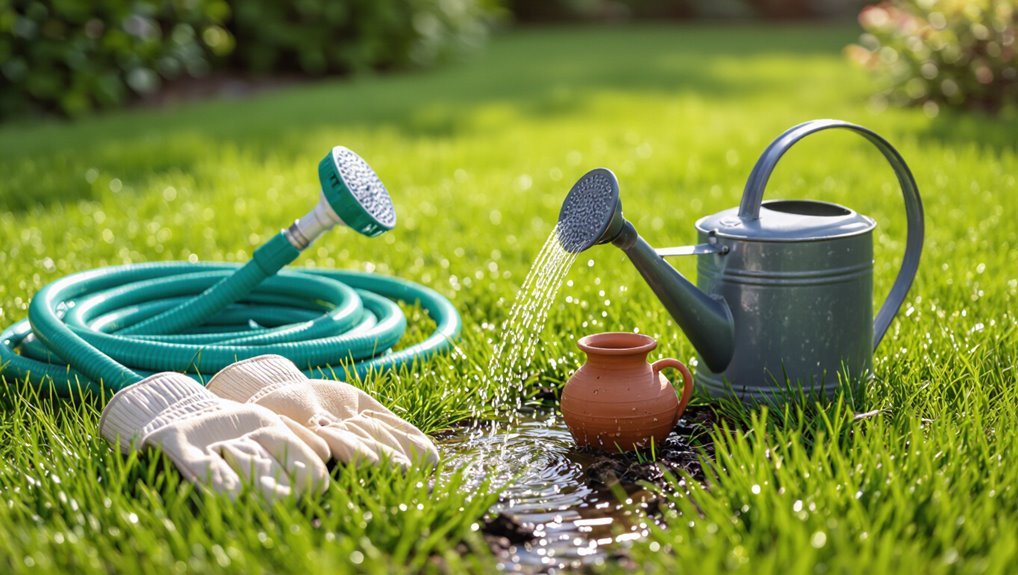
Non-sprinkler watering methods can conserve water, encourage deeper root growth, and reduce equipment and installation costs.
These approaches are particularly useful for small yards, properties with water-use restrictions, newly laid sod, or during drought conditions.
Choice of technique should reflect grass species and local climate, since some varieties respond better to hand or targeted watering than others.
Benefits of non-sprinkler watering (water savings, root health, cost)
Many homeowners and groundskeepers choose alternatives to sprinkler systems because targeted watering can cut water use, encourage deeper root growth, and lower installation and maintenance costs.
Non-sprinkler methods—hose-end watering, soaker hoses, hand-watering, and drip lines—demonstrate how to water grass without sprinklers while reducing runoff, promoting root depth, and trimming utility and equipment expenses.
They conserve water, improve turf resilience, and lower long-term costs.
Situations that call for sprinkler alternatives (small yards, restrictions, new sod, drought)
Several common scenarios favor alternatives to sprinklers: compact urban yards where coverage is impractical, properties under local irrigation restrictions, newly laid sod that requires gentle, frequent moisture, and prolonged droughts that demand strict conservation.
In these cases, targeted methods—hand watering, soaker hoses, drip systems, and watering cans—offer precise control, reduced waste, and adaptable schedules to protect turf health while complying with limits.
Grass types and climate considerations for hand or targeted watering
Choosing hand or targeted watering methods also depends heavily on grass species and local climate.
Cool-season grasses need deeper, less frequent soakings; warm-season varieties tolerate shorter, targeted watering.
Sandy soils and arid climates require more frequent hydration, while clay retains moisture longer.
Shade versus sun exposure alters needs.
Matching technique, timing, and volume to species and regional rainfall optimizes health and conserves water.
Quick Answer: Effective Principles for Watering Without Sprinklers
A concise approach favors deep, infrequent watering to encourage deep roots rather than frequent shallow sprays that promote surface growth.
Watering by hand or with hoses is best done early morning or late evening to reduce evaporation and disease risk.
Required volume varies by grass species and season, with cool-season lawns needing less in summer and warm-season grasses tolerating drier conditions but still needing about 1–1.5 inches per week when active.
Deep, infrequent watering vs. frequent shallow watering
Favoring deep, infrequent watering over frequent shallow sprays promotes stronger, deeper root systems and greater drought resilience in turf.
Applying water slowly and thoroughly encourages roots to seek moisture, reduces surface evaporation, and minimizes disease risk.
Shallow, frequent watering keeps roots near the surface, increases vulnerability to stress, and wastes water.
Measure soil moisture and irrigate to reach several inches deep for lasting health.
Best times of day to water by hand or other methods
When watering by hand or with hoses and soaker lines, early morning—typically between dawn and mid-morning—offers the best balance of low wind, cooler temperatures, and time for foliage to dry before nightfall, reducing evaporation and disease risk.
Evening watering can be a secondary option in hot, dry climates if foliage dries quickly; avoid midday heat and gusty conditions that waste water and stress plants.
How much water your lawn needs (by grass type and season)
Many lawns typically need about 1 to 1.25 inches of water per week in the growing season, adjusted by grass type and local climate.
Cool-season grasses require this during spring/fall, with reduced summer irrigation to avoid stress; warm-season grasses need 0.75–1 inch weekly at peak growth.
Adjust for soil type, rainfall, and temperatures, applying deeper, less frequent watering to encourage roots.
9 Practical Methods to Water Grass Without Sprinklers
A range of practical alternatives can keep a lawn healthy without installing fixed sprinklers. The following methods balance precision, labor, and water efficiency to suit different yard sizes and budgets.
Readers can choose from quick hose control to slow, deep watering and soil treatments that boost absorption.
- Comfort — the ease of using a hose nozzle or watering can for small, focused areas.
- Confidence — the steady effectiveness of soaker hoses, drip lines, and portable oscillating units.
- Relief — improved wetting agents and soil conditioners that make each watering count.
1. Hose-end watering with nozzle control
Hose-end watering with an adjustable nozzle allows control of flow rate and spray pattern to promote even coverage across a lawn.
The method’s advantages include low cost and flexibility, while drawbacks are labor intensity and variable timing depending on yard size.
Typical sessions range from 20 minutes for small patches to several hours for larger areas when done manually.
How to set flow and pattern for even coverage
Begin by adjusting nozzle flow to match turf needs and walking speed: set a moderate stream for firm soil or a gentler spray for sandy areas.
Then test while pacing at the designed watering rate to guarantee overlap and uniform wetting.
Divide lawn into strips, mark turn points, and maintain consistent nozzle angle and speed.
Inspect soil moisture after passes and tweak flow or pattern until coverage is even.
Pros, cons, and time estimates
When managed with a nozzle and steady pace, hose-end watering delivers precise control over application rates and targeted coverage.
However, it requires more hands-on time and attention than automated systems.
Pros: low equipment cost, flexible targeting, immediate adjustments.
Cons: labor-intensive, inconsistent if hurried, potential backflow risk.
Time: small lawns 15–30 minutes per session; larger areas 45–90 minutes.
2. Soaker hoses and drip lines laid on the lawn
Soaker hoses and drip lines can be laid directly on turf to deliver slow, even moisture to root zones. Installers should outline run patterns, space lines according to hose emitters, and test flow before covering.
Proper spacing and gentle slopes reduce dry spots and pooling, while routine flushing and occasional pressure checks prevent clogging and prolong system life.
Water-saving practices—morning scheduling, low-pressure operation, and targeting root zones rather than foliage—maximize efficiency and turf health.
Installation steps and spacing recommendations
Several simple steps guarantee effective installation and proper spacing of soaker hoses and drip lines on a lawn.
Lay hoses along contours, secure with stakes, and connect to a pressure regulator and timer-compatible valve.
Space parallel lines 6–12 inches for dense turf or 12–24 inches for established lawns.
Test flow, adjust placement for even coverage, and cap ends to maintain pressure.
Water-saving tips and maintenance
Conserving water and maintaining performance for soaker hoses and drip lines requires routine checks and small operational changes.
Inspect for leaks, clogs, and pressure fluctuations monthly.
Mulch beds to reduce evaporation and adjust emitters for seasonal needs.
Water early morning, use timers for consistent cycles, and flush lines annually.
Replace damaged sections promptly to preserve efficiency and uniform coverage.
3. Manual watering with watering cans for small patches
For small patches, calculating how many liters a watering can holds and how many passes are needed guarantees even distribution and the correct depth per watering.
Practical guidance includes measuring coverage area, converting recommended depth (e.g., 1 cm) into volume, and marking grid points to avoid overlaps or misses.
This method is best for isolated spots or seedlings but is time-consuming and impractical for larger lawns.
How to calculate volumes and distribute water evenly
Measure the area and calculate the water needed per square foot before filling the can: determine patch square footage, multiply by desired depth (inches), convert to gallons (1 inch over 1 sq ft ≈ 0.623 gallons).
Use a measured can volume, mark equal portions, and walk systematic swaths.
Apply water uniformly, pause to let soak-in, and remeasure after irrigation for consistency.
Best use cases and limitations
A watering can is best suited to small, discrete patches—new sod pieces, repair plugs, container edges, and narrow strips along walkways—where control and gentle delivery matter more than speed.
It enables targeted soaking, reduces runoff, and conserves water for limited areas.
Limitations include inefficiency for lawns, physical effort, uneven coverage if rushed, and impracticality during droughts or for large repairs.
4. Portable oscillating or pulsating sprinklers (hand-placed, non-fixed)
Portable oscillating or pulsating sprinklers offer flexibility by being hand-placed to target dry spots and vary coverage as needed.
Ideal placement and run times are determined by observing spray patterns, lawn slope, and soil absorption rates, then adjusting duration to avoid runoff and guarantee deep watering.
Compared with fixed systems, portable units require more attention but can concentrate water where it’s needed and avoid the upfront cost and installation of permanent heads.
How to optimize position and run times without a fixed system
Position oscillating or pulsating sprinklers thoughtfully and adjust run times based on observed coverage and soil moisture rather than fixed schedules.
Place units to overlap slightly for uniform wetting, avoid runoff on slopes by shortening cycles, and move sprinklers to dry patches.
Use a soil probe or finger test after runs, increase duration in hot, windy conditions, and reduce it after rain.
Comparison to fixed sprinklers
While movable oscillating or pulsating sprinklers deliver targeted, short-term coverage, they differ from fixed systems in predictability, efficiency, and labor.
Portable units require manual placement and monitoring, causing uneven overlap and variable run times.
Fixed systems provide consistent distribution, automated scheduling, and lower labor but involve installation cost.
Choice depends on budget, yard complexity, and willingness to manage placement and timing manually.
5. Wetting agents and soil conditioners to improve water absorption
Wetting agents and soil conditioners such as surfactant-based wetting agents, gypsum, and organic compost improve infiltration and reduce surface runoff, allowing less frequent but deeper watering.
Choosing labeled, lawn-safe products and following manufacturer rates minimizes plant damage and groundwater contamination.
Consider local regulations and test a small area first to monitor effectiveness and any environmental impacts.
What products to use and how they reduce watering frequency
Improve soil moisture retention by selecting products that enhance water infiltration and reduce runoff.
Use wetting agents to break surface tension, allowing water to penetrate hydrophobic patches.
Apply organic soil conditioners—compost, humic acids, or biochar—to increase porosity and water-holding capacity.
Polymer gels and moisture crystals store water near roots, extending intervals between irrigations.
Follow label rates and reapply seasonally for best results.
Safety and environmental considerations
Because these additives directly alter soil chemistry and moisture dynamics, users should weigh their benefits against health, safety, and environmental impacts before application.
Select certified wetting agents and conditioners with minimal toxic residues, follow label directions, avoid overapplication, and limit use near waterways.
Consider organic alternatives, test small areas first, store products securely, and dispose of containers per regulations to protect people, pets, and ecosystems.
6. Mulching and turf management to retain soil moisture
Effective mulching and careful turf management can markedly reduce irrigation needs by shading soil and slowing evaporation.
Suitable mulches—such as compost, shredded bark, or straw—should be applied thinly at lawn edges and used to fill bare spots to protect roots without smothering grass.
Combined with higher mowing heights and periodic aeration to improve infiltration, these practices help retain moisture and promote a healthier, drought-resistant lawn.
Types of mulches and application methods for lawn edges and bare spots
Mulch choices and placement can greatly reduce evaporation along lawn edges and in bare patches, conserving moisture where sprinklers do not reach.
Suitable options include coarse wood chips for paths, shredded hardwood around borders, straw for temporary bare spots, and compost for seedbeds.
Apply 1–3 inches, keeping mulch away from crowns and stems.
Refresh seasonally and monitor for pests or compaction.
Mowing and aeration practices that conserve water
Raise mower blades and aerate compacted areas to keep turf healthier and reduce irrigation needs.
Taller grass shades soil, cuts evaporation, and develops deeper roots; weekly mowing should remove no more than one-third of blade height.
Core aeration relieves compaction, improves infiltration, and enhances drought resilience.
Leave clippings as mulch to return nutrients and conserve moisture, reducing overall watering frequency.
7. Rainwater harvesting and manual distribution
Rainwater can be captured with simple containers like barrels or large buckets fitted with a screened inlet to keep debris and mosquitoes out.
Then, it should be stored in a shaded, secure spot to preserve water quality.
Collected water is best applied to turf using a watering can, soaker hose connected to the barrel outlet, or by filling portable containers for targeted, even distribution.
This approach conserves mains water and lets lawn care be timed to cooler parts of the day for maximum absorption.
Simple collection options (barrels, buckets) and safe storage
Simple, low-cost containers such as barrels and food-grade buckets provide an accessible starting point for capturing runoff and roof-collected water, making manual irrigation feasible without pumps or complex systems.
Covers, screened inlets and elevated stands reduce contamination and allow gravity flow.
Store out of direct sun, label nonpotable use, secure lids to prevent mosquitoes, and inspect for cracks or leaks regularly.
How to distribute harvested rain to the lawn efficiently
Move collected water efficiently from storage to turf with a mix of gravity, hand tools, and time-saving attachments.
Use gravity-fed hoses or simple siphons for downhill yards; fill watering cans sized for repeat trips.
Attach a soaker hose or microtubing to barrels for slow, even distribution.
Schedule deep, infrequent applications and target root zones to conserve volume and prevent runoff.
8. Smart timing and zone rotation strategy for hand-watering
The section outlines a practical schedule that assigns watering times and frequencies by zone based on soil type, sun exposure, and visible grass health indicators like color and growth.
It explains simple, repeatable checks—such as the screwdriver or finger test and monitoring wilting or foot-print recovery—to track moisture without electronic sensors.
It also recommends rotating zones to concentrate water where needed and to prevent overwatering adjacent areas.
Creating a watering schedule by zone and grass health indicators
Establishing a zone-based watering schedule helps match hand-watering efforts to varying soil types, sun exposure, and turf conditions across a lawn.
Each zone receives tailored frequency and duration based on soil drainage and shade.
Monitor grass indicators—color, blade firmness, and recovery after compression—to adjust timing.
Prioritize deep, infrequent irrigation for roots; reduce frequency for shaded, moisture-retentive areas to prevent overwatering.
How to track moisture without sensors
How can one gauge soil moisture without electronic sensors? A simple screwdriver or trowel probe reveals dampness at root depth; a handful squeeze test shows crumbly versus muddy texture.
Observe grass color and foot-print recovery for stress signs. Track recent rainfall and irrigation timing in a log.
Deep, infrequent checks across zones guarantee thorough assessment and informed hand-watering decisions.
9. Temporary low-pressure irrigation systems (portable timers, battery pumps)
Temporary low-pressure irrigation setups pair battery-powered pumps or portable timers with soaker hoses or drip lines to provide controlled, even watering without a full sprinkler system.
A brief setup guide covers selecting compatible fittings, pump capacity, timer programming, and recommended products from trusted brands for small lawns or temporary needs.
These systems are preferable for seasonal use, irrigation during water restrictions, or sites lacking permanent plumbing.
Setup guide and recommended products
When mains irrigation is unavailable, a low-pressure portable system built from a battery-powered pump, inline timer, and soaker hoses offers a practical, controllable way to water turf. The pump pressurizes water from a barrel or tote while the timer automates run intervals to prevent overwatering.
Setup: secure pump to container, attach inline timer, run soaker hoses across lawn.
Recommend 12V diaphragm pumps, battery timers with rain-delay, and flat soaker tubing.
When temporary systems are preferable
If a permanent irrigation system is impractical or unavailable, temporary low‑pressure setups—using portable timers and battery pumps—provide a fast, flexible way to keep turf healthy during short‑term needs such as construction, seasonal drought, or trial landscaping.
They suit renters, experimental plantings, and emergency watering. These systems minimize installation time, reduce water waste with scheduled cycles, and allow easy relocation or removal when normal irrigation returns.
How to Plan and Schedule Watering Without Sprinklers
Planning and scheduling watering without sprinklers begins with mapping the lawn into zones to guarantee even coverage and account for sun exposure and slope.
Run times and frequency should be based on soil type and current weather, with shorter, more frequent sessions for sandy soils and deeper, less frequent watering for clay or loam.
Seasonal adjustments — increasing frequency during heat or cutting back to promote recovery after drought — complete the schedule.
Mapping your lawn into zones for even coverage
Dividing a lawn into clear, manageable zones guarantees water is applied evenly and efficiently without sprinklers.
The homeowner maps areas by sun exposure, slope, soil drainage and plant type, marking boundaries and grouping similar needs.
Zones guide manual watering routes, hose and nozzle placement, and use of soaker hoses or watering cans.
Clear labels prevent over- or under-watering across the landscape.
Determining run times and frequency by soil type and weather
Because soil texture and recent weather dictate how much water actually reaches roots, determining run times and frequency starts with identifying soil type and monitoring local conditions.
Sandy soils need shorter, more frequent sessions; clay retains moisture, favoring longer, less frequent watering to avoid surface runoff.
Adjust timing after rain, cool mornings reduce evaporation, and use probes or moisture sensors to confirm root-zone moisture before irrigating.
Seasonal adjustments and recovery after heat or drought
Adapt irrigation schedules and volumes as seasons shift, increasing frequency and evening or early-morning watering during heat waves to replace rapid evapotranspiration.
Then scale back in cooler, wetter months to prevent overwatering.
During drought, prioritize deep, infrequent soakings to encourage root recovery, monitor soil moisture, apply mulch, and postpone fertilization.
Gradual normalization after rain or cooler weather restores routine without stressing turf.
Common Problems and How to Fix Them
Common lawn-watering issues are identified by visible symptoms such as uneven wetting, patchy growth, and signs of overwatering like yellowing or fungal spots.
Practical fixes include spot-watering, adjusting schedule and volume, aerating compacted areas, dethatching, and improving surface drainage.
Clear diagnosis of each symptom guides the appropriate corrective action to restore even, healthy turf.
Uneven wetting and patchy growth’ diagnosis and solutions
Diagnose uneven wetting and patchy growth by observing patterns, testing soil moisture, and noting turf response after irrigation; these clues distinguish distribution issues from underlying soil or compaction problems.
Identify low spots, thatch layers, or hydrophobic soil. Improve water distribution with targeted hand-watering, hose-end sprinklers, or soggy-area aeration.
Amend compacted or sandy zones, topdress thin turf, and reseed bare patches for uniform recovery.
Overwatering signs and corrective actions
Overwatering can be as damaging as drought, producing yellowing or wilting grass, spongy soil, fungal growth (like mold or brown patch), and runoff or pooling after irrigation.
Reduce frequency, increase interval between waterings to encourage deeper roots, and measure soil moisture before irrigating.
Improve scheduling to morning, remove excess surface water, trim irrigation duration, and treat visible fungal issues with targeted fungicide or cultural sanitation.
Dealing with compacted soil, thatch, and poor drainage
After correcting watering practices, attention should turn to physical soil and surface issues that also impede water infiltration and root health: compacted soil, excessive thatch, and poor drainage.
Core aeration relieves compaction; dethatching removes organic barriers preventing moisture penetration.
Amend heavy clay with organic matter and sand where appropriate.
Install French drains, grade slopes, or create raised beds to channel water away and prevent pooling.
Tools, Materials, and Products to Have on Hand
Practical watering requires a small kit of reliable tools and products to save time and water while keeping turf healthy. A few well-chosen hoses, nozzles, soaker hoses, and timers paired with moisture meters and rain barrels will make routine watering predictable and efficient.
Adding targeted lawn-care items—wetting agents, compost, and seed—helps the grass use water more effectively and recover faster.
- High-quality hoses, adjustable nozzles, soaker hoses, and portable timers
- Soil moisture meters, watering cans, and rain barrels
- Water-saving products: wetting agents, compost, and drought-tolerant grass seed
Recommended hoses, nozzles, soaker hoses, and portable timers
Choose reliable hoses, nozzles, soaker hoses, and portable timers to make manual or low-flow irrigation efficient and consistent; quality materials reduce leaks, control water delivery, and save time.
Select kink-resistant, UV-stable hoses, adjustable pistol or fan nozzles for targeted flow, porous soaker hoses for beds and borders, and simple battery-operated timers to automate duration and frequency without complex installation.
Soil moisture meters, watering cans, and rain barrels
A few simple tools—soil moisture meters, watering cans, and rain barrels—make hand-watering accurate, efficient, and sustainable.
Soil moisture meters prevent over- or under-watering by indicating when roots need water.
Watering cans deliver measured, targeted volumes for seedlings and patch repairs.
Rain barrels collect free water for lawn use, reducing municipal water demand and buffering during short dry spells.
Water-saving lawn care products (wetting agents, compost, grass seed)
After discussing tools that aid hand-watering, attention turns to products that reduce overall water needs: wetting agents that improve soil infiltration, compost that increases moisture retention, and drought-tolerant grass seed blends that require less frequent irrigation.
Homeowners should apply wetting agents per label, topdress with compost annually, and overseed with appropriate blends to build resilient, water-efficient turf that demands fewer supplemental waterings.
Cost, Water Use, and Environmental Impact Comparison
A brief comparison of common manual watering methods highlights differences in water use, cost, and environmental trade-offs to help choose the most efficient approach. The table below summarizes estimated water use and cost alongside runoff and conservation concerns for typical methods. This comparison frames practical choices for reducing expenses and environmental impact.
| Method | Notes |
|---|---|
| Hand watering with hose | Moderate water use; low equipment cost; moderate runoff risk if overwatered |
| Soaker hose | Lower water use; moderate setup cost; good for conservation when timed |
| Watering can | Low water use for small areas; minimal cost; minimal runoff |
| Greywater reuse | Very low additional water cost; moderate setup/regulatory concerns; potential contamination risk |
| Mulch and soil amendments | Indirect water savings; low cost; reduces runoff and improves conservation |
Estimated water usage and costs for each method
Several common non-sprinkler irrigation methods—hand watering with a hose, soaker hoses, drip systems, and watering cans—vary considerably in upfront cost, typical water consumption, and environmental impact.
Hand watering uses about 0.6–1.0 gallons per minute per nozzle, low upfront cost.
Soaker hoses and drip systems deliver 0.2–0.5 gpm per zone, moderate cost.
Watering cans use minimal water but are labor intensive.
Environmental pros and cons (runoff risk, water conservation)
Efficiency and runoff determine the environmental balance of non-sprinkler irrigation methods.
Drip systems minimize runoff and conserve water but require maintenance; soaker hoses offer targeted delivery with moderate efficiency.
Manual watering and sprinkling cans reduce overuse if timed carefully but risk uneven application.
Greywater and rain barrels conserve mains water yet need filtration and considerate application to prevent contamination or excess runoff.
Step-by-Step Example: Watering a 1,000 sq ft Lawn Without a Sprinkler
The example begins with preparing the lawn and gathering tools: a hose with flow meter or cup, a sprinkler head for calibration, a rake, and a soil probe to check moisture.
It then outlines a zone-by-zone watering schedule for the 1,000 sq ft area with specific timings and volumes to avoid runoff.
Finally, it covers follow-up care and monitoring over the next 2–4 weeks to adjust frequency based on soil moisture and turf response.
Preparing the lawn and tools
Prepare the lawn by removing debris, mowing to the recommended height for the grass type, and checking for compacted or bare spots that need aeration or overseeding.
Gather a hose with adjustable nozzle, a water timer or flow meter, a watering can for targeted areas, a rake, aerator or spike tool, and seed or topdressing materials.
Inspect hose fittings and test water pressure before starting.
Zone-by-zone watering schedule with timings
When dividing a 1,000 sq ft lawn into manageable zones, a homeowner should plan each zone so that watering delivers about 0.5 to 1 inch of water per week total, applied in two to three sessions to promote deep rooting.
Using a hose with an adjustable nozzle and a simple timer, zones of roughly 250–350 sq ft work well for hand-watering, with each pass per zone lasting 10–20 minutes depending on flow rate and soil type.
For schedule example, water zones A and B Monday/Thursday, C and D Tuesday/Friday, and reserve a weekend session only during heat spells.
Follow-up care and monitoring for 2 to 4 weeks
After establishing a zone schedule and completing the initial watering passes, the next two to four weeks require systematic follow-up care and monitoring to guarantee young roots develop and soil moisture remains appropriate.
Inspect daily for wilting, dry patches, or puddling. Adjust frequencies based on rainfall, soil probe readings, and turf response.
Mow sparingly, avoid heavy traffic, and document observations to refine the schedule.
Maintenance and Long-Term Tips to Minimize Future Watering
A consistent lawn care routine—proper mowing height, timed fertilization, and periodic overseeding—reduces water needs by promoting deeper roots and thicker turf.
Homeowners should evaluate long-term water savings and yard size to decide when a permanent irrigation system becomes cost-effective.
Keeping records of watering, lawn health, and local climate patterns allows adjustments that further minimize future watering.
Lawn care routine (mowing height, fertilization, overseeding)
Maintain a consistent lawn care routine—proper mowing height, timely fertilization, and periodic overseeding—to strengthen turf and reduce future water needs.
Mow at species-appropriate heights, leaving grass slightly taller to shade soil. Apply balanced fertilizers per soil test schedules, emphasizing slow-release formulas.
Overseed thin areas in fall or cool seasons, improving density and root depth. These practices enhance drought resilience and lower irrigation frequency.
When to consider installing a permanent irrigation system
When lawn size, water restrictions, or frequent manual watering demands exceed practical time and efficiency thresholds, homeowners should evaluate installing a permanent irrigation system.
Consider long-term cost versus labor savings, property layout, soil type, and reliable water supply.
Professional design guarantees even coverage and efficient controllers.
Choose systems with zoned scheduling, pressure regulation, and freeze/shutoff protections to minimize waste and maintenance.
Record-keeping and adjusting based on climate trends
After weighing the benefits of a permanent irrigation system, homeowners should adopt systematic record-keeping to guide future watering decisions.
Logs note dates, amounts, weather, soil moisture and plant response. Annual summaries reveal trends: longer dry spells, shifting rainfall patterns, or heatwaves.
Adjust schedules, mulch, or species selection accordingly. Records enable proactive, data-driven reductions in supplemental watering over time.
Conclusion
The yardowner has learned that sprinklers are not the only route to a lush lawn; quiet methods, timed care, and careful planning can yield surprising results. Yet a secret remains: when drought bites or soil betrays, only vigilance and adaptation save grass from failure. With tools ready and a routine formed, the next step is simple — try one method, watch closely, and be prepared to change course before the lawn’s pulse falters.