How to Remove Freon From Ac Unit Safely: Step-By-Step Guide for Homeowners
Homeowners cannot safely or legally remove Freon from an AC unit without the proper certification and equipment. Only EPA Section 608-qualified technicians are authorized to handle refrigerants, as they use approved recovery machines and safety gear. Attempting to do this yourself can lead to injury, fines, and environmental damage. A certified professional will evaluate for leaks, isolate the system, recover the refrigerant into labeled cylinders, and ensure proper disposal or reclamation according to regulations. For a detailed overview of the process and alternatives for homeowners, continue reading.
Can a Homeowner Safely Remove Freon from an AC Unit? Direct Answer and Legal Considerations
A homeowner generally should not attempt to remove refrigerant from an AC unit; licensed technicians with proper certification and equipment are required for safe recovery.
Federal law (EPA regulations) and many local rules prohibit unlicensed handling of refrigerants and mandate specific recovery and disposal procedures.
Attempting DIY recovery exposes the homeowner to legal penalties, environmental harm, and personal injury or equipment damage liability.
Summary answer and short recommendation
Homeowners should not attempt to remove Freon (refrigerants) from an air conditioning system themselves: doing so can violate federal and state laws, pose serious health and environmental risks, and requires specialized equipment and certification (such as EPA Section 608 in the U.S.). For guidance on how to remove freon from ac unit, hire a certified technician.
| Risk | Recommendation |
|---|---|
| Legal | Use certified pros |
| Health | Avoid exposure |
| Environmental | Prevent leaks |
| Equipment | Professionals only |
Federal and local regulations on refrigerant handling
Because refrigerants are regulated substances, removing Freon from an air conditioning unit is generally restricted to certified technicians under federal and many state laws.
Doing it unlicensed can result in civil and criminal penalties. Local ordinances may add licensing, disposal, and transport requirements.
Proper documentation, EPA Section 608 certification, and approved recovery equipment are commonly mandated; homeowners should consult local regulators before acting.
Risks and liabilities for homeowners who attempt refrigerant recovery
Attempting refrigerant recovery without proper certification and equipment exposes a homeowner to significant safety, legal, and financial risks.
Injury, property damage, environmental harm, and regulatory fines can result. Liability may include civil suits, cleanup costs, and criminal penalties for illegal release or disposal.
Insurance may not cover unauthorized work. Certified professionals mitigate these risks through training, proper tools, and legal compliance.
Basics of Refrigerants and Why Proper Recovery Matters
In residential contexts, the term “Freon” commonly refers to several refrigerants such as R-22 and R-410A used in air conditioning systems.
These fluids absorb and release heat as they circulate, enabling cooling through phase change and pressure differentials.
Uncontrolled release can harm the ozone layer, contribute to climate change, and pose health risks from inhalation or asphyxiation, so proper recovery is essential.
What “Freon” refers to (common refrigerants in residential AC)
“Freon” commonly denotes a class of refrigerants used in residential air conditioning systems, not a single chemical.
Historically it referred to CFCs like R-12; later replacements include HCFC R-22 and HFCs such as R-410A and R-134a.
Each differs in chemistry, pressure, temperature behavior, environmental impact, and regulatory status.
Identifying the specific refrigerant is essential before recovery, servicing, or disposal.
How refrigerants function in an AC system
After identifying which refrigerant is present, the next step is to understand how that substance enables heat transfer within an air-conditioning system.
Refrigerant circulates between evaporator and condenser, changing phase to absorb indoor heat as a low-pressure vapor and release it outdoors as a high-pressure liquid.
Proper recovery preserves system charge, prevents contamination, and enables safe, efficient servicing and future refrigeration performance.
Environmental and health hazards of refrigerant release
Because refrigerants are designed to undergo phase changes and circulate freely, their uncontrolled release poses both environmental and health risks that extend beyond the immediate worksite. They deplete ozone or increase greenhouse forcing and can cause asphyxiation, frostbite, or cardiac sensitization in confined spaces. Proper recovery prevents contamination and regulatory penalties.
| Hazard Type | Example |
|---|---|
| Environmental | Ozone depletion, warming |
| Health | Asphyxia, frostbite |
Tools, Equipment, and Certification Needed for Safe Refrigerant Recovery
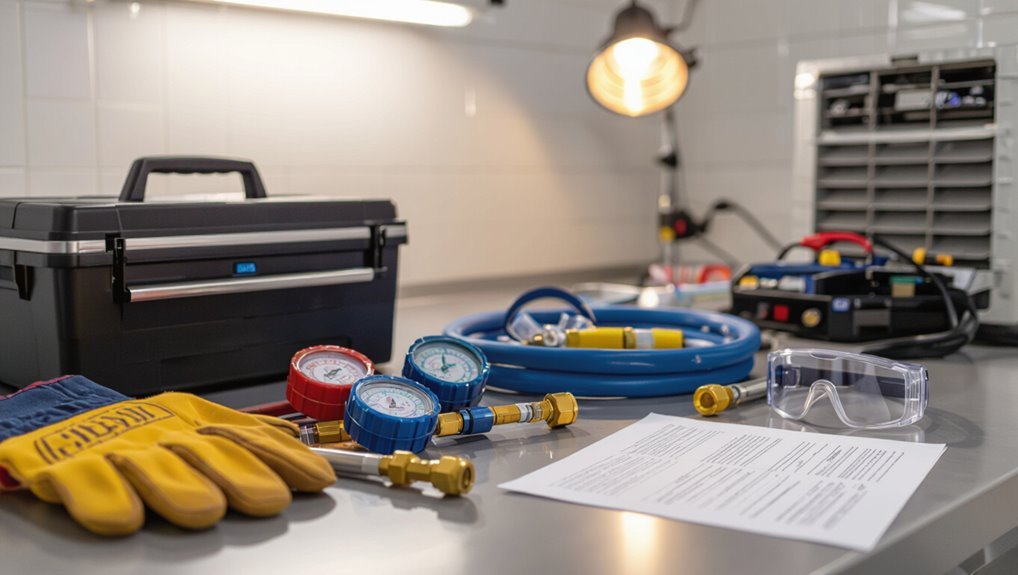
Safe refrigerant recovery requires specific tools—such as a recovery/recycle machine, manifold gauge set, and approved recovery cylinders—used alongside proper PPE like gloves and eye protection.
Technicians typically hold certifications (for example, EPA Section 608) and state licenses that authorize handling and documentation of refrigerants.
Homeowners should hire a certified technician for major systems, leaks, or when local regulations prohibit uncertified recovery.
Required recovery equipment (recover/recycle machine, manifold gauge set, recovery cylinder)
A small set of specialized tools is essential for legal and effective refrigerant recovery: a recover/recycle machine to pull refrigerant from the system, a manifold gauge set to monitor pressures and control flow, and recovery cylinders to store the reclaimed refrigerant.
Each component must match the refrigerant type and system size, be certified for recovery service, and be inspected for leaks, valves, and proper labeling before use.
Recommended PPE and safety gear
Having confirmed the recovery machine, gauges, and cylinders are appropriate and leak-free, attention turns to the personal protective equipment and safety gear required for handling refrigerants.
Recommended PPE includes chemical-resistant gloves, safety goggles or face shield, long-sleeve clothing, and nitrile overboots.
A vapor respirator with appropriate cartridges is advised for confined spaces.
Guarantee a well-ventilated work area and have an approved fire extinguisher nearby.
Certifications and licenses professionals hold (EPA Section 608 overview)
Compliance with certification and licensing requirements underpins responsible refrigerant handling.
Technicians must hold EPA Section 608 certification—Type I, II, III, or Universal—authorizing work on specific equipment. Licensed contractors may also require state or local HVAC permits.
Certifications verify training in recovery techniques, leak prevention, recordkeeping, and environmental regulations, ensuring legal, safe refrigerant recovery and disposal practices.
When a homeowner might need to hire a certified technician
Given the certification and licensing framework just described, homeowners should recognize specific situations that require a certified technician for refrigerant work.
Complex leaks, compressor or condenser replacement, sealed-system breaches, large refrigerant charges, brazing or vacuuming lines, and legal disposal of recovered refrigerant all necessitate certified technicians with EPA Section 608 credentials, recovery equipment, and liability insurance to guarantee safety, compliance, and proper system performance.
Step-by-Step Safe Refrigerant Recovery Process for Homeowners (What a Pro Does)
The professional begins by preparing the site: shutting down power, isolating circuits, and securing a clear, ventilated workspace.
They then identify service ports, confirm the refrigerant type and system condition, and attach manifold gauges and the recovery machine following manufacturer procedures.
During recovery, the technician monitors pressures and temperatures, runs the machine until readings indicate full removal, then performs a vacuum, leak test, and final verification.
Preparation: shutdown, power isolation, and workspace safety
Before any refrigerant is handled, the system must be shut down, disconnected from power, and the work area secured to prevent hazards.
The technician confirms breaker lockout/tagout, removes fuses if present, and verifies absence of voltage.
Nearby ignition sources are eliminated, ventilation is arranged, and bystanders are kept clear.
Personal protective equipment is donned and spill containment is positioned.
Identifying service ports, refrigerant type, and system condition
Locate the service ports and label the refrigerant type, then assess system condition before any recovery begins. The technician inspects access valves, checks nameplate for refrigerant, notes oil stains, and verifies no visible leaks or corrosion. Record findings and photos; confirm required tools and certification before proceeding.
| Item inspected | Purpose |
|---|---|
| Service ports | Access points |
| Nameplate | Refrigerant ID |
| Lines/joints | Leak signs |
| Compressor | Mechanical state |
Connecting manifold gauges and recovery machine correctly
Having confirmed service port locations, refrigerant type, and system condition, the technician prepares the manifold gauges and recovery machine for connection.
Caps and valve cores are removed, hoses routed: blue to low, red to high, center to recovery inlet.
All fittings are tightened with appropriate wrenches.
Recovery unit and gauge valves remain closed until leak-free connections are verified and recovery procedures begin.
Running the recovery machine and monitoring pressures and temperatures
The technician starts the recovery machine, opens the recovery-unit service valves, and then slowly opens the manifold low-side valve while keeping the high-side valve closed to establish flow from the system into the recovery unit.
He watches gauge readings and temperature probes, ensuring pressures drop steadily without spikes.
Audible, visual, and machine indicators are monitored; any abnormal rise or overheating prompts immediate shutdown and inspection.
Vacuuming, leak testing, and verifying full refrigerant removal
After establishing flow into the recovery unit, the technician closes the manifold valves, isolates the system, and starts the vacuum pump to remove residual vapor and moisture. Gauges and a micron gauge are watched until target vacuum (typically below 500 microns) is achieved.
The technician performs a calibrated leak test, monitors for pressure rise, isolates and holds vacuum, and repeats evacuation until no pressure increase confirms full refrigerant and moisture removal.
Properly labeling and storing recovery cylinders
One or more clearly marked recovery cylinders should be prepared and handled according to regulations before they leave the work area:
Cylinders must display refrigerant type, service date, technician ID, and cylinder status (full/empty/pressurized).
Store upright, secured, away from heat and ignition, in a ventilated, labeled containment area.
Follow local disposal and transport rules, maintain leak-free valves, and document chain of custody.
Alternative Actions Homeowners Can Take Instead of Removing Refrigerant Themselves
Homeowners can consider non-release options such as professionally draining, capping lines, or decommissioning a unit to prevent refrigerant escape.
Engaging a certified HVAC contractor—what to expect from diagnostics, recovery procedures, certifications to verify, and key questions to ask—ensures compliant handling.
While awaiting service, temporary measures like powering off the system, sealing access panels, and keeping the area ventilated reduce risk without disturbing refrigerant.
Drain, cap, or decommission options that avoid refrigerant release
Consider alternatives that prevent refrigerant release by isolating and decommissioning the system rather than attempting on-site recovery. Homeowners can drain non-refrigerant fluids, cap lines, or disconnect components and tag the unit for professional refrigerant reclamation. Document actions and secure access to prevent accidental damage until certified removal occurs.
| Action | Purpose | Note |
|---|---|---|
| Drain condensate | Remove water | Safe, routine |
| Cap lines | Isolate refrigerant | Temporary seal |
| Decommission unit | Prevent use | Label clearly |
Hiring a certified HVAC contractor: what to expect and questions to ask
When should a certified HVAC contractor be called for refrigerant-related work, and what should the homeowner expect during the visit?
A licensed technician should be hired for any refrigerant handling or suspected leaks.
Expect inspection, leak detection, containment, recovery with EPA-compliant equipment, documentation, and repair estimates.
Ask about certification, insurance, recovery methods, disposal, warranty, cost breakdown, and written permits or reports.
Safe temporary measures while waiting for professional service
Several immediate, noninvasive steps can reduce risk and discomfort while waiting for a certified HVAC technician.
Occupants should ventilate affected areas, avoid direct exposure, turn off the AC power at the breaker, and evacuate rooms with strong odors.
Pets and children must be kept away.
Do not attempt refrigerant recovery or puncture lines; instead, document symptoms and secure the area for professionals.
Common Problems, Warning Signs, and What Not to Do
Common mistakes can result in illegal refrigerant release or permanent damage to the system.
Warning signs such as poor cooling, oil stains, and hissing or frost on lines typically indicate leaks or other refrigerant system failures.
In emergencies—strong odors, visible leaks, or electrical burning—shutting off power, ventilating the area, and calling a qualified technician are immediate priorities.
Mistakes that lead to illegal release or equipment damage
Improper procedures and shortcuts often cause accidental Freon release or irreversible harm to HVAC equipment. Technicians who bypass recovery protocols, use incorrect fittings, or apply excessive heat to components risk both legal penalties and costly repairs.
Consequences include fines, contamination, compressor damage, and voided warranties.
Common mistakes:
- Skipping certified recovery unit use
- Using wrong hoses or adapters
- Overheating joints to force refrigerant out
- Failing to close service valves properly
Symptoms that indicate refrigerant system issues (leaks, poor cooling, oil stains)
How can one tell when a refrigerant system is failing? Indicators include diminished cooling performance, longer run cycles, and uneven room temperatures.
Visible oil stains or residue near connections and coils often signal leaks. Hissing sounds, ice buildup on evaporator coils, and unusually high electric bills also point to refrigerant loss.
Prompt professional diagnosis is advised to prevent further damage.
Emergency situations and immediate steps to take
When signs such as hissing, ice on coils, sudden loss of cooling, or oil stains are observed, immediate attention is required because these often indicate active refrigerant leakage or component failure that can escalate quickly. Evacuate area, shut off power, ventilate, avoid ignition, and call a certified technician. Do not attempt DIY recovery or puncture lines.
| Sound | Visual | Smell |
|---|---|---|
| Hiss | Ice | Oil |
| Rattle | Stain | Sweet |
| Pop | Frost | Chemical |
| Silence | Leak | Faint |
| Sputter | Drip | Strong |
Costs, Permits, and Environmental Disposal Requirements
Costs for professional refrigerant recovery and disposal typically fall within a moderate range depending on system size and local labor rates.
Local regulations may require permits, tracking, or reporting of recovered refrigerant to authorized facilities.
Recovered refrigerant is either reclaimed for reuse through specialized recycling processes or sent for approved destruction to prevent atmospheric release.
Typical cost range for professional recovery and disposal
A professional recovery and disposal of refrigerant typically falls between $75 and $300 for residential systems, though larger commercial jobs or rare refrigerants can push totals higher.
Final prices depend on refrigerant type, recovery labor, travel, and disposal fees.
Technicians may charge flat rates or hourly fees; bundled HVAC services increase cost.
Obtain written estimates comparing service details before hiring.
Local permit or disposal reporting requirements
Because refrigerants are regulated substances, local jurisdictions often require permits, manifests, or disposal reports before or after recovery operations.
Homeowners should check municipal and state HVAC or environmental agency rules, obtain any required permits, and retain paperwork from certified technicians.
Failure to comply can incur fines.
Proper documentation guarantees legal disposal chain-of-custody and facilitates inspections or future property transfers.
How recovered refrigerant is recycled or destroyed
Following permit verification and paperwork retention, attention shifts to the fate of recovered refrigerant: whether it is reclaimed for reuse, recycled for limited applications, or destroyed to prevent atmospheric release.
Licensed reclaimers test, filter, and certify refrigerant meeting purity standards; contaminants require destruction via approved incineration or chemical processes.
Costs vary; invoices, manifests, and disposal permits document chain-of-custody and regulatory compliance.
Preventive Maintenance to Minimize Future Refrigerant Work
Routine preventive maintenance reduces the need for future refrigerant handling by catching problems early through scheduled inspections and leak detection methods.
Technicians should promptly seal, repair, or replace corroded or damaged components to stop leaks before they require refrigerant recovery.
When equipment ages or uses phased-out Freon, evaluating upgrades to modern, lower-global-warming refrigerants or full system replacement can prevent repeated refrigerant work.
Regular inspections and leak detection methods
Implementing scheduled inspections and consistent leak-detection practices helps identify small issues before they require refrigerant recovery or costly repairs.
Technicians verify operating pressures, inspect fittings, coils, and valves, and use electronic leak detectors, UV dye, or soap-bubble tests to locate escapes.
Routine monitoring of system performance, refrigerant levels, and corrosion indicators reduces unexpected losses and informs timely maintenance decisions without describing repair or replacement steps.
Seal, repair, or replace components to prevent leaks
Addressing identified leak sources by sealing, repairing, or replacing components reduces the likelihood of future refrigerant loss and the need for recovery. Technicians should tighten fittings, replace corroded tubing, and swap failing valves or coils. Routine sealing and component replacement preserves system integrity and lowers long‑term service needs.
| Seal fittings | Replace tubing | Swap valves |
|---|---|---|
| Tighten connections | Repair corrosion | Install new cores |
Upgrading to environmentally safer refrigerants and when to consider replacement
When environmental regulations, efficiency goals, or aging equipment dictate change, upgrading to lower‑GWP refrigerants or replacing units becomes a practical preventive step.
Evaluating compatibility, retrofit costs, and long‑term service implications guides the decision. Technicians assess oil miscibility, pressure differences, and warranty impacts.
If leaks recur, compressors fail, or retrofit costs approach replacement, full unit replacement with modern, efficient refrigerant systems is recommended.
Quick Checklist for Homeowners Facing Refrigerant Removal or AC Decommissioning
Homeowners should verify a concise set of safety and documentation items before permitting refrigerant removal or AC decommissioning to guarantee compliance and minimize risk.
The checklist typically covers pre-service confirmations and post-service verification and recordkeeping.
Key items to review include:
- Verification of technician certification and required permits
- Photos and serial numbers of equipment before work begins
- Post-service refrigerant recovery logs and disposal receipts
- Signed service report with final pressure readings and leak test results
Safety and documentation items to confirm before work begins
Before any refrigerant handling or system decommissioning begins, confirm key safety and documentation items to secure legal compliance and worker protection:
verify technician EPA certification and insurance,
review local permit and disposal requirements,
confirm presence of required PPE and leak detection equipment,
obtain owner authorization and equipment history,
ascertain safe power isolation and site ventilation,
and document agreed scope, timelines, and emergency procedures.
Post-service verification and recordkeeping items
A concise post-service checklist guarantees the homeowner receives complete verification and documentation after refrigerant removal or AC decommissioning.
Technician signatures, license and EPA certification copies, recovered refrigerant logs with quantities, disposal or reclamation receipts, leak test results, system pressure and vacuum readings, final system condition notes, photos of work, and a dated service report retained for warranty, regulatory compliance, and future servicing.
Conclusion
Removing freon without certification is monstrously risky and typically unlawful; homeowners should not attempt DIY recovery. Proper handling preserves health, the environment, and legal compliance, so hire a licensed HVAC technician who uses approved recovery equipment, disposes refrigerants per regulations, and files necessary paperwork. When decommissioning, consider certified contractors, recycling centers, or refrigerant reclaimers, and follow preventive maintenance to reduce future interventions. Always prioritize safety, legalities, and environmental stewardship.