How to Remove Asbestos Pipe Insulation Safely: Step-by-Step Guide and When to Call a Pro
Removing asbestos pipe insulation safely requires careful planning and adherence to safety protocols. Homeowners should first assess the condition of the insulation; if it is intact and stable, it is often safest to leave it undisturbed. For minor, nonfriable repairs, DIY methods may be possible with the right training and permits. However, if the insulation is damaged, extensive, or in occupied areas, hiring a licensed abatement contractor is essential. These professionals use specialized equipment, including HEPA ventilation and air monitoring, to ensure safe removal and disposal. Always follow legal requirements and consider medical monitoring. Detailed procedures and tools for both DIY and professional assistance are outlined below.
What to Know Before Removing Asbestos Pipe Insulation
Before any work begins, readers should understand that asbestos fibers can cause serious respiratory disease if released and inhaled.
They should also be aware of applicable local regulations covering testing, removal procedures, and hazardous waste disposal.
Guidance is needed on when insulation may be left undisturbed versus removed and when a licensed asbestos professional must be engaged.
Why asbestos insulation is dangerous
Disturbing asbestos-containing pipe insulation can release microscopic fibers that, when inhaled, lodge in lung tissue and increase the risk of serious diseases such as asbestosis, lung cancer, and mesothelioma.
Exposure risk rises with aging, crumbling insulation and improper handling.
Anyone researching how to remove asbestos pipe insulation must understand fiber hazards, use appropriate controls, and consider professional removal to minimize long-term health consequences.
Legal and regulatory considerations (local laws, disposal rules)
Many jurisdictions regulate asbestos work and waste, so anyone planning to remove pipe insulation must first identify applicable local, state/provincial, and federal requirements.
Compliance often mandates licensed contractors, specific notification or permitting, trained workers, air monitoring, and designated disposal facilities.
Improper transport or landfill acceptance can incur fines.
Verify regulations, document permits, and retain disposal receipts to demonstrate lawful handling and chain of custody.
When removal is necessary vs. when to leave it undisturbed
Regulatory requirements and disposal rules influence whether removal is permitted or required, but the decision to remove asbestos pipe insulation should be based primarily on condition, location, and likelihood of fiber release.
Removal is warranted for damaged, friable, or disturbed insulation in occupied areas or during renovations.
Intact, nonfriable insulation in stable, inaccessible locations is usually safer left undisturbed with monitoring and maintenance.
When to hire a licensed asbestos professional
When should a licensed asbestos professional be called in?
A professional is necessary for extensive, friable, or damaged insulation; disturbed materials releasing visible dust; complex piping systems or confined spaces; presence of vermiculated or unknown asbestos types; occupancy during work; or when local regulations require certification.
They provide safe removal, containment, air monitoring, waste disposal, and regulatory compliance, reducing health and legal risks.
Quick Answer: Can You Remove Asbestos Pipe Insulation Yourself?
A brief checklist helps determine whether a homeowner can handle asbestos pipe insulation removal safely: assess extent of contamination, accessibility, required tools and PPE, and local regulations.
Attempting DIY removal carries health risks from fiber release and potential legal or insurance liabilities if work is noncompliant.
When uncertainty exists or the job is extensive, hiring a licensed abatement professional is the safer option.
Short assessment checklist to decide DIY vs. professional
How risky is the job and who has the right tools and training to control that risk?
Use this checklist:
- asbestos confirmed or presumed
- friable material
- pipe accessibility
- length/area
- HVAC proximity
- presence of occupants
- required permits
- available PPE and HEPA systems
- experience with wet removal and containment
- local disposal options.
If multiple boxes checked, hire a licensed professional.
Risks and liabilities of DIY removal
Consider asbestos pipe insulation removal as a high-risk task with significant health, legal, and financial consequences if handled improperly.
DIY removal can expose occupants to airborne fibers, increasing mesothelioma and lung cancer risk, void insurance, and breach local regulations.
Improper containment triggers costly remediation, fines, and liability for third-party harm.
Professionals reduce exposure, guarantee compliance, and assume regulatory and disposal responsibilities.
Safety Preparations and Required Equipment
Before any work begins, a clear checklist of personal protective equipment and properly rated tools and materials must be assembled.
The work area should be segmented into controlled decontamination and work zones with protocols for entry, exit, and waste containment.
Appropriate air monitoring and testing equipment options should be selected and scheduled to verify control of airborne asbestos fibers.
Personal protective equipment (PPE) checklist
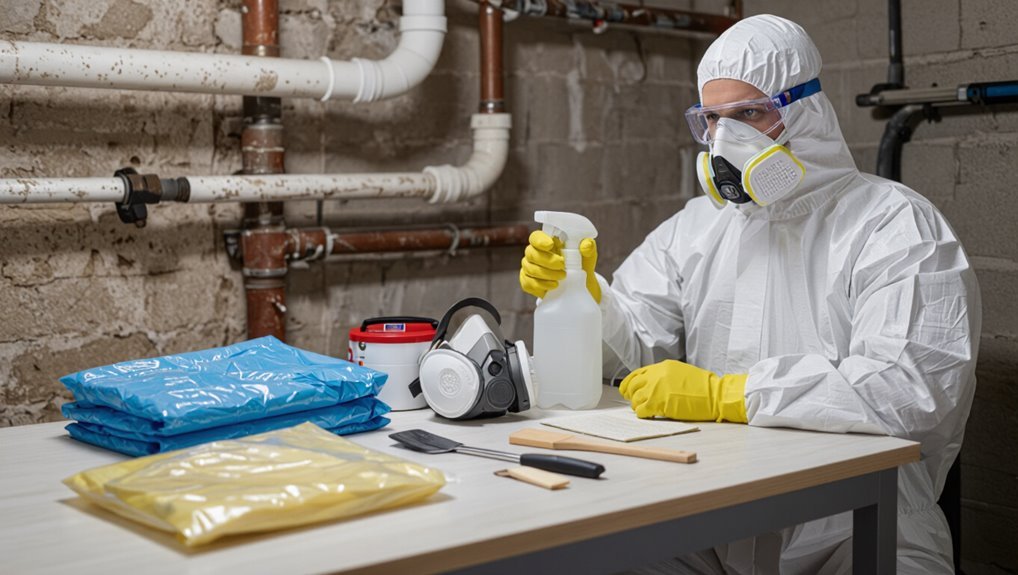
A concise, itemized PPE checklist guarantees all necessary protective gear is identified and available before any asbestos work begins, minimizing exposure risk and regulatory noncompliance. The checklist enumerates certified respirators, disposable coveralls, gloves, eye protection, and decontamination supplies; items must meet standards, be inspected, and properly fitted.
| Item | Purpose |
|---|---|
| Respirator (P100) | Filtration |
| Coveralls | Barrier |
| Gloves | Hand protection |
| Eye protection | Prevent irritation |
Tools and materials needed for safe removal
Several specific tools and materials are essential for safe asbestos pipe insulation removal, each selected to minimize fiber release and protect workers.
Required items include certified HEPA vacuum, wetting solution and spray bottles, hand tools for gentle stripping (spatulas, shears), labeled impermeable disposal bags, heavy-duty tape, warning signage, respirator cartridges, and a dedicated containment-compatible lighting source.
Proper labeling and secure transport materials complete the list.
Establishing decontamination and work zones
Establish clear, contiguous work, contamination, and clean zones that prevent fiber migration and streamline movement of personnel and materials.
Define physical boundaries with tape, sheeting, and signage. Provide a contained entry/exit with a wet decontamination corridor, disposable waste containers, and HEPA-filtered vacuum staging.
Assign roles, limit access, and maintain logbooks to track personnel and waste movement for accountability and containment.
Air monitoring and testing equipment options
Proper selection of air monitoring and testing equipment is critical to verify containment integrity and protect workers from airborne asbestos fibers.
Use calibrated pump-and-filter samplers for personal and area samples, phase-contrast microscopy (PCM) for routine counts, and transmission electron microscopy (TEM) for definitive identification.
Include continuous real-time particle counters for leak detection, plus certified labs, chain-of-custody, and documented sampling plans.
Step-by-Step Guide to Removing Asbestos Pipe Insulation Safely
Before beginning work, a certified professional conducts pre-removal testing and a site assessment to determine asbestos type, extent of contamination, and appropriate controls.
The work area is then prepared by sealing off the space, posting signage, and controlling ventilation. After this, insulation is wetted to minimize fiber release.
Removal proceeds with techniques matched to pipe type and insulation condition. All removed material is handled, double-bagged, and packaged for disposal per regulations.
Pre-removal testing and site assessment
Once the decision is made to remove asbestos pipe insulation, a thorough pre-removal testing and site assessment must be conducted to identify asbestos-containing materials, determine fiber concentration risks, and define necessary controls.
Certified inspectors collect bulk samples, air baseline data, and visualize disturbance pathways.
Assessment documents occupancy, access, pipe condition, and required PPE levels, informing work scope, containment strategy, and emergency procedures.
Preparing the work area (sealing, signage, ventilation control)
When preparing the work area for asbestos pipe insulation removal, the team must establish airtight containment, clear and secure access routes, and control airflow to prevent fiber migration.
They must seal floors, walls, and ceilings with durable plastic, post warning signage, restrict entry to authorized personnel, set up negative-pressure ventilation with HEPA filtration, and provide decontamination entry/exit zones to maintain isolation and safety.
Wetting and minimizing fiber release
With containment established and airflow controlled, the removal team focuses on suppressing asbestos fiber release by thoroughly wetting the insulation and using gentle techniques.
Decontamination-grade wetting agents reduce dust, applied via low-pressure sprayers or misting. Workers avoid dry scraping, keep materials saturated during removal, collect runoff, and monitor fiber counts.
Continuous visual inspection guarantees dampness until material is safely contained for disposal.
Safe removal techniques for different pipe types and insulation condition
Begin by identifying pipe type and insulation condition to determine the appropriate removal method: thin metal pipes with intact, cement-like insulation require different tools and handling than corroded steel or ornate copper runs wrapped in loose friable insulation. Match technique to condition: wet non-friable surfaces, score and peel cement-like layers, and use hand tools with HEPA vacuums for friable areas.
| Pipe Type | Recommended Technique |
|---|---|
| Thin metal, intact | Score and peel |
| Corroded/friable | Hand tools, wetting |
Handling and packaging removed materials
Contain and control removed asbestos promptly to minimize fiber release and cross-contamination.
Workers double-bag waste in heavy-duty, labeled asbestos disposal bags, sealing with tape. Rigid containers are used for sharp or bulky pieces.
Wet materials to suppress dust before handling.
Store packaged waste in a secure, ventilated area pending transporter pickup.
Maintain handling logs and chain-of-custody documentation.
Clean-up procedures and final decontamination
After removal, a defined clean-up and decontamination sequence guarantees remaining asbestos fibers are contained and personnel are safe: HEPA-filtered vacuums, wet wiping with approved solutions, and double-bagging of waste are performed.
Workers decontaminate in a controlled area, removing disposable PPE into sealed bags and showering before re-entering clean zones.
All debris and tools are labeled, secured, and transported per regulations.
Post-removal air clearance testing
With bulk cleanup and personal decontamination complete, attention turns to verifying the air is safe for reoccupation through post-removal air clearance testing.
A qualified industrial hygienist collects area and background air samples using calibrated pumps and cassette filters, often performing PCM and TEM analyses.
Clearance criteria must meet regulatory limits; only documented passing results permit reentry.
Records should be retained for compliance.
Special Scenarios and Techniques
The discussion shifts to techniques tailored for specific challenges, contrasting approaches for friable versus non‑friable insulation and methods for confined areas such as elbows, flanges, and valves.
It also addresses protocols for working in occupied buildings or homes and procedures for emergency repairs to damaged asbestos insulation.
Recommended practices emphasize containment, minimal disturbance, and contacting licensed professionals when risks or access constraints exceed safe DIY measures.
Removing friable vs. non-friable asbestos insulation
Distinguishing between friable and non‑friable asbestos insulation is critical because each requires different handling, containment, and removal methods to control fiber release and protect workers and occupants.
Friable material crumbles easily and demands full containment, negative pressure, wet removal, and licensed abatement.
Non‑friable material is more stable; careful wetting, glove‑bagging or controlled mechanical removal with minimal disturbance may suffice, always following regulations.
Dealing with tight spaces, elbows, flanges, and valves
Navigate tight spaces and irregular fittings cautiously, since elbows, flanges, valves, and narrow access points concentrate asbestos-containing material and raise the risk of fiber release.
Use hand tools with glove protection, wet methods to suppress dust, and disposable containment wraps. Work slowly, minimize disturbance, seal removed fragments in labeled bags, and document locations.
Retreat and reassess if access impedes safe control.
Safe removal in occupied buildings or homes
When removing asbestos insulation in occupied buildings or homes, maintain strict containment, clear communication with occupants, and scheduling strategies that minimize exposure and disruption.
Establish sealed work zones, negative air pressure, and visible signage. Coordinate access times, relocate vulnerable occupants temporarily, and ventilate adjacent areas.
Use trained personnel, HEPA filtration, and routine air monitoring. Document procedures and provide occupants with post‑work clearance results.
Emergency repairs for damaged asbestos insulation
Responding quickly to damaged asbestos insulation requires procedures that prioritize containment, worker safety, and minimizing fiber release.
Emergency actions include isolating the area, shutting HVAC, wetting debris with amended water, and covering damage with sealed sheeting or tape.
Only trained personnel in PPE should stabilize or bag fragments; avoid sweeping.
Notify authorities and schedule professional abatement for permanent repair and clearance testing.
Disposal, Transport, and Documentation
Proper disposal and transport of asbestos waste require secure labeling, sealed packaging, and adherence to carrier and jurisdictional manifest rules.
Contractors must locate and use permitted asbestos disposal facilities and obtain any required permits or notifications.
Accurate records, including manifests, permits, and customer notifications, should be retained per regulatory retention schedules.
Proper labeling and packaging for disposal
Clear, accurate labeling and secure packaging are essential to confirm asbestos-containing materials are handled, transported, and disposed of safely and legally.
Waste must be double-bagged in heavy-duty, leak-tight asbestos-rated bags, sealed, and labeled with hazard warnings, generator information, and removal date.
Packages should be intact, clearly marked, and accompanied by required manifest or documentation per local regulations to confirm traceability and compliance.
Finding approved asbestos disposal facilities
Before any asbestos waste leaves the site, the generator must identify and arrange disposal at a facility authorized to accept asbestos-containing materials; such facilities are typically licensed landfills or specialized hazardous-waste sites that meet state and local criteria for handling friable asbestos. The generator verifies permits, acceptance policies, hours, fees, and required documentation before scheduling delivery.
| Permit status | Acceptance policy |
|---|---|
| Licensed | Friable allowed |
| Conditional | Pre-notification |
| Restricted | Asbestos only |
Transportation rules and manifest requirements
With the receiving facility confirmed and paperwork prepared, attention turns to the rules governing transport and the manifest that must accompany asbestos waste.
Transport must follow federal and state hazardous waste regulations, using labeled, leak‑tight containers and approved carriers.
A detailed manifest documenting generator, transporter, waste type, quantity, and destination accompanies each shipment; copies follow the waste through chain of custody until facility signature confirms receipt.
Recordkeeping, permits, and customer notifications
Maintain meticulous records, secure required permits, and notify customers promptly to guarantee legal compliance and transparency throughout disposal and transport of asbestos-containing materials. Documentation must list manifests, disposal site receipts, and worker exposure logs. Permits and notifications follow local regulations; copies go to clients. Retain records per law and provide timely customer updates to document chain of custody and regulatory adherence.
| Manifests | Receipts | Logs |
|---|---|---|
| Permits | Copies | Retention |
Costs, Timeframe, and Hiring a Professional
Costs and time for removing asbestos pipe insulation vary with material type, accessibility, cleanup scope, and regulatory requirements, typically ranging from several hundred to several thousand dollars.
A professional asbestos contractor should provide a written scope of work, containment and abatement methods, timeline, and waste disposal plans.
Homeowners are advised to verify licenses and certifications, confirm insurance and warranties, and ask specific questions about testing, permits, and contract terms before hiring.
Typical cost factors and price ranges
Several key factors influence the price of removing asbestos pipe insulation, including the amount and condition of the material, the complexity of access, local disposal and testing fees, and whether specialized containment or air monitoring is required.
Typical residential jobs often range from a few hundred to several thousand dollars; extensive or hard-to-reach piping can push costs higher, with emergency or regulated disposal adding premiums.
What to expect from a professional asbestos contractor
Engaging a professional asbestos contractor brings specialized equipment, certified personnel, and regulatory compliance that together determine the overall cost and timeline of a removal project.
Contractors assess scope, create containment plans, obtain permits, and provide disposal. Costs reflect labor, testing, and waste fees.
Typical jobs take hours to days; complex systems may require phased work. Written estimates and clear schedules are standard.
Questions to ask and certifications to verify before hiring
Why ask about certifications and timelines up front? A homeowner should confirm licensed asbestos removal credentials, proof of training, and estimated project duration. Request itemized cost estimates and minimum containment procedures. Verify local regulator registration and air monitoring plans.
| Question | What to verify |
|---|---|
| Certification | License, training proof |
| Timing | Start, duration, milestones |
Contract terms, insurance, and warranties
Review the contract carefully before work begins to guarantee scope of work, exact costs, payment schedule, start and completion dates, change-order procedures, insurance coverage, and warranty terms are clearly stated and legally enforceable.
The contractor should carry liability and worker’s compensation insurance; request certificates.
Confirm asbestos-specific coverage, contract termination rights, dispute resolution, warranty length and exclusions, and documented cleanup standards before signing.
Health Monitoring and Long-Term Considerations
After removal, attention turns to symptoms and long-term risks associated with asbestos exposure, including persistent cough, shortness of breath, and elevated cancer risk that may take years to appear.
Regular medical surveillance and prompt testing are recommended for anyone with suspected exposure or new respiratory symptoms.
Ongoing prevention focuses on avoiding recontamination through proper cleanup, air monitoring, and scheduled follow-up inspections.
Symptoms and long-term risks of asbestos exposure
Early signs of asbestos-related illness are often subtle—persistent cough, breathlessness on exertion, or chest pain—that can appear decades after exposure. Symptoms may progress to pleural thickening, asbestosis, lung cancer, or mesothelioma; risk increases with dose and latency. Regular monitoring and prompt reporting of changes are essential.
| Condition | Typical feature |
|---|---|
| Asbestosis | Fibrosis, dyspnea |
| Pleural disease | Thickening, effusion |
| Lung cancer | Cough, hemoptysis |
| Mesothelioma | Chest pain, weight loss |
Medical surveillance and when to seek testing
Following recognition of possible asbestos-related symptoms, establishing an ongoing medical surveillance plan helps detect disease progression or new pathology at a stage when management options are more effective.
Periodic chest imaging, pulmonary function tests, and symptom reviews are recommended based on exposure level and latency.
Prompt evaluation is advised for new or worsening cough, breathlessness, chest pain, or unexplained weight loss; occupational records support testing decisions.
Preventing recontamination and follow-up inspections
Maintain strict controls around the work area to prevent recontamination and plan scheduled follow-up inspections to confirm containment integrity and worker safety.
Secure barriers, negative pressure, HEPA filtration, and controlled decontamination routes.
Log air clearance tests, waste manifests, and personnel exposures.
Schedule periodic post‑remediation air monitoring and medical checkups as required.
Document findings and remedial actions; escalate to professionals if results exceed limits.
Common Mistakes and How to Avoid Them
Common errors during asbestos pipe removal can greatly increase exposure risk, environmental contamination, and legal consequences.
The following list highlights frequent mistakes and directs attention to avoidance measures:
- Improper PPE or no air monitoring
- Dry scraping and use of power tools
- Improper disposal or mixing contaminated waste
- Failing to obtain permits or notify authorities
Mistake: improper PPE or no air monitoring
Personal protective equipment (PPE) and air monitoring are essential defenses when removing asbestos pipe insulation; neglecting either drastically increases health risks. Workers must use certified respirators, disposable suits, and continuous air sampling; omissions contaminate homes and bodies. Immediate cessation and professional consultation are required if monitors spike or PPE fails.
| Fear | Consequence |
|---|---|
| Exposure | Disease |
| Regret | Lifelong |
Mistake: dry scraping and power tools
Using dry scraping or power tools on asbestos pipe insulation releases large quantities of hazardous fibers into the air, vastly increasing the risk of inhalation and contamination.
Such methods destroy encapsulation, create invisible dust clouds, and spread fibers beyond the work area.
Proper wetting, careful manual techniques, and using approved removal methods minimize fiber release; otherwise, professional abatement should be engaged.
Mistake: improper disposal or mixing contaminated waste
Dispose of asbestos-contaminated materials incorrectly and the hazard spreads: mixing asbestos waste with regular trash, breaking bulk into unsealed containers, or sending it to non‑approved facilities can release fibers during transport, handling, or storage and expose workers, occupants, and the environment.
Properly double-bag, label, and secure wet-packaged asbestos waste; use licensed disposal sites and documented chain-of-custody to prevent cross-contamination and legal violations.
Mistake: failing to obtain permits or notify authorities
Although permits and notifications can seem bureaucratic, failing to obtain them before removing asbestos pipe insulation creates legal, safety, and liability risks.
Contractors and homeowners may face fines, project shutdowns, or improper oversight that increases exposure.
Notify regulators, secure required permits, and schedule inspections.
Proper documentation protects health, guarantees compliance with containment and disposal rules, and preserves insurance coverage and legal defense.
Helpful Resources and References
A concise set of trusted references helps readers verify legal obligations and locate qualified help when removing asbestos pipe insulation.
Key sources include official government guidance, industry associations, certification bodies, and vetted suppliers for PPE and testing.
Examples and starting points are listed below for quick reference:
- National and local government regulations and guidance
- Professional associations and certification organizations
- Accredited asbestos testing and abatement firms
- Recommended suppliers for PPE and monitoring equipment
Government guidance and regulations
When handling asbestos pipe insulation, homeowners and contractors should consult applicable federal, state, and local regulations to guarantee compliance with legal requirements for removal, transport, and disposal.
Key sources include the U.S. EPA, OSHA, and state environmental agencies. These authorities publish rules, clearance criteria, manifest and landfill requirements, reporting obligations, and guidance on notification, permissible work practices, and penalties for noncompliance.
Professional associations and certification bodies
Consult professional associations and certification bodies for authoritative training standards, credentialing, technical guidance, and directories of qualified asbestos abatement firms.
Relevant organizations publish certification requirements, continuing education, best-practice protocols, and codes of conduct. They verify contractor credentials, offer searchable member directories, and provide dispute resolution resources.
Consultation guarantees selection of licensed, insured professionals who follow recognized safety and testing procedures, reducing liability and exposure risks.
Recommended suppliers for PPE and testing services
Several reputable suppliers and laboratories specialize in respiratory protection, disposable protective clothing, HEPA-filtered vacuums, and accredited asbestos testing services suitable for abatement projects.
Recommended vendors include industrial safety suppliers, certified environmental labs, and manufacturers offering NIOSH-approved respirators, Tyvek® suits, and HEPA vacuums.
Select providers with clear certifications, positive reviews, warranty support, and local emergency response capabilities.
Verify accreditation and sample handling protocols before purchase.
Conclusion
Removing asbestos pipe insulation is not to be treated casually; it demands meticulous precautions and, often, professional involvement. Like traversing a minefield in slow motion, each step must be deliberate to prevent airborne fibers. When protocols, personal protective equipment, or containment cannot be guaranteed, a licensed abatement contractor should be engaged. Long-term health monitoring and adherence to local regulations remain essential to minimize exposure risks and protect occupants and workers alike.