
How to Choose a Kitchen Faucet: Expert Tips to Match Style, Function & Budget
Choosing the right kitchen faucet involves balancing style, function, and budget. Start by identifying your daily tasks and setting a realistic budget. Ensure compatibility with your sink and countertop by checking mounting holes, spout height, and reach. Opt for durable materials, ceramic-disc valves, and finishes that resist wear. Select a style—be it traditional, modern, or industrial—and consider features like pull-down sprays or touchless operation for added convenience. Don’t forget to factor in installation complexity and maintenance needs. For a comprehensive guide, including practical checklists and maintenance tips, continue reading to finalize your ideal faucet choice.
How to Choose the Right Kitchen Faucet for Your Home
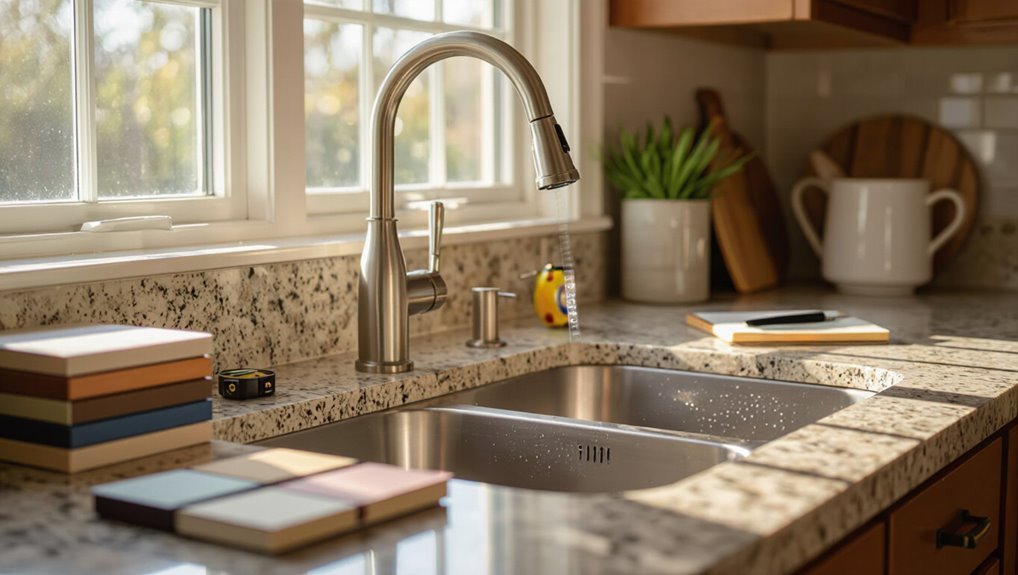
Choosing the right kitchen faucet comes down to balancing style, function, and budget to match the home’s needs and aesthetic.
Homeowners commonly replace faucets because of leaks, poor performance, outdated appearance, or to upgrade features like pull-down sprays and touch activation.
Evaluating priorities and common failure points helps narrow the best single option for a given kitchen.
Quick summary the single best way to decide based on style, function, and budget
When balancing style, function, and budget, the single best way to decide is to prioritize the faucet’s primary role in the kitchen and select the highest-quality model within that focused price range.
Aesthetic finish and extra features should be secondary considerations that complement function rather than dictate it.
A concise approach to how to choose a kitchen faucet: define tasks, set a realistic budget, then pick the best-performing option.
Common reasons people replace kitchen faucets
After prioritizing function, budget, and a complementary finish, homeowners often replace kitchen faucets for a handful of practical reasons.
Common drivers include persistent leaks, low water pressure, worn finishes, outdated style, inefficient spray functions, and broken handles or cartridges.
Upgrading for improved water efficiency, touchless operation, or better cleanup reach also motivates replacement, balancing performance gains with aesthetic cohesion.
Key factors to consider before shopping
Before shopping, the homeowner should confirm sink and countertop compatibility, noting mounting type and number of holes. They should also check household water supply and plumbing requirements.
Measurements for spout height, spout reach, and clearance determine which faucets will fit and function properly.
Finally, finish and material durability and the choice between single- or double-handle operation affect longevity and everyday ease of use.
Sink and countertop compatibility (mounting type, number of holes)
Although often overlooked, sink and countertop compatibility determines which faucet designs will fit and function correctly in a kitchen; mounting type (deck-, wall-, or undermount) and the number and spacing of predrilled holes dictate selection and installation constraints.
Measure hole count, spacing, and deck thickness. Verify whether escutcheons or single‑hole converters are needed.
Confirm clearance for handle operation and sprayhead movement before purchasing.
Water supply and plumbing requirements
When evaluating water supply and plumbing requirements, homeowners should confirm pipe type and size, shutoff valve condition, water pressure, and the presence of backflow preventers or water treatment devices that may affect faucet compatibility and performance.
Also verify hot and cold supply locations, adapter or braided hose needs, and whether additional fittings or certified installers are required to meet local codes and guarantee leak-free, efficient operation.
Size and reach: spout height, spout reach, and clearance
After confirming supply lines and fittings, attention shifts to faucet proportions: spout height, spout reach, and clearance determine usability and fit within the sink and surrounding cabinetry.
Measure sink depth and lip to guarantee tall spouts clear cabinets and windows. Reach must center water flow over the basin to prevent splashing.
Check handle sweep and swivel range for obstruction-free operation.
Finish and material durability
Because finish and material determine both appearance and longevity, buyers should evaluate corrosion resistance, scratch hardness, and coating quality before shopping.
Solid brass and stainless steel offer superior corrosion resistance; plated finishes (chrome, nickel) vary by thickness and warranty.
Consider PVD coatings for scratch and fade resistance.
Matte and textured finishes hide wear but may require specific cleaners to avoid damage.
Handle type and ease of use (single-handle vs. double-handle)
Finish and material choices influence not only appearance but also how a faucet is handled.
So buyers should next compare single-handle and double-handle designs for usability.
Single-handle faucets allow one-handed temperature and flow adjustment, ideal for multitasking.
Double-handle faucets offer separate hot and cold control and finer temperature tuning but require two-handed operation, potentially less convenient during busy kitchen tasks.
Valve type and longevity (ceramic disc, ball, cartridge)
Examine the faucet’s valve type before shopping, since it largely determines durability, maintenance needs, and how smoothly the controls operate.
Ceramic disc valves offer long life and leak resistance; cartridges balance reliability and straightforward replacement; ball valves are economical but may require more maintenance and tolerate harder wear.
Match valve choice to water hardness, serviceability, and expected lifespan for best value.
Spray functionality and modes
Spray functionality influences daily kitchen tasks more than many shoppers realize, so evaluating available spray modes and their controls is essential before buying.
Consider spray patterns (stream, spray, pause), water pressure adaptability, and smooth switching mechanisms like toggle buttons or magnetic docking.
Multi-function heads aid rinsing, filling, and gentle cleaning.
Durability of seals and ease of maintenance determine long-term performance and reliability.
Installation complexity and tools required
Evaluating installation complexity and required tools helps buyers match a faucet to their DIY skills or plumber needs.
Consider number of holes, deck or wall mount, and supply line compatibility.
Check for included hardware, mounting type, mounting plate needs, and clearances under sink.
Note whether specialized tools or basin wrenches, plumber’s tape, or sealants are necessary and estimate labor time.
Warranty, brand reputation, and replacement parts availability
After considering installation complexity and the tools required, prospective buyers should assess warranty terms, brand reputation, and the availability of replacement parts, since these factors affect long-term satisfaction and total ownership cost.
Review warranty length, coverage, and transferability; check brand service history and user reviews; confirm replacement cartridges, aerators, and handles are stocked or standardized to simplify repairs and reduce future expense.
Styles and designs to match your kitchen aesthetic
Choosing a Kitchen Faucet evaluates how a faucet’s look reinforces the room’s overall character and function. Styles range from timeless to industrial, and homeowners should weigh aesthetics against usability and coordinating accessories.
Key options to examine include:
- Traditional and farmhouse styles
- Transitional designs for flexible aesthetics
- Modern and minimalist faucets
- Industrial and commercial-style faucets and integrated accessories (soap dispensers, pot fillers)
Traditional and farmhouse styles
Warm finishes and graceful silhouettes define traditional and farmhouse kitchen faucets, blending classic ornamentation with functional simplicity to complement period or country-inspired interiors.
Designs favor exposed spouts, bridge or gooseneck profiles, porcelain or cross handles, and subtle detailing like fluting or rope accents.
Prioritize durable materials and straightforward repairability to maintain authentic appearance while ensuring everyday practicality and longevity.
Transitional designs for flexible aesthetics
Transformative kitchen faucets bridge traditional and contemporary elements to suit a wide range of interiors.
They pair soft curves with clean lines, neutral finishes with subtle detailing, and versatile functions that complement mixed cabinetry and hardware.
Ideal for homeowners seeking cohesion during gradual renovations, adaptable faucets offer balanced aesthetics, practical performance, and compatibility with both classic and updated décor without committing to a single stylistic era.
Modern and minimalist faucets
Simplicity defines modern and minimalist faucets, where pared-back forms and unobtrusive finishes prioritize function and visual calm.
Clean lines, single-lever controls and concealed aerators reduce clutter while enhancing usability. Matte black, brushed nickel or soft metallics complement streamlined cabinetry.
Compact spouts and wall-mount options maximize counter space. Emphasis rests on efficient water flow, durable materials and unobtrusive integration with contemporary kitchen layouts.
Industrial and commercial-style faucets
Industrial-inspired faucets bring a utilitarian edge to kitchen design, pairing exposed hardware, high-arc pre-rinse spouts, and robust finishes to echo professional environments.
They prioritize durability, with brass or stainless construction, industrial-style levers, and flexible spring coils for reach and control.
These fixtures suit loft, farmhouse, or contemporary kitchens seeking rugged visual impact while supporting heavy use and straightforward maintenance.
Integrated and matching accessory options (soap dispensers, pot fillers)
While functionality remains primary, integrated accessories like soap dispensers and pot fillers also serve as cohesive design elements that tie a kitchen’s look together.
Coordinated finishes and streamlined profiles maintain visual harmony; matching styles—from minimalist single‑handle sets to vintage bridge faucets—ensure consistency.
Practical placement, durable materials, and optional built‑in filtration or swivel features add convenience without compromising aesthetic unity.
Functionality breakdown: Choosing features that matter
The next consideration is which functional features will best serve daily kitchen tasks. Options range from pull-down, pull-out, and fixed spouts to touchless or touch-activated operation, dual-function sprayers with multiple patterns, built-in filtration or instant-hot systems, and water-saving flow controls governed by GPM regulations.
Weighing pros, cons, and installation or maintenance implications helps prioritize the features that matter most.
Pull-down vs. pull-out vs. fixed spouts pros and cons
How should a homeowner choose between pull-down, pull-out, and fixed-spout faucets? The homeowner weighs spray reach, sink size, and tasks. Pull-downs suit deep sinks and heavy prep; pull-outs fit compact or secondary sinks; fixed spouts offer durability and simpler aesthetics but limited reach.
| Type | Best for |
|---|---|
| Pull-down | Deep sinks, heavy prep |
| Pull-out | Compact sinks, flexibility |
| Fixed spout | Durability, simple style |
Touchless and touch-activated faucets benefits and considerations
Because hands-free operation reduces contact with germs and speeds common tasks, touchless and touch-activated faucets are increasingly chosen for busy kitchens.
They offer water-conserving sensors, convenient activation with elbows or wrists, and reduced surface wear.
Considerations include sensor reliability, battery or hardwired power, occasional false triggers, and higher upfront cost.
Maintenance and compatibility with filtration systems also influence selection.
Dual-function sprayers and spray patterns
Following considerations about touch-free activation, attention shifts to the sprayer itself: dual-function sprayers and varied spray patterns determine how water is delivered for rinsing, filling, and cleaning tasks.
Dual-mode faucets toggle between stream and spray or offer pause functions. Multiple patterns (aerated stream, powerful spray, sweep) improve versatility.
Durable nozzles, easy-switch levers, and adjustable flow balance performance and water conservation.
Built-in filtration and instant hot water options
When evaluating faucets for enhanced utility, built-in filtration and instant hot water options address separate but complementary needs: cleaner drinking water and immediate access to near-boiling temperatures for cooking and sanitation.
Integrated filters reduce contaminants and improve taste without countertop units; instant hot systems save time but require safety features, maintenance, and space for a tank or heater under the sink.
Water-saving features and flow rates (GPM) and regulations
Alongside filtration and instant-hot capabilities, water-saving features and advertised flow rates determine a faucet’s everyday efficiency and compliance with local standards.
Aerators, laminar flow restrictors, and hands-free sensors reduce consumption while preserving performance.
Buyers should check GPM ratings—commonly 1.8, 1.5, or 1.2—and verify ENERGY STAR or local plumbing-code certification to confirm legal compliance and genuine water savings.
Budgeting and value: how much to spend
A clear price framework helps readers distinguish economy, mid-range, and premium faucet options and set realistic expectations.
The article highlights which features—such as ceramic cartridges, advanced spray functions, and durable finishes—justify higher prices.
It also notes long-term costs to evaluate, including replacement cartridges, repair availability, and finish longevity.
Price bands explained: economy, mid-range, premium
Although budget constraints shape choices, faucets generally fall into three price bands—economy, mid-range, and premium—each offering distinct trade-offs in materials, features, and longevity.
Economy models prioritize low cost with basic finishes and shorter warranties.
Mid-range balances quality, finish options, and reliable performance.
Premium faucets emphasize durable materials, refined styling, extended warranties, and higher build quality for long-term value.
What features are worth the extra cost
When deciding how much to invest in a kitchen faucet, prioritize features that deliver measurable benefits—durable valve mechanisms, solid brass or stainless construction, and reliable finishes that resist corrosion and wear—because these directly reduce repair costs and prolong service life.
Additionally, consider ceramic cartridges, smooth single‑handle operation, strong pull‑down sprays, and a good warranty; these enhance daily usability and justify higher upfront cost.
Long-term cost considerations: repairs, cartridges, finishes
Long-term costs hinge less on the purchase price than on predictable maintenance items—replacement cartridges, finish touch-ups, and occasional valve repairs—that accumulate over a faucet’s service life.
Anticipated expenses include cartridge replacements every few years, finish restoration for high-use surfaces, and labor for unexpected leaks. Warranties, readily available parts, and reputable brands reduce lifetime cost; cheap replacements often increase total ownership expense.
How to measure and prepare for installation
Before installation, the homeowner should gather a tools-and-materials checklist and confirm measurements for the sink, deck, and supply lines.
The workspace must be prepared and the water supply shut off to prevent leaks during the swap.
If measurements are unclear, pipes are corroded, or unexpected complications arise, a professional plumber should be called.
Tools and materials checklist
A clear checklist prevents surprises during faucet installation: precise measurements of deck thickness, hole diameter, and supply line lengths, along with the required tools—adjustable wrench, basin wrench, plumber’s tape, silicone sealant, and a screwdriver—should be gathered and verified before work begins.
Also include replacement supply hoses, mounting hardware, locking nuts, a bucket, rags, flashlight, and safety glasses; confirm compatibility and quantity.
Measuring your sink, deck, and supply lines
Several precise measurements are required to guarantee a faucet fits and functions correctly: deck thickness, hole diameter and spacing, distance to the backsplash, and the lengths and routing of existing supply lines.
Measure deck thickness for mounting hardware, hole diameters and center-to-center spacing for single or multiple-hole faucets, clearance to the backsplash for spout reach, and supply line lengths and connector types for compatibility.
Preparing the workspace and shutting off water
With measurements confirmed, attention shifts to preparing the workspace and shutting off the water to guarantee a safe, efficient installation.
Clear under-sink area, lay towels and a bucket for residual water, and protect countertops.
Locate and close the shutoff valves or the home’s main supply, then open faucet to drain lines.
Gather necessary tools and inspect supply hoses for compatibility before proceeding.
When to call a professional plumber
If the project involves unfamiliar plumbing configurations, structural modifications, or persistent leaks, homeowners should consider hiring a professional plumber.
A pro assesses sink hole dimensions, deck thickness, supply line compatibility, and valve condition, ensuring accurate measurements and proper tools.
They identify hidden issues, obtain permits if needed, and complete secure installations that prevent future damage, saving time and avoiding costly mistakes.
Comparing top faucet types and brands
A concise comparison of top faucet types and brands focuses on performance, durability, and warranty to help readers make a practical choice. The following table highlights best picks by category to clarify trade-offs. Consider budget, value, suitability for large sinks, and touchless options when weighing brands and models.
| Category | Best Pick |
|---|---|
| Best budget | Basic single-handle models with reliable cartridges |
| Best value | Mid-range pull-downs with extended warranties |
Performance, durability, and warranty comparisons
Evaluate faucet performance, durability, and warranty terms by focusing on water flow, build materials, and manufacturer support.
Compare flow rate consistency, spray function reliability, and valve type (ceramic disc versus cartridge).
Inspect materials—brass, stainless steel, plating—and corrosion or finish warranties.
Review warranty length, coverage scope, and claim process responsiveness.
Prioritize brands with documented longevity and accessible customer service.
Best picks by category (best budget, best value, best for large sinks, best touchless)
Choices among kitchen faucets hinge on planned use and budget, so the best picks are grouped by category—budget, value, large-sink, and touchless—to match performance and features to specific needs.
For budget: reliable single-handle models with basic pull-down sprayers.
Best value: midrange brands offering ceramic cartridges and finishes.
Large-sink: high-arc, long-reach pulldown designs.
Touchless: sensor-activated, battery or hardwired units with temperature memory.
Common problems and how to avoid them
Common kitchen faucet problems include leaks, persistent drips, and stiff handles, each with straightforward causes and repairs.
Mineral buildup and finish wear can be minimized with regular cleaning and appropriate water treatments.
Incompatible mounting or supply connections are often detectable before purchase by measuring deck holes and supply line types.
Leaks, drips, and handle stiffness causes and fixes
A handful of typical faucet problems—leaks, persistent drips, and stiff handles—trace back to worn seals, mineral buildup, pressure issues, or defective cartridges and valves.
Diagnose by isolating supply lines, checking O-rings and cartridge condition, and testing pressure.
Replace failing cartridges or seals, tighten connections, flush lines, and install pressure regulators or aerators as needed.
Regular inspection prevents escalation.
Mineral buildup and finish wear prevention and cleaning tips
Several factors—hard water minerals, acidic cleaners, and abrasive scrubbing—accelerate mineral deposits and finish degradation on kitchen faucets; preventing buildup requires regular gentle cleaning, water-softening measures where needed, and choosing nonabrasive products compatible with the faucet’s finish.
Wipe dry after use, remove deposits with vinegar-soaked cloths or manufacturer-approved descalers, avoid scouring pads, and apply protective wax sparingly.
Incompatible mounting or supply issues how to detect before buying
How will a new faucet actually fit and connect to existing plumbing?
Measure hole count, spacing, deck thickness and supply line size.
Verify sink or countertop hole configuration (single, center-set, widespread) and available clearance for spouts and handles.
Check shutoff valve locations and adapter needs for 1/2″ or 3/8″ connections.
Confirm mounting hardware compatibility to avoid returns or modifications.
Maintenance and care to extend lifespan
Routine maintenance preserves both appearance and function, so the article outlines gentle cleaning methods tailored to chrome, stainless, brass, and matte finishes.
It then explains simple parts that commonly require replacement—cartridges, aerators, and seals—and how to identify wear.
Finally, a seasonal checklist with quick monthly and annual tasks is offered to catch issues before they escalate.
Routine cleaning methods for different finishes
Because finish-specific care prevents damage and preserves appearance, cleaning methods should be tailored to the faucet’s material and coating.
Soft cloths and mild soap suit chrome and stainless finishes; nonabrasive cleaners and microfiber protect brushed and matte surfaces.
For oil-rubbed bronze, use pH-neutral cleaners sparingly and avoid wax removal.
Rinse thoroughly and dry to prevent spots and waterborne corrosion.
Replacing cartridges, aerators, and seals
Inspecting and promptly replacing worn cartridges, aerators, and seals keeps a faucet functioning smoothly and prevents leaks that can cause larger damage.
Regular inspection detects mineral buildup, reduced flow, or dripping. Replacing cartridges restores handle operation; swapping aerators improves flow and filtration; new seals stop leaks.
Use manufacturer parts, follow torque specs, and test thoroughly after reassembly to guarantee reliable, long-term performance.
Seasonal checks and quick maintenance schedule
Performing simple seasonal checks and quick maintenance every few months preserves faucet performance and prevents small issues from becoming costly repairs.
Inspect for leaks, test handle operation, clean aerator, and check supply lines. Follow a concise schedule:
- Inspect exterior and connections for drips
- Exercise handles and spray functions
- Clean or replace aerator screen
- Tighten fittings and flush lines
Practical buying checklist
A concise checklist helps confirm that a chosen faucet will fit the sink, perform as expected, and offer good long-term value.
Before purchase, buyers should run through a short set of checks and prepare key questions for retailers or installers to avoid surprises.
Suggested items to confirm include:
- Number and size of mounting holes and deck clearance
- Water supply compatibility and required adapters
- Warranty details, parts availability, and service policy
- Installation time estimate and any additional labor or materials needed
Final pre-purchase checklist to ensure fit, function, and value
Before committing to a purchase, buyers should run through a concise checklist that verifies compatibility with sink and countertop dimensions, confirms desired performance features, and compares long-term value.
Verify hole count, deck thickness, and clearance for spray heads; confirm flow rate, handle reach, and finish durability; check warranty terms, replacement part availability, and installation complexity; and compare total cost including any adapters or tools.
Questions to ask retailers or installers before buying
How should buyers frame their questions to retailers or installers to avoid surprises?
Buyers should ask about model compatibility with sink holes and deck plates, warranty terms and service process, exact installation costs and required parts, water pressure and flow rates, finish durability and maintenance, lead times and return policies, and whether certified installers or permits are needed.
Clarify exclusions and get written estimates.
Real-life scenarios to guide your choice
Different household layouts and routines call for specific faucet features. A compact apartment may prioritize low-clearance, space-saving designs, while a busy family kitchen needs durable, easy-to-use fixtures for daily wear.
For hosts who handle large pots and frequent entertaining, a high-arc, flexible spray faucet better accommodates heavy use and varied tasks.
Small apartment kitchen with limited clearance
In many small apartment kitchens where clearance is limited, countertop depth, cabinet overhangs, and nearby shelving dictate faucet height and reach more than style preferences; choosing a low-profile, single-handle or pull-down model with a modest spout arc helps prevent collisions with upper cabinets while preserving sink usability.
Compact wall-mounted or deck-mounted options, swivel-stop features, and retractable sprays maximize function while minimizing interference.
Family kitchen with heavy daily use
While compact kitchens prioritize low-profile fixtures to avoid cabinet conflicts, a family kitchen used heavily every day demands durability, ease of use, and features that streamline frequent tasks.
Prioritize solid brass or stainless construction, ceramic-disc valves, high-flow aerators, and pull-down sprays with secure docking.
Consider single-handle operation, easy-clean finishes, and accessible repair parts to minimize downtime and maintenance.
Entertainer’s kitchen with large pots and frequent hosting
Because hosting demands handling oversized cookware and rapid prep cycles, the entertainer’s kitchen requires a faucet that combines high reach, robust flow, and flexible spray control.
A pull-down or commercial-style faucet with a tall spout, strong gallons-per-minute rating, and adaptable spray modes speeds filling and cleanup.
Durable finish and easy maintenance resist stains from frequent use, ensuring reliable performance during large gatherings.
Conclusion
Sunlight glances off a brushed-steel spout; a steady stream answers familiar routines. Choosing a kitchen faucet becomes like selecting a dependable companion—balanced form, the right reach, and a smooth pull that fits daily motion. Practical choices—finish, spray options, budget—align like tiles into a coherent surface, while simple care keeps the mechanism humming. With a clear list of needs and a few thoughtful tests, the perfect faucet will sit ready, quiet and sure.