How to Tell How Old a Hot Water Heater Is: 5 Easy Ways to Find the Age
To determine the age of your hot water heater, start by locating the data plate on the tank or front panel. This plate will display the model and serial numbers, which can be decoded using brand-specific methods (like those for A.O. Smith, Rheem, or Bradford White). If the serial number is unreadable, you can often verify the build date through the model number or manufacturer records. Additionally, physical signs such as rust, sediment buildup, and the condition of the anode rod can provide clues about its age. For detailed decoding and replacement advice, continue reading.
How to Quickly Determine the Age of Your Hot Water Heater
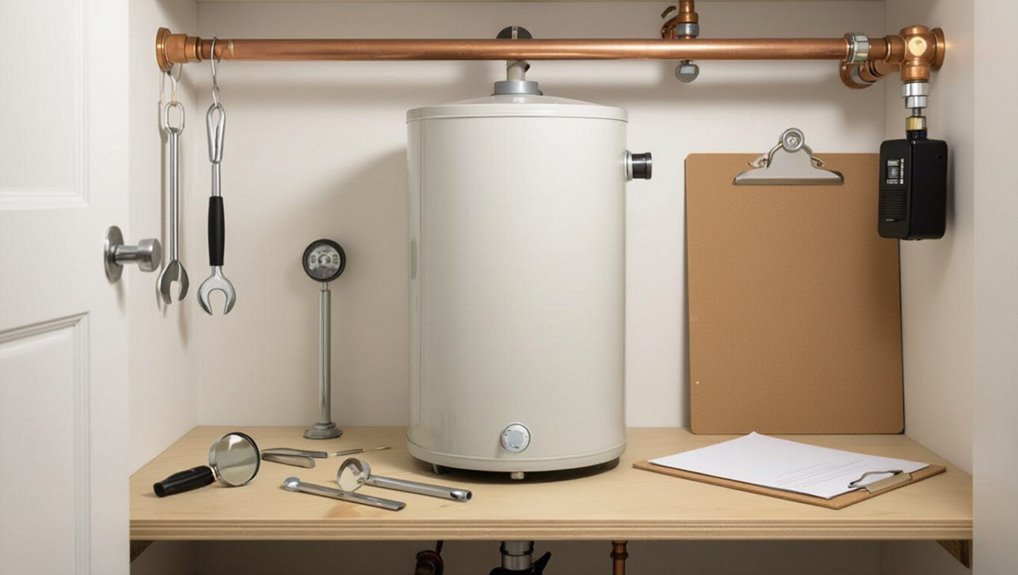
A quick check of the heater’s serial or manufacturer code can reveal its exact age in minutes with a simple lookup.
Knowing the unit’s age matters for safety inspections, efficiency expectations, and scheduling replacement.
The following steps explain how to read the code and interpret its implications.
One-sentence summary: find the age in minutes using serial/manufacturer code
When time is short, the quickest way to determine a water heater’s age is to read the serial number or manufacturer code and decode the embedded date information, since most makers include month and year markers within those strings.
A concise one-sentence method: locate the serial/manufacturer code, identify month/year markers per brand reference, then compute age in minutes from manufacture to now—use online decoders for speed.
When knowing the age matters for safety, performance, and replacement planning
Having the manufacture date on hand makes it possible to assess whether a heater still meets safety standards, is likely to perform efficiently, or should be scheduled for replacement.
Age influences corrosion risk, warranty validity, and compliance with updated codes. It informs maintenance frequency, replacement budgeting, and timing to avoid failures.
Decisions about retrofit, efficiency upgrades, or immediate replacement hinge on accurate age information.
Identify the Heater Type and Where to Look
The reader should first determine the heater type—traditional tank (gas or electric), tankless, or hybrid/heat pump—as this affects where identifying information is located.
For tanks, the data plate with model and serial is typically on the upper or side jacket; tankless units usually have it on the front panel, and hybrids often place it near the control box.
The data plate commonly lists model, serial number, manufacture date, and capacity, which are key to establishing age.
Common heater types: tank (gas/electric), tankless, hybrid/heat pump
Identifying a water heater starts with recognizing its basic type—storage tank (gas or electric), tankless, or hybrid/heat pump—because each has distinct appearance, labels, and placement cues.
Storage tanks are cylindrical with inlet/outlet pipes and often a draft hood or electric elements.
Tankless units are compact wall‑mounted boxes.
Hybrid heat pumps combine a larger tank with an external compressor module.
Typical locations of the data plate and serial number on each type
Recognizing the heater type narrows where to search for its data plate and serial number because manufacturers place labels differently on tanks, tankless units, and hybrids.
On storage tanks, check the upper shoulder, back near inlet/outlet plumbing, or around the burner access panel.
Tankless units usually have a label inside the service panel or on the side.
Hybrids often place plates on the unit’s exterior cabinet or near the compressor.
What information the data plate contains (model, serial, manufacture date, capacity)
A data plate serves as the heater’s identification card, listing key details such as the model number, serial number, manufacture date, and capacity so owners and technicians can confirm age, specifications, and warranty status.
It also shows fuel type, input/output ratings, pressure and temperature limits, manufacturing code, and certification marks.
These concise entries enable verification, replacement matching, and service diagnostics.
Decode the Serial Number by Brand
Manufacturers embed date codes in serial numbers using various formats, commonly year/month or month/year combinations (for example, “1209” for December 2009 or “0912” for September 2012 depending on the maker).
Major brands such as A.O. Smith, Rheem, Bradford White, and Whirlpool each use distinct coding schemes and examples will clarify reading them.
The following examples show typical brand formats and how to extract the manufacture date.
How manufacturers format dates (examples of year/month codes)
Decode serial numbers by looking for consistent patterns in how brands embed manufacture dates—commonly as a two- or four-digit year paired with a one- or two-digit month, or as a letter-number code where a letter represents the month and numbers the year.
Examples include YYMM or YYYYMM stacks, MYY or MY formats, and single-letter month codes (A–L) followed by two-digit years; separators vary.
Major brands and decoding examples
A quick overview of major manufacturers helps readers match serial-number formats to specific brands.
Common examples include:
- A.O. Smith
- Rheem / Ruud
- Bradford White
- Whirlpool / Maytag
- State, Kenmore, and others
Following sections will show how each brand encodes production dates in their serial numbers.
A.O. Smith
For A.O. Smith, the serial number often begins with a letter indicating month (A–L) followed by two digits for year.
Some formats use a two-digit year at the start.
Locate the serial on the tank label, then match the letter to month and the digits to manufacture year.
When unclear, contact A.O. Smith with the full serial for confirmation.
Rheem and Ruud
Many Rheem and Ruud water heaters hide the manufacture date within their serial numbers, typically encoded as a letter for the month followed by two digits for the year or as a two- or four-digit year sequence depending on model and production era.
Owners can consult brand charts or online decoders; serial placement varies by tank model.
Record the code and compare to manufacturer guides for precise manufacture month and year.
Bradford White
Shifting from Rheem and Ruud, Bradford White serial numbers use a distinct format that reveals manufacture date and plant information when decoded correctly.
Typically the prefix indicates plant code, followed by two digits for year and two for month. Some older units use letter-month codes.
Consult Bradford White decoding guides or contact the manufacturer with the serial for exact production details and verification.
Whirlpool and Maytag
Whirlpool and Maytag water heater serial numbers typically embed the manufacture date within a compact code, often using two digits for the year and two for the month or a letter-to-month scheme; knowing the brand-specific pattern lets owners and technicians determine age quickly from the serial.
Consult the unit label for the exact format—year/month pairs or a coded letter indicate production date; decode accordingly.
State, Kenmore, and others
State, Kenmore, and several other manufacturers embed production dates into serial-number sequences using distinctive formats—letter-month codes, two-digit year/month pairs, or brand-specific prefixes—so technicians can pinpoint manufacture dates without opening the tank.
Technicians read serials for patterns: a leading letter for month, paired digits for year, or model-linked codes. Cross-referencing brand decoding guides confirms the inferred manufacture month and year.
Use the Model Number and Manufacturer Records
If the serial number is faded or missing, the model number can often narrow the manufacture year to a range based on design changes and model release dates.
The manufacturer can confirm the exact build date if provided with the model number, any remaining serial data, purchase records, and a photo of the rating plate.
Many brands also offer online lookup tools or archives and can be reached via customer service for official verification.
When serial number is unreadable: using model number to estimate manufacture year
Although the serial number is often the quickest way to determine a water heater’s age, the model number can provide a reliable estimate when the serial is unreadable.
Manufacturers assign model codes that change over time and can be cross-referenced with company records, catalogs, or dealer documentation to narrow the manufacture year.
Compare model prefixes, edition numbers, and specification changes to pinpoint the likely production period.
How to contact manufacturer for verification (what to provide)
Once the model number has narrowed the likely production period, contacting the manufacturer can confirm the exact manufacture date and any factory records.
Provide the model number, any readable serial number fragments, purchase or installation date, and photos of rating plate and heater.
Include location, fuel type, and contact details.
Request written confirmation or reference number for records.
Online lookup tools and official resources
Where to start when a model number seems cryptic: manufacturers and independent databases offer searchable tools that translate model and serial details into manufacture dates and specifications.
Users consult online lookup tools and official records to confirm age, warranty, and replacement guidance.
- Enter model and serial on manufacturer sites
- Use certified dealer lookup pages
- Check independent databases
- Verify via PDF manuals
- Record lookup results for reference
Estimate Age by Physical Clues and Condition
Physical signs such as rust, corrosion, heavy sediment, and a worn anode rod provide practical clues to a heater’s remaining life.
Typical lifespans—about 8–12 years for tank units, 15–20 for tankless, and similar ranges for heat-pump models—help place those signs in context.
A brief, safe visual inspection (checking the tank exterior, pipe connections, and drain valve while following shutdown and grounding precautions) can confirm whether age-related wear is present.
Signs of age: rust, corrosion, sediment buildup, anode rod wear
Rust and corrosion on a water heater’s exterior, combined with internal signs like sediment buildup and a deteriorating anode rod, provide clear visual clues about its age and remaining lifespan.
Flaking paint, rust stains around fittings, reduced heating efficiency from sediment, and a heavily corroded or consumed anode rod indicate advanced wear.
These signs suggest closer inspection or replacement is warranted.
Common lifespan benchmarks for different types (tank, tankless, heat pump)
After noting exterior corrosion, sediment, and an anode rod nearing the end of its life, attention turns to how long different water heater designs typically last.
Conventional tank units often last 8–12 years.
Tankless systems commonly reach 15–20+ years with proper maintenance.
Heat pump (hybrid) water heaters typically last about 10–15 years, influenced by climate and usage patterns.
How to perform a simple visual inspection safely
A careful visual inspection can reveal most clues needed to estimate a water heater’s age and overall condition without tools or invasive work.
Observe corrosion, rust streaks, and scale on tank surfaces and fittings; check for leaks, pooling, or discolored insulation.
Note faded labels, brittle plastic, and sediment buildup around drains.
Confirm power and water supplies are off before approaching and avoid confined, hot areas.
Use Maintenance Records and Installation Dates
Maintenance records and installation documents often provide the most reliable age information for a water heater.
Past receipts, building permits, or home inspection reports can be checked in homeowner files, municipal records, or with the inspector/contractor who performed the work.
Asking previous owners or installers about installation dates and checking warranty registrations or manufacturer registration paperwork can confirm the unit’s age.
Where to find past receipts, permits, or home inspection reports
Where can past receipts, permits, and inspection reports be located when determining a water heater’s age?
Records often reside in the homeowner’s file cabinet, email archives, or cloud storage. Municipal building departments maintain permit databases.
Home inspection companies keep digital reports for years. Utility or plumbing contractors may supply invoices.
Reviewing these sources yields installation dates, serial numbers, and service histories useful for age verification.
Asking previous owners or contractors the right questions
How can past owners or contractors clarify a water heater’s age and service history? They can provide installation dates, original purchase receipts, and maintenance logs noting repairs or part replacements.
Ask specific questions: installation year, any major repairs, dates of last flush or anode replacement, and who performed work.
Record names, contact info, and verify claims against available documents for accuracy.
How water heater warranties and registration dates help determine age
Often, warranty paperwork and registration dates provide the clearest documented evidence of a water heater’s age when installation records are incomplete.
Maintenance logs, service invoices, and manufacturer registration receipts pinpoint purchase or activation dates. Warranty start dates indicate installation windows and coverage periods.
Cross-referencing those dates with contractor invoices or utility records confirms age accurately, aiding replacement decisions and resale disclosures.
Compare Symptoms to Typical End-of-Life Issues
The homeowner should match observed signs—such as leaks, rumbling or banging noises, and shorter hot-water runs—to common end-of-life symptoms for a water heater.
If the unit is near or past its expected service life, frequent breakdowns or costly component repairs often favor replacement over further fixes.
Older heaters also lose efficiency, increasing operating costs and strengthening the case for an upgrade to a more efficient model.
Warning signs of imminent failure (leaks, noise, reduced hot water)
Many clear warning signs indicate a water heater is approaching failure: persistent leaks, unusual noises, and a noticeable reduction in hot water capacity.
Rusty or discolored water, frequent thermostat cycling, and sediment-triggered rumbling signal internal degradation.
Small weeps at fittings, pooling at the base, or sudden temperature drops mean imminent malfunction.
Prompt inspection prevents damage and informs replacement timing.
When age makes repairs uneconomical vs replacement
Recognizing those warning signs leads naturally to weighing repair against replacement: age, failure patterns, and repair history determine when continued fixes are uneconomical.
Frequent component failures, recurring leaks, corrosion at tank seams, and multiple past repairs indicate approaching end-of-life.
If repair cost approaches or exceeds replacement, or reliability remains poor, replacement is usually the prudent choice to avoid repeated service calls and sudden failure.
Energy efficiency decline with age and cost implications
As a water heater ages, its heat exchange efficiency and insulation degrade, causing higher fuel or electricity use for the same hot-water output. Increased consumption raises operating costs and signals approaching failure; technicians compare bills, recovery time, and frequent cycling to decide replacement. Typical indicators match end-of-life patterns and justify cost-benefit calculations.
| Indicator | Implication |
|---|---|
| Higher bills | Reduced efficiency |
| Longer recovery | Worn elements |
| More cycling | Sediment build-up |
| Corrosion | Impending leak |
| Frequent repairs | Replacement likely |
Step-by-Step Checklist to Find Your Water Heater’s Age
A concise checklist helps determine a water heater’s age reliably.
First, document the data plate and serial number, then decode them using the manufacturer’s guidelines and review any installation or maintenance records.
Finally, inspect the tank and anode rod and contact the manufacturer or a qualified technician if the age remains unclear.
Step 1: Locate and photograph the data plate and serial number
Begin by locating the heater’s data plate—usually a metal sticker or stamped plate on the unit’s side or top—and photographing it clearly so the model, serial number, manufacturer, and manufacturing date (or codes) are legible for later reference.
Note placement, take multiple angles, and guarantee lighting avoids glare.
Record plate text separately in case photos are unreadable or file loss occurs.
Step 2: Decode serial/model using brand guidelines
With clear photos and a recorded plate text, the next step is to interpret the serial and model identifiers using the manufacturer’s decoding rules.
Consult the maker’s website or manuals for character-position meanings, month/year codes, and prefix standards.
Apply the brand-specific pattern to extract the manufacture date.
If unclear, contact manufacturer support with the serial/model for verification and note the decoded date.
Step 3: Check maintenance and installation records
Several common documents can quickly confirm a water heater’s age: installation invoices, warranty registrations, service logs, and inspection reports.
Review files for dates, technician notes, model and serial numbers, and stamped receipts.
Contact installers or service companies if records are missing.
Digital accounts, emailed confirmations, and municipal permits also often contain installation dates useful for verifying the heater’s timeline.
Step 4: Inspect physical condition and anode rod
After checking records, a visual and physical inspection provides immediate clues about a heater’s service life.
Corrosion, rust stains, dents, leaks, and faded labels indicate age and wear.
Remove the anode rod to assess its consumption—severe pitting or depletion suggests many service years.
Note tank sediment buildup and mineral deposits; these signs help estimate remaining lifespan and maintenance history.
Step 5: Contact manufacturer or a pro if unsure
When uncertainty remains after inspecting labels and the tank, contact the manufacturer or a licensed plumber for a definitive age determination.
Provide serial and model numbers, photos, and purchase records. Manufacturers can decode serial formats; plumbers can assess installation signs and component wear.
Expect clear guidance, possible service history, and replacement recommendations.
Keep records for future reference and warranty verification.
Common Mistakes and How to Avoid Them
Common errors in determining a water heater’s age include misreading serial codes or confusing the manufacturing year with the installation date.
Technicians and homeowners may also mistake model revision numbers for manufacture dates, leading to incorrect estimates.
Additionally, tankless and hybrid units use different coding schemes that are often overlooked, so consulting manufacturer guides helps prevent these mistakes.
Misreading serial codes or relying on manufacturing year vs installation year
Although serial numbers and manufacturing dates can seem authoritative, they often mislead homeowners who equate them with the installation date.
Serial codes indicate production, not when a unit was set up; replacements, storage delays, or dealer stock can create gaps.
Inspect installation paperwork, service records, and utility receipts to confirm actual in-service date rather than assuming manufacture equals installation.
Confusing model revisions with manufacture dates
Because manufacturers frequently issue model revisions without changing the model name or exterior labeling, homeowners can mistake a late-design update for a newer production date.
Inspectors should compare serial numbers, revision codes, and official technical bulletins rather than relying on cosmetic details.
Verify with manufacturer support or authorized dealers to confirm manufacture date; document findings to avoid future confusion.
Ignoring tankless and hybrid coding differences
How should inspectors account for differing date codes on tankless and hybrid water heaters?
Inspectors must recognize manufacturers use varied coding schemes; tankless units often embed production weeks, hybrids may use batch codes.
Consult brand-specific decoding guides, cross-reference serials with manuals or manufacturer support, and avoid assuming residential tank conventions apply.
Documentation and photos guarantee accurate age determination and reduce misclassification.
Practical Next Steps After Determining the Age
Once the heater’s age is known, the next considerations are whether symptoms warrant repair or full replacement and what that decision will cost.
The discussion should cover budgeting, choosing the appropriate type and capacity, and timing for installation.
It should also address preparing the site and arranging responsible disposal of the old unit.
Deciding between repair and replacement based on age and symptoms
Evaluating whether to repair or replace a hot water heater hinges on its age and presenting symptoms: units under eight years often merit targeted repairs for isolated issues, while those over ten years with multiple failures or efficiency loss typically justify replacement.
Consider frequency of leaks, recovery time, noise, and rising energy bills; weigh repair cost versus expected remaining service life before deciding.
How to budget for replacement and select the right type and size
After determining a unit’s age and whether replacement is advisable, the next step is to establish a realistic budget and choose the appropriate type and capacity.
Consider fuel source, energy efficiency, and upfront versus operating costs. Match capacity to household demand (gallons or flow rate for tankless).
Factor warranties, local rebates, and installation complexity when comparing conventional, tankless, heat pump, and hybrid options.
Preparing for installation and disposing of old units responsibly
Begin by creating a clear plan that outlines timing, access, and responsibilities for the swap so installers can work efficiently and safely.
Then prepare the space, gather permits, and arrange disposal. Consider recycling or donation options and document warranties.
- Clear site access
- Turn off utilities
- Permit and inspection
- Recycle or donate old unit
- Record replacement details and warranty
Quick Reference: Lifespan, Typical Serial Codes, and Replacement Triggers
A compact lifespan guide helps homeowners and technicians quickly assess when a water heater is nearing end of service: most conventional tank units last 8–12 years, high-quality models and tankless systems can run 15–20+ years, and local water chemistry or maintenance history can shorten or extend those ranges.
| Indicator | Meaning | Action |
|---|---|---|
| Serial code date | Manufacture year | Verify model |
| Rust/leaks | Advanced wear | Replace |
| Low output | Sediment/age | Flush or upgrade |
Conclusion
Like an old lighthouse keeping time by rust and paint, the water heater’s age is read in serial codes, model records, and the slow language of wear. By checking type and manufacturer, decoding numbers, and noting leaks or insulation gaps, one moves from guesswork to certainty. This small inspection—guided by a checklist and mindful of common pitfalls—turns opaque history into clear next steps: repair, replace, or extend life with confident decisions.