
How to Get Hot Water Faster Upstairs: 10 Proven Fixes to Stop the Wait
To get hot water faster upstairs, focus on improving insulation, enhancing your plumbing system, and implementing recirculation methods. Common issues like long, uninsulated pipes and narrow lines can significantly delay hot water delivery. Simple solutions include insulating hot water lines, checking valves, and flushing your water heater. For immediate results, try opening nearby taps or adjusting the thermostat. For a more permanent fix, consider installing demand recirculation systems, point-of-use water heaters, or rerouting your pipes. This guide provides diagnostics, cost-effective options, and step-by-step installation instructions for each solution.
How to Stop Waiting for Hot Water Upstairs Quick Solutions That Work
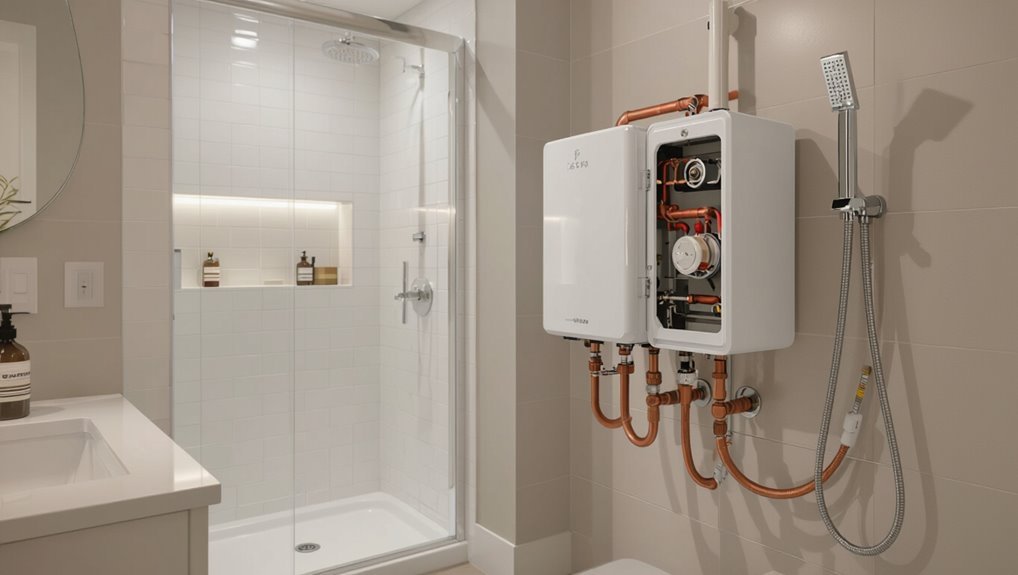
The section outlines quick, practical fixes that can be attempted in minutes—such as insulating exposed pipes, flushing a nearby faucet, or adjusting the water heater temperature.
It then explains simple diagnostic steps to determine whether the issue is a minor obstruction or a broader system problem.
Finally, it gives clear guidance on when to stop DIY efforts and call a plumber for professional inspection or repair.
Immediate fixes you can try in minutes
Try simple, quick adjustments before calling a plumber: check whether the nearest sink or tub needs to be opened briefly to purge trapped cold water, confirm the water heater’s temperature setting and pilot/burner status, and inspect visible supply-line valves to guarantee they’re fully open.
Additionally, flush faucet aerators and showerheads, run hot water at the farthest fixture briefly, and insulate exposed hot pipes—practical steps for how to get hot water faster upstairs.
When to call a plumber versus DIY
After exhausting quick checks—opening nearby fixtures, confirming heater settings, clearing aerators, and insulating visible pipes—homeowners must decide whether the problem is handyman-level or requires a licensed plumber.
DIY is appropriate for insulating, valve adjustments, and minor pipe thawing.
Call a plumber for persistent temperature inconsistency, leaks, sediment-clogged tanks, gas/combustion issues, or when work requires permits, specialized tools, or safety certification.
Why Hot Water Takes So Long to Reach Upstairs Faucets
The time it takes for hot water to reach an upstairs faucet is largely determined by the basic plumbing layout and the physical distance from the heater.
Common factors that slow delivery include long or narrow pipes, poor or missing insulation, and the absence of a recirculation system.
The water heater’s location and its recovery rate further affect how quickly hot water becomes available.
Basic plumbing layout and how distance affects delivery
In most homes, hot water originates at a single source—typically a water heater—and travels through a network of pipes to reach upstairs fixtures. The farther a faucet is from the heater, the more pipe volume the hot water must fill before warm flow arrives.
Vertical risers, branch runs and manifold locations determine routing. Greater distance increases wait time; fixture order and layout influence delivery sequence.
Common causes: pipe length, diameter, insulation, and recirculation absence
Long runs of cool piping, narrow diameters, poor insulation, and the lack of a recirculation system each contribute to slow hot-water delivery upstairs by increasing the volume of cold water that must be flushed before warm water arrives, reducing flow rate, allowing heat loss along the route, or eliminating any mechanism to constantly keep hot water near fixtures.
Additional factors include excessive bends, shared mains, and undersized fittings that compound delays.
Water heater location and recovery time impacts
Distance matters: when a water heater sits far below or across from upstairs fixtures, the cool water trapped in lengthy pipes must be flushed before hot water arrives, directly increasing wait time.
Heater capacity and recovery rate determine how quickly replacement hot water is produced; undersized tanks or slow recovery prolong delays.
Strategic relocation, booster heaters, or faster-recovery units reduce upstream lag and improve delivery.
Diagnosing the Problem Step-by-Step
The homeowner should first time each faucet and log temperature readings at intervals to quantify the delay and any cooling pattern.
Next, compare results across fixtures to determine whether the issue is localized or affects the whole house.
Useful tools include an infrared thermometer, stopwatch, and flow meter, and attention should be paid to signs of hidden problems such as leaks, sediment buildup, or faulty valves.
How to measure wait time and record temperature changes
Begin by timing how long it takes for hot water to arrive at the upstairs faucet and noting temperature changes at regular intervals; this establishes a baseline for diagnosing delays.
Use a stopwatch and thermometer, record arrival time, initial temperature, and readings every 15–30 seconds until stable.
Log fixture location, time of day, and any concurrent water use to correlate patterns and repeat tests for consistency.
Checking for localized versus whole-house delay
How can one tell if slow hot water is confined to a single fixture or affects the entire house?
The methodical approach compares wait times and temperatures at multiple fixtures: test an upstairs tap, a nearby bathroom, and a ground-floor sink.
Consistent delays indicate a systemic issue (pipe routing, heater capacity), while a single slow outlet suggests fixture-specific problems like clogged lines or valve restrictions.
Tools to use: infrared thermometer, stopwatch, flow meter
Several simple tools make diagnosing slow hot water straightforward: an infrared thermometer to read pipe and fixture temperatures, a stopwatch to measure wait and travel times, and a flow meter to quantify delivery rates.
The infrared identifies thermal drops along runs; the stopwatch times from tap to hot-water onset; the flow meter reveals low supply or restrictive fittings.
Record readings for comparison and targeted fixes.
Signs of hidden issues: leaks, sediment, or faulty valves
Detecting hidden problems like leaks, sediment buildup, or failing valves depends on observing specific, measurable signs rather than guessing.
Cold spots, fluctuating temperatures, reduced flow, and unusual noises indicate sediment or partial blockages.
Moisture, unexplained water bills, or pressure drops point to leaks.
Stiff or loose valve handles, persistent drips, and inconsistent mixing suggest valve failure.
Document findings before repair.
10 Proven Fixes to Get Hot Water Faster Upstairs
The following three categories summarize practical ways to get hot water upstairs faster.
- Short-term, low-cost actions
- Moderate upgrades with clear ROI
- Long-term plumbing improvements
Each category will be briefly explained with specific fixes and expected benefits.
Short-term, low-cost actions
A few targeted, low-cost actions can noticeably speed hot water delivery to upstairs fixtures.
Common measures include insulating the hot water pipes that run upstairs, flushing the water heater to clear sediment, and adjusting the thermostat for more consistent recovery.
Addressing leaks in fixtures and supply lines also preserves hot water and improves delivery time.
Insulate hot water pipes leading upstairs
Insulate hot water pipes running to upstairs fixtures to reduce heat loss and speed hot water delivery.
Fit foam or fiberglass sleeves around accessible hot lines, sealing seams with tape or adhesive.
Prioritize pipes in unheated spaces like attics, crawlspaces, and exterior walls.
Improved insulation shortens wait time, conserves energy, and costs little.
Measure lengths first to buy appropriate insulation.
Flush the water heater to remove sediment
Following pipe insulation, attention to the water heater itself can further speed hot water delivery upstairs: flushing removes mineral and sediment buildup that reduces tank capacity and heat transfer efficiency.
Periodic flushing—draining a few gallons until clear—restores performance, shortens delivery delay, and lowers cycling.
Homeowners can perform this safely by following manufacturer guidelines or hiring a technician for thorough flushing and inspection.
Lower water heater thermostat to reduce recovery lag
Lowering the water heater thermostat a few degrees speeds recovery by reducing the temperature gap the burner or element must make up after hot water is drawn.
This means the tank replenishes usable hot water faster for upstairs fixtures.
Adjusting setpoint downward by 5–10°F can shorten recovery time without noticeable comfort loss.
Check thermostat accuracy and safety settings to maintain adequate hot-water supply.
Fix or replace leaking fixtures and supply lines
Repairing or replacing leaking fixtures and supply lines eliminates hidden cold-water draw and restores proper pressure so hot water reaches upstairs taps faster.
Inspect accessible valves, hoses, and faucet bases for drips; tighten connections or replace worn cartridges and flexible lines.
Small leaks waste hot water and reduce flow; prompt repairs or inexpensive replacement parts improve delivery speed with minimal cost and effort.
Moderate upgrades with clear ROI
Moderate upgrades can shorten wait times considerably while often paying for themselves through saved water and energy.
Options include installing a dedicated hot water recirculation pump, using a demand-activated recirculation system, or adding a point-of-use tankless or small electric heater upstairs.
Each approach has different installation costs, operational savings, and suitability depending on the plumbing layout.
Install a hot water recirculation pump (dedicated loop)
Installing a dedicated hot water recirculation pump creates a continuous loop of heated water between the water heater and upstairs fixtures, delivering near-instant hot water without wasting water down the drain.
A dedicated loop uses separate return piping, minimizes heat loss, and maintains temperature.
Installation costs vary but payback comes from water savings and improved convenience; professional sizing guarantees efficient operation and longevity.
Install a demand-activated recirculation system
A demand-activated recirculation system supplies hot water on call by running a pump only when a fixture signals a need, cutting standby heat loss and conserving energy compared with continuous-loop systems.
Sensors or push-button switches trigger brief circulation, returning cooled water to the heater until hot arrives.
Installation requires pump, controls, and check valves; savings depend on usage patterns and pipe length.
Add a point-of-use tankless or small electric water heater upstairs
When placed near upstairs fixtures, a point-of-use tankless unit or compact electric storage heater delivers hot water almost instantly, cutting wait times and reducing wasted water down the line.
These units require minimal piping, lower heat loss, and offer quick ROI through water and energy savings.
Selection should match peak demand; professional installation guarantees correct electrical or gas sizing, safety, and code compliance.
Long-term plumbing improvements
Long-term plumbing improvements focus on reducing the distance and volume of cold water trapped in hot lines and increasing flow capacity to upper floors.
Re-routing or shortening hot water runs cuts deadhead volume, delivering hot water to taps faster.
Upsizing pipe diameter improves flow and pressure to upstairs fixtures, making the system more responsive overall.
Re-route or shorten hot water lines to reduce deadhead volume
Re-routing or shortening hot water lines reduces the deadhead volume—the standing water between the heater and upstairs fixtures—so hot water arrives sooner and less energy is wasted.
Strategic rerouting eliminates long loops and unnecessary runs, moving supply closer to demand points.
Professional assessment identifies practical paths, minimizes disruption, and guarantees codes and insulation are respected, yielding faster delivery and lower standby heat loss.
Upsize pipe diameter for better flow to upper floors
Upsizing hot water supply lines increases flow capacity and reduces the time it takes for hot water to reach upper-floor fixtures.
Replacing undersized piping with larger-diameter lines lowers friction loss, maintains pressure, and shortens delivery delay.
This long-term upgrade may require routing adjustments and permits; professionals should calculate ideal sizes based on fixture unit demand, run length, and heater capacity to guarantee balanced performance.
Comparing Recirculation Options and Point-of-Use Systems
A comparison of recirculation systems and point-of-use units helps homeowners weigh trade-offs across cost, complexity, water savings, energy impact, and installation time. The summary table below highlights key criteria and which systems suit different house types and budgets. This overview sets up specific recommendations for compact homes, large houses, and tight budgets.
| Criterion | Recirculation Systems | Point-of-Use Units |
|---|---|---|
| Typical cost | Higher upfront, greater long-term savings | Lower upfront, limited systemic savings |
| Complexity & install time | More complex, longer install | Simple, quick install |
| Best for | Large houses, frequent hot water demand | Small homes, isolated sinks, tight budgets |
Evaluation criteria: cost, complexity, water savings, energy impact, installation time
When comparing recirculation systems and point-of-use units, homeowners and installers should weigh five practical criteria—cost, installation complexity, water savings, energy impact, and installation time—to determine which approach best fits a specific house and usage pattern.
Cost assesses upfront and long-term expense; complexity covers plumbing and controls; water savings estimates waste reduction; energy impact examines standby and pumping losses; installation time gauges disruption and labor.
Which systems work best for different house types and budgets
Homes and installers should match the hot-water delivery method to house layout, occupancy patterns, and budget constraints: whole-house recirculation systems suit multi-story residences with frequent or simultaneous demand, offering rapid delivery at higher upfront cost and installation complexity.
In contrast, point-of-use heaters are best for small homes, isolated bathrooms, or tight budgets where minimal plumbing changes and lower capital outlay outweigh limited per-fixture savings.
For mixed needs, hybrid solutions combine centralized recirculation with targeted POU units.
Energy and Cost Considerations
A cost-focused comparison weighs ongoing energy use of recirculation pumps against the typically higher standby losses and electricity draw of point-of-use heaters.
Attention should be given to insulation payback periods and practical energy-saving measures that reduce both heat loss and utility bills.
Available rebates, tax credits, and the expected payback timeline help determine when upgrades become financially sensible.
Operating cost trade-offs: recirculation pumps vs. point-of-use heaters
Compare the long-term energy and dollar impacts of recirculation pumps and point-of-use (POU) heaters before choosing a solution.
Recirculation systems circulate stored hot water, raising standby losses and electrical usage but serving many fixtures with one source.
POU heaters eliminate wait time locally, reducing distribution losses yet increasing installation count and peak energy draw.
Evaluate usage patterns, fuel prices, and maintenance costs.
Insulation payback and energy-saving tips
When properly installed, pipe and tank insulation deliver measurable reductions in standby heat loss, often paying back their upfront cost within months to a few years depending on energy prices and hot water usage.
Insulation thickness, quality, and sealing reduce heat loss and shorten delivery delays.
Supplement with thermostat setbacks, lower storage temperatures, and routine maintenance to maximize savings while preserving comfort and system longevity.
Rebates, incentives, and when upgrades make financial sense
Following insulation and maintenance measures, homeowners can often recoup part of their investment through utility rebates, tax credits, and local incentive programs that target water-heating efficiency.
Eligibility and amounts vary; manufacturers, contractors, and government sites list offers.
Cost-effectiveness depends on upfront price, energy savings, and payback period.
Simple measures like pipe insulation often pay back fastest; major upgrades require analysis of usage, rates, and incentives.
Common Mistakes and How to Avoid Them
Common errors that slow hot water delivery include ignoring pipe insulation and small leaks, which waste heat and prolong wait times.
Selecting oversized tanks or the wrong pump type can create inefficiency and poor flow control.
Attempting complex fixes without professional knowledge risks violating codes or voiding warranties.
Overlooking insulation and small leaks
Although easy to miss, inadequate pipe insulation and small leaks are frequent culprits behind slow hot-water delivery and wasted energy in upstairs fixtures.
Neglected insulation allows heat loss along supply lines; tiny drips cause pressure drops and longer recovery times.
Inspect accessible piping, seal joints, replace damaged insulation with proper-rated wrap, and repair leaks promptly to restore flow efficiency and reduce energy waste.
Choosing oversized equipment or incorrect pump types
After addressing insulation and small leaks, attention should turn to equipment sizing and pump selection, since oversized tanks and inappropriate circulator types can create as many problems as undersized systems.
Excessive tank capacity wastes energy and delays recovery; wrong pump curve or speed causes short-cycling, noise, and poor flow.
Match tank capacity and pump characteristics to system demand and piping to guarantee efficient, responsive hot water delivery.
DIY pitfalls that create code or warranty issues
Many DIY fixes that seem straightforward can unintentionally violate local codes or void warranties when they alter safety devices, electrical connections, or pressure-relief components.
Ignoring permits, using nonlisted parts, or bypassing tempering valves risks fines and denied claims. Homeowners should consult manufacturers, follow code, obtain inspections, and hire licensed electricians or plumbers for regulated work to preserve safety and coverage.
Maintenance Checklist to Keep Hot Water Fast Long-Term
A concise maintenance checklist helps preserve upstairs hot water speed and prevents common failures.
Recommended actions include a seasonal routine and signs for professional help, plus simple homeowner checks:
- Flush tank, inspect valves, and verify pipe insulation seasonally.
- Schedule professional service when sediment, leaks, or slow recovery appear.
- Run timed flow and temperature checks to monitor ongoing performance.
Seasonal tasks: flushing, inspecting valves, checking insulation
Several seasonal checks keep upstairs hot water delivery reliable and efficient: flushing the tank to remove sediment, inspecting pressure-relief and shutoff valves for proper operation, and verifying insulation on pipes and the tank to minimize heat loss.
Perform tank flushes yearly, test valves for leaks or stiffness, replace worn insulation, and seal gaps where cold air contacts pipes.
Document actions and dates.
When to schedule professional service
After completing seasonal checks—tank flushing, valve inspections, and insulation repairs—deciding when to call a professional helps preserve performance and prevent costly failures.
Schedule service if reduced flow persists, strange noises or odors emerge, temperature inconsistencies continue, or visible corrosion appears.
Recommend annual inspections for older systems, prompt diagnostics after repeated pilot or ignition failures, and prioritizing repairs before major leaks occur.
Simple homeowner tests to monitor performance
Run a few quick, repeatable checks each month to catch declines in hot-water performance before they become problems.
Timed delivery: measure seconds until hot water at an upstairs sink reaches set temperature.
Flow check: note pressure at that faucet.
Temperature stability: record temperature after five minutes of continuous use.
Leak inspection: scan visible pipes and valves.
Log results and compare monthly for trends.
Typical Costs and Timeline for Improvements
Typical cost ranges and expected timelines help homeowners weigh options from simple DIY fixes to full recirculation system installs or point-of-use heaters.
DIY fixes often cost under a few hundred dollars and can be completed in a few hours, while recirculation systems typically run from $1,000–$5,000 with a day or two of disruption for a professional install.
Point-of-use electric units commonly cost $150–$600 each and are usually installed in one to several hours per unit, with gas or integrated options taking longer and possibly requiring permits.
Cost ranges for DIY fixes, recirculation installs, and point-of-use heaters
Costs and timelines for speeding up hot water upstairs vary widely depending on the chosen approach.
Typical DIY fixes—insulating pipes, reducing faucet aerator flow—cost $20–$200 in materials.
Dedicated recirculation systems range $500–$3,000 installed; pump-only retrofit kits $150–$700.
Point-of-use electric tankless units run $150–$600 plus installation.
Warranties, permits, and labor rates influence final prices.
Expected disruption and project duration for each option
Having outlined price ranges and timelines for different approaches, attention turns to how much the homeowner should expect their household and schedule to be affected during installation.
DIY fixes cause minimal disruption—hours, mostly tool noise and limited water shutoff.
Professional recirculation systems require a day or two with pipe access and brief hot-water outages.
Point-of-use heater installs typically take a few hours with minor access needs.
Real-World Examples and Scenario Recommendations
Readers are presented with targeted examples for common situations.
For a small apartment with long pipe runs, the most affordable fixes are prioritized.
For multi-story family homes, a thorough solution is recommended, while older houses with limited access require specific workaround strategies.
Small apartment with long runs best affordable fixes
In many small apartments where the water heater sits far from upstairs bathrooms, simple, low-cost measures can greatly reduce wait time for hot water.
Examples include insulating exposed hot pipes, installing a demand-activated recirculation pump kit, shortening fixture run lengths if accessible, and adding point-of-use under-sink heaters.
These options balance cost, ease of installation, and measurable improvement in delivery time.
Multi-story family home recommended comprehensive solution
When a family home spans multiple floors and the main water heater sits far from upper bathrooms, a coordinated, whole-house approach yields the best balance of comfort, efficiency, and cost-effectiveness.
Recommended steps include zoning hot water with dedicated return loops, insulating all hot lines, installing demand-controlled recirculation, evaluating tankless or hybrid heaters near upper-use zones, and prioritizing professional hydraulic balancing and permit-compliant installation.
Older homes with limited access workaround strategies
Lacking the space and access that allow whole-house retrofits, older homes often require targeted workaround strategies to speed hot water upstairs without major demolition.
Practical options include point-of-use tankless units at upstairs bathrooms, small recirculation pumps on existing loops, insulating accessible pipes, and rerouting minimal sections to shorten runs.
Choose solutions that balance cost, disruption, and code compliance for each layout.
Step-by-Step Installation Overview for a Demand Recirculation System
A concise installation overview outlines pre-installation planning and the components required for a demand recirculation system, including pump type, check valves, and control modules.
It then summarizes the basic wiring and plumbing sequence at a high level—pump placement, connection to the hot and cold lines, and control wiring—without detailed schematics.
Finally, it highlights safety steps, necessary permits, and post-installation testing to verify flow, temperature, and leak-free operation.
Pre-installation planning and required components
Before starting installation, the homeowner or contractor should verify site conditions, gather necessary permits, and assemble all required components so the work proceeds efficiently and to code.
Required items include a recirculation pump, dedicated return line or retrofit valve, check valves, isolation valves, compatible fittings, thermostat or push-button controller, power supply provisions, mounting hardware, and manufacturer documentation for sizing, flow rates, and warranty compliance.
Basic wiring and plumbing sequence (high-level)
Begin by verifying power is isolated and the main cold-water supply is accessible.
Then outline the routing of the pump, controller, and return path.
Mount pump near manifold, route supply from hot branch through pump to fixtures, and provide dedicated return or crossover to cold line.
Wire controller to pump and power, include sensor/call button connections, and install check valves and isolation valves.
Safety, permits, and testing after installation
Confirm permits, lock out power, and follow safety protocols before energizing the recirculation system.
Inspect all connections, verify grounding, and confirm valve orientations.
Obtain required inspections and final permit sign-off.
Energize briefly to check for leaks, noise, and proper pump direction.
Test temperature response at distant fixtures, document settings, and provide homeowner safety and maintenance instructions for ongoing compliance and performance monitoring.
Quick Reference: Which Fix to Choose Based on Symptoms
Which symptoms appear when hot water is slow upstairs determines the most effective fix: intermittent delays or consistent lukewarm flow point to different causes. A concise guide links symptom to likely cause and recommended action.
| Symptom | Likely Cause | Recommended Fix |
|---|---|---|
| Intermittent delay | Long piping | Pipe insulation/recirculation |
| Consistent lukewarm | Undersized heater | Upgrade heater |
| No hot water | Failure/leak | Repair/replace |
Conclusion
Like a dim corridor that suddenly brightens, the house’s plumbing can transform from patient waiting to instant warmth. Each fix is a key, each diagnosis a map, guiding the cold that lingers in pipes toward prompt comfort upstairs. By choosing the right solution—be it recirculation, insulation, or a localized heater—the household trades delay for certainty, turning hesitant drops into a steady, welcoming flow.