
How to Drain a Sump Pump Without Electricity: Safe Manual Methods and Backup Options
When electricity is unavailable, you can effectively drain a sump pump by using manual methods such as hand pumps, buckets, siphons, or a wet/dry vacuum. Before starting, ensure your safety by wearing gloves and boots, and disconnect the power at the breaker. For longer-term solutions, consider battery-powered, water-powered, or generator backups, ensuring they match your system’s capacity and connections. Regular maintenance of the sump pit, float, and discharge lines is crucial to minimize emergency situations. Always follow ventilation and contamination precautions, document your actions, and consult professionals for severe flooding. Detailed steps and comparisons for these methods are provided below.
How to Drain a Sump Pump Without Electricity: Quick Overview and Safety First
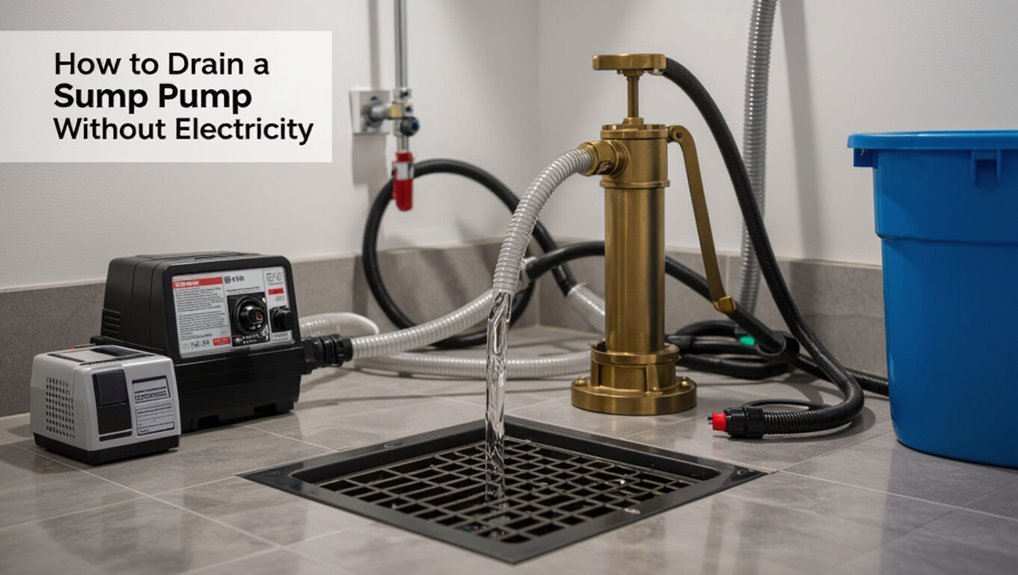
Situations such as prolonged power outages, pump failure, or heavy storms can require draining a sump basin without electricity to prevent basement flooding.
Before any manual drainage is attempted, the person should disconnect electricity at the panel, wear waterproof gloves and boots, and guarantee good ventilation to avoid hazards.
A concise checklist of tools—bucket, submersible hand pump or siphon hose, wrenches, flashlight, and clean-up materials—should be assembled before beginning.
When and why you might need to drain a sump pump without power
When power fails during heavy rain or a storm, homeowners may need to drain a sump pit manually to prevent basement flooding and water damage.
Situations include prolonged outages, overwhelmed pumps, or malfunctioning float switches.
Learning how to drain a sump pump without electricity helps protect possessions, prevents mold and structural harm, and buys time until power or repairs restore normal pump operation.
Immediate safety precautions before attempting manual drainage
Before any attempt to drain a sump pit manually, a few critical safety checks must be completed to prevent injury and further property damage.
Verify electricity to the basement is off at the breaker to avoid energized equipment.
Check stable footing and adequate lighting.
Check for hazardous fumes or sewage odors.
Confirm that helpers are nearby with a phone for emergency contact.
Required tools and supplies checklist
A compact kit of tools and supplies makes manual sump-pit drainage faster and safer.
Include: heavy-duty gloves, rubber boots, safety goggles, flashlight or headlamp with spare batteries, manual hand pump or utility pump, long discharge hose, bucket and extension handle, wrenches, pliers, adjustable screwdriver, tarp, absorbent rags, and a basic first-aid kit.
Store items in a labeled waterproof container near the sump.
Assessing Your Sump System Before Manual Drainage
Before attempting manual drainage, the homeowner should identify the sump pump type and pit layout to determine the best removal method.
They must locate check valves, discharge lines, and any access points that could affect water flow or allow backflow.
Finally, an inspection should distinguish between sewage-contaminated and clean water to select appropriate protective gear and disposal procedures.
Identifying the type of sump pump and pit layout
Understanding the sump pump type and pit layout is essential for safe, effective manual drainage. The person should identify submersible versus pedestal pumps, pump size and power source, and whether multiple units exist.
Note pit dimensions, depth, inlet locations, and any grates or covers. Recognizing these features informs tool choice, evacuation method, and risk assessment before proceeding with manual draining.
Locating check valves, discharge lines, and access points
Inspection of the sump system should begin with locating the check valve(s), tracing the discharge line, and identifying any accessible cleanouts or unions that permit manual draining.
Note valve orientation, condition, and any visible leaks.
Follow the discharge route outside to verify termination points and freeze vulnerability.
Mark access points, confirm thread sizes and tools required, and document obstacles before attempting manual drainage.
Inspecting for sewage vs. clean water hazards
After locating check valves, discharge lines, and access points, attention should turn to determining whether the sump handles sanitary sewage, greywater, or solely storm/groundwater, since the hazard profile and handling procedures differ markedly.
Inspect inlet sources, nearby plumbing, odor, and visible solids. Confirm with building plans or professionals if uncertain.
Treat sewage as biohazard: use PPE, avoid pump-out without containment, and contact waste specialists.
Manual Drainage Methods Step-by-Step
The following section outlines practical, step-by-step manual methods for removing sump pit water without power.
It covers use of submersible hand pumps (bellows or piston), manual diaphragm/utility pumps, creating a gravity siphon with hose, and removing water with buckets or a battery/manual wet–dry vacuum.
Each method is presented with basic setup, operation tips, and safety reminders.
Using a submersible hand pump (Bellows or Piston)
A submersible hand pump, either bellows-style or piston-type, provides a reliable manual option for removing water from a sump basin when power is unavailable. The user immerses the pump, operates repeatedly, and directs discharge hose away from the foundation.
Careful sealing and steady rhythm optimize flow.
- Squeezing bellows, water spurts into hose
- Piston rod cycling, steady column of water
- Hose arcing away from house
Using a manual diaphragm/utility pump
Moving from bellows and piston styles, a manual diaphragm (utility) pump offers continuous, high-volume transfer with fewer strokes and better solid-handling capacity.
It sits on the sump edge; operator pumps lever or foot pedal, diaphragm pulls and pushes water through discharge hose. Ideal for slurry and debris-laden water; requires firm positioning and periodic debris clearing.
- A squat metal body with inlet screened
- A flexible diaphragm rhythmically flexing
- A thick hose spitting gritty water
Creating a siphon with hose and gravity
Start by laying a hose so one end rests at the sump bottom and the other extends downhill well below the pit’s outlet. Once water fills the hose and gravity takes over, a siphon will continuously draw water without pumps or power.
Guarantee an airtight priming, anchor the intake to avoid stirring sediment, and monitor outflow to prevent backflow.
- A clear hose snaking downhill
- Intake weighted on the pit floor
- Water streaming from the lower end
Removing water with buckets and wet/dry vacuum (battery-powered or manual)
When a siphon is impractical or the pit contains debris that risks clogging a hose, hands-on removal with buckets or a wet/dry vacuum becomes the preferred option.
Workers bail water in shallow scoops, transfer to nearby drains or containers, or deploy a battery wet/dry vacuum with extension hose.
Frequent emptying and debris screening prevent clogs and spills.
- Rusted bucket scraping sludge
- Cordless vacuum gulping water
- Worker lifting heavy pail
Backup Options When Electricity Is Unavailable
When grid power fails, several backup options can keep a sump system operational and prevent flooding.
Viable choices include battery-powered pumps (considering pump type, expected runtime, and charging/setup), generator-driven units (proper sizing, safe transfer connections, and awareness of exhaust and backfeed risks), and water-powered pumps (which rely on municipal water pressure and need specific plumbing).
For longer or repeated outages, solar arrays or inverter-based systems can be sized to run pumps and recharge batteries for extended protection.
Battery-powered backup pumps: types, runtime, and setup
If electricity fails, a battery-powered backup pump provides an independent means to remove water from a sump pit, using stored DC power to run either a submersible or pedestal-style unit. Types include sealed lead‑acid and lithium models; runtime depends on battery capacity and pump draw. Proper setup: dedicated battery, inline fuse, and automatic switch-over or manual activation.
| Type | Notes |
|---|---|
| SLA | Affordable, heavier |
| Lithium | Longer life, lighter |
Generator-powered backup: sizing, safe connection, and risks
Start a portable or standby generator only after calculating the sump pump’s startup and running wattage to guarantee the unit can handle the initial surge and continuous load.
Match generator capacity, allow margin for other loads, and use a proper transfer switch or outdoor-rated extension with GFCI.
Follow ventilation and fuel storage safety.
Be aware of carbon monoxide, electrical backfeed, and maintenance requirements.
Water-powered backup pumps: how they work and plumbing requirements
Although relying on municipal or well water pressure rather than electricity, water-powered backup pumps convert flowing potable water into suction to lift sewage or sump water out of a basin and discharge it to the usual outlet.
They require minimum inlet pressure, proper venting, check valves, and backflow prevention; professional installation guarantees code compliance, adequate flow, and prevents contamination of the potable system.
Solar-powered or inverter-based solutions for longer outages
Water-powered backups offer a reliable non-electric option for short outages, but longer-duration interruptions often require stored or generated electricity to run conventional sump pumps.
Solar arrays with battery banks or inverter-connected deep-cycle batteries can power pumps for days. Proper sizing, charge controllers, and weatherproof installation guarantee reliability.
Maintenance, periodic testing, and safe inverter grounding are essential to prevent failures and hazards.
Preventing Flooding During Power Outages
When power fails, homeowners should evaluate battery backup systems for capacity and ideal placement to guarantee reliable operation.
A water-powered backup or a redundant pump can provide additional protection, while enlarging the sump pit and adjusting float switch settings helps prevent premature cycling.
Regular maintenance of pumps, batteries, and pit components reduces the likelihood of emergency draining during outages.
Installing automatic battery backup systems: selection and placement
Install a dedicated automatic battery backup system to guarantee a sump pump continues operating during outages, selecting a unit sized for the pump’s voltage and current demands and placing it where it stays dry, ventilated, and accessible.
Verify battery capacity for expected outage duration, choose sealed AGM or gel batteries to reduce maintenance, install a clear alarm or telemetry, and follow manufacturer wiring and ventilation guidelines.
Installing a water-powered backup or redundant pump
Battery backups offer one reliable route, but homeowners can also rely on water-driven systems or a second electric pump for redundancy to keep basements dry during outages.
Water-powered backups connect to municipal supply, using flow to evacuate sump water without electricity; they require pressure checks and a backflow preventer.
Alternatively, a dedicated secondary pump on separate power or alarm circuits provides failover protection.
Improving pit capacity and float switch configuration
Expanding the sump pit and optimizing float switch placement reduces the chance that accumulated water will overwhelm a system during a power outage.
Increasing pit volume, lowering pump activation height, and installing multiple floats or a vertical float minimize short-cycling and provide reserve capacity.
Positioning switches to avoid debris entrapment and testing alternate activation points guarantees reliable operation when primary power and automatic controls fail.
Routine maintenance to reduce emergency drain needs
Regular, targeted maintenance greatly lowers the likelihood that a sump system will require emergency manual draining during a power outage.
Inspect and clean the pit, remove debris, test and lubricate the float, verify discharge lines are clear and sloped, and replace worn check valves.
Schedule seasonal checks, document findings, and address minor issues promptly to prevent failures and reduce emergency interventions.
Troubleshooting Common Problems During Manual Drainage
Common issues encountered during manual drainage include clogged inlet screens or accumulated solids, unpleasant odors and contamination risks, and frozen or blocked discharge lines.
The guide explains how to clear debris safely, manage and neutralize contaminants, and address ice or obstructions in the discharge path.
Emphasis is placed on protective gear, proper tools, and steps to restore flow without power.
Dealing with clogged inlet screens and solids
Inspect the pump inlet screen and surrounding sump basin for debris before beginning manual drainage.
Remove visible solids with gloves and a small scoop or net; avoid pushing material further into the inlet.
If the screen is removable, detach and rinse with clean water.
For compacted clogs, use a plastic scraper or short brush.
Reinstall securely and test flow before continuing manual pumping.
Handling odors and contamination safely
When odors or contaminated water are present during manual sump drainage, the operator should treat the area as a potential biohazard: wear gloves, impermeable boots, eye protection, and an N95 or higher respirator.
Ventilate the space and avoid skin contact.
Contain and bag contaminated absorbents and PPE, disinfect tools and surfaces with appropriate solutions, and wash hands thoroughly.
Arrange professional waste disposal if sewage contamination is suspected.
What to do if the discharge line is frozen or blocked
If the discharge line is frozen or blocked, the manual drainage process can stall and allow water to back up into the sump or surrounding area.
Inspect the line visually, clear visible ice or debris with warm water and a plastic scraper, and use a hand auger or snake for clogs.
Confirm downstream outlets are open. If obstruction persists, call a professional to avoid damage.
Safety and Health Considerations
Protective gear such as gloves, boots, and eye protection should be used when handling sump water, and thorough handwashing is recommended afterward to prevent contamination.
Care must be taken around intermittent power to avoid contact with electrical components or standing water near outlets.
Professional help or emergency services should be contacted if flooding exceeds safe levels, contamination is suspected, or electrical hazards cannot be controlled.
Personal protective equipment and hygiene after handling sump water
Any person handling sump water should wear appropriate personal protective equipment (PPE) to minimize exposure to contaminants commonly found in basement runoff.
Recommended PPE includes nitrile gloves, waterproof boots, eye protection, and a respirator if aerosolization occurs.
After work, remove PPE carefully, wash hands and exposed skin with soap and water, disinfect boots and tools, and launder clothing separately.
Avoiding electrical hazards when power is intermittent
When power is intermittent, people should treat every circuit and device as potentially live and unstable, taking extra precautions to prevent shocks, short circuits, and equipment damage.
Disconnect nonessential appliances, avoid using cords or tools with exposed wiring, keep water away from outlets and panels, use battery-powered lighting, and guarantee portable generators or backup systems are grounded and operated per manufacturer guidelines.
When to call a professional plumber or emergency services
How should one decide whether a sump pump problem requires a professional plumber or emergency services?
If flooding threatens structural integrity, sewage backup occurs, electrical sparks or persistent smoke appear, or water rises despite manual draining, contact emergency services or a licensed plumber immediately.
For routine failures, odd noises, or intermittent operation without immediate danger, schedule a professional inspection and repairs promptly.
Cost, Time, and Effectiveness Comparison of Manual and Backup Methods
Although electricity loss forces homeowners to choose alternatives, comparing costs, time, and effectiveness clarifies which manual or backup methods suit specific situations. Manual pumping is low-cost but labor-intensive and slow. Battery backups cost more, offer moderate runtime, and are reliable. Generators provide high effectiveness and runtime but higher expense and setup time.
| Method | Trade-off |
|---|---|
| Manual pump | Low cost, high labor |
| Battery backup | Moderate cost, reliable |
| Generator | High cost, high performance |
Quick Reference: Best Method by Situation
A concise guide highlights which approach suits common scenarios when electricity is unavailable.
It points to the fastest stopgap for immediate flooding, the most reliable choice for prolonged outages, and the cheapest DIY setup for routine preparedness.
Readers can use the quick list below to match conditions to a practical option.
- A person wading in with a portable utility pump or large bucket to remove rising water fast
- A family relying on a generator-powered pump or gravity-fed transfer with stored hoses for multi-day outages
- A homeowner assembling a low-cost hand pump or siphon system from hardware-store parts for ongoing low-cost use
Best short-term emergency method
Prioritize methods that match available tools, time, and water volume to stop basement flooding quickly.
In short-term emergencies, use a heavy-duty utility pump powered by a portable generator or a manual transfer pump if only brief operation is needed.
Direct discharge outside away from foundation, monitor flow, and rotate operators to avoid fatigue.
Seal small leaks and remove valuables while arranging longer-term solutions.
Best method for extended outages
Assess long-duration outages by matching water volume, available fuel or manual stamina, and access to discharge routes to select the most sustainable pumping strategy.
For extended events, prioritize powered backup solutions with reliable fuel (generator-driven pumps, petrol or diesel trash pumps) or continuous manual options (rotary or diaphragm hand pumps) sized for expected inflow.
Guarantee fuel storage, maintenance, and safe exhaust/discharge planning.
Best low-cost DIY option
Consider simple, low-cost solutions that match the situation’s scale and skill level: shallow floods are best handled with utility shop vacuums or bilge pumps powered by batteries.
Moderate seepage can be managed with a homemade siphon and gravity discharge.
Deeper or continuous inflow may require a converted trash pump driven by a small gas engine or a hand-operated rotary pump.
For most homeowners, a battery bilge pump or siphon offers the best balance of cost, ease, and effectiveness.
Final Checklist Before Leaving the Site
Before departing, the technician verifies the sump pump and any backup system resume normal operation once power is restored.
They record the steps taken, components inspected or replaced, and any irregularities observed.
A concise service log and confirmation of function guarantee clarity for future maintenance and accountability.
Confirming pump and backup function after restoration of power
Restore power and observe the sump system through a complete cycle to verify both the primary pump and any backup activate and shut off correctly.
Confirm float switches move unobstructed, check for proper pump priming and discharge flow, listen for abnormal noises, and guarantee check valves prevent backflow.
Verify alarm functionality and that electrical connections and battery backups indicate normal status before departing the site.
Documenting actions taken and parts replaced
With system operation verified, the technician records each action taken and every component replaced to create a clear service history.
Entries include date, time, observed issues, tests performed, parts swapped with serial numbers, and any adjustments.
Notes specify temporary measures applied, recommended follow-up, and owner acknowledgments.
A printed copy and digital photo log are left with the homeowner and retained for warranty and maintenance tracking.
Conclusion
When electricity fails, manual sump drainage and simple backups can avert basement flooding. One effective strategy is a manual pump or siphon; another is a generator-powered or battery backup system. Significantly, FEMA estimates that 90% of basements with sump pumps experience some form of water intrusion during major storms, underscoring preparedness importance. Combining inspection, safe manual pumping, and an appropriate backup reduces risk and protects property until power and full systems are restored.