
How to Adjust Bidet Pressure: Quick Steps to Find the Perfect Setting
To adjust bidet pressure, start by identifying your bidet type and locating its pressure control, which may be an inline valve, side panel, or wall shutoff. Begin with the lowest setting to test comfort, then gradually increase while monitoring nozzle function and hose condition. Utilize pulsing or oscillating modes for a gentler cleanse. If the water flow is weak, check for clogs, filters, or supply valves, and consult a professional for persistent issues. More detailed guidance follows below.
How to Quickly Choose the Right Bidet Pressure
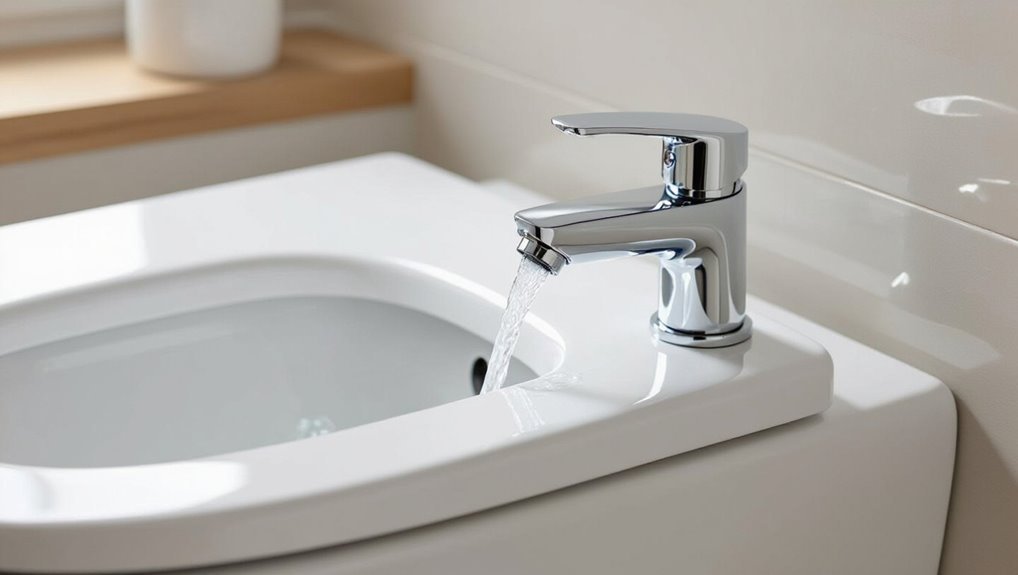
Bidet pressure refers to the force of water used for cleaning and affects comfort and effectiveness.
Choosing the right pressure matters because too low may not clean adequately while too high can cause discomfort or irritation.
As a quick guide, start on a low setting for sensitive users, a medium setting for typical use, and a higher setting for deep-clean needs, then fine-tune from there.
What bidet pressure means and why it matters
Water pressure determines how forcefully the cleansing stream contacts the body, and understanding it helps users match comfort with effectiveness.
Bidet pressure influences cleanliness, skin comfort, and water usage. Users learning how to adjust bidet pressure can prevent irritation, guarantee efficient rinsing, and conserve water.
Proper pressure selection balances gentle care with sufficient force for hygiene without causing discomfort or splashing.
Quick recommended starting settings by user need (sensitive, normal, deep-clean)
A simple set of starting pressures helps users decide quickly: a very gentle low flow for sensitive needs, a moderate medium flow for everyday use, and a firmer high flow for deep-cleaning.
Begin at the recommended level, test briefly, then adjust up or down in small increments.
Sensitive users prefer low, most prefer medium, and occasional deep-cleaning calls for the high setting.
Step-by-Step Guide to Adjusting Bidet Water Pressure
The guide begins by identifying the bidet type—handheld, integrated seat, or standalone sprayer—to determine where controls are located.
It then directs the user to find the pressure control on common models and instructs to start at the lowest setting, testing and incrementally increasing until the spray is comfortable.
Finally, it recommends testing different modes (pulsing, oscillating) at varying pressures to find the ideal combination.
Identify your bidet type (handheld, integrated toilet seat, standalone sprayer)
Which bidet is installed determines the method for adjusting pressure.
Handheld units feature a trigger or trigger lock and a hose connection.
Integrated toilet seats combine nozzle assemblies and electronic or mechanical controls.
Standalone sprayers are simple wall- or tank-mounted units with in-line valves.
Identifying the type clarifies what controls, access points, and potential plumbing interfaces will be encountered during adjustment.
Locate the pressure control on common models
Locating the pressure control begins with inspecting the visible user interface and nearby plumbing connections specific to the bidet type.
For handheld sprayers, look for inline valves on the supply hose.
Integrated seats typically have side panels, remote controls, or rear access panels.
Standalone units often feature a wall-mounted shutoff or T-valve.
Note valve shapes and labeled markings before adjusting.
Step 1 Start at the lowest setting and test
Begin at the lowest pressure setting and activate the bidet briefly to confirm flow.
The user observes spray strength, direction, and any unusual noises. Check for leaks and confirm water temperature remains stable.
Note initial comfort level and stop immediately if pressure feels sharp.
Record this baseline setting before any adjustments, ensuring a safe starting point for gradual changes later.
Step 2 Incrementally increase until comfortable
With the baseline recorded, the user should raise the pressure in small increments, testing briefly at each step to gauge comfort and spray behavior.
Pause after each increase to note sensation and coverage. Stop when cleansing feels thorough without causing discomfort.
If sensitivity occurs, reduce to the previous setting. Record the chosen level for consistent future use and adjust slightly as needed over time.
Step 3 Test different modes (pulsing, oscillating) at various pressures
Explore each spray mode at multiple pressure levels to determine which combination provides the best balance of coverage and comfort.
The user should sample pulsing, oscillating, and steady sprays, noting sensation, coverage area, and any sensitivity.
Try low, medium, and higher pressures for each mode, pausing between tests.
Record preferred pairings for final selection and consistent results.
Step 4 Lock or save preferred setting if feature available
After identifying the preferred mode-and-pressure combinations, the next step is to lock or save those settings so they can be recalled consistently.
Consult the bidet’s manual or on-unit menu to enable memory functions. Save favorite profiles, assign user presets if available, and verify successful storage by cycling power or selecting another mode.
This prevents accidental changes and speeds future use.
Preparing for Safe and Accurate Adjustment
Before changing settings, the user should complete a brief pre-adjustment checklist—run a dry test, wear protective clothing if needed, and have towels ready.
Special care is advised for first-time users and children, with lower initial pressure and closer supervision.
Anyone who is postpartum or has medical concerns should consult a healthcare provider before making adjustments.
Pre-adjustment checklist (dry run, protective clothing, towels)
One clear pre-adjustment step is to perform a dry run and set up protective clothing and towels to prevent water spray and accidental soiling.
The user should close the toilet seat, test controls without water flow, position absorbent towels around the area, and wear a waterproof apron or spare clothing.
Guarantee access to tissue and a waste bag for quick cleanup.
Considerations for first-time users and children
For first-time users and children, careful preparation helps confirm safe, comfortable, and accurate bidet pressure adjustments.
Begin at the lowest setting, explain sensations, and demonstrate controls. Supervise children, ensure seated stability, and provide a stop method (remote, pause button).
Adjust gradually, solicit feedback, and watch for discomfort. Use gentle temperatures and short initial durations to build tolerance and confidence.
Medical and postpartum precautions
Consult medical guidance and prioritize gentle settings when adjusting bidet pressure for users with recent surgery, hemorrhoids, perineal tears, or postpartum recovery.
Adjust gradually, use the lowest effective pressure, and prefer warm water.
Advise testing on noninjured skin first and stopping if pain, bleeding, or irritation occurs.
Recommend consulting a healthcare provider before regular use and documenting any adverse reactions.
Troubleshooting Common Pressure Issues
Common pressure problems can often be resolved with simple checks such as verifying the water supply, cleaning filters, and adjusting valves.
If flow remains weak, too strong even at the lowest setting, or fluctuates, the guide will outline targeted fixes and diagnostic steps.
Persistent issues or signs of leaks and internal damage indicate it is time to contact the manufacturer or a licensed plumber.
Weak or no water flow quick fixes
Start by checking the basics: verify the bidet’s water supply valve is fully open, the inlet hose is free of kinks, and the main shutoff hasn’t been accidentally partially closed, since these simple issues cause most weak or absent flow.
Next, inspect and clean inlet filters, ascertain aerators or nozzles aren’t clogged, confirm electronic models receive power, and test for household low-pressure.
Pressure too strong even on lowest setting solutions
When a bidet delivers an uncomfortably strong spray even at its lowest control, the user should first consider whether the unit’s pressure regulator, mixing valve, or internal flow limiter is malfunctioning or improperly set.
These components, along with a misadjusted shutoff or a high household supply pressure, are the most likely causes and determine the appropriate corrective steps.
Inspect and test these parts, adjust or replace faulty regulators, verify shutoff valve position, and consult the manufacturer or a plumber if high incoming pressure persists.
Uneven or fluctuating pressure causes and fixes
Investigate uneven or fluctuating bidet pressure by systematically isolating possible sources: intermittent water supply, failing internal valves or diaphragms, air trapped in lines, debris obstructing flow, or incompatible downstream fittings.
Check supply shutoff and hoses for kinks, flush lines to purge air and sediment, inspect and clean inlet screens and nozzle ports, replace worn seals or valve cartridges, and retest under consistent supply conditions.
When to call a plumber or contact manufacturer
Escalate to professional help if basic diagnostics—checking supply valves, hoses, inlet screens, and performing simple flushes—do not restore steady pressure or if signs of internal failure appear, such as persistent leaking, sudden loss of hot water, or valves that won’t operate smoothly.
Contact a plumber for plumbing faults and a manufacturer for warranty, electronic control, or proprietary valve failures; document symptoms, model, and installation details.
Comparing Pressure Controls Across Popular Bidet Types
Different bidet types offer distinct pressure controls that affect user experience and adjustment options. Integrated electric seats typically provide preset ranges and digital adjustment, non-electric attachments rely on valves or faucet pressure settings, and handheld sprayers depend on manual trigger control and user technique. The following table summarizes key control methods and typical pressure behavior for quick comparison.
| Bidet Type | Control Mechanism | Typical Pressure Range / Notes |
|---|---|---|
| Integrated electric seats | Digital knobs/buttons, internal pumps | Low–medium presets; some models offer high-power modes |
| Non-electric attachments | Inline valves, faucet diverters | Subject to household water pressure; adjustable via valve |
| Handheld sprayers | Manual trigger or lever | Wide variability; pressure determined by user squeeze and supply pressure |
| Common considerations | Installation, maintenance, and safety features | Affects achievable pressure and consistency |
Integrated electric seats: features and typical pressure ranges
Integrated electric bidet seats combine motorized pumps, electronic controls, and nozzle adjustments to deliver consistent, customizable water pressure tailored to user preferences.
Typical pressure ranges span gentle cleansing (low) to firm streams (high), often adjustable in 5–10 incremental steps.
Additional features include preset memory, soft-start ramps to prevent shock, and pressure-lock safety to limit maximum output for sensitive users.
Non-electric attachments: valve and faucet-based control
Non-electric bidet attachments rely on mechanical valves or faucet diverters to modulate water flow, offering a direct, pressure-dependent experience tied to household supply and valve settings.
Users adjust small integrated knobs or inline shutoff valves to vary intensity; results depend on incoming pressure, valve quality, and nozzle design.
Installation simplicity and reliability contrast with limited fine-tuning compared to powered systems.
Handheld sprayers: manual control nuances
Handheld sprayers offer direct, user-driven pressure control by the simple act of squeezing the trigger, giving immediate feedback and broad modulation from a gentle mist to a focused stream.
Users can vary grip, squeeze duration, and nozzle angle to fine-tune flow. Mechanical simplicity means few failure points, but water supply pressure and hose length still influence maximum force and responsiveness.
Tips for Personalized, Long-Term Comfort
Users are encouraged to create pressure profiles that record preferred settings for different household members to guarantee consistent, personalized use.
Pairing those profiles with temperature adjustments helps identify combinations that maximize comfort without wasting energy.
Regular maintenance, such as cleaning filters and checking valves, preserves steady pressure and prolongs reliable performance.
Creating a pressure profile for different users
Begin by mapping each household member’s sensitivity and routine needs to establish a baseline pressure profile: note preferred pressure levels, nozzle positions, and any special requirements (e.g., post-surgery care or elderly fragility).
Record adjustments, preferred presets, and use frequency. Test settings over several days, refine increments, label profiles clearly, and store recommendations for caregivers to guarantee consistent, safe, personalized comfort.
Combining temperature and pressure for optimal comfort
After mapping pressure profiles, attention turns to pairing those settings with temperature to maximize comfort and safety.
Users are advised to match gentler sprays with warmer but not hot water, and firmer sprays with moderate temperatures to avoid irritation.
Small incremental changes help identify preferred combinations.
Documenting selections for each user guarantees consistent, personalized comfort while preventing sudden, uncomfortable shifts.
Maintenance habits that preserve consistent pressure
Maintain a simple routine of inspection and cleaning to keep bidet pressure steady over time.
Periodic checks of hoses, filters, and connections prevent clogs and leaks that alter flow.
Descaling nozzles, replacing worn seals, and cleaning aerators sustain performance.
Record maintenance dates and address anomalies promptly.
Routine care preserves calibration and guarantees users experience consistent, personalized pressure without sudden drops or spikes.
Safety and Maintenance Related to Water Pressure
Proper water pressure management also protects seals and hoses from premature wear and failure.
Seasonal factors such as mineral buildup from hard water and the risk of freezing should inform pressure settings and winterization steps.
Regular cleaning and a quarterly inspection schedule help catch leaks, corrosion, or pressure-related damage before they escalate.
Protecting seals and hoses from high-pressure damage
Inspecting seals and hoses regularly helps prevent high-pressure damage to a bidet’s water connections. Users should check for cracks, bulges, or soft spots and replace compromised parts promptly.
Installing a pressure regulator and using reinforced, rated hoses reduce strain. Tighten fittings to manufacturer torque specs and avoid overtightening.
Routine leak tests and scheduled part replacement extend component life and prevent failures.
Seasonal considerations (hard water, freezing temperatures)
Consider seasonal risks to a bidet’s pressure system—hard water deposits can restrict valves and jets over time, while freezing temperatures can cause hoses and fittings to crack or burst.
Users should monitor mineral buildup and insulate or winterize exposed supply lines.
Where water hardness is high, consider softening options; in cold climates, shutoff and drain external lines to prevent pressure-related failures and leaks.
Recommended cleaning and inspection schedule
After addressing seasonal risks like mineral buildup and freezing, a concise cleaning and inspection schedule helps maintain steady bidet pressure and prevent failures.
Inspect hoses, valves, and filters monthly for leaks, clogs, or wear. Deep-clean nozzles and replace filters every 3–6 months depending on water hardness.
Annually test pressure-regulating components and tighten fittings; document findings and corrective actions.
Quick Reference: Ideal Pressure Settings by Use Case
A quick reference helps match bidet pressure to common needs for comfort and effectiveness.
Suggested ranges include:
- Sensitive skin or medical recovery: very low to low pressure
- Everyday cleaning; child-friendly settings: low to medium pressure
- Post-workout or heavy cleaning: medium to high pressure
Adjust gradually and test briefly to confirm comfort and cleanliness.
Sensitive skin or medical recovery
For users with sensitive skin or those recovering from surgery or childbirth, selecting a very gentle bidet pressure is essential to prevent irritation and promote healing.
Recommended settings prioritize low, pulsed streams or warm water at minimal force. Users should start at the lowest level, increase only if comfortable, and consult medical advice for post-operative care.
Soft cleansing minimizes inflammation and supports recovery.
Everyday cleaning
Determine a gentle but effective setting tailored to routine bathroom use: medium-low pressure for everyday cleansing, slightly higher for removing residue after bowel movements, and lower, pulsed modes for quick freshening.
Users should start low, adjust incrementally, and test briefly. Focus on comfort, cleanliness, and minimal splash.
For shared bathrooms, note preferred settings and reset if needed to maintain consistent hygiene and user comfort.
Post-workout or heavy cleaning
Increase water pressure moderately after intense exercise or when heavier cleansing is needed, targeting a level that removes sweat, salt, and odor without causing discomfort or splashback.
Users should begin slightly above everyday settings, test briefly, and adjust in small increments.
Aim for thorough rinsing of active areas, maintain a steady stream to prevent misting, and stop if sensitivity or irritation occurs.
Child-friendly settings
After adjusting pressure upward for post-workout cleaning, attention shifts to far lower, gentler settings appropriate for children.
Caregivers should select the lowest effective pressure, short spray duration, and wider nozzle angle if available. Start at minimal intensity, observe comfort and response, then incrementally adjust.
Include temperature checks and instruct older children on controls. Prioritize safety, comfort, and modesty.
Conclusion
In a mere moment, the reader will have tamed a geyser: adjusting bidet pressure becomes less like diplomacy with a temperamental king and more like fine-tuning a concerto. With clear steps, precautions, and troubleshooting, one can transform a violent spray into a gentle whisper—or vice versa—at will. Mastery of controls across models guarantees personalized comfort, safety, and longevity, leaving bathrooms forever liberated from embarrassing misfires and soggy regrets.
