
How to Prevent Calcium Buildup in Your Water Heater: Easy Steps That Work
To prevent calcium buildup in your water heater, regularly maintain the unit by flushing the tank annually, using vinegar or commercial descalers to remove deposits, and replacing anode rods every 1–3 years. Installing a water softener can also reduce incoming hardness. Additionally, lowering the thermostat settings and scheduling professional inspections will enhance efficiency and extend the lifespan of your appliance. Following these practical steps ensures optimal performance and helps avoid costly repairs. Continue reading for detailed maintenance schedules and cost comparisons to help you take effective action.
Why calcium buildup happens in water heaters
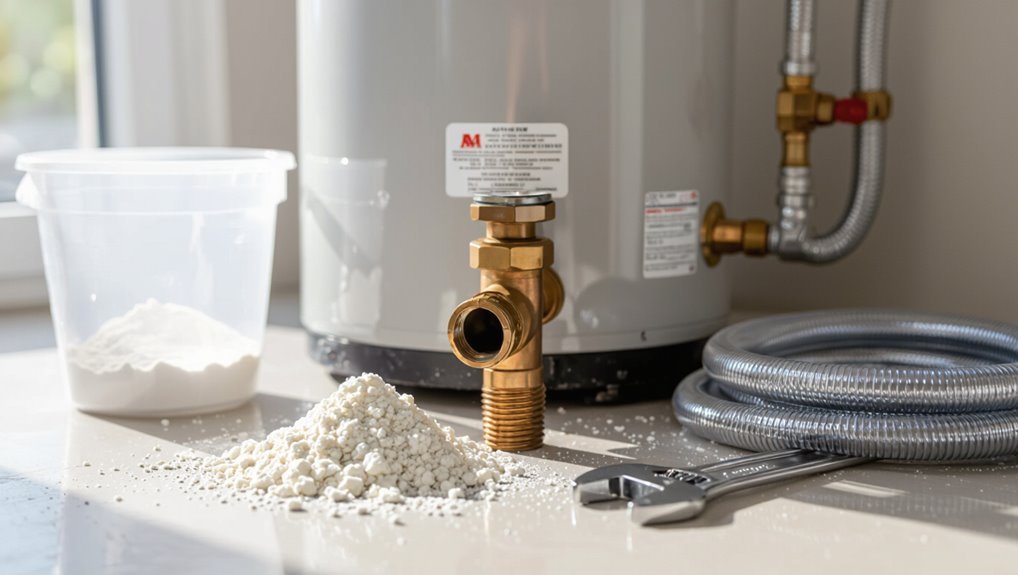
Hard water rich in calcium and magnesium promotes scale formation as dissolved minerals precipitate when heated.
Higher water temperatures and pressure spikes accelerate mineral precipitation and adhesion inside tanks.
Reduced hot-water flow, rumbling noises, and decreased heating efficiency are common signs of calcium buildup.
How hard water contributes to scale formation
Because groundwater commonly contains dissolved minerals, water entering a heater often carries calcium and magnesium ions that precipitate when heated.
Hard water increases ion concentrations, promoting scale on heating elements and tank surfaces. This accumulation reduces efficiency and lifespan.
Understanding hardness helps owners choose treatments—softeners, filters, or routine flushing—central to how to prevent calcium buildup in water heater and maintain performance.
Temperature and pressure effects on mineral precipitation
When heated, dissolved calcium carbonate becomes less soluble and is more likely to precipitate out of water. Thus, rising tank temperatures directly accelerate scale formation on elements and walls.
Increased pressure also shifts equilibrium, promoting precipitation during thermal expansion or pressure spikes.
Localized hot spots and extended high-temperature setpoints intensify deposition rates, reducing heat transfer efficiency and accelerating corrosive underfilm development on tank surfaces.
Common signs your heater has calcium buildup
How can a homeowner tell if calcium is accumulating in a water heater?
Reduced hot water flow, strange noises (popping or rumbling), decreased heating efficiency, and premature thermostat cycling are typical indicators.
White, chalky residue near valves or drain fittings and frequent clogging of fixtures also suggest scaling.
Increased energy bills and shorter tank lifespan further signal significant calcium buildup requiring attention.
Immediate actions to reduce existing calcium deposits
The article outlines immediate steps to address calcium deposits, beginning with flushing the tank to remove loose sediment.
It then covers safe use of white vinegar or commercial descaling solutions for dissolving stubborn buildup.
Finally, it explains indicators that professional descaling is needed and when to contact a technician.
Flushing the tank
Drain the water heater to remove accumulated calcium and sediment that reduce efficiency and shorten appliance life.
A controlled flush clears loose deposits, restores heat transfer, and lowers energy use. Periodic flushing prevents buildup and prolongs service intervals.
Follow safety steps and manufacturer’s guidance before draining.
- Relief: water runs hotter, bills drop
- Confidence: appliance lasts longer
- Satisfaction: cleaner, quieter system
Using a vinegar or descaling solution safely
When mineral buildup persists after a controlled flush, applying a vinegar or commercial descaling solution can dissolve remaining calcium deposits and restore heat transfer efficiency.
Users should follow a precise, safety-focused procedure to avoid equipment damage or personal injury. Isolate power, ventilate, wear gloves and eye protection, use manufacturer-recommended concentrations, and rinse thoroughly afterward to prevent corrosion and residue.
- Relief at restored efficiency
- Confidence in safe steps
- Satisfaction from prolonging equipment life
When to call a professional for descaling
How urgent is professional descaling depends on symptoms and homeowner skill: if water temperature fluctuates, hot water runs out rapidly, unusual noises persist after a controlled flush, or visible scale appears in outlets, a licensed technician should be contacted;
additionally, if the heater is gas-fired, under warranty, or the owner is uncomfortable with chemical descaling or working around electrical/gas connections, professional service reduces risk of damage and guarantees thorough removal.
Prompt inspection confirms extent and prevents failure.
Long-term strategies to prevent calcium buildup
Long-term prevention focuses on system-level changes that reduce mineral content and scale formation. Options include installing a water softener (ion-exchange or salt-free) and considering alternative conditioners such as salt-free or magnetic devices.
Adjusting the water heater thermostat to a lower temperature also helps slow scale buildup.
Installing a water softener: types and benefits
Because hard water supplies dissolve minerals that eventually accumulate in heaters, installing a water softener is a primary preventive measure: it removes calcium and magnesium ions before they enter the plumbing system, reducing scale formation, improving heater efficiency, and extending appliance lifespan. Choices include ion-exchange, cartridge, and electronic models; benefits encompass lower maintenance, energy savings, and longer equipment life.
| Type | Benefit |
|---|---|
| Ion-exchange | Effective removal |
| Twin-tank | Continuous soft water |
| Metered | Efficient resin use |
| Compact cartridge | Space-saving |
| Professional install | Ideal performance |
Alternative conditioning systems: salt-free conditioners and magnetic devices
Beyond traditional ion-exchange softeners, homeowners may consider salt-free conditioners and magnetic or electronic descalers as alternative long-term strategies to limit calcium buildup.
Salt-free systems condition minerals to reduce scaling without removing hardness, requiring minimal maintenance.
Magnetic/electronic devices claim to alter mineral crystallization; results vary by water chemistry.
Both options suit users seeking low-maintenance, environmentally friendly approaches, though performance is context-dependent.
Lowering thermostat settings to reduce scale formation
Lowering a water heater’s thermostat can slow calcium carbonate precipitation by reducing the temperature-driven chemical reactions that cause scale to form on heating elements and tank surfaces.
Modest reductions (e.g., from 140°F to 120°F) decrease deposition rates, extend element life, and improve efficiency.
Balance corrosion, Legionella risk, and user comfort; consult manufacturer guidelines and consider complementary measures like periodic flushing and water softening for best results.
Routine maintenance schedule to minimize scaling
A clear routine prevents scale from compromising heater performance and lifespan. The recommended schedule varies by heater type, with specific intervals for inspecting anode rods and replacing them as needed.
Regular checks of sediment traps and drain valves complete the maintenance cycle.
- Worry eased when inspections are timely
- Confidence restored by fresh anode protection
- Relief from sudden failures with routine sediment checks
Recommended inspection frequency for different heater types
Because mineral accumulation and operational stress vary by design and usage, inspection intervals should be tailored to the specific water-heater type.
Tank heaters: inspect annually for sediment and element wear; high-hardness areas consider biannual checks.
Tankless units: inspect every 12–24 months, more often with heavy use.
Heat-pump and hybrid systems: annual inspections; commercial or high-demand systems require quarterly reviews.
Anode rod checks and replacement intervals
Following recommended inspection intervals for different heater types, attention should shift to the anode rod, a sacrificial component that slows tank corrosion and indirectly reduces mineral-related problems.
Owners should inspect rods every 1–3 years depending on water hardness and usage. Replace when heavily corroded, pitted, or reduced to less than half diameter.
Timely replacement preserves tank integrity and helps limit scale accumulation.
Sediment trap and valve maintenance
Inspect sediment traps and drain valves at regular intervals to prevent accumulated grit and minerals from settling at the tank bottom and accelerating scale formation.
Flush the trap and open the drain valve quarterly or more often in hard-water areas to expel debris.
Replace worn valves and seals promptly.
Maintain a log of service dates and findings to guarantee consistent preventative action and prolong heater efficiency.
Choosing the right water heater to reduce scaling
Selection of a water heater can greatly influence calcium accumulation, with tankless units typically reducing standing-water scale while conventional tanks may trap more mineral deposits.
Materials and protective coatings—such as stainless steel, glass-lined tanks, or anti-scale coatings—alter corrosion and buildup rates.
Proper sizing and installation, especially in hard-water areas, guarantee sufficient flow rates and allow for compatible treatment options to minimize scaling.
Tankless vs tank heaters: scale implications
Choosing between tankless and storage-tank water heaters greatly affects how and where scale forms, because the two technologies heat and move water differently. Tankless units concentrate heat at exchangers, risking localized scaling; tanks allow bulk deposition. Maintenance, water hardness, and flow patterns determine buildup rates.
| Tankless | Storage-tank |
|---|---|
| Localized scale | Even sediment |
| Requires descaling | Requires flushing |
Materials and coatings that resist buildup
Materials and coatings play an essential role in limiting calcium deposition, as different metals, linings, and surface treatments alter how minerals nucleate and adhere.
Stainless steel elements resist scaling better than bare steel; glass-lined tanks reduce direct mineral contact.
Nonstick ceramic or polymer coatings on heat exchangers and sacrificial anodes tuned for chemistry also decrease buildup, extending efficiency and service intervals.
Sizing and installation considerations for hard-water areas
After addressing surface treatments and component choices that limit mineral adhesion, attention turns to how size and installation affect scaling in hard-water conditions.
Selecting appropriately sized tanks reduces stagnation and high heat cycles that accelerate deposits. Installations should include softeners, sediment traps, and accessible drain valves.
Vertical orientation, insulation, and controlled temperature settings further limit calcium accumulation and simplify maintenance.
Common mistakes that accelerate calcium buildup
Neglecting regular flushing and inspections allows mineral deposits to accumulate unchecked, hastening scale formation.
Excessively high thermostat settings increase the rate of calcium precipitation.
Using incorrect or incompatible descaling chemicals can damage tank components and leave residue that promotes further buildup.
Skipping regular flushing and inspections
Skipping scheduled flushes and inspections allows mineral-laden water to sit and concentrate, accelerating scale formation on heating elements, tank walls, and plumbing connections.
Neglecting routine maintenance reduces efficiency, raises energy costs, and shortens component lifespan.
Periodic draining, sediment removal, and visual checks detect early buildup, leaks, or anode wear.
Ignoring these tasks leads to costly repairs and premature replacement.
Setting water temperature too high
Many homeowners set water heaters to high temperatures believing it improves performance, but elevated settings speed calcium precipitation and scale formation.
Higher heat increases mineral solubility limits, causing faster deposition on tank walls and heating elements.
Maintaining moderate temperatures reduces scaling rate, extends equipment life, and improves efficiency.
Technicians recommend following manufacturer temperature guidelines and using thermostatic mixing valves to balance safety and scale control.
Using incorrect descaling chemicals
Choose descaling chemicals carefully, because using the wrong products can worsen calcium buildup and damage water heater components.
Many household cleaners are incompatible with tank materials or heating elements, leaving residues that attract scale.
Professionals recommend manufacturer-approved descalers or diluted acid solutions applied per instructions.
Incorrect concentrations, mixes, or dwell times accelerate corrosion, reduce efficiency, and void warranties; always verify compatibility first.
Cost-benefit comparison of prevention methods
A concise cost–benefit comparison weighs upfront costs against long‑term savings and considers environmental and operational impacts to identify the most practical prevention strategy. The analysis compares initial investment, maintenance frequency, energy use, waste generation, and expected lifespan for each option. Decision-makers can use these factors to select the method that balances budget, performance, and sustainability.
| Factor | Consideration |
|---|---|
| Upfront cost | Initial purchase and installation expenses |
| Long-term savings | Reduced repairs, energy efficiency over time |
| Environmental impact | Water waste, chemical use, energy consumption |
| Operational impact | Maintenance frequency and downtime |
| Useful lifespan | How long the method remains effective |
Upfront costs vs long-term savings
Preventive measures for calcium buildup vary considerably in upfront cost, from inexpensive water-softening salts to more costly whole-home water softeners or magnetic descalers.
These initial expenses should be weighed against projected energy savings, repair avoidance, and extended appliance life. A simple salt regimen or periodic flushing yields low cost and modest savings; installed softeners or professional treatments raise upfront expense but typically deliver greater long-term value.
Environmental and operational impacts
Beyond upfront costs and projected savings, evaluating environmental and operational impacts reveals additional dimensions to the cost-benefit balance of calcium-control methods.
Energy-efficient options reduce fuel use and emissions but may require maintenance.
Chemical treatments lower scale quickly yet generate wastewater and disposal concerns.
Mechanical filters offer low environmental footprint but need regular servicing.
Decision-making should weigh emissions, resource use, maintenance frequency, and regulatory constraints.
Troubleshooting persistent scaling problems
When visible fixes fail, technicians look for hidden scale-related performance issues such as reduced flow, longer heat-up times, or erratic thermostat cycling.
Simple diagnostic tests and inspection of heating elements or burners can confirm whether buildup is the root cause.
If repairs repeatedly fail or costs approach replacement, replacing the unit is often more cost-effective than ongoing fixes.
Diagnosing hidden scale-related performance issues
Detecting hidden scale-related performance issues requires systematically comparing expected heater behavior to measured outputs: reduced heat transfer, longer recovery times, fluctuating water temperatures, unusual noise, or rising energy use can all indicate internal scaling even when external inspection appears normal.
Technicians should log temperature rise, recovery time, inlet/outlet differentials, and energy consumption; targeted inspection with borescope or sediment sampling confirms deposits and guides descaling actions.
When replacement is more cost-effective than repair
At what point does continued descaling and part replacement stop saving money compared with installing a new unit?
The decision favors replacement when repeated service calls, rising energy bills from insulated inefficiency, and recurring component failures approach the price of a new heater.
Calculate total repair costs over expected remaining life; if replacement yields lower lifecycle cost and improved warranty, replace.
Practical tips to extend water heater life in hard-water homes
Many homeowners in hard-water areas can greatly extend their water heater’s lifespan by adopting targeted maintenance and simple preventative measures.
Regular flushing, a sacrificial anode check, and installing a water softener reduce calcium stress and improve efficiency.
Promptly addressing leaks prevents escalation.
Emotional reassurance follows practical action:
- Relief: fewer surprises, steady hot water.
- Confidence: lower bills, longer service.
- Pride: protected investment.
Conclusion
Calcium clings like stalagmites in a forgotten cave, slowly starving the heater of efficiency until it wheezes under mineral weight. By flushing, softening, and inspecting, homeowners can banish those rocky invaders before tanks turn to crusted relics. Routine care becomes armor, a gentle siege that keeps pipes singing and bills small. With vigilance the water heater endures, no archaeology required—just simple acts that let hot water flow like a clear, relentless spring.
