How to Keep Toilet Drain Clear: Simple DIY Tips to Prevent Clogs
To keep your toilet drain clear and prevent clogs, adopt simple habits and use basic tools. Regularly check for visible debris and only flush toilet paper—limit the amount per flush and avoid wipes or foreign objects. For slow drains, use a flange plunger, and for tougher blockages, a toilet auger is effective. Monthly vinegar soaks can help dissolve mineral deposits, while enzyme cleaners can be left overnight for added maintenance. Additionally, inspect tank parts and schedule septic service as needed. Follow these practical steps for effective toilet drain care and troubleshooting.
What keeps toilet drains clear: a simple overview
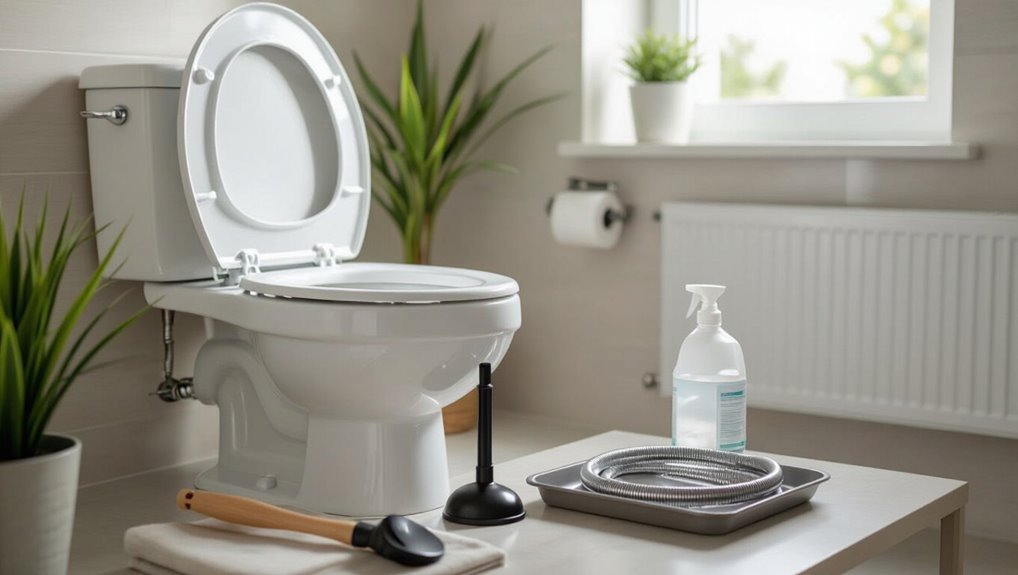
A clear toilet drain depends on proper flow dynamics and minimal obstructions.
Common causes of clogs and slow drains include excess toilet paper, sanitary products, hair, and mineral buildup that restricts the trap and pipe.
Toilet bowls and traps are designed to use a controlled flush of water and gravity to carry waste through the S-shaped trap and into the sewer line.
Common causes of toilet clogs and slow drains
Recognize that most toilet clogs and slow drains stem from a few predictable causes: excess toilet paper, non-flushable items, mineral buildup, and partial blockages in the trap or drain line.
Routine habits and hard water accelerate issues; wipes, feminine products, and grease create obstructions.
Gentle maintenance, mindful flushing, and occasional descaling explain how to keep toilet drain clear and reduce recurring slow drains.
How toilets are designed to move waste and water
Toilets rely on a coordinated design of bowl shape, trapway curvature, and water delivery to move waste and keep the drain clear.
Gravity, water flow, and siphoning combine: a controlled flush sends a surge that creates siphon action, pulling waste through the trapway while water seals the drain to block sewer gases.
Smooth glazing and proper slope prevent adherence and promote clearance.
Quick, immediate actions to clear a partially slow toilet
Before reaching for tools, one should perform basic safety checks such as ensuring the water level is controlled and removing any visible debris.
If safe, a plunger applied with firm, even pressure can often restore flow when used correctly.
For more persistent slow drainage, a toilet auger can be fed gently into the trap to break up or retrieve obstructions without damaging the bowl.
Safe first checks before any tools
If a toilet is flushing slowly, start with quick, safe checks that require no tools: verify the water level in the tank, confirm the flapper is seating and lifting properly, and look for obvious obstructions in the bowl near the outlet.
Next, make sure the fill valve refills at the correct height, test the flush handle linkage for slack, and remove visible debris with gloved hands.
How to use a plunger effectively
Grasp the plunger firmly and create a tight seal over the bowl’s outlet before beginning—proper positioning concentrates pressure where it’s needed and prevents air leaks.
- Push gently at first, then use vigorous, controlled thrusts to dislodge the obstruction.
- Maintain the seal and vary stroke length; avoid splashing by keeping slow returns.
- After success, flush to confirm flow; clean and sanitize the plunger and surrounding area.
When and how to use a toilet auger (snake)
Use a toilet auger when plunging fails to restore normal flow or when water drains slowly despite no visible obstruction.
The homeowner should feed the coated cable gently into the trap, crank clockwise to break or hook the clog, then retract slowly while flushing to clear debris. Sanitize and dry the tool after use.
- Feed cable slowly
- Crank to engage clog
- Retract and flush
Preventive maintenance routines to keep the drain clear
Routine preventive maintenance keeps a toilet drain functioning and reduces emergency clogs.
Recommended practices include simple weekly and monthly habits, clear household flushing rules, and use of appropriate commercial cleaners or safe homemade solutions.
The following section outlines specific schedules, do’s and don’ts, and product options.
Weekly and monthly habits that reduce clogs
Although occasional blockages are inevitable, simple weekly and monthly actions greatly lower the chance of a clogged toilet by catching buildup early and preventing foreign objects from entering the drain.
- Inspect and remove visible debris; wipe seat and rim to stop grime entering the bowl.
- Run a toilet brush around the bowl weekly; monthly use a vinegar soak to dissolve mineral buildup.
- Check flapper and tank parts monthly for leaks or wear that encourage inefficient flushing.
Proper flushing practices everyone in the household should follow
Adopt consistent flushing habits to prevent clogs and extend the toilet’s functional life. Households should follow simple, clear rules so drains remain free and repairs are minimized.
- Flush only toilet paper; dispose of wipes, sanitary items, and tissues in a bin.
- Use a full, single flush; avoid multiple partial flushes that can leave residue.
- Teach kids proper amounts of paper per flush.
Recommended cleaning products and safe homemade options
Good flushing habits reduce the risk of clogs, but regular cleaning helps prevent buildup before it becomes a problem.
Recommended products include enzyme-based cleaners for organic buildup, mild toilet bowl cleaners for mineral residue, and nonabrasive brushes.
Safe homemade options use baking soda plus vinegar or diluted bleach occasionally.
- Enzyme cleaner
- Baking soda + vinegar
- Soft brush and mild cleaner
Tools and products worth having for prevention and quick fixes
A concise kit of tools and products makes routine prevention and quick fixes more effective, including the right plunger type, a toilet auger, enzyme cleaners, and drain guards.
Guidance is offered on when to choose enzyme or bacterial cleaners for regular maintenance and biological clogs versus chemical drain cleaners for stubborn, inorganic blockages.
A brief product comparison highlights effectiveness, safety, speed, and long‑term impact to help select the appropriate solution.
Essential tools explained (plunger types, auger, enzyme cleaners, drain guards)
Essential tools for keeping a toilet drain clear include a few specific items that address common blockages and prevention.
A basic kit streamlines responses to clogs and maintenance while minimizing damage risks.
Recommended items focus on mechanical removal, routine protection, and biological maintenance.
- Plunger (flange and cup)
- Toilet auger (closet auger)
- Drain guard and enzyme cleaner combo
When to use enzyme/bacterial cleaners vs chemical drain cleaners
After outlining the basic tools—plungers, a toilet auger, and preventive guards—deciding between enzyme/bacterial cleaners and chemical drain solvents depends on the type of clog, frequency of use, and safety considerations.
Use enzyme/bacterial products for organic buildup and routine maintenance; they’re safer for pipes, septic systems, and skin.
Reserve chemical solvents for stubborn, inorganic blockages, applied sparingly with protective gear and proper ventilation.
Product comparison: enzyme cleaner vs chemical cleaner
How do enzyme-based cleaners compare with chemical solvents for routine toilet care and quick fixes? Enzyme cleaners slowly digest organic buildup, are safe for pipes and septic systems, and suit maintenance. Chemical solvents act fast on severe clogs but can damage seals, harm septic bacteria, and require caution. Choose enzymes for prevention; reserve chemicals for stubborn blockages.
| Enzyme cleaner | Chemical cleaner |
|---|---|
| Slow, safe | Fast, harsh |
| Preventative use | Emergency use |
How to inspect and diagnose recurring toilet drain issues
A homeowner should first distinguish whether symptoms—slow flushes, gurgling, or backups—are confined to one toilet or affect multiple fixtures, which suggests a main sewer or septic problem.
Simple tests, like filling and flushing a nearby sink or using dye in the bowl, can reveal partial blockages or venting issues.
Persistent backups, sewage odors, recurring clogs after snaking, or costs that exceed a clear DIY threshold warrant calling a plumber and budgeting for inspection and repair.
Signs a problem is local to the toilet vs main sewer/septic issues
Where is the blockage: in the toilet itself or farther down the sewer line? Observable signs help differentiate: slow refill or gurgling only at that toilet, frequent clogs confined to one fixture, and improved flow after plunging indicate a local blockage.
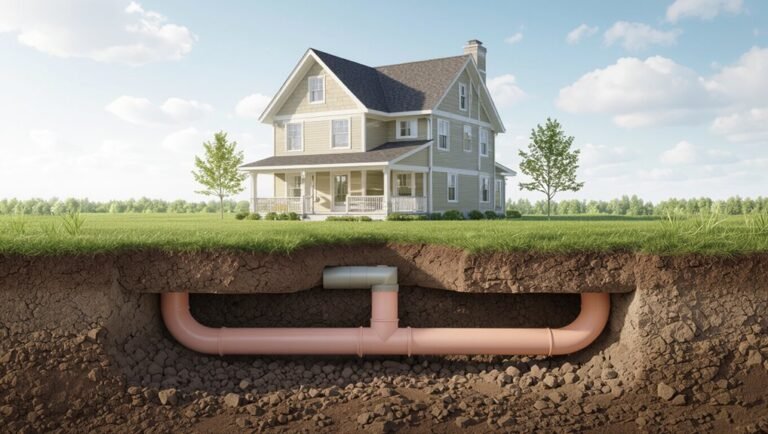
Multiple fixtures backing up, sewage odor outside, or yard sinkholes point to main sewer or septic failure requiring professional inspection.
How to test for partial blockages and venting problems
Once the difference between a localized toilet clog and a main-line problem is established, testing for partial blockages and venting faults focuses on simple, observable diagnostics that narrow the cause.
- Check flush flow and bowl refill—slow siphon or gurgling suggests partial trap or branch blockage.
- Run nearby drains—simultaneous backups indicate shared blockage.
- Observe roof vent airflow with a smoke test or flashlight; weak draft points to vent restriction.
When to call a plumber: red flags and cost expectations
Recognize specific warning signs that warrant professional help rather than DIY fixes: persistent backups affecting multiple fixtures, recurring clogs after snaking, sewage odors, slow drains despite clear traps, loud gurgling or bubbling from vents, and water rising in other drains when the toilet is flushed.
Call a plumber for suspected mainline blockages, tree root intrusion, collapsed pipes, or sewer line problems.
Expect diagnostics and repairs to range widely—often $150–$2,500.
Simple DIY fixes for common clog types
The next section outlines straightforward DIY methods for the most frequent toilet clogs.
It covers clearing paper and soft-waste blockages, safely removing foreign objects, and treating mineral buildup from hard water.
Each fix includes the basic tools and steps a homeowner can use before calling a plumber.
Clearing paper and soft-waste blockages
Start by evaluating water level and flush behavior to confirm a paper or soft-waste blockage rather than a mechanical fault or hard obstruction.
Then proceed with gentle DIY clearing techniques focused on break-up and removal without tools that could damage seals.
- Use a flange plunger with firm, steady pumps.
- Try a biodegradable enzyme drain cleaner overnight.
- Flush repeated small volumes of hot (not boiling) water.
Removing foreign objects safely
Address common items—toys, hygiene products, jewelry, and small toiletries—by matching the removal method to the object’s size and location to avoid pushing it farther or damaging the toilet.
Small visible items can be retrieved with gloved hands or long-nose pliers.
Deeper obstructions suit a wet-dry vacuum, toilet auger, or professional help if resistance, leaks, or fragile fixtures risk further harm.
Dealing with mineral buildup and hard-water deposits
Many toilets develop mineral crusts and hard-water deposits around the rim, jet holes, and trap over time, reducing flow and causing partial clogs.
Simple, targeted DIY methods—soaking with vinegar or a mild acid, scrubbing with a brush, and clearing rim jets with a wire or toothbrush—can dissolve buildup without harsh chemicals.
However, repeated or heavy scaling may require stronger descalers or professional service.
Regular maintenance prevents recurrence.
Long-term solutions to prevent future clogs
Long-term prevention focuses on strategic upgrades and system improvements rather than repeated repairs.
Consider higher-performance toilet models with larger trapways or pressure-assist flushing, and evaluate plumbing factors such as venting, pipe slope, and diameter to reduce recurring blockages.
For properties on septic, incorporate regular inspections and pumping into a maintenance schedule to keep the whole system functioning.
Upgrades to consider (toilet models, larger trapways, pressure-assist options)
Consider upgrading the fixture when persistent clogs occur despite proper use and maintenance: modern toilet models with larger trapways, improved bowl designs, and pressure-assist flushing can greatly reduce blockages by moving waste more efficiently and reducing reliance on repeated plunging.
Select a low-water, high-performance model; verify trapway diameter and bowl profile; consider pressure-assist for commercial or heavy-use bathrooms to minimize future clogs.
Plumbing improvements to reduce recurring problems (venting, slope, pipe diameter)
Evaluating and correcting the underlying plumbing is essential for preventing recurring toilet clogs. Proper venting, correct pipe slope, and adequate pipe diameter guarantee reliable waste removal and reduce strain on fixtures.
Inspect vent stacks for blockages, confirm drain runs slope ~1/4″ per foot, and verify pipe size meets code (typically 3–4 inches).
Professional correction prevents chronic backups and improves system longevity.
Septic-system considerations and maintenance schedule
Beyond correcting pipe slope and venting, attention to the septic system itself prevents recurring toilet clogs on a property-wide scale.
Regular inspections, pumping every 3–5 years, and monitoring tank levels reduce backups. Avoid flushing non-biodegradables and limit grease.
Maintain drainfield drainage and divert roof/runoff away. Keep records of service and respond promptly to slow drains or odors to forestall costly repairs.
Troubleshooting scenarios and targeted remedies
When the toilet slows only after several flushes, the cause is often a partial clog or a failing trap seal and can be addressed by targeted snaking or cleaning the bowl rim and jet holes.
If multiple fixtures slow or back up when the toilet runs, the problem likely lies in the sewer line and requires inspection with a camera or professional clearing.
Gurgling, odors, or bubbling point to vent or drain blockages and are resolved by clearing vent stacks, using augers, or calling a plumber for trapped-sewer diagnostics.
Toilet drains slow only after multiple flushes probable causes and fixes
Recognize that a toilet which flows well at first but slows after several flushes typically points to intermittent buildup, partial venting issues, or a problem with the trap or drain line restricting flow over successive uses.
- Clear mineral or organic buildup with a toilet auger and enzyme cleaner.
- Inspect and clear vent stacks; temporary gurgling suggests vent restriction.
- Check trap and partial line blockages; snaking beyond the trap may restore consistent flow.
Multiple fixtures slow or backup when toilet is used likely sewer line issue
If multiple fixtures slow or back up while the toilet is flushed, the problem likely lies beyond the fixture itself and into the shared drain or sewer line.
Suspect a partial blockage, tree root intrusion, or collapsed pipe.
Recommend avoiding water use, shutting off valve if severe, and contacting a plumber for camera inspection and hydro-jetting or excavation—DIY remedies are limited and risky.
Gurgling, odors, or bubbling what they indicate and how to address
A few common symptoms—gurgling toilets, wastewater odors, or bubbling in drains—typically signal ventilation or blockage issues in the plumbing system rather than a malfunction of the fixture itself.
These indicate partial clogs, blocked vent stacks, or sewer line problems. Check vents, clean accessible traps, snake the drain, and inspect sewer lines.
If odors or gurgling persist, contact a licensed plumber for camera inspection and repair.
Practical do’s and don’ts to avoid clogging the toilet
Prevent clogs by following simple habits that reduce the chance of blockages and make maintenance easier.
Regularly flush only toilet paper and human waste; avoid wipes, sanitary products, and grease.
Schedule routine checks for slow drains and use a plunger promptly.
Educate household members on safe disposal and keep a small bin nearby.
- Use toilet paper only
- Plunge quickly on slow flushes
- Dispose solids elsewhere
Conclusion
Keeping a toilet drain clear hinges on simple habits and timely action: 80% of household clogs result from excess paper and non-flushables, a reminder that small choices matter. Regular maintenance, prompt response to slow drainage, and having basic tools reduce problems and expense. When recurring issues arise, inspection and targeted repairs often reveal fixable causes. With consistent prevention and sensible use, most toilets stay clear, functional, and less likely to demand professional intervention.