How to Turn Off Your Gas Furnace for Summer: Step-by-Step Shutdown Guide
To safely turn off your gas furnace for the summer, follow these straightforward steps: First, ensure the unit is cool and not in operation. Set the thermostat to the Off or Heat Pump/Auxiliary mode. Next, close the gas shutoff valve on the appliance; reserve the meter valve for long-term absences or in case of leaks. Then, disconnect the electrical power at the furnace or the breaker. It’s essential to test your carbon monoxide detectors and label any valves for clarity. Lastly, consider scheduling maintenance while the furnace is offline to avoid future issues. For detailed safety checks and guidance on restarting, continue reading.
What Turning Off Your Gas Furnace for Summer Entails
The section explains why shutting off a gas furnace for summer can save energy, reduce wear, and lower the risk of malfunctions.
It outlines circumstances when turning the unit off is appropriate versus when maintaining periodic operation is advisable.
It also notes safety checks and any local codes or professional requirements to verify before doing so.
Why shutting off a gas furnace in summer is important
Shutting off a gas furnace for the summer reduces unnecessary fuel use, limits wear on components, and lowers the risk of combustion-related hazards while systems remain idle.
Turning the unit off conserves energy, trims utility bills, and prevents premature part failure.
For homeowners seeking guidance on how to turn off gas furnace for summer, following a clear shutdown procedure also aids safe, efficient seasonal maintenance.
When to turn off versus when to leave it on
When should a gas furnace be turned off for the summer versus left on depends on climate, home usage, and system features:
In mild or warm regions where heating is rarely needed, powering down conserves fuel and reduces wear.
In colder climates, homes with sensitive plumbing or integrated HVAC systems that use the furnace for air circulation or heat recovery may be better served by maintaining minimal operation or scheduled cycles.
Periodic checks balance savings and protection.
Safety and legal considerations to check first
Choosing to power down a gas furnace for the summer carries specific safety and legal implications that should be verified before proceeding.
Inspect for gas leaks, guarantee carbon monoxide detectors function, and secure pilot light procedures per manufacturer instructions.
Confirm local codes, warranty terms, and landlord or HOA rules.
When in doubt, consult a licensed HVAC technician to avoid liability or hazards.
Tools and supplies You’ll Need
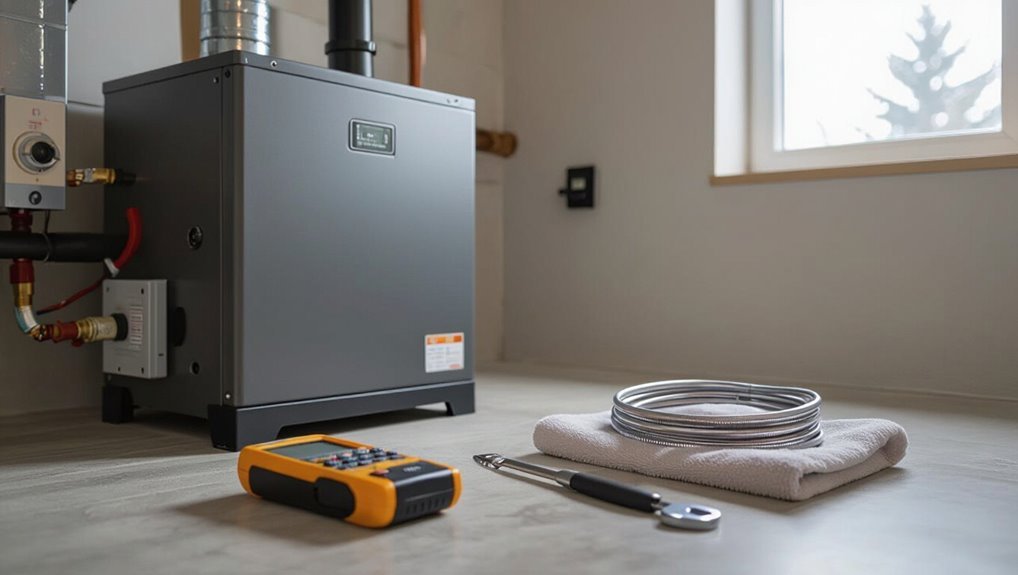
A concise checklist of basic tools and safety gear helps guarantee the furnace shutoff is performed correctly and without incident.
Recommended items include a screwdriver set, adjustable wrench, flashlight, work gloves, and a carbon monoxide detector.
If the unit shows signs of damage, complex wiring, gas leaks, or the homeowner lacks confidence, a licensed HVAC professional should be contacted instead of attempting further DIY work.
Basic tools and safety gear checklist
Essential items for shutting off a gas furnace include basic hand tools, personal protective equipment, and a few specialty items to guarantee the job is done safely and correctly.
A concise checklist helps prepare for inspection and shutdown.
- Screwdrivers, adjustable wrench, flashlight
- Gloves, safety glasses, dust mask
- Gas shutoff tool, multimeter, sealant
When to call a professional instead of DIY
Recognize when a job exceeds typical DIY scope: complex gas valve repairs, persistent odors, pilot or ignition failures, corroded piping, or any uncertainty about leak sources require a licensed HVAC or gas technician.
Additionally, call a pro for electrical faults, repeated shutdowns, unclear gas shutoff procedures, failed pressure tests, or when local codes and permits apply.
Safety and certified diagnostics prevent hazards and liability.
Step-by-Step Shutdown Procedure
Before beginning any work, the furnace should be confirmed idle and cool to the touch.
The technician then powers down the thermostat to summer mode, shuts off the appliance gas valve and—if local practice requires—turns off the gas at the meter.
Finally, electrical power to the furnace is switched off safely to complete the shutdown.
Confirming the furnace is idle and cool
Verify the furnace is fully idle and cool before proceeding with any shutdown steps.
Observe that blower and burner are silent, pilot or ignition LEDs indicate standby, and exterior surfaces feel cool to the touch.
Allow at least 30–60 minutes after the last cycle to dissipate residual heat.
If unusual smells or warmth persist, delay shutdown and consult a technician for inspection.
Turning off the thermostat and setting summer mode
Begin by switching the thermostat from heating to off or to a dedicated “summer” or “cool” setting, following the device’s display prompts or mode selector.
Verify the fan is set to auto or off to prevent unnecessary circulation.
Adjust temperature setpoints higher for energy savings.
Lock or schedule the thermostat if available, and document the change for seasonal maintenance records.
Shutting off the gas supply at the appliance
Locate the furnace’s gas shutoff valve and confirm the area is well-ventilated; this valve is typically a black or yellow-handled lever on the gas line near the appliance.
Turn the lever perpendicular to the pipe to close it.
Wait several minutes, then check burners and pilot (if visible) for extinguishment.
Label the valve position and document the shutdown date for future reference.
Turning off the gas supply at the meter (if required)
If turning off the gas at the meter is required, the technician should first confirm local regulations and utility company policies before proceeding.
They then locate the meter valve, use appropriate tools, and rotate the valve to the off position following utility guidelines.
After securing the valve, the technician tags the meter, notifies the utility if required, and documents the action for records.
Switching off electrical power to the furnace safely
Disconnecting the furnace’s electrical supply prevents accidental operation and reduces risk during maintenance or seasonal shutdown.
The technician locates the furnace’s electrical switch or dedicated circuit breaker, turns it off, and verifies power is off by attempting to start the unit or using a non-contact voltage tester.
If unsure, consult the breaker panel diagram or a qualified electrician to guarantee safe de-energization.
Lockout/tagout and labeling for household members
After electrical power to the furnace has been shut off, the technician or homeowner should apply simple lockout/tagout steps and clear labeling to prevent accidental re-energization by household members.
Attach a visible lock or taped-off switch cover and a bold tag stating “Do Not Operate — Furnace Off for Summer.”
Inform occupants of the reason, expected duration, and contact person for questions.
Post-Shutdown Tasks
After shutdown, a brief inspection and cleaning of accessible components helps prevent debris buildup and identifies obvious issues.
Air filters should be changed or cleaned while the system is offline to improve summer air quality and reduce strain when the furnace is next used.
If any concerns are found, scheduling professional maintenance during the off-season guarantees repairs and tune-ups can be completed without disrupting heating needs.
Inspecting and cleaning accessible components
Begin by visually inspecting all accessible components of the furnace—filter, burners, blower assembly, venting, and condensate lines—to identify dirt, corrosion, or wear that could worsen over the off-season.
Remove debris, vacuum dust from the blower and burner areas, and wipe accessible surfaces with a damp cloth.
Clear vent obstructions and guarantee condensate lines and drain pans are free-flowing to prevent mold and corrosion.
Changing or cleaning air filters before summer use
Replace or clean the furnace air filter before restarting the system for summer to guarantee proper airflow and indoor air quality.
The homeowner should locate the filter, note its size and type, then either wash reusable filters per manufacturer instructions or install a new disposable pleated filter.
Regular replacement improves efficiency, reduces dust, and prevents strain on the blower during seasonal use.
Servicing or scheduling maintenance while offline
Schedule or perform recommended maintenance while the furnace is offline to address wear, verify safety components, and prevent issues before the heating season.
A qualified technician can inspect heat exchangers, burners, controls, and vents, test safety switches, lubricate moving parts, and tighten electrical connections.
Document findings, replace worn components, and schedule repairs so the system is ready and safe when restarted.
Common Problems and How to Avoid Them
Common post-shutdown issues include gas leaks or unusual smells, which require prompt detection and immediate evacuation if suspected.
Ignition or pilot light problems can arise when systems are restarted after long inactivity and may need a professional inspection.
Incorrectly cutting power or gas can damage components or create safety hazards, so careful following of manufacturer instructions is advised.
Leaks, smells, and how to detect gas issues
How can one tell if a gas furnace is leaking or producing unusual odors? Detectable signs include a persistent sulfur or rotten-egg smell, hissing sounds near connections, dead indoor plants, or visible corrosion and soot around fittings.
Use a soap-and-water test on joints, install a carbon monoxide alarm, and ventilate immediately. If confirmed, evacuate and contact the gas utility or a qualified technician.
Ignition or pilot light issues after shutdown
After addressing leaks and odors, attention should turn to ignition and pilot-light behavior once the furnace is shut down for the season.
Inspect the pilot assembly and igniter for soot, corrosion, or cocked thermocouples. Confirm the pilot is fully extinguished if shutting gas; clean components and tighten connections.
Schedule professional service for persistent ignition faults to prevent wear and unsafe restarts.
Problems caused by improper power or gas shutoffs
Shutting off power or gas incorrectly can create several preventable issues when a furnace is taken out of service for the summer.
Incorrect procedures may damage electrical controls, trip breakers, or leave valves partially open, creating leaks or unsafe conditions.
Condensation and corrosion can occur without proper drainage.
To avoid problems, follow manufacturer steps, label switches, close gas at the appliance, and verify seals and pilot settings.
How to Restart the Furnace in Fall
Before reactivating the system in fall, a concise pre-start safety checklist should be completed to confirm no gas leaks, proper ventilation, and intact electrical connections.
Next, the gas valve and electrical shutoffs are restored step-by-step following manufacturer guidance and local codes.
Finally, the ignition and thermostat are tested to verify reliable ignition sequence and correct temperature control.
Pre-start safety checklist
When preparing to restart the furnace for fall, a concise pre-start safety checklist helps prevent hazards and assures reliable operation.
Inspect venting and flues for obstructions, check the area for combustible materials, verify filters are clean or replaced, confirm thermostat batteries and settings, look for signs of leaks or corrosion, and make sure pilot assembly and burner ports are free of debris before powering up.
Reversing gas and electrical shutoffs step-by-step
Begin by confirming the furnace’s gas valve and electrical supply are ready to be reactivated: locate the service shutoff for the gas line near the appliance and the electrical switch or circuit breaker that isolates the furnace, then plan to restore them in a controlled sequence to avoid surges or leaks.
Close all access panels, reopen the gas valve slowly, reset the breaker, and monitor for audible leaks or tripped breakers.
Testing ignition and thermostat operation
Restore power and gas to the furnace, then verify ignition and thermostat function by observing startup behavior and confirming control signals.
The technician watches the thermostat call for heat, listens for ignition sequence, and checks flame stability and burner operation.
Voltage and control wiring are inspected, thermostat settings calibrated, and safety interlocks tested.
Document results and address anomalies before regular seasonal use.
Energy, Cost, and Safety Benefits
Shutting off a gas furnace for the summer can reduce gas consumption and lower utility bills, with savings depending on local rates and household usage patterns.
Seasonal shutdowns also limit wear on the furnace and related HVAC components, which can help maintain system efficiency and extend service intervals.
Additionally, powering down the unit reduces risks associated with pilot lights, gas leaks, and accidental combustion during periods of nonuse.
Expected savings and HVAC efficiency impacts
Turning off a gas furnace for the summer can yield clear energy and cost advantages while influencing overall HVAC system efficiency and safety.
Homeowners typically save on gas bills during warmer months, and reduced run hours lower wear on components.
Proper shutdown and restart can maintain balanced system performance, potentially extending service intervals and improving summer AC efficiency by removing unnecessary furnace cycling.
Safety advantages of seasonal shutdowns
Although primarily associated with cost savings and efficiency, a seasonal furnace shutdown also provides distinct safety benefits:
It reduces gas leak and carbon monoxide risks by disabling fuel flow and pilot systems, lowers fire hazards from malfunctioning components or accumulated dust, and minimizes wear-related failures during idle months.
This proactive measure simplifies inspections and maintenance, improving overall household safety before autumn restart.
Troubleshooting Quick Guide
A brief troubleshooting guide outlines common issues to watch for after shutting off a gas furnace for summer.
Key prompts include:
- If you smell gas after shutdown
- If the furnace won’t power back up in fall
- When to contact an HVAC technician
These points help the reader recognize hazards and decide when to act or call a professional.
If you smell gas after shutdown
If any scent of gas is detected after the furnace is shut down, treat it as a potential leak and act immediately: evacuate occupants, avoid flames or electronics, and do not operate switches.
From a safe location, call the gas company or emergency services. Do not re-enter until professionals declare it safe.
Arrange a licensed technician to inspect and repair the system before reuse.
If the furnace won’t power back up in fall
Begin troubleshooting by confirming basic power and fuel conditions: verify the thermostat is set to heat and has fresh batteries, check the furnace switch and circuit breaker for power, and secure the gas valve or fuel source is open.
Inspect the furnace error LED or display for codes, reset any tripped switches, confirm the condensate/drip pan and float switch aren’t engaged, and reseat control board connections.
When to contact an HVAC technician
Contacting an HVAC technician is recommended when basic checks—thermostat settings, power supply, gas valve, resettable switches, and visible error codes—do not resolve the issue or when symptoms suggest a safety or mechanical fault, such as persistent gas smell, frequent cycling, unusual noises, inability to ignite, or recurring trips of the breaker.
A technician should also be called for suspected gas leaks, failed ignition systems, abnormal combustion, or complex control board failures.
Comparison of Shutdown Options
A concise comparison helps readers choose between shutting the gas at the appliance or at the meter, and between a full power cutoff or leaving the thermostat to disable heating. The following table summarizes key differences to guide a safe, practical decision. Further discussion will weigh safety, convenience, and service implications.
| Option | Control Point | Typical Impact |
|---|---|---|
| Appliance shutoff | Valve on furnace | Stops gas to unit only |
| Meter shutoff | Main gas shutoff | Cuts gas to entire building |
| Thermostat-only | Electrical control | Prevents burner ignition but leaves gas available |
| Full power cutoff | Combo of electrical + gas | Guarantees no power or gas to furnace |
Turning off gas at appliance vs. at meter
Weighing whether to shut off the gas at the furnace or at the meter hinges on convenience, safety, and access: turning the appliance valve off isolates the unit for maintenance while leaving the home’s supply available, whereas closing the meter valve cuts gas to the entire building and reduces risks during extended absence or suspected leaks.
Choose appliance shutoff for quick service; choose meter shutoff for prolonged vacancy or confirmed leak.
Full power cutoff vs. thermostat-only shutdown
Having decided whether to shut off gas at the appliance or the meter, the next decision concerns how the furnace is powered during the off-season: a full power cutoff (shutting electrical and gas feeds) versus a thermostat-only shutdown (leaving power on but programming the thermostat to stop heating).
Full cutoff eliminates standby consumption and potential faults; thermostat-only preserves controls, timers, and safety features.
Choose based on safety, maintenance, and convenience.
Practical Tips and Best Practices
Practical tips focus on preparing the system for months of inactivity and leaving clear records for anyone who follows.
Recommended items include a simple seasonal checklist such as:
- filter change and inspection schedule,
- condensate and vent checks,
- labeled shutoff and thermostat settings.
Clear documentation and visible labels reduce confusion and help future owners or renters maintain safe operation.
Seasonal maintenance schedule recommendations
Because a clear schedule prevents overlooked tasks and extends equipment life, homeowners should follow a concise seasonal maintenance calendar for their gas furnace.
Quarterly checks: inspect vents, filters, pilot/light, and condensate lines.
Pre-winter: professional tune-up, combustion and safety tests.
Post-winter: clean and replace filters, check ducts.
Record dates and outcomes; address issues promptly to avoid costly repairs.
Documentation and labeling for future owners or renters
When preparing a home for sale or rental, clear documentation and visible labels for the gas furnace guarantee safe, efficient handover and reduce future confusion.
Include shutdown date, steps taken, pilot/light instructions, and last service record.
Label switches, valves, filter size, and thermostat type.
Store manuals, manufacturer contact, and local utility/emergency numbers in a marked folder for new occupants.
Conclusion
As summer arrives, the homeowner completes the furnace shutdown and anticipates savings and safety. With 78% of households reporting lower summer energy bills after seasonal HVAC adjustments, the practice proves both practical and impactful. By following the step-by-step procedure, performing post-shutdown checks, and addressing common issues, one minimizes risk and expense while preserving equipment longevity—turning off the gas furnace becomes a simple, responsible seasonal routine.