How to Stop a Table Wobbling: 9 Simple Fixes You Can Do Right Now
If your table is wobbling, it’s often due to uneven floors, loose legs, or worn feet. To quickly fix it, press down on each corner to identify the problem leg, slide a card under the short leg, and tighten any loose screws. For temporary solutions, use folded paper, felt pads, or adhesive shims. For a more permanent fix, consider replacing or reshaping the leg ends, installing screw-in levelers, or reinforcing joints with glue. Simple tools and precise adjustments can usually resolve the issue, with additional step-by-step options available for more persistent wobbling.
Why tables wobble and when it matters
Tables wobble for a few predictable reasons: uneven flooring, mismatched leg lengths, loose joints, or warped components.
This instability can create safety hazards, reduce functional stability, and undermine the table’s appearance.
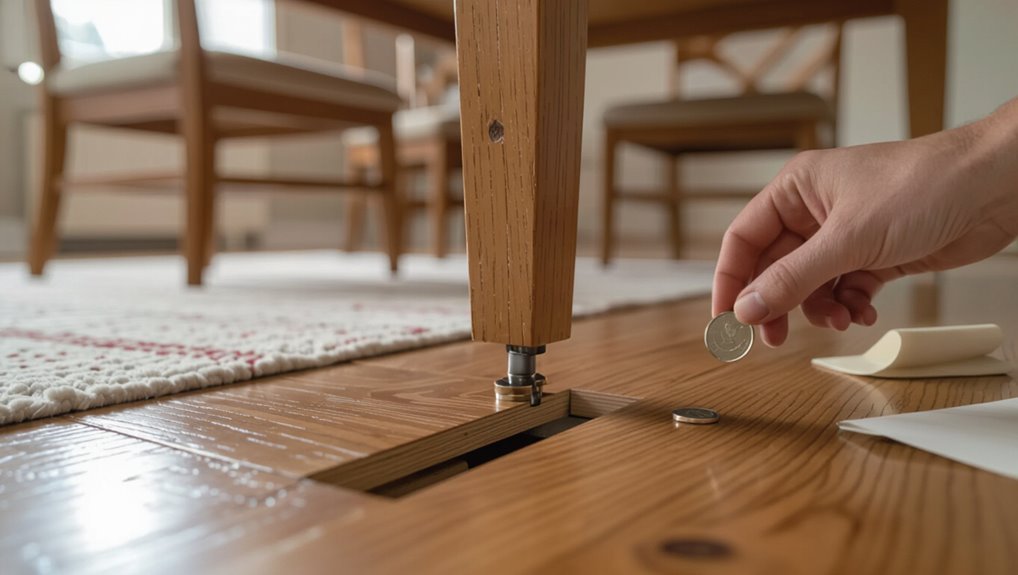
A simple one-person test—pressing each corner or placing a coin under legs one at a time—quickly identifies the offending leg or joint.
Common causes of a wobbly table
A slight wobble often signals one of several underlying issues: uneven flooring, misaligned or loose legs, warped or improperly attached tabletop surfaces, or missing glide pads.
Typical causes include hardware loosening, shrinkage or swelling from humidity, uneven glides, scratched or compressed leg tips, and manufacturing tolerances.
Identifying the root cause guides simple repairs and explains how to stop a table wobbling effectively.
Safety, stability, and aesthetic concerns
Many household and commercial tables wobble in ways that range from mildly irritating to hazardous, and understanding when that motion matters helps prioritize fixes.
Unchecked wobble can destabilize objects, spill liquids, cause falls, or worsen structural joints. Stability affects usable weight, safety in busy environments, and visual appeal; addressing both functional and cosmetic issues prevents damage, liability, and diminished room aesthetics.
How to quickly test which leg or part is causing the wobble
Several quick checks can pinpoint which leg or component causes a table to wobble.
Inspect leg joints, tighten visible fasteners, and press each corner while observing movement.
Slide a thin card under each foot until stability returns to identify the short or uneven leg.
Test top-to-frame connections for looseness.
Note any warped wood or missing glides for targeted repair.
Quick fixes you can do right now
A few quick fixes can stabilize a wobbly table without tools or skill. The following concise actions address common causes like uneven legs, loose fittings, and missing pads.
These options are fast, inexpensive, and reversible.
- Level with folded paper or cardboard under the short leg.
- Add felt pads or furniture glides to equalize height and protect floors.
- Tighten loose screws and bolts, or adjust adjustable feet where fitted.
Leveling with folded paper or cardboard
One quick, low-cost way to steady a wobbly table is to slide a folded piece of paper or a thin strip of cardboard under the shorter leg until the tabletop sits level.
Fold to desired thickness, trim to fit leg base, and test stability. Replace or adjust the shim if it compresses.
This temporary fix is unobtrusive and reversible for immediate use.
Using felt pads or furniture glides
Stick small felt pads or furniture glides under the shorter leg to add precise height and protect floors while stopping the wobble.
Choose thickness to match the gap, trim pads for a snug fit, and press firmly. For uneven wear, stack thin pads or replace worn glides.
Periodically check adhesion and swap pads before they compress to maintain stability and floor protection.
Tightening loose screws and bolts
After quick felt-pad adjustments, a wobble often persists because fasteners have loosened; tightening screws and bolts is a fast, effective remedy that requires only a screwdriver or wrench.
Inspect leg joints, apron connections and hardware under the tabletop. Apply appropriate driver or socket, snug but avoid overtightening.
Replace stripped screws, use lock washers or threadlocker for recurring loosening, then recheck stability before use.
Shimming with adhesive rubber or cork pads
Apply small adhesive rubber or cork pads to level a wobbling table quickly and without tools.
Place pads under the short or unstable leg, testing thickness by stacking or trimming to match floor height.
Use non-slip material to improve grip and reduce noise.
Choose durable pads rated for furniture weight and clean surfaces before applying to guarantee a secure, lasting bond.
Adjusting adjustable feet
Turn adjustable feet clockwise or counterclockwise to raise or lower the problematic leg until the table sits squarely on the floor.
Check stability after each small adjustment. Use a wrench if fittings are tight.
Lock nuts or threaded collars should be tightened to prevent movement.
Test across all seating positions and readjust as needed.
Replace damaged feet to restore consistent contact and prevent future wobble.
Simple DIY repairs for long-term stability
Next, the article outlines simple DIY repairs that provide lasting stability.
Topics include replacing or reshaping a leg end, fitting screw-in levelers or glide feet, and gluing and reinforcing loose leg joints.
It also covers safely shortening an overlong leg to restore even support.
Replacing or reshaping a leg end (furniture foot replacement)
Replacing or reshaping a leg end restores a stable contact point and often fixes wobble without replacing the entire piece of furniture.
Inspect the foot for wear, rot, or unevenness. Sand or trim irregularities, replace damaged pads or glued-on caps, or fit new wooden or rubber feet sized to the leg.
Test stability, tighten fastenings, and recheck after use to guarantee lasting balance.
Adding screw-in levelers or glide feet
Install screw-in levelers or glide feet to give a quick, adjustable solution that levels furniture on uneven floors without altering the piece permanently.
Measure leg diameter, choose compatible threaded inserts or self-tapping levelers, then fit and adjust each foot until wobble stops.
Durable materials (nylon, rubber, metal) protect floors and provide long-term stability; check and readjust periodically for maintained balance.
Gluing and reinforcing loose leg joints
Strengthen loose leg joints by cleaning, gluing, and reinforcing the connection so the table regains long-term stability without major reconstruction.
Remove old glue and debris, dry-fit parts, apply appropriate wood glue, and clamp firmly until cured.
Add corner blocks, metal brackets, or dowels for extra support.
Sand excess glue and reattach feet.
Test stability and retighten hardware as needed.
Shortening an overlong leg safely
Measure the discrepancy and mark the leg precisely before cutting: confirm tabletop level, support the table on a stable surface, and transfer the required reduction onto the leg with a square to guarantee a straight, perpendicular cut.
Use a fine-tooth saw or powered mitre saw, clamp firmly, and cut slowly. Sand end flat, test level, and seal exposed wood.
Re-check tightness and stability before regular use.
Tools and materials checklist
A concise checklist helps identify what is needed for quick fixes and longer-lasting repairs.
Basic handheld tools and small sharp items suit immediate adjustments, while specialized equipment is reserved for heavier restoration. The following list outlines common tools and materials to evaluate before starting work.
- Screwdriver, pliers, utility knife
- Levelers, shims, wood glue, felt or rubber pads
- Sander, saw, drill for larger or structural repairs
- Measuring tape, pencil, clamps, safety gear
Basic tools for quick fixes (screwdriver, pliers, knife)
Gathering a small set of basic hand tools makes quick table stabilizations straightforward: a Phillips and flathead screwdriver, needle-nose pliers, and a utility knife cover most minor adjustments and temporary fixes.
These tools tighten loose screws, realign brackets, remove old padding, and trim uneven leg caps. Compact, inexpensive, and commonly available, they enable immediate, simple interventions before pursuing permanent solutions.
Materials for durable repairs (levelers, shims, glue, pads)
After tightening fasteners with basic hand tools, attention turns to materials that provide lasting stability: adjustable levelers, tapered shims, wood or epoxy glue, and protective pads.
Adjustable levelers correct uneven floors; shims fill gaps under legs; glue secures loose joints; pads prevent slipping and protect floors.
Choose corrosion-resistant metals and waterproof adhesives for durable, low-maintenance repairs.
When to use specialty tools (sander, saw, drill)
Decide which specialty tools are necessary by matching the repair task to the capability of each tool:
a sander for smoothing uneven surfaces or removing old finish that keeps legs from seating flat,
a saw for trimming or shortening legs and cutting precise shims,
and a drill for installing threaded levelers, reinforcing loose joints with screws, or creating pilot holes for epoxy anchors.
Use tools only when simpler fixes fail.
How to diagnose complex wobble problems
Before attempting repairs, the inspector systematically checks whether the tabletop or frame is warped, as visible twists or gaps can cause instability.
Next, attention turns to leg sockets for cracks, stripped threads, or looseness that allow movement.
Finally, the assessor compares the table against the floor using a level and temporary shims to determine if the problem is the furniture or the surface.
Identifying warped tabletops and frames
Several clear signs point to a warped tabletop or frame: a gap under one edge when the table sits on a flat floor, rocking that disappears when pressure is applied to a specific corner, uneven contact between leg tops and the apron, and visible bowing or twisted seams in the tabletop.
Measure diagonals, check for persistent gaps with a straightedge, and note seasonal wood movement or uneven fastening.
Checking for damaged or worn leg sockets
When wobble persists after ruling out warped tops and uneven legs, inspect the leg sockets for wear, splitting, or loose joints that allow movement; these are common culprits in complex wobble problems.
Check for enlarged mortises, crushed plywood, loose glue, or missing fasteners.
Wiggle each leg at the joint, note play, and determine whether repair requires regluing, shimming, dowels, or socket replacement.
Evaluating uneven floors versus table defects
After confirming leg sockets are intact or repaired, the next step is distinguishing table defects from uneven flooring, since both can produce identical symptoms.
Place a straightedge or level across tabletop and measure gaps to detect warp or twist.
Use a coin or shim under legs while observing stability. If shimming corrects wobble consistently, the floor is at fault; otherwise inspect frame and joints.
Comparison of common solutions
The following brief comparison surveys how common fixes rank by effectiveness, cost, difficulty, and longevity, and which work best for wood, metal, glass, or laminate tables. A concise table highlights trade-offs to guide choice. The goal is to match the simplest reliable fix to the table type and expected lifespan.
| Fix type | Best for table types | Quick note |
|---|---|---|
| Adjustable feet | Metal, laminate | Low cost, easy install |
| Felt/glue pads | Wood, glass | Cheap, short-term |
| Shims/wedge | Wood, metal | Low cost, moderate durability |
| Leg reattachment/repair | All types | Higher cost, long-lasting |
Effectiveness, cost, difficulty, and longevity of fixes
A quick comparison of common fixes—adjustable glides, shims, tightened fasteners, leg sleeves, and leveling kits—helps determine which is best for a given wobble by weighing effectiveness, cost, difficulty, and expected longevity.
Adjustable glides and shims are low-cost, easy, short-to-medium term; tightening fasteners is cheapest and immediate but may recur; leg sleeves are simple cosmetic fixes; leveling kits yield durable, higher-cost results.
Best solutions by table type (wood, metal, glass, laminate)
Knowing which fix fits a particular tabletop material makes choosing economical and long-lasting repairs easier.
For wood, tighten joints, apply shims or replace worn pads; use glue for loose mortise-and-tenon.
For metal, tighten or replace fasteners, add rubber feet, weld cracks.
For glass, secure with non-slip pads and tighten frame; avoid drilling.
For laminate, use tightened hardware, adhesive-backed shims, or replace edge strips.
Preventive measures to avoid future wobble
Preventive steps focus on regular inspection, proper assembly practices, and selecting suitable contact materials for the floor.
A simple maintenance schedule and periodic torque checks on fasteners reduce the chance of looseness developing.
Choosing the correct feet or pads for the flooring type prevents uneven wear and helps maintain long-term stability.
Routine maintenance and inspection schedule
When scheduled inspections are performed every few months, potential looseness or wear can be caught before it develops into a wobble.
A concise checklist should include leg alignment, foot condition, joint gaps, surface damage, and signs of insect or moisture damage.
Document findings, note trends, and schedule simple corrective actions like tightening, shimming, or replacing worn pads to prevent recurrence.
Proper assembly and torque guidelines for fasteners
Following documented inspection findings, attention should turn to correct assembly and specified torque for all fasteners to prevent future wobble.
Components should be aligned, threads cleaned, and appropriate lubricants applied sparingly.
Use calibrated torque tools and follow manufacturer values; apply gradual, cross-pattern tightening for multi-bolt connections.
Recheck torque after initial use period and record settings to guarantee consistent long-term stability.
Choosing the right feet and pads for your floor type
Because different floor surfaces interact with table legs in distinct ways, selecting feet and pads that match the flooring type is essential to prevent wobble and protect both table and floor.
Hard floors benefit from rubber or felt pads for grip and slight leveling; carpeted areas need wider glide feet to distribute load.
Adjustability and durable materials extend stability and reduce movement over time.
When to call a professional or replace the table
If wobble persists after basic fixes, professional assessment may be more cost-effective than continued DIY attempts.
Obvious signs that repair isn’t worth it include extensive structural damage, recurring joint failure, or repair estimates approaching replacement cost.
Before scheduling service, document damage, remove loose items, and measure dimensions to help a technician provide an accurate quote.
Signs a repair isn’t worth doing
Often a wobble is easy to fix, but there are clear signs that a repair is no longer practical and professional help or replacement should be considered.
Structural damage (split joints, rotten legs), pervasive warping, missing or irreparable components, and repeated failures after prior fixes indicate diminished returns.
If stability compromises safety or functionality, replacement or expert assessment is prudent.
Cost thresholds for professional repair vs. replacement
When a wobble clearly exceeds simple DIY fixes — such as with split joints, extensive rot, or repeated failure after repairs — the decision comes down to cost versus value.
Estimate professional repair, replacement price, and remaining lifespan.
Prioritize safety, sentimental or antique value, and matched materials.
If repair approaches or exceeds replacement cost without sufficient longevity or restored value, replacement is the practical choice.
How to prepare the table for a repair service
Prepare the workspace and assess the table before the technician arrives to streamline the repair process and reduce onsite labor time.
Clear surrounding area, document wobble symptoms and any previous fixes, note material and leg attachment types, and measure dimensions.
Pack hardware found earlier.
Provide easy access to power and lighting.
Communicate desired outcome and budget constraints so the technician can recommend repair versus replacement efficiently.
Quick troubleshooting flowchart for common scenarios
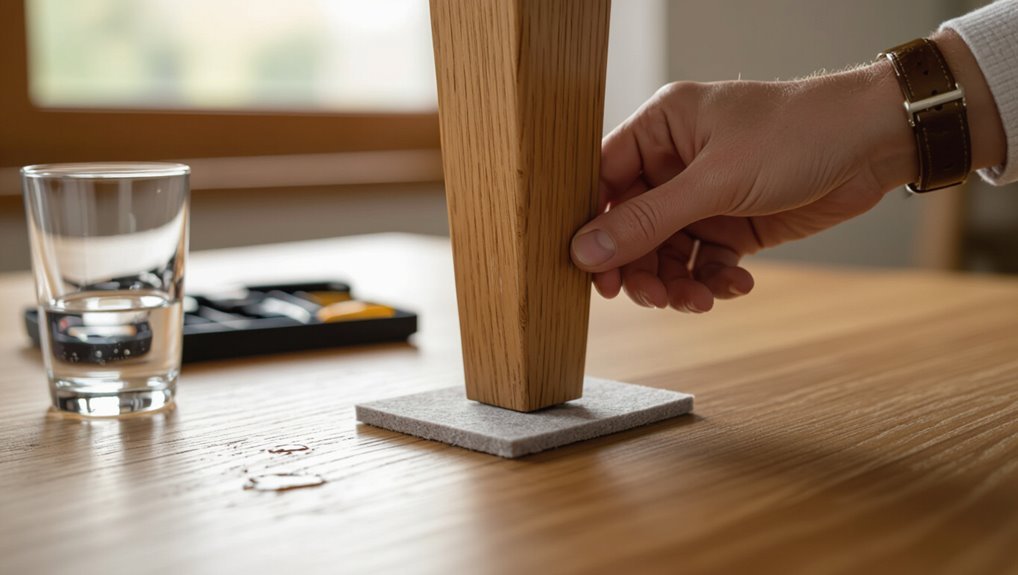
Which quick checks should be tried first depends on the wobble’s origin; the flowchart below leads a reader through concise, prioritized diagnostics—inspect floor level, examine leg and joint stability, try simple shims or tightening, then escalate to replacement or reinforcement if those steps fail.
The chart directs: verify level with a tool, test each leg, tighten fasteners, add shims, inspect hardware, consider professional repair.
Conclusion
Like a boat steadied by a well-placed oar, a stable table keeps small lives balanced. The fixes here are pebbles cast into a restless pond—quick taps, tightened screws, measured shims—that still more than mere furniture: they restore quiet order. Whether with a temporary shim or careful repair, action transforms wobble into steadiness, reminding that attention to small, practical things anchors daily life and preserves the calm harbor of home.