How to Determine Water Heater Size: A Simple Guide to Choosing the Right Capacity
To choose the right water heater size, focus on your peak-hour hot water demand, household size, and the number of fixtures used simultaneously. For tank units, a guideline is 30-40 gallons for 1-2 people, 40-50 gallons for 3-4, and 50-80+ gallons for larger families. For tankless models, consider the peak gallons per minute (GPM) required. Additionally, factor in recovery rates, efficiency, and space constraints to prevent oversizing or inadequate supply. Follow the practical sizing steps and checklist for a well-informed decision.
How to Choose the Right Water Heater Capacity Quickly
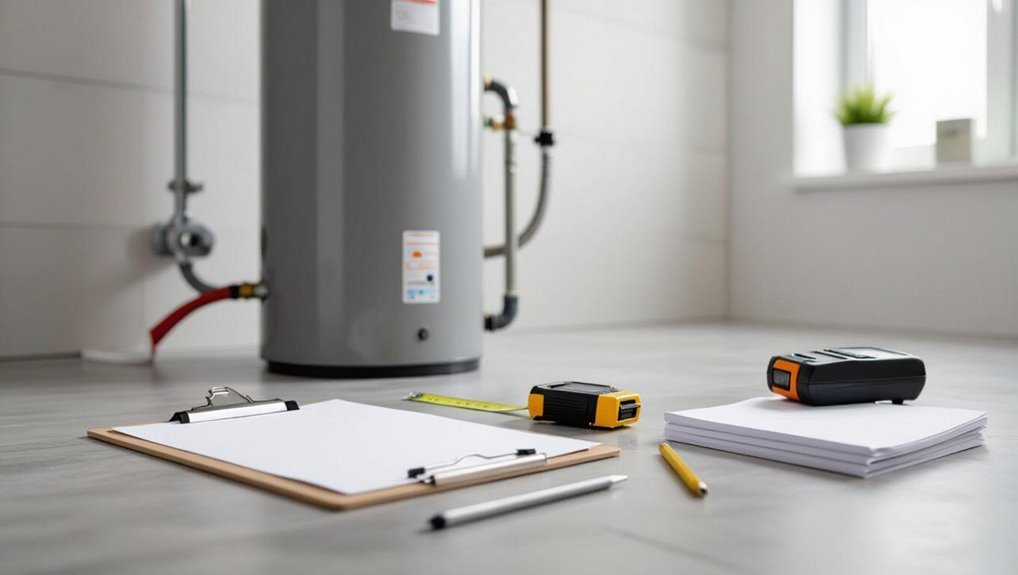
The selection hinges on a few key factors: peak hour demand, fixture flow rates, and household usage patterns.
A quick rule maps typical household sizes to recommended tank capacities or tankless flow rates to streamline choices.
These guidelines help narrow options so a suitable heater can be chosen efficiently.
Key factors that determine the correct water heater size
Because household hot-water needs vary by plumbing fixture, family size, and usage patterns, selecting the right water heater capacity hinges on a few measurable factors: peak-hour demand, simultaneous appliance use, desired temperature rise, and recovery rate.
The guide explains how to determine water heater size by quantifying fixture flow rates, estimating concurrent loads, calculating required gallon-per-hour recovery, and matching heater output to anticipated peak demand.
Quick-capacity recommendation based on household size and usage patterns
For most households, a simple rule-of-thumb links family size and routine habits to recommended tank capacity: 30–40 gallons for one to two people, 40–50 gallons for three to four, and 50–80 gallons for five or more—adjusting upward when frequent simultaneous uses (showers, dishwasher, laundry) or high-temperature rises are common.
Users with low demand may choose smaller tanks; high-demand homes should size conservatively or consider tankless units.
Understand Water Heater Types and How They Affect Sizing
Different water heater designs change sizing needs: tank units require adequate storage (commonly 20–80+ gallons). Tankless models are sized by peak flow rate, and hybrid heat-pump heaters balance smaller tanks with higher efficiency.
Fuel type also matters because electric, natural gas, and propane models have different recovery rates that affect how much stored capacity or flow a household actually needs.
Typical ranges consequently vary—residential tanks often fall between 30 and 80 gallons, tankless units are rated for 2–10+ GPM, and hybrids typically pair 40–60 gallon tanks with enhanced recovery.
Tank vs. tankless vs. hybrid (heat pump) capacity implications
When selecting a water heater, the choice between tank, tankless, and hybrid (heat pump) systems directly shapes capacity needs and performance expectations.
Tank units store ready gallons useful for peak draws; tankless deliver continuous flow limited by gallons-per-minute output; hybrids combine stored volume with heat-pump efficiency, often requiring larger tanks for heat-pump cycles.
Each type alters sizing strategy based on usage patterns and installation constraints.
Electric vs. gas vs. propane recovery rates and impact on size
Although fuel type does not change the basic purpose of a water heater, it strongly determines recovery rate—the speed at which a unit reheats incoming cold water—and accordingly influences required tank size and performance during peak demand.
Typically, gas and propane units offer faster recovery than electric due to higher burner output, reducing needed tank capacity. Electric heaters recover slower, often requiring larger tanks or supplemental systems to meet simultaneous hot-water draws.
Typical size ranges for each water heater type
Fuel source shapes recovery and consequently alters typical tank recommendations for residential installations. Typical ranges reflect recovery and household demand: electric 30–80 gallons, gas 30–80 gallons with faster recovery, propane similar to gas, tankless sized by GPM, and heat-pump models larger for efficiency.
| Type | Typical Range |
|---|---|
| Electric | 30–80 gal |
| Gas | 30–80 gal |
| Propane | 30–80 gal |
| Tankless/HP | GPM-rated / larger tanks |
Calculate Required Capacity for Tank Water Heaters
The section explains First Hour Rating (FHR), its role in matching a tank heater’s output to peak-hour hot water demand.
It outlines a step-by-step method for calculating required FHR by summing fixture draw rates and accounting for simultaneous use.
Examples demonstrate calculations for small, medium, and large households to illustrate typical sizing results.
What is First Hour Rating (FHR) and why it matters
First Hour Rating (FHR) quantifies how much hot water a tank-style heater can deliver in the first 60 minutes of use, combining the tank’s stored hot water and the recovery capacity as the unit heats incoming cold water.
It matters because FHR indicates whether a heater meets peak demand, guiding selection to avoid shortages during consecutive fixtures and ensuring consistent supply without oversizing.
Step-by-step method to compute FHR needs based on fixtures and simultaneous use
A simple, repeatable procedure helps translate household plumbing fixtures and their likely simultaneous use into a required First Hour Rating (FHR) for a tank water heater.
Identify fixtures and standard flow rates. Estimate simultaneous usage patterns. Sum peak flow to get gallons per hour. Convert to required FHR considering inlet temperature and recovery.
- List fixtures
- Assign flows
- Estimate simultaneity
- Sum and adjust
Example calculations for small, medium, and large households
Begin by applying the step-by-step procedure to three representative household sizes—small, medium, and large—to illustrate how fixture counts, flow rates, and simultaneity translate into a required First Hour Rating (FHR).
For each case calculate total GPM, apply simultaneous use factor, determine peak demand volume, then select a tank with an FHR meeting or slightly exceeding that demand, noting recovery rate differences.
Sizing Tankless and On-Demand Water Heaters
Sizing tankless and on-demand water heaters requires matching the unit’s flow rate (GPM) and temperature rise to household needs.
The required GPM is calculated by summing flow rates of simultaneous fixtures (showers, faucets, appliances) and comparing that to the heater’s capacity.
Practical sizing examples use regional cold inlet temperatures and seasonal variations to compute necessary temperature rise for accurate selection.
How flow rate (GPM) and temperature rise determine tankless sizing
Determining the correct tankless water heater hinges on two measurable factors: the peak flow rate required (in gallons per minute, GPM) and the needed temperature rise to reach desired hot-water output.
Manufacturers match unit capacity (GPM at a specific temperature rise) to household demand; higher required rise or simultaneous fixtures reduce effective GPM.
How to calculate required GPM for common fixtures
Having established that peak flow and temperature rise set the required capacity, the next step is converting household fixture use into a combined GPM demand.
Practitioners tally fixture flow rates and likely simultaneous use to size on-demand units.
- Shower: 1.5–2.5 GPM
- Kitchen sink: 1.5–2.2 GPM
- Bathroom sink: 0.5–1.0 GPM
- Washing machine: 2.0–2.5 GPM
Example temperature-rise calculations by region and season
When calculating temperature rise for tankless water heaters, regional incoming ground-water temperatures and seasonal variation must be accounted for to determine the required BTU/hr (or kW) output at a given flow rate.
Examples: northern winter inlet 40°F to desired 120°F requires 80°F rise; southern summer inlet 70°F requires 50°F rise.
Multiply rise by GPM and conversion factor to size the unit.
Consider Recovery Rate, Energy Efficiency, and Fuel Availability
The recovery rate—how quickly a heater reheats water after draw—directly affects whether a smaller tank or higher BTU rating will meet household demand.
Energy factor (EF) or Uniform Energy Factor (UEF) ratings indicate long‑term efficiency and can tip sizing choices toward appliances that save fuel even if they have different capacity or recovery characteristics.
Prioritization between faster recovery and a larger tank depends on peak usage patterns, fuel availability, and whether short recovery times or stored volume better match the home’s hot water profile.
Recovery rate definition and its role in sizing decisions
Because recovery rate measures how quickly a water heater can raise the temperature of incoming cold water to the set point, it is a critical specification for sizing decisions:
Recovery rate indicates gallons per hour heated after first-hour output, guiding whether a given tank size meets peak demand.
Higher recovery reduces required capacity; lower recovery may require a larger tank or supplemental heating, influenced by fuel type and household usage patterns.
Energy factor (EF)/Uniform Energy Factor (UEF) and long-term sizing trade-offs
1 key metric for long-term water heater planning is the unit’s energy factor (EF) or its successor, the Uniform Energy Factor (UEF), which quantifies how efficiently a heater converts fuel into usable hot water over typical usage cycles.
Higher UEFs reduce operating costs and fuel demand; pairing efficiency with suitable recovery rate and available fuel types balances lifetime savings against initial cost and supply constraints.
When to prioritize faster recovery vs. larger tank
When choosing between a faster recovery rate and a larger tank, homeowners should weigh how peak demand patterns, energy efficiency, and available fuel types interact to determine overall performance and cost.
Prioritize faster recovery when short intervals separate high-demand events or when tank size is constrained.
Favor larger tanks for long, sustained demand or unreliable fuel supply; balance against higher standby losses and operating expenses.
Practical Scenarios and Recommended Capacities
This section compares typical household scenarios to recommended water heater capacities to help match demand with equipment size.
It outlines guidance for a single person or studio, small families (2–3 people), medium families (4–5 people), and large or high-demand situations such as multiple bathrooms and hot tubs.
Readers will find brief capacity ranges and key considerations for each case to simplify selection.
Single person or studio apartment sizing guide
How much hot water does a single occupant or studio typically need?
A single person or studio usually requires 20–30 gallons for efficient daily use: shower, handwashing, light dishwashing.
Tankless units with 2–4 GPM can suffice if simultaneous use is rare.
Prioritize energy-efficient or compact tanks (20–30 gal) when space and cost constraints dominate.
Small family (2 to 3 people) sizing guide
A small family of two to three people typically requires a water heater that balances higher peak demand with modest overall usage.
Practical recommendations are 30–50 gallons for storage tanks or tankless units rated at 6–9 GPM, depending on simultaneous appliance use.
Consider morning shower overlap, dishwasher cycles, and laundry frequency.
Choose higher capacity or flow rate if multiple fixtures run concurrently; otherwise lower-end options suffice.
Medium family (4 to 5 people) sizing guide
Because a medium household often sees overlapping morning and evening hot-water use, sizing must account for simultaneous showers, a dishwasher, and occasional laundry.
Practical recommendations typically call for 50–80 gallon storage tanks or tankless units rated 9–12 GPM, adjusted upward if multiple fixtures run at once or high-flow fixtures are installed.
Installers should match peak hour demand, consider recovery rate, and modestly oversize for efficiency and comfort.
Large households and heavy-demand scenarios (multiple baths, hot tubs)
When multiple full bathrooms are used concurrently or appliances such as hot tubs and spa jets are added to the demand profile, sizing must account for prolonged high-flow draws rather than brief peak events.
Large households typically require 80–120+ gallon tanks or high-capacity tankless systems with sustained GPM ratings (8–12+).
Include recovery rate, simultaneous usage patterns, and possible expansion for future needs.
Installation and Space Considerations
Installation and space constraints often determine which water heater sizes are practical for a given home, including tank footprint, required clearances, and routing for venting and gas or electrical connections.
Technicians must verify venting capacity, gas line sizing, and circuit availability since these factors can limit usable capacity or require upgrades.
Retrofitting a larger or smaller unit into an existing enclosure may necessitate structural changes, code compliance checks, or different equipment types.
Physical footprint and clearance requirements for tanks
A tank’s physical footprint and required clearances determine where it can be sited and how serviceable it will be.
Installers evaluate floor space, access for maintenance, and minimum side, front, and top clearances per manufacturer and local code.
Compact or slim models suit tight areas but may limit capacity.
Planning guarantees access for repairs, replacement, and safe movement around the unit.
Venting, gas supply, and electrical limitations that affect usable size
Venting, gas supply, and electrical capacity impose practical limits on the usable size of a water heater because each system must meet safety codes and manufacturer specifications to operate reliably.
Insufficient venting causes combustion backdraft or condensation; limited gas line pressure or meter capacity restricts BTU input; and circuit amperage and breaker ratings constrain electric element sizing.
Professionals must verify infrastructure before selecting capacity.
Retrofitting smaller or larger units in existing spaces
Many retrofits involve fitting a different-capacity water heater into an existing enclosure or footprint, and doing so requires careful measurement of space, clearances, and service access to guarantee code compliance and safe operation.
Assess combustion air, vent routing, and discharge proximity; verify platform strength and seismic restraints.
Make certain replacement connections match fuel, electrical, and drain locations or plan for rerouting by qualified professionals.
Cost, Maintenance, and Lifespan Implications of Size Choices
Choosing a larger or more advanced water heater affects both upfront purchase price and ongoing energy costs. Tankless and heat-pump systems often costing more initially but saving on operation.
Maintenance frequency and procedures vary by size and technology, influencing service costs and reliability.
Expected lifespan differs as well—tank heaters typically last 8–12 years while high-efficiency units can last longer—so replacement timing should factor into total cost of ownership.
Upfront cost vs. operating cost by size and type
Although a larger water heater raises the initial purchase and installation expense, its long-term operating costs and maintenance demands can differ substantially by type and capacity.
Tankless units cost more upfront per kW but often yield lower energy bills; large storage tanks are cheaper to buy but incur standby losses.
Fuel type, efficiency ratings, and household usage determine total lifecycle cost.
Maintenance needs for different sizes and technologies
Different sizes and technologies impose distinct maintenance routines and influence expected service life: storage tanks require periodic flushing, anode rod inspections, and more frequent element or burner servicing as capacity increases.
In contrast, tankless systems need descaling and filter maintenance tied to flow and water hardness rather than volume.
Larger tanks may incur higher parts and labor costs; high-demand tankless units require more frequent professional checks to preserve efficiency.
Expected lifespan and replacement timing considerations
When evaluating replacement timing, homeowners should weigh expected lifespan against upfront and ongoing costs: conventional storage tanks typically last 8–12 years with regular maintenance, while tankless units often reach 15–20 years but demand periodic descaling and occasional component replacement.
Size affects wear: oversized or undersized systems cycle more, shortening life.
Budget for planned replacement, warranties, and local hard-water impacts on longevity.
Common Sizing Mistakes and How to Avoid Them
Many homeowners select water heaters that are too large, causing higher upfront costs, wasted energy, and short cycling.
Conversely, undersized units lead to frequent cold showers and premature stress on the system; signs of undersizing include rapid depletion during peak use and inconsistent temperatures.
Accurate load calculations and realistic assumptions about simultaneous fixtures prevent these common miscalculations.
Over-sizing pitfalls and inefficiencies
Although larger units may seem like a safe choice, over-sizing a water heater creates real inefficiencies: increased standby heat loss, higher upfront and operating costs, and more frequent short-cycling that can shorten equipment life.
Excess capacity wastes energy, raises installation complexity, and may necessitate larger venting or space. Sizing to realistic peak demand optimizes efficiency, longevity, and total cost of ownership.
Under-sizing risks and signs you need a larger unit
Undersizing a water heater can produce immediate and chronic problems: insufficient hot water during peak use, frequent recovery cycles that strain components, and higher operating costs from repeated heating spikes.
Persistent lukewarm showers, rapid temperature drop when multiple fixtures run, and shortened appliance lifespan indicate capacity shortfall.
Upgrading prevents performance gaps, reduces wear, and restores consistent supply for household demand.
Miscalculations to watch for when estimating demand
How often do estimation errors lead to buying the wrong water heater? Common miscalculations include undercounting simultaneous fixtures, ignoring peak-hour demand, using outdated flow rates, and neglecting recovery time.
Overestimating future usage also wastes energy and cost. Accurate demand assessment uses current appliance flow data, realistic simultaneous-use scenarios, and manufacturer recovery specs to select an appropriately sized, efficient unit.
Buying and Upgrade Checklist
Before purchasing or upgrading, homeowners should prepare a concise checklist covering essential questions to ask a professional installer, required permits, and available rebates or energy incentives that could influence model choice.
The checklist should also note local code or permit timelines that affect installation scheduling and eligibility for incentives.
A simple decision flowchart outlining capacity options based on household size, peak demand, and efficiency targets can guide the final selection.
Questions to ask a professional installer
What should a homeowner ask to guarantee the new water heater meets household needs and code requirements?
The homeowner should request installer input on required capacity, recovery rate, and fuel type suitability; compatibility with existing plumbing and vents; estimated installation timeline and labor scope; warranty details and maintenance recommendations; safety features and setback clearances; and a written quote outlining parts, labor, and disposal of the old unit.
Permits, rebates, and energy incentives that affect selection
After confirming installer recommendations and a clear written quote, the homeowner should consider permits, rebates, and energy incentives that can influence both choice and cost.
Local permit requirements may dictate unit type and installation timing; utility rebates and state tax credits can lower upfront expense; efficiency standards affect eligibility.
- Check local permit fees and timelines.
- Verify utility rebate programs.
- Confirm state/federal tax incentives.
- Ascertain model meets efficiency criteria.
Final decision flowchart for choosing capacity (decision steps)
How should a homeowner translate measurements, household needs, and installer input into a single capacity choice?
A concise flowchart:
- verify peak hour demand,
- compare to unit first-hour rating or recovery rate,
- factor simultaneous use and future changes,
- check installer recommendations and space constraints,
- confirm permits and incentives,
- choose smallest model meeting demand with margin for reliability,
- document decision and schedule installation.
Conclusion
Choosing the right water heater capacity is like picking the proper shoe—comfort and fit prevent problems down the road. Homeowners should match heater type, tank size or flow rate, and recovery capability to household demand while weighing fuel, efficiency, space, and budget. Proper sizing minimizes costs, extends equipment life, and avoids supply shortages. With careful measurement, attention to common mistakes, and a clear upgrade checklist, an appropriately sized heater delivers reliable, efficient hot water for years.