
How to Keep PEX From Freezing in a Crawl Space: Proven Prevention & Fixes
To prevent PEX pipes from freezing in cold crawl spaces, take these essential steps: inspect for gaps, elevate pipes off cold surfaces, and insulate with closed-cell foam. Seal rim joists and vents with a continuous vapor barrier. Consider installing self-regulating heat tape or low-watt thermostat-controlled heaters to maintain a minimum temperature. Regularly schedule inspections, label valves, and document any repairs made. Below, you’ll find more detailed prevention tips and troubleshooting advice for both homeowners and professionals.
Preventing PEX Pipes from Freezing in a Crawl Space: Quick Summary
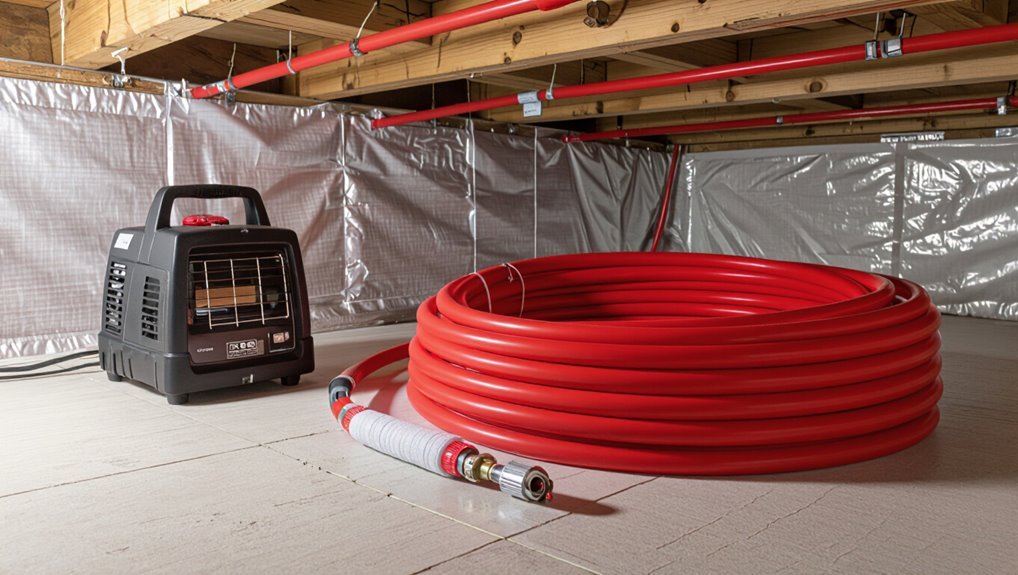
When a PEX pipe in a crawl space feels cold, the first steps are to open nearby valves, increase ambient heat, and apply safe localized warmth to the affected run.
For lasting protection, prioritize insulation, proper vapor barriers, sealing air leaks, and maintaining a minimum crawl space temperature.
These immediate actions paired with long-term measures minimize freeze risk and limit damage.
Immediate actions to take when pipes feel cold
Act quickly if a PEX pipe in the crawl space feels cold: check for frost, listen for ice, and confirm whether any fixtures are losing water flow.
Isolate affected lines, open nearby faucets to relieve pressure, and apply gentle warmth with a hair dryer or heat lamp at a safe distance.
Document locations and temperatures.
For guidance on how to keep PEX from freezing in the crawl space, contact a plumber.
Long-term prevention priorities
Prioritize insulating, sealing, and maintaining consistent heat as the core strategies to prevent PEX pipes in a crawl space from freezing.
Focus on high-quality pipe insulation, continuous vapor barrier installation, and air-sealing foundation vents and gaps.
Add reliable passive or low-wattage heat sources, schedule annual inspections, and address moisture to prevent insulation degradation.
Document work and monitor during cold spells for early intervention.
Why PEX Freezes Less Easily But Still at Risk
PEX tubing’s flexibility and slight thermal expansion give it greater resistance to bursting than rigid copper or PVC under freezing conditions.
Nevertheless, cold pockets near foundation walls, uninsulated vents, and low-lying runs in crawl spaces remain common freeze points.
Visible frost on insulation, reduced flow or air in lines, and sudden pressure drops are typical signs that PEX is approaching freezing risk.
Properties of PEX tubing compared to copper and PVC
A key factor in PEX’s better performance in cold conditions is its material flexibility and lower thermal conductivity compared with copper, and greater durability than PVC.
PEX expands slightly when freezing, reducing rupture risk. Its lower conductivity slows heat loss, though thin wall sections and exposed runs still permit freezing.
Connections and insulation quality remain critical to overall freeze resistance.
Common freeze points in crawl spaces
In crawl spaces, common freeze points include exposed runs along exterior walls, uninsulated joist bays, and sections of pipe near vents or foundation penetrations where cold air intrusion is most likely.
Additional vulnerable spots are low-clearance areas with stagnant air, gaps around sill plates, and long horizontal runs lacking thermal mass.
Localized drafts and surface exposure raise freezing risk despite PEX’s flexibility and tolerance.
Signs your PEX is at risk of freezing
How can one tell when flexible water lines are approaching freeze conditions?
Temperature near pipes drops toward freezing, condensation forms on surfaces, and water flow slows or sputters.
Frost or ice appears on pipe insulation.
Exposed sections feel unusually cold to the touch.
Repeated partial freezes, nearby frozen soil, or malfunctioning heat sources indicate elevated risk despite PEX’s flexibility.
Assessing Your Crawl Space for Freeze Vulnerability
A quick crawl-space assessment should start with a close look at insulation, vents, and any air leaks that could admit cold.
Pipe routing, slope, and whether lines run along exposed foundation walls or under floor joists determine freezing risk.
If ventilation, moisture, or access issues are found—or if pipe routing is complex—a professional inspection is recommended.
Inspecting insulation, vents, and air leaks
Crawl space vulnerability hinges on the condition of insulation, vents, and unintended air pathways; a concise inspection identifies where cold air reaches PEX lines.
Inspect insulation for gaps, compression, moisture, and displacement.
Verify vents are properly screened and operable, noting drafts.
Trace seams, rim joists, conduit penetrations, and access hatches for leaks; seal or weatherstrip breaches to reduce cold infiltration.
Checking pipe routing, slope, and exposure
After sealing insulation gaps and blocking drafts, attention should turn to the physical layout of the PEX lines: routing, slope, and exposure determine where water may pool, slow, or encounter the coldest pockets.
Inspect runs for low spots, long horizontal stretches, and proximity to exterior walls or concrete. Re-route to higher positions, add slight pitch toward drains, and shield lines from direct cold exposure.
Evaluating crawl space ventilation and moisture
Several factors within the crawl space—ventilation rate, humidity levels, and standing water—directly affect the risk of PEX freezing by altering air temperature and condensation patterns.
Inspect vents for airflow direction and blockage, measure relative humidity, and identify sources of ground moisture or leaks.
Prioritize sealing uncontrolled vents, improving drainage, and adding vapor barriers to reduce damp, cold conditions that promote pipe freezing.
When to call a professional inspection
When is a professional inspection warranted to evaluate freeze risk in the crawl space?
A professional should be called if repeated cold-weather pipe issues occur, obvious insulation gaps exist, persistent moisture or mold is present, structural problems limit retrofit options, or conditions impede safe access.
Experts diagnose thermal bridging, ventilation imbalance, and pipe routing, then recommend targeted insulation, heat tracing, or encapsulation solutions.
Passive Prevention Methods for Crawl Space PEX
Passive measures can greatly reduce freeze risk for crawl space PEX by focusing on targeted insulation, air-sealing, and strategic placement.
Recommended actions include installing appropriate foam or fiberglass pipe insulation and thermal sleeves, sealing drafts and closing vents when safe, and raising pipes away from cold surfaces and exterior walls.
Clear guidance on materials and installation practices helps guarantee these passive steps provide reliable, low-maintenance protection.
Insulating PEX: materials and installation best practices
Effective insulation is the foundation of preventing PEX from freezing in crawl spaces, reducing heat loss and minimizing condensation risk.
Recommended materials include closed-cell foam pipe insulation, foam rubber sleeves, and fiberglass with vapor barrier.
Install continuous, snug-fit insulation over bends and fittings, seal seams with compatible tape or mastic, and maintain a small service access.
Avoid compressing insulation or leaving gaps.
Sealing air leaks and closing vents strategically
After insulating pipes, attention shifts to controlling airflow in the crawl space: sealing gaps and judiciously closing vents reduces cold air infiltration that undermines insulation performance.
Identify foundation penetrations, rim joist gaps, and duct openings; seal with appropriate materials (caulk, spray foam, weatherstripping).
Partially close or seasonally manage vents to balance moisture control and thermal protection.
Verify with smoke tests and periodic inspections.
Raising pipes above cold surfaces and away from exterior walls
Several simple adjustments—raising PEX lines off cold concrete or earth and routing them away from exterior walls—can greatly reduce freeze risk in crawl spaces.
Elevating pipes improves airflow around them, limits conductive heat loss to chilled surfaces, and positions lines nearer warmer interior zones. Supports, hangers, or short runs on joists minimize contact with cold masonry.
Maintain clearance and secure fittings to prevent sagging or stress.
Using thermal barrier wraps and pipe sleeves
Raising PEX off cold surfaces reduces conductive heat loss, and adding thermal barrier wraps or foam pipe sleeves provides a complementary layer of insulation that slows freezing in crawl spaces.
These products fit snugly, resist moisture, and reduce convective chill. Properly sealed seams and rated materials improve performance.
Periodic inspection guarantees integrity; replace damaged insulation to maintain continuous thermal protection around PEX lines.
Active Prevention Techniques
Active prevention techniques focus on adding controlled heat to vulnerable PEX runs through methods such as approved heat tape or self-regulating heat cable, installed per manufacturer instructions for safe operation.
Thermostat-controlled heating elements, properly rated crawl space heaters, or space heaters can maintain temperatures above freezing while minimizing energy waste and hazard.
Where available, integrating steady low-level heat from HVAC ducting or radiant systems offers a continuous, lower-risk means of freeze protection.
Applying heat tape and heat cable: selection and safe installation
Applying heat tape or heat cable is a reliable method to prevent PEX from freezing when chosen and installed correctly.
Selection favors self-regulating, PEX-rated cables; avoid constant-watt types on plastic.
Secure cable with approved clips, maintain manufacturer spacing, and keep connections dry and accessible.
Regular inspection is essential.
- Confidence restored
- Anxiety reduced
- Control regained
Installing thermostat-controlled heat sources
Install a thermostat-controlled heat source to maintain safe pipe temperatures with minimal energy waste.
A dedicated low-wattage radiant panel or cable connected to a pipe-focused thermostat measures ambient or pipe-surface temperature and activates heat only when needed.
Placement targets vulnerable runs, wiring follows code, and thermostat setpoints are conservative to prevent freezing while avoiding overheating and excess energy consumption.
Using crawl space heaters and space heaters safely
Several compact heaters can be effective in preventing PEX from freezing when used in crawl spaces or rooms, but they must be selected and operated with strict attention to clearance, ventilation, and electrical safety.
Units should be listed for indoor use, placed on stable noncombustible surfaces, kept away from insulation and flammable materials, and plugged into dedicated GFCI-protected circuits.
Regular inspection is essential.
Integrating continuous low-level heat from HVAC or radiant systems
While localized heaters can address immediate cold spots, integrating continuous low-level heat from an HVAC system or in-floor radiant loops provides a more reliable, hands-off method to prevent PEX lines from freezing.
Properly zoned ductwork or a dedicated low-temperature radiant loop maintains steady ambient warmth, reduces freeze risk, lowers condensation, and requires less maintenance than intermittent heating.
Install controls and insulation to optimize efficiency.
Electrical and Safety Considerations
Attention to electrical and safety details is essential when adding heat to PEX lines: only UL-listed heating products should be used and installed per manufacturer instructions.
Proper GFCI protection, correct wiring and power-load planning help prevent electrical hazards and overloaded circuits.
Installations must also respect fire-safety, moisture, and clearance requirements to reduce risk and guarantee reliable operation.
Choosing UL-listed heating products and following manufacturer instructions
Select heating products that carry a UL (Underwriters Laboratories) listing and adhere strictly to the manufacturer’s installation and operating instructions to verify electrical safety and maintain warranty coverage.
Doing so assures components meet safety standards, reduces fire and shock risk, and clarifies approved placement, mounting, and clearance requirements.
Retain product documentation for inspections and follow specified maintenance intervals and replacement guidelines to preserve performance and compliance.
GFCI, wiring, and power load planning
Plan electrical work for PEX freeze protection with careful attention to GFCI requirements, wiring methods, and circuit loading to guarantee safety and reliable operation.
Install GFCI-protected circuits where required, use appropriate wire gauge and conduit, and separate dedicated circuits for heat tapes or cable to prevent nuisance trips.
Calculate continuous load, allow margin for other devices, and consult local code or a licensed electrician.
Fire safety, moisture, and clearance requirements
After addressing GFCI placement, wiring methods, and circuit loading for heat-trace systems, attention must shift to fire safety, moisture management, and clearance requirements to secure installations do not create hazards.
Installers must keep heat sources away from combustibles, use fire-rated cable where required, maintain manufacturer-recommended clearances, protect electrical connections from condensation, and ensure crawlspace ventilation and vapor barriers reduce corrosion and mold risks.
Cost, Energy Use, and ROI Comparison
Choices between insulation, heat tape, and small pipe heaters are often decided by comparing upfront cost, ongoing energy use, and expected maintenance.
The table below summarizes typical purchase price, annual operating cost, lifespan, maintenance frequency, and a simple ROI note for each option to prompt further evaluation.
| Item | Summary |
|---|---|
| Insulation | Low upfront cost, near-zero energy use |
| Heat tape | Moderate cost, continuous electricity draw |
| Pipe heaters | Higher upfront, higher energy use |
| Maintenance & Lifespan | Varies: insulation long/low, tapes moderate, heaters require more checks |
Upfront cost vs operating cost of insulation, heat tape, and heaters
A concise comparison of upfront and operating costs helps determine the most economical method to prevent PEX from freezing: insulation has a low initial price and zero electrical draw, heat tape requires moderate purchase and continuous electricity, and space heaters demand higher capital outlay plus substantial ongoing energy use.
Evaluating local energy rates, expected cold-duration, and installation complexity yields the true return on investment for each option.
Insulation typically wins for low ongoing cost; heat tape balances cost and targeted protection; heaters are last-resort for severe, intermittent cold.
Expected lifespan and maintenance needs
Moving from cost and operating trade-offs to longevity and upkeep clarifies the full lifecycle expense of each freeze-prevention method.
Insulation lasts decades with minimal checks; heat tape typically requires replacement every 5–10 years and annual inspections.
Electric space heaters have shorter service lives and higher maintenance.
ROI compares upfront durability versus recurring repair, energy, and replacement costs to guide selection.
Retrofitting and Upgrading Crawl Spaces
A practical retrofit strategy for protecting PEX in crawl spaces begins with encapsulating the area to control moisture and temperature, followed by insulating rim joists and the subfloor to reduce heat loss.
Piping should be rerouted or consolidated to minimize exposure and simplify future maintenance.
Where risk remains high, consideration should be given to relocating lines or replacing PEX with more cold-tolerant materials.
Encapsulating the crawl space: benefits and steps
When properly sealed and insulated, an encapsulated crawl space transforms a damp, heat-sapping void into a controlled barrier that protects PEX plumbing from freezing, reduces moisture-related damage, and improves overall HVAC efficiency.
Encapsulation steps include installing a continuous vapor barrier, sealing vents and penetrations, conditioning or dehumidifying the space, and protecting pipes with air barriers.
Routine inspection guarantees long-term integrity and freeze prevention.
Adding insulation to rim joists and subfloor
Several targeted measures improve thermal protection at the rim joists and between the subfloor and crawl space:
Install rigid foam board or spray foam at rim joists, sealing gaps and penetrations to stop air leaks.
Add insulating batts or foam panels between floor joists, maintaining ventilation balance.
Secure vapor barriers and seal seams to reduce moisture and thermal bridging, protecting PEX lines from cold exposure.
Rerouting or consolidating piping for protection
Consider rerouting or consolidating PEX lines to places within the crawl space that offer more consistent warmth and easier protection.
Grouping runs along interior foundation walls or near heat sources reduces exposure.
Shorten exposed lengths, minimize exterior-facing branches, and route parallel runs together for shared insulation or heat tape.
Guarantee accessible layout for maintenance and secure piping to prevent sagging or stress at fittings.
When to replace PEX with alternative materials or relocate piping
Assess the need to replace PEX or relocate piping when recurring freeze damage, persistent access limitations, or repeated repairs indicate the existing installation no longer meets performance or safety standards.
Consider upgrading to rigid copper or CPVC where thermal mass and rigidity improve freeze resistance, or relocating lines above the frost line or into conditioned space.
Factor cost, code, insulation, and long-term maintenance into the decision.
Troubleshooting Frozen or Burst PEX
The section explains how to locate a frozen PEX run safely by checking exposed lines, insulated zones, and temperature differentials without touching brittle pipe.
It outlines safe thawing methods and tools—warm air, heat tape, and space heaters—plus guidance on finding and repairing small leaks in PEX fittings and sleeves.
It also states clear criteria for when to shut off the water and call an emergency plumber to prevent further damage.
How to locate a frozen section safely
Locating a frozen section in a PEX system begins with identifying where flow stops and temperatures drop along the line: visually inspect exposed runs for frost, condensation, or bulging, check fixtures for weak or no flow, and feel accessible pipes for cold spots working outward from the last working fixture.
Trace piping maps, check shutoff positions, listen for flow at valves, and mark suspected frozen segments for safe access.
Safe thawing methods and tools
Begin thawing only after confirming the frozen segment and shutting off downstream fixtures and, if practical, the main water supply to reduce pressure and limit damage if a crack opens.
Use low-heat, controlled methods: warm air from a space heater or heat gun on low, electrical heat tape, or hot towels.
Monitor progress continuously, avoid open flames, and keep insulation dry to prevent re-freezing.
Identifying and repairing small leaks in PEX
After thawing, attention should shift to inspecting the PEX for small leaks that can follow freezing or minor bursts.
A systematic visual and tactile check locates damp spots, bulges, or hairline splits.
Minor leaks often repair with roll-on or push-fit repair couplings, or epoxy putty for temporary fixes.
Pressure-test after repair and monitor for recurrence; document locations for future prevention.
When to shut off water and call an emergency plumber
Decisive action is essential when frozen or burst PEX poses an immediate risk to a property.
The main valve should be shut off if visible leaks, pooling water, loss of pressure, or significant pipe deformation occur.
After isolating water, contact an emergency plumber immediately for safe thawing, damage assessment, and permanent repair.
Document damage for insurance and avoid DIY fixes that risk further failure.
Maintenance Checklist and Seasonal Preparation
A clear maintenance routine helps prevent PEX failures when temperatures drop. Routine monthly and pre-winter tasks, inspections after extreme cold, and organized records make emergency response faster and less stressful.
Owners and technicians benefit from a simple, actionable checklist that reduces damage risk and anxiety.
- Monthly and pre-winter tasks to verify insulation, heat tracing, and shutoff accessibility.
- Items to inspect immediately after extreme cold events (kinks, leaks, frozen sections).
- Record-keeping and labeling for quick winter response and streamlined repairs.
Monthly and pre-winter tasks
Performing monthly checks and pre-winter tasks assures PEX plumbing remains resilient through cold months.
Inspect insulation, securing loose wraps and replacing damaged foam.
Verify crawl space ventilation dampers and adjust or close as appropriate.
Test heat tape and timers, clear debris from access points, and confirm thermostat setbacks won’t allow dangerously low temperatures.
Document findings and schedule repairs before prolonged cold.
Items to inspect after extreme cold events
After an extreme cold event, the inspection checklist focuses on identifying damage and restoring system integrity to prevent future failures.
Inspect PEX for bulging, splits, or frostline cracks; check fittings, manifolds, and shutoff valves for leaks; verify insulation integrity and vapor barriers; confirm heat cable continuity and thermostat operation; assess crawl space ventilation and drainage; document needed repairs and prioritize emergency fixes.
Record-keeping and labeling for quick winter response
Several concise records—inspection dates, repair notes, component serials, and sensor baselines—enable rapid assessment and response when temperatures drop.
Labels on PEX runs, valves, and heat sources reduce search time.
A dated digital log with photos, schematic map, and alert thresholds guides technicians.
Include contractor contacts, warranty info, and last insulation upgrade.
Review and update pre-winter; store backups offsite.
Real-World Examples and Case Scenarios
The section presents concise, real-world examples showing typical fixes for various crawl space layouts, from spot insulation to rerouting vulnerable runs.
It outlines cost-effective measures suitable for rentals and older homes where permanent upgrades are impractical.
It also summarizes cases where full encapsulation or a professional retrofit proved necessary and why.
Typical fixes for common crawl space layouts
Identify the crawl space layout and underlying cause before selecting a remedy: wet, uninsulated dirt-floor cavities need different interventions than enclosed, insulated spaces with exposed PEX.
For dirt floors: install vapor barrier, improve drainage, raise lines, add insulation sleeves.
For enclosed insulated spaces: seal penetrations, add localized heat tape or thermostat-controlled heaters, secure attic vents and monitor humidity to prevent condensation and freezing.
Cost-effective solutions for rental or older homes
For landlords and occupants of older homes, fixes must balance effectiveness with low cost and minimal permanent alteration to the property.
Practical measures include targeted pipe insulation, inexpensive foam board barriers, simple heat tape on vulnerable runs, sealing crawl space vents seasonally, and using portable space heaters safely during extreme cold.
Case examples show reduced freeze incidents without major renovation expenditures.
When full encapsulation or professional retrofit was required
Several documented incidents required full encapsulation or professional retrofit when localized fixes repeatedly failed to prevent PEX freezing.
In each case, contractors assessed persistent ice formation, moisture ingress, and extensive air leakage.
Complete vapor barrier installation, insulation upgrade, and HVAC adjustments eliminated thermal bridges.
Homeowners reported long-term reliability after retrofit, despite higher upfront costs compared with spot repairs and temporary heat solutions.
Recommended Products and Installation Resources
The section identifies practical products and reliable resources for protecting PEX against freezing.
It highlights insulation types, heat tape options, and thermostatic controllers, and points to code guidance, manufacturer instructions, and professional services for proper installation.
Readers are directed to choose solutions that match their risk level and local requirements.
- Insulation that retains heat and blocks cold penetration.
- Self-regulating heat tape and thermostats for controlled protection.
- Authoritative codes, manufacturer manuals, and licensed installers for compliant work.
Types of insulation, heat tape, and thermostatic controllers to consider
Consider insulation type, heat-trace options, and thermostatic controls together as a coordinated strategy: selecting closed-cell foam or fiberglass with a vapor barrier for exposed runs, pairing it with self-regulating heat tape where freeze risk is highest, and adding a thermostat-controlled controller to prevent overheating and conserve power.
Choose UL-listed tapes, match wattage to pipe size, and use frost sensors or adjustable thermostats for reliable, efficient operation.
Links to code guidance, manufacturer instructions, and professional services
After selecting insulation, heat-trace, and thermostat components, refer to authoritative guidance and vendor documentation to guarantee safe, code-compliant installation.
Include links to applicable building codes, local plumbing regulations, and manufacturer installation manuals for chosen PEX, tape, and controllers.
Recommend contacting licensed plumbers or certified HVAC/electrical contractors for permit, inspection, and complex installations; cite industry bodies and recall databases for product safety updates.
Final Checklist Before Cold Weather Arrives
A concise pre-winter checklist helps guarantee PEX plumbing is ready for subfreezing temperatures: inspect insulation and heat tape, verify outdoor faucets and irrigation lines are drained or shut off, seal gaps where cold air reaches pipes, and confirm interior temperatures and thermostat schedules prevent prolonged drops below safe levels.
- Confirm insulation integrity and repair gaps.
- Test and label heat tape and timers.
- Shut off and drain exposed lines; document actions.
Conclusion
As frost edges the joists like sugar on a winter tart, the crawl space transforms from passive storage to weatherfront. The reader is left with the clear image of insulated PEX snaking warmly through the dark, wrapped in foam and fed steady warmth from thermostatic cables. With vigilant sealing, thoughtful drainage, and simple seasonal checks, those pipes stand ready—resilient as a hearth—so taps flow on and winter’s hush never freezes the home’s quiet lifeblood.
